Saturday, April 30, 2011

Blessed John Paul II

 Soul of Christ, sanctify me
Body of Christ, save me
Blood of Christ, inebriate me
Water from Christ's side, wash me
Passion of Christ, strengthen me
O good Jesus, hear me
Within Thy wounds hide me
Suffer me not to be separated from Thee
From the malicious enemy defend me
In the hour of my death call me
And bid me come unto Thee
That I may praise Thee with Thy saints
and with Thy angels
Forever and ever
Amen 

.

Divine Mercy


Divine Mercy
St. Faustina Kowalska
The Diary
Divine Mercy Sunday
The Chaplet Of Divine Mercy
Divine Mercy Miracles
Divine Mercy Shrine In Krakow, Poland
Divine Mercy In The News
Divine Mercy In The Blogs
Divine Mercy And The Jesuits

Divine Mercy Sunday

Jesus' Call to Mercy
"I demand from you deeds of mercy, which are to arise out of love for Me. You are to show mercy to your neighbors always and everywhere. You must not shrink from this or try to excuse or absolve yourself from it. I am giving you three ways of exercising mercy toward your neighbor: the first — by deed, the second — by word, the third — by prayer. In these three degrees is contained the fullness of mercy, and it is an unquestionable proof of love for Me. By this means a soul glorifies and pays reverence to My mercy. Many souls ... are often worried because they do not have the material means with which to carry out an act of mercy. Yet spiritual mercy, which requires neither permissions nor storehouses, is much more meritorious and is within the grasp of every soul. If a soul does not exercise mercy somehow or other, it will not obtain My mercy on the day of judgment. Oh, if only souls knew how to gather eternal treasure for themselves, they would not be judged, for they would forestall My judgment with their mercy" (1317)

Link (here)

Polish Jesuit Unhappy With Polish Cardinal

Krzysztof Madal, an influential Jesuit priest, slammed plans to include the ampoule in the altar of a new church saying it was returning the "Catholic Church to the medieval practices of the past". "In medieval days people didn't read and write, and knew little about the world so the Church needed stimuli," he added. "But times have changed and using blood as a relic is not a good idea." The blood was taken by doctors at the Gemelli Clinic in Rome during a tracheotomy operation, carried out shortly before the pope's death. Cardinal Stanislaw Dziwisz, John Paul's former secretary, would like to incorporate the blood into an altar in a new church at Lagiewniki, the town near Krakow that will house a planned John Paul II Centre, dedicated to the work and memory of the late pope. "He would like it placed in a special crystal in the altar so it is clearly visible to the faithful," said Father Jan Kabzinski, who is working on the centre.
Link (here)

NAZI Monster And War Criminal Rudolf Hoess, His Jesuit Confessor And The Divine Mercy

Soon after his appointment, Archbishop Wojtyla approached Jesuit theologian Ignatius Rozycki and asked him to review Sister Faustina's writings. Initially skeptical, Fr. Rozycki spent ten years in an exhaustive study of the Sister and her notebooks, which the Vatican had condemned in 1958. Father Rozycki's findings were published and the prohibition lifted in 1978. Beatified in 1992, St. Faustina was canonized in the year 2000; on the latter occasion Pope John Paul II declared the first Sunday after Easter "Divine Mercy Sunday."
A few weeks ago I came upon a thought-provoking homily by Father Matthew Kelty, O.C.S.O., which was given on Divine Mercy Sunday, 2006. It seems that during the former Commandant's solitary confinement in Krakow, where he awaited execution for his war crimes, Rudolph Hoess heard the bells of the local Carmel and was reminded of the Faith he had observed as a child but had long since rejected. He called for a German-speaking priest.
The local Jesuit provincial, Fr. Ladislav Lohn, S.J., went to the convent of Sister Faustina and asked the Sisters to pray earnestly while he went to hear the prisoner's confession. In the end Hoess was reconciled with the Church and received Holy Communion. Later Hoess wrote his wife and five children, expressed sorrow for his crimes, and begged forgiveness of the people of Poland. Hoess was executed April 16, 1947.
In his homily, Father Kelty contends that, though he may rightly spend an eternity in Purgatory, by the mercy of God even a man like Rudolph Hoess could be saved. This is an uncomfortable truth for some, even offensive to those whose sense of justice could be satisfied with nothing less than eternal damnation for such a "monster."

Link (here)

Jesuit In The Philippines Touched By The Divine Mercy

Falling In Love with His Divine Mercy
by Suzette T. Yu-Kho (ICA batch 1991)
Like many Catholics, I once took my faith for granted: I did not attend Mass regularly, stopped going to Confession and avoided religious people. I strayed away from the Faith and began dabbling in other forms of worship. I even took part in an East Indian “healing” seminar (it only lasted for a day). Each of them guaranteed the same results: true peace and happiness. Yet despite all their sweet words and the promise of Eden, I felt empty. As I plunged deeper into sin, I thought there was no escape. There was no way that I could go back to the Church and face God being the sinner that I was--I was incredibly ashamed of myself! How could I stand there singing hymns with other “saintly” people who never committed such atrocious deeds? I could not fathom confessing to a priest once again who in my mind would surely rebuke me; consequently, for a quite a long time, I did not receive the Holy Eucharist either.
Years later, I was still in my predicament when I heard of Stanley Villavicencio: a Filipino lay person who touched the lives of sinners from all around the world and opened their hearts to Jesus Christ’s Divine Mercy.
His testimony was mind-boggling: after three days of being pronounced “clinically dead” in Chong Hua Hospital in Cebu, he came back to life, much to the shock of his doctors and family members who were busy arranging his funeral. He claimed to have seen Jesus upon his death amidst a garden filled with various kinds of beautiful flowers. Jesus then showed him the film of his life starting from the time he was a young boy up to the moment of his death. Whenever he committed a venial sin, the film would slow down; whenever he committed a mortal sin, the film would stop and enlarge itself.
Nothing could be denied since the film had the exact date and time of when the sins were done--even the minutes and seconds were recorded! He also said the sins he confessed to a priest felt lighter compared to the sins he did not confess. After reviewing the film of his life, Jesus then sent Stanley back to earth with a mission and that was to spread the word of His Divine Mercy.
He told Stanley that He would be communicating with him very often. In this dream-like state, Stanley could see, touch and even embrace Christ. Stanley was also asked to obey his authorities (Cardinal Vidal and Msgr. Cris Garcia, his spiritual director) who instructed him to write down the messages he would receive every time there was an encounter with Jesus.
Msgr. Cris Garcia who had been endowed with the gift of internal locution was made aware of each encounter simultaneously by Jesus Himself; he in turn would confirm the messages with Cardinal Vidal. To date there have been 31 encounters with our Lord since 1993. Jesus’ main message is simple: the doors of His Mercy are still wide open to penitent sinners. Souls should not hesitate to come back to Him even if their “sins be as plentiful as the stars in the sky”. If people refuse to pass through the doors of His Mercy, they have to pass through the doors of His Justice after the period of time He allots. He is also asking us to pray the Chaplet of Divine Mercy unceasingly, receive the Sacraments of Penance and Holy Eucharist often and celebrate the Mass regularly. The Chaplet of Divine Mercy is a powerful tool against hell for a dying soul: if prayed for a dying soul, God will see the soul through the wounds of His Son instead of through that person’s sins. If a repentant sinner prays the Chaplet for himself even just once, God will also be merciful to him because Jesus says that He will stand between the sinner and His Father upon that person’s death. Furthermore, Jesus promises that on the Feast of the Divine Mercy (the first Sunday after Easter) “the soul that will go to Confession and receive Holy Communion shall obtain complete forgiveness of sins and punishments”. Church officials say that the graces one receives during Divine Mercy Sunday is similar to the graces obtained during baptism. Stanley’s resurrection was so miraculous that the doctor who attended to him decided to enter the seminary.
He is now a Jesuit priest doing missionary work in Africa besides being the head of the Jesuit Hospital of the Philippines. Stanley’s testimony is also supported by 22 bishops and 2 cardinals in the Philippines as well as various Church leaders throughout the world including the late Pope John Paul II
(who during his lifetime was promoting the Divine Mercy devotion and fulfilled the vision of Saint Faustina in the 1930s by declaring the first Sunday after Easter as the Divine Mercy Sunday in 2000; Pope John Paul II incidentally died on the eve of the Divine Mercy Sunday in 2005). His story has attracted a huge number of people from different countries and has converted many to Christianity. When he went to China to deliver his message, he miraculously started speaking in Mandarin even though he had no background on the language. By the end of his speech, the Chinese audience had tears in their eyes: they understood every word he said and 200 of them embraced the Catholic Faith right away!
Link to the full article (here)

Fr. Joseph Andrasz, S.J.: Spiritual Director To St. Faustina Of The Divine Mercy

Fr. Joseph Andrasz, S.J.

St. Faustina had great difficulty finding confessors and spiritual directors who understood what God was doing in her life. She finally found two good ones in Fr. Joseph Andrasz, S.J., and in Fr. Michael Sopocko. Link (here)

She writes of a Mass celebrated by her spiritual director, Fr. Joseph Andrasz, SJ: "...
I saw the Infant Jesus who, with hands outstretched toward us, was sitting in the chalice being used at Holy Mass. After gazing at me penetratingly, He spoke these words: 'As you see Me in this chalice, so I dwell in your heart'"
(Diary, 1346). The little Jesus is instructing St. Faustina that, through His Eucharistic Presence, He dwells in her heart as the source of her strength. Even as the Infant Jesus strengthened her in the Eucharist, His abiding presence also filled her heart with great joy. Her desire grew for Him alone as the greatest treasure of all. She writes of February 2, 1936,
"... when Mass began, a strange silence and joy filled my heart. Just then, I saw Our Lady with the Infant Jesus ... . The most holy Mother said to me, 'Take my Dearest Treasure,' and she handed me the Infant Jesus. When I took the Infant Jesus in my arms, the Mother of God and Saint Joseph disappeared. I was left alone with the Infant Jesus"
( Diary, 608).. Link (here)

Jesuit Theologian Influential In The Spead Of Jesus' Divine Mercy Devotion

Had it not been for the Holy Father's efforts on her behalf, Faustina and her notebooks may well have disappeared into obscurity. Initially branded "hysterical" and "deceived" by local clergy, in 1938 she died of tuberculosis at the age of thirty-three. However, God had not finished the work He had begun with Sister Faustina, nor did the men who had silenced her foil His plans.
Soon after his appointment, Archbishop Wojtyla approached Jesuit theologian Ignatius Rozycki and asked him to review Sister Faustina's writings. Initially skeptical, Fr. Rozycki spent ten years in an exhaustive study of the Sister and her notebooks, which the Vatican had condemned in 1958. Father Rozycki's findings were published and the prohibition lifted in 1978.
Beatified in 1992, St. Faustina was canonized in the year 2000; on the latter occasion Pope John Paul II declared the first Sunday after Easter "Divine Mercy Sunday."
Link (here)

Friday, April 29, 2011

Fr. Louis Jouin, S.J. "Expression Of The Inward Feelings Of Our Soul"

The giving to God that honor, reverence, veneration and service, which we owe Him as our Creator and our last end, is called worship. It may be performed either by internal or external acts, and hence our worship may be internal or external. Yet our external worship, in order to be worthy of God, must necessarily be the outward manifestation or expression of the inward feelings of our soul; otherwise, it would be mere mummery or hypocrisy.
That we owe to God both internal and external worship, is an obvious truth. Worship consists in acts of adoration, prayer, obedience to God's will, and love for Him. Now, the duty of performing these acts flows necessarily from the relations which exist between us and God. God is our Creator and our last end. 
Since He is our Creator, we are bound to acknowledge His infinite power and majesty, and His supreme dominion over us. We are therefore obliged to adore Him. We must acknowledge our entire dependence on Him; hence arises the duty of prayer, and of entire submission to His divine will. We are also bound to thank Him for all.
Link (here) to the mentioned portion of the book entitled, Evidences for Religion by Fr. Louis Jouin, S.J.

Thursday, April 28, 2011

Polish Jesuit Fr Stanislaw Skudrzyk And The Divine Mercy

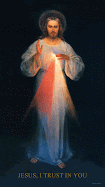
The Divine Mercy apostolate has been flourishing, not only in Poland, but throughout Europe, Asia and other parts of the world, including Australia where it was brought by migrants from Poland in 1950 and was actively promoted by the Polish Jesuit Chaplain Fr Stanislaw Skudrzyk. He arranged the transport of the first picture of Jesus Divine Mercy to Melbourne which was solemnly blessed by Archbishop Mannix on the Sunday of Divine Mercy, 20 April 1952, and given a place of honour in St Ignatius Church in Richmond, until 1959.

Link (here)

Polish Jesuit: Fr. Michał Piotr Boym, S.J.

The Jesuit missionaries who operated in China between the late 16th and early 17th century were a an outstanding group, but even against this background the story of Michael (Michał) Boym (ca. 1612–1659) is remarkable. Born in Lwów (a.k.a Lemberg, Lvov, Lviv), he left his native Poland to join the Jesuits, and was posted to China. He happened to arrive to China right around the time of the Manchu invasion and the fall of the Ming Dynasty. Fifty years earlier, the Wanli Emperor never deigned to meet Matteo Ricci and Diego Pantoya in person (and when given the portrait of the priests, exclaimed "Ah, they are Hui-Hui!"). Now, when Beijing and Nanjing both fell to  the Manchus, Koffler (another Jesuit, an Austrian) and Boym were able to enter the inner circle of the court of the Yongli Emperor (a grandson of Wanli), who was still resisting the Manchus from the empire's southwestern corner, and to baptize several members of the royal family. As the Ming's situation became increasingly precarious, Empress Elena sent Boym to Europe with a plea for help from the Pope. The Portuguese (who controlled Jesuit's operations in China and elsewhere in Asia) and the Jesuit leadership, however, were not all that enthusiastic about supporting the Ming's nearly-lost cause, so getting to Europe became yet another adventure for Boym and his traveling companion, a Chinese Christian named Andrew Zheng.

Engaged as he was with politics and the missionary business, Boym managed to write a few important books and articles, only some of which were published at the time. One of the best known is his delightful Flora Sinensis (1656). The album actually covered both flora and fauna, and not only of China. One of the most interesting pictures there was the one showing two creatures: Sum Xu (松鼠) and Lo Meo Quey (绿毛龟).

松鼠 is transcribed songshu in modern Chinese transcription (Hanyu Pinyin), and is the usual Chinese word for "squirrel". (The literal meaning is "pine rat".) ''Sum Xu'' would be the normal way to transcribe this in the Portuguese-influenced transcription that Boym used; elsewhere, for example, he has the Shandong province as Xantum. While Boym's picture of the creature is reasonably squirrel-like, his description of the creature's lifestyle is, however, decidedly non-squirrel-ly. According to Boym, the ''sumxu'' was a pretty yellow-and-black animal, commonly tamed, and made to wear silver a collar. Valued as good hunters of mice, they would sell for 7 to 9 silver coins. Based on this, it has been suggested (e.g., by Hartmut Walravens) that he was actually describing some animal from the mustelid family (including martens, ferrets, weasels, etc.) that may have been domesticated in China.

Jesuit Cardinal Roberto Tucci On Pope John Paul II And Totus Tuus


Cardinal Roberto Tucci, S.J.
Benedict XVI is about to begin his annual spiritual exercises which have as focus this year : "The Light of Christ at the heart of the Church - John Paul II and the theology of saints ". To coincide with this event we bring you a feature focusing on the prayer life of the late Polish Pontiff as witnessed by one of his closest advisors, Jesuit Cardinal Robert Tucci. Striking, says this Cardinal who was chief organizer of almost all of John Paul II's journeys abroad , was this pope's capacity to isolate himself from everything around him and pray: 
"..even when we were staying in the nunciature early in the morning he would spend three quarters of an hour, alone in the chapel ...he was a man in continuous dialogue with Our Lord, with the Mother of God..." 
In this interview you can also hear how John Paul II drew inspiration from a French Saint for the inscription "totus tuus" on his coat of arms , how his interest in Saint John of the Cross and Saint Teresa of Avila stemmed from the influence of a Polish tailor and finally how before becoming pope he spent time writing at a prie-dieu in the presence of the Blessed Sacrament...
Link (here) to Vatican Radio
Listen to this program presented and produced by Veronica Scarisbrick : RealAudioMP3

Wednesday, April 27, 2011

Jesuit On Pope John Paul II, Our Lady And Eucharistic Amazement

In his encyclical "Ecclesia de Eucharistia," Pope John Paul II called Mary "Woman of the Eucharist" and said that she "has a profound relationship to it." 
She gave flesh to Jesus, thus making it possible for Him to give His flesh for the life of the world. Pope John Paul's words should lead us to "Eucharistic amazement," 
a favorite expression of his, because they challenge us to make an act of faith in the Presence of Jesus in the Eucharist and in ourselves when we receive Him. 

Link (here) to Fr. James Kubicki, S.J., his blog is called "Offer it Up" this post is entitled, "Our Lady of the Blessed Sacrament"

Fr. Jean-Yves Calvez, S.J. "My Friend Karol And I"

Fr. Jean-Yves Calvez, S.J.
.....in the days before the Ted Williams tunnel in Boston, and getting back and forth through the Sumner and Callahan Tunnels could be something of a chore. As we sat there, under the harbor, in the tunnel, Fr. Jean-Yves Calvez, S.J. asked me a simple question: “So Michael, what theology classes are you taking this semester?” I answered: “Well Father, I am taking Jesuit Spirituality and Vatican II Theology.” Fr. Calvez quickly responded: “Very interesting, I was at the council you know.” “No Fr. Calvez, I didn’t know that, what did you do at the council?” This turned out to be the first dumb question that I asked, I expected an answer like “I got coffee,” or “I was a page.” With all gentility and humor, Fr. Calvez responded: “I worked on a document.” My second dumb question: “Really Father, which document?” I expected to hear one of the more minor documents and that he had just advised in the writing of it.
He responded: “I wonder if you have heard of it, it is called Gaudium et Spes, my friend Karol and I wrote most of it.” STOP for a minute; let’s just break down that statement. 1) Gaudium et Spes, arguably the most important, revolutionary, beautifully written, document of the council. 
Inarguably in the top four in all categories because it is one of the four Constitutions, the four most authoritative documents, of the council. (2) His friend Karol. You likely know this polish friend of Jean by a different name, John Paul II. 
Read (here) the full post at the Jesuit authored blog, The Road From LaStorta by Scholastic Mike Rogers, S.J. 

Former Irish Jesuit Headquarters Is Up For Sale

Loyola House, Former Irish Jesuit Headquarters
A RESIDENTIAL site going for sale today at the junction of Sandford Road and Eglinton Road in Dublin 4 will be seen as the best redevelopment opportunity to have been brought on to the market since the industry took a severe hit.  Agents CB Richard Ellis is quoting €2.5 million for the three-storey house, Loyola, owned by the Jesuit order, which was extensively damaged by fire in 2007. It stands on a site of 0.512 hectares (1.25 acres) with frontage on to Sandford Road and Eglinton Road. Large detached houses in this prestigious corner of Dublin 4 – within easy walking distance of both Donnybrook and Ranelagh – were selling for more than €5 million before the market took a dive. Loyola was not listed for preservation but was one of the largest houses in the area with a floor area of 751sq m (8,083sq ft). It served as the headquarters of the Jesuit order in Ireland Only last month, An Bord Pleanála granted planning permission for an apartment development on the site with seven homes to be located in the original building and 11 more in a new block. Eight of the apartments will have two bedrooms, six will have three bedrooms and the remaining four will have one bedroom. If the site is sold at the asking price it will work out at slightly less than €140,000 per unit. At the peak of the market, sites in south Dublin sold for up to €300,000 per unit.
Link (here) to the full post at An Irish Town Planner's Blog

Fr. James Kubicki, S.J. On The Council Of Quiercy

The love of Jesus is personal but it is also universal. The Catechsim of the Catholic Church, quoting the Council of Quierzy in the year 853, states: "There is not, never has been, and never will be a single human being for whom Christ did not suffer" (#605). It is this universal love that leads us, in the "Celebration of the Lord's Passion," to offer a long set of "General Intercessions." In them we pray for the entire Church, for the pope, for the clergy and laity of the Church, for those preparing for baptism, for the unity of Christians, for the Jewish people, for those who do not believe in Christ, for those who do not believe in God, for all those in public office, and for all those in special need. 
Link (here) to the full post by Fr. James Kubicki, S.J.

Phil Lawler On The Washington Post Article

St. Ignatius of Loyola
Despite the catastrophic decline in membership in the Society of Jesus, the Post happily passes along the party line, suggesting that while the Jesuits can’t seem to attract young men into their ranks, still they continue to exercise considerable influence, through the various schools and universities they control. There are no longer many Jesuits teaching at those schools, and the attitudes prevalent on campus would shock a Jesuit—or a Jesuit-trained student—of previous generations. That doesn’t matter. The important thing is the Jesuits still have clout, and the “Jesuit tradition”—a phrase that seems as malleable as the “spirit of Vatican II", and usually connotes the same things—is upheld
But even as the Jesuits brace for near-extinction in this part of the world, their ideals are spreading.
For the Washington Post, “this part of the world” means the area inside the Washington Beltway. For Jesuit institutions the clientele can be described more specifically as generally well educated, affluent, mostly Caucasian, ethnically Catholic.
Link (here) to the full piece at Catholic Culture.

Tuesday, April 26, 2011

Fr. James Martin, S.J. On The Sacking Of Padro Arrupe By Blessed John Paul The Great

Blessed John Paul the Great and Pedro Arrupe, S.J.
I had my differences with Pope John Paul II, technically my former boss.  (Who doesn't disagree with the boss from time to time?)  He wasn’t always the biggest fan of the Society of Jesus (aka the Jesuits, my religious order), though some of his suspicions seem to have originated with some of his advisers.  
When, in an unprecedented move in 1981, he suddenly removed Pedro Arrupe, the beloved superior general of the Jesuits, from his post, a great many Jesuits were both dismayed and angered.  John Paul, suspicious of the Jesuits’ work in “liberation theology” (an approach that emphasizes the liberation of the poor from suffering, as Jesus had), was apparently told by some advisers that the Jesuits would be disobedient after his public sacking of Arrupe.  
We were not.  Over the years, multiple sources have told me that John Paul was surprised by our fidelity--and pleased.  It changed his view of the Jesuits.
Link (here) to read the full post by Fr. James Martin, S.J. at America's blog In All Things

Fr. Gregory Jordan, S.J. The Exorcist Of The Archdiocese Of Brisbane

Bishop Julian Porteous
The North Sydney seminar was the second organised by Julian Porteous, the Auxiliary Bishop of Sydney, who stood in as exorcist for the archdiocese before a unnamed priest was appointed to the role last year. Bishop Porteous did not wish to comment yesterday but told the Herald last year that young people potentially risked a dangerous fascination with the occult, fuelled by the Twilight and Harry Potter series. He also warned an interest in the underlying spiritual beliefs of yoga, reiki massages and tai chi could lead people into the grip of ''demonic forces''.
Father Gregory Jordan, S.J., 80, who was appointed as exorcist to the archdiocese of Brisbane about 10 years ago, said in his experience ouija boards and astrology posed a risk. He said the growth in demand for exorcisms in Western countries, albeit from a low base, was unquestionable: he had performed four this week. 
The Jesuit priest, who was asked to preview The Exorcist in 1973, said the Catholic rite involving prayers to drive out the devil bore little resemblance to its depiction in popular culture. Most exorcisms dealt with ''oppression'' (feeling weighed down) or ''obsession'' (unusual, persistent negative thoughts) rather than possession,
Father Jordan said. ''After an exorcism I've had people say, 'I feel lighter.' They straighten their shoulders.'' A protocol in place stipulated that the subject of the rite was medically examined before undergoing it, he said.
''When there's real doubt, I simply … give them the Sacrament of anointing, which is quite appropriate and [with] which generally speaking they're quite happy,'' he said.
Link (here) to the full article at Sydney Morning Herald

Georgetown Adjunct Professor Dr. Joseph Palacios And False Rights

Dr. Joseph Palacios, adjunct Professor of Liberal and Latin American Studies at Georgetown University (a Jesuit-conducted institution in Washington, DC), attacked the Vatican under the above title in his April 19, 2011 press release. What is the reason? In March, the Vatican opposed the newly declared g@y “rights” at the United Nations. 
Palacios is the director of Catholics for Equality Education, another group of dissenters trying to destroy the Church from within.  Palacios especially mocks the idea of Archbishop Silvano Tomasi that the real victims are now those who dare to oppose those false “rights” (“they are stigmatized…vilified, and prosecuted” stated Tomasi at the UN Human Rights Council. See “Holy See statement on S@xual Orientation. Human s@xuality is not an identity,” C.I., May 2011, p. 28. Website: http://catholicinsight.com/online/church/vatican/article_1128.shtml, April 14). Palacios is an example of a person who has pushed his earlier religious understanding of creation out of sight and now embraces the immorality of the activist h@mosexual lifestyle as the new preferred ideology of equality. 
In his press release, he rejects natural law morality; the (traditional) consensus that anti-social behaviours must be forbidden by law (p@dophilia and inc@st being two examples); the Church’s refusal to accept sexual orientation and gender identity as human rights categories; her refusal to accept any model other than the male-female one as pro-creators in the natural order of biology; and her subsequent non-recognition of LGBT…persons. In other words, Palacios stamps with both feet on the traditional natural law anthropology (which has existed since Jesus Christ) and its recognition of the divinely ordered human family of father, mother and children.
Link (here) to read the lengthy article at Catholic Insight by Alphonse de Valk

Some Jesuit Universities "Expanding The Circle"

From March 3 through 6, an Expanding the Circle conference was held at the Hotel Nikko in San Francisco. Expanding the Circle is an initiative of the California Institute of Integral Studies, and its stated purpose is “Creating an inclusive environment in higher education for LGBT/Q students and studies.” Catholic universities were well represented.

Fr. Donal Godfrey, S.J.

Titles of some of the workshops at the conference indicated the bias common to post-modern social science, that reality is a human construction: “Reimagining S@xual Desire and Spiritual Longing in Sacred Texts”; “Does G-d Really Hate Me: Reconstructing and Reinterpreting Challenging Religious Texts”; “(Re)vamping the Que@riculum: Issues in the Teaching of Language and S@xuality”; “Imagining Qu@er Selves: LGBTQ Literature, Libraries, and the Coming Out Process”; and the near-parodic “Fostering Multivariate Inclusion: Multiple Marginalized Identities and the Interplay of Sexuality.” Others, while more crudely titled, were quite clear: “That’s SO G@y: Queering the Curriculum in High Schools through Community Collaboration”; “Ripe for the Picking: Queer-Themed FIGs (First-Year Interest Groups)”, and “Building a Successful LGBTQ Program at Catholic Institutions.” The following Catholic schools participated: College of the Holy Cross, DePaul University, Dominican University, Georgetown University, Loyola Marymount University, Marian University, Marquette University, Santa Clara University, St. Anselm College, St. Edward’s University, St. Joseph’s University, St. Louis University, and the University of San Francisco. 
Link (here) to read the full article at California Catholic Daily

Jesuit On Baba

On Easter Sunday, Sri Sathya Sai Baba (1926-2011) died in India at aged 85. The accounts of his death are many in the Indian press, and will increase as the day of his funeral, a state affair, approaches. (Just google “Death of Sai Baba” and you will see.)
Link (here) to the full article at America by Fr. Francis Clooney, S.J.
Superior General Pedro Arrupe, S.J. in a written response to the Holy Father Pope John Paul II "On regrettable shortcomings of the Society of Jesus" (here)

Monday, April 25, 2011

Easter Monday Of 1859

Notre Dame de Paris

It would be difficult to form an idea of the crowd of men that besiege the houses of the Jesuits toward the end of Lent, and one often wonders how the health of these Fathers, generally so delicate, can withstand the fatigue of hearing so many confessions. When they have been engaged in that occupation during the whole day, one or more will come in after time in the evening, or at night, and still the door is opened, and they find the Father they ask for, receiving them with open arms. For a sinner returning to God, a Jesuit never admits obstacle or delay. "At any hour of the day, at all hours of the night, we are ready to assist you," said Father Felix, at the close of one of his retreats. Father Lefebvre, who consecrates himself especially to the direction of men, was, one day, asked how many he had sent, for his share, to the General Communion at Notre Dame. "About eight hundred," was the answer. 
The Fathers seem never so happy as when, on Easter morning, they are worn out and speechless with fatigue—that is their alleluia !" You abuse your strength," said a friend to one of these indefatigable laborers; "nature can not bear such an excess of work." "After me—another" was the simple and almost careless reply. His Superior, to whom it was remarked, on Easter Monday of 1859, that he must be very much fatigued with the past week's labor, answered: "Ah, we have had great consolations! There have been many conversions; our ministry has been blessed; the confessionals were crowded. The Lord be praised!" 
Of his great fatigue, of his weak health—not a word! The ministry at Paris, during the winter, is overwhelming. When a Jesuit is exhausted, they give him a vacation; they send him to preach a retreat in the provinces. So as to lose no time, he travels by night, and generally ascends the pulpit on the day of his arrival. After the first exercises, he is called to hear confessions, and thenceforth all his time is divided between the pulpit and the confessional; that is what they call vacation. 
Link (here) read the full account of the Parisian Jesuits in the book entitled, The History of the Society of Jesus

Sunday, April 24, 2011

Easter Of 1541

It was now necessary to proceed to the choice of a Superior. Hitherto they had none, for Ignatius abstained from all supremacy or dictation; on every point (except the name) the opinion of all the members was asked; when government was necessary, they exercised it in turn. 
Now that they were recognized as an order, they required a head; and in the Easter of 1541, Ignatius summoned all to Rome who 1541. could come, the others were to send their vote in writing. 
Only five could be collected; Brouet came from Sienna, Laynez from Parma, Le Jay from Brescia, Bobadilla was at Bisignano, in the kingdom of Naples; there the inhabitants petitioned the Pope that they might retain him, and the Pope forbade him to return. He had not time to send his written vote, but afterwards declared that he should have chosen like the rest. 
In prospect of this election, Xavier and Rodriguez had left their votes sealed up at Rome. Faber sent his, copied twice over, for fear of accident, from Worms, where he was attending at the Diet. Those who could come, reached Rome as soon as possible, because there was much to do. 
They had desired their Father Ignatius to form a plan for them—this was now considered, closely examined and adopted. Then the election was deferred till April 7, that all might pass three days in prayer, abstaining from consulting with one another. On the 7th the sealed papers were opened. Ignatius Ignatius was named by all.
Link (here) to read the full account of St. Ignatius of Loyola's election as the Superior General of The Society of Jesus

Saturday, April 23, 2011

Eustace Of The Hurons Was Baptized On Holy Saturday

A Huron Indian warrior
........all that I can do is to declare sincerely the desire that I have for it. After that, if my Soul be burned in Hell, you will be the cause of it. But, whatever you may do, I will always pray to God, because I know him; and perhaps he will have mercy on me, for you say that he is better than you." "But," said one of our Fathers, " what made you first think of believing?" "Even before you came to this Country," he replied, " I had escaped from a great many perils in which my Companions perished. I saw very well that it was not I who extricated myself [19] from these dangers. I had this thought, that some more powerful Spirit, who was unknown to me, gave me favorable aid" (although the Hurons attribute to dreams the source of all their good fortune); 
"I was convinced that all that was only nonsense, but I knew no more about it. When I heard of the Greatness of God, whom you preach, and of what Jesus Christ had done when he was on Earth, I recognized him as the being who had preserved me, and I resolved to honor him all my life. When I went to war, I recommended myself to him night and morning. It is to him that all my victories are due; he it is in whom I believe; and I ask you for Baptism, so that he may have pity on me after my death." 
Was it possible to refuse such a Man? We Baptized him publicly, with some others, on Holy Saturday, and gave him the name of Eustache. When he had performed his Devotions on Easter Sunday, he started for the War with some of our best Christians, who had remained solely for the purpose of celebrating that holy Day, although the Troops whom [20] they were to join had already departed. But, before separating, finding that a considerable number of persons were assembled there belonging to various Nations, they wished of their own accord to hold a Council. Here, in a few words, are the resolutions that they took:
"Let us hereafter be but one body and one mind, since we all serve the same Master. Whenever any one of us passes by a Village wherein a Christian dwells, let him not lodge elsewhere. Whenever any one is afflicted, let him seek consolation among the others. Let us not reveal one another's faults to the Infidels; but let it be recognized, through the friendship that we shall have for one another, that the Name of Christian is a tie more binding than Nature's bonds.
'' Let us inform our Relatives who are not of the same Faith as we, even if they be our fathers and our children, that we do not wish our bones to be mingled together after our death, since our Souls will be eternally separated, and our affection will not continue beyond this life."
 Link (here) to French Jesuit, Fr. Jerome Lalemant, S.J. of his account as found in the Jesuit Relations and Allied Documents of a Huron warrior named Eustace and his story of conversion.

The Jesuits Are Vanishing

When John Langan came to Georgetown University in 1975 as a young Jesuit priest, he was one of 112 brothers from the Catholic order on campus. Jesuit Robert Drinan, a Massachusetts Democrat, was in Congress, and Jesuit John McLaughlin was in the West Wing advising Republican President Richard Nixon. Today there are barely half as many Jesuits at Georgetown, the order’s flagship university. Gonzaga, a Jesuit high school, is down to 17, compared with 43 in 1970. There’s talk that St. Aloysius, a Jesuit parish in the District known for its social justice efforts, could close when the current Jesuit leaves. And there are no full-time Jesuit staff members at all at the Washington Jesuit Academy, where the board chairman is Jewish. The Jesuits are vanishing from the Washington area, where they established the first Catholic Church in the colonies.
Link (here) to the full article at the Washington Post by Michelle Boornstein

Friday, April 22, 2011

Fr. Herbert Thurston, S.J. On Good Friday

There is every reason to believe that these solemn prayers in our Good Friday service date back at least to the time of John Cassian and St. Jerome. Very possibly they formed an almost invariable adjunct to the three lessons and the psalmi responsorii, of which, as was said above, the non-liturgical synaxes mainly consisted. In the middle ages I think that they still survived in our English churches in the prayers known as the bidding prayers, and in France in the prieres du prone. 1 But although they must thus have been an almost, daily feature in the life of the Christians of the fourth century, it is only on this one occasion in the whole year that they are heard in our churches now. Probably the apparently meaningless Oremus, which is said in the Mass before the antiphon called the Offertory, marks the place where once they stood.

THE ADORATION OF THE CROSS

After the solemn prayers the next feature which meets us in the morning office of Good Friday is the rite which in the Latin books is described as adoratio crucis, but which amongst our English forefathers was known as the creeping to the cross. There is not, I think, any sufficient reason for dwelling upon the preliminary ceremonies with which that most impressive function is introduced. I content myself with reproducing the rubrics in the Holy Week book, which sufficiently explain the details of what is done. After reading the foregoing prayers the priest puts off his chasuble, and taking down the cross, covered with a veil, from the altar, he goes with the deacon and subdeacon to the Epistle corner of the altar, where he uncovers the top of it, and shows it to the people, singing with the deacon and subdeacon the following Anthem :

Latin

Ant. Ecce lignum crucis
in quo salus mundi pependit.

English

Ant. Behold the wood of the cross, on which
hung the salvation of the world.


To which the choir, prostrate on the ground, answer :

Venite, adoremus. Come, let us adore.

From thence the priest proceeds again to the Epistle corner, where he uncovers the right arm of the cross, singing a second time, in a higher key,

Ecce lignum, etc.,

as before. Lastly, he goes to the middle of the altar, and uncovers the whole cross, singing a third time, still higher,

Ecce lignum, etc.

After which he carries it to a place prepared before the altar, where himself first kisses it, and then all the clergy and laity, two and two, kneeling thrice on both knees, and kissing the feet of the crucifix. During this ceremony two chanters in the middle of the choir sing the following verses, wherein the Redeemer of the world is represented as reproaching the Jews for their ingratitude..

Latin

POPULE meus quid feci tibi ?
aut in quo contristavi te ?

Re-sponde mihi.

V. Quia eduxi te de terra Egypti:
parasti crucem Salvatori tuo.

English

My people, what have I done to thee ?
in what have I grieved thee?

Answer Me.

V. Because I brought thee out of the land of Egypt:

Thou hast prepared a cross for thy Saviour

Thursday, April 21, 2011

Father Reese, Cardinal Dulles And The Jesuit Wake-Up Call

Cardinal Avery Dulles, S.J.
Well, Father Reese, what about an institution that lost two-thirds of its members? In the US, the Society of Jesus went from 8,400 members in 1965 to 2,650 last year.
The decline continues with no end in sight. Yet the American Jesuits have not only refused to study the problem of catastrophic decline themselves, they have gone out of their way to knee-cap scholars whose explanations were unflattering. 
Just ask Peter McDonough, the co-author of Passionate Uncertainty: Inside the American Jesuits. The late Cardinal Avery Dulles, SJ, was not terribly fond of the book; he criticized its implicit liberal bias. Yet Cardinal Dulles still recognized Passionate Uncertainty as “a wake-up call” for the Jesuits.
.
Link (here) to read the full piece at Catholic Culture.

The Warm Golden Color

This is an interior picture of the Chiesa della Sacra Noma di Gesu (Church of the Sacred Name of Jesus) in Rome.  
It is the founding church of the Jesuit Order, and it is just amazing.  Because the dome lantern contains yellow glass, 
when the sun comes through in the afternoon, it turns the whole interior a warm golden color.  Bellissimo!!
.
Link (here)

Father Johnny Go, S.J.

Fr. Johnny Go, S.J.
A Holy Week retreat runs from Thursday to Saturday to cater to people whose schedules or locations prevent them from attending face-to-face prayer sessions. Prepared by Jesuit priest Johnny Go along with other Jesuits, the retreat titled “The Fugitives of Lent” takes off from the stories of the people whom Go calls the “bad guys” of the season – Judas Iscariot, who betrayed Jesus Christ; Pontius Pilate, who sentenced him to death; and Peter the Apostle, who denied his Lord thrice. In Go’s effort to try something different this year, four comic book characters take center stage in the brief preparatory module for the retreat. In the first few web pages of the retreat, Go invites participants to go deep into the characters of “the comic world’s worst villains” – Frankenstein, The Penguin, Dracula, and Lex Luthor.
Link (here) to read the full article at CathNews Philippines

Fr. John B. Guida, S.J. Mistaken For John Wilkes Booth

Fr. John B. Guida, S.J.
John Wilkes Booth
A photograph of the Georgetown Jesuit who was jailed after being mistaken for John Wilkes Booth is only one of about 80 Civil War items on display at the Georgetown University’s Lauinger Library through the month of June. The items are from the library’s Special Collections Research Center and from the Woodstock College Archives. Authorities released John B. Guida, S.J., a philosophy professor, once Booth (who assassinated President Abraham Lincoln) was found. “On the occasion of the 150th anniversary of the Civil War, the Special Collections Research Center wanted to tell the story of the war’s impact on Georgetown and its faculty and students,” explained University Archivist Lynn Conway, who put the exhibition together. “It is a story of perseverance and survival. 
As the war progressed, the College saw its grounds occupied by Union troops on multiple occasions, according to documents in the exhibition. The university tried to maintain normal activities throughout the war, according to Georgetown documents. 
Faculty melted down silver spoons that belonged to students who had already left campus to make silver medals awarded for academic achievement at the 1862 commencement."
Link (here) to read the full post at Jesuit.org.

With Fr. James Kelly, S.J. On Manitoulin Island

There are many factors that get in the way of my seeing much of the rest of Manitoulin Island outside of our weekly visits to Anderson Lake - not having a license being the main one, but we're also pretty busy here most of the time, so that cuts down on potential traveling time!!-.  So, you can understand that I was rather looking forward to spending a day or 2 with Fr Jim Kelly, who has parishes in 4 other locations on the Island (M'Chiging, Gore Bay, Mindamoya and Sheshawaning. ) a few weekends ago. Besides the fact that I knew I'd get along with Jim amazingly well, I was eager to see some other parts of this beautiful Island, but also to visit other parishes. As attached as I am to Wiki, I needed to experience how other parishes live their faith on Manitoulin Island.
Link (here) to Dan Lackmen's blog A Beautiful Journey With Christ.

Wednesday, April 20, 2011

Rosebud Indian Reservation And The Wisconsin Province

The St. Francis Mission
A recent national survey of clergy sexual abuse reports found that 683 allegations were made against Catholic clergy in the U.S. last year, nine of which originated in the Diocese of Rapid City and dated from 30 to 45 years ago. The majority of the Rapid City diocese’s allegations were made in connection with the litigation involving a Catholic boarding school for Native American students at St. Francis, a Jesuit-run mission on the Rosebud Reservation that was staffed by the Wisconsin Province of the Society of Jesus, according to the Rev. Steve Biegler, diocese administrator. None of the nine allegations involved any priests currently serving in the western South Dakota diocese and two were against a diocesan priest who has been dead for 40 years, he said.
Link (here) to read the full report.

Tuesday, April 19, 2011

Fairbanks Bishop Listening To The Victims Of Jesuit Priest Abuse

Bishop Donald Kettler
Bishop Donald Kettler, head of the Roman Catholic Diocese in Fairbanks, sat in a tiny meeting room in the Yup’ik village of St. Michael.  
“I’ve come this evening just to, to hear what you’d like to tell me, or what you’d like to say to me,” said Kettler, who oversees a northern and western Alaska diocese more than three times the size of Italy. A grey V-neck sweater framed his priest’s collar and soft features.  
“If there’s something that you’d like to tell me, please, uh, you know. Do that.” About 10 villagers stared back at the Bishop in silence. A man and woman sat holding hands next to a window. Someone had closed the blinds. Finally, a middle-aged man named Ben Andrews spoke. 
“Joseph Lundowski. Father Endal …” he began, naming the men who sexually abused him and a generation of other St. Michael children on an almost daily basis. “I wish that those who victimized me, I wish they was here, too,” said Andrews, 
who says his father once beat him for saying he’d been raped by a priest. Andrews clasped his hands together on the wooden table, then put his palms to his head as Kettler apologized on behalf of the church.
Link (here) to the great blog post at Laitytude

An Excerpt From PBS Television News Show Frontline Entitled "The Silence" Documenting A Small Portion Of The Jesuit Alaskan Fiasco

One man, Ben Andrews, recounts that when he told his father what the priest had done, his father grabbed his belt, "… and he hung me upside down. He beat me and told me never to talk about priests like that. My dad went out. He came back pretty drunk and I saw him holding a pistol in his hand. He looked at my mom, and pointed the gun at her. The gun went off and my brother was in the front. The bullet pierced both of them. I held him in my arm. My brother didn't have to die just because I told my dad the truth."
Link (here) to read the full piece at the ultra-liberal NCR

Another Lawsuit, Just 20 Million Dollars This Time

Doug Perlitz
A federal lawsuit seeking $20 million in damages was filed Monday against Fairfield University, the Society of Jesus and a Colorado man sentenced to nearly 20 years in prison for sexually abusing children at a school he founded in Haiti. The lawsuit was filed by one of Douglas Perlitz's accusers. It maintains that Fairfield University, the Jesuit order and other defendants were negligent in hiring and supervising Perlitz in the work he did in Haiti. And it accuses other defendants, some of them not named, of aiding Perlitz's efforts to cover up the abuse. Alice Poltorick, a spokeswoman for the Society of Jesus, New England, called Perlitz' actions "deeply disturbing" and said the order would "work to address this claim diligently and with great sensitivity towards any individual who was harmed by Mr. Perlitz." Officials at Fairfield University, which put its employees on the fundraising arm of the Haitian school, declined to comment, saying they hadn't yet seen the lawsuit. A message left for an attorney for Perlitz wasn't immediately returned.
Link (here) to the full AP report.
Link (here) to read all the back stories of Doug Perlitz and Fr. Carrier, S.J.
I thought the term might just as well be, “Catholic cannibalism.” Fr. Francis X. Clooney, S.J. (here)

Another Inspiring Quote From Fr. Thomas J Reese, S.J.

In other words, the Catholic church has failed to deliver what people consider fundamental products of religion: spiritual sustenance and a good worship service. And before conservatives blame the new liturgy, only 11 percent of those leaving complained that Catholicism had drifted too far from traditional practices such as the Latin Mass.    His full essay is online at the National Catholic Reporter. 
Link (here) to read the full blog post at The Pittsburgh Post-Gazatte

Zamboangueno Jesuit On Holy Week

Fr. Buddy Wee, a Zamboangueno Jesuit priest who teaches Religious Studies at the Ateneo de Zamboanga University said in understanding the true meaning of Lent, one must be willing to change for the better. He also emphasized traditional Church customs of asking penitents to fast and abstain finds essence in the willingness to sacrifice for a better good. It also re-introduces one to a selfless devotion . While Fr. Wee said lent highlights self sacrifice through fasting and abstinence, alms giving and care for others, these traditions must be carried out not only during the Lenten season but through everyday of our lives. The Christian world enters Holy Week this week, the highpoint of the observance of the Lenten season, as devotees are expected to congregate in churches, for prayers, hear mass, seek penance and renewal with the Divine Almighty. Fr. Wee called for prayers and the faithful to read the Holy Book and reflect on the words of God to find true meaning this Holy Week.
Link (here) to Zamboanga Today Online