Showing posts with label Liberation Theology. Show all posts

Monday, June 2, 2014

Liberation Theology Is Very Archaic, If Not Already Dead

While in Rome last week, the president of the Latin American Bishops’ Council said at a news conference that the Church in the region has fortunately moved beyond liberation theology. “The relevant figures of liberation theology are all very elderly, and liberation theology as such, as the expression of what it was, is very archaic, if not already dead,” commented Archbishop Carlos Aguiar Retes of Tlalnepantla May 27 at the offices of the Pontifical Commission for Latin America.
"There were efforts by some liberation theologians to clarify their theology,” he said. “But that was during the 1970s and 80s, and today, thank God, we have a much wiser theological reflection that does not neglect the necessary, comprehensive, liberation of man.” "Now it is not about class warfare, with the confrontation between rich and poor, because as we know, for the Church this is not the way to social liberation.”
Archbishop Aguiar explained that liberation theology "had been put forth with a sociological foundation that did not square with theological foundations," and that consequently "that is where it fell apart." True liberation, he said, "is showing the merciful face of God the Father, the tenderness of God among us”; this strengthens the human condition, the family as the place where the person matures and is educated, and prepares future generations to be leaders in all areas of society, "whether social, economic, or political." This task, Archbishop Aguiar reflected, “is one that Pope Francis has described in ‘Evangelii Gaudium.’”
Link (here) to CNA 
Tons of stuff on Liberation Theology and Jesuits (here)

Fr. James Martin, S.J. On Liberation Theology

Pope John Paul II admonishing  Fr. Ernesto Cardenal, S.J.
In its heyday, liberation theology was not without controversy: some in the church, and some in the Vatican, thought it skirted too close to Marxism--including Pope John Paul II.  On the other hand, John Paul didn’t shy away from personally involving himself in direct political activism in Poland.  It was the Latin American version of social action that seemed to bother him more.  But even John Paul affirmed the notion of “preferential option for the poor,” as did Paul VI before him.  “When there is question of defending the rights of individuals, the defenseless and the poor have a claim to special consideration,” John Paul wrote in his great encyclical Centesimus Annus, which celebrated 100 years of—uh oh--Catholic Social Teaching. “Liberation theology” is easy to be against.  For one thing, most people don’t have the foggiest idea what you’re talking about.  (It even sounds vaguely suspicious, too.)  It’s also easier to ignore the concerns of the poor, particularly overseas, than it is to actually get to know them as individuals who make a moral claim on us.  For another, there are lots of overheated websites that facilely link it to Marxism.  My response to that last critique is to read the Gospels and count how many times Jesus tells us with should help the poor and even be poor.  In the Gospel of Matthew, in fact, Jesus tells us that the ones who are to enter the Kingdom of heaven are those who help “the least of my brothers and sisters,” i.e., the poor.   After that, read the Acts of the Apostles, and read about the apostles “sharing everything in common.”  Then let me know if helping the poor is communist or simply Christian. I have no idea if President Obama subscribes to liberation theology. But I do.
Link (here) to read the full post entitled, Glenn Beck and Liberation Theology by Fr. James Martin, S.J.
Link (here) to the photo and lengthy  story of “Pope John Paul II on his 1983 arrival in Managua, publicly reprimanded Jesuit priest and Sandinista Minister of Culture Ernesto Cardenal."

More on the subject
An interview with sanctioned Fr. Jon Sobrino, S.J. in Sojourners Magazine (here)
More on Glenn Beck's Restoring Honor program in Washington, D.C. (here)
Read about the Italian Father Alighiero Tondi, S.J. and his Communist connections with the Catholic Action Movement (here) as told by Time Magazine
Jesuit Education and Social Change in El Salvador By Charles Joseph Beirne, S.J.
Go (here) to read the one time Jesuit Fr. Malachi Martin on Liberation Theology in his famous book entitled, The Jesuits.

Wednesday, May 7, 2014

Bergogliano And Anti-Bergogliano Factions

This turmoil was exemplified by the monumentally lethal “Dirty War” that raged in two phases in Argentina from 1973 until 1983. By this time Bergoglio was serving amid growing controversy as the Provincial Superior of the Society of Jesus in Argentina (1973 to 1979), and then as the Rector of the Philosophical and Theological Faculty of San Miguel until 1986 when he was abruptly removed. His actions or inactions during this period are now being re-examined as he assumes papal power. Referring to the enthusiasm with which he accepted his new role, the New York Times observed that “he was less energetic when it came to standing up to Argentina’s military dictatorship during the 1970s as the country was consumed by … the Dirty War. He has been accused of knowing about abuses and failing to do enough to stop them.” “History condemns him,” declared a senior Brazilian academic. “It shows him to be opposed to all innovation in the church and above all, during the dictatorship, it shows he was very cosy with the military.” Francis rejected suggestions that he had hard-right sympathies, claiming that it was merely his “authoritarian way of making decisions” while he was head of the Argentinian Jesuits in the 1970s “that created problems” in the past. Nevertheless, such problems were substantial and the criticism he faces has been emphatic. For example, a presently serving provincial of another Latin American country and one of the most senior figures in the Society of Jesus confided his negative views in an e-mail quoted by Paul Vallely, in his new biography, Pope Francis: Untying the Knots (2013): 

Yes, I know Bergoglio. He’s a person who’s caused a lot of problems in the Society and is highly controversial in his own country … As Provincial he generated divided loyalties: some groups almost worshipped him, while others would have nothing to do with him … He left the Society of Jesus in Argentina destroyed [and] we have spent two decades trying to fix the chaos that the man left us … It will be a catastrophe for the Church to have someone like him in the Apostolic See. 

 As Vallely observes, “this constituted an extraordinary counterblast” to the acclaim that otherwise met the election of Pope Francis, but it was “far from a lone voice” from within the Jesuit order to which Bergoglio had dedicated a major part of his adult life. It is clear that great bitterness enveloped Bergoglio during his time as Provincial Superior, as Vallely’s account reveals. Regarded as a gifted and charismatic young man, Bergoglio had enjoyed a rapid ascent through the ranks to head the order at only thirty-six, just three months after taking his perpetual vows. Under his leadership the province broke up into Bergogliano and anti-Bergogliano factions, driven, Vallely argues, by two polarising forces: Vatican II and Peronism.
Link (here)

Saturday, April 26, 2014

Fr. James Martin, S.J. On The Sacking Of Padro Arrupe By Blessed John Paul The Great

I had my differences with Pope John Paul II, technically my former boss.  (Who doesn't disagree with the boss from time to time?)  He wasn’t always the biggest fan of the Society of Jesus (aka the Jesuits, my religious order), though some of his suspicions seem to have originated with some of his advisers.  
When, in an unprecedented move in 1981, he suddenly removed Pedro Arrupe, the beloved superior general of the Jesuits, from his post, a great many Jesuits were both dismayed and angered.  John Paul, suspicious of the Jesuits’ work in “liberation theology” (an approach that emphasizes the liberation of the poor from suffering, as Jesus had), was apparently told by some advisers that the Jesuits would be disobedient after his public sacking of Arrupe.  
We were not.  Over the years, multiple sources have told me that John Paul was surprised by our fidelity--and pleased.  It changed his view of the Jesuits.
Link (here) to read the full post by Fr. James Martin, S.J. at America's blog In All Things
Superior General Pedro Arrupe, S.J. in a written response to the Holy Father Pope John Paul II "On regrettable shortcomings of the Society of Jesus" (here)

Sunday, March 23, 2014

I Think That Is What Pope Francis Wants Too

Fr. Martin Maier, S.J.
Fr Martin Maier SJ gave the address, which received a rousing clap at the conclusion from the congregation. He said of Romero that, “the heart of Romero’s spirituality and his pastoral action was the Option for the Poor”, adding that “it is also at the heart of Pope Francis’ spirituality”. Fr Maier felt the key insight of Romero was “conversion to the poor, and I think that is what Pope Francis wants too”. A German Jesuit and liberation theologian, he spent many years in El Salvador, and continued serving while persecution was strife. He continues to visit El Salvador, including teaching a theology course and ministering at the weekends at the same parish where he was originally a parish priest.
Amongst the people at the service who knew Archbishop Romero personally was El Salvador’s Ambassador to Britain, Werner Matias Romero. In a word of thanks at the end he reported that, “in an exciting year 2014 for El Salvador, where we went to the polls twice and elected a new president, I am hopeful that Archbishop Romero will continue to be our inspiration”.
There had been bidding prayers for El Salvador and for trouble spots of the world, particularly Syria and the Middle East, the Ukraine and the Russian Federation. Also, there were prayers for the work of the Archbishop Romero Trust and the ministry of the Church of St Martin in the Fields in favour of the poor and dispossessed.
Link (here)

Thursday, February 27, 2014

A Complicated Relationship With Liberation Theology

The former Jesuit Cardinal Jorge Mario Bergoglio has had a complicated relationship with liberation theology, clashing with left-leaning members of his Jesuit order who took up its politicized call to confront Argentina’s violent military dictatorship in the 1970s.
Nevertheless, Francis fully embraces its call for the church to have a “preferential option for the poor.”
The Vatican newspaper, L’Osservatore Romano, has been on a rehabilitation campaign of sorts, saying that with the first Latin American pope, liberation theology can no longer “remain in the shadows to which it has been relegated for some years, at least in Europe.”
Link (here) to read the full story at the Globe and Mail

Friday, October 11, 2013

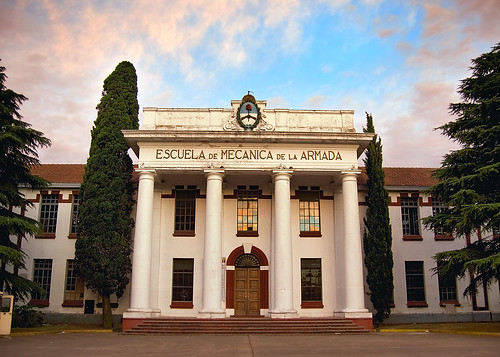
Naval School of Mechanics

The Vatican has firmly denied these claims and there have since been many reports of the "quiet diplomacy" used by Pope Francis, who was then named Jorge Mario Bergoglio and head of the Jesuit order in Argentina. There was no official word on the content of the talks between Francis and Jalics, who was born in Hungary and now lives in a German monastery. Francis has said he experienced "a period of great internal crisis" at the time of the junta and admitted to making mistakes in his leadership. A recent book by an Italian journalist, however, said he took in many leftist students at risk of being jailed by the dictatorship and advised hi
s priests on how best to avoid being spied on. It also published transcripts from testimony given by Bergoglio to prosecutors investigating the crimes of the junta in which he said he lobbied for the release of Jalics and Orlando Yorio.
The two young Jesuits who were preaching in the slums were taken in March 1976 to the notorious Naval School of Mechanics, a torture centre run by the junta. They were freed after five months. 
Father Franz Jalics now lives in a monastery in Germany. Following controversy after the Pope's election in March, Jalics released a statement saying: "Yorio and I were not reported by Father Bergoglio". "I myself formerly tended to believe that we were reported. At the end of the 1990s however it became clear to me after numerous conversations that this assumption was baseless," Jalics said.
Link (here)

Thursday, September 19, 2013

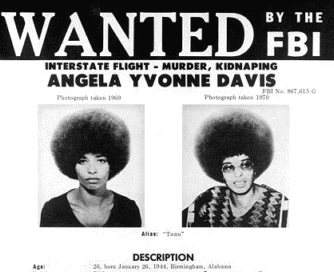
Seattle University To Host Angela Davis

A Catholic university in Washington has invited communist and abortion supporter Angela Davis to speak on campus, raising concerns among those who say her views are anathema to Catholic teaching. Davis will give a lecture on October 17th at Seattle University, a Jesuit institution. Her talk is sponsored by the Center for the Study of Justice in Society, and will ostensibly be about prison reform.
Davis is a controversial choice for a Catholic university, however. She is a former leader of the U.S. Communist Party, and ran for vice president twice in the 1980s on the Communist ticket. She holds socially liberal views at odds with Catholic teaching, including the view that abortion rights are a “fundamental prerequisite for the emancipation of women.”
These views should disqualify her from a speaking slot at a Catholic university, wrote James Bascom of TFP Student Action, a conservative education group. “It would be difficult to find a speaker who contradicts the teaching of the Catholic Church on more levels than Angela Davis,” he wrote in a blog post for TFP Action. “Stalin maybe?” Catholic institutions should recognize the death and destruction wrought by communism in the 20th century and decline to honor one of the ideology’s devotees with a guest lecture, wrote The College Fix. Seattle University did not respond to a request for comment.
Link (here) to The Daily Caller

Sunday, September 15, 2013

Cardinal Avery Dulles, S.J. "Little Or No Encouragement From Catholic Clergy"

Asked whether spreading the faith was a high priority of their parishes,75 percent of conservative Protestant congregations and 57 percent of African American congregations responded affirmatively, whereas only 6 percent of Catholic parishes did the same. Asked whether they sponsored local evangelistic activities, 39 percent of conservative Protestant congregations and 16 percent of African American congregations responded positively as compared with only 3 percent of Catholic parishes. Converts to Catholicism often report that on their spiritual journey they received little or no encouragement from Catholic clergy whom they consulted.
Link (here) to Ralph Martin's disturbing look at Catholic de-Sacramentalization. In this essay you will find Cardinal Dulles' quote.

Tuesday, July 16, 2013

Bert Thelen 80 Year Old Jesuit Leaves The Society Of Jesus, "It Is Time For The Church To Turn Her Attention From Saving Face To Saving The Earth, From Saving Souls To Saving The Planet."

May the Grace of Jesus Christ, the Love of God, and the Peace of the Holy Spirit be with you! I am writing to tell you about what may be the most important decision of my life since entering the Jesuits. With God's help, at the behest of my religious superiors and the patient support and wise encouragement of my CLC group and closest friends, I have decided to leave ordained Jesuit ministry and return to the lay state, the priesthood of the faithful bestowed on me by my Baptism nearly 80 years ago. I do this with confidence and humility, clarity and wonder, gratitude and hope, joy and sorrow. No bitterness, no recrimination, no guilt, no regrets.
Bert Thelen former Jesuit
It has been a wonderful journey, a surprising adventure, an exploration into the God Who dwells mysteriously in all of our hearts. I will always be deeply grateful to the Society of Jesus for the formation, education, companionship, and ministry it has provided, and to my family for their constant support. I can never thank God enough for the loving and loyal presence in my life of each and every one of you.
 Why am I doing this? How did I reach this decision? I will try to tell you now. That is the purpose of this letter.
For about 15 years now, as many of you have noticed, I have had a "Lover's Quarrel" with the Catholic Church. I am a cradle Catholic and grew up as Catholic as anyone can, with Priests and even Bishops in our household, and 17 years of Catholic education at St. Monica's Grade School, Milwaukee Messmer High School, and Marquette University.
I took First Vows at Oshkosh in the Society of Jesus at age 25 and was ordained at Gesu Church to the priesthood ten years later in 1968. I have served the Church as a Jesuit priest in Milwaukee, Omaha, and Pine Ridge for 45 years, including 18 years on the Province Staff culminating in my being the Wisconsin Provincial for six years and attending the 34th General Congregation in Rome. My last 14 years at Creighton and St. John's have been the best years of my life. I have truly enjoyed and flourished serving as pastor of St. John's. I cannot even put into words how graced and loved and supported I have been by the parishioners, parish staff, campus ministry, Ignatian Associates, and CLC members! It is you who have freed, inspired, and encouraged me to the New Life to which I am now saying a strong and joyful "Yes." You have done this by challenging me to be my best self as a disciple of Jesus, to proclaim boldly His Gospel of Love, and to widen the horizons of my heart to embrace the One New World we are called to serve in partnership with each other and our Triune God. It is the Risen Christ Who beckons me now toward a more universal connection with the Cosmos, the infinitely large eco-system we are all part of, the abundance and vastness of what Jesus called "the Reign of God."
Why does this "YES" to embrace the call of our cosmic inter-connectedness mean saying "NO" to ordained ministry? My answer is simple but true. All mystical traditions, as well as modern science, teach us that we humans cannot be fully ourselves without being in communion with all that exists. Lasting justice for Earth and all her inhabitants is only possible within this sacred communion of being. We need conversion – conversion from the prevailing consciousness that views reality in terms of separateness, dualism, and even hierarchy, to a new awareness of ourselves as inter-dependent partners , sharing in one Earth-Human community. In plainer words, we need to end the world view that structures reality into higher and lower, superior and inferior, dominant and subordinate, which puts God over Humanity, humans over the rest of the world, men over women, the ordained over the laity.
As Jesus commanded so succinctly, "Don't Lord it over anyone … serve one another in love." As an institution, the Church is not even close to that idea; its leadership works through domination, control, and punishment. So, following my call to serve this One World requires me to stop benefiting from the privilege, security, and prestige ordination has given me. I am doing this primarily out of the necessity and consequence of my new call, but, secondarily, as a protest against the social injustices and sinful exclusions perpetrated by a patriarchal church that refuses to consider ordination for women and marriage for same- sex couples.
I have become convinced that the Catholic Church will never give up its clerical privilege until and unless we priests (and bishops) willingly step down from our pedestals. Doing this would also put me in solidarity with my friend, Roy Bourgeois, my fellow Jesuit, Fr. Bill Brennan, the late Bernard Cooke, and many other men who have been "de-frocked" by the reigning hierarchy. It will also support the religious and lay women, former Catholics, and gay and lesbian couples marginalized by our church. I want to stand with and for them. I am, if you will, choosing to de-frock myself in order to serve God more faithfully, truly, and universally.
But why leave the Jesuits? Make no mistake about it: the Society of Jesus shares in and benefits from this patriarchal and clerical way of proceeding. We still regard ourselves as the shepherds and those to whom and with whom we minister as sheep. I discovered this painfully when the Society of Jesus decided against having Associate members. We are not prepared for co-membership or even, it seems at times, for collaboration, though we pay lip service to it. "Father knows best" remains the hallmark of our way of proceeding. I can no longer, in conscience, do that. But I still honor and love my fellow Jesuits who work from that model of power over. It is still where we all are as a company, a Society, a community of vowed religious in the Roman Catholic church. Leaving behind that companionship is not easy for me, but it is the right thing for me to do at this time in my life. When I went through a formal discernment process with my CLC group, one member whose brilliance and integrity I have always admired and whose love and loyalty to the Jesuits is beyond question, said of my decision, "You cannot NOT do this!" He had recognized God's call in me.
 A few other considerations may help clarify my path. The Church is in transition – actually in exile. In the Biblical tradition, the Egyptian, Assyrian and Babylonian captivities led to great religious reforms and the creation of renewed covenants. Think of Moses, Jeremiah, and Isaiah. I think a similar reform is happening in our Catholic faith (as well as other traditions).
We have come through far-reaching, earth-shaking evolutionary changes, and a new (Universal) Church as well as a new (One) World is emerging. My decision is a baby step in that Great Emergence, a step God is asking me to take.
Consider this. Being a Lay Catholic has sometimes been caricatured as "Pray, pay, and obey." Of course, that is a caricature, an exaggeration, a jibe. But it does point to a real problem. Recently, the hierarchical church mandated the so-called revision of the Roman Missal without consulting the People of God. It was both a foolish and a self-serving effort to increase the authority of Ordained men, damaging and even in some ways taking away the "Pray" part of "Pray, pay, and obey." No wonder more and more Catholics are worshipping elsewhere, and some enlightened priests feel compromised in their roles. I, for one, feel that this so-called renewal , though licit, is not valid. It is not pleasing to God, and I feel compromised in trying to do it.
Now, consider this. All of this liturgical, ecclesial, and religious change is located in and strongly influenced by what both science and spirituality have revealed as happening to our world, our planet, our universe.
The very earth we are rooted and grounded in, as well as the air we breathe and the water we drink, are being damaged and destroyed even beyond (some say) our capacity to survive. And, as Fr. John Surette, S.J., has so wisely observed, "Injustice for the human and destruction of Earth's ecosystem are not two separate injustices. They are one." Biocide is even more devastating than genocide, because it also kills future inhabitants of our precious Earth.
It is time. It is time to abandon our refusal to see that our very environment is central to the survival and well being of ALL earthlings. It is time for the Church to turn her attention from saving face to saving the earth, from saving souls to saving the planet. It is time to focus on the sacred bond that exists between us and the earth. It is time to join the Cosmic Christ in the Great Work of mending, repairing, nurturing, and protecting our evolving creation. It is time for a new vision of a universal Church whose all-inclusive justice and unconditional love, an expression of Christ consciousness and the work of the Holy Spirit, empowers ALL and can lead to a future that preserves the true right to life of all of God's creatures. This includes future generations who will bless us for allowing them to live, evolve, and flourish. Can't you hear them crying out, "I want to live, I want to grow, I want to be, I want to know?"
In light of all this, how can I not respond to the call both Isaiah and Jesus heard, the call of our Baptism? "The Spirit of the Lord is upon me, because the Lord has anointed me and sent me to bring Good News to the oppressed." All creation will be freed, and all people will know the freedom and glory of the Children of God. Yes, Lord, I will go. Please send me.
And that is why I am leaving Jesuit priesthood. Since first vows I have always thought and hoped and prayed that I would live and die in this least Society of Jesus. But now, something unexpected! A real surprise! I HAVE lived and died in the Society of Jesus, but, now, nearly 80, I have been raised to new life. I am born again – into a much larger world, a much newer creation. I have greatly benefited from the spiritual freedom given in and by the Society of Jesus. I feel no longer chained, limited, bound, by the shackles of a judicial, institutional, clerical, hierarchical system. As St. Paul once reminded the early Christians, "It is for freedom that you have been set free." And as St. Peter, the first Pope, learned when he said to Jesus, "You know that I love you," love is all about surrender and servanthood.
Thank you for your attention to this self presentation. I am grateful that you have followed me in the journey described here, and I am sorry for whatever sadness, disappointment, or hurt this may have caused you. But what I have written here is my truth, and I can't not do it! If you want to discuss this with me, ask questions, or give me feedback, I welcome your response, either by letter, e-mail or phone. Please pray for me, as I do for all of you, the beloved of my heart and soul.
Yours in the Risen Christ, Bert Thelen
Link (here)

Sunday, July 14, 2013

Defrocked Jesuit Priest Jesus Aguirre y Ortiz de Zarate,

In 1978 the Duchess of Alba, Spain’s richest and most titled woman, her full name is Maria del Rosario Cayetana Alfonsa Victoria Eugenia Francisca Fitz-James Stuart y de Silva and she is a duchess seven times over. scandalized the nation by marrying defrocked Jesuit priest Jesus Aguirre y Ortiz de Zarate, her former confessor. Aguirre administered the Alba estate until his death in 2001. 
Link (here) to The Telegraph

Saturday, July 13, 2013

Ex Jesuit Says He Is Married To Another Man

Former Jesuit James Nickoloff
A Barry University professor who told students he was “married” to another man was one of two theologians from Catholic colleges who spoke at a dissident homosexual conference last week. DignityUSA rejects Catholic teaching that homosexuality is “disordered” and actively affirms and promotes the homosexual lifestyle. The theme of its conference this year was "Let Justice Roll Like a River." Among the speakers was James Nickoloff, a former Jesuit who teaches theology at Barry University in Florida, a Catholic institution founded by the Adrian Dominican Sisters. According to his faculty profile, Nickoloff has taught at Boston College, the College of the Holy Cross, the Weston Jesuit School of Theology and Santa Clara University. It was at Santa Clara where Nickoloff taught a course called “The Church and Homosexuality.” According to the syllabus, required readings included Catholic teaching and a book by Richard Cleaver, Know My Name: A Gay Liberation Theology. Nickoloff shared his marital status with students in an introductory letter for a 2009 online class at Santa Clara University titled “The Church in the World.” 
Link (here) to Creative Minority Report

Tuesday, July 2, 2013

Liberation Theology Insider, "He Was Right. In fact, The Church Was Irrelevant For Us. And Not Only Her, Even Christ Himself"

Mingled with the theology with the current fashion and seemingly unstoppable Marxism. First they justify class struggle, then armed struggle which leads inevitably to violence. And many Catholics, including priests, religious and seminarians have followed this siren song. The result has been great suffering and serious cracks and splits in the Catholic Church by priests who bartered the cross with the machine gun. Clerics, who, instead of following the example of the saints, rather imitated the example of Che Guevara and fought in the guerrilla struggle through the cities and the jungle and were eventually shot by the police or military.
For this reason, the Latin American bishops condemned the contagious Marxist theology in 1979. The same was done in detail, explained by the doctrinal congregation, under the leadership of Cardinal Joseph Ratzinger at the express request of Pope John Paul II, who was from in the Soviet-controlled Eastern Bloc, and was particularly sensitive to the topic. The CDF studied the phenomenon from the perspective of orthodoxy and the social doctrine of the Church. The condemnation was accomplished with two documents: Libertatis Nuncio (1984) and Libertatis Conscientia (1986). In both, it was noted that liberation theology was in a dependent relationship to the Marxist critique of society and is therefore incompatible with the Gospel message.
Leonardo Boff, today, with other colleagues of the anti-Church boulevard magazine Fatto Quitidiano has this intervention Ratzinger never forgiven. He turned his back on the church and began a personal vendetta against them, including through its Brazilian "Base Communities". A kind Brazilian Don Gallo . Recently Boff was reported to praise again and speak of Pope Francis effusively. And the media habitually gave him quite a hearing. It had been Boff, who had demanded on behalf of the Council, to the media, that "someone like Bergoglio" should not even be admitted to the conclave. 
The reason for the Boff did not mention, of course, is that Cardinal Bergoglio had met in Argentina Marxist liberation theology up close and dislikes. Bergoglio rejected the theses of Marxist theology and opposed his brothers in the Jesuit order, who joined Boff and Gutierrez. The result was a still ongoing resentment from parts of the Order against Bergoglio. As Boff has never forgiven him for the condemnation of the theology he created, so have some have the same Jesuits never forgiven Bergoglio. 
It is interesting in this context an interview that the Brazilian newspaper Folha de São Paulo was held with Clodovis, the brother of Leonardo Boff. Clodovis, a member of the Servites, contradicted his brother:
"In the two documents published by Cardinal Ratzinger, he defended the original core of liberation theology: the commitment to the poor because of the faith. At the same time he criticized the Marxist influence. The Church can't do this. It's not like a civil society where people can say what they want. We are tied to a belief and if someone professes another faith, he closes himself from the Church. From the outset, it was clear the importance was to make Christ the foundation of all theology. In the hegemonic discourse of liberation theology, however, I have noticed that faith in Christ only appeared in the background. The anonymous Christianity of Karl Rahner was a great excuse to neglect Christ, prayer, the sacraments and the mission in which the focus was only on the change of social structures."
Clodovis Boff, formerly himself a representative of the Teología de la Liberación , who was already critical of it in 1986 and finally distanced from liberation theology in 2007, added: "In the 70s Cardinal Eugneio Sales withdrew my teaching license of Theology at the Catholic University Rio. Sales told me in a friendly way: "Clodovis, I think you are mistaken. Doing good is not enough to be a Christian. The center is to confess the faith ... " ""He was right. In fact, the Church was irrelevant for us. And not only Her, even Christ Himself "
Link (here) to  The Eponymous Flower

Thursday, June 20, 2013

America Magazine Pushes Junk Global Warming Science

Scientists believe that the last time concentrations were this high was during the Pliocene epoch, around 3 temperatures were 5-7 degrees Fahrenheit warmer than they currently are and sea levels were nearly 80 feet higher than they are today. Since that period, scientists believe that naturally changing ocean patterns may have contributed to the significant decrease of atmospheric CO2, and a subsequent decline in global temperatures. Whatever the cause of this CO2 reduction, atmospheric CO2 concentrations stabilized at around 280 parts per million around 10,000 years ago, and lasted until the dawn of the industrial revolution in the 1800s—the time when humanity began releasing unprecedented amounts of greenhouse gases as fossil fuels became the predominant form of energy.
million years ago, a time when the Earth’s average
Link (here) to full article at America Magazine written by  Daniel R. DiLeo and Daniel J. Misleh
For the real story on Global Warming go (here)
More on the fraudulent hockey stick model of climate change (here)
We are actually in a global cooling for the last 15 years (here)
The politics of "Global Warming" (here)

Friday, June 7, 2013

Fr. Greg Boyle, S.J., "Have You Ever Met Anybody Who Would Agree With That?"

Fr. Greg Boyle, S.J.
In an August  5, 2010 video interview with NonprofitNews Jesuit Fr. Greg Boyle was asked about the overturning of the referendum to ban homosexual ‘marriage’ Proposition 8.  
Fr. Boyle replied:
These things are actually easier than people make them out to be it seems to me. I think it’s always important to kind of say, ‘how does God see sexual orientation.’ Does God feel like that same-sex marriage could happen? I don’t think anybody who has a connection to God and God’s understanding and depth of compassion who’s gonna say no. And this is contrary to the party line.”
Fr. Boyle returned to the question later in the interview, speaking of opposing same-sex ‘marriage’ as “demonizing people.”  He said, “You cannot demonize people [whom] you know. It obliterates that forever. So, that’s important in all these issues, gay marriage, etc. All you need to know is the gay couple who have kids, and that obliterates forever anybody’s inclination to say this is wrong. “ Fr. Boyle also ridiculed the Catholic Church’s refusal to ordain women to the priesthood.  “You know the Vatican just said that the ordination of women is a grave sin,” he said. “Have you ever met anybody who would agree with that, I mean my 85-year-old mother doesn’t…”
Link (here) to Lifesite News
Link (here) to read about the new scientific study of identical twins on the "born this way" topic debunking DNA links to sodomy.

Wednesday, May 29, 2013

Teología Del Pueblo Is Not Teología De La Liberación

Fr. Juan Carlos Scannone, S.J.
Getting back to liberation theology, does Bergoglio reject holus-bolus everything about liberation theology?El Jesuita, Bergoglio says liberation theology had its pros and cons: the “pro” being its expression of what’s called the “preferential option for the poor,” the “con” being its “ideological deviations.” Well, that’s very close to the assessment expressed in the two “Instructions on Liberation Theology” published by the Congregation for the Doctrine of the Faith in 1984 and 1986.
In the interview-book
And who is the Argentine Jesuit that our NYT friends have in mind? In all probability (because there’s really no other candidate), the reference is to Juan Carlos Scannone, S.J., who taught Bergoglio Greek and literature in the seminary.
The difficulty with the Times’ claim, however, is that Scannone isn’t much of a liberation theologian. In fact Scannone has written papers emphasizing where his thought differs from the liberationists. In a 2011 interview, for example, Scannone himself said: “Myself, I‘ve never had anything to do with Marxism.” Scannone specifies that the primary difference between his thought and that of the liberationists is, to use his words, his theology “has neither used Marxist methodology for analyzing reality nor categories taken from Marxism.” Instead, Scannone is best known in Argentina for developing what’s called a teología del pueblo (theology of the people) — something, he says, that is viewed positively by Rome and which Bergoglio has praised on numerous occasions. It’s a theology that takes seriously the popular spirituality and often deeply traditional piety of ordinary people — the kind of thing that’s often the subject of much condescending commentary by your average German progressive theologian but which was also regarded by liberationists such as the late Fr. Juan Luis Segundo, S.J. as a mass phenomenon incapable of fostering revolutionary change, making it an obstacle to “progress.”
But the teología del pueblo, Scannone specifies, also draws considerable inspiration from Paul VI’s 1975 apostolic exhortation Evangelii Nuntiandi. In that sense, Scannone argues, the theology of the people represents “a journey of return between Latin America and Rome.” Here it’s worth noting that Evangelii Nuntiandi firmly rejected — over and over and over again — politicized concepts of Christian liberation and underscored that the Church “refuses to replace the proclamation of the kingdom by the proclamation of forms of human liberation.”
Practically speaking, the teología del pueblo that’s alive and well in Argentina tends to be translated into bottom-up and locally based approaches to poverty. It also rejects calls for class struggle and Sandinista-style revolution. And while adherents of teología del pueblo in Argentina certainly insist on a great deal of government intervention, they also firmly reject top-down paternalism — something no doubt reinforced by the populist and statist policies pursued by the Krichners that have wreaked havoc upon Argentina’s economy over the past ten years. But if you want to get a sense of where Francis may take the Catholic Church regarding social and economic issues, you needn’t waste your energy toiling through texts like Boff’s Church: Charism and Power. Instead, pick up a copy of the concluding document of the Fifth General Conference of the Consejo Episcopal Latino Americano held at Aparecida in 2007.
Link (here) to The National Review


Monday, May 27, 2013

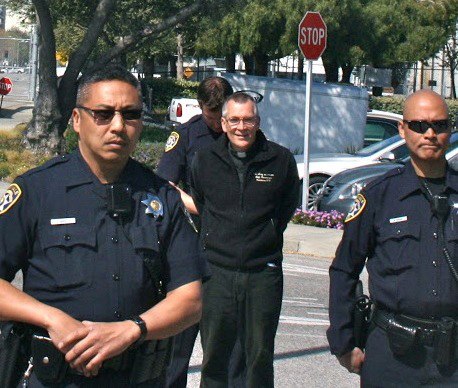
Fr. Steve Kelly, S.J. Back In Federal Prison


Fr. Steve Kelly, S.J. being arrested
A noted Jesuit peace activist who has spent over a decade in jail for nonviolent protest actions, mostly over Fr. Steve Kelly, who has been on probation since June 2012 after serving a 15-month sentence for breaking into a nuclear weapons facility, was sent back to prison May 20 by a federal judge. Kelly, 64, was transported from the SeaTac Detention Center to the United States District Court, Western District of Washington at Tacoma, to receive the 60-day sentence. With time served, he is expected to be released May 29. More than a dozen friends and supporters, including members of Tacoma’s St. Leo parish community and his Jesuit superior Fr. John Fuchs, attended the hearing. Some also attended a vigil outside the courthouse an hour before Kelly’s court appearance. Kelly was arrested March 29, Good Friday, for blocking a road outside the Lockheed Martin missile plant in Sunnyvale, Calif. A trespassing charge was later dropped, but he was taken into custody for an outstanding federal warrant associated with probation violations.
nuclear weapons issues, has been returned to prison for probation violations.
Link (here) to National Catholic Fishwrap

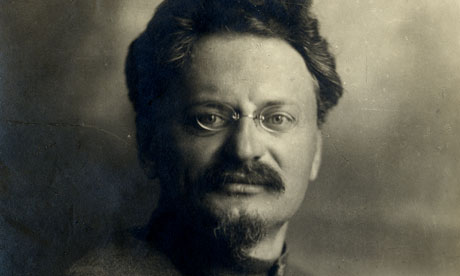
Leon Trotsky Writes About The Jesuits

Leon Trotsky
The Jesuit order, organized in the first half of the 16th century for combating Protestantism, never taught, let it be said, that any means, even though it be criminal from the point of view of the Catholic morals, was permissible if only it led to the “end”, that is, to the triumph of Catholicism. Such an internally contradictory and psychologically absurd doctrine was maliciously attributed to the Jesuits by their Protestant and partly Catholic opponents who were not shy in choosing the means for achieving their ends. Jesuit theologians who, like the theologians of other schools, were occupied with the question of personal responsibility, actually taught that the means in itself can be a matter of indifference but that the moral justification or judgment of the given means flows from the end. Thus shooting in itself is a matter of indifference; shooting a mad dog that threatens a child – a virtue; shooting with the aim of violation or murder – a crime. Outside of these commonplaces the theologians of this order made no promulgations. 
In so far as their practical moral philosophy is concerned the Jesuits were not at all worse than other monks or Catholic priests, on the contrary, they were superior to them; in any case, more consistent, bolder, and perspicacious. The Jesuits represented a militant organization, strictly centralized, aggressive, and dangerous not only to enemies but also to allies. 
In his psychology and method of action the Jesuit of the “heroic” period distinguished himself from an average priest as the warrior of a church from its shopkeeper. We have no reason to idealize either one or the other. But it is altogether unworthy to look upon a fanatic warrior with the eyes of an obtuse and slothful shopkeeper. If we are to remain in the field of purely formal or psychological similitudes, then it can, if you like, be said that the Bolsheviks appear in relation to the democrats and social- democrats of all hues as did the Jesuits – in relation to the peaceful ecclesiastical hierarchy. Compared to revolutionary Marxists, the social-democrats and centrists appear like morons, or a quack beside a physician: they do not think one problem through to the end, believe in the power of conjuration and cravenly avoid every difficulty, hoping for a miracle. Opportunists are peaceful shop. keepers in socialist ideas while Bolsheviks are its inveterate warriors. From this comes the hatred and slander against Bolsheviks from those who have an abundance of their historically conditioned faults but not one of their merits.
Link (here) to read Leon Trotsky's evil Marxist rant  Their Morals and Ours

Monday, May 20, 2013

" He Who Ate My Bread Has Lifted His Heel Against Me"

Pope Francis’ early morning homilies in the Casa Santa Marta residence chapel — often under Monday, the Holy Father set the tone for the week leading up to Pentecost Sunday. He focused on the Holy Spirit who, he said, helps Christians remember the history of the faith and the gifts God has given. Without this grace, he said, the faithful risk slipping into idolatry. Many Christians don’t know who the Holy Spirit is or what He is, he said, and the Holy Spirit “is always somewhat ‘the unknown’ of the faith.” And yet, he continued, the Holy Spirit is “God active in us” and “awakens our memory” of how Christ redeemed us of our misery and sin.
reported — continue to challenge the faithful, and this past week was no exception. On
Without this memory a Christian is not a true Christian, but becomes an “idolator,” the Pope went on, a “prisoner of circumstance, a man or woman who has no history.” To remember the grace of God is especially important, he said, when, for example, “a little vanity creeps in, when someone believes themselves to be a winner of the ‘Nobel Prize for Holiness.”
The Holy Father concluded with an invitation to Christians to ask the grace of memory so that “they will not forget that they were slaves and the Lord has saved them.” On Tuesday, the Holy Father again mined the theme of idolatry, but also the selfishness personified by Judas. Selfish people like Judas do not understand what giving and love are and become traitors, isolated and alone, he said. But if we really want to follow Jesus we must “live life as a gift” to give to others, “not as a treasure to be kept to ourselves.” Judas “never understood what gift really means,” the Pope said, and this was clearly seen when he bitterly criticized Mary Magdalene for washing Jesus’ feet with expensive perfume, saying that it could be used for the poor. “This is the first reference that I personally found in the Gospel of poverty as an ideology,” the Pope said.
Link (here) to The National Catholic Register