Showing posts with label Jesuits and the Priesthood. Show all posts

Wednesday, January 8, 2014

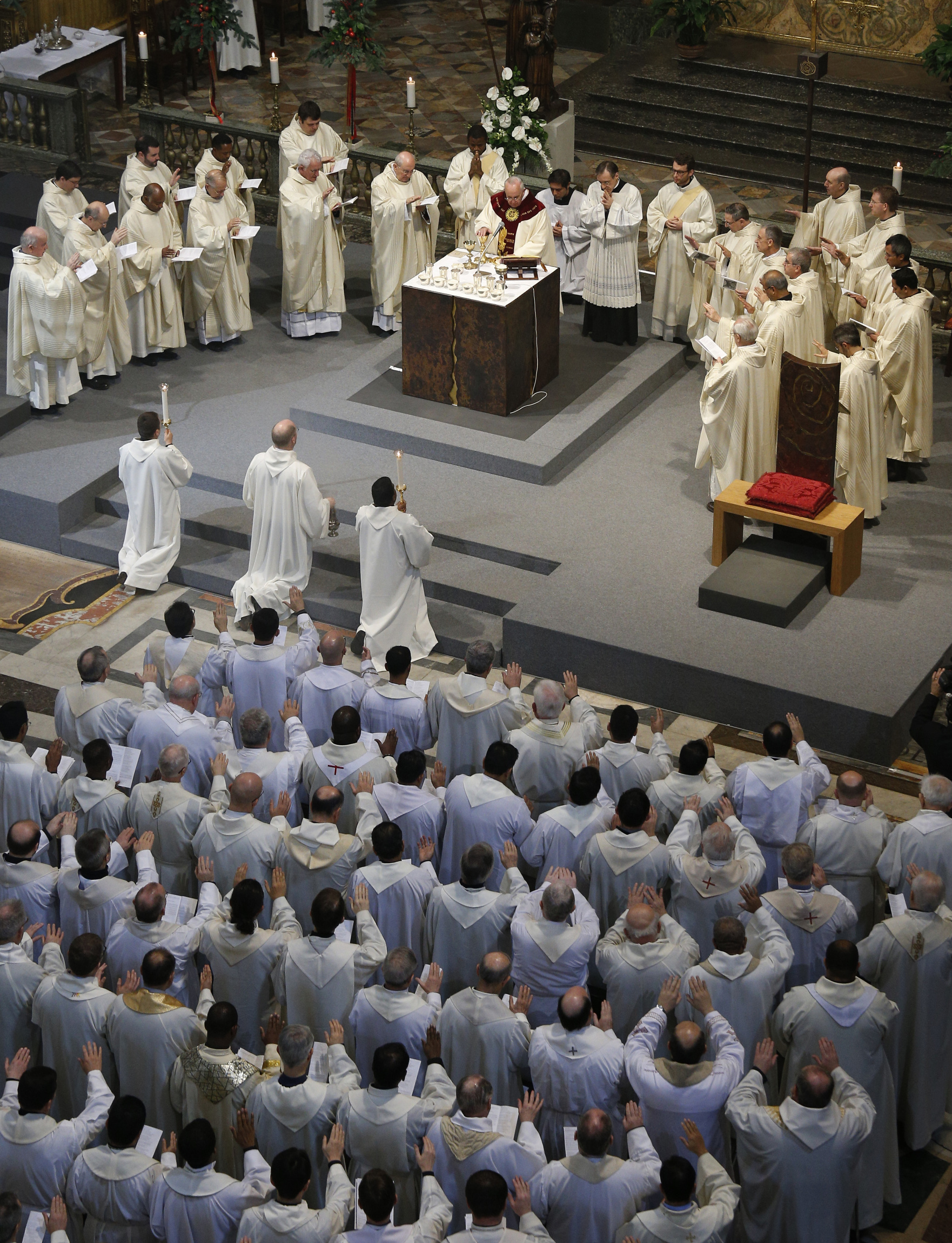
Pope Francis, “We Jesuits Wish To Be Etched In The Name Of Jesus,”

Pope Francis’ brief homily was largely on the recently canonized companion of St. Ignatius, Peter Faber. But the Pope also had some remarkable things to say about what he thought was the heart of the Jesuit (and hence his own) vocation. The Pope’s relationship with the general of the Order, Aldo Nicholas, is cordial.This homily, however, might be called not an exhortation to Franciscan poverty, Dominican preaching, Benedictine “ora et labora,” or even Jesuit obedience, but to Augustinian “restlessness.” Almost everyone, in any age, who reads St. Augustine, including popes, is struck by his famous passage that reads: “Thou hast made us for Thyself, O Lord, and our hearts are restless until they rest in Thee.” Such a powerful passage is peculiar to no religious order, or even to any religion or philosophy, but is the heritage of every human being who is aware of what goes on in his own soul.
“We Jesuits wish to be etched in the name of Jesus,” Pope Francis continues, using the words of St. Ignatius: “This means to think as He does, to will the good with Him, to see as He sees, and to walk with Him. It means to do what he has done and with the same sentiments, with the passion of His Cross.”
The Pope, following St. Paul, does not present an easy doctrine. “The heart of Christ is the heart of God, who, through love, has ‘emptied’ Himself out. Every one of us Jesuits who follow Jesus ought to be disposed to ‘empty’ himself. We are called to lower ourselves: to be of those who have emptied themselves.”
Link (here) to read the rest of Fr. James Schall's fantastic article

Friday, May 10, 2013

Fr. Albert Power, S.J., " The Catholic Church Needs A Much Larger And More Energetic Band Of Fire-fighters"

Fr. Albert Power, S.J.
Encouraging Vocations.

Now, it is clearly our duty to do all we can to help in fostering and developing vocations — both to the priesthood and to religious life — in children and young people under our care. The success of the Church depends greatly on the number and fervour of her priests and religious. Jesus calls them especially to be the salt of the earth. Just as salt preserves food from decay, so, by aiming at a life of holiness, and by making available to others the supernatural means of sanctification provided by Christ, priests and religious help to check the tendency to corruption, which is inherent in fallen human nature. It is true that on every man and woman lies this duty of resisting moral decay and sin, and anyone living a practical, Catholic life does actually and effectively promote this health-giving process. But, still, just as there are doctors and nurses specially devoted to safeguarding the public health, even though each individual has his own personal duty in the matter, so, in the spiritual world, there must be those who specially concentrate on the work of promoting the health of the soul. And what a splendid purpose in life it is! And how many more would take up the toilsome work of Priest or Brother or Nun, if only they understood better the excellence and nobility of the calling! In every human heart, not utterly perverted by self-indulgence and sin, there exists a longing after higher things; as is evidenced by the splendid response made when a sudden call to heroic sacrifice is made — for example, in time of war.
Saint John Bosco said: "I know young people well; a large proportion of them have, in germ, the vocation to a higher life." 
That germ it is our duty to develop. And at no time was it more urgent than today, when such wonderful opportunities are opening up for the conversion of heathen nations. The Catholic Church is at a turning point in her career. Mankind is being gradually linked up into a closer union by new methods of rapid transit and communication, and the barriers that hitherto walled off the uncivilised peoples of the globe are being broken down. Unexampled opportunities for disseminating knowledge are placed at the disposal of all who care to make use of them. 
The enemies of Christianity are making use of them with restless energy, to attack our religion; and the Catholic Church needs a much larger and more energetic band of fire-fighters to check the progress of the conflagration of evil doctrines and evil practices at present sweeping the world and threatening to engulf our civilization.
Those fighters are chiefly Priests, Brothers and Nuns and we should strain every nerve to recruit their ranks, which, especially in certain European countries, have been sadly depleted since the great wars of this century. Catholic parents should be led to consider it their greatest honour and privilege to devote to the service of God and the welfare of society one or more of their children. In no nobler way can they contribute to the extension of God's Kingdom on earth.
Link (here) to the full article entitled, Love Is Calling by Fr. Albert Power, S.J.

Monday, February 18, 2013

Fr. Robert Nash, S.J., "Persona Sacra"

In the heart of every right-minded Catholic there is firmly implanted an instinctive reverence for the priesthood. It is no matter of surprise to him to read of the tributes of respect paid to priests, even by those in high places. He can understand quite well that the Emperor Constantine would never himself sit down to table until the last priest was seated. It does not seem to him any extravagant veneration to find St. Catherine of Siena kneeling on the dusty roadside and kissing the footprints of a priest. He gives unhesitating approval to the sentiment of St. Francis of Assisi who writes that if he met a priest and an angel he would salute first the priest, and only after the priest, the angel. And he is inclined to believe or at least countenance, the anecdote which relates that before a certain priest’s ordination his angel guardian was seen walking before him, but after ordination the angel followed behind. All this and much more, indicative of a deep reverence for the priesthood, seems to a Catholic the most natural thing in the world.
In much the same way does he regard the attacks of Christ’s enemies on the priesthood. He expects the priest, as a matter of course, to be made a target for special venom in time of persecution. Our Lord promised His priests as much. “If the world hates you, know you all that it has hated Me before you. If you had been of the world, the world would love its own; but because you are not of the world, but I have chosen you out of the world, therefore the world hates you. Remember My word which I said to you: ‘The servant is not greater than his Master’. If they have persecuted Me, they will also persecute you.”
Passionate devotion to the priesthood on the one hand and violent hatred on the other — both are fully accounted for when we recall Our Lord’s words to the effect that His priests are “chosen out of the world.” They are His in quite a peculiar sense. Indeed so close is the bond of friendship between Christ and His priest that the glories of the priesthood are most easily summed up by saying that the priest stands before the world as “another Christ.” At Our Lord’s Baptism the heavenly Father pointed to Christ, standing there in the waters of the Jordan, and declared to the world: “This is My beloved Son in Whom I am well pleased. Hear ye Him.” That same wonderful declaration the Father makes in favour of His priest. The Sacrament of Holy Orders imprints on the priest a “character” or mark by virtue of which he is set apart as being, in quite an especial manner, the property of God. It is of course most true that every creature belongs absolutely to God, and that sanctifying grace elevates the creature to the wondrous dignity of Son of God. But in addition to this the priest is the well-beloved son; he is the Benjamin in God’s great family, for his soul is enriched with exceptional graces. Theologians call him a “persona sacra" — a sacred person. A church is “sacred” because it is set apart exclusively for the service of God. A vessel is “sacred” when it is used only at Mass or to hold the Blessed Sacrament. In the same way a priest is “sacred” because he has entered into a contract with God to spend himself exclusively on what has to do with the service of God, and on His side God has accepted this offering and has sealed the priest as His well-beloved son. Just as the image stamped on the coin shows it to be true, or as the signature at the foot of a document proves it to be genuine, so this “character” or mark set upon the priest by God entitles him to a place of special honour in the ranks of God’s friends. That is why the priest, for the very reason that he is “another Christ,” must expect love from those who love Christ, and bitter opposition from those who hate Christ. 
Link (here) to to read the full article at TCTS by Fr. RobertNash, S.J.

Tuesday, July 24, 2012

A Jesuits Role In The Faith And Progess Of Souls In Christian Life And Doctrine

The 35 General Congregation
The Jesuit is a member of a Society founded chiefly for this purpose: to strive especially for the defense and propagation of the faith and for the progress of souls in Christian life and doctrine. 

 Exposcit debitum of Pope Julius III, July 21, 1550


From experience, the Society has learned that pivotal to its fidelity in chastity has been the strong though humble and simple devotion to the Blessed Virgin that has flourished among us since the time of St. Ignatius. 

General Congregation 34, "Chastity in the Society of Jesus," §247


 Although serving God our Lord much out of pure love is to be esteemed above all, we ought to praise much the fear of His Divine Majesty, because not only filial fear is a thing pious and most holy, but even servile fear -- when the man reaches nothing else better or more useful -- helps much to get out of mortal sin. And when he is out, he easily comes to filial fear, which is all acceptable and grateful to God our Lord: as being at one with the Divine Love. 

Saint Ignatius Loyola, Spiritual Exercises, 18


When Ignatius wondered in Barcelona whether he should study and how much, it was a question of whether after his studies he should enter a religious order or go through the world as he was. And when he thought of entering a religious order, then he thought and desired to enter one that was corrupt and unreformed ... to be able to suffer more, and also perhaps thinking that God would help them.

 Autobiography of Saint Ignatius Loyola, §71

The fervour that characterized our beginnings, manifested in Ignatius and in his friends in the Lord, must also be apparent in our present day. Father Nadal, speaking in the name of the first Jesuits, noted that the Society is a light shining forth from Christ. It fills our beings, arouses strong desires and urges us to work for the salvation of all in a mission received from the Vicar of Christ on earth.

 Introductory Allocution of Father General Peter Hans Kolvenbach 
 to the Congregation of Procurators, Sept 17, 1999.

Today the Jesuit is a man whose mission is to dedicate himself entirely to the service of faith and the promotion of justice.
 General Congregation 32, "Our Mission Today," §41

In like manner, we are to [call to mind the] sin of one who went to hell because of one mortal sin. Consider also countless others who have been lost for fewer sins than I have committed.... Enter into conversation with Christ our Lord. Recall to memory that of those who are in hell; some came there because they did not believe in the coming of Christ; others, though they believed, because they did not keep the commandments. 

St. Ignatius Loyola, Spiritual Exercises, §§52, 71.


In the years after final vows, the ordained Jesuit experiences all the pressures and complexities of priestly ministry in the Society: he will probably be engaged in a ministry which makes constant and exhausting demands on him.

 General Congregation 34, "Jesuit Identity and Ministerial Priesthood," §189


Such men should be appointed superiors who enjoy a good reputation and authority among their subjects. 

Complementary Norms, 340

We do not publish this decree because we judge that infidelity in chastity is widespread within the Society of Jesus. On the contrary, we are convinced that, despite the challenges and testings of these years, fidelity in chastity characterizes the life of the Society today as it has characterized it in the past. 

General Congregation 34, "Chastity in the Society of Jesus," §228

It would be unreasonable for traveling Jesuits to expect local people to view their conduct as it would be understood in their own native land. 

General Congregation 34, "Chastity in the Society of Jesus," §255

Respect for the dignity of the human person created in the Image of God underlies the growing international consciousness of the full range of human rights. 

General Congregation 34, "Our Mission and Justice," §55

And touching our Society, be it known that we have made a league -- all the Jesuits in the world, whose succession and multitude most overreach all the practices of England -- cheerfully to the carry the cross you shall lay upon us, and never to despair your recovery, while he have a man left to enjoy your Tyburn, or to be racked with your torments, or consumed with your prisons.

 Saint Edmund Campion, S.J., final address to the Privy Council, 1581


The Society expects from every Jesuit not only fidelity to his vows but the normal public signs of this fidelity. Jesuits should embody in their ministry and in their lives an unequivocal "professional" conduct (modestia) that manifests their commitments as priests and as religious. Their manner of proceeding -- both as a community and as individuals -- ought to preclude any ambiguity about their lives, enabling those to whom they minister to rely instinctively upon their disinterestedness and fidelity. 

General Congregation 34, "Chastity in the Society of Jesus," 187

As servants of the Gospel, we are channels of the creative Spirit working in and through our persons to build the body of Christ. 

Introductory Allocution of Father General to the Congregation of Procurators, Sept 17, 1999

Obedience is to be offered by all promptly, cheerfully, and in a supernatural spirit, as to Christ.... Our holy Father Saint Ignatius desired that we should all excel in the virtue of obedience. Accordingly, with all our force and energy we should strive to obey, first, the Sovereign Pontiff, and then the superiors of the Society, not only in matters of obligation, but also in others, even at the mere hint of the superior's will, apart from any express command. 
General Congregation 31, "The Life of Obedience," §277f.


 In the light of our tradition, we can say that no ministry which prepares the way for the Kingdom or which helps to arouse faith in the Gospel is outside the scope of Jesuit priests. In recent years we have come to recognize that it is for the priest, as sign and minister of the Lord's active presence, to be present in or to collaborate with all human efforts which help in establishing the Kingdom. 

General Congregation 34, "Jesuit Identity and the Ministerial Priesthood," §172


Since Vatican Council II, at the request of the Church itself, consecrated life has not ceased being in motion. Still today, even under the pen of certain of our confreres, publications are not lacking which describe our deeds, and especially our misdeeds, in this time of permanent upheaval, showing a certain nostalgia for the times of stability, when the orientation of a religious institute seemed more sure of itself. 

Final Allocution of Father General to the Congregation of Procurators, Sept 23, 1999.


The mission of the Society derives from our continuing experience of the Crucified and Risen Christ who invites us to join him in preparing the world to become the completed Kingdom of God. The focus of Christ's mission is the prophetic proclamation of the Gospel that challenges people in the name of the Kingdom of his Father; we are to preach that Kingdom in poverty. 

General Congregation 34, "Servants of Christ's Mission," §31


 Few are called to the life of a Jesuit, but for the man who is called, chastity only makes sense as a means to greater love, to a more authentic apostolic charity. 

General Congregation 34, "Chastity in the Society of Jesus," 236


 Each Jesuit enriches the Society's mission and contributes to what Saint Paul calls "the priestly service of the Gospel of God." 

General Congregation 34, "Jesuit Identity and Ministerial Priesthood," §163


In Jesus Christ, we can accept the magnitude of this challenge: to work at the integration of faith and justice, to strive to understand how the Gospel is to be inculturated, to embark with new zeal on the task of interreligious dialogue, to continue to join our professional and pastoral skills to the Ignatian way of proceeding. The Crucified Jesus reminds us that in weakness and vulnerability God's love can shine forth mightily. 

General Congregation 34, "United with Christ on Mission," §7

No community life is possible, however, and no renewal can be truly fruitful unless each Jesuit "keep before his eyes God, and the nature of this Institute which he has embraced and which is, so to speak, a pathway to God." His vocation summons each Jesuit to find privileged time and space to pray with Christ, as friend to friend, learning from this encounter how to be a servant of his mission. 

General Congregation 34, "United with Christ on Mission," §11


The task for the Jesuit priest, in the midst of these multiple demands, is to continue a life of faith and a generous and humble service of Christ. Even if he is not primarily involved in direct pastoral service of others, it will help him to keep his priestly identity alive if he is able to minister regularly to a sacramental community; lay people, especially the poor, build the personal faith of those who serve them.

 General Congregation 34, "Jesuit Identity and Ministerial Priesthood", §190

In these years, throughout the Society, we have been purified in the faith by which we live, and have grown in our understanding of our central mission. Our service, especially among the poor, has deepened our life of faith, both individually and as a body: our faith has become more paschal, more compassionate, more tender, more evangelical in its simplicity. 

General Congregation 34, "Servants of Christ's Mission", §15


We never go into politics, never; politics as such. It is true we try, for instance today, in the whole question of international justice, to help the underdeveloped countries and so forth. We are for truth, for justice. If you call politics this high idea of justice, fine. But if you speak of politics in the sense of parties, or working for governments, we are completely out of this. 

Father General Pedro Arrupe, S.J., in a BBC interview by Malcolm Muggeridge, January 25, 1970


I think former Jesuits are Jesuits. You don't leave. I really believe that. Ignatius recognized that laymen are the core of the Society. Although it's not necessarily true canonically, I would say they are Jesuits.

 Father General Peter-Hans Kolvenbach, S.J., quoted in Company Magazine, Fall 2000, p. 22.


 Nor can it be said that the pope was speaking of matters that do not involve our faith, since the essence of his teaching directly concerns the human and divine dignity of man and of love. In the enormous crisis of growth which envelops the whole world, the pope himself has been what the entire Church must be, and Vatican II affirmed, "both a sign and a safeguard of the transcendence of the human person" (Gaudium et Spes, §76). For this reason the service we as Jesuits owe to the Holy Father and to the Church is at the same time a service we owe to humanity itself. 

Letter of Father General Pedro Arrupe, S.J. to the whole Society, 
on the encyclical Humanae vitae, in Acta Romana Societatis Iesu. Vol. XV, Fasc. II, 1968

Link (here) to the must read full post at WFF

When you are finished and have returned from reading the full article, go (here) and watch the PBS video of Fr. James Martin, S.J. and Joseph Fessio, S.J. debate some of the issues mentioned.
Tuesday, June 19, 2012

Avant Garde Statement

Fr. Karl Rahner, S.J
Catholic theologians of note were making statements that went far beyond anything said in the aula of St. Peter’s. Fr. Jean Danielou, S.J., expressed himself as being in favor of the ordination of deaconesses “without delay and therefore before the end of the Council.” Avant garde as his statement may seem, it was not made in a theological vacuum. In 1962 Fr. Haye van der Meer, S.J., with Fr. Karl Rahner as his mentor, completed a doctoral thesis at Innsbruck titled “Theologische Uberlegungen uber die Thesis: subiectum ordinationis solus est mas” (“Theological Reflections on the Thesis: the male alone is fit for ordination”). The author considers the usual arguments for excluding women from ordination — arguments from Scripture and traditional theology — and concludes that there is no valid reason for continuing the exclusion. Moreover, he claims that Canon 968, Section 1, limiting ordination to a vir baptizatus, requires clarification. The canon has ordinarily been interpreted as forbidding the ordination of women, but it seems more likely that what it forbids is the ordination of non-baptizatus. Thus ordination of a femina baptizata was never contemplated by the framers of the canon; so they could scarcely have intended to legislate against it.

At about the same time that Fr. van der Meer was working on his dissertation in Innsbruck another Jesuit, Jose Idigoras, was pursuing a similar investigation at the Catholic University in Lima, Peru. Adapted excerpts from his doctoral thesis, “La Mujer dentro del Orden Sagrado” (“Woman in Relation to Holy Ordination”), were printed in the widely circulated Informations Catholiques Internationales in 1963 and 1965. Idigoras also examines the usual antifeminine arguments and, like van der Meer, concludes that the church not only may but must admit women to orders if it is to be true to the gospel and to St. Paul’s obviously doctrinal statement (opposed to the discriminatory disciplinary statements) that in Christ “there is neither male or female” (Gal. 3:28).

A North American, Fr. Charles R. Meyer of the Mundelein seminary faculty in the Chicago archdiocese, takes up in an article in a recent issue of Chicago Studies (excerpted in the popular Catholic Digest) the problem of whether, as Fr. Idigoras claims, some of St. Paul’s female assistants were genuinely ordained deaconesses — a problem which is crucial, since the Catholic Church regards admission to the diaconate as so related to ordination that women could not be capable of the diaconate unless they were also capable of the priesthood. Fr. Meyer’s study concludes:
We must, I think . . . admit that the theologians and canonists of our time have been . . . guilty of some dishonesty in treating the question of the ordination of women in the early Church. In their treatises on the matter there seems to be a selective presentation of the facts, if indeed any attempt at all is made to do other than merely repeat what their predecessors have said. . . . But the time for complete honesty is at hand . . . now theologians must make a careful and unprejudiced re-examination of the whole question. This is the least they can do.
Other theologians who have discussed this problem publicly are Fr. Hans Kung and Fr. George H. Tavard, who have said that they know of no valid theological objection to the ordination of women.
Link (here) to Womanpriests

Saturday, April 28, 2012

PRAYER FOR THE HOLY CHURCH AND FOR PRIESTS

O my Jesus, I beg You on behalf of the whole Church:
Grant it love and the light of Your Spirit,
and give power to the words of Priests
so that hardened hearts might be brought to repentance and return to You, O Lord.
Lord, give us holy Priests;
You yourself maintain them in holiness.
O Divine and Great High Priest,
may the power of Your mercy
accompany them everywhere and protect them
from the devil's traps and snares
which are continually being set for the soul of Priests.
May the power of Your mercy,
O Lord, shatter and bring to naught
all that might tarnish the sanctity of Priests,
for You can do all things.
My beloved Jesus,
I pray to you for the triumph of the Church,
that you may bless the Holy Father and all the clergy;
I beg you to grant the grace of conversion
to sinners whose hearts have been hardened by sin,
and a special blessing and light to priests,
to whom I shall confess for all of my life.

Saint Faustina Kowalska

Link (here) to the annual Letter to Priests

Monday, February 13, 2012

Pray For The Jesuit Priests

Pope Benedict XVI and Superior General at the General Congregation 35
If we lose respect toward our Jesuit priests, we will lose respect for our Church and for our God, as well.  The greatest blessing we can receive on earth is the blessing that comes from our priests. 
When a Jesuit priest blesses you, it is Jesus blessing you. Do not forget to pray for your Jesuit shepherds. Their priestly hands are blessed by Jesus. When you go back to your parishes, show to the others how we should respect our priests. If your Jesuit priest is not doing things the way you think he should, do not judge him around. 
Take the rosary and pray to dear God for him. That would be the way to help the Jesuit priest, and not to judge, because in this world that we live in, people judge and criticize so much, through love and not to take into our own hands what only Our Heavenly Father, God, is supposed to do. We have this time we are living in right now, and we have the time of the Triumph. Between these two times, there is a bridge, and that bridge is our priests. That is why without priests, there is no Triumph. Do not to judge our priests and not to forget that our Heavenly Father chose them.  How can we take into our own hands what only God Himself is supposed to do? Because if God invited the priests, God will be their judge.
This post is adapted from this original post (here) at the site entitled, Medjugorje Miracles

Monday, April 18, 2011

Fr. Mark P. Scalese, S.J. "Mandatory Celibacy Is Far And Away The Biggest Deal Breaker"

Fr. Mark P. Scalese, S.J.
Once there were nearly 100 Jesuits — members of an order founded by St. Ignatius Loyola in the 16th century — at Fairfield University. Today, there are 22. Only six are professors; the others are administrators, or retired. That means some of the university’s 3,200 undergraduates will make it through four years without having a single Jesuit professor. The graying of the Jesuit population is felt at each of the 28 Jesuit-run institutions of higher learning in the United States, from Georgetown University in Washington, founded in 1789, to Wheeling Jesuit University in West Virginia, established in 1954. Nationwide, the number of Jesuits has declined, to under 3,000 from about 10,000 in 1965. More than half are over age 60. 
That they aren’t being replaced by younger Jesuits is the result of social and economic circumstances, including increased opportunity for poor Catholics and the stringent requirements of the priesthood. (“In my experience, mandatory celibacy is far and away the biggest deal breaker,” says Father Scalese.) 
But the declining numbers “don’t mean we’re all sulking off into the sunset,” says the Rev. Dr. Charles L. Currie, president of the Association of Jesuit Colleges and Universities. 
Link (here) to read the full New York Times article

Thursday, December 9, 2010

Georgetown Hosts Controversial Event

Welcome to a
Catholic Family Conversation on LGBT Issues
with Andrew Sullivan and Maggie Gallagher

Wednesday, December 8, 2010; 8:30-10:00 PM (ET)
Georgetown University ICC Auditorium
Link (here)
 
The Catholic Archdiocese of Washington has reaffirmed the illegitimate status of Catholics for Equality, a budding homosexualist “Catholic” group that is scheduled to be hosted at a student event at Georgetown University on Wednesday evening.
Link (here) to Lifesite

Fr. Z on the subject (here)

Monday, December 6, 2010

Was Removed From All Ministries

Maureen Locher, from the Maryland Province, said Neil McLaughlin, now 82, was removed from all ministries and barred from practicing or describing himself as a priest publicly in 2006, two years before the recent allegation. That action was taken after the Province had reviewed McLaughlin’s record and discovered a much earlier allegation of s@xual misconduct that apparently had not been acted on, Locher said. The entire first incident occurred before the United States Conference of Catholic Bishops issued its “Charter for the Protection of Children and Young People.” The charter was a response to the priest s@x abuse scandal that started in Boston and swept across the nation. Coupled with new mandates from the Vatican, it was designed in part as an answer to numerous allegations that bishops had concealed the problem by reassigning accused priests rather than removing them from duty. Locher noted the Jesuits are technically not bound to the charter since they are not diocesan priests, but they follow it.
 Link (here) to read the full article at the Times Leader

Monday, September 27, 2010

Jesuit On Celebacy

....the tension between the "debt" of marriage and the analogous "debt" owed by the priest. It is this tension which justifies the likening of priestly noncontinence to adultery. The latter debt, owed by the High Priest as Head of our fallen race, must be paid in persona Christi: it is the debt of the Cross, rendered to the benefit of the Church by the one High Priest, a ransom offered in his name, by his authority, at every celebration of the Mass. Here, it would seem, between the consummation of Matrimony by conjugal intercourse, and the consummation of the sacrifice of the Cross by the death of Christ, is the sacramental analogy we seek, and also the concrete transcendence of the symbolism of marriage by the symbolism of the Eucharist that is here in issue. It must be remembered that by both consummations, an irrevocable covenant is instituted, and that, as between these analogates, it is the Eucharist which constitutes the prime.
Link (here) to a fantastic piece by Fr. Donald J. Keefe, S.J. 
Priestly Celibacy in Patristics and in the history of the Church (here)

Jesuit On Ignatian Chastity

Friendship in the Society should offer Jesuits the opportunity to develop a range of relationships that communicate varying levels of intimacy and trust, including some that might approximate the intense friendship between Ignatius, Xavier, and the first companions. 
Developing such intimacy among men is not the usual experience of males in our culture and is challenging for Jesuits whatever their s@xual orientation might be.  Heterosexual and hom@s@xual Jesuits will both need to discover how this closeness and vulnerability can be realized as a gift of our community life and a healthy expression of living chastity.  
Perhaps this is one way we accept the invitation that “Jesuit community is not just for mission; it is itself mission.”

.
Link (here) to the essay entitled, Living Chastity by Fr. Gerdenio Sonny Manuel, S. J.

Sunday, July 25, 2010

23 Reasons Why A Jesuit Priest Should Wear A Roman Collar

This is reason number 9 out 23, original published at the Homiletic and Pastoral Review

A Jesuit priest in a Roman collar is an inspiration to others who think: “Here is a modern disciple of Jesus.” The Roman collar speaks of the possibility of making a sincere, lasting commitment to God. Believers of diverse ages, nationalities and temperaments will note the virtuous, other-centered life of the man who gladly and proudly wears the garb of a Catholic priest, and perhaps will realize that they too can consecrate themselves anew, or for the first time, to the loving Good Shepherd.
Link (here) to read the full list at Courageous Priest

Saturday, July 10, 2010

Fr. James Martin, S.J., "The Presbyterian Church's Decision Is A Positive Reflection Of Society's Greater Acceptance Of Gays And Lesbians In Our Country."

The Catholic Church, however, shows no signs of loosening its stance towards g@y ordination or same-sex marriage. Father James Martin, a Jesuit priest and BT expert, said the likelihood of a similar action in the Catholic Church is "slim to none." 
The Vatican, he said, "has been very clear about not accepting gay men into seminaries and religious orders." 
But Father Martin added, "the Presbyterian Church's decision is a positive reflection of society's greater acceptance of gays and lesbians in our country."
 
Link (here) to read the full post at the liberal secular blog/site Big Think

Thursday, June 10, 2010

The Catholic Marquette University "Pays Off" The Non-Catholic, Non-Employee For Not Being Catholic

Throughout my tenure as president, I have vigorously defended the academic freedom of various faculty members – in the face of statements from bishops, in support of the breadth of intellectual inquiry that makes a university strong, and in making promotion and tenure decisions. And I will continue to do so. I certainly respect the rights of our faculty to pursue any research in their own fields of expertise, including scholarly investigation of gender, sexuality and identity. While the events of the past few weeks have raised questions about Marquette’s commitment to the LGB/T community on campus, s@xual orientation was not a factor in my decision. I remain firmly and fully committed to and supportive of the university’s efforts to improve faculty and student diversity. Throughout my administration, and with my active support, openly gay faculty and staff.

Link (here) to the latest in the "Jesuit g@y wars" by Marquette University President Fr. Robert A. Wild, S.J.

Read (here) the official release on the unspecified financial settlement with Dr. Jodi O'Brien 

Friday, June 4, 2010

Three Jesuits To Be Ordained To The Priesthood

The Jesuits of the New Orleans Province celebrates its 2010 ordination class of three men who will be ordained to the priesthood on Saturday, June 5, 2010, at 10:00 a.m. Archbishop of Mobile, Thomas J. Rodi, will preside over Mass and the ordination in St. Joseph’s Chapel at Spring Hill College in Mobile, Alabama. 
Link (here) to find out who is being ordained

Sunday, May 23, 2010

Marquette Warrior On Recruiting Violations

From Milwaukee News Buzz, the following in a story about the role of Archbishop Listecki in the rejection of Jodi O’Brien, l@sbian candidate for Dean of Arts and Sciences at Marquette. 
Professor Nancy Snow (picture)says the selection committee vetted O’Brien’s work and found nothing to object to before recommending her and another candidate for the job. She insists that university leadership has long been familiar with the professor since it sent a representative to Seattle to encourage her to apply for the dean position. Two years prior, she had applied for the same position, which has been occupied by an interim dean, but withdrew from consideration for family reasons.
This appears to confirm our inference that O’Brien was the designated l@sbian affirmative action candidate for the deanship, moved forward by liberal faculty and administrators who viewed her appointment as a move toward “diversity” at Marquette.
Link (here) to the Marquette Warrior John C. McAdams, his post is entitled, Marquette Heavily Requited L@sbian Dean Candidate Jodi O'Brien.

Sunday, May 16, 2010

Questions For Jesuits From The Superior General


Father General Adolfo Nicolás said there had been a warm reception to the decrees from the 35th General Congregation, although it was clear the Society is still in the process of receiving, deepening and implementing the spirit of them.
 
‘It is an encouraging sign of our continued commitment to mission that the image of ‘Frontiers' seems to have captured the imaginations of so many Jesuits and inspired reflection on the new frontiers we need to address', he said.
 
The Father-General indentified a number of questions in need of further reflection and discussion. These were:
 

  • How do we more deeply understand and adequately respond to the demographic change that is already taking place in the Church and certainly in the Society, in which we see our numbers increasing in Asia and Africa and diminishing in Europe and America?
  • How do we orient our spiritual and social ministries to respond more creatively to today's dominant culture? In other words, how can we help men and women of today's secularised societies to recover the sense of the transcendence of God, of the spiritual life and of Christian values that go beyond competition, comfort and profit? How do we contribute to justice in a world that shirks from and distances itself more and more from its responsibilities?
  • How do we deepen and make more effective our pastoral contact with and accompaniment of the poor, the youth, refugees, migrants, all those displaced in society or deprived of hope? How do we accompany local churches that are experiencing difficulties?
  • How do we help heal and strengthen the credibility of the Church and of religious life, especially in the light of the recent scandals that have adversely affected trust and confidence among many?
  • In the light of the challenges of mission, how do we continue to strengthen both the promotion of vocations and of formation, particularly in the following areas: formation for leadership; formation to live and serve at the ‘frontiers'; formation to love and serve freely, helped by a solid psychological and spiritual integration? How can we improve ongoing formation so as to respond to the exhaustion that threatens not a few Jesuits who take upon themselves more than they can handle?
  • In the light too of the challenges above, how can we improve our mode of governance toward greater coordination in the service of a more effective and life-giving mission?
 
‘I offer these as a matter for prayerful reflection, discernment, and discussion, in the hope of awakening creative responses in the Society', Father Nicolás said.

Link (here) to the full article at Province Express a publication of the Australian Jesuits

Wednesday, April 28, 2010

The Sending Of The Son By The Father Is The Foundation And Model

Why did Jesus restrict the ministerial priesthood to men? Jesus never gave reasons, just as he never revealed why he instituted the pastoral authority of the Twelve, or why he conferred the primacy upon Peter.

But Jesus did reveal in what direction our mind should proceed by emphasizing the link between his own priestly mission and that of his disciples: "As you sent me into the world, I have sent them into the world" (Jn 17:18). The sending of the Son by the Father is the foundation and model of the sending of the disciples on the part of Christ.

The similarity between the two missions is complemented by the fact that the disciples relate to Jesus as his representatives. Jesus willed that his disciples should act in his name and be his representatives. He conferred upon them a pastoral power in the image of his own and entrusted to them the task of celebrating the Eucharist in his name. 
Link (here) to Ignatius Insight the article is called, Woman and the Priesthood the writer is Fr. Jean Galot, S.J. 
 
Photo is of Roman Catholic Priests in procession in Madrid, Spain (here)

Friday, March 19, 2010

A Priest Of Vicious Life And Scandalous Conduct, Is The Greatest Enemy To God

The faithless priest grows to he who surrenders himself to the spirit of wickedness and unhappily becomes his bondsman.
A priest of this character, a priest of vicious life and scandalous conduct, is the greatest enemy to God, the greatest enemy to the Church, aye, the greatest enemy to himself. He is an enemy to God, because, instead of glorifying Him, he dishonors Him ; he is an enemy to the Church, because, instead of edifying her, he lays her waste and destroys her; he is an enemy to himself, because, instead of the reward which awaited him, he is preparing for himself a life of dishonor, a death of terror, a tremendous judgment and an unspeakable eternity.
We had gone this far in drawing out this terrible picture when we ourselves were frightened at it, and we could not bring ourselves to go on and lay it in full before our readers. For who will read our book ? Good priests or those who wish to become such. Why should they be saddened by a picture which has no application to them ? Those to whom it would apply will not read the book : The wicked man when he is come into the depth of sins contemneth.
When a wicked priest, if there be such, becomes a scourge who destroys and a wolf who murders the souls of the flock whose salvation is entrusted to him, then is verified the saying, corruptio optimi pessima.  
Such a priest, let us hope, is an exception. For the most part priests are good men, and even their enemies admit that in no age have they given less cause for censure than in the present.

Link (here) to the portion mentioned in the book entitled, Jesus Living in the Priest by Fr. Jacques Nicolas Thomas Millet, S.J.
Engraving by Gustave Dore entitled The Kiss of Judas