Showing posts with label Austrian Jesuits. Show all posts

Wednesday, June 15, 2011

Fr. Geoffrey Schneider, S.J. To Turn 99

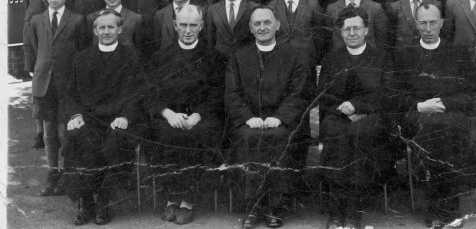
Fr. Geoffrey "Fritz" Schneider, S.J. far right
If Jesuit Fr Geoffrey Schneider knew that he would still be working at the age of 98, he may just have chosen another vocation, for it was the Jesuits' fierce work ethic that put him off joining the novitiate in the first place, reports Province Express.  
"I was baptised by a Jesuit, a friend of my father's, I lived in a Jesuit parish in Hawthorn, and I attended Xavier College. And so I saw a lot of the Jesuits," Fr Schneider explains. "I thought they worked too hard, so I didn't want to join them. Then after a while I realised that whatever work you do, if you aim to do it well you have to work hard. So I thought I might as well join the Jesuits." 
Seventy-eight years later, the capacity for hard work is like marrow in the bones of this gentle, affable Jesuit, who will turn 99 in December this year. Every school day, Fr Schneider walks from his home on Jeffereys Street in Milsons Point, Sydney, to the St Aloysius Junior School where he has an office with his name affixed to the door. Here he works as school chaplain, a position he has held for close on 30 years.
Link (here) to Australia's Cathnews

Thursday, April 28, 2011

Polish Jesuit Fr Stanislaw Skudrzyk And The Divine Mercy

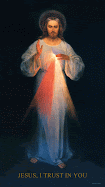
The Divine Mercy apostolate has been flourishing, not only in Poland, but throughout Europe, Asia and other parts of the world, including Australia where it was brought by migrants from Poland in 1950 and was actively promoted by the Polish Jesuit Chaplain Fr Stanislaw Skudrzyk. He arranged the transport of the first picture of Jesus Divine Mercy to Melbourne which was solemnly blessed by Archbishop Mannix on the Sunday of Divine Mercy, 20 April 1952, and given a place of honour in St Ignatius Church in Richmond, until 1959.

Link (here)

Sunday, March 20, 2011

Fr. Friedrich Kronseder, S.J. , Maria Von Trapp And The Sound Of Music

The Trapp Family Singers
Maria Augusta Kutschera was born on a train enroute to Vienna just before midnight on January 26, 1905. Her anxious entrance into the world set in motion a life full of remarkable and challenging events that would be immortalized on stage and screen. Maria's mother died when she was two years old. Her father left her with an elderly cousin so that he could be free to travel. She experienced a lonely and very strict upbringing without any siblings or other children in the household. The movie strongly portrays Maria as the epitome of religious devotion in and out of convent life. 
Most people are unaware that she was raised as a socialist and atheist and became actively cynical towards all religions. Those beliefs quickly and dramatically changed by the chance meeting of a visiting Jesuit priest to Maria's college. Maria had entered a crowded church assuming she was about to enjoy a concert by Bach. Instead, a well-known priest, Father Kronseder has just begun preaching. 
Caught in the middle of a standing-room-only crowd, Maria soon found herself caught up in the words of this preacher. In Maria's words, "Now I had heard from my uncle that all of these bible stories were inventions and old legends, and that there wasn't a word of truth in them. But the way this man talked just swept me off my feet. I was completely overwhelmed by it..." When he finished his sermon and came down the pulpit stairs Maria grabbed his elbow and loudly asked, "Do you believe all this?" A meeting between the priest and Maria changed her beliefs and the course of her life
Link (here) to read the full biography.
Fr. Friedrich Kronseder, S.J. was the Spiritual Director to Fr. Hans Urs von Balthasar, S.J. (here)

Thursday, December 9, 2010

Jesuit Says, "I Am A Deeply Religious Atheist"

Father Roger Charles Lenaers (85), at a lecture in Vienna according to a report of the Linz commerce website, 'kath.net'.   The old man is active in the parish of Vorderhornbach in the Diocese of Innsbruck.  Religion consists in a thin flow of experience for the Jesuit that the human intellect can't grasp entirely and is hidden behind an experiential "something""Because of this I am a deeply religious atheist."
Link (here) to The Eponymous Flower
Link (here) to the original German article

Wednesday, September 15, 2010

Fr. Josef A Jungmann, S.J. On "Et Cum Spiritu Tuo"

As the great Jesuit liturgist Fr. Josef Andreas Jungmann wrote:

"We can best understand the (excellent link>) 'Et cum spiritu tuo' as a popular consensus in the work of the priest, not that the congregation here gives the priest authority or power to act in its stead, but that the congregation once more acknowledges him as the speaker under whose leadership the united group will approach almighty God. Thus in the greeting and its response we have the same double note that reappears at the end of the oration [opening prayer]; the 'Dominus vobiscum' seems to anticipate the 'per Christum' of the close of the oration, and the 'et cum spiritu tuo' is a forerunner of the people's agreement expressed in the Amen" (The Mass of the Roman Rite, Volume 1, Page 365).
Link (here) to catholic.net

Sunday, July 18, 2010

A Jesuit Presence In Innsbruck

The Jesuit presence in Innsbruck dates back to 1562, when St. Peter Canisius established a Jesuit college at the invitation of Emperor Ferdinand I. The institution that Canisius founded survives to this day as the Akademisches Gymnasium Innsbruck
which is no longer under Jesuit administration but remains one of the leading secondary schools in Western Austria. 
The Faculty of Catholic Theology of the University of Innsbruck also traces its origins to the Jesuit college founded in 1562, though the university itself wasn't founded until 1669.
.
Link (here) to Jesuit Joe at The City and the World.

Wednesday, June 16, 2010

Fr. Richard Leonard, S.J. And Glass Doors On Tabernacles

This piece is from Fr. Z at WDTPRS, below is an excerpt of Father John's comments.
The Precious Blood may not be reserved except in very rare cases when a tiny amount from Mass may be kept for Communion of sick people who absolutely cannot take even the smallest amount of solids or gluten, etc.Otherwise, if a tabernacle had a door made from something that was a strong as the glass that goes into military vehicles in Afghanistan, then I suppose it would be okay.  In any event, it should be veiled.  The veil, not the sanctuary lamp, is the best sign of the presence of the Blessed Sacrament.
Link (here) to read the full post. 
More on Fr. Richard Leonard, S.J. (here)

Sunday, May 16, 2010

Questions For Jesuits From The Superior General


Father General Adolfo Nicolás said there had been a warm reception to the decrees from the 35th General Congregation, although it was clear the Society is still in the process of receiving, deepening and implementing the spirit of them.
 
‘It is an encouraging sign of our continued commitment to mission that the image of ‘Frontiers' seems to have captured the imaginations of so many Jesuits and inspired reflection on the new frontiers we need to address', he said.
 
The Father-General indentified a number of questions in need of further reflection and discussion. These were:
 

  • How do we more deeply understand and adequately respond to the demographic change that is already taking place in the Church and certainly in the Society, in which we see our numbers increasing in Asia and Africa and diminishing in Europe and America?
  • How do we orient our spiritual and social ministries to respond more creatively to today's dominant culture? In other words, how can we help men and women of today's secularised societies to recover the sense of the transcendence of God, of the spiritual life and of Christian values that go beyond competition, comfort and profit? How do we contribute to justice in a world that shirks from and distances itself more and more from its responsibilities?
  • How do we deepen and make more effective our pastoral contact with and accompaniment of the poor, the youth, refugees, migrants, all those displaced in society or deprived of hope? How do we accompany local churches that are experiencing difficulties?
  • How do we help heal and strengthen the credibility of the Church and of religious life, especially in the light of the recent scandals that have adversely affected trust and confidence among many?
  • In the light of the challenges of mission, how do we continue to strengthen both the promotion of vocations and of formation, particularly in the following areas: formation for leadership; formation to live and serve at the ‘frontiers'; formation to love and serve freely, helped by a solid psychological and spiritual integration? How can we improve ongoing formation so as to respond to the exhaustion that threatens not a few Jesuits who take upon themselves more than they can handle?
  • In the light too of the challenges above, how can we improve our mode of governance toward greater coordination in the service of a more effective and life-giving mission?
 
‘I offer these as a matter for prayerful reflection, discernment, and discussion, in the hope of awakening creative responses in the Society', Father Nicolás said.

Link (here) to the full article at Province Express a publication of the Australian Jesuits

Wednesday, April 28, 2010

Left To Their Fate

Father Adolf Kristen and Brother Vinzenz Scharmer are the first Austrian Jesuits to cast their eyes on the Daly River – here the missionaries are going to attempt to convert the Aboriginal people in the area to the Roman Catholic faith. But – the author of the diary records – as the two men step to the water’s edge they are disappointed: “No doubt they expected to find it resemble the Danube in its majestic flow, and found it smaller than the river Inn!” What they saw in the surface of the water is to all intents and purposes their own reflection … 

“The river is starting to rise.” 
And then the floods come, as in almost every year; but this time it almost completely destroys the Jesuits’ settlement – shortly after the Superior, with the authorization of the Superior General in Rome, decides that all the missionaries must leave the Daly River from one day to the next. No one else compares the river with the Inn or the Danube. The Aborigines are left to their fate. The flood is not the only reason for abandoning the mission. The mirror images have now become dim, blurred and distorted.
Link (here) to at the website Environment History Network the article is entitled, at the Riverside: Jesuit Missionaries.

Friday, August 21, 2009

Jesuit Turns 101 Years Old

Fr. Joseph Neuner, S.J., veteran Indologist, theologian and spiritual advisor to Mother Teresa, celebrated his 101st birthday at Sanjeevan Ashram, headquarters of the Pune Jesuit province, here on Wednesday.
Fr Neuner, born on August 19, 1908 at Feldkirch in Austria, has been a Puneite since 1938. As professor of theology at Jnana Deep Vidyapeeth, he has taught thousands of priests, some of whom rose to be bishops and cardinals.
The centurion was in a cheerful mood, receiving greetings from people when this Sakaal Times reporter called on him on Wednesday. The priest was greeted by his fellow Jesuits and others on his 101st birthday.
"Fr Neuner did not want a big celebration and so we did not invite many people for the birthday,”
said Fr Anil Soares, one of the priests residing at the Jesuit provincialate. Although his movement and activities have now been restricted,
Fr Neuner still follows the community routine at the Jesuit house. He has meals and tea along with other Jesuits.
Refusing to be assisted, he comes to the dining hall with the support of a walker. He converses with others on the latest happenings although in the recent past, he has been hard on hearing. “But he never misses his exercise of walking in the passage with the walker,” adds Fr Soares. Neuner, who for a few years, stayed on the first floor of ‘Sanjeevan Ashram’ was shifted to the ground floor when he neared his century.
Before his arrival in India, Neuner had completed a doctorate thesis at Rome-based Gregorian University on the theme, ‘The idea of sacrifice in the Bhagvadgita’. During World War II, Neuner along with other German nationals in the country, was detained by the British government and was incarcerated for over five years, initially in Ahmednagar and later at Dehradun.
Neuner served as an expert at the Vatican Council II, which is said to have ushered in reforms in the Catholic Church.
The Catholic Church had appointed Neuner as censor theoloigicus in 1999 for the proceeding launched for beatification of Mother Teresa. His job was to study the nun’s published writings to find if they contained any heresy.
The Mother was declared a Blessed, a step towards sainthood, a few years later.

Link (here)

Thursday, June 11, 2009

Sevenhill Jesuits

The Port Pirie Diocese was pioneered by Austrian Jesuits, from Sevenhill, who built 30 churches throughout the area and established 27 schools. It now incorporates 22 parishes and takes in Uluru in the Northern Territory.

Link (here)

Saturday, April 4, 2009

Former Jesuit Starts The Servants Of Jesus and Mary

The Mass is offered by a priest of the Congregation Servi Jesu et Mariae (Servants of Jesus and Mary). The founder, Fr. Andreas Hönisch of this little order, who only just died last year, was expelled from the Jesuits in the 1970s on account of his orthodoxy and so founded the SJM in 1988 to carry on the work of the traditional Jesuits in the spirit of St. Ignatius Loyola.

Link (here)

Wednesday, March 25, 2009

Wlodimir Ledochowski General # 26 General from 1915 to 1942

He was born the only son of Count Antonius Kalka Ledochowski on the family estate a few miles north of Vienna in Loosdorf. Though of Polish ancestry, the land—at that time in history—was under Hapsburg rule, so the family was nominally Austrian.

In a family where two sisters had preceded him, the birth of a son on October 7, 1866 was a cause for rejoicing.

He studied at the Jesuit Secondary School, the Theresianum, in Vienna and for a time was page to the Empress. He studied Law at the University of Crakow and then began studies for the secular priesthood. At the age of 23, while attending the Gregorian University on via Del Seminario in Rome, he decided to become a Jesuit and entered the Society in 1889. Five years later he was ordained a Jesuit priest. At first he took to writing, but was soon made Superior of the Jesuit residence in Cracow, then, Rector of the College. He became the Polish Vice-Provincial in 1901 and Provincial of Galicia in 1902. From 1906 until February 1915 he was the German Assistant.

After the death of Wernz the 26th General Congregation was convened which would last from February 2, 1915 until March 18 and be held in the Germanico-Hungarico College. The 49-year-old Wlodimir Ledochowski was elected the 26th General of the Society on February 11 on the second ballot.

Despite the upheaval of the World War and the economic Depression of the 1930s, the Society increased during Ledochowski's term in office.

He called the 27th General Congregation to take place at the Germanico to acquaint the Society with the new code of Canon Law and to bring the Jesuit Constitutions into line with it. He called another Congregation (the 28th)—between March 12 and May 9, 1937—in order for the delegates to appoint a Vicar General as he was now feeling the effects of age and needed competent assistance. He established the Oriental Institute and the Russian College as well as the Institutum Biblicum of the Gregorian University. He saw a certain emancipation of the Society after the Concordat between the Church and the Italian Government was ratified. Property was returned to the Society making it possible for the Jesuits to build a new Gregorian University building transferring from the Palazzo Borgomeo on via del Seminario to Piazza Pilotta within a few paces of the Quirinal Palace. He then built the new Curia Generalis on property acquired from the Vatican on Borgo Santo Spirito-about a hundred meters from St. Peter's Square. The Concordat, somewhat engineered by a Jesuit, Father Tacchi-Venturi, put new life into the Society and its property increased with its influence and reputation.

Ledochowski's Generalate was one of the most productive, physically as well as spiritually, certainly since the restoration. Ledochowski also saw the beginnings of the Second World War and was torn by the sufferings of his Jesuit sons on both sides.

After 27 years and 10 months as General from February 11, 1915 until December 13, 1942—he devoutly rendered his soul to God and, after his funeral in the Gesú his remains were taken to the Society's mausoleum at Campo Verano on the eastern edge of Rome, where they were interred.

Link (here)

More

*Rare Video* 1940 the Jesuit General Superior Wlodimir Ledochowski (here)

NY Times article, NEW JESUIT HEAD IS A RUSSIAN POLE; Father Wlodimir Ledochowski Elected General of the Society of Jesus. Published February 12, 1915 (here) Very informative!


Monday, February 23, 2009

Jesuits In Vienna Cover Up Catholic Christian Sacred Artwork With Graffiti

Outer space is the perfect metaphor for God and the mysteries of life. It's infinitely vast, it's mysteriously unknowable, and it elicits wonder and contemplation in all who behold it.
This might be why Austrian artists Christoph Steinbrener and Rainer Dempf installed a massive NASA photograph of an astronaut floating in space on the ceiling of the historic Jesuit Church in Vienna in an exhibit entitled The Jesuits' Cosmos.
The photo, which will be on display through May 25, 2009, is printed on a huge section of semi-transparent net fabric. Employing a change in lighting, the curators can switch the focus between the astronaut and the curvature of the blue planet to a "reverted view" of the Andrea Pozzo ceiling frescoes above them. Either way, the viewer is awed with a sense of spatial illusion. I like this trend of installing thought-provoking pieces of modern art in houses of worship. It's a pleasant reminder that we're all on the same planet, just trying to get along and figure a few things out.

Link (here)

What is graffiti? Go (here) What is Teilhardism? Go (here)

Wednesday, February 4, 2009

17th Century Italian Jesuit Martino Martini

You'll feel miles away from traffic and smog. If you dig obscure history, an often-overlooked site (west of the front gate of the Siwo brewery on Xixi Lu) is the tomb of Italian Jesuit Martino Martini, an influential missionary in the sixteenth century whose corpse, according to legend, did not decay. Martini's most important work is Novus Atlas Sinensis. Interesting as missionary history is his Brevis Relatio de Numero et Qualitate Christianorum apud Sinas

Link (here)

Picture is of a detailed part of a map of the Province of Peking from Martino Martini’s Novus Atlas Sinensis (Amsterdam, 1665). Martini (1614-1661), the Tyrolese Jesuit, created this atlas, the first major geographical survey of that country published in Europe.

Thursday, December 4, 2008

A Jesuit For Over Sixty Years

Jesuit Weingartner receives Austrian Honorary Cross for Science and Arts

By Nancy T. Lu

Ninety-year-old Jesuit missionary Friedrich Weingartner received last November 28 the Austrian Honorary Cross for Science and Arts awarded by the Austrian Federal President Heinz Fischer.

The ceremony held in recognition of his extensive research and study of the languages of the indigenous people in Taiwan took place at the Fu Jen Catholic University's Faculty of Theology and Infirmary in Hsinchuang City, Taipei County. Sieglinde Spanlang, the director of the Austrian Tourism Office, decorated Weingartner with the medal and also presented him with a certificate.

Born in Meggenhofen near Linz in Upper Austria, Weingartner studied theology in Innsbruck, philosophy in Munich, as well as Mandarin and linguistics in Manila, Hamburg and the United States.

Weingartner was ordained a priest in Innsbruck, Austria, in 1947. He joined the army but got kicked out after his priesthood was exposed. Besides, he was very seriously sick with typhoid fever then and, therefore, had to be discharged from military service to the envy of his colleagues in the army.

Throughout his nearly 50 years as a missionary in Taiwan, he was engaged in the study up close of aboriginal languages. He took risks for some of the aborigines were known to be headhunters, venturing deep into remote areas with existing aboriginal communities.

After he retired in 1995, he focused in the next 10 years on the language, grammar, phonology and syntax of the Saisiat minority tribe in Paishou Tsun, Shihtan Hsiang, Miaoli County. He wrote down what he learned, thereby helping preserve what was otherwise an unwritten language.

The Aboriginal Languages Research Center at the Tien Educational Center in Taipei was founded by him. He equipped it with audio and tape recorders from Germany.

The television network Osterreichischer Rundfunk (ORF) sent a team in 2005 to do a special coverage on Weingartner. The film tracking down the life of Weingartner was shown to the small group gathered to celebrate with the Jesuit priest his awarding.

Sunday, July 6, 2008

J.P. Sonnen Finds Some Extraordinary Jesuits In Rome

From Rome: Jesuit glory of old lives on...
It's a great honor to be affected by holy Jesuits of old. Fr. Blet, S.J., joined the Society of Jesus in 1937. Being a Frenchman, he survived the horrors of the war as a seminarian and then went on to be perhaps the most famous Catholic Church historian of today. Vigilant and holy, it's a delight to chat with him as he explained, in English, a bit about his trips to America. Truly, he's a tender, tender angel. Fr. Gumpel, S.J., is an Austrian. He is a brilliant man in every way and has a mind like a rapier. One might even say he's a genius and such a gentleman and scholar. It was a delight to chat with him about his compatriot, Al Cardinal Stickler, S.D.B. Later in the day, I was humbled as my telephone rang and it was Fr. Gumpel to tell me that Cardinal Stickler is buried at the catacomb of S. Callisto, off the Via Appia. The trademark of these two men is their holiness. Please pray for them. Both are faithful Jesuits and warriors for the cause. Would be great to spend one's eternity in heaven with men like these.

Link (here)
Fr. Gumpel, SJ is on the right