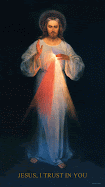
Showing posts with label Divine Mercy. Show all posts

Wednesday, April 23, 2014

NAZI Monster And War Criminal Rudolf Hoess, His Jesuit Confessor And The Divine Mercy

Soon after his appointment, Archbishop Wojtyla approached Jesuit theologian Ignatius Rozycki and asked him to review Sister Faustina's writings. Initially skeptical, Fr. Rozycki spent ten years in an exhaustive study of the Sister and her notebooks, which the Vatican had condemned in 1958. Father Rozycki's findings were published and the prohibition lifted in 1978. Beatified in 1992, St. Faustina was canonized in the year 2000; on the latter occasion Pope John Paul II declared the first Sunday after Easter "Divine Mercy Sunday."
A few weeks ago I came upon a thought-provoking homily by Father Matthew Kelty, O.C.S.O., which was given on Divine Mercy Sunday, 2006. It seems that during the former Commandant's solitary confinement in Krakow, where he awaited execution for his war crimes, Rudolph Hoess heard the bells of the local Carmel and was reminded of the Faith he had observed as a child but had long since rejected. He called for a German-speaking priest.
The local Jesuit provincial, Fr. Ladislav Lohn, S.J., went to the convent of Sister Faustina and asked the Sisters to pray earnestly while he went to hear the prisoner's confession. In the end Hoess was reconciled with the Church and received Holy Communion. Later Hoess wrote his wife and five children, expressed sorrow for his crimes, and begged forgiveness of the people of Poland. Hoess was executed April 16, 1947.
In his homily, Father Kelty contends that, though he may rightly spend an eternity in Purgatory, by the mercy of God even a man like Rudolph Hoess could be saved. This is an uncomfortable truth for some, even offensive to those whose sense of justice could be satisfied with nothing less than eternal damnation for such a "monster."

Link (here)

Tuesday, April 22, 2014

Jesuit On St. Faustina And Divine Mercy


St. Faustina Kawalska
In the Gospel (Luke 11: 1-4) Jesus teaches his disciples to pray, calling upon God as Jesus himself did: "Father". God is the one Father whose human children made in his own image and likeness must forgive one another as their Father forgives them. 
Jesus directed St. Faustina to write a diary that contained her thoughts, prayers, and the words of Jesus to her. In one passage (#723) Jesus said: "The greater the sinner, the greater the right he has to My mercy." "Right"
That's not a word we would think of in this context, but Jesus declares that because he came to forgive sinners, they are the ones who have the most claim on his mercy. Another passage (#1183) is a prayer that St. Faustina wrote. It sounds very much like the "one day at a time" spirituality of the Morning Offering: "O Jesus, I want to live in the present moment, to live as if this were the last day of my life. I want to use every moment scrupulously for the greater glory of God, to use every circumstance for the benefit of my soul. I want to look upon everything, from the point of view that nothing happens without the will of God."
Link (here) to Fr. James Kubicki, S.J. and his blog, Offer It Up

Jesuit In The Philippines Touched By The Divine Mercy

Falling In Love with His Divine Mercy
by Suzette T. Yu-Kho (ICA batch 1991)
Like many Catholics, I once took my faith for granted: I did not attend Mass regularly, stopped going to Confession and avoided religious people. I strayed away from the Faith and began dabbling in other forms of worship. I even took part in an East Indian “healing” seminar (it only lasted for a day). Each of them guaranteed the same results: true peace and happiness. Yet despite all their sweet words and the promise of Eden, I felt empty. As I plunged deeper into sin, I thought there was no escape. There was no way that I could go back to the Church and face God being the sinner that I was--I was incredibly ashamed of myself! How could I stand there singing hymns with other “saintly” people who never committed such atrocious deeds? I could not fathom confessing to a priest once again who in my mind would surely rebuke me; consequently, for a quite a long time, I did not receive the Holy Eucharist either.
Years later, I was still in my predicament when I heard of Stanley Villavicencio: a Filipino lay person who touched the lives of sinners from all around the world and opened their hearts to Jesus Christ’s Divine Mercy.
His testimony was mind-boggling: after three days of being pronounced “clinically dead” in Chong Hua Hospital in Cebu, he came back to life, much to the shock of his doctors and family members who were busy arranging his funeral. He claimed to have seen Jesus upon his death amidst a garden filled with various kinds of beautiful flowers. Jesus then showed him the film of his life starting from the time he was a young boy up to the moment of his death. Whenever he committed a venial sin, the film would slow down; whenever he committed a mortal sin, the film would stop and enlarge itself.
Nothing could be denied since the film had the exact date and time of when the sins were done--even the minutes and seconds were recorded! He also said the sins he confessed to a priest felt lighter compared to the sins he did not confess. After reviewing the film of his life, Jesus then sent Stanley back to earth with a mission and that was to spread the word of His Divine Mercy.
He told Stanley that He would be communicating with him very often. In this dream-like state, Stanley could see, touch and even embrace Christ. Stanley was also asked to obey his authorities (Cardinal Vidal and Msgr. Cris Garcia, his spiritual director) who instructed him to write down the messages he would receive every time there was an encounter with Jesus.
Msgr. Cris Garcia who had been endowed with the gift of internal locution was made aware of each encounter simultaneously by Jesus Himself; he in turn would confirm the messages with Cardinal Vidal. To date there have been 31 encounters with our Lord since 1993. Jesus’ main message is simple: the doors of His Mercy are still wide open to penitent sinners. Souls should not hesitate to come back to Him even if their “sins be as plentiful as the stars in the sky”. If people refuse to pass through the doors of His Mercy, they have to pass through the doors of His Justice after the period of time He allots. He is also asking us to pray the Chaplet of Divine Mercy unceasingly, receive the Sacraments of Penance and Holy Eucharist often and celebrate the Mass regularly. The Chaplet of Divine Mercy is a powerful tool against hell for a dying soul: if prayed for a dying soul, God will see the soul through the wounds of His Son instead of through that person’s sins. If a repentant sinner prays the Chaplet for himself even just once, God will also be merciful to him because Jesus says that He will stand between the sinner and His Father upon that person’s death. Furthermore, Jesus promises that on the Feast of the Divine Mercy (the first Sunday after Easter) “the soul that will go to Confession and receive Holy Communion shall obtain complete forgiveness of sins and punishments”. Church officials say that the graces one receives during Divine Mercy Sunday is similar to the graces obtained during baptism. Stanley’s resurrection was so miraculous that the doctor who attended to him decided to enter the seminary.
He is now a Jesuit priest doing missionary work in Africa besides being the head of the Jesuit Hospital of the Philippines. Stanley’s testimony is also supported by 22 bishops and 2 cardinals in the Philippines as well as various Church leaders throughout the world including the late Pope John Paul II
(who during his lifetime was promoting the Divine Mercy devotion and fulfilled the vision of Saint Faustina in the 1930s by declaring the first Sunday after Easter as the Divine Mercy Sunday in 2000; Pope John Paul II incidentally died on the eve of the Divine Mercy Sunday in 2005). His story has attracted a huge number of people from different countries and has converted many to Christianity. When he went to China to deliver his message, he miraculously started speaking in Mandarin even though he had no background on the language. By the end of his speech, the Chinese audience had tears in their eyes: they understood every word he said and 200 of them embraced the Catholic Faith right away!
Link to the full article (here)

Saturday, April 28, 2012

PRAYER FOR THE HOLY CHURCH AND FOR PRIESTS

O my Jesus, I beg You on behalf of the whole Church:
Grant it love and the light of Your Spirit,
and give power to the words of Priests
so that hardened hearts might be brought to repentance and return to You, O Lord.
Lord, give us holy Priests;
You yourself maintain them in holiness.
O Divine and Great High Priest,
may the power of Your mercy
accompany them everywhere and protect them
from the devil's traps and snares
which are continually being set for the soul of Priests.
May the power of Your mercy,
O Lord, shatter and bring to naught
all that might tarnish the sanctity of Priests,
for You can do all things.
My beloved Jesus,
I pray to you for the triumph of the Church,
that you may bless the Holy Father and all the clergy;
I beg you to grant the grace of conversion
to sinners whose hearts have been hardened by sin,
and a special blessing and light to priests,
to whom I shall confess for all of my life.

Saint Faustina Kowalska

Link (here) to the annual Letter to Priests

Wednesday, April 11, 2012

Jesuit Says, "The Mercy Of God Is Divine Mercy"

The Mercy of God
by Fr. John A. Hardon, S.J.
If there is one divine attribute that we spontaneously associate with Christ and Christianity it is the attribute of mercy. Mercy, we may safely say, is the distinctive quality of being a Christian: to be a Christian is to be merciful. There are many reasons for this. One reason cannot be that the word mercy, just as a word, is so common in the New Testament. By actual count, justice is used almost three times as often as the word mercy in the New Testament. This is not a matter of arithmetic; it is a matter of spirit. The spirit of Christianity is the spirit of mercy.
Pope John Paul II went so far as to say that “Jesus Christ is the incarnation of Divine Mercy.” Surely Christ is the incarnation of God. But among the divine attributes which most distinguishes who Christ is as the incarnation of the God-head, none identifies Christ more concretely and distinctively than mercy.
Our scope in this article is to cover three areas of a subject which is as vast as our faith. First, what does the Church understand by mercy? Then, how is Christ really incarnate Divine Mercy? And then very pertinently, how do we not only have the option but the obligation of responding to the profound mystery of the Mercy of God who became Man out of love for us? What is mercy? It comes in two stages. First stage. Mercy is love shown not only to those who are in need. Mercy is love shown not only to those who are in want. Need expresses the real objective absence or lack in someone. Want is rather the subjective, the psychological desire to get whatever a person wants. Can people need what they don’t want? Yes. Objectively they may need many things which subjectively they may not want. Do people want things which they don’t need? Do they ever! Nevertheless this is not a clever distinction.
Read the rest of the lengthy article (here)

Saturday, April 30, 2011

Divine Mercy


Divine Mercy
St. Faustina Kowalska
The Diary
Divine Mercy Sunday
The Chaplet Of Divine Mercy
Divine Mercy Miracles
Divine Mercy Shrine In Krakow, Poland
Divine Mercy In The News
Divine Mercy In The Blogs
Divine Mercy And The Jesuits

Divine Mercy Sunday

Jesus' Call to Mercy
"I demand from you deeds of mercy, which are to arise out of love for Me. You are to show mercy to your neighbors always and everywhere. You must not shrink from this or try to excuse or absolve yourself from it. I am giving you three ways of exercising mercy toward your neighbor: the first — by deed, the second — by word, the third — by prayer. In these three degrees is contained the fullness of mercy, and it is an unquestionable proof of love for Me. By this means a soul glorifies and pays reverence to My mercy. Many souls ... are often worried because they do not have the material means with which to carry out an act of mercy. Yet spiritual mercy, which requires neither permissions nor storehouses, is much more meritorious and is within the grasp of every soul. If a soul does not exercise mercy somehow or other, it will not obtain My mercy on the day of judgment. Oh, if only souls knew how to gather eternal treasure for themselves, they would not be judged, for they would forestall My judgment with their mercy" (1317)

Link (here)

Fr. Joseph Andrasz, S.J.: Spiritual Director To St. Faustina Of The Divine Mercy

Fr. Joseph Andrasz, S.J.

St. Faustina had great difficulty finding confessors and spiritual directors who understood what God was doing in her life. She finally found two good ones in Fr. Joseph Andrasz, S.J., and in Fr. Michael Sopocko. Link (here)

She writes of a Mass celebrated by her spiritual director, Fr. Joseph Andrasz, SJ: "...
I saw the Infant Jesus who, with hands outstretched toward us, was sitting in the chalice being used at Holy Mass. After gazing at me penetratingly, He spoke these words: 'As you see Me in this chalice, so I dwell in your heart'"
(Diary, 1346). The little Jesus is instructing St. Faustina that, through His Eucharistic Presence, He dwells in her heart as the source of her strength. Even as the Infant Jesus strengthened her in the Eucharist, His abiding presence also filled her heart with great joy. Her desire grew for Him alone as the greatest treasure of all. She writes of February 2, 1936,
"... when Mass began, a strange silence and joy filled my heart. Just then, I saw Our Lady with the Infant Jesus ... . The most holy Mother said to me, 'Take my Dearest Treasure,' and she handed me the Infant Jesus. When I took the Infant Jesus in my arms, the Mother of God and Saint Joseph disappeared. I was left alone with the Infant Jesus"
( Diary, 608).. Link (here)

Jesuit Theologian Influential In The Spead Of Jesus' Divine Mercy Devotion

Had it not been for the Holy Father's efforts on her behalf, Faustina and her notebooks may well have disappeared into obscurity. Initially branded "hysterical" and "deceived" by local clergy, in 1938 she died of tuberculosis at the age of thirty-three. However, God had not finished the work He had begun with Sister Faustina, nor did the men who had silenced her foil His plans.
Soon after his appointment, Archbishop Wojtyla approached Jesuit theologian Ignatius Rozycki and asked him to review Sister Faustina's writings. Initially skeptical, Fr. Rozycki spent ten years in an exhaustive study of the Sister and her notebooks, which the Vatican had condemned in 1958. Father Rozycki's findings were published and the prohibition lifted in 1978.
Beatified in 1992, St. Faustina was canonized in the year 2000; on the latter occasion Pope John Paul II declared the first Sunday after Easter "Divine Mercy Sunday."
Link (here)

Thursday, April 28, 2011

Polish Jesuit Fr Stanislaw Skudrzyk And The Divine Mercy

The Divine Mercy apostolate has been flourishing, not only in Poland, but throughout Europe, Asia and other parts of the world, including Australia where it was brought by migrants from Poland in 1950 and was actively promoted by the Polish Jesuit Chaplain Fr Stanislaw Skudrzyk. He arranged the transport of the first picture of Jesus Divine Mercy to Melbourne which was solemnly blessed by Archbishop Mannix on the Sunday of Divine Mercy, 20 April 1952, and given a place of honour in St Ignatius Church in Richmond, until 1959.

Link (here)

Sunday, April 11, 2010

Polish Jesuit And The Divine Mercy In Africa

In 1989 whilst promoting the message of Divine Mercy Val Conlon met Polish Jesuit Fr. Jacub Rostworowski in Dublin, who was on his way to Zambia to serve as a missionary. Fr. Jacub was influenced to become a priest after seeing his father who was a professional artist paint the Image of Divine Mercy in his studio in Cracow.
After his ordination Fr. Jacub was appointed Chaplain first at the Hospital in Rabka. This is the hospital where Saint Faustina had convalessed during her final bout of illness, and then he became Chaplin at the convent where she died.
Fr. Jacub invited Val to visit all the places associated with Saint Faustina in Cracow before his departure for the missions. Since then they have been friends and when Fr. Jacub started working with poor children and orphans in Zambia H.U.D.T started to help him with his work.


Children in Zambia with
The Divine Mercy Image

With your generosity, we will continue our Works of Mercy in Zambia where Fr. Jacub is bringing Divine Mercy in real terms to his parishioners. There are many ongoing projects, we are helping him build a school, a Divine Mercy Church, and a Shrine. Link (here)


School being built in Zambia by H.U.D.T

Fr. Jacub is helped by H.U.D.T


Marian Shrine built by Fr. Jacub and H.U.D.T in Zambia


Divine Mercy Devotees in Zambia


Letter from Fr.Jacub to Val Conlon thanking him for all the help he has received from H.U.D.T in helping his community in Zambia.

Saturday, April 18, 2009

Jesuit Fr. Oswald Mascarenhas Leading The Divine Mercy Conference In Michigan

Divine Mercy Conference 2009 Divine Mercy Conference 2009 The Divine Mercy, is an amazing 24/7 conference. Available are seven full days packed with extraordinary opportunities to grow in faith and to seek the Lord's Mercy! Daily Mass, Confessions, 24-hour Adoration, inspiring speakers, and prayer ministry will be offered each day. Don't miss this chance to immerse yourself in the Healing Presence of Christ!

Super Natural Connections At Parish Named After Jesuit Saint

Saint Stanislaus Kostka Catholic Church here will unveil what is believed to be the world's largest monstrance at 6 p.m. eastern time Saturday, May 31. A monstrance is a container that displays a consecrated Host (which Catholics believe is the body of Christ under the appearance of bread) for veneration. The monstrance will serve as focal point of the new Sanctuary of The Divine Mercy, to be built on the grounds of this inner city parish.The gilded receptacle has taken sculptor Stefan Niedorezo two years to carve from linden wood using Renaissance methods. The iconic monstrance is nine feet tall and weighs 700 pounds. Malgorzata Sawczuk applied the gilding and serves as project conservator.

The monstrance depicts the Blessed Mother as the link between the old and new covenants. She stands over the Ark of the Covenant, a sacred container that held the stone tablets inscribed with the 10 Commandments. Mary is "clothed with the sun, with the moon under her feet, and on her head a crown of twelve stars," as depicted in the Book of Revelation (Rev 11:19 and 12:1-2).

The unveiling takes place on the feast of the Visitation, where Mary visited her cousin Elizabeth and found the supposedly barren woman pregnant with a son who would become John the Baptist, forerunner of Jesus (Lk 1:39-57). The public is invited to the ceremony, which will be televised live on EWTN, the worldwide Catholic television network; Catholic TV; and the Latin American TV station El Sembrador. Relevant Radio will provide U.S. coverage. Mass will be celebrated by Cardinal Francis George, Archbishop of Chicago.

The vision for the sanctuary and monstrance began nine years ago when St. Stanislaus Kostka pastor Fr. Anthony Bus, CR, heard a call from Mary asking that he build the sanctuary. He wrote a book about his experience titled A Mother's Plea: Lifting the Veil in Sanctuary (Marian Press).

The book, originally published in 2005, has been a popular title in Catholic book circles partly because of its apocalyptic theme. It has been updated this year with information on the painstaking effort to build the sanctuary. Donations and proceeds from Fr. Bus's book financed sculpting the monstrance. Following the unveiling, planners will begin raising funds to build the sanctuary. Estimated cost is between $15 million and $20 million. SOURCE Saint Stanislaus Kostka Catholic Church

Link (here)


Jesuits and Jesus of the Divine Mercy (here)

Friday, March 20, 2009

Jesuit On Apparitions

Salvatore M. Perrella, an expert in dogma and Mariology from the Mariunum Pontifical School in Rome, explained recently the criteria used by the Church to determine the legitimacy of Marian apparitions. His explanation comes in the wake of the Church’s approval of the apparitions of Our Lady of Laus in France.

In an article for L’Osservatore Romano, Perrella cited Jesuit Father Giandomenico Mucci to explain the difference between a vision and an apparition. The first is of a spiritual nature, while the second is of a physical one. That is, the seer has a real and sensible experience of the one in the apparition.

After explaining the Church’s process for verifying Marian apparitions was discussed at the Lateran Council and the Council of Trent, Perrella explained that currently “discernment about the veracity” of alleged apparitions “falls to the diocesan bishop or archbishop—and in recent times to the episcopal conference in question—and to the Pope.”

He also pointed out that the “Congregation for the Doctrine of the Faith drafted an internal and secret document on February 25, 1978, after four years of study, signed by the prefect Cardinal Franjo Seper to be used by the competent authorities” in evaluating supernatural occurrences.

Perrella went on to point out that the CDF instructed that for an investigation to proceed, “precise information” should be gathered about the various aspects of the alleged apparitions such as testimonies of conversions, theological analysis of the message of the apparitions, a medical and psychological review of the seer or visionary, including his or her educational level, an examination of their spiritual life, their level of communion with the Church, miraculous healings and occurrences, and other factors.

After a detailed examination of the numerous events related to apparitions, Perrella said, the Church “has approved a total of 11 apparitions out of 295 that have been studied—including now the 12th, which are those of Our Lady of Laus, approved on May 4, 2008.”

“Once verified and authenticated by Church authorities, the extraordinary manifestations may be freely embraced, as faith is reserved only to the public Revelation of God which ended with the death of the last Apostle,” he said.

In any case, Perrella stressed, the apparitions approved by the Church only manifest the evangelical mission of Mary throughout the history of the Church, which has been to point the way to the Father’s house through faith in the Lord Jesus.

Such revelations, while they help to increase faith, “do not add to the Revelation given to the Church in Sacred Scripture, but rather they help to make it current during a specific period in history,” he said.

Link (here)

This is one of the few photographs that allegedly actually shows an apparition of the Virgin Mary. It is one of the many visions that was seen in 1968, when the Virgin appeared atop a Coptic Orthodox Church of St. Mary in the town of Zeitoun, a suburb of Cairo, Egypt. The vision was actually shown on Egyptian television. The apparition was first spotted by two car mechanics who thought it was a nun in a white habit about to jump off the roof. The vision appeared on and off for about two years. Link (here)

Monday, February 9, 2009

Divine Mercy Chicago

Karen Hall from Some Have Hats posted this (here), read her full post

I just opened an e-mail from a Jesuit friend who sent me the photo I'm pasting below. It's the newly completed monstrance at the Sanctuary of the Divine Mercy in Chicago. If you don't know the story behind it, I highly recommend A Mother's Plea and its sequel. The story is amazing and inspiring. Interesting, isn' it, that Mary chose Chicago as the site for this sanctuary?

Great pictures of the Sanctuary (here)