Showing posts with label Jesuits and the Bible. Show all posts

Tuesday, February 25, 2014

Fr. C.C. Martindale, S.J. On The Anti-Christ

Have either John or Paul prophesied the Advent of a definite individual Antichrist at the end of time? No.“End of the World,” and the events surrounding it, must necessarily occur as historical events, it seems equally necessary that they must express themselves in something concrete, either a man, or a group, or a political or systematic unit of some sort; but the Old Testament, Saint Paul, and Saint John use their image of a definite one person precisely when their gaze is fixed rather on their own time, which is, in a sense, the least “real,” most transitory, plane of all those that they contemplate. Babylon, Tyre, Antiochus, Rome – and all the persecutors of all history for ever, are but the crude material examples of a much deeper and abiding truth, just as the Two Witnesses stand as symbol of that residue of the Faithful who never cease their promulgation of God’s truth even in the worst of persecution, and, “though they be dead, yet shall they live,” as Our Lord promised; and just as we ought not to try to tie them down to definite personalities, like Moses and Elias, Elias and Enoch, Peter and Paul, so neither should we seek to assign a definite individual as the captain of the enemy host that forever bears hard upon them.
There is certainly nothing to prevent our surmising that the enemies of God may be led or represented by an individual, at the end of human history just as at any other time; indeed, since the
Link (here) to read more from Fr. C.C. Martindale, S.J.

Wednesday, April 24, 2013

He’ll Be A Welcome Guest In The Holy Land

When Shimon Peres flies to Italy next week to formally ask Pope Francis I to visit Israel, the president will actually be inviting the newly elected pontiff to make his second trip to the Holy Land. Forty years ago, The Times of Israel has ascertained, Jorge Mario Bergoglio made an unfortunately timed first visit. It was early October 1973, and Bergoglio, then in his mid-30s, had been in Rome completing a course for his new job as the Provincial Superior of the Society of Jesus in Argentina. He flew to Israel intending to tour widely, but arrived at the very start of the Yom Kippur War. Sources in the Argentinian Jewish community, with whom Bergoglio has a long and warm relationship, said the rumor is that he stayed in Israel “for only a few hours” before being “evacuated” because of the war. Not quite. In fact, the Vatican told The Times of Israel, Bergoglio was here for about a week, but the war certainly “caused difficult problems for the visit.”On his first day and a half, Bergoglio was able to visit holy sites in Jerusalem, including the church-filled neighborhood of Ein Kerem, and Bethlehem, said Father Federico Lombardi, the director of the Holy See Press Office. After that, however, because of the fighting, Bergoglio was unable to tour further. Instead, he spent the next six days confined to the American Colony Hotel, on the seamline between West and East Jerusalem. He used the time “studying the Letters of Saint Paul to the Corinthians,” Lombardi said, using books that he borrowed from the library of the Jerusalem branch of the Pontifical Biblical Institute. Since beginning his papacy last month, Francis I has told Jewish leaders that Catholics and Jews are “bound by a very special spiritual bond,” and pledged to work to further advance “the progress there has been in relations between Jews and Catholics since the (1960s) Second Vatican Council in a spirit of renewed collaboration.” No sooner had Bergoglio taken office, than Peres invited the new pope to visit Israel, asking him to contribute to peace as a spiritual, rather than a political, leader.“He’ll be a welcome guest in the Holy Land, as a man of inspiration who can add to the attempt to bring peace in a stormy area,” Peres said.“All people here, without exception, without difference of religion or nationality, will welcome the newly elected pope.”
Link (here) to The Times of Isreal

Tuesday, March 26, 2013

Vigano The Jesuit And Vigano The Apostalic Nucio To The United States

Archbishop Carlo Maria Vigano
Lorenzo Viganò, a Jesuit biblical scholar, has declared in an interview that his brother "lied to Ratzinger when he asked to remain in Rome because he had to take care of me, sick". According to what has been written, to oppose the transfer to Washington, Carlo Maria Viganò allegedly wrote to Pope Ratzinger saying that he could not leave on account of the "necessary, dutiful and direct assistance" that engaged in towards his brother. Lorenzo, who lives in Chicago, says in the interview that he is fine, and has not spoken with his brother for two years, due to "tensions on account of our inheritance". And he says, "it is very serious that Carlo Maria has written falsely to the Pope, instrumentalizing me for personal ends".
Link (here) to Vatican Insider

Friday, March 8, 2013

Worth Knowing And Worth Keeping

THE commandments are God’s Law. The observance of God’s Law means man’s happiness here and hereafter. Most people think of the commandments in terms of hereafter. The fact is they are the only means of happiness here. God made man to be happy and showed him how to be happy by giving him the commandments. When the world was made up of only two people, it was a happy world. But they spoiled it. They broke God’s rule of happiness, His commandments. It has been an unhappy world ever since. For men have followed the folly of the first man and woman and have tried to make a happy world by ignoring God’s Law. The result has been failure. God’s Law is a plan for human living, a way for human happiness. So God’s Law is worth knowing and worth keeping. 
The commandments were first given to Moses for the Jewish People. In their centuries-old history, they were happy when they kept them, unhappy when they violated them. When our blessed Lord came to Earth He proclaimed the commandments and made their meaning clear. His Church, which is His Living Voice and His Living Self, continues to proclaim them and explain them. There are ten commandments. Their message is love of God and love of fellow man. 
Love means action. If you love Me, keep My commandments. (John 14:15) Love means life, true life, a share in God’s Life. If any man love Me, My Father will love him, and we will come to him, and dwell with him. (John 14:23) We only really live when God lives in us. St. Paul expressed it: “I no longer live alone; God lives in me.” (See Galatians 2:20) Our Savior made it clear that we cannot live alone. Life without love is death. And there is no true love without the love of God as beginning, middle and end.
Link (here) to read the full article on the Ten Commandments by Fr. Gerald C. Treacy, S.J.

Saturday, March 2, 2013

Fr. John Navone, S.J., "Faith Directs Itself To Reason, And That Reason Is A Reality That Is Not Invented By The Human Mind."

John Paul II, in his encyclical Ex Corde Ecclesia, asserts that Christian professors and teachers must “set the content, objectives, methods and results of their (teaching and) research within the framework of a coherent (Christian) world vision.” 1 Richard John Neuhaus states that “A Christian university will settle for nothing less than a comprehensive account of reality. Not content with the what of things, it wrestles with the why of things; not content with knowing how, it asks what for. Unlike other kinds of universities, the Christian university cannot evade the hard questions about what it all  means. Therefore, theology and philosophy are at the heart of a Christian university.” 
Christian faith is a guide to philosophy. Not all philosophies reach the reality that is. Faith directs itself to reason, and that reason is a reality that is not invented by the human mind. We did not fabricate the mind we have that thinks. We are to use it. We invent neither it nor reality.
Surely something has to be said about the wonderful intelligibility of the universe, as assumed and verified by science, in the full context of God as primary cause. Part of the mileage theology gets from the scriptural datum, that the human images the divine, is the insight that our understanding of the universe is the exercise of a created logos mirroring the divine Logos. It is a step from this realization to Augustine’s notion that it is the graced logos in us that is capable to recognize the Logos in Jesus Christ.
Link (here) to the full article by Fr. John Navone, S.J. at Homiletic and Pastoral Review

Thursday, February 28, 2013

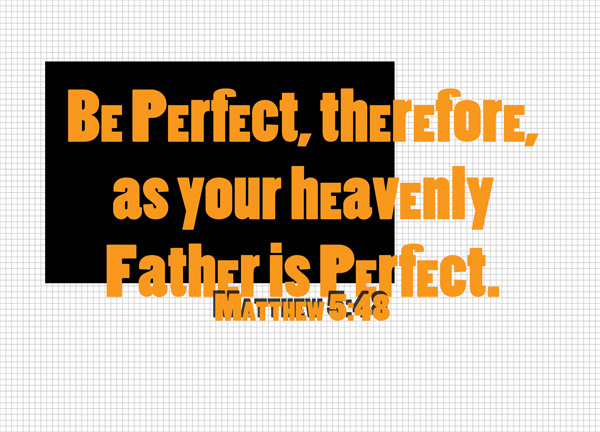
Fr. Kenneth Baker, S.J. On Perfection

What does it mean to be perfect?  Perfect is defined as that which is complete or whole.  So a perfect house, or a perfect car, is one that is complete—it has everything it needs to function well, as a house or as a car.  The imperfect is anything that lacks wholeness and completeness.  So a house without a roof is imperfect, and a car with no motor is imperfect. My reason for raising this subject is that Our Lord tells us, in Matthew 5:48, that we should be perfect as our heavenly Father is perfect.  Also, I have noticed, in reading St. Thomas Aquinas, that he often uses the distinction between what is imperfect and what is perfect. 
Our ultimate goal in life, a supernatural goal, which is the face-to-face vision of God in heaven for all eternity, is a state of perfection.  Everyone in heaven right now is perfect.  Each one is perfect, according to the degree of grace attained, according to divine providence, something similar to the hierarchies of angels.  God alone is infinitely perfect in every way. 
Perfection in this life means developing all of one’s faculties, and practicing all the virtues, especially the theological virtues of faith, hope and charity, and the moral virtues of prudence, justice, fortitude and temperance.  For example, what is required by the Church in the canonization process is that the individual under consideration must be proven to have practiced heroic virtue, that is, to have achieved a certain perfection.
Read (here) the full article by Fr. Kenneth Baker, S.J. at Homiletic and Pastoral Review

Monday, February 18, 2013

Fr. Domenico Grasso, S.J., "Chrestians"

Tacitus, a great Latin historian, writing around the year 116, devotes a whole page of his Annals to Jesus. In speaking of the burning of Rome, which was presumably the work of Nero himself, he attempts to recapture the drama of the destruction of Troy. Tacitus claims that the emperor, in order to quell the voices accusing him of having been the cause of the disaster, accused those people who were called "Chrestians". He goes on to say that the founder of this sect,
Christ (Chrestus), had been put to death by the Roman procurator, Pontius Pilate, during the reign of Tiberius. This 'dangerous superstition' which, for a time was successfully controlled, began to spread from Judea, where it first originated, to the City (of Rome), where all the most common and shameful things seem to congregate and win applause. (Annals, XV, 44) 
This brief description, which Tacitus probably found in the Senate archives, fully supports what we knew of Jesus from the Gospels. He is a Jew who was put to death, under the reign of Tiberius, by the procurator Pontius Pilate; he was the initiator of a religious movement whose followers are called Christians. For the Latin historian, Jesus is an historical personality, living at a precisely determined moment in history, a few decades prior to Tacitus' writing. Tacitus' witness is confirmed by the writings of Suetonius around the year 120. In his Life of Claudius, he tells us that this Emperor expelled the Jews from Rome because of their constant agitations "over Chrestus". (Vita Claudii, XXV) The word which he uses, "Chrestus", obviously stands for Christ, the Greek translation of the Hebrew term "Messiah" (anointed). Suetonius alludes to the frequent heated debates between Christians and Jews on the nature and teachings of Christ. Still, as Abbot Giuseppe Ricciotti, C.R.L observes, "since he was only poorly informed on the subject of Christianity, Suetonius seems to believe that this Chrestus was personally present in Rome at the time and had provoked the rioting himself". (Ricciotti, Life of Christ, 2nd ed., Milan, 1941, p.107) But even for Suetonius, Christ is a real person and not a myth. Before Tacitus and Suetonius, Pliny the Younger, Roman governor of Bithynia (in modern Northern Turkey), in his correspondence with the Emperor Trajan (A.D. 112) speaks of Christians and their presence throughout the territory under his administration.
Describing their religious practices, he says that they used to congregate at dawn on a given day to sing hymns to Christ whom they regarded as their God. (Pliny, Letters, X, 96) 
From this testimony, written less than 100 years after the death of Jesus, we have exact information regarding the place and time in which Christ lived. These sources speak of him as an historical personage, and not a myth, as would be expected from the Orient. 
Link (here) to the piece by Fr. Domenico Grasso, S.J. entitled, The Gospels: Historical and True

Wednesday, January 16, 2013

Jesuit On Ratzinger And Quirinius

First, Ratzinger almost invariably takes the minority opinion concerning contentious historical questions.  He – very problematically in my opinion – glosses historical problems such as the dating of the census and the disagreement between Matthew and Luke about where Joseph and Mary are originally from.  After quickly glossing the issue, he concludes: “The two different strands of tradition agree on the fact that Bethlehem was Jesus’ birthplace.   If we abide by the sources, it is clear that Jesus was born in Bethlehem and grew up in Nazareth.”   Yet it is not so simple.  If the census that purportedly took place ca. 6 BC did not actually take place, then there was no reason for Joseph to go to Bethlehem. 
And the scholarship of Alois Stoger that Ratzinger cites to support the idea that Quirinius may have briefly been in Syria in 6-7 BC, and that the census may have been initiated at that time only to be completed twelve years later, is far from convincing and quite a stretch of the historical record. 
Matthew is also clearly wrong in thinking that Jesus and Mary were from Bethlehem.  The other gospels are clear in their claim that Joseph and Mary were from Nazareth.  And so, if Matthew is wrong about his Bethlehem claim, and Luke is in position of faulty historical data, then can it be so easily claimed, “it is clear that Jesus was born in Bethlehem”?  Would it not be easier for Ratzinger to treat the faulty historical records that Matthew and Luke utilize in their infancy narratives in the same way he treats their appropriation of two different genealogies, viz., by claiming that the authors have “based themselves on traditions whose sources we cannot reconstruct.  It seems to me utterly futile to formulate hypotheses on this matter.  Neither evangelist is concerned so much with the individual names as with the symbolic structure within which Jesus’ place in history is set before us”?  Could not the sources that the evangelists were working with also have been flawed and beyond our reconstruction?  May they not too have been more interested in the “symbolic structure” of these sources than with the historicity of every detail?
This brings us to my second concern. Ratzinger’s offhand rejection of anything but “history” (and a rather Modern view of it, it seems to me) creates problems for his literary analysis.  
For example, he cites with approval Rene Laurentin’s observation that Luke structures his infancy narrative using the 490 days announced by Gabriel in the book of Daniel.  John the Baptist’s 6 months in the womb prior to Jesus, added to Jesus’ 9 months, combined with the 40 days until the Presentation in the Temple, total 490 days.  Very neat. 
But how might such a literary technique square with history?  Are we to believe that John the Baptist was actually historically 6 months older than Jesus and that this fact also just happens to fit neatly into the schema of 490 days? 
Scholars such as Luke Timothy Johnson and Raymond E. Brown also reject the infancy narratives as midrash, yet they are far more conscious than Ratzinger of the constructions at work in the narratives and the issues that these constructions raise for their historicity.
Link (here) to the full opinion piece by Jesuit Scholastic Nathan O'Holloran at Whomsoever Desires

Wednesday, October 31, 2012

Bartimaeus

Bartimaeus is a model. “He represents the man who has lost the light and knows it.” Others lose the light and refuse to acknowledge it. This sentence foreshadows the context of the Synod on the new evangelization. It is directed precisely at those who once had the faith and seem to have lost it. The Church has realized that its own mission is hindered precisely by the vast numbers of Catholics in the “developed” world who have lost or do not practice their faith. They have, as it were, blinded themselves.
Bartimaeus, in the Gospel account, simply says: “Jesus, Son of David, have mercy on me.” When Christ asks him what he wants, he replies: “Lord, that I may see.” What are we to make of this response? “Bartimaeus represents man aware of his pain and crying out to the Lord, confident of being healed.” Benedict notes that this plea, “Lord, that I may see,” like the publican’s, “Lord, be merciful to me a sinner,” has become a part of the Church’s own prayer. Bartimaeus teaches us that our path is to follow Jesus on our journey. We too pray that we may see. 
Link (here) to The Catholic World Report to read the full piece by Fr. James Schall,S.J.

Sunday, March 11, 2012

Strictly Protestant

    In the late 1940s Leonard Feeney, S. J. began to teach that there is
    no salvation outside the Church. He was correct in saying that there
    were official teachings, even definitions, on that score. But his
    tragic error came when he adopted Protestant method, thinking that in
    that way he would be one of the only true Catholics! We spoke of his
    protestant method with good reason. First, he was excommunicated for
    disobedience, refusing to go to Rome to explain his position. Then
    the Holy Office, under Pius XII, sent a letter to the Archbishop of
    Boston, condemning Feeney's error. (It is known that Pius XII
    personally checked the English text of that letter). In the very
    first paragraph pointed out what is obvious: we must avoid private
    interpretation of Scripture -- for that is strictly Protestant. But
    then the letter said we must also avoid private interpretation of the
    official texts of the Church. To insist on our own private
    interpretation, especially when the Church contradicts that, is pure
    Protestant attitude.

Saturday, March 10, 2012

Cardinal Albert Vanhoye, S.J. "You See His Delicate Love For The Lord "

Cardinal Albert Vanhoye, S.J.
It is clear that for the Christian it is necessary to begin with the Gospel, to delve into it in meditation, in prayer, to apply it to your own life. This is the first essential thing. But the Gospel itself points to the Old Testament. Jesus is the promised Messiah. So, it is helpful to read the prophetic texts, especially the messianic ones. The Psalms are useful for prayer, but it must be said that they do not always have the Gospel spirit. A distinction has to be made, then. Some Psalms are full of curses against enemies, they are very far from Jesus' precept about loving enemies and praying for them. It is clear that it is necessary for the faithful to have the assistance of aids that present the texts and place them at the intellectual level of the faithful, their capacity to understand and live.
Then among the Gospels there is a difference between the Synoptics and John's Gospel. From the point of view of the faithful the most interesting Gospel is Mark's, which is very lively, which tells of miracles in a very detailed way, etc. The Gospel of Matthew gives a richer teaching and so it is necessary to always return to it to be filled again with the evangelical spirit. On the other hand, John's Gospel goes deeply into the faith in a marvelous way. It is necessary to really meditate on John's Gospel, to grasp it in faith and love for the Lord. Luke, too, is very interesting. It is the disciple's Gospel. 
It would also be possible to start with Luke's Gospel, which occupies itself more with the disciple's relationship to the Lord Jesus. The great discourses of Matthew are broken up in Luke's Gospel. The beatitudes, instead of being expressed in the third person are addressed directly to the disciples: "Blessed are you poor… ." This is an example. Then Luke relates himself to Jesus in a very delicate way, especially in the account of the Passion. There you see his delicate love for the Lord very well; his way of softening the most cruel, most offensive things.
Link (here) to Zenit

Tuesday, January 17, 2012

The Great Biblical Scholar Cornelius a Lapide, S.J. On The Wedding Feast At Cana

Cornelius a Lapide records that the marriage festival at which Christ turned water into wine at the request of the Blessed Virgin Mary was that of Saint Simon the Apostle. Here's the quote:
With more probability, Baronius, following Nicephorus (Hist. l. 8. c. 30), thinks that the bridegroom at this marriage was the Apostle Simon, who was surnamed the Cananite from Cana. And Baronius adds from the same Nicephorus that the place where the marriage was celebrated was adorned by a famous church built there by S. Helena, the mother of Constantine the Great. As soon as Simon had seen this miracle of Christ at his wedding, he bade farewell to his bride and the world, and followed Him, and was chosen to be one of His twelve Apostles. This was the reason why Christ came to this wedding; and by coming, indeed, honoured marriage; but by calling him to Himself, He showed that celibacy and the apostolate were better than marriage.
An interesting tradition, to say the least. By the way, Saint Simon the Cananite was the son of Cleophas who was the brother of Saint Joseph.

Link (here) to  the full post at Canterbury Tales

Wednesday, November 16, 2011

Karl Keating And Fr. Thomas P. Rausch, S.J.

The new apologists are criticized for harboring skepticism regarding some of today’s theologizing. Fr. Thomas P. Rausch, S.J. says, "Whatever their primary motivation, these new apologists are deeply suspicious of modern scholarship." He sees "a lack of sympathy for mainstream Roman Catholic theology." The new apologists suffer from "an inability to reconcile faith with critical reason," and they "appear unable to enter into a real dialogue with modernity, with the critical questions it raises for faith."

If I may be so bold as to criticize these comments, I would note first that "contemporary Catholic theology" is not of one cloth. William May is not Charles Curran. Joseph Ratzinger is not Edward Schillebeeckx. Bernard Orchard is not Raymond Brown. Each of these men is a Catholic theologian writing today, and thus each produces "contemporary Catholic theology." If the new apologists are unsympathetic to the thought of the second man in each pairing, it is no more and no less accurate to say that the opponents of the new apologists are unsympathetic to the thought of the first man in each pairing. Thus, it would be equally accurate—and equally meaningless—for the new apologists to say of their detractors that they are unsympathetic to that half of "contemporary Catholic theology" which is the one more closely aligned with the thought of John Paul II. Fr. Rausch claims that the new apologists "are relentlessly hostile to contemporary Catholic theology precisely because it is critical." This is incorrect, on two grounds. The new apologists use much contemporary Catholic theology, such as that produced by Hans Urs von Balthasar, Henri de Lubac, Avery Dulles, Aidan Nichols, and even Francis Sullivan (the latter with occasional reservations, admittedly). To the extent the new apologists are "hostile" to "contemporary Catholic theology," their "hostility" is either to heterodoxy, as exemplified in the promotion of priestly ordination for women or in the rejection of Humanae Vitae, or to poorly reasoned positions, such as those adduced in favor of the late dating of the New Testament books.

Let us grant that "hostility" toward some "contemporary Catholic theology" exists (though I think it might better be described as "skepticism"). What is the origin of it? Fr. Rausch says the new apologists dislike what he identifies as mainstream theology because it is critical and they are not. But much of that theology is critical only in a certain sense. It is critical in that it criticizes what has been the received teaching or understanding. But it is often quite uncritical when looking at itself. 
Link (here) to read Karl Keating's full article at Catholic Answers, entitled No Apology from the New Apologists.

Friday, November 4, 2011

Fr. Jim McDermott, S.J. On The Very Very Literal Translation Of The Bible

If you've read my column at all over the last year or so you know I have little patience for the change in the eucharistic prayer from "for all" to "for many".  And if you're wondering what the heck I'm talking about, it's during the prayer over the cup:
Take this, all of you, and drink from it.
This is my blood, given up for you and for all
so that sins may be forgiven. 
The reason they're changing it: the New Testament text from which it's taken literally says "for many", not "for all".  So, it's a correction. The problem is, it sounds like we're suddenly rolling back God's plan of salvation. You know how we used to say God loves everybody, is interested in everybody, regardless of what they believe or ever did or what not?  Well, now we're thinking, not so much. He'd settle with a good 30-50%.
Link (here) to the blog Gone Walk About, by Fr. 

Monday, April 18, 2011

Jesuit On The Entrance To Jerusalem

Fr. Cornelius a’ Lapide thinks it reasonable to conclude that Christ rode upon both the ass and the colt, though of course not at the same time but in succession. The Jesuit scholar states that it is most likely that the Savior rode the ass down the Mount of Olives and up the hill to the entrance of Jerusalem, but that, when he entered the Holy City, he sat upon the colt. 
The primary reason Fr. Cornelius gives for this transitioning between the two beasts is that “the colt perchance was not strong enough to bear a rider in the descent and ascent of the mountain.” The colt, of course, was smaller than the ass (being its foal) and therefore was likely too weak to carry the Christ. 
On the other hand, “the ass was not so becoming for the entry into the city.” Therefore, the Lord sat upon the ass’ colt when he came to the City itself. And this is corroborated by the other Gospels which specify that the animal upon which the Savior sat as he came into Jerusalem was a colt.
Link (here) to read the full article at The New Theological Movement

Wednesday, March 16, 2011

What Is A Christian

“It was at Antioch that the disciples of Jesus were first called Christians” (Acts 11:26)  The early Christians were known as disciples of Jesus.  
To be a Christian then is not just to know about Jesus.  Knowledge about Jesus can be found in the Bible.  But the Bible is not a Christian.  Knowledge about Jesus an also be found in the Catechism.  
But the Catechism is not a Christian.  All the knowledge we have about Jesus can be put on a silicon chip.  But a silicon chip is not a Christian.
 
Link (here) the Jesuit Fr. K of the New Orleans Province, Fr K's blog Disciples of Jesus

Saturday, October 2, 2010

Jesuit On The Catholic Biblical View Of The End Times And The Protestant Interpitation

One of today’s best known—and, happily, one of the most solidly Catholic—biblical scholars, Father William Kurz, S.J. of Marquette University, has prepared an easily readable review of what the Bible does (and does not) say about end times. Through a careful examination of key biblical themes, symbols, and images from Genesis through Revelation, Kurt urges that the Bible is not some kind of puzzle designed to allow us to construct an intricate end-times scenario, but a body of divine revelation by which God wants to show us how best to cooperate with his salvific plan, including mysteries like the end times, for which he has chosen to reserve knowledge about the details.
Kurz shows at length that many of the most common fundamentalist interpretations of the scriptures on these questions are faulty. Perhaps it is the understandable desire to supply from the imagination what seems missing, even when it means running beyond the evidence. But whatever the motive for their convoluted reasoning, these attempts often reach beyond what is possible in principle to grasp when claiming to predict the way in which God will conclude history. What will be much more helpful, Kurz maintains, is a careful study of the biblical evidence of how God wants us to be ready at all times, without fear of our personal death or of end times, but always prepared by living faithfully in Christ. The believer should be mindful of God’s abiding intent to free us from our sins and, as the Lord’s Prayer emphasizes, to deliver us from evil. The reason for our hope about the Second Coming resides in the suffering, death, and resurrection of Jesus at his First Coming.
Link (here) to read the full book review. 
To purchase the book go (here)

Wednesday, July 21, 2010

Not His Own Musings About Pious Things

Back in the dressing room, I put on my clericals and walked out. Going by the technicians' office, I said goodbye. One of them looked at me astonished.  
"I didn't know that you were a man of the Word." I had to laugh: My clerical status does not shine through a hospital gown. I do not ever remember being called a "man of the Word." No doubt, this form of address is an honored title in black Protestant churches. It was meant as that. 
The title made me think. Is a priest a "man of the Word?" His three powers are to "teach, to rule, and to sanctify." So, yes, he is a man of the Word. He recognizes Scripture -- and, through it, the Church and Christ -- as the source of any "word" he speaks in its name. The man of the Word is first to be sure that his word is the word that the Lord handed down, not his own musings about pious things.
 
Link (here) to read the full article by Fr. James V. Schall, S.J. at Inside Catholic entitled, The Man of the Word.
Print "Jesus Talks About Heaven" 

Tuesday, May 11, 2010

Dogma Is The Ace, Moral Theology Is The King, Canon Law Is The Queen And Scripture Study Is The Jack

Before Vatican II dogma was Ace, moral theology was King, canon law was Queen, and Scripture study was Jack. That certainly was the case at Innsbruck, Austria, where I studied and where both Rahners taught and also the famous liturgist, Josef Jungmann, S.J..
In the USA before the Council in some theologates moral theology was Ace because priests were being prepared to hear confessions, while preaching was a secondary goal.
As a result of the emphasis in the seminary on the importance of dogma and morals, priests were well-schooled in those subjects and were prepared to preach on them. There was emphasis on dogma, and also morals, because of the certitude connected with them.
Each thesis had a “note” of doctrinal certainty, with the authority of the Church behind it from defined definitions in the previous twenty ecumenical councils.
Catholic dogma gives the student certitude about what the Church holds and also offers different levels of certitude, for example: a defined dogma, a matter of Catholic faith (de fide catholica), theologically certain, common opinion and so forth.
Scripture study, on the other hand, does not offer the certitude that dogma does. 
Yes, the text of the Bible is without error, but every text has to be interpreted and that is where the problem is. As you know, there are thousands of different interpretations of the meaning of passages in the Bible. The sola scriptura of the Protestants has resulted in thousands of different Protestant groups.
Link (here) to the full piece entitled In Defense of Dogma by Fr. Kenneth Baker, S.J. at Homiletic and Pastoral Review.

Wednesday, March 10, 2010

The Son Of Siro, "After The Manner Of The Nazarenes"

He observed that the prophet was rather tall and well proportioned, with a tendency to slimness. There was about him an air of serenity and command, attracting the love and reverence of the seriously-minded son of Siro. The hair was a rich golden-brown, long and falling down to the shoulders. It was parted on the forehead after the manner of the Nazarenes. The forehead was white, broad and high, giving its owner an indescribably noble appearance. Upon approaching nearer, Lazarus saw that the complexion was so marvelously clear as to resemble the purest alabaster, or Parian marble. The cheeks were faintly tinged with color; the lips had the redness of perfect health. The beard, a shade or two lighter than the hair, was not long, but thick and forked. The features which most impressed Lazarus were the eyes. They were clear, grey and piercing. At times they appeared almost blue, changing and deepening in color as they expressed the various emotions of the soul.

Link (here) to the mentioned portion of  The Son of Siro: A Story of Lazarus, by Fr. J.E. Copus, S.J.