Showing posts with label Jesuits in Australia. Show all posts

Monday, September 30, 2013

Fr. W. H. Anderson, S.J. "The Delicate And Vigilant Prudence Of A Saintly Temper Of Soul, Jealous For The Divine Honour And The Good Of Others - Is Among The First Qualities For A Confessor."

St. John Vianney
I. - What Confession is Not.


People's mistakes about the Catholic Faith, and the charges of some who ought to know better, take various lines. They "shall say all manner of evil against you, falsely, for My sake." The supremacy of the Pope is popularly denounced as ambition; the Sacramental system, as priestcraft; the science of casuistry, as the art of lying; intentions of Masses, as the greed of wealth. Definitions of dogma? they are said to be bondage to the intellect; spiritual guidance? it is bondage to the will; recommending almsdeeds? it is robbing the widow and orphan; evangelical counsels? rank Manichaeism; repression of error by Catholic powers? old-world intolerance. Such are the opinions about us in the public mind. We are all these things together; or now one, now the other, according to the humour of the moment. The wind shifts and veers, but the bark of Peter steers among many rocks, and is always close on a lee-shore. "The Church of Rome," says someone in a popular serial, "hardens the heart; but, enrevanche, it softens the brain!" ( Of course the very opposite is the truth of the matter!) The charges against the Sacrament of Penance are darker still. Men do not hesitate to accuse those whom Our Lord has consecrated to minister the means of grace to His people of being ministers of evil, of conscious, voluntary, systematic evil. Not only of being unworthy, personally, of their vocation to peculiar holiness - which has been the case (God knows) in the Church's history - but they are supposed to be, in the confessional, agents of evil, instruments of evil, practitioners, teachers, inculcators of evil. Of evil most hateful in the eyes of God, Who is thrice-holy. Men say all this in an easy, off-hand kind of way, which is by no means without its malice. Some of them, it is to be feared, would even feel sorry to be undeceived. Yet a person need not be knowingly malicious, or dishonest, to have some uneasy suspicions of the kind. It is riot hard to imagine a "man of good-will" saying to a Catholic: "Many parts of your system attract me. I feel their beauty, their solemnity and reasonableness, but I do not see my way through the confessional. There is something dark and mysterious there. What goes on in it? What is said and advised? I wonder what is confessed, and under what conditions it is absolved? Confession gives great power to man over his fellows: and man is a poor, frail creature, after all. Power is dangerous to him. Experience, and the poet, tell us that man,
" 'Dressed in a little brief authority,
 Plays such fantastic tricks, before high heaven,
 As make the angels weep.'
Are any such tricks played in that sacred tribunal?"

Now, to answer this man of good-will - not the professed calumniator, who gets his bread by unwashed falsehood - we make three statements.

1. The confessional is not a school of evil.

It is repulsive even to put this in words, speaking, as we are, of one of the Holy Sacraments of Our Lord's Church. Sanctity, as every little child may know, is one of the four great marks of that Church, to create and perpetuate which Jesus suffered on the Cross. [One, Holy, Apostolic, and Catholic.] And the Church is holy, among other reasons, in virtue of the Holy Sacraments which she administers.
They are the channels of grace, and grace is a gift from the All-holy God. But they who do not believe the Sacraments can only look on the outside of things. And what they see is not self-evidently holy, but simply mysterious. It may be holy or unholy for aught they know, for they know nothing, and can know next to nothing. People disappear within the confessional, and come out again. The priest is bound by the Sacramental seal, not so much as to hint, or breathe upon, anything he has heard. The person confessing is also bound to some extent, though not Sacramentally, yet by sacred obligations of trust and confidence. Why? Because the whole transaction is supernatural. It has no relation to any other mode of acknowledgement, or to any other manifestation, or to mere human and friendly counsel. These may be honourable to both parties, and advantageous to the seekers : but they are not Sacramental confession.

So our well-meaning man, having derived no light from what  he sees, and perhaps little from inquiry, has no resource but to go to our books and find out for himself.

He goes, then, to our books - books that need not fear the light, though they were not written for him. They were written for men who are called to be practitioners in the most discriminative and delicate science that can occupy human thought. Such books are not less necessary because they must needs be partly concerned with painful details. Sin itself is a matter of detail; it is not only a general state of soul, but a succession of acts, words, thoughts, omissions. The confessor, like the judge in a court, hears about sins, and enforces rules for amendment, in detail. He must know the individual case of his penitent, and in all needful detail. If he did not, he would be like the falsely charitable man of whom St. James speaks, who says to the needy, "Go in peace, be you warmed and filled," yet gives not those things that are needful - "what shall it profit?"
The priests of God, under the law, had the office of viewing, discerning, and declaring those who came to them, to be either tainted and excommunicated lepers or clean from leprosy. A whole chapter in Leviticus is occupied with the rules that were to guide the priest in this office of discerning. They make up, so to say, a treatise of moral theology on the subject of leprosy, issued by divine command, and in great detail. The leper is to come and manifest himself.    
What would it profit it he came to the priest muffled up, and not (as Our Lord bade the lepers in the Gospel) showing himself to the priest? This would be just like a sinner coming to acknowledge his guilt in general, not detailing it as far as is needed for the priest to Judge of his case. It would be neither more nor less than the "General Confession" in the Protestant prayer-book, which is easier to make than even coming to church. A man who does not believe the Gospel must, of course, disbelieve the power of the priest.
The Jews, disbelieving the Gospel, by logical consequence denied that power in the Person of the Author of Sacraments, the Great High Priest. Their objections, then, were the objections against the confessional now. They said,. "Who is this that speaks blasphemies? Who can forgive sins but God alone?" "Who is this that forgives sins also?" Perfectly true, if they were right in rejecting Christ. Perfectly false, since He is true. Our Lord can absolve by a word, for He is God, which the Jews did not believe. And, because He is God, they to whom He has given the power can absolve by a word - which most non-Catholics do not believe. 
The unbelief is the same in both cases. Men do not believe that the human is secretly endured with the superhuman power. But does anyone really believe the words, "Receive all of you the Holy Ghost; whose sins you shall forgive, they are forgiven them." "I will give to you (Peter) the keys of the Kingdom of Heaven; and whatsoever you shall loose on earth, it shall be loosed also in heaven"? Then for that man to suppose it needless that the conscience of the penitent should be examined, and that the priest should be instructed to examine it, is to show a want of good sense that men would be ashamed of in any question of politics, commerce, or social science. It is a pity, they who are so ready to quote, translate, or caricature our books, when it seems to suit their purpose, should not quote and translate other passages in them, quite as easy to find. For on the threshold of treatises on some departments of moral science, none the less needful to divers classes of souls because they are painful and distressing, the student is solemnly warned to study with the fear and thought of God before his eyes; to study them simply for His glory and his neighbour's good; in a spirit, not of curiosity, but of humble prayer. Subjects, without which a treatise on moral science would be as fatally incomplete as an imperfect treatise on physical healing, are entered upon reluctantly, and treated just so far as is demanded by the good of souls. They are to be studied by those for whom alone they are intended. and, therefore, so written as to remove them from popular use. Students for whom these treatises are meant either possess or aspire to the supernatural gift of consecration to the priesthood. They are, by office, obligation, and rule, men of prayer, trained to keep their consciences jealously from every permitted thought of sin. They endeavour, and pray that divine grace may crown their endeavour, to look on the transgressions of their brethren as the sun looks on the foul places of earth, with undefiled eye; they only approach the field of swine that they may bring back from it the repentant prodigal.
Further, ecclesiastical students are warned that, when they enter on their ministry, and receive confessions, they are to be most careful in the questions they put. They are never to push them beyond what is really needful. They are to err on The side of too little rather than of too much; to consult more for the profit of souls than even for the integrity of the Sacrament; to avoid, above all things, suggesting, much more making known, what the penitent may be happily ignorant of.
In a word, prudence - the delicate and vigilant prudence of a saintly temper of soul, jealous for the divine honour and the good of others - is among the first qualities for a confessor. He is a physician of souls, bound to know his science thoroughly, and to apply it with careful, anxious discrimination. A medical man would be poorly furnished who had not read surgical treatises that gave detailed accounts of all manner of diseases and painful operations. Do these things corrupt or harden his heart, when his motive for the study is high and pure? Do people get up public meetings, and go about lecturing against him, because such books are on his shelves and such knowledge is in his head? Who denounces him as unworthy the confidence of the fathers of families, or of the purest of a nation's daughters, because he is a scientific surgeon, and not a mere blundering empiric? What the surgeon is in the physical order, the priest is in the spiritual. Rather, the priest has a science and an office as much more responsible, delicate, and needful than the other's, as the soul is more precious than the body, and the grace of God than bodily health or life.    There is a most true proverb, that the surgeon should have "an eagle's eye, a lion's heart, and a lady's hand." And this, in a higher and better sense, is what the careful, prayerful study of moral theology tends to make the confessor. How far does this common sense view of things enter into the statement regarding us, or even the wish and hope about us, of those who cater for the public attention, and for blind public prejudice, on the subject of confession?
Link (here) to a whole lot more by Fr. W. H. Anderson, S.J. his piece is entitled, Confession to a Priest: What it is Not, What it Does to Society, What to the Individual.

Monday, July 15, 2013

Fr. Frank Brennan, S.J., "We Should Restrict Artificial Reproduction Of Children"

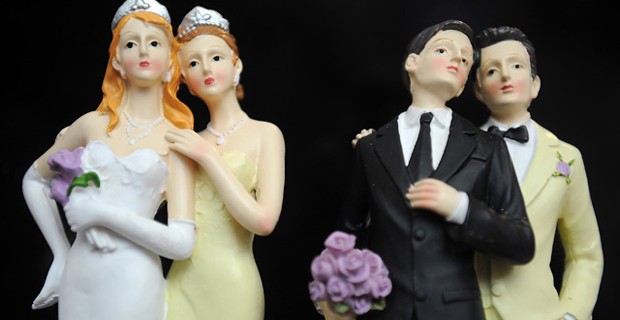
It is high time to draw a distinction between a marriage recognized by civil law and a sacramental marriage. In deciding whether to expand civil marriage to the union of two persons of the same gender, legislators should have regard not just for the well being of same sex couples and the children already part of their family units, but also for the well being of all future children who may be affected, as well as the common good of society in setting appropriate contours for legally recognized relationships. Same sex couples wanting to create their own children may in the foreseeable future be able to use only their own genetic material, precluding the possibility that such children will have a biological father and a biological mother. Whether or not we legislate for same sex marriage, we should restrict artificial reproduction of children such that they will have a biological father and a biological mother, and hopefully able to be known by them.
Link (here) to Eureka Street to read the full piece by Fr. Frank Brennan, S.J.

I Want To Spend My Heaven By Doing Some Good Upon The Earth.

Saint Therese of Lisieux lying in state
Yet perhaps no woman since Catherine of Siena has influenced, and continues to influence, so many human lives as this French recluse! To us believers it is another striking illustration of the truth that the grain of wheat must fall into the ground and die in order to produce fruit. It is – one may reverently say – the story of Calvary over again. The Man whose words and example have revolutionized human thought and human existence more effectively than any other, died on a Cross, executed as a public malefactor by the official representative of the most flourishing empire the world has ever known.
In the story of Saint Therese, we may perhaps call attention to the following points as helping to explain the extraordinary impression she produced. It is an interesting and probably unique fact that as death approached she foresaw and foretold the spiritual triumph that would be hers after death, and the world-wide favor she would win. 
A few of her sentences uttered from her bed of pain have become household words in Catholic circles, such as her promise to send a “Shower of Roses,” or the words inscribed on the plain wooden cross erected over her grave in Lisieux cemetery: “Je veux passer mon ciel a faire du bien sur la terre.” (‘I want to spend my Heaven by doing some good upon the earth.’)  On July 16, 1897, Therese received Viaticum from the hands of a young priest who celebrated his first Mass in the Convent Chapel, and next day she made the following prophetic announcement to her sister, Mother Agnes, “I feel that my mission is soon to begin, my mission to make the good God loved as I love Him, to teach souls my ‘little way’. I will spend my heaven in doing good upon earth. There cannot be any rest for me till the end of the world, till the angels will have said ‘time is no more’.” Events since that memorable date have proved the truth of her prophecy. The records of the “Pluie de Roses” (‘Shower of Roses’) published year after year tell how generously she has kept her word.
Link (here) to the full article by Fr. Albert Power, S.J.

Tuesday, June 11, 2013

Fr Paul Joseph Duffy S.J. Requiescat in Pace

Fr Paul Joseph Duffy S.J. Died peacefully at the Manresa Residence, Hawthorn, Melbourne, on June 4, 2013. Son of Francis and Frances (both dec.), brother of Desmond Duffy, Carmel Duffy, Norma Anderson and Frances Duffy (all dec.). Previous Provincial of the Australian Jesuits, University lecturer, Exec. Dir. Centre of the Study of Communications and Culture St Louis Uni.U.S.A., Writer and Pastor. His memory is treasured by his Jesuit Community, Parish and friends. Requiescat in Pace
Link (here)

Monday, May 13, 2013

That Organization Still Exists In The World, And Is Called The Catholic Church.

It is at his mother's knee the Catholic child learns to believe in the Church as "the pillar and ground of truth," (1 Timothy 3:15) and he will usually have already accepted all the Catholic doctrine before he begins to reflect on and examine his ultimate reasons for doing so. But when he does begin to enquire, his reasoning will run along the lines indicated. Now, let us see more in detail the steps of the process whereby a man may work his way to the conclusion that Catholicism is the true religion — just as he may work his way by study and weighing of evidence to the conclusion that William the Conqueror invaded England in 1066, or Captain James Cook discovered Botany Bay in 1770. I suggest the following steps as indicating the ordinary method by which the argument proceeds; and remember that these steps or propositions are all to be examined, sifted, and established by ordinary reasoning, apart from any act of religious faith; just as a judge or jury will weigh and examine the evidence placed before them in order to reach a verdict.

First then (and to begin at the very beginning), we know by the light of reason that God exists, Creator of the universe and of our own souls.

Secondly: We are bound (by natural law) to show Him respect, obedience, and service; that is, we are bound to practice religion.

Thirdly:
A part of the reverence and submission we owe to God is to accept His statements — in case He should make any to us.

Fourthly:
It is neither impossible nor improbable that God should communicate with mankind and deliver to them certain truths and commands, and should make it quite clear that they proceed from Him.

Fifthly:
As a matter of historical fact, such divine communications have taken place in the past especially through Jesus of Nazareth.

Sixthly:
Jesus of Nazareth was a true Prophet of God — divinely empowered to teach men religious truth.
Seventhly:
Jesus claimed to be Himself a Divine Person, and His claim was justified.

Eighthly:
He founded a teaching organization, which was to be world-wide in its scope, and was to last for all time.

Ninthly:
That organization still exists in the world, and is called the Catholic Church.

The first four of these propositions — about God's existence, the duty of worship, the possibility of Divine Revelation — may, perhaps, for most people be quite obvious, and in no need of proof; but others will wish to have the reasons for them set forth with some fullness — and that is what we now propose to do. In Catholic schools of philosophy and theology, these matters are gone into fully and with the most minute care. Every Catholic Priest before his ordination must spend several years studying these questions. The output of books upon them, especially in Latin, is enormous. The policy of the Catholic Church is not a hush-hush policy. She has no desire to shirk difficulties or throw dust in the eyes of her students. To us it is sometimes amusing enough to watch the proceedings of certain people who are anxious to have a tilt at religion. 
They bring out as a new and original idea some difficulty or other about God's providence, miracles, free-will, et cetera, which is really as old as the hills. It amuses us because we remember in our seminary days discussing these very problems, wrangling for hours over them in class and out. 
And we always remember that they were discussed by Saint Thomas Aquinas seven hundred years or so ago, or by Saint Augustine eight hundred years earlier still. Yet to these modern opponents of religion, who are often quite ignorant of history, especially of the history of Christian thought, the difficulties seem something quite new and original.
Link (here) to CATHOLIC COMMON SENSE. The Existence of God, by Fr. Albert Power, S.J.

Sunday, May 12, 2013

Gird Yourself, And Put On Your Sandals


SAINT PETER AND HIS GUARDIAN ANGEL.

(Acts of the Apostles, Chapter 12.)

And at the same time, Herod the king stretched forth his hands, to afflict some of the Church. And he killed James the brother of John with the sword. And seeing that it pleased the Jews, he proceeded to take up Peter also. Now it was in the days of the azymes. And when he had apprehended him, he cast him into prison, delivering him to four files of soldiers to be kept, intending after the Pasch to bring him forth to the people. Peter, therefore, was kept in prison. But prayer was made without ceasing by the Church unto God for him. And when Herod would have brought him forth, the same night Peter was sleeping between two soldiers, bound with two chains: and the keepers before the door kept the prison. 
And behold an Angel of the Lord stood by him: and a light shined in the room: and he striking Peter on the side raised him up, saying: Arise quickly. And the chains fell off from his hands. And the Angel said to him: Gird yourself, and put on your sandals. And he did so. And he said to him: Cast your garment about you, and follow me. 
And going out he followed him, and he knew not that it was true which was done by the Angel: but thought he saw a vision. And passing through the first and the second ward, they came to the iron gate that leads to the city, which of itself opened to them. And going out, they passed on through one street: and immediately the Angel departed from him. And Peter coming to himself, said: Now I know in very deed that the Lord has sent His Angel, and has delivered me out of the hand of Herod, and from all the expectation of the people of the Jews. And considering, he came to the house of Mary the mother of John, who was surnamed Mark, where many were gathered together and praying. And when he knocked at the door of the gate, a damsel came to hearken, whose name was Rhoda. And as soon as she knew Peter's voice, she opened not the gate for joy, but running in she told that Peter stood before the gate. But they said to her: You are mad. But she affirmed that it was so. Then said they it is his Angel. But Peter continued knocking. And when they had opened, they saw him, and were astonished. But he, beckoning to them with his hand to hold their peace, told how the Lord had brought him out of prison and he said: Tell these things to James and to the brethren. And going out he went into another place. Now when day was come there was no small stir among the soldiers, what was become of Peter. And when Herod had sought for him, and found him not; having examined the keepers, he commanded they should be put to death: and going down from Judea to Caesarea, he abode there. And he was angry with the Tyrians and the Sidonians. But they with one accord came to him, and having gained Blastus, who was the king's chamberlain, they desired peace, because their countries were nourished by him. And upon a day appointed, Herod being arrayed in kingly apparel, sat in the judgment-seat, and made an oration to them. And the people made acclamation, saying: It is the voice of a god, and not of a man. And forthwith an Angel of the Lord struck him, because he had not given the honour to God: and being eaten up by worms, he gave up the ghost. But the word of the Lord increased and multiplied. And Barnabas and Saul returned from Jerusalem, having fulfilled their ministry, taking with them John, who was surnamed Mark.
Link (here) to The Holy Angels of God by Fr. M. J. Watson, S.J.

Saturday, May 11, 2013

The Fire Of Whole-Hearted Devotion And Loyalty

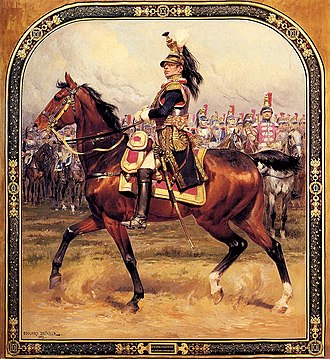
French cavalry general Jean-Joseph Ange d'Hautpoul
The Trumpet Call.

It happened before the Battle of Eylau, in 1807. Napoleon was driving the Russians before him as he moved forward towards the town of Eylau, when he found himself held up near Landsberg by a strong force of Russian infantry, posted in a defile, with several pieces of cannon in front. They were separated from the French by a deep ravine, crossed by a narrow bridge. Napoleon ordered a body of light hussars to cross the bridge and attack. They did so, but were met by such well-directed fire that they beat a hasty retreat. Napoleon then ordered a body of dragoons to advance and break the Russian square. They also failed. Then the cuirassiers were told to advance. These were the heaviest armed troops in the army. Both horses and riders were encased in heavy plates of steel armour, so that when they charged at full speed the impetus was terrific. 
The General in Command, Jean-Joseph Ange d'Hautpoul, was an enthusiastic admirer of Napoleon, and to be thus entrusted with a special commission was the most prized of distinctions. The cuirassiers charged so furiously that the Russian lines were broken, the square swept away, and the road cleared for Napoleon's advance. 
When General d'Hautpoul rode up to the Emperor to report, Napoleon did a very unusual thing. He dismounted and embraced him before the whole division. Quite overcome by this extraordinary work of the Emperor's gratitude and approval, the general, when he had recovered a little, drew himself up, saluted, and spoke thus: "Sire, there is only one way in which I can show my appreciation of the honour you have conferred upon me today: I must die for your Majesty." Next day he rode into the thickest of the fight at Eylau and fell mortally wounded.

Heroism.

Think of what it meant for a Commander-in-Chief to know he had men like that serving him! With what confidence he issued orders when he knew his followers were longing to prove their devotion by dying for him! It seems extraordinary that men should set so little store on life as to be ready to fling it away like a bauble for a beloved leader; yet that is what the human heart is capable of. And experience has proved that, when a great call comes which stirs men's souls deeply, this spirit of self-sacrifice leaps to life, and men and women go smiling to death for the sake of victory.
Jesus Christ knew this, and He came to appeal to this quality in the human soul. He came to wake to living flame this fire of whole-hearted devotion and loyalty; and the story of the Catholic Church during the past nineteen centuries or so bears witness to the success of His appeal. 
For the Catholic Church subsists age after age, full of life and energy, in the midst of a hostile world, just because of that fire that is kept ever blazing in the hearts of her children by Christ's unique appeal. For His appeal is not merely that of the best and greatest, the wisest and most glorious Leader and Captain the world has ever seen, fighting for the noblest cause it has ever been given to men to fight for — it is all that, too, but it is infinitely more. For, through Christ's lips, God Himself is stooping to ask His creatures for service.
Link (here) to the full article by Fr. Albert Power, S.J.

Friday, May 10, 2013

Fr. Albert Power, S.J., " The Catholic Church Needs A Much Larger And More Energetic Band Of Fire-fighters"

Fr. Albert Power, S.J.
Encouraging Vocations.

Now, it is clearly our duty to do all we can to help in fostering and developing vocations — both to the priesthood and to religious life — in children and young people under our care. The success of the Church depends greatly on the number and fervour of her priests and religious. Jesus calls them especially to be the salt of the earth. Just as salt preserves food from decay, so, by aiming at a life of holiness, and by making available to others the supernatural means of sanctification provided by Christ, priests and religious help to check the tendency to corruption, which is inherent in fallen human nature. It is true that on every man and woman lies this duty of resisting moral decay and sin, and anyone living a practical, Catholic life does actually and effectively promote this health-giving process. But, still, just as there are doctors and nurses specially devoted to safeguarding the public health, even though each individual has his own personal duty in the matter, so, in the spiritual world, there must be those who specially concentrate on the work of promoting the health of the soul. And what a splendid purpose in life it is! And how many more would take up the toilsome work of Priest or Brother or Nun, if only they understood better the excellence and nobility of the calling! In every human heart, not utterly perverted by self-indulgence and sin, there exists a longing after higher things; as is evidenced by the splendid response made when a sudden call to heroic sacrifice is made — for example, in time of war.
Saint John Bosco said: "I know young people well; a large proportion of them have, in germ, the vocation to a higher life." 
That germ it is our duty to develop. And at no time was it more urgent than today, when such wonderful opportunities are opening up for the conversion of heathen nations. The Catholic Church is at a turning point in her career. Mankind is being gradually linked up into a closer union by new methods of rapid transit and communication, and the barriers that hitherto walled off the uncivilised peoples of the globe are being broken down. Unexampled opportunities for disseminating knowledge are placed at the disposal of all who care to make use of them. 
The enemies of Christianity are making use of them with restless energy, to attack our religion; and the Catholic Church needs a much larger and more energetic band of fire-fighters to check the progress of the conflagration of evil doctrines and evil practices at present sweeping the world and threatening to engulf our civilization.
Those fighters are chiefly Priests, Brothers and Nuns and we should strain every nerve to recruit their ranks, which, especially in certain European countries, have been sadly depleted since the great wars of this century. Catholic parents should be led to consider it their greatest honour and privilege to devote to the service of God and the welfare of society one or more of their children. In no nobler way can they contribute to the extension of God's Kingdom on earth.
Link (here) to the full article entitled, Love Is Calling by Fr. Albert Power, S.J.

Sunday, March 3, 2013

Fr. Albert Power, S.J., "Papacy Is A Tribute To The Unshakeable Strength Of The Catholic System"

Pope Benedict XV
think of the two doctrines that are most characteristic of Catholicism and that have been exposed to the fiercest attacks of her enemies - namely, the authority of the Pope and the Real Presence of Christ in the Eucharist; and see whether these doctrines play a less intense part in the life of the Church in the twentieth century than they did in past ages. I think I am safe in saying that at no period of the Church's history have these two factors of Catholicism - the Papacy and the Eucharist - been so strongly emphasized, so honourably recognized, so passionately clung to and defended as they are today.
A vivid and palpable proof of the part which faith in the Eucharist plays in Catholic life is furnished by the great International Eucharistic Congresses of the past forty years, held in capital cities all over the civilized world. The success of these Congresses surpassed the wildest dreams of those who suggested them. Never in the long history of the Church have there been - at least outside of Rome - such magnificent public demonstration of Catholic belief in the Real Presence of Christ. That same intense belief is also responsible for the extraordinary increase in daily Communion since the great Eucharistic decree of Pope Pius X. made frequent reception easy for all the faithful.
Then, too, the events of the past fifty years, especially the happenings during the Great War and the world wide recognition of the splendid work and influence of Pope Benedict XV., and of our present Holy Father, PiusXI.; furthermore, recent events connected with the restoration of the temporal power and the recognition of the fact that the Pope, as head of a vast spiritual organization, including in its ranks men of every nation under heaven, must himself be quite independent, owing allegiance to no temporal sovereign, in order that he may be an impartial ruler of all - these events emphasize the unique position accorded to the Pope even by non-Catholics the world over. When we add to this the deep and special reverence and submission shown to him by the three hundred millions of his own subjects, one may well ask: On what foundation does this extraordinary dignity of the Pope rest - this majesty authority recognized in one man alone of the whole human race? The answer is: On the Catholic doctrine of the Pope's right to teach and rule as the successor of St. Peter. It is Catholicism that gives him his strength, and the honour paid by the whole world to the Papacy is a tribute to the unshakeable strength of the Catholic system, of which the Pope is the living embodiment. 
Link (here) to read the full piece by Fr. Albert Power, S.J.

Tuesday, October 16, 2012

Amazing Jesuit

Fr. Geoffrey Schneider, S.J.
As the world’s oldest full-time teacher, Sydney priest Geoffrey Schneider knows a thing or two about how to bring the best out of students. The secret, according to the 99-year-old, is “a mountain of patience”. “If things are going wrong, don’t start shouting. Just proceed quietly and things will settle down eventually,” said Father Schneider, who turns 100 in December. “Their books will eventually open.” The Jesuit priest has taught at schools in Sydney, Melbourne and Perth, shaping the intellects and values of leading figures of Australian government, business, academia and sport, including Tony Abbott. But as most workers switch between jobs or eagerly plan their retirement, 
Father Schneider yesterday signaled no intention of ending his 47-year tenure at Sydney’s St Aloysius’ College, where he is touted as the world’s oldest full-time teacher. Nobody has so far come forward to challenge that title. “Retirement?,” he says. “So I can read the paper every morning and then forget what’s in it? “That’s what a retired friend told me happens to him,” he said, recounting a recent visit to a home for retired priests. “At 3pm there’s afternoon tea and if you don’t turn up in the first minute they come knock on your door and say, ‘It’s tea time now’. “Really, I shouldn’t be frightened of it, but it just doesn’t appeal to me. I just feel I can be more useful here.” 
 Father Schneider’s thousands of former pupils also include Liberal frontbencher Joe Hockey, ABC political correspondent Mark Simkin and Wallabies star Pat McCabe. Asked whether Mr Abbott was an unruly youngster, Father Schneider chuckled he could never “invent anything better than has been in the news of late”. He politely added neither Mr Abbott nor Mr Hockey were particularly “troublesome children”. Father Schneider’s ripe age has some particular advantages, such as his lived experience of 20th century history and a handy grasp of Latin, preferred by some older Catholics. He enjoys a fierce popularity at St Aloysius’. In the early 1990s, Year 3 students were asked to name a new building after their favourite Jesuit saint. Innocently, they chose “Saint” Schneider.  
“I didn’t worry about it at the time, really, but after that we received a direction that the Jesuits were not to have any buildings named after them while they are alive,” 
 he said. “I don’t believe it wasn’t a direct consequence of what happened, but they managed to name the building before that order came down.” Father Schneider is also the namesake of the annual Schneider Cup, which recognises excellence in soccer and rugby.
Link (here) ucanews

Former Jesuit, Now Anti-Catholic

Having abandoned established Christianity, the former Jesuit priest and prominent historian, Dr Ian Guthridge, knows what religion 'looks and feels like' from the inside and from the outside. Dr Guthridge was a Jesuit priest for 20 years. In the late 1960s, after much deliberation and reflection, he abandoned the constraints of traditional religion, the priesthood and ultimately the church. He is now a historical and religious writer of note and joined Sonya Feldhoff in the studio to discuss the cases for and against religious belief, referring to his latest book "Religion - Faith, Fact or Fantasy?" 
Link (here) to the Australian Broadcast Company

Tuesday, May 3, 2011

Jesuit Reaction To The Removal Of An Extreme Liberal Bishop

Fr. Frank Brennan, S.J.
The sacking of Toowoomba Catholic Bishop William Morris was a "heavy-handed exercise of ecclesiastical authority," Jesuit priest and lawyer Father Frank Brennan said yesterday. 
Father Brennan said questions had been raised about the orthodoxy of Bishop Morris, effectively sacked by the Pope for his support of the ordination of women and other Liberal reforms, after his ordination as bishop 18 years ago. 
In a widely circulated letter, Father Brennan said he had first known the bishop when he was secretary to Archbishop Francis Rush in Brisbane. He was "then a very successful parish priest of the huge Gold Coast parish" before being made bishop of Toowoomba in 1993.
Link (here) to the full piece at The Australian

Tuesday, April 26, 2011

Fr. Gregory Jordan, S.J. The Exorcist Of The Archdiocese Of Brisbane

Bishop Julian Porteous
The North Sydney seminar was the second organised by Julian Porteous, the Auxiliary Bishop of Sydney, who stood in as exorcist for the archdiocese before a unnamed priest was appointed to the role last year. Bishop Porteous did not wish to comment yesterday but told the Herald last year that young people potentially risked a dangerous fascination with the occult, fuelled by the Twilight and Harry Potter series. He also warned an interest in the underlying spiritual beliefs of yoga, reiki massages and tai chi could lead people into the grip of ''demonic forces''.
Father Gregory Jordan, S.J., 80, who was appointed as exorcist to the archdiocese of Brisbane about 10 years ago, said in his experience ouija boards and astrology posed a risk. He said the growth in demand for exorcisms in Western countries, albeit from a low base, was unquestionable: he had performed four this week. 
The Jesuit priest, who was asked to preview The Exorcist in 1973, said the Catholic rite involving prayers to drive out the devil bore little resemblance to its depiction in popular culture. Most exorcisms dealt with ''oppression'' (feeling weighed down) or ''obsession'' (unusual, persistent negative thoughts) rather than possession,
Father Jordan said. ''After an exorcism I've had people say, 'I feel lighter.' They straighten their shoulders.'' A protocol in place stipulated that the subject of the rite was medically examined before undergoing it, he said.
''When there's real doubt, I simply … give them the Sacrament of anointing, which is quite appropriate and [with] which generally speaking they're quite happy,'' he said.
Link (here) to the full article at Sydney Morning Herald

Tuesday, November 16, 2010

Former Jesuit Says, " Jesuits,... Have Lost Their Inspiration"

Jack de Groot
Former Jesuit Jack de Groot, head of Catholic aid agency Caritas, is slightly sceptical of this notion. The Jesuit spirituality is attractive - ''people are redeemed by God to do good things. It's a large vision with a bit of risk-taking and adventure, and intellectual rigour and robustness'' - but he thinks there is a myth and mystique about Jesuits, which they trade on and encourage. He says they struggle to collaborate and that they have lost inspiration as they lose control of their enterprises. Jesuit provincial Steve Curtin acknowledges there is some justice in de Groot's criticism. ''We are doing more now than we've ever done,'' he says. ''There's lay leadership in a lot of areas. It's an evolving partnership, but it's not easy for Jesuits to learn to work collaboratively. We've been trained to take the initiative and be out on the front line without a lot of support or help. Teamwork has not been our forte.''
Link (here) to the full article in The Age

Tuesday, September 7, 2010

The Lingering Effects Of The Problem

Xavier College - Burke Hall in Melbourne, Australia
High-profile members of the campaign group Protest the Pope, an umbrella group of organizations opposing the visit, will meet Smith on Wednesday. They have planned a march on 19 September to coincide with his visit to the capital, which will culminate in a vigil in Hyde Park. Organisers meeting Smith include the g@y rights campaigner Peter Tatchell, Andrew Copson, the chief executive of the British Humanist Association, and Terry Sanderson, president of the National Secular Society. He said he would not be "lectured" by the archbishop. "There is a defensive tone in what [Smith] is saying," he said. "It is an indication of the church's fear that something will happen to bring the pope into disrepute. I think something should happen to embarrass the pope into, for example, confronting the child abuse scandal. We're not going to be kind to the Pope because he does not deserve to be respected." Although there is a rainbow coalition of groups opposing the papal visit, they have agreed a strategy that will focus on the stories of sexual abuse survivors. Organizers are planning to to fly abuse survivors into London from across the world for a press conference on 15 September, the eve of the visit. They include Mark Fabbro, an Australian who says he was s@distically r@ped by a priest at a Jesuit school (Xavier College-Burke Hall) in Melbourne in 1971, when he was 11.
Link (here) to the full article at The Guardian 

Saturday, June 19, 2010

Fr. Geoffrey King, SJ On The Excommunication Of Sr. Margaret Mary McBride

Abortion and excommunication

As a canonist I was taken aback by Bishop Olmstead’s declaration of a latae sententiae excommunication in the case of Sr Margaret Mary McBride. The immorality of Sr McBride’s action in giving advice that the termination of the pregnancy is at very least open to question, as Charles Curran (5 June) indicates. But I would argue on more narrowly canonical grounds that Bishop Olmstead’s declaration of a latae sententiae penalty is unjustified.
Canon 1329§2 deals with accomplices in a delict, and imposes a latae sententiae penalty only on those without whose cooperation the relevant offence would not have been committed. Laws imposing penalties must be interpreted strictly (canon 18). It seems to me that in the strict sense Sr McBride’s ethical advice was not indispensable to the termination of pregnancy.

Even if this argument were to be rejected, there would remain the even more significant list of factors that in effect excuse from a latae sententiae penalty. These are enumerated in canon 1324, and include motivation from necessity or even grave incommodum – which is a bit more than “serious inconvenience”, but still a rubric under which saving a human life would surely fall. Even if one erroneously believes that such a factor is present, it is enough to excuse from the penalty. Canon 1324§1 ends with the more general statement that one who acts without full imputability, even where the imputability remains grave, is not bound by a latae sententiae penalty (cf. canon 1324§3). Given that we are dealing with a disputed moral question, and that Sr McBride was surely motivated by the desire to save a woman’s life, her imputability surely falls short of being “full”.

Whether Sr McBride acted rightly is perhaps open to argument, but it is a huge canonical step from a wrong action to an offence meriting excommunication.

Fr. Geoffrey King, SJ

Link (here) to the Tablet.

Thursday, June 10, 2010

Jesuit On Holy Orders, Transubstantiation And The Year Of The Priest

The Year of the Priest ends this week. Suitably enough, it ends in the week that began with the Feast of Corpus Christi which is one where the Eucharist gets focus. One of the heresies common among Catholics - I've even heard it from priests - is that the supreme significance of priesthood is that from Ordination on, the priest has the power to change bread and wine into the body and blood of the Lord. It was put that starkly by one commentator responding to my recent blog on the Real Presence of Christ in the celebration of the Eucharist.

From the Catechism of the Catholic Church

1336 The first announcement of the Eucharist divided the disciples, just as the announcement of the Passion scandalized them: "This is a hard saying; who can listen to it?" The Eucharist and the Cross are stumbling blocks. It is the same mystery and it never ceases to be an occasion of division. "Will you also go away?": the Lord's question echoes through the ages, as a loving invitation to discover that only he has "the words of eternal life" and that to receive in faith the gift of his Eucharist is to receive the Lord himself.

The institution of the Eucharist

1337 The Lord, having loved those who were his own, loved them to the end. Knowing that the hour had come to leave this world and return to the Father, in the course of a meal he washed their feet and gave them the commandment of love. In order to leave them a pledge of this love, in order never to depart from his own and to make them sharers in his Passover, he instituted the Eucharist as the memorial of his death and Resurrection, and commanded his apostles to celebrate it until his return; "thereby he constituted them priests of the New Testament."
Link (here)


Wednesday, June 2, 2010

Your Darling Dr. Bert

Noreen Wood made her first suicide attempt in August of that year and was sent to the Melbourne Clinic - the first of 10 admissions over the next four years. Meanwhile, 
Fr. Herbert Balding, S.J.  (here) , (here) and (here) was moved to the Jesuit centre at Sevenhill in South Australia, where he wrote to her that the ''shrinks are not doing you any good. It's time to put yourself into the hands of your darling Dr Bert''. Somehow, he persuaded her husband and her psychiatrist that she needed a holiday, and he arranged for her to come to Sevenhill, where he would try to have sex with her while the other Jesuits said Mass next door. 
After Wood's husband, suspicious by now, complained to the police and the Melbourne vicar-general, Balding was sent to Tennant Creek in the Northern Territory in 1979. From there he rang her so often that the bishop queried the phone bill, Wood says, while she got sicker and sicker. In 1983, he returned to Melbourne as emergency chaplain at St Vincent's and wanted to resume his relationship with Wood, who had separated from her husband. She refused. In 1987, a friend suggested another Melbourne Jesuit priest as someone she could talk to. She met the priest - who she now calls an opportunistic predator - in his room at the Jesuits' house in Parkville. After a long conversation, she says he kissed her on her mouth. Wood says she threatened another suicide attempt, so the Jesuit arranged for her to stay with his mother. It was New Year's Eve, and the mother went out to visit friends, leaving the priest to look after her.
''All his talk was of a s@xual nature. He was using f--- and worse. I'm not stupid, I know when a guy's getting revved up. He's telling me about his e...@ulations and drinking. He pushes me against the wall and tells me in explicit language what he'd like to do to me. But when someone walks past the unit he jumps away. ''He told me the only reason he didn't do what he wanted was because 'it would look as if every f---ing Jesuit was f---ing me'.'' 
Later, when Wood asked him why he behaved like that, she says he told her he had to stop her ''coming on'' to him - he had to speak that way as a form of shock treatment.
Link (here) to the full article at the Australian national newspaper The Age. 

Photo is of St Aloysius Church, Sevenhill, in the Clare Valley, South Australia  
 
Background and further details can be found at
 Melbourne women in legal row over abuse claim at CathNews
Row over abuse claim settlement at The Age

Wednesday, May 26, 2010

"Unless You Eat The Flesh Of The Son Of Man And Drink His Blood, You Do Not Have Life Within You." A Quote By Jesus As Found In John 6:53

Stating that “Catholics can become fanatical about one form of the Body of Christ in the bread of the Eucharist as the REAL presence of Christ,” Father Michael Kelly, the Jesuit CEO of the Asian Catholic news agency UCA News, criticized the doctrine of transubstantiation in a May 24 column. In his column-- a critique of the new, more accurate liturgical translations that reflect the content and dignity of the original Latin-- Father Kelly writes:

Regrettably, all too frequently, the only Presence focused on is Christ’s presence in the elements of bread and wine. Inadequately described as the change of the “substance” (not the “accidents”) of bread and wine into the body and blood of Christ, the mystery of the real presence of Christ in the Eucharist carries the intellectual baggage of a physics no one accepts. Aristotelian physics makes such nice, however implausible and now unintelligible, distinctions. They are meaningless in the post-Newtonian world of quantum physics, which is the scientific context we live in today.
The Catechism of the Catholic Church, on the other hand, teaches:

The Council of Trent summarizes the Catholic faith by declaring: "Because Christ our Redeemer said that it was truly his body that he was offering under the species of bread, it has always been the conviction of the Church of God, and this holy Council now declares again, that by the consecration of the bread and wine there takes place a change of the whole substance of the bread into the substance of the body of Christ our Lord and of the whole substance of the wine into the substance of his blood. This change the holy Catholic Church has fittingly and properly called transubstantiation." (no. 1376)

Source(s): these links will take you to other sites, in a new window.

Link (here) to the Catholic Culture piece.

Wednesday, April 28, 2010

Left To Their Fate

Father Adolf Kristen and Brother Vinzenz Scharmer are the first Austrian Jesuits to cast their eyes on the Daly River – here the missionaries are going to attempt to convert the Aboriginal people in the area to the Roman Catholic faith. But – the author of the diary records – as the two men step to the water’s edge they are disappointed: “No doubt they expected to find it resemble the Danube in its majestic flow, and found it smaller than the river Inn!” What they saw in the surface of the water is to all intents and purposes their own reflection … 

“The river is starting to rise.” 
And then the floods come, as in almost every year; but this time it almost completely destroys the Jesuits’ settlement – shortly after the Superior, with the authorization of the Superior General in Rome, decides that all the missionaries must leave the Daly River from one day to the next. No one else compares the river with the Inn or the Danube. The Aborigines are left to their fate. The flood is not the only reason for abandoning the mission. The mirror images have now become dim, blurred and distorted.
Link (here) to at the website Environment History Network the article is entitled, at the Riverside: Jesuit Missionaries.