Showing posts with label Italian Jesuits. Show all posts

Friday, April 26, 2013

Fr. Paolo Dall'Oglio, S.J., "..Commit Oneself To The Struggle For Justice, Including Militarily,"

As confusion continues to surround the whereabouts of two kidnapped Orthodox bishops in Syria, a Jesuit expert says it's time to "decriminalize" the word jihadist in thinking about the conflict
"It means a believing Muslim person who's obedient to the divine order to commit oneself to the struggle for justice, including militarily," Jesuit Fr. Paolo Dall'Oglio told a crowded assembly Tuesday afternoon in Rome. 
He compared the armed uprising in Syria to the Italian resistance against fascism. "There is no contradiction between jihad and democracy," Dall'Oglio insisted. Dall'Oglio was speaking at a conference on Syria organized by FOCSIV, a federation of organizations of Christian volunteers. He was joined by Franco Frattini, an Italian politician and the country's former foreign minister under the center-right government of Silvio Berlusconi. Frattini began by confessing he wasn't sure what to do about the Syrian conflict, in part because he's not clear "on the force of jihadist movements within the opposition."
Link (here) to the Fishwrap

Thursday, April 11, 2013

Fr. Giovanni La Manna, S.J., "Francis I Will Not Create Conflicts Between Obeying The Father General And His Holiness.

Fr. Giovanni La Manna, S.J.
Jesuits must obey not only the pope, but also the Father General -- the so-called Black Pope -- who is currently Adolfo Nicolás. How will they relate to these two figures?

I believe that the new pope is an exceptional person, in both a spiritual and a human sense, and that he will have the maturity to avoid any type of conflict. As for the mission of Jesuits, they take a vow which goes beyond obedience: the so-called "fourth vow of obedience to the pope." Based on this vow, the pope can ask Jesuits to undertake a mission at any moment, and Jesuits are bound to obey him, regardless of the Father General's wishes. But I am certain that this won't happen: Francis I will not create conflicts between obeying the Father General and His Holiness.

What is the significance of the first Jesuit pope for the Church's history?

It is certainly something new, and like all new things it will bring joy and curiosity among the faithful. Personally, I am very happy and curious to see how a Jesuit pope will move forward.

From your perspective, will there also be some recognition of your order?

The new pope is a person who received a Jesuit education, and those who have been Jesuits for years cannot erase their origins. His education influenced the way he conducted himself as the Archbishop of Buenos Aires; a man is unlikely to forget that which has shaped him. The fact that he is a Jesuit will influence the way he serves the Church. We have already had a taste of this in tonight's greeting -- in his request that the faithful pray for him even before blessing him. Just as the pope blesses the people of the Church, Francis I asked his people to bless and pray for him.

What does his name mean? Do you think he chose it in reference to St. Francis and his vow of poverty?

Since His Holiness has a Jesuit history, I very much think that he chose it with St. Francis Xavier in mind (San Francisco de Jasso Azpilcueta Atondo y Aznares de Javier), one of the first missionaries who tried to evangelize in new lands. I believe that the choice is rooted in His Holiness' own history and therefore in that of the Jesuits.

Thinking and living as a Jesuit, I immediately thought of this reference to our Francis Xavier, a important saint for Jesuits and one of the first blessed witnesses of the Society of Jesus, who spent his entire life on his mission of evangelization. I am sure that this name rings in the spirit of His Holiness.

What kind of pope will Frances I be? Will he offer a break from the past, or continuity?


He will certainly keep the path of his predecessors in mind. But he will assign priorities in his own way, and the fact that he is a Jesuit will affect how he identifies these priorities. Considering the name he has chosen, he will surely be a man committed to the New Evangelization in the Year of Faith.

He will guide the Church with the attention of someone looking at the world from another point of view -- in his case, from Argentina. And in that way he will help bring fresh air and a review of priorities to the universal Church. All of this brings nothing but excitement and enthusiasm to the Church. Returning again to his first speech as pope: By asking the faithful to bless him, he began a dialogue -- a new reciprocal relationship. It is not a one-way speech, but one which bespeaks a sense of shared reality.
Link (here) to the full interview of Fr. Giovanni La Manna, S.J. the President of The Astalli Canter in Rome

Monday, March 18, 2013

Fr. Giovanni La Manna, S.J., "This Choice Moves The Entire Thread Of Our History"

"This choice moves the entire thread of our history," said Jesuit priest Giovanni La Manna, who heads the Astalli Foundation in Rome, a Catholic nongovernmental organization for refugee rights. "If the Lord has called the only Jesuit cardinal to become pope there must be a reason, and I'm sure we'll understand later why." Perhaps it was just a matter of time before a Jesuit was selected, as the Vatican itself is located near a 16th century fresco in the center nave of the Church of Jesus in Rome where lie the remains of St. Ignatius of Loyola, the revered founder of the Society of Jesus. 
In his day, St. Ignatius was called on by Pope Paul III to help reform a broken church that was combating corruption and a waning influence. Experts believe that, last week, another Jesuit was elected in a conclave to shepherd the Catholic Church out of a crisis of credibility -- but, this time, directly as pope. The announcement left many Jesuits dumbfounded as they heard the name of their only cardinal elector being spelled out in Latin from the balcony on the night that white smoke wafted over St. Peter's Square. 
"It's just such incredible news because Jesuits don't expect to become bishops, let alone the pope," said Fr. Gerard Whelan, Jesuit professor at the Gregorian University in Rome. Indeed, popes have punished Jesuit theologians for being too progressive in preaching and teaching. The just-retired Benedict XVI, sent a polite but firm letter inviting the order's worldwide members to pledge "total adhesion" to church doctrine, including on divorce, homosexuality and liberation theology. The order, which now comprises about 19,000 men worldwide, was founded by seven men who bonded together as they took their first vows of chastity and poverty in Paris in 1534.
Link (here) to Newsday

Monday, February 18, 2013

Fr. Domenico Grasso, S.J., "Chrestians"

Tacitus, a great Latin historian, writing around the year 116, devotes a whole page of his Annals to Jesus. In speaking of the burning of Rome, which was presumably the work of Nero himself, he attempts to recapture the drama of the destruction of Troy. Tacitus claims that the emperor, in order to quell the voices accusing him of having been the cause of the disaster, accused those people who were called "Chrestians". He goes on to say that the founder of this sect,
Christ (Chrestus), had been put to death by the Roman procurator, Pontius Pilate, during the reign of Tiberius. This 'dangerous superstition' which, for a time was successfully controlled, began to spread from Judea, where it first originated, to the City (of Rome), where all the most common and shameful things seem to congregate and win applause. (Annals, XV, 44) 
This brief description, which Tacitus probably found in the Senate archives, fully supports what we knew of Jesus from the Gospels. He is a Jew who was put to death, under the reign of Tiberius, by the procurator Pontius Pilate; he was the initiator of a religious movement whose followers are called Christians. For the Latin historian, Jesus is an historical personality, living at a precisely determined moment in history, a few decades prior to Tacitus' writing. Tacitus' witness is confirmed by the writings of Suetonius around the year 120. In his Life of Claudius, he tells us that this Emperor expelled the Jews from Rome because of their constant agitations "over Chrestus". (Vita Claudii, XXV) The word which he uses, "Chrestus", obviously stands for Christ, the Greek translation of the Hebrew term "Messiah" (anointed). Suetonius alludes to the frequent heated debates between Christians and Jews on the nature and teachings of Christ. Still, as Abbot Giuseppe Ricciotti, C.R.L observes, "since he was only poorly informed on the subject of Christianity, Suetonius seems to believe that this Chrestus was personally present in Rome at the time and had provoked the rioting himself". (Ricciotti, Life of Christ, 2nd ed., Milan, 1941, p.107) But even for Suetonius, Christ is a real person and not a myth. Before Tacitus and Suetonius, Pliny the Younger, Roman governor of Bithynia (in modern Northern Turkey), in his correspondence with the Emperor Trajan (A.D. 112) speaks of Christians and their presence throughout the territory under his administration.
Describing their religious practices, he says that they used to congregate at dawn on a given day to sing hymns to Christ whom they regarded as their God. (Pliny, Letters, X, 96) 
From this testimony, written less than 100 years after the death of Jesus, we have exact information regarding the place and time in which Christ lived. These sources speak of him as an historical personage, and not a myth, as would be expected from the Orient. 
Link (here) to the piece by Fr. Domenico Grasso, S.J. entitled, The Gospels: Historical and True

Thursday, November 15, 2012

From The Chapel Of The Jesuit Infirmary In Rome


A mosaic of Mary and Joseph presenting the child Jesus to Simeon decorates the chapel of the Jesuit infirmary in Rome June 8. The Vatican's Congregation for Divine Worship and the Sacraments is establishing an office to promote the development and use of appropriate liturgical art, architecture and music.
Link (here) to the Catholic Register

Saturday, July 28, 2012

80 Years Of Jesuit Run Vatican Radio

Guglielmo Marconi and Fr. Giuseppe Gianfranceschi, S.J.
Vatican Radio, which is managed by the Society of Jesus, celebrated 80 years of broadcasting earlier this month. The station debuted with a broadcast of Pope Pius XI in Latin on February, 12, 1931. Jesuit Father Giuseppe Gianfranceschi was the first director of Vatican Radio, and today Jesuit Father Federico Lombardi holds the position. To commemorate the anniversary, there is an exhibition at the Vatican Museums and a book on the history of the last 30 years will be published in September. Fr. Lombardi explained why the pope wanted the radio station created: “To talk freely across borders in an age in which totalitarianism was spreading, there was Bolshevism in the East, there was Nazism on the horizon, there was Fascism and so on. Being able to speak freely with people around the world, also in particular, churches that were experiencing difficulty or being persecuted, was absolutely vital. Vatican Radio is a place in which many people prepare the news and information in different languages to give the pope and the church a voice in today’s world,” Lombardi said.
Link (here) 

Monday, July 9, 2012

Italian Jesuit On Islamic Hell

Father Paolo Dall'Oglio, S.J. a brawny bear of a man who enunciates each word with a theatrical sense of certitude, scoffs at the "jihad priest" label. He says he remains committed to a peaceful resolution of the conflict in his adopted homeland — a "jihad of the spirit, not a jihad of arms," as he declared during a recent stay in the rebel-occupied Syrian town of Qusair. 
Still, the Italian-born priest warns: "If nonviolence becomes another name for a lack of responsibility, then I am not with nonviolence anymore. I am with the right to defend people." Talk like that helped get Dall'Oglio expelled from Syria last month after 30 years in Syria, 
where his devotion to Christian-Muslim "harmony" earned him a global following as a charismatic and pugnacious interfaith visionary. The outspoken cleric says he was "kicked out" by church authorities acting on demands from the Syrian government, enraged by his strident pronouncements backing the 16-month uprising against President Bashar Assad. He evinces little sympathy for fellow Christians who fear Assad's fall could unleash an era of Islamist repression."They are in a state of Islamophobia," Dall'Oglio says of Syrian Christians still loyal to a fraying police state that has throttled dissent but tolerated religious minorities for more than four decades. "From the 1980s, all they've heard, repeated and repeated, is that without the Assad state, Syria would be an Islamic hell."
Link (here) to The LA Times

Thursday, June 21, 2012

"Bury Me At The Feet Of Aloysius Gonzaga."

St. Aloysius Gonzaga, S.J.
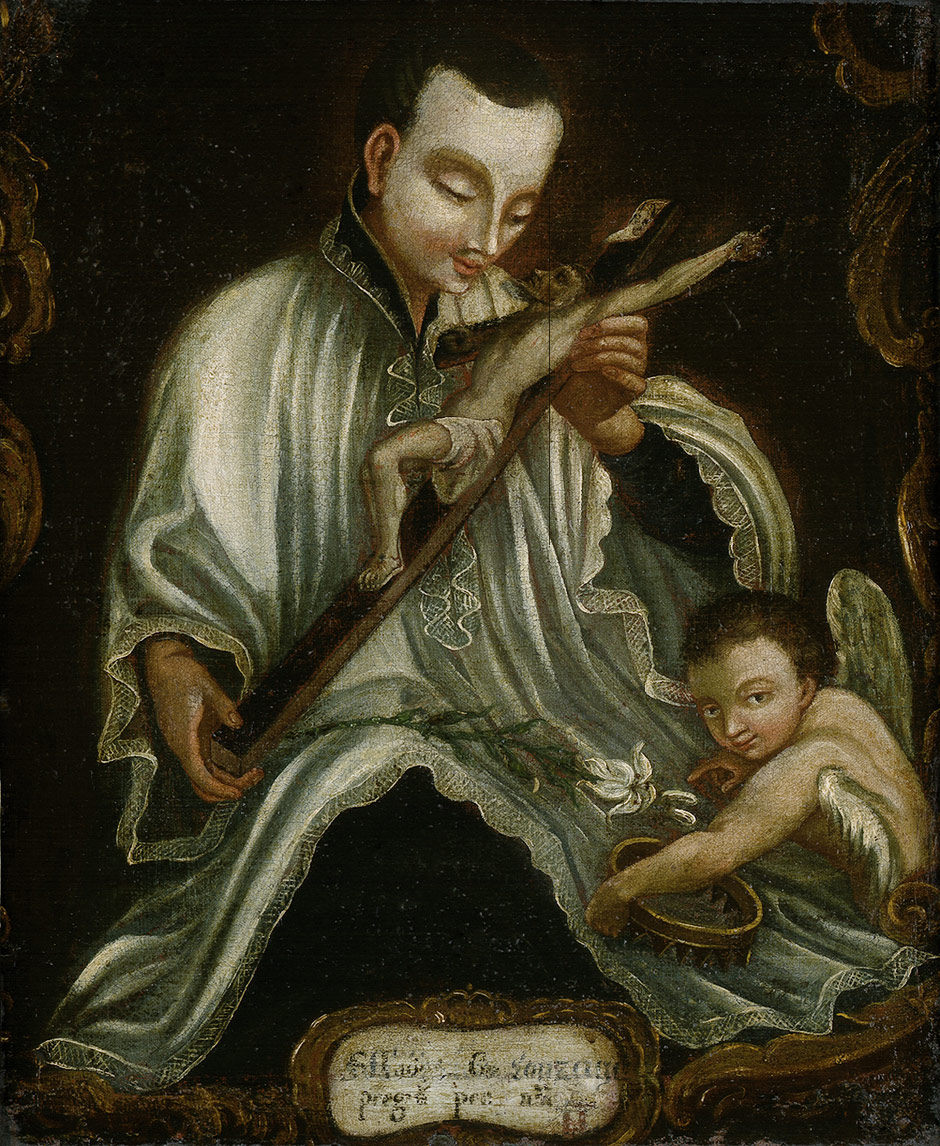
The Jesuits lost a devoted friend in the person of St. Charles Borromeo, who died in 1584. It is a calumny to say that he had turned against them and had taken the seminary of Milan from their direction. It was they themselves who had asked to be relieved of the responsibility, for he had so multiplied their colleges in his diocese, that it was impossible to give the seminary the attention it required. It is true that he was greviously offended by one individual Jesuit who injected himself into a controversy that was going on between the governor and the archbishop, and assailed the great prelate in the pulpit of the very church which had been given to the Society by Borromeo; but Claudio Aquaviva quickly brought him to the cardinal's feet to ask forgiveness, and then suspended him for two years from preaching. That incident, however, in no way diminished the affection of the saint for the Society. His last Mass was said in the Jesuit novitiate which he had founded, and he died in the arms of his Jesuit confessor, Father Adorno, two days afterwards. Seven years later, on June 21, 1591, another saint died, the young Aloysius Gonzaga. Borromeo knew him well, and had given him his first Communion. This boy saint was not only an angel of purity, but also a martyr of charity, for he died of a fever he had caught from the victims of a plague whom he was attending during a pestilence that devastated Italy. The venerable Robert Bellarmine was his confessor and spiritual father, and, later, when he was about to expire, he said to those around him: "Bury me at the feet of Aloysius Gonzaga."
Link (here) to the Jesuits

The Church Is Endangering Christians

Fr. Paolo Dall'Oglio, S,J,
Christians, who make up around 10% of the Syrian population, have been split by the uprising. Some have sided with the regime and some with the opposition, while the fearful majority have remained on the fence. This has caused splits in some mixed communities. Just before leaving, Father Paolo Dall'Oglio, S.J. an Italian who brokered the release of a Christian held in Qusayr, a town close to the mixed city of Homs where the violence has been most fierce. “Those who had taken them—and they were not mainstream members of the opposition—saw the church in full alliance with the regime. The church is endangering Christians,” he says. “But I was comforted by the fact they said they were not against Christians but against those who had collaborated with the regime.” Father Paolo hopes that the violence can be stemmed so the civil war doesn't eclipse an uprising that is calling for a plural, democratic country. "I see an Islamic bent in the armed opposition," he says. "We need not be afraid of Islamists but the less democratic ones will come to the fore as the war continues.".
Link (here) to read the full story at the Economist.

Sunday, June 17, 2012

"Jesus Is Beautiful, Jesus Is Beautiful."

Oh supernatural beauty of my Jesus, which made an impression even on the animals themselves! Oh ungrateful men, where is your heart? Is it possible that you are not moved at the sight of such lovable beauty? The cause of your insensitiveness is obvious: If you do not love Jesus, it is because you do not know Him. My brother, what is it that has the greatest power over your heart? Beauty, is it not true? Why do you not turn then your love towards this beauty of Jesus so pure and so holy? If only you knew, my brother, how beautiful He is, my Jesus ----- "Love Me, My daughter," He said one day to a virtuous virgin to whom He appeared, "Love Me, My daughter, because I am beautiful, generous and noble of heart." 
Yes, my lovable Jesus, You are certainly beautiful and You have by Your beauty alone softened the most obstinate hearts from evil ways. Fr. Bernard Colnago, S.J. found himself once in a cottage with five brigands and a wicked woman. What did he do to convert them? Did he open Hell before their eyes? No, but assuming a religious countenance, he said to them in a serious and modest tone, "Jesus is beautiful, Jesus is beautiful." 
These words were the arrows which pierced those hearts of stone and all were converted. 
Link (here) to read the full mediation entitled The Beauty of Jesus by St. Leonard Port-Maurice

Saturday, May 5, 2012

The Madonna Is Here With Us

 Photo from the sky over Jesolo, Italy

A mysterious figure of light has inspired a lively debate among Italians ever since it appeared in the sky briefly before a Medjugorje prayer meeting took start in Jesolo a bit north-east of Venice on October 16. About 8.20 in the morning attendees outside the multi-hall Palaturismo suddenly stopped and looked to the sky. Meanwhile, the Blessed Sacrament was being carried into Palaturismo. 
“We all saw what appeared to be a cloud but then it was clear that there was not a cloud anywhere. It was the Madonna of Medjugorje who had appeared in Jesolo to protect us” 
a young, un-named man from Jesolo who attended the whole day told the local newspaper Nuova Venezia....... “Having now seen the place from the outside, there is nothing that could have created a reflex, like a window. We can also exclude possible effects from the camera equipment: A flash was not used which may have overexposed some object, and it can not be a stain or dirt on the objective which would have resulted in a dark, black figure. The explanation of the meteorite is at least bold: They leave a trail with a very different intensity of light” Daniel Miot writes on his blog. “I think it is real, that something really appeared in the sky.” 
The same conclusion was reached by attending priest Fr. Massimo Rastrelli, a Jesuit from Naples. “The Madonna is here with us, even though there is no visionary” 
he told the attendees. Interviewed by Nuova Venezia he later re-affirmed his conviction that the Virgin had, indeed, appeared.
Link (here) to  Medjugorje Today

Thursday, May 3, 2012

Fr. Giuseppe De Rosa, S.J. On The Jehovah Witnesses

Charles Taze Russell the founder of The Jehovah Witnesses
Fr. Giuseppe De Rosa, S.J. contends that Jehovah's Witnesses are not Christians because they have falsified Sacred Scripture. According to the article, they do not have a proper religious life and, what is perhaps worse, suffer in the organization from a kind of mental plagiarism, which leads them to break all human relations with anyone who is not part of their organization.  The author gives a number of proofs to support his statements. For example, the Witnesses cannot be classified as Christians, because they deny two dogmas without which Christianity would not exist: the Holy Trinity and Jesus' divinity, as the incarnate Son of God.  
In spite of the fact that Jehovah's Witnesses call themselves the "only true Christians," for them "Jesus is not God but the first creature of God and they identify him with Michael, the Archangel," writes Fr. De Rosa.  Moreover, "they have their own Bible, which is not the Hebrew-Christian one," notes the article, and it is translated "in a way that confirms the Witnesses' doctrine," falsifying "essential things, making it say things it does not say or even say the contrary of what it says."  Moreover, the Jehovah's Witnesses do not have "religious practices or a sacramental life." 
Fr. De Rosa specifically notes the case of Baptism, which for the Witnesses is only an outward sign of a decision to follow Jehovah. Once a year a meeting is held to commemorate Jesus' death. The ceremony includes a solemn prayer, a hymn, a memorial of Jesus' Last Supper, and the "passing of the symbols," that is, the bread and wine, which, however, not all consume, but only those who feel they are part of the 144,000 'anointed' destined to be in heaven with Jesus, while all the other Jehovah's Witnesses will live in a kind of terrestrial paradise.  
The fact that the end of the world did not come in 1874, or 1914, or 1925, or 1975 as predicted by the Witnesses, and that at present all that is said is that the date is "imminent but not specified," does not cause a crisis in the followers, is due to the "psychological hammering" to which they are subjected, according to the theologian. 
"This causes the destruction of what is most human in man: his ability to think autonomously, to reason and to exercise his critical capacity, his liberty."  According to Fr. De Rosa, the Jehovah of the Witnesses "is not the Father and the Friend of all men. He recognizes only the Witnesses as his own, and he has prepared the terrestrial paradise only for them. What awaits all other men is destruction and extermination." In other words, he is "a God-Exterminator of millions of people," 
Link (here) to the full piece at EWTN

Monday, April 30, 2012

Fr Fio Mascarenhas S.J. On Discerning Spirits

The Holy Spirit by Giaquinto, 1750s.
– the following are some general signs
  1. Truth. If a person maintains opinions that are manifestly against revealed truth, the infallible teaching of the Church, or proven theology, or philosophy, or science, it must be concluded that he/she is deluded by the devil or is the victim of excessive imagination or faulty reasoning.
  2. Docility. Persons moved by the Holy Spirit accept with true peace the advice and counsel of those with authority over them. They manifest sentiments of humility and self-effacement.
  3. Discretion. The Holy Spirit makes the person discreet, prudent, and thoughtful in all his/her actions. There is nothing of precipitation, frivolity, exaggeration or impetuosity; all is well balanced, edifying, and full of calmness and peace.
  4. Peace. The person experiences a profound and stable serenity in the depths of his/her spirit.
  5. Purity of intention. The person seeks only that God’s will be done and that God be glorified in all that he/she does, without human interest or motivation out of self love.
  6. Patience in suffering. No matter what its source, or whether or not it is justly received, the soul bears it with equanimity.
  7. Simplicity. Together with veracity and sincerity, this is never lacking in those who are truly motivated by the Spirit. Any duplicity, arrogance, hypocrisy, or vanity must be attributed rather to the devil.
  8. Freedom of spirit. First of all there is no attachment to any created thing, even the gifts received from God. Second, all is accepted from the hands of God with gratitude and humility, whether it be a question or consolation or trial. The opposite would be done in the case of those with a rigid and unyielding will, who are controlled by self love.
  9.  Link (here) to the full article.

Saturday, March 31, 2012

Fr. Marcello Mastrilli, S.J. And "Hell's Mouth"

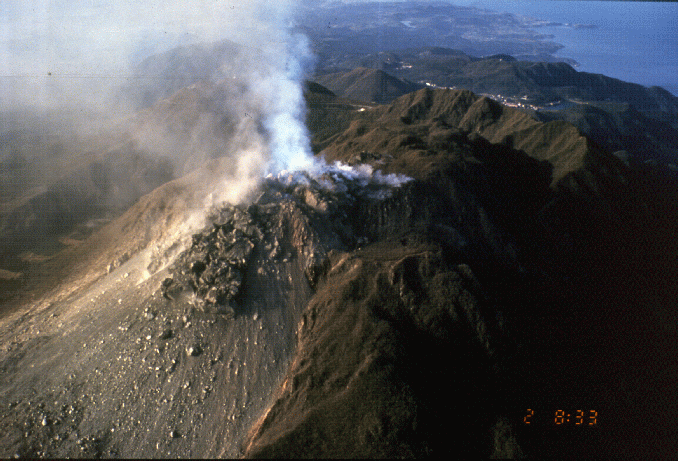
Mount Unzen in Japan
In spite of all the edicts and precautions of the Japanese Government, several devoted Missionaries still contrived to evade the vindictive vigilance of the officials, and to remain on the island in disguise. Among these was Father Spinola, who said that the day on which he put on this disguise was one of even greater happiness than that on which he entered the Society. He was indeed needed ; for cruel persecutions arose everywhere, accompanied by new and hideous tortures. Christianity was to be stamped out by any and every means. At Arima and Chimabara the people were punished with mutilations and slow torture, and on the site of the college and church of the Jesuits two hundred persons were tortured to death in a most sickening manner.

Monday, March 26, 2012

Italian Jesuit In Communion Controversy

Fr. Franco Annicchiarico, S.J.
.....celebration of Mass in the Chapel of La Sapienza University of Rome (photo), run by the Jesuits ( http://www.uniroma1.it/sapienza/cappella/i-gesuiti ): The celebration was chaired by the Deputy Chaplain, Father Franco Annicchiarico, S.J...... while I was still kneeling, the celebrant has shunned me wandering and began to distribute Communion to the other. After a second of dismay I got up and went to sit on the front bench. Needless to say my dismay and my desolation: "To refuse communion because I showed devotion to the Holy Eucharist, as if I were a heretic, an excommunicated, which gives a public scandal! It allows the communion to practicing homosexuals, and even full-blown and you deny me just because I knelt down! "
Link (here) to the Italian blog Messa en Latino to read the full post.
Blogger Note: Website is in Italian use translation tool.

Tuesday, February 7, 2012

Abundance Of Divine Light

St. Aloysius Gonzaga, S.J.
Passing over the names of many grave, learned, and pious divines, names carrying much weight in their day, we may rest satisfied with the testimony of the great Robert Bellarmine, whose high reputation for spiritual gifts and theological science is still fresh in our times. As Aloysius's confessor, we have had occasion to record his opinion more than once in the course of the saint's life. It may here be added that he was in the habit of saying that so long as Aloysius was at the college, he did not fear that any evil could happen to it; and in a discourse delivered before the whole community in the year 1608, he has left on record an attestation truly remarkable, as coming from one whose own soul was so sublimely illuminated. 
"When I gave," he said, "the Spiritual Exercises of St. Ignatius to Luigi, I discovered in him such abundance of divine light, that I must confess that, at my advanced age, I learned from this youth how to meditate." 
When raised to the Cardinalate, the venerable prelate not only continued his yearly practice of repairing to the College church of the Company to venerate the tomb of Aloysius on his anniversary, but used to make a devout visit to the room whence he had taken his flight to Heaven, and there would shed tears of tenderness in memory of their last parting. Viewing this apartment as a hallowed spot, he did not think it ought to be used any longer as a common infirmary, and the superiors readily acquiesced in his desire. 
Heaven itself seemed to signify its approval, for many times was sweetest music heard to issue from it. No research could ascertain the source of these melodious strains; whence it was piously inferred that they proceeded from choirs of angels who descended to consecrate with their songs the spot from which their loved companion had left the earth to take his place in their glorious ranks. 
When the Holy See had declared Aloysius to be in the possession of eternal glory, the cardinal had this room converted into a chapel at his own expense. He rendered his crowning testimony by desiring to be laid after death at the feet of "the blessed Aloysius," once his spiritual son, but, in the spirit of obedience, left the disposition of his body to the will of his superiors; and they, to confer upon him the greatest honour within their power, deposited him in the same
Link (here) to the book entitled, The Life of St. Aloysius Gonzaga, S.J.

Monday, November 7, 2011

7,000,000,000

Fr. Federico Lombardi, S.J., the director general of Vatican Radio, welcomed the birth of the seven billionth person in his weekly editorial.“Dear baby number seven billion,” said the Italian priest Nov. 5, “we pray that you can understand that your life will find its fullest meaning not in this world but in the next. Because this is what you were born for. Your Creator and Father made you for this"
Link (here) to CNA/EWTN

Friday, November 4, 2011

John Nelson Darby's Jesuits

Dispensationalism is a method of Bible interpretation which was first devised by John Nelson Darby (1800-1882), and later formulated by the controversial American Cyrus Ingerson Scofield [sometimes referred to as Cyrus Ingersoll Scofield] (1843-1921), and is also known as Pre-millennial Dispensationalism. Although Darby was not the first person to suggest such a theory, he was, however, the first to develop it as a system of Bible interpretation and is, therefore, regarded as the Father of Dispensationalism. The origin of this theory can be traced to three Jesuit priests; (1) Francisco Ribera (1537-1591), (2) Cardinal Robert Bellarmine (1542-1621) one of the best known Jesuit apologists, who promoted similar theories to Ribera in his published work between 1581 and 1593 entitled Polemic Lectures Concerning the Disputed Points of the Christian Belief Against the Heretics of This Time, and (3) Manuel Lacunza (1731–1801). The writings of Ribera and Bellarmine, which contain the precedence upon which the theory of Dispensationalism is founded, were originally written to counteract the Protestant reformers' interpretation of the Book of the Revelation which, according to the reformers, exposed the Pope as Antichrist and the Roman Catholic Church as the whore of Babylon.
Link (here)

Monday, October 24, 2011

Novices in the Society of Jesus:Antonio Valentino, S.J. and the Novitiate at Novellara, Italy
by Fr. Peter J. Tongi, S.J.  Go read the very interesting essay  (here)

Saturday, October 8, 2011

If I Were Dying

Fr. di Antonio Spadaro, S.J.
"Remember that I will die soon is the most important tool I've ever met to make the big choices in life": these are the words that Steve Jobs delivered June 12, 2005 in a famous speech to the graduates of Stanford. This "commencement address", was a unique opportunity for him to tell himself. Re-read this speech on the day that Steve Jobs has left this earth is probably a good way to honor him. And Steve is right. His words echo those of Ignatius of Loyola, the founder of the Jesuits, who believes that one way to make a good choice in life is to do "as if I were dying, and so smooth, I'll believe my decision ( Spiritual Exercises, 186). Death is not the case of Ignatius and Steve a bogey, but the finding that the fears, the futility and embarrassment disappear before the thought of death and what really counts is what is really important for us.I do not know if Jobs was a believer. From this discussion it is not claimed much. Here I simply speak of the inner disposition to make meaningful choices in life, focusing on what matters. No man, believer or unbeliever, can make choices in life thinking of himself as immortal.
Link (here) to Italian Jesuit di Antonio Spadaro, S.J.