Showing posts with label Jesuit Media. Show all posts

Saturday, April 26, 2014

Acerbus Jesuit

John Paul II could not accept open debate and discussion in the church. Loyalty was more important than intelligence or pastoral skill. As a result, the quality of bishops appointed under him declined, as did the competence of people working in the Vatican.
This is not to downplay John Paul's important role in world affairs. He was much more important to the peaceful fall of Communism than Ronald Reagan. He also did more to improve Catholic relations with Jews than any pope in history. 
But the sad truth is that while he was good for the world, he was bad for the church. His suppression of theological discussion and debate, his insensitivity to women's issues, and his appointments kept the church from responding pastorally and intelligently not only to the sexual abuse crisis but to other issues facing the church. 
I have no doubt that John Paul is in heaven, but the effort to canonize him should be put on hold
Link (here) to Fr. Thomas J Reece, S.J. and his full article at On Faith.

Friday, April 25, 2014

We Agreed

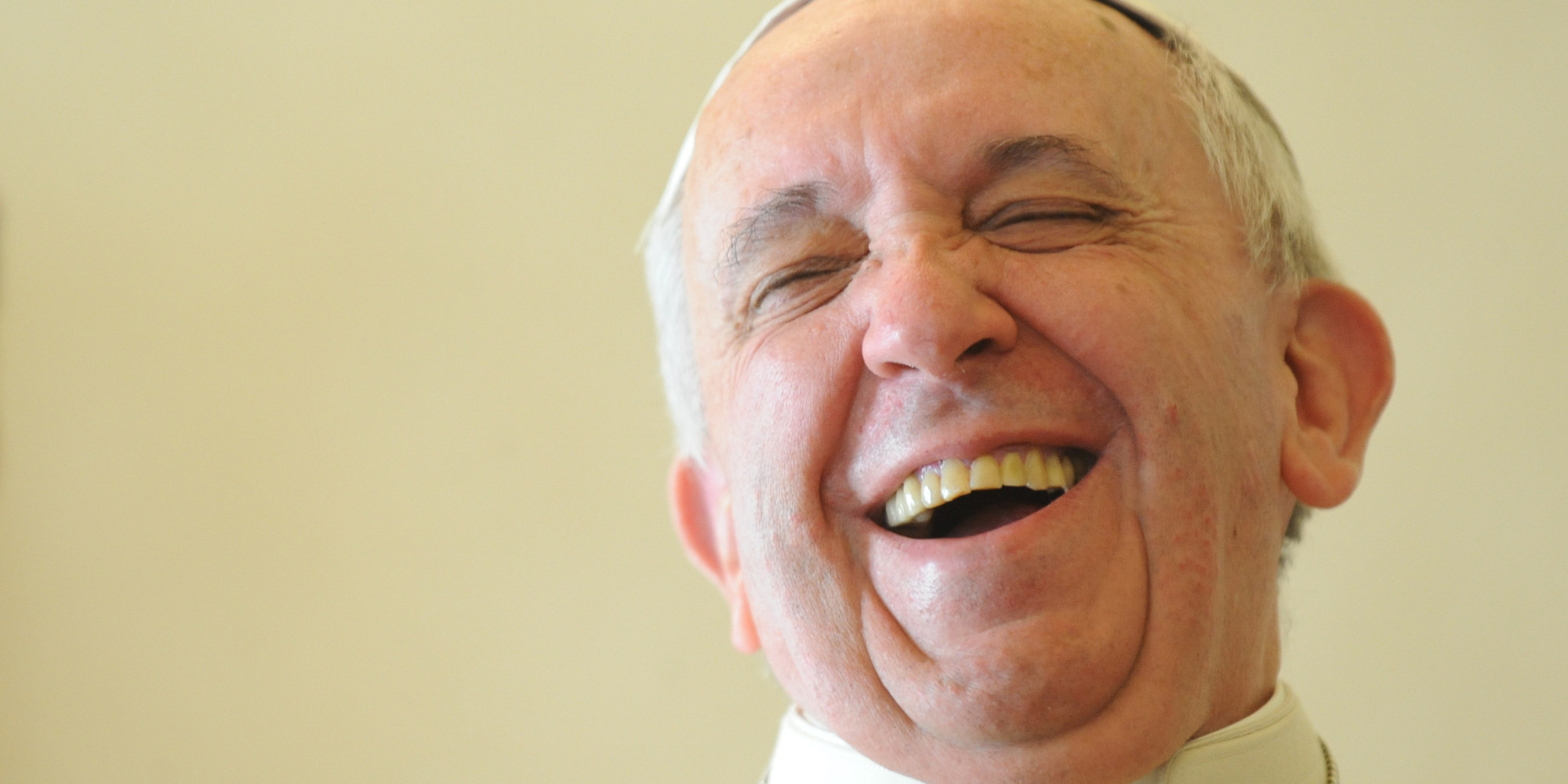
Pope Francis has a great smile. His preternaturally straight teeth and crinkly-happy eyes are prominently featured on the cover of the U.S. edition of his first book of writings, The Church of Mercy, which came out on Easter Sunday. Apparently, this was intentional. "His smiling face on the cover displays beautifully one of the major attributes he keeps talking about, which is joy," said Steve Connor, the director of new product development at Loyola Press. The small, Jesuit organization won the rights to print the book over several major publishing houses, he said, but that didn't necessarily change how the book was packaged. 

"One of the things we agreed to in getting the bid is that we wouldn’t change any of the language in book," he said. The collection, originally put together by the Italian professor Giuliano Vigini, was sanctioned by the Vatican, so the English-language version had to stay pretty much the same as the original text. "You don’t really have a lot of wiggle room to change what the book is about. How a major press would have done it is not much different than how we did it."
The one thing Loyola did have control over, though, was branding: How do you sell a book of theological reflections to a mass-market audience? Make it pretty, for starters. "We wanted a beautiful cover, making it attractive for a U.S. audience to read," Connor said. The look of the book was one of the only things the press could control, which makes each design decision seem more significant: the subtle patterns that look like they were modeled after couch upholstery, the round, friendly font, the palette of sepia tones. These were all thought out—as Connor said, "the muted colors give a sense of seriousness to the book."

Wednesday, February 5, 2014

Fr. Thomas Reese, S.J. "But Then There Are People Who Want To Spin The Pope’s Point Of View To Further A Particular Agenda"

comments are worth worrying about.
“There are basically three kinds of inaccurate comments,” Reese said. “There are the pranksters, and there are people who simply make mistakes because they don’t understand the issues being discussed. It’s hard to get worked up over those things.
“But then there are people who want to spin the pope’s point of view to further a particular agenda, and that’s very problematic and reprehensible.”
Link (here) to The Washington Post

Sunday, July 7, 2013

Fr. Kenneth Baker, S.J., "In Jesus, There Is Hope Of Union With God And Eternal Life"

Fr. Kenneth Baker, S.J.
For many people in our mass-media society, appearance is the reality. Thus, they think the Church has
changed in some basic areas—such as sexual morality or the doctrine on purgatory—whereas, in fact, she has not changed at all. Where do these false perceptions come from?
Often, they come from superficial or false reports in the media; from false propaganda spread about by dissident Catholic intellectuals; from erroneous teaching in Catholic schools on all levels; and from biased preaching in our parishes. 
To counter this trend, Pope John Paul II, the Pope of Truth, told bishops and priests during his pontificate that they should preach the whole truth about God, Christ and the Church.  One of the reasons for the present abysmal religious ignorance among so many Catholics is precisely that many bishops and priests, or their surrogates, have not done that. If they had done it, the Pope would not have to correct them. 
Change and permanence: there is always a certain tension between them in this life.  Immersed in change, we long for that which is lasting. Our false prophets of change will be carried away by the very change they glorify. But the one Church of Christ will remain until the end of time.  
Our task as priests and preachers of Jesus Christ is, first, to live, and then to proclaim, the true and unchanging Good News of salvation.  In Jesus, there is hope of union with God and eternal life, which we celebrate especially during the Easter Season. In all things else, there is emptiness and ultimate disappointment.
Link (here) to read the full article at HPR by Fr. Kenneth Baker, S.J.

Monday, June 17, 2013

Pope Francis To The Jesuit Journal La Civilta Cattolica, "“Your Fidelity To The Church Still Needs You To Stand Strong Against The Hypocrisies That Result From A Closed And Sick Heart”

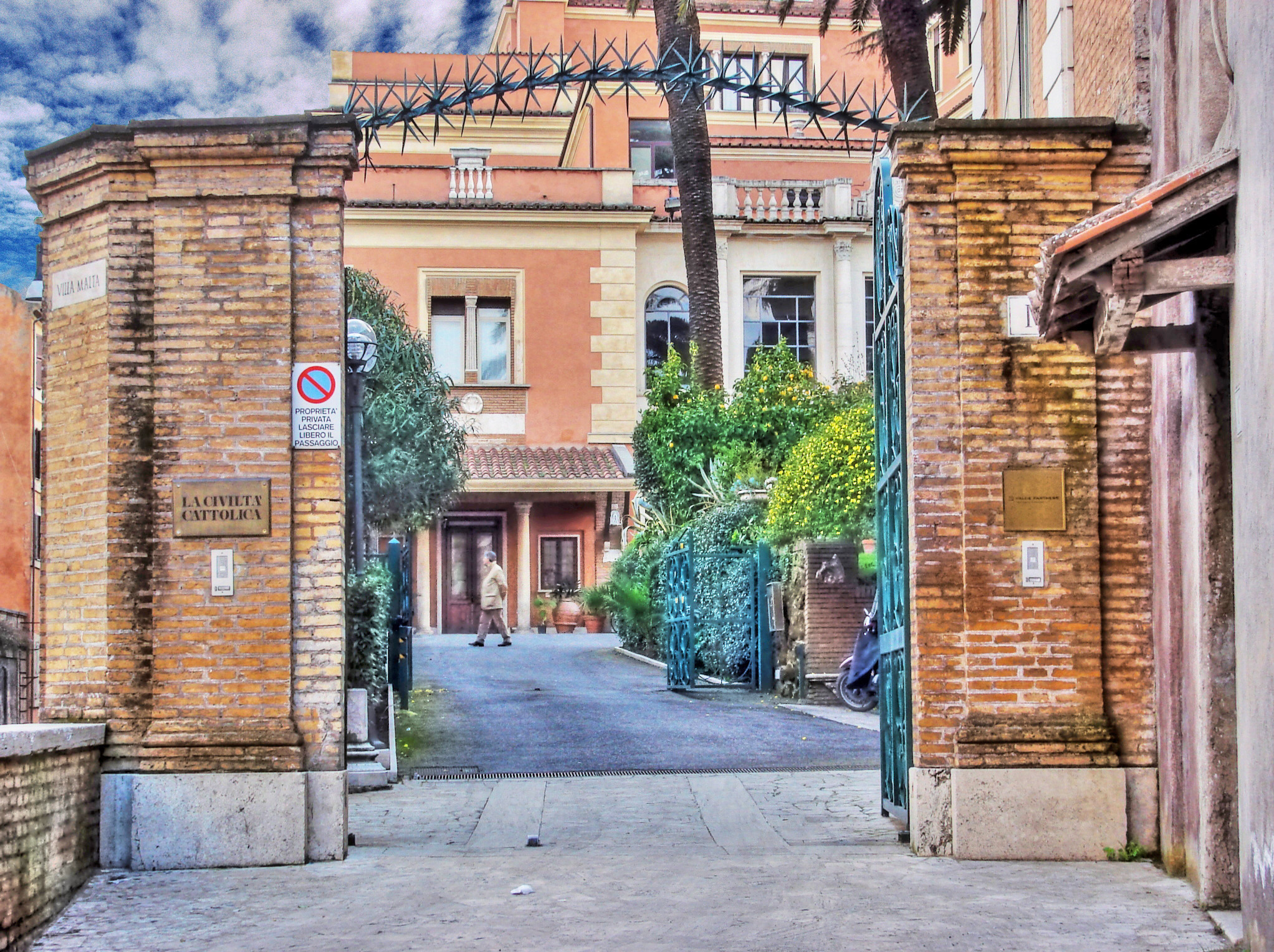
The Jesuit Residence in Rome of "La Civilta Cattolica."
Pope Francis met with the staff of the Jesuit journal La Civilta Cattolica on Friday morning, encouraging them“self-referential” Church. “Even the Church, when it becomes self-referential, gets sick and old,” Pope Francis said. “May our gaze, well fixed upon Christ, always be prophetic and dynamic towards the future. In this way you will always remain young and daring in your reading of events!” La Civilta Cattolica, whose name means “Catholic civilization,” is a primarily Italian-language review that has been published in Rome since it was founded in 1850. The Pope told the review’s staff that dialogue means “being convinced that the other has something good to say” and “making room for their point of view” without falling into relativism.
Dialogue requires one to “lower the defenses and open the doors.” “Your fidelity to the Church still needs you to stand strong against the hypocrisies that result from a closed and sick heart,” he told the review’s staff. “But your main task isn’t to build walls but bridges. It is to establish a dialogue with all persons, even those who don't share the Christian faith but ‘who cultivate outstanding qualities of the human spirit.’” He said dialogue should take place even with “those who oppress the Church and harass her in manifold ways.” “Through dialogue it is always possible to get closer to the truth, which is a gift of God, and to enrich one another,” he said. 
He noted the example of Father Matteo Ricci, S.J., a pioneering sixteenth-century Jesuit missionary who sought to present Christianity in terms that Asian cultures would find more understandable and accessible. The Pope praised the “Jesuit treasure” of spiritual discernment. He said this discernment “seeks to recognize the Spirit of God’s presence in human and cultural reality, the seed already planted by his presence in events, feelings, desires, in the deep tensions of our hearts and in social, cultural, and spiritual contexts.” Pope Francis said La Civilta Cattolica staff are called to help heal the “rift” between the Gospel and the culture, “which even passes through each of your and your readers’ hearts.”
to dialogue with everyone and to avoid the failings of a
Link (here) Catholic News Agency

Wednesday, April 10, 2013

The "Go-To" Jesuit

The Rev. Thomas J. Reese chuckles when he recalls the origins of his role as a “go-to” commentator on all things Catholic. Reese, a Jesuit priest and political scientist writing for the Catholic journal America, was covering the U.S. Conference of Catholic Bishops as the group developed a pastoral letter on war and peace in 1983. Inside the press room during down time of the bishops’ meeting, a reporter asked if anyone knew anything about an item on the agenda that day. Reese had read up on that subject a few days earlier and began explaining.
“All of a sudden, everybody had their pens out, taking notes from me,” said Reese, whose Roman collar convinced reporters that he knew quite a bit about Catholicism. “I started to back away and said, ‘Wait a minute, I’m covering this, too.’ ”
Despite his early reluctance, Reese has become one of the media’s most sought-after experts on the inner workings of the Catholic Church. He’s written several books about the hierarchy, including “Inside the Vatican: The Politics and Organization of the Catholic Church.”
Link (here) to the Buffalo News

Tuesday, February 12, 2013

A Jesuit's New Work On The Eucharist

Fr. Mitch Pacwa,S.J. offers a new scripture study on the Catholic Church’s ‘source and summit,’ 
A timely resource for faith-study as well as Lenten reflection (beginning Wednesday, February 13), Pacwa’s new book clarifies the full meaning of the Eucharist and its critical bond to a healthy faith, its essential connection with Scripture, and explanation on such issues as:
  • How does receiving Christ’s Real Presence heal or restore someone?
  • How should the faithful really ‘meet’ Jesus in Holy Communion?
  • Where are symbols of the Eucharist in the Old Testament?
  • How do Old Testament sacrifices prefigure Christ’s – and why?
  • What did Jesus mean when he asked his disciples to ‘Do this in remembrance of Me’?
  • Why did Christ confect the sacrament of the Eucharist before his death?
  • Why is Jesus called the Lamb of God?
“Since Vatican II, the Eucharist has been the touchstone experience of the changes initiated by that Council – changes in language, at least three English translations, and many experiments (both licit and some illicit) on how to celebrate Mass. So there is a need to better understand the Mass,” says Pacwa.  “The Mass, like the rest of our faith, is rooted in God’s revelation. Not only can Catholics gain a better grasp of the Mass through seeing its scriptural roots, but this perspective is crucial for dialogue with other Christians,” he adds. “Finally, a scriptural perspective on the Mass helps balance tensions about the Eucharist that are found even among Catholics.”
Link (here) to RNS for the full piece

Monday, January 7, 2013

Memento Mori

St. Augustine of Hippo wrote: "Magnum mysterium mihi"—I am a great mystery to myself. Why exactly Alfred Hitchcock asked Tom Sullivan to visit him is not clear to us and perhaps was not completely clear to him. But something whispered in his heart, and the visits answered a profound human desire, a real human need. Who of us is without such needs and desires? Some people find these late-in-life turns to religion suspect, a sign of weakness or of one's "losing it." But nothing focuses the mind as much as death. There is a long tradition going back to ancient times of memento mori, remember death. Why? I suspect that in facing death one may at last see soberly, whether clearly or not, truths missed for years, what is finally worth one's attention. 
Link (here) to read the full article by Fr. Mark Henniger, S.J. at The Wall Street Journal

Monday, December 3, 2012

Jesuit On The Radio

Fr. Rocco Danzi, S.J., director of campus ministry at Saint Peter's University, discussed vocations, spirituality and engaging young adults in ministry and service on The Busted Halo Show with Fr. Dave Dwyer on Sirus XM Radio on Oct. 23. Click here to listen to the interview.
 

Friday, August 3, 2012

Jesuit On Medjugorje Integrity

The Medjugorje visionaries
EWTN talk show host the Rev. Mitch Pacwa, who has been to Medjugorje and did a documentary about it with actor Martin Sheen, said the Vatican will look carefully at the reported messages. For example, early on, there was a dispute between Franciscans based in Medjugorje and a regional bishop, who was skeptical of the Marian apparitions. "Some of the visionaries took a stance and said the Virgin Mary is on the side of the Franciscans," Pacwa said. "That's odd. That's inappropriate. The church does not want the visionaries to ask questions trying to get answers. If it's from God, God is going to take the initiative." EWTN, the Catholic broadcasting network based in Irondale, Ala., welcomes Catholics who visit Alabama to go to Caritas, but does not take a stand on the apparitions or make recommendations to pilgrims. Pacwa said there is no chance for the visions to get approval while they're still going on, and it's a long shot even after they stop.
One quirk that emerged was when two of the Medjugorje visionaries said the Virgin Mary endorsed a book, "The Poem of the Man-God," that had been condemned by the Vatican. The fanciful 1940s biography of Jesus by Maria Valtorta contains details like a dancing girl brushing up against Jesus, Joseph giving young Jesus an anachronistic tool kit with screwdrivers and the Virgin Mary making statements such as "man disgusts me," Pacwa said. "The book had been condemned by the church in 1959 because it said a lot of silly things that contradicted what was in the gospels," Pacwa said. "The church rejected it. Any vision must be judged by revelation that exists in the gospels. You can't say anything you want." What may be the unraveling of the Medjugorje visions is the lack of any spiritual depth to the messages, Pacwa said.
"That is a much more pointed critique," he said. The writings of Sister Faustina, now a saint, describe visions from Jesus. "As you kept reading, a new depth of spiritual life began to show itself," Pacwa said. "You can see definite growth over the years in her spiritual messages. I don't see that with the messages of Medjugorje. They tend to be the same thing over and over again. Something I would look for is a growth in spiritual depth. I haven't sensed it." Pacwa said Vatican theologians will take all that into account and that Medjugorje in the end may be denied church approval. "I don't have a sense this is going to go swimmingly. I am very impressed with a number of the positive things I have experienced there. I have a lot of respect for the good things that have occurred. But I'm not going to be naive about some of the problems. It has to be dealt with, with full integrity."
Link (here) to STL Today

Saturday, July 28, 2012

80 Years Of Jesuit Run Vatican Radio

Guglielmo Marconi and Fr. Giuseppe Gianfranceschi, S.J.
Vatican Radio, which is managed by the Society of Jesus, celebrated 80 years of broadcasting earlier this month. The station debuted with a broadcast of Pope Pius XI in Latin on February, 12, 1931. Jesuit Father Giuseppe Gianfranceschi was the first director of Vatican Radio, and today Jesuit Father Federico Lombardi holds the position. To commemorate the anniversary, there is an exhibition at the Vatican Museums and a book on the history of the last 30 years will be published in September. Fr. Lombardi explained why the pope wanted the radio station created: “To talk freely across borders in an age in which totalitarianism was spreading, there was Bolshevism in the East, there was Nazism on the horizon, there was Fascism and so on. Being able to speak freely with people around the world, also in particular, churches that were experiencing difficulty or being persecuted, was absolutely vital. Vatican Radio is a place in which many people prepare the news and information in different languages to give the pope and the church a voice in today’s world,” Lombardi said.
Link (here) 

Sunday, July 15, 2012

Fr. Vincent P. Miceli, S.J. "Violate The Lex Orandi And You Must Inevitably Destroy The Lex Credendi."

Once again we find that Cardinal Newman foresaw another serious attack upon the Christian Faith. This time he warned Christians against innovators who would relax Christian forms and usher into the Church liturgical frenzy. Such devotees of change question every Christian form of prayer, every posture of devotion, every devotion itself and the very personal or traditional symbols of the faith. Their lust for innovation is used as a battering ram against the stability of long-established, time-tested sacred rites, which have been witnesses and types of precious Gospel truths for Christian communities. Hurriedly, even violently, they replace divine forms with new diluted Masses, new prayers, new sacraments, new churches, new terminologies - all of which confuse the faithful. Newman writes: "No one can really respect religion and insult its forms. Granted that forms are not immediately from God, still long use has made them divine to us for the spirit of religion has so penetrated and quickened them, that to destroy them is, in respect to the multitude of men, to unsettle and dislodge the religious principle itself. In most minds usage has so identified them with the notion of religion, that one cannot be extirpated without the other. Their faith will not bear trans planting . . . . Precious doctrines are strung like jewels upon slender threads." [John Henry Newman, Parochial and Plain Sermons, Vol. II, Christian Classics Inc., Westminster, Md., 1966, pp. 75, 76]
Liturgical détente has led to the loss of the sense of the sacred. To realize this tragic event we must reflect on what the sense of the sacred really comprises. The sacred is a mystery. It heralds the presence here and now of the world above, the world of the divine, and it fills man with incomparable reverence. The sacred reveals that the religious sphere is set apart, wonderfully superior and distinct from the rest of man's existence. But this apartness, far from precluding contact between the religious and natural spheres of man's existence, is actually a precondition for their fruitful intercommunion. 
Sacredness is one of those ultimate data perceived in and by itself, unexplainable, indivisible, mysterious. Sacredness is a reality which does not exist solely outside man as a knower, but it invades and involves the whole man as a free person. 
The sacred seizes each man in his ontological, intellectual, psychological and historical developments. [Alice von Hildebrand, Introduction to a Philosophy of Religion, Chicago, Franciscan Herald Press, 1970, Chap. IV, pp. 32-39] Thus the sacred must be approached, not with curiosity the way we approach an objective problem, but with awe and trembling, the way we approach mysteries. For the sacred represents the divine call from above, forcing the man of good will, like Moses before the burning bush, like the three Apostles before the transfiguration of Christ, to his knees in a prostration of adoration. The challenge emanating from the sacred is so powerful that man cannot remain indifferent to it. In the presence of God, the Source of Sacredness, man either adores with the prayer, "Thy Will be done," or rebels with the cry, "I will not serve!" Thus God is the ineffable Someone at the summit of every experience of the sacred. This Summit of the Sacred claims the first place in every intelligent being's life, angels and men. Religion is man's response to the sacred, to God, the Supreme Ruler, Prior, Independent yet ever-present Other. The sence of the sacred presents man with these paradoxical experiences. God is presented as totally Other, transcending man, yet He is simultaneously experienced as being intimately present, nearer to man than man is to himself, filling man with awe and yet desiring to give Himself to man in intimate communication and communion. St. Paul reminds us that "in Him we live and have our being."
The sacred also brings man the experience of God's brilliance and luminosity. Thus man's response to God is his response to the numen or the numinous, that is, to the wholly illuminating, fascinating and ravishing Reality who is God. The experience of the Mysterium Tremendum suffuses the being of man with awe, a mixed feeling of reverence, fear and wonder accompanied by an acute, grateful consciousness of one's creatureliness in the presence of an infinitely good Creator. In the experience of the sacred a "shudder" moves the whole person which, speechless, trembles to the deepest core of its being. The sacred presents God as the Mysterium Fascinans before whom the posture of prayer and adoration is the only adequate response called for by the whole of man's being. Thus religion and the sacred always go together. Indeed, religion vanishes with the loss of the sacred, and vice versa. Religion flourishes with growth in the consciousness and love of the sacred. The moment the sense of the sacred diminishes in a people, it is a sure sign that the faithful are becoming secularized, materialized, paganized. For them they have lost an awareness of the presence of God and of His Kingdom that descends from above. [Rudolph Otto, The Idea of the Holy, Oxford University Press, N.Y., p. 6]
The sacred applies not only to God but to all beings and things that have a special connection with Him- angels, saints, miracles, churches, sacraments, etc. Moreover, there are sacred places and times. The Holy Land where Christ lived, died and redeemed man is a sacred place. Then too, sacred times reenacts, relives historically events, e.g. the daily Mass liturgy and especially, Holy Week which relives the events of man's salvation. But in all sacred instances, eternity is not pulled down to the level of time, rather time soars into eternity. For the sacred is above time, though inserted in time and capable of ransoming time. Thus, the sacred, as essentially related to religion can redeem and blot our man's faults committed in time. By transcending and transforming time through a life and liturgy of faith in the true religion, the sacred does not obliterate time, but saves and sanctifies it. The Source of the Sacred embraced man and his history when the Son of God forever embraced in His divinity the sacred humanity he received from Mary, His Mother.
Man, therefore, is capable of transforming his domain of the non-sacred, of the profane, with the sense of the sacred or of degrading that domain and himself by obliterating in himself his love for the sacred. Man attacks the sacred when he rejects God and the true religion. The Antichrist will be the hater and destroyer of the sacred par excellence. For he will promote himself and his affairs on this earth as his only and ultimate concerns- and those will be the destruction of the image of Christ in the souls of men and the branding of those same souls with his own and Satan's seal. Thus the Antichrist would find modern times much to his liking. For in our generation a social climate charged with hatred of God has produced what even the atheist men of culture have sardonically referred to as the "Savage Sixties" and the "Sick Seventies." For once man rejects God, man becomes what Kierkegaard calls "the eternal zero." This is logical and necessary for, since his awareness of himself is founded on his awareness of God, the godless man, rootless and directionless, is at sea in an absurd world. Of course, he has an identity crisis. And with his animus against God and the sacred, he becomes a menace and a plague to the faith and holiness of his fellowmen. For when he breaks the sacred chains of love that bind him to God, he ends up breaking even the chains of civility and decency that should bind him to his fellowmen. Moreover, it is not surprising that the man who has rejected God and the sacred continues to talk about God, religion, liturgy and the Church. Now, however, he speaks of man from infancy to maturity. Now he experiments with these sacred realities as if he were tinkering with toys or automobiles. Now this "uncommitted interest," this neutrality toward divine, sacred realities is a typical game of ridicule played by the spiritually defeated and exhausted "playboys," choosing to be smart and clever rather than sacred and serious. These atheistic, intellectual snobs refuse to realize that God, religion, the liturgy and the Church can never be merely interesting or amusing myths. The sphere of the sacred is really uninteresting in the shallow, cute sense of that term. For the sacred sector demands one's total self-donation to God, one's eternal salvation being jeopardized if one refuses to say "yes" to God. Trivial things and affairs can be the subject of interest and cleverness. But adherence to the sacred realm is a tremendously serious, ultimate, tragic affair. It is the awful, shuddering one thing necessary for which all else must eventually be put aside, even temporal life itself. When one jokes about the sacred, one is well on the way to participating in the sacrilegious.
For the rejection of the sacred as revealed in the dynamics of ridicule or in the cult of the clever always degenerates into the dynamics of hate and the cult of self, both of which lead to hatred of God, of the Church, of others and finally of oneself. Thus, in our times a social climate charged with hatred of God, poisoned with irreducible religious-moral-political tensions and with hourly seditious preachments bereft of all truth, of all objectivity, of all love is the logical, violent result of the loss of the sense of the sacred. A society sickened from its rejection of God and the sacred necessarily produces a sick culture. In a modern play, Prometheus Unbound, Prometheus, the Titan who stole fire from Zeus, the god of the gods, is confronted by the foul furies and asks them wonderingly: "Can anyone exult in his own deformity?" Dostoevsky's Underground Man answers with a soul-searing affirmation: "I am a sick man . . . , I am a spiteful man. I am an unpleasant man." Underground Man then adds that he finds his only enjoyment "in the hyper-consciousness of his own degradation." [Duncan Williams, op. cit. p. 57] Today the Christian and post-Christian savage is idealized in philosophical, political, ethical, literary and theological works as the authentic man-come-of-age- the Rebel Hero of Paradise Lost, the Promethean Savior of a Cosmos Regained. From the heights of this hateful, overweening pride such a man has created a culture in which he defines his fellowman as "that most precious capital," "that useless passion," "that walking bag of sea water." This is the spirit of the Antichrist who will hate everyone made in the image and likeness of God. For as sacrilegious man he will hurl these slogans against his fellow man from a rhetoric of hatred that takes satanic joy in destroying the dignity, sacredness and divinity with which God has endowed men created and redeemed by His Son. Much of the new liturgy has been drained of the numinous and the sacred. The new forms are without splendor, flattened, undifferentiated. Why was kneeling replaced by standing? Jesus himself fell on his knees and on his face as he prayed to his heavenly Father. Satan too knows the meaning of worship and man's need for it. He tried to get Jesus to fall down and worship him. Why has the liturgical year and the Mass been so unfortunately mutilated against the wishes of the faithful? In fact, the faithful are now confused about the Mass, the feasts of the saints, the holy seasons. 
Why was the Gloria, that prayer of total concentration on God's Majesty and Goodness, restricted practically to Sundays alone, and only to those Sundays outside of Lent? Moreover, is the faith really renewed and vivified by obscuring our sense of community with the Christians of apostolic and ancient times? 
The new liturgy no longer draws us into the true experience of reliving the Life of Christ. We are deprived of this experience through the elimination of the hierarchy of feasts and the at random changing of the dates of famous feasts. [Dietrich von Hildebrand, The Devastated Vineyard, Franciscan Herald Press, Chicago, 1973, pp. 70ff] Then too, the new forms are the result of experimentation. But one experiments with things, with objects that one wants to analyze. Experimentation is the method of science. The wretched idolatry and vulgarity of tinkering with sacred realities has, unfortunately, penetrated the Church and produced a mediocrity-ridden liturgy, a show for spectators that distracts from the holy, frustrates intimate communion with God and trivializes, where it does not suppress, sacred actions, symbols, music and words. In reality such diminished liturgies have renewed nothing. Rather these innovations have emptied churches, dried up vocations to the priesthood and sisterhood, driven off converts and opened the doors wide to a flood of renegades. Even though valid in its essence, such a new liturgy cannot inspire for it is colorless, artificial, banal, without the odor and flavor of sanctity. A humanized and popularized, man-oriented liturgy will never produce saints. Only a divinized, God-oriented liturgy can accomplish that miracle. One suspects that many priests realize the banality of the new liturgy. That is why they often become, during the Mass and other ceremonies, actors and entertainers. They put on a show in order to gain the attention of the congregation. These comedians in chasubles preach a utopian Christianity rather than the true Christianity. Their treasure is man rather than God; their emphasis this-worldly rather than other-worldly; their goal progress rather than sanctity; their apostolate is immanent rather than transcendent; their means to their goal is the way of revolution rather than the way of the cross; they preach a secular Church instead of the Sacred Church founded by Christ; the essence of their morality is self-assertion rather than self-denial; the Christ they present to the congregation is the Humanist Christ rather than the God-Man crucified Christ; they speak in tongues of protest rather than in tongues of fire, the fire of love flaming forth from the Holy Spirit; they genuflect before the world and stand before Christ; they work for a democratic Church instead of a hierarchic Church; they are moved by resentment and envy instead of radiating the joy of Christ. In our times, then, it is not any longer a secret that the enemies within and outside the Church want to destroy belief in the divinity of Christ. Once the liturgy is humanized, Christ the center and Object of it becomes the humanist, par excellence, the liberator, the revolutionary, the Marxist ushering in the millennium; he ceases to be the Divine Redeemer. We must be alerted to these shadows of the Antichrist who plan, by convincing us to abandon our sacred forms, at length to seduce us into denying the Christian faith altogether. The Church is attacked by these children of Satan in and outside her fold, because she is a living form, "the sacrament- the sign and instrument- of communion with God and of unity among all men"; because she is the visible body of religion. 
Hence these shrewd masters of sedition know that when her sacred forms go, religion will go also. Violate the lex orandi and you must inevitably destroy the lex credendi. That is why they rail against so many devotions as superstitions; why they propose so many alterations and changes, a tactic cleverly calculated to shake the foundations of the faith. 
We must never forget, then, that forms apparently indifferent in themselves become most important to us when we are used to using them to nurture our lives in holiness.
Places consecrated to God's honor, clergy carefully set apart for His service, the Lord's Day piously observed, the public forms of prayer, the decencies of worship, these things, viewed as a whole, are sacred relatively to the whole body of the faithful and they are divinely sanctioned. Rites sanctified by the Church through ages of holy experience, cannot be disused without harm to souls. Moreover, in the words of Newman, "Liturgical reformists must ever be aware of the following truth; Even in the least binding of sacred forms, it continually happens that a speculative improvement becomes a practical folly, and the wise are tripped up by their own illusions." [Newman, op. cit. pp. 78] Bishops would be wise to follow Newman's conclusions in this war on the sacred liturgy:
Therefore, when profane persons scoff at our forms, let us argue with ourselves thus - and it is an argument which all men, learned and unlearned, can enter into: "These forms, even were they of mere human origin (which learned men say is not the case, but even if they were), are at least of a spiritual and edifying character as the rites of Judaism. And yet Christ and his Apostles did not even suffer these latter to be irreverently treated or suddenly discarded. Much less may we suffer it in the case of our own; lest stripping off from us the badges of our profession, we forget that there is a faith to maintain and a world of sinners to be eschewed." [Newman, op. ct. pp. 78,79]
The Fathers of the Church emphasize the corruption of the liturgy that will prevail at the last days. As the end draws near, the Church will be subjected to a fiercer, more diabolical persecution than any previously suffered. There will be a cessation of all religious worship. "They shall take away the daily sacrifice." Some Fathers interpret these words to mean that the Antichrist will suppress for three and a half years all public religious worship. Others remind us that the Antichrist will set up his throne within the Temple of God and demand worship of himself from his depraved followers. We are living in times so wicked that many nations will not allow innocent, defenseless human beings natural birth much less the opportunity to receive the grace of supernatural birth. St. Augustine wondered whether in the days of the Antichrist Baptism would be administered to infants of Christian parents. The reign of the Antichrist will be effected before Moses and Simon the Sorcerer displayed before Peter and John. St. Cyril writes: "I fear the wars of the nations; I fear divisions among Christians; I fear hatred among brethren But enough! God forbid that it should be fulfilled in our day! However, let us be prepared." [John Henry Newman, Discussions and Arguments on Various Subjects, p. 102. Newman quotes St. Cyril's Catechism, xv, 16, 17] Unfortunately, it has happened in our day; the liturgy is a sign of contradiction among Christians today; 
the Holy Mass that once united Christians now, with the new liturgy, fiercely divides Christians. Many Catholics, because of the dilution of the sacred in the new liturgy, and the breezy manner in which many radical priests celebrate it, cannot attend such liturgies; they find it morally impossible to have to endure the desacralized antics allowed by the liturgical storm troopers. Hence they stay away. Thus we see that, over and above the persecution of blood and death, there is even today a persecution of craftiness and subversion. 
The precursors of the Man of Sin are very effective in splitting up and dividing Christians. They are successful in dislodging many from the rock of salvation, in driving many into heresy and schism, depriving them of their Christian liberty, strength, peace and their household in Christ. How do we recall a sacrilegiously sick society that functions on the fashionable fallacy that murder is the best therapy for the world's problems to the sanity and sanctity of the sublime? We, especially all true followers of Christ, must help man return to the nature and deep significance of the sacred. Only when men grasp and appreciate the nature, meaning and value of the sacred will they be equipped and willing to understand and courageously confront the moral disvalues of their dying society. Truly an awareness of the sense of the sacred is a barometer that accurately indicates the vitality of the religion, morals and culture of a people. A blindness to the nature of the sacred is a sure preparation of society and mankind for the coming of the Antichrist. On the other hand, a clear vision and love of the sacred will enable mankind to see the unearthly beauty of the holy and to fall in love with God who is Holiness itself.
Link (here) to Mary's Touch to more of Fr. Vincent P Miceli, S.J. work

Vincent Peter Miceli was born into an Italian immigrant family in New York City in 1915. One of ten children, Vincent manifested a scholarly propensity from the earliest age. He also developed a staunch work ethic which he exhibited throughout the 77 years of his life. While still in school he would leave school and begin work at 3 p.m. until 10 p.m. delivering books six days a week. When he was 21, he became interested in the Society of Jesus and received his degree from Spring Hill College in Alabama in 1942. Following major seminary, he was ordained in St. Mary's Kansas which was then still a Jesuit school.  He acquired his S.T.L. from the Jesuits' St. Louis University in 1950 and was privileged to be in Dietrich von Hildebrand's last class in 1960 before receiving his Ph.D. from Fordham University in 1961.

Monday, July 9, 2012

Jesuit App

Across the United States, the Society of Jesus, the U.S.'s largest order of priests and brothers in the Roman Catholic Church, runs universities, high schools and middle schools, parishes and retreat houses. And today, the 450-year-old religious order has an app. Available for free at the iTunes App Store, the Jesuit app operates on any iPhone, iPod Touch or iPad; a similar app will soon be available at the Android Marketplace for use on devices such as the Droid, Evo and HTC Touch. The new app allows users to locate Jesuit retreat centers, schools and parishes across the U.S., read the latest news and information about the Jesuits, and access Jesuit prayers and spirituality documents.
Link (here) to Youtube

Thursday, July 5, 2012

Homiletic & Pastoral Review

Since Homiletic & Pastoral Review magazine went exclusively online on the Feast of Mary, the Holy Mother of God, this year, we have learned much about both the advantages and drawbacks of web-based publishing. Obviously, we miss the print edition. At the same time, we are reaching more readers online as we continue our high standard of presenting the richness of the Faith in a way that attracts, enriches, and converts. In our June issue, for example, we feature a full-length article by Dominican Father Austin Green on "The Eternal Priesthood of Jesus Christ", as well as an article by Cistercian Father, Roch Kereszty on the priest’s role the New Evangelization. Essays such as these bolster the morale of priests and encourage us all to love Christ and his people with great constancy, courage, and cheer. HPRweb.com has articles on pressing moral issues and, in every month’s crop of new articles, at least one essay on prayer, and not a few more pieces on contemporary concerns. Articles in the June edition include Deacon James Keating on spiritual martyrdom, Carmelite Carolyn Humphries on mystical prayer, and the indefatigable Jesuit Father James Schall on why the Congregation for the Doctrine of the Faith's Dominus Iesus is needed more today than ever before. In addition to a dozen plus articles every month, HPRweb.com also reviews books pertinent to any pastor or parishioner wanting to keep current with both scholarly works as well as the more popular, pastoral books published today. We also run our highly-touted homilies for the month as well as feature Father Brian Mullady, O.P., who answers our readers’ questions in his usual in-depth and thorough manner.

In Corde Iesu,

Father David Vincent Meconi, S.J.
Saint Louis University

To read the magazine online or sign up for their free newsletter, Click here.

Friday, June 29, 2012

The Jesuits America Magazine On Archbishop Fulton J. Sheen

Archbishop Fulton J. Sheen was one of the Church’s great missionaries.

In 1979, the Jesuit magazine America called him
“the greatest evangelizer in the history of the Catholic Church in the United States. He lavished personal attention on both rich and poor.”
A reporter observed in 1952:
“The bishop’s official date book, listing names of those he plans to see (‘I will see anybody with a spiritual problem’), regularly bulges with eight hundred to a thousand entries.”
Thousands attended his convert classes. No one, of course, could count the hundreds of thousands, perhaps millions, who came into the Church, wholly or in part, as a result of Sheen’s publications and media and personal appearances.

Link (here)

Thursday, May 24, 2012

Jesuit On Faith And Reason At Georgetown

In John Paul II’s Fides et Ratio, a seminal document which, I would estimate, was read by less than one percent of graduates of Catholic colleges during their past four academic years. Leading us all to “the truth is ultimately an act of love.” 
What is lacking in our universities is precisely this openness to all reality. “Faith’s recognition of the essential unity of all knowledge provides a bulwark against the alienation and fragmentation which occur when the use of reason is detached from the pursuit of truth and virtue,” Catholic institutions have a role to play but only if they are able to recognize what is at stake in their purpose for existing. Evidently, many have failed in this matter. The pope speaks of a “culture that is genuinely Catholic.” What is obvious today is that, with the decrees constantly coming from the government, the culture is becoming less and less open to any sort of Catholic presence except that which is confined to a narrow range of itself. 
It is consoling that the bishops seem to recognize what is at stake. It is, shall we say, “unsettling” that the universities largely do not. In an official statement (May 15), the President of Georgetown has affirmed, even in cases like the current one, that the university does not approve of anything that is contrary to basic Catholic teachings. Kathleen Sebelius speaks because she recognizes the value of her role as a nominal Catholic in submitting the freedoms of the Constitution to the control of a “rights-state” that is all too willing defines for us what religion must mean if it is “allowed” to participate in public life. We are perhaps seeing the end of the great American experiment of religious freedom by those who have little understanding or sympathy for it. Catholics, ironically, are seeing their freedoms restricted and ended by the aid of other Catholics, political and academic, who have denied, in practice, any real connection between reason and revelation. 
Link (here) to read full essay by Fr. James V. Schall, S.J. at The Catholic World Report.

Wednesday, May 23, 2012

Jesuit On The Burning Bonfire At Georgetown University

Georgetown is my alma mater, and I have many fond memories of the college at which I matriculated almost fifty years ago. I had many fine Jesuit and lay teachers (amongst the latter, not all were Catholic but understood, respected, and celebrated the institution’s mission and identity as a Catholic and Jesuit center of learning) who helped me simultaneously cultivate my mind and soul. I don’t think I would have the same experience today if I were matriculating in the present day.
Why? Was the decision to change the soul of the institution intentional? Probably not. But change has happened through decisions that persons responsible for the nature and soul of Georgetown have made freely over the years. The evidence of the withering of the Catholic soul has grown during the passage of time. I cannot say if there is still time for Georgetown, and other schools pursuing the same path, to self-prune, but I pray for this. Being an optimist, I want to say there may well be a final opportunity, but the time is growing short, very short, for this to happen.
Almost twenty-two years have passed since Blessed John Paul II issued his apostolic constitution Ex Corde Ecclesiae addressing many important matters concerning Catholic universities, their mission, and their identity. Some of the institutions which claim the modifier “Catholic” have taken the counsel of JPII to heart, but others have not. Georgetown is in the latter category, so it appears, judging from all the currently available evidence. Today I join the appeal of Professor Patrick Deneen and others acknowledging that much will be lost when this, the oldest Catholic university in the United States, takes that final step that severs itself from the Vine of Christ. As I said, there may still be time, and if there is, it is preciously little. The bonfire that may result is not one of vanity but of a soul. With the soul gone, the vanity will remain.
Link (here) to Mirror of Justice blog and the full article by Fr. Robert John Araujo, S.J.

Monday, May 21, 2012

Social Media Jesuit And His Twittersphere

The report from the Congregation for the Doctrine of the Faith -- the church's orthodoxy watchdog -- was publicly released last month by the U.S. Conference of Catholic Bishops. The report said that although the women's leadership group had been vocal about social justice issues -- the report praised the nuns' work with the needy -- the group had been unacceptably silent on other issues, notably opposition to same-sex marriage and abortion. The Vatican ordered the nuns to focus more on promoting church orthodoxy. Reactions to the analysis have included standard letters and phone calls as well as Facebook posts and Twitter hash tags. "Fifty years ago, a document like this would have been published internally and then trickled down," said Sister Janice Farnham, a retired professor and historian at the Boston College School of Theology and Ministry. Farnham said she read about the report on the BBC's wire and not through the "traditional avenues of the church." The document quickly reached the masses via Internet links and re-posts. Social media are the perfect place for people to weigh in when they feel voiceless, said the Rev. James Martin, a Jesuit priest and author of "The Jesuit Guide to (Almost) Everything." "Everyone who is baptized is part of the church, but sometimes Catholics don't feel that they have venues in which they can express their views," he said. 
Martin started a hash tag (.whatsistersmeantome) to thank nuns for dedicating their lives to the communities in which they work and to separate the comments from the rest of the Twittersphere. The conversation soon grew to include voices supporting orthodox, habit-wearing orders. Jacob Biddle tweeted, "Sisters to me mean habited women who fight heresy and the devil, not embrace them like LCWR." Robert Salazar tweeted a link to a cloistered community in New Jersey and praised its work. 
"Great sisters -- obedient to God and His Church." Some associated with the Leadership Conference of Women Religious don't agree with the claim that they've strayed from church doctrine. "For me, to follow Jesus was to engage in my community that struggled for civil rights," said Campbell, whose organization, Network, was singled out for criticism in the Vatican's review. "To nourish my faith was to nourish my quest for justice, and my community does that." The assessment, based on a two-year investigation, shook those affiliated with the conference and brought attention to how nuns conduct themselves. For example, some take a more activist role to their work, while others may focus on a more contemplative life. "There is room for both kind of sisters," Martin said. "The problem is some Catholics think that being a traditional sister is the only way."
Link (here) to read the full story at The Portland Press Herald

Tuesday, May 15, 2012

Jesuit To Speak At Graduation


students

Christendom College is pleased to announce that Reverend Kenneth Baker, S.J., and Mother Agnes Donovan, S.V., will join the 100 members of the Class of 2012 for commencement exercises over the weekend of May 11-13, 2012. Father Baker will offer the Baccalaureate Mass on Friday, May 11, and will be awarded an Honorary Doctorate from College President Dr. Timothy O'Donnell at the Commencement Exercises on Saturday, May 12. Father Baker was the editor of Homiletic & Pastoral Review for the past 40 years, and currently serves as Editor Emeritus of the online edition. He made his perpetual vows in the Society of Jesus (the Jesuits) in 1949, and was ordained to the priesthood in 1960. He earned his Ph.D. from Marquette University in 1967 and spent a number of years teaching at Gonzaga University in Washington. After serving as the president of Seattle University for almost year, in 1970, he resigned and moved to New York where he began his role as editor of Homiletic & Pastoral Review. 
Link (here) to Christendom College

Monday, May 14, 2012

Fr. Patrick Howell, S.J. "Particularly Inquisitional"

Fr. Patrick Howell, S.J.
In the seven years I have been writing this column, I have rarely dealt with issues specific to the Catholic Church. Rather I have tried to focus on contemplative walks in the Arboretum, the spirituality of gardening, the gift of family, strengthening Christian unity through ecumenical relationships, the importance of prayer, the wealth of spiritual resources in Catholic tradition and so forth. Two exceptions would be the sexual-abuse crisis, "Jesuits reflect on abuse scandal" (Seattle Times, April 30, 2010), and the election of the new pope in April 2005. But now the Catholic faithful have been rocked by another incredible initiative from the Holy See, and I cannot pass over in silence. (Note of explanation: "Holy See" refers to the central church leadership. "Vatican" refers to the city-state or political entity.) In this instance, the Holy See through the Congregation on Doctrine and Faith has mandated a reining in of the Leadership Conference of Women Religious (LCWR). It calls into question the leadership of the American Catholic sisters and hence their generous, intelligent, compassionate contributions, and their prophetic voice within the church. Many are shocked, even scandalized, by this intervention. The reasons given are even more problematic. The ones that leap out are that Women Religious has been silent on issues of sexual ethics, such as contraception and gay marriage, and that some of their invited keynote speakers at their national conferences have raised up significant issues the church still needs to deal with. By implication, they have focused too much on social-justice issues such as homelessness, oppressive political structures, capital punishment, and so forth without sufficient attention to the doctrinal teaching of the church. And they should never have raised questions about the ordination of women. Being called on the carpet for maintaining a respectful silence on controversial issues related to sexual ethics seems particularly inquisitional.
Link (here) to The Seattle Times and the full opinion piece by Fr. Patrick Howell, S.J.