Showing posts with label Jesuit Refugee Service. Show all posts

Sunday, June 2, 2013

Fr. Nawras Sammour, S.J. "We Need To Step Back And Realize That We Went Too Far,"

Fr. Nawras Sammour, S.J.
For Jesuit Father Nawras Sammour, the ongoing conflict in Syria is a professional challenge and a personal "have all left." Tens of thousands of Syrians have died and millions have been displaced in more than two years of fighting between President Bashar Assad's government and rebels seeking his resignation. "Sometimes I can't believe we Syrians have reached that level of violence," Father Sammour said. "I'm shocked. Shocked. "We need to step back and realize that we went too far," he told Catholic News Service May 31 during an interview at JRS headquarters near the Vatican. In a situation that is so tense and so divided, particularly among different Muslim groups, Father Sammour said Syria's small Christian communities may be frightened. But with Christian aid programs and partnerships with others providing assistance, they also enjoy a certain respect as non-partisans looking only to help others. Father Sammour is Jesuit Refugee Service's regional director for the Middle East and lives in Damascus, Syria. He was born in Aleppo, and his mother, brother and sister still live there, but his nieces and nephews
Link (here) to CNS 
Link (here) to watch a video documentary of the violence and destruction in Aleppo

Saturday, April 13, 2013

Jesuit To Obama Adminstration, "Contrary To The Rhetoric Of Family Values That Permeates Our Political Discourse"

Fr. Sean Carroll, S.J,
First it was guns. Now, immigration. Members of the Catholic Church have been hitting hard at Congress this week on matters of national policy. The latest is Jesuit Father Sean Carroll who told members of Congress on Wednesday that U.S. immigration policy violates basic Christian biblical teachings — namely, that it separates families, Raw Story reported. 
“With each passing day, we as a country continue to separate family members, through our immigration laws and our detention and deportation practices, contrary to the rhetoric of family values that permeates our political discourse,” he said, at a congressional hearing headed by pro-abortion progressive Rep. Raul Grijalva from Arizona, 
Raw Story reported. Father Carroll said that 5,100 children are now in foster care, separated from caretakers who have been detained or deported by federal authorities.“This reality falls far short of what Scripture teaches regarding care for the widow, the orphan and the stranger,” he said. “Our current policies essentially leave many children as orphans, wives and husbands as widows and widowers, and the stranger deported across the border, away from their family members who need them so deeply.”
Link (here) to The Washington Times

Thursday, April 11, 2013

Fr. Giovanni La Manna, S.J., "Francis I Will Not Create Conflicts Between Obeying The Father General And His Holiness.

Fr. Giovanni La Manna, S.J.
Jesuits must obey not only the pope, but also the Father General -- the so-called Black Pope -- who is currently Adolfo Nicolás. How will they relate to these two figures?

I believe that the new pope is an exceptional person, in both a spiritual and a human sense, and that he will have the maturity to avoid any type of conflict. As for the mission of Jesuits, they take a vow which goes beyond obedience: the so-called "fourth vow of obedience to the pope." Based on this vow, the pope can ask Jesuits to undertake a mission at any moment, and Jesuits are bound to obey him, regardless of the Father General's wishes. But I am certain that this won't happen: Francis I will not create conflicts between obeying the Father General and His Holiness.

What is the significance of the first Jesuit pope for the Church's history?

It is certainly something new, and like all new things it will bring joy and curiosity among the faithful. Personally, I am very happy and curious to see how a Jesuit pope will move forward.

From your perspective, will there also be some recognition of your order?

The new pope is a person who received a Jesuit education, and those who have been Jesuits for years cannot erase their origins. His education influenced the way he conducted himself as the Archbishop of Buenos Aires; a man is unlikely to forget that which has shaped him. The fact that he is a Jesuit will influence the way he serves the Church. We have already had a taste of this in tonight's greeting -- in his request that the faithful pray for him even before blessing him. Just as the pope blesses the people of the Church, Francis I asked his people to bless and pray for him.

What does his name mean? Do you think he chose it in reference to St. Francis and his vow of poverty?

Since His Holiness has a Jesuit history, I very much think that he chose it with St. Francis Xavier in mind (San Francisco de Jasso Azpilcueta Atondo y Aznares de Javier), one of the first missionaries who tried to evangelize in new lands. I believe that the choice is rooted in His Holiness' own history and therefore in that of the Jesuits.

Thinking and living as a Jesuit, I immediately thought of this reference to our Francis Xavier, a important saint for Jesuits and one of the first blessed witnesses of the Society of Jesus, who spent his entire life on his mission of evangelization. I am sure that this name rings in the spirit of His Holiness.

What kind of pope will Frances I be? Will he offer a break from the past, or continuity?


He will certainly keep the path of his predecessors in mind. But he will assign priorities in his own way, and the fact that he is a Jesuit will affect how he identifies these priorities. Considering the name he has chosen, he will surely be a man committed to the New Evangelization in the Year of Faith.

He will guide the Church with the attention of someone looking at the world from another point of view -- in his case, from Argentina. And in that way he will help bring fresh air and a review of priorities to the universal Church. All of this brings nothing but excitement and enthusiasm to the Church. Returning again to his first speech as pope: By asking the faithful to bless him, he began a dialogue -- a new reciprocal relationship. It is not a one-way speech, but one which bespeaks a sense of shared reality.
Link (here) to the full interview of Fr. Giovanni La Manna, S.J. the President of The Astalli Canter in Rome

Pope Francis To Visit The Jesuit Operated Astalli Center

The Astalli Center in Rome
A priest in Rome says Pope Francis personally called him to say he will visit the Astalli Center, a local facility “Yesterday I received a call on my cell phone. It was Pope Francis and he told me he would come. This is wonderful,” Father Giovanni La Manna, head of the Jesuit Service for Refugees in Rome, posted on his Twitter account April 7. The Astalli Center offers refugees free medical care, psychological counseling, legal advice, meals, showers, a laundromat and educational assistance. Undocumented refugees can use the services at the Center without fear of being identified and deported, due to an agreement between the Jesuits and the city of Rome. Most the immigrants at the center are Muslims refugees fleeing from the Middle East and Africa, and the lines to use its services are often long. In a previous interview with CNA, Fr. Manna, who has been working at the center since 2003, said the stories behind many of the refugees are tragic. Most of them have fled because their lives were in danger because of political or religious reasons, he said. Others have been forced to flee because 
run by the Jesuits, that helps thousands of undocumented refugees – many with tragic histories.
“being a Christian in a Muslim country is very difficult.” “There are also many women who have fled because their families force them to marry someone they don’t love,” the priest added. The inspiration to help these refugees “comes from the Gospel. We don’t make anything up, we just keep in mind what the Gospel says and teaches,” Fr. Manna noted.  
And in welcoming these people we make no distinction for race, language or religion. To us they are people who deserve care and help.” The Jesuit Service to Refugees started in 1980 and has spread throughout the world to help people in need. The Astalli Center in Rome receives nearly 400 people day, and a team of volunteers helps the Jesuits care for them.
Link (here) to

Wednesday, April 3, 2013

Online Jesuit University

Kakuma Refugee Camp
One of the most remote outposts of Jesuit higher education is tucked away in dusty northwest Kenya, in a “Nowhere” in Swahili.
place whose name means
There, at Kakuma Refugee Camp, a small group of students -- refugees from several neighboring African countries, including Sudan, Ethiopia and Somalia -- are enrolled in online courses taught by 28 Jesuit colleges, mostly in the United States.
The courses are part of Jesuit Commons, a project that seeks to bring courses from the order’s universities to refugee camps worldwide. So far, the program has enrolled about 225 students at three camps in a diploma track that will eventually lead to a credential from Regis University, a Jesuit college in Colorado with a well-established online presence; more than 350 students have participated in service learning courses intended to give them knowledge they use while still at the refugee camps.
The program is eyeing a major expansion -- and perhaps, in the coming years, the creation of an online-only Jesuit university that would issue degrees of its own.
The underlying technology is similar to the massive open online courses, or MOOCs, offered by an increasing number of selective colleges in the U.S. and touted for their potential to expand the reach of higher education. The project’s founders hasten to draw a distinction between the massive courses, which they say are being used mostly as a branding opportunity for already prominent universities, and the Jesuit Commons project, which attempts to use similar technology to carry Jesuit education overseas.
Link (here) to Inside Higher Education


Tuesday, February 1, 2011

St. Stanislaus Seminary From 1823 Until 1971 In Florissant, Missouri

St. Stanislaus Seminary 1928
The 999 acre historical St. Stanislaus Seminary which was originally started in 1823 in the then Louisiana Territory by 8 Belgian Jesuit missionaries, including Father Pierre-Jean De Smet, under the encouragement of Bishop DuBourg and President James Monroe. This mission first started as just a log cabin residence and an Indian School near the present intersection of Howdershell and Charbonier Roads in historic Florissant, Missouri. In 1840 the log cabins were replaced with a four level stone building which became the longest running Jesuit novitiate in the United States until 1971. In 1971 most of the property was sold to United Pentecostal Church International and the historic stone building became the Museum of Western Jesuit Missions. Part of the property sold contained 351 Jesuit burials which were supposedly exhumed and moved to nearby Calvary Cemetery. This left 121 burials remaining at this historic Jesuit location including the oldest grave sites, some of which were located upon an old Native American burial mound. 
Link (here) to the full article at Haunted America Tours.

Friday, July 30, 2010

South Of The Border

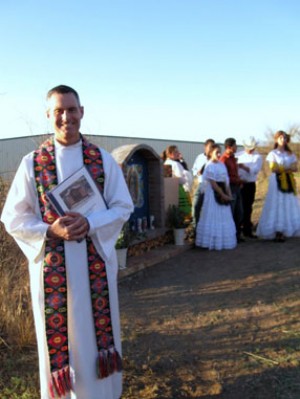
In fluent English, Hernandez explained how he had been stopped by U.S. immigration inspectors at the border at Tijuana as he returned home from a trip to his native state of Veracruz in east-central Mexico for his great-grandfather's funeral. Instead of being at work in Seattle, Hernandez was among about 75 men having a hearty breakfast at the "comedor," or dining room, run by the Kino Border Initiative, a collaborative effort of the Jesuit provinces of California and Mexico, the Diocese of Tucson, Ariz., the Archdiocese of Hermosillo, Mexico, Jesuit Refugee Service and the Missionary Sisters of the Eucharist.
Link (here) to the full article at The Tidings

Thursday, April 2, 2009

Director Of Jesuit Refugee Services In Cambodia Talks About The Evil Of Khmer Rouge

Khmer Rouge Trial Underway

(31 Mar 09 - RV) The trial of a former teacher accused of carrying out the murderous policies of the Khmer Rouge is underway this week. Prosecutors yesterday opened their first case in a U.N.-assisted genocide tribunal against the 66 year-old Kaing GuekEav, who is charged with war crimes and crimes against humanity, as well as torture and homicide. The director of Jesuit Refugee Services in Cambodia, Sr. Denise Coghlan says she hopes the trial will allow the true extent of the Khmer Rouge atrocities to emerge.

Listen to the audio file (here)