Showing posts with label Jesuit Missions. Show all posts

Friday, June 6, 2014

The Jesuit Elephant

It seems that elephants roamed the Philippines not just in prehistoric times but as late as the 17th century, as Jesuit Ignacio Francisco Alcina in his multivolumeHistoria de las islas e indios de Bisayas(1668) as a “torre de carne” (tower of flesh) that some Christian saints referred to as “Goliath” because of the size. (The iconic Japanese monster Godzilla may not look like it, but its name when read in Japanese sounds like “gorilla.”)  Alcina noted that the Visayan word for elephant was “gadya,” and that the ivory (“garing” in Tagalog, hence one of the attributes of the Virgin Mary, “Tower of Ivory,” is “Torre ng Garing”) was used for bracelets, ear pendants, daggers and sword hilts, and even jewelry boxes.
described by the
According to Alcina, elephants were not to be found in the Visayas but in Jolo. These were smaller than elephants from Cambodia and India, and were prized for their: ivory tusks that were made into religious images of the Santo Niño, the Virgin Mary, and other saints; bones, similar to ivory, that were fashioned into jewelry; hide that was made into breastplates, helmets, and armor that protected the wearer from sword and lance but not from an arquebus or musket; and, last but not least, meat that was eaten, too!
Alcina wrote: “The natives of that island (Jolo) eat the flesh. One of our fathers who stayed there told me that he had eaten the meat and that it was tougher than beef and did not taste as good.” Elephants were said to be intelligent, hardworking, and fierce when provoked. They were modest, too. When told that elephants were never seen mating, that they concealed themselves when they mated, Alcina remarked: “A lesson in modesty for men who sometimes and even frequently lack the modesty which these brute animals observe so well.”

What I found fascinating, though, was the fact that Alcina saw elephants in Manila where they were received as gifts from Cambodia and neighboring countries. Alonso Fajardo, governor-general from 1618 to 1624, gave the Jesuits a tamed elephant that served them many years hauling logs, beams and posts during the construction of the Jesuit residence in the city.
Alcina talked fondly about their pet elephant and of its sad end:
“I have heard unusual and very strange stories related about it… I shall tell only one, which seems to have a connection with the friends of Bacchus (Greek god of grape growing and wine) of whom there are many here. It seems that if they were not watchful, he went to the wine cellar or store room, either at the Colegio or that of the Procurator General, sniffed out the casks which contained wine, very easily uncovered them with his trunk and siphoned out one entire cask at one time; thus showing his joy with a thousand gambols. If, perchance, he took in too much he would be intoxicated and cause some violence. However he was able to get out into the countryside until it passed; afterwards he returned to the house very docile.
“When he felt hungry, they say, he used to go among the houses of the natives; they knew what he wanted and gave him either rice or various fruits to eat. In this manner he went to many dwellings, as though asking alms, until he was satisfied. He approached the doors of the houses of those who would not give him anything and struck the posts and tore them off and flattened the houses, thus they were careful to give him something immediately so that he would not harm them. This happened when days passed without his returning to our house where what was needed was given him.
“He lived for years until a Brother of ours, angered by some mischief or other, whether stealing food or drink, who was in a house in the field where the elephant was taken to haul logs, which were newly cut, fastened the beast with strong ropes to a large tree and left him there to die of hunger. Since this animal had cost him little, he was little concerned about it perishing.”
Quite a sad end for the pet elephant in the 17th-century Jesuit house in Manila whose name is lost to history. I hope that inhumane Jesuit brother was castigated in life and in the hereafter for his cruelty.

Link (here) to The Inquirer

Saturday, April 5, 2014

Jesuit History Up For Sale In Arizona

The owners of a historic southern Arizona ranch where past guests include President Lyndon B. Johnson and John Wayne said Wednesday they are holding out hope for a buyer. Veronica Schultz, 62, said that she and her husband, Richard, have only taken a few calls from people interested in looking at Rancho de la Osa in Sasabe, which lies about 71 miles south of Tucson. They plan to close the site as a guest ranch June 25.
``If it has not been sold or there isn't an offer pending, or something, then we are thinking of becoming the Inn at Rancho de la Osa,'' Veronica Schultz told The Associated Press. ``So an inn but with no horseback riding. That way we could rest for up to four days.'' 
 According to the Arizona Daily Star, the couple is asking $1.9 million for the 239-acre facility which includes nine buildings, 19 guest rooms and a cantina. The ranch, which dates back to 1725, has changed ownership over the years. Originally built by Jesuit priests, the property was a trading post for local tribes as well as a sanctuary for traveling missionaries working for Jesuit priest Eusebio Francisco Kino. 
The ranch was attached to the Gadsden Purchase in 1889 and bought by Col. William Spencer Sturgis. The colonel branded it as La Osa Ranch and added more structures and ran a thriving cattle ranch operation. Investors operated the ranch from 1927 to 1996 when Richard and Veronica Schultz bought it for $800,000. ``It's a signature property in Southern Arizona,'' said Gary Brasher, associate broker with Russ Lyon Sotheby's International Realty which is handling the sale. Brasher said the next owner could keep it as a guest ranch or turn it into a wellness spa or make it a private estate. The couple said they are ready to retire and travel. The demands of running the place last around the clock and they can't keep up. ``I'm the cleaning lady and I'm the pool boy,'' said Richard Schultz, 68. The couple, who plans to settle in a home in Oro Valley, knows their ideal buyer.``I just hope somebody with  as much enthusiasm as us for the property buys it and keeps it going. It's a really special place,'' Veronica Schultz said.
Link (here)

Wednesday, January 29, 2014

Fr. Frans van der Lugt, S.J., "People Have Nothing To Eat"

Fr, Franz van der Lugt, S.J.
We refuse to die of hunger in Homs. We Christians and Muslims love life and want to live. This was the appeal Fr. Frans van der Lugt sent via YouTube. The Dutch Jesuit has been living in Syria for decades and is the only European left in the besieged city.Activists in the Bustan ad Diwan area of Homs shared the video posted on YouTube by Fr. Frans in recent days. The video shows Fr. Francis as he is also known, speaking from what seems to be a church altar.
“I am here to talk to you about the old city of Homs which has been under siege” for one year and seven months now. “I represent the local Christian communities,” the priest said referring to the 70 or so Christians that remain in Syria’s third major city. Homs supports the revolt and has suffered huge destruction under the country’s repressive regime.
“Christians and Muslims are going through a difficult and painful time and we are faced with many problems. The greatest of these is hunger,” Fr. Frans states. “People have nothing to eat. There is nothing more painful than watching mothers searching for food for their children in the streets.”
Link (here) to read the rest of the story at UCANews

Monday, October 28, 2013

“A Copernican Revolution”

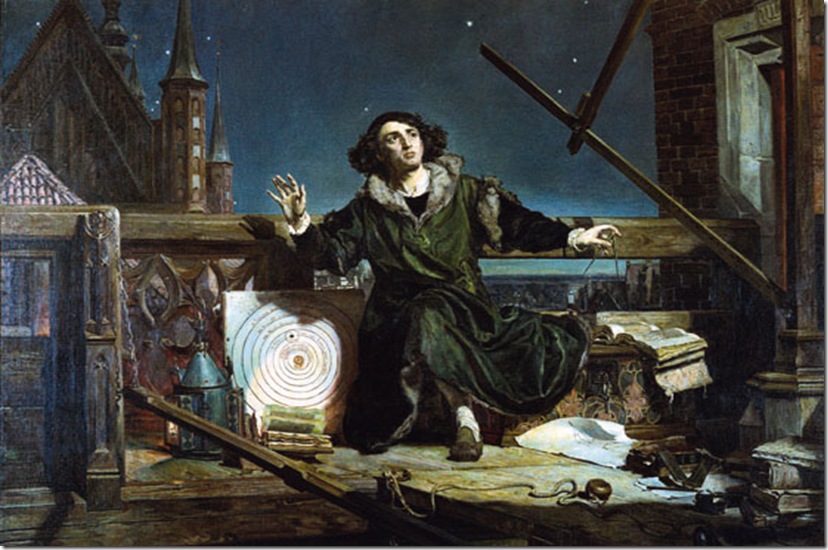
Jan Matejko's Conversations with God
In an interview with L’Osservatore Romano, Father Cristian Martini Grimaldi, an Argentine Jesuit who has served for decades as a missionary in Japan, recalled the future Pope Francis’s leadership as a Jesuit provincial. Father Grimaldi, who was sent to Japan by the future Pope, now directs the martyrs’ museum in Nagasaki.

Father Grimaldi recalled how Father Jorge Mario Bergoglio would emphasize that the Jesuits under his care must take responsibility for their actions.
In Argentine Catholic culture at the time, Father Grimaldi recounted, priests would wait for the lay faithful to come to parishes before interacting with them. Father Bergoglio, he said, instituted “a Copernican revolution”: he instructed Jesuit novices to go out and teach the catechism in poor neighborhoods and invite the poor to church. 
Link (here) to Catholic Culture

Friday, October 18, 2013

Saint Among Savages

St. Isaac JoguesWe could say that St. Isaac is the true standard bearer of the faith in a new land, carrying the banner of Christ into unchartered territory. In this he followed in the footsteps of Christ himself, laying down himself in sacrifice out of love for others, even those who despised him, and in doing so became a pioneer in the truest sense: “Jesus the pioneer and perfecter of our faith, who for the joy that was set before him endured the cross, despising the shame” (Heb 12:2). This deliberate following of Christ can be seen in a consecration of himself that Jogues made while still safely within his Huron mission in French Canada. Fr. Francis Talbot, S.J., in his monumental biography of Jogues, Saint among Savages, recounts this incident: “He begged and demanded of God that he would be immolated, would be sacrificed as a victim of Divine love. He offered himself, body, soul, will, mind, memory to God, that God might do with him as He pleased.” Like the Declaration of Independence and the Bill of Rights, this prayer ought to be considered one of the foundational statements of America. This This willingness to endure death at the hands of savage torturers helped birth a new Christian realm in this continent. Interestingly enough, during his captivity Jogues had a dream in which his ministry and martyrdom appeared to him as a tour through a large city, built upon the exact spot as the Mohawk village of his imprisonment. He describes his first sight of the city as follows: “I had gone out of our village as I usually did…. When I returned, everything seemed changed. The tall palings that surrounded our village on all sides were transformed into very beautiful towers, battlements, and walls…. some savages…came out and assured me that it truly was our little hamlet.” Entering the first wall of this city he saw a slain lamb over the gate. Passing through a second gate he encountered a garrison and was apprehended and brought to a palace. Outside the gate of the palace Jogues saw many people who knew from France. He was taken in and judged and punished by the king of this city in a manner similar to how the Mohawks had tortured him. Jogues interpreted his judgment of suffering as the price he had to pay to abide in this city. He does not, however, provide us with an explanation of the rest of the dream. Could this great city be an image of the new realm of Christendom which was formed in the continent of America? What strikes me most about the city is that it combines images from America, France, and Heaven with Christ as king ruling over all. The city was placed on the site of the Mohawk village, with the natives outside of and exiting the outer ring; the second ring that of his fellow Christians and guarded by angels; and finally the palace, the seat of Christ. To me it seems that from the palace Christ’s reign would extend to the outer circle through the mediation of the more interior one. Thus, we can see Christ’s plan for the extension of his domain, creating a unity that draws all together, but through the mediation of Christian suffering.
Link (here) to Crisis Magazine

Wednesday, June 5, 2013

Fr. George Belgarde, S.J. Defending The Faith

Fr. George Belgarde, S.J. Blessing with Holy Water at a Sunday Mass
A worker at a Buddhist temple near Albany sued a Catholic shrine next door, asking it to remove a log barrier from a shared access road, and an apology for the inconvenience. The road closure is "unauthorized" and contrary to the doctrine of "love your neighbor," Yik Cheng claims in a pro se complaint in Montgomery County Supreme Court. Cheng, a religious worker at the Western Supreme Buddha Temple in Fultonville, about an hour west of Albany, sued the Shrine of Our Lady of Martyrs Inc., Father George Belgarde, a Jesuit who is director of the shrine, and Larry Steiger, superintendent of buildings and grounds. Cheng claims the defendants blocked the access road with tree trunks. The shrine was once the Mohawk Indian village of Ossernenon, where three Jesuit missionaries were martyred in the 1640s, according to the group's website. The village was the birthplace of Kateri Tekakwitha, the first Native American to be made a Catholic saint.
Established in 1885, the 400-acre shrine includes five chapels, two museums and a Jesuit cemetery. It is a site for pilgrimages and masses, and last year hosted thousands who came to celebrate Tekakwitha's canonization in October. The Western Supreme Buddha Temple is in the shrine's former retreat house, which an affiliated group, the American Sports Committee, bought from the Roman Catholic Diocese of Albany in 2005.
According to The Daily Gazette in Schenectady, the American Sports Committee, a group of Chinese Buddhist missionaries who teach yoga, paid $500,000 for the three-story retreat house and 76 acres of land.
According to the complaint, the blocked road is the primary access to the temple, although a narrow stone road the Buddhists built to the south also leads there. The Gazette, which reported on the barrier in April, said the stone road is best used with a four-wheel-drive vehicle. The newspaper said a letter sent to the Buddhists indicated that shrine officials were concerned the shared road was deteriorating, and so would limit use to shrine visitors. The tree trunks were laid across the road April 1, according to the complaint, along with a "Closed" sign. Other signs and yellow tape were added the next week. "Father Belgarde personally confronted the plaintiff and another member of the organization, who did not know the road was blocked, and reacted angrily when we tried to enter the shrine from our accustomed route, and spoke angrily when we approached him to inquire about the situation," Cheng says in the complaint.
"Father Belgarde took an openly hostile stance toward our temple and our members, and refused to discuss or consider a compromise like his predecessors," Cheng adds.
Belgarde became director of the shrine in 2011, according to the shrine's website. Cheng claims the road closure violates First Amendment rights to freedom of religion and public assembly. "Freedom of religion inevitably includes the access to a place for the purpose of worship," the complaint states. It claims the "Closed" sign at the barrier will confuse tourists who may think the temple is closed, and will discourage shrine pilgrims who might want to visit the temple, too. "The barricade erected by Father Belgarde and Larry Steiger will both physically and symbolically cut off our interaction with the visitors and pilgrims who come to the shrine and leave both sides more isolated," the complaint states. Cheng wants the defendants ordered to remove the signs and barrier, and a permanent injunction to prohibit a future road closing. Cheng also seeks court costs, legal fees, and an apology.
Link (here)

Tuesday, June 4, 2013

Pere Marquette, Was Reburied On June 8, 1677

Pere Marquette Memorial Shrine in Ludington, MI
Father Jacques Marquette, better known as Pere Marquette, was reburied on June 8, 1677, according to American-Indian funeral customs. The French-born Jesuit priest — who explored the Mississippi River and the shores of Lake Michigan, founded St. Ignace and ministered to Indians — died somewhere along the Lake Michigan coast at age 37 on May 18, 1675, and was buried there. However, two years later, Kiskakons and Iroquois disinterred him and put his cleaned bones in the sun to dry before putting them in a birch-bark box. They transported Marquette’s remains in a convoy of 30 canoes to St. Ignace, where two priests rowed out to meet them. The pair asked the Native Americans to confirm it was Marquette, and then they recited the “De Profundis” psalm, according to Reuben Gold Thwaites’ book, “Father Marquette.” After the funeral rites, Marquette was lowered into a small vault in the middle of the church, the book says, “where it rests as the guardian angel of our (Ottawas) mission, The savages often come to pray over his tomb.” The small church was destroyed in a fire in 1700 and nobody knew where the beloved priest was buried until 177 years later, when the then-parish priest happened upon bone fragments with pieces of a birch-bark box.

Link (here) to the Detroit Free Press

Saturday, April 27, 2013

Seventeenth Century French Jesuit Missions, World Trade Of Beaver Pelts And Trade With China

Sometimes a hat is more than just a hat
April 27, 2008 Hans Werner
Vermeer's Hat: The Seventeenth Century and the Dawn of the Global Worldby Timothy Brook
Like me, Canadian historian Timothy Brook is captivated by the paintings of sometime tavern keeper and art dealer, Johannes Vermeer (1632-1675).
Vermeer may only have sold one of his own paintings in his lifetime, but his canvases still infiltrate our psyches with the jewel-like finish of their multiple layers of transparent glazes. Their images of intimately observed moments of ordinary life seem almost to dissolve in light, like a memory of eternity.
Unlike me, Brook – principal of St. John's College at the University of British Columbia, he also holds the Shaw Chair of Chinese Studies at Oxford – is an expert in Chinese history. In Vermeer's Hat: The Seventeenth Century and the Dawn of Global Trade, he combines a passion for the paintings with his historical expertise in a novel and rewarding approach to history. Brook has noticed that the props in Vermeer's paintings each unfold into a story which, in one way or another, leads back to China.
Take that eponymous hat, for example. It refers to the imposing headgear sported by a fashion-conscious cavalier chatting up a young lady in Vermeer's Officer and Laughing Girl.
The hat is constructed of beaver pelt, and that takes us to Samuel de Champlain's early settlement of Canada. By the time Champlain founded Québec (1608), his French backers could count on a 200-fold return on their investment on pelts from Canada – which, you have to admit, is almost as good as drug-dealing.
It worked for the Indians, too, because beaver pelts didn't mean much to them, so they thought they were taking the Europeans for a ride, bartering common fur for stuff they really wanted, like metal goods and weapons technology. A real win-win situation. So what's this got to do with the price of eggs in China? Well, it turns out that Champlain was more obsessed with discovering a route to China than he was with settling Québec. Back then, you have to remember, folks thought that the Pacific washed up somewhere on the other side of Lake-of-the Woods or thereabouts (give or take a few thousand miles). Sure, Champlain was eager to corner the fur trade for his investors, but he really wanted the money to finance further exploration west. Not for nothing did he name Lachine, for la Chine (China). The idea was to build a customs shed there once all the fabulous loot started flowing in from the Far East. If this sounds a trifle bizarre, consider what happened when, in 1630, Champlain got wind of the existence of Lake Superior. He sent out a (You learn something new) coureur-de-bois by the name of Jean Nicollet with a full suit of Chinese court robes in his luggage.
The regalia was a necessary entré to Chinese centres of power, and Champlain probably got it from Jesuit missionaries back in France. Why, we may ask, would a scruffy backwoodsman be humping rich silk and brocade through the uncharted Canadian wilderness, if he didn't expect to see China round the next headland?
Of course, Champlain's intervention in inter-Indian warfare in 1609, in order to secure the fur monopoly, quite coincidentally turned out to be the decisive turning point for European-Indian relations ever after. But then, that's how history really works. You'll see more of it at work in chapters dealing with the Chinese porcelain in Vermeer's Young Woman Reading a Letter at an Open Window (ca. 1657), and the silver being weighed out in Vermeer's Woman Holding a Balance (ca. 1664). The Chinese wanted the silver and the Europeans wanted the porcelain. That single link encompasses the entire globe in a vast network of trade connections involving the Spanish, the Portuguese and the Dutch empires, and their impact on Chinese history.
Because the Pope had inconveniently divided the world's oceans between the Spaniards and the Portuguese, the Dutch, coming to the game late and being Protestant to boot, were left with little option but to loot Spanish and Portuguese galleons or blow them out of the water.
When this caused international comment, the powerful Dutch East India Company – prototype of our modern capitalist corporations – commissioned Dutch jurist Hugo Grotius to write the first defence of the freedom of the seas in 1609. His argument was that the Dutch weren't committing piracy, only free trade. But the Dutch also had a secret weapon: tobacco.
Vermeer never painted any smokers, but many of his contemporaries did, and you can see men puffing on pipes all over 17th century Dutch genre painting. You may be amused to read of early attempts to stamp out the nicotine habit, none successful. This worked out beautifully for the British two centuries later, when it was Britannia's turn to rule the waves. The Brits found it easy to parley the Chinese addiction to nicotine into an addiction to opium.
Since the Brits had the monopoly on the poppy, the strategy not only drained the Chinese economy and destabilized the Chinese regime, but it also nicely redressed the balance of trade in favour of Britain. It's taken China two centuries to recover. One of the charms of Vermeer's Hat is its gallery of unlikely characters.
For instance, there's Sebastian Lobo da Silveira, Governor of Portuguese Macao, whose story certainly points a moral about over-eating. Nicknamed "the Wolf," Silveira was not only the most corrupt official in the colony, he was also the most obese. Summoned back to Lisbon to answer charges in 1647, he was shipwrecked off Mozambique, where the other survivors left him when they couldn't shift his bulk through the jungle.
Nobody knows what happened to the Wolf, but you can bet it wasn't very pleasant. Vermeer's Hat is wonderful excursion into early globalization and little-known corners of Chinese history. On the other hand, it is just a mite sobering to realize just how much (if not all) of human history is actually determined by the ever-popular project of getting Stuff.

Friday, April 5, 2013

Tin Roof Of A Jesuit Church

The sun is setting over Nova Holanda, one of Rio de Janeiro’s numerous favelas. The light reflects off the
makeshift tin roof of a Jesuit church lighting up the sprawling, ramshackle streets. In the distance, the hum of traffic goes to and from the airport, the occupants in a different world to the 130,000 people that inhabit this particular favela.
For the abject poverty of this shanty town, it is strangely beautiful but almost an alternate universe. Shortly it will be dark and the complexities of the place properly come to life. Already, six young drug traffickers stand around one of a number of street tables littered with a miniature mountain of bags of cocaine.
After dusk, the AK-47s that rest in the background hang around the necks of these Carioca (residents of Rio), with two rival gangs in charge and at war in this particular corner of this Brazilian metropolis. In the midst of it all, stands Luta Pela Paz, a magical-sounding place meaning Fight for Peace set up by a former London boxer and ex-student of St Paul’s School, whose alumni range from Samuel Pepys to Chancellor of the Exchequer, George Osborne.
Link (here) to The Standard

Fr. Paolo dall’Oglio, S.J., "Christian Neo-proselytism And The Blasphemous Actions"

Fr. Paolo dall’Oglio, S.J.
Below are excerpts from Fr. Paolo dall’Oglio’s article, translated with as much fidelity to the writer’s Italian
style.
Title: Eclipse of the Sun

We hope that we are dealing with an eclipse of the sun. Monsignor Fisichella, who “personally followed the spiritual path of acceptance of the Christian faith” of the deputy editor of Corriere della Sera, Magdi Cristiano Allam, through to his baptism by the Pope on the Easter Vigil, characterized this as a “special event” (evento riservato). But it was not a suburban parish priest who baptized him, but the successor of St. Peter. The mind turns naturally to Oriana Fallaci, the notorious Islamophobe and great writer who died recently. She was a friend of the Monsignor as well as of the deputy editor, and an important representative of Italian “Islamo-pessimism” in the defense and reconstruction of Judeo-Christian identity in Western civilization. 
In her view the most dangerous enemy of this civilization is Islam, much more than materialism, secularism and the liberal mentality….In the mirror of Fallaci’s thinking, Muslims feel frustrated in their spiritual aspirations and stuck in an anachronistic caricature, which causes them to drift towards terrorism…
The moon of urgent concern for freedom of conscience and religion has blocked the sun of charitable discretion, of respect for Muslim feelings, and of the renunciation of proselytism (and we have already had the incident about praying for the conversion of the Jews in the re-approved Latin liturgy for Good Friday). It has overshadowed the Copernican Revolution of the Second Vatican Council which also went in favor of Islam, and the renewal of official dialogue between the Holy See and important Muslim organizations. It discouraged numerous efforts to construct harmony and friendship, in the quarters of European cities as well as in the countries, for secular and peaceful Islamic-Christian coexistence. It neutralized attempts to defuse inter-religious violence and to show how far the Church is from the neocolonialist logic of the Western hegemonic powers (strapoteri), and how a great majority of Muslims are opposed to the logic of hostile confrontation….
Before the world, and on the occasion of his baptism, Magdi Allam has declared his intent to affirm “the authentic religion of truth, of life and of freedom” against the “the root of evil is inherent in an Islam that is physiologically violent and historically conflictive.” In this fashion he confirmed the Muslim impression, intentionally or not, that there is a an objective strategic convergence of Christian neo-proselytism and the blasphemous actions against the holiest realities of Islam promoted by the northern European media. 
In other words it is difficult to escape the impression that the sacred banner of freedom of conscience is being used by the West to introduce a Trojan Horse into Islam with the aim of causing it to disintegrate. Mr. Allam and his catechists should remember that Christian history frequently has registered inconceivable cruelty in the repression of apostasy and heresy. Even recently, to save “Western civilization,” horrible crimes have been committed against the integrity of individuals and against freedom of conscience by regimes who define themselves as defenders of the Church.
Link (here) to the full article at First Things

Wednesday, February 27, 2013

A Chief Curse Of Life In Japan

St. Ignatius of Loyola was so keenly interested in the fortunes of his sons, wherever they might be, that he once said he would like to know how many fleas bit them at night. Plenty of fleas bit his dearest son Francis Xavier while snatched his brief slumbers on the matted floor, for though the cleanest people in the world beat and shake the mats incessantly the fleas still thrive in such excellent cover and are, or used to be a chief curse of life in Japan.
From the book entitled, St. Francis Xavier, S.J., by Fr. James Brodrick, S.J. page 245 an Image Book

Thursday, February 21, 2013

Fr. Hugh Kelly, S.J., " The Most Widespread And Sustained Missionary Effort In The History Of Christianity"

St. Francis Xavier, S.J.
For centuries, in the late middle ages, the spread of Christianity in Asia had been held up by the wide-spread conquests of the Moslem power. The followers of Mahomet were the fanatical enemies of Christianity, in the long wars of the Crusades; and for centuries, they lay across all the land routes to the east. But in the last decade of the fifteenth century two events occurred which allowed the current of Christian missions to flow again. In 1492, Columbus discovered America and in 1497, Vasco da Gama rounded the Cape of Good Hope and thus opened up the sea approaches to the east. These two discoveries threw open to Christian zeal vast fields, white to the harvest, and resulted in a wonderful outburst of missionary activity. The ships which Spain and Portugal sent out to the west and to the east, in addition to their complements of sailors, soldiers, merchants, and adventurers, carried zealous and intrepid missionaries. Francis Xavier is the acknowledged leader of that army. He was the spearhead in the most widespread and sustained missionary effort in the history of Christianity. By his heroic example and his burning letters, he drew the attention of Catholic Europe to the vast multitudes so suddenly revealed as waiting for the good news of the gospel. His courage, zeal and enterprise, have made him the symbol and inspiration of all foreign missionaries. The Holy See created him the patron of foreign missions. His heroic achievement, and his devotion to a high ideal, have been generously recognised even by historians who do not share his faith. His career has been called one of the most heroic efforts of human history.
Link (here) to SAINT FRANCIS XAVIER, S.J. Jesuit and Missionary by Fr. Hugh Kelly, S.J.

Wednesday, February 20, 2013

St. Francis Xavier, S.J., ' The Japanese Are Best Disposed Towards Our Christian Way Of Life.”


“Among all the nations of the Far East that I know, the Japanese are best 
                                             disposed towards our Christian way of life.”


Three hundred years of cruel persecution could not completely destroy the seeds Xavier had planted. All the early Jesuit and Franciscan missionaries were killed, every known Christian was martyred. But seven generations later, when missionaries were able to return to Japan, they found over 60,000 Catholics hidden in the mountains or in small fishing villages. They still sang the Ave Maria in Latin! They still practiced the daily recitation of the Rosary
Link (here) to Shrine of St. Jude

Thursday, February 14, 2013

Fr. Gary Smith, S.J. In The Missions

Fr. Gary Smith, S.J.
Father Smith, who spent the past decade working in refugee camps in Uganda, South Africa and Kenya, shared reflections of his work to a standing-room only crowd on Feb. 4. He was the first speaker of a “Jesuit Ministries Around the World” lecture and discussion series, sharing stories and photos of his years working with the Jesuit Refugee Services.

After a moment of thought, he answered the question.

“There were moments when I was very lonely and discouraged,” the priest said. “But even in my darkest moments, it felt like God was very near.”

He also experience joy like he’d never known; when you’re so deprived of creature comforts, he said, love and laughter become more pronounced.

During the lecture, Father Smith shared slides of photos of friends and people he met during his time in the refugee camps.  During his time in Africa, he trained catechists and celebrated Masses under the trees in areas without chapels. He ran small Christian groups, where people could discuss passages of the scripture.

He offered counseling and training to the people who would run the refugee camps. In 2009, Father Gary Smith celebrated 50 years as a Jesuit, serving the poor. He ministered for eight years in the Old Town section of Portland. During Father Smith’s work in Africa there were scary times, such as encounters with the Lord’s Resistance Army. The violent rebel group led by Joseph Kony abducts Ugandan children and has brutally attacked thousands of people in the Democratic Republic of Congo, South Sudan and the Central Africa Republic. Hundreds of thousands have been displaced. 
At times, bouts of malaria wreaked havoc on Father Smith’s body and mind. He also spoke of remarkable encounters — witnessing the birth of a baby girl. The priest (the only one in the village with a vehicle) and midwife couldn’t get the mother to the far-away clinic in time, so the baby was delivered on the side of the road.  The mother, Mary, cradled her newborn, and asked Father Gary: “What’s the name of your mother?” “Eunice,” he said. That would be the baby’s name, too.    

There was an 11-year-old girl who had lived her entire life with a face deformed by a cleft lip, a birth defect common with malnourished mothers. Father Smith arranged the simple surgery for the girl, and afterward the mother was so overjoyed she repeated, over and over, “It’s a miracle.” He gave the little girl a mirror and watched as she gazed at her new face during the long drive back to their village. “When we got back to the village, it was like we were astronauts coming back from the moon,” he said. 
Link (here) to The Catholic Sentential to read the full story


Monday, February 4, 2013

Tarillion, S.J. On Constantnople

Constantinople is a universe containing an immensity of Christians. They reckon at least two hundred thousand Greeks, and the Armenians perhaps are eighty thousand, amongst the permanent inhabitants, omitting those that come and go, whom commerce and the court circulate. The plague affords a striking proof how populous this city is. I have seen, myself, two hundred thousand people mown down by the mortality. The dead that passed the portals to be inhumed outside the city, gave us the means to make this calculation. And yet the streets were as full of living people a few weeks subsequently, as if nobody had died.
Many families that inhabited the town in the time of the Genoese, are still at Pera and Galatea ; they amount to about four hundred persons ; they are the ambassadors' interpreters ; while some are doctors, a profession from which they derive consideration, and free admission to the Turkish lords, without even excepting the seraglio. The retinue and households of the several ambassadors and the merchants of then nations, in all almost three thousand persons, are the most distinguished of the Christian Franks. The crowd is increased by the Christian vessels, and the streets near the shore are often to be seen thronged with their newly-landed. The Catholic slaves of Constantinople, who are working the ships, or chained to the gallies, or imprisoned in the bagnio of the Grand Seignior, are 5,000; there are 20,000 others in possession of his subjects. A native of Ragusa, M. R. Galani, a Dominican, and titular archbishop of Ancyra, a gentleman of great regularity of life, and who is strictly attentive to his duties, is ecclesiastical superior to all these Catholics. The situation of our house is such, that we can easily assist this population. At the centre of Galatea, near the sea, in the thoroughfare of all that come from the bottom of the harbour, appears the finest church in Turkey. The pillars that support, the balustrade that terminates the vestibule, and hems the staircase that conducts to it, these are all of snowwhite marble. It possesses the prerogative of mosques, a cupola, and a covering of lead. The nave is decorated by sepulchral monuments of ambassadors of France and of Princess Tekeli; you will find her mother's mausoleaum in a separate chapel. This pious and courageous princess died at Nicomedia. To render her the services which for several years she had received at Constantinople, the Jesuits considered it a duty to visit Nicomedia as long as she resided there. A mission had commenced at Nicomedia, which, impracticable without a plausible pretext, such as a visit to this princess, expired when the lady died.
Link (here) to the full 18th century letter by Father Trallion, S.J.

Friday, February 1, 2013

The Maxims Of St. Peter Claver, S.J.


1. 
Man's salvation and perfection consists in doing the will of God, which he must have in view in all things, and at every moment of his life; the more he accomplishes this divine will, the more perfect he will be.

2. 
To do the will of God, a man must despise his own; the more he dies to himself, the more will he live to God. But to acquire this double advantage we must love God, and the more we purge the heart of self-love, the more shall we love God.

3. 
To love God as he ought to be loved, we must be detached from all terrestial love ; we must love nothing but Him; or if we love anything else, we must love it only for His sake.

4. 
Let a man direct all his thoughts, words, and actions, solely to the glory of God, incessantly striving for submission to His will, insomuch as to desire neither evil nor good, unless God wills it; and in whatever trials he may be placed, the peace of his soul cannot then be troubled.

5. 
To derive true profit from whatever happens, a man should be silent amidst reproaches, injuries, and ill-treatment, whether there be any fault on his side or not; and when people contend with him, let him prefer silence to victory.

6. 
To make rapid progress in virtue a man must carefully guard his tongue, and let truth, peace, and edification be in all his words. Let him say much in few words; and that he may always speak well, let him always speak either of God or with God.

7.
 Let him prefer nothing to obedience, no matter who commands; submitting to all creatures for the sake of God, and doing all that is required of him with great peace of mind. If however he cannot do all, and is asked the reason, let him be content with simply saying that he could not; and whatever may be said, let him answer nothing—no, absolutely nothing: whatever reproaches may be made, let him be silent, accepting all for the sake of God; provided there be nothing contrary to God, or to obedience. This is indeed the way in which to vanquish self."

Link (here) to the Maxim's of St. Peter Claver, S.J.

Tuesday, January 8, 2013

Percy of Newcastle On The Jesuit Missionary

Eustace Sutherland Campbell Percy, 1st Baron Percy of Newcastle
To the continental mind, however skeptical or hostile, this is obvious obvious alike to the Belgian freethinker confronted with Cardinal Désiré-Joseph Mercier and to the Czech politician who meditates a new concordat with Rome. For in Europe a united and self-organised Church is still a ubiquitous power, a formidable factor in the political life of every state, and reason, which might find a dozen ready explanations of the existence of state churches or of scattered and ephemeral sects, is forced to seek a more potent motive to account for such continuity of existence and concentration of strength. But the English mind, confronted to-day with the reassertion by the Anglican Church of its independence from the State, the American mind disturbed by the rapid growth of the Roman Church in the United States, and the Protestant mind as a whole, influenced by the revived ideas of catholicity and reunion, must now be impressed by much the same considerations. We have here clearly no code of morality at the service of government, no mere sectarian fashions in doctrine, but a corporate consciousness persisting from century to century. 
The same course of reasoning may carry the investigator a little further. This conception must be something more than what is known as the "saving of souls' The Jesuit missionary among the Hurons might risk his life to "turn little Indians into little angels' to quote the words of one of them, by surreptitious baptism of dying infants ; he might be satisfied to win a convert at the torture-stake by the promise of the "French heaven"; but, both as a matter of reasonable deduction and of historical fact, it was no such restricted policy that had created the tremendous organization of his Order and inspired its Generals, or that gave to the New France of the seventeenth century the character that endures in the province of Quebec to-day.
 In our own times, the colonial administrator in Africa knows from experience that missionary teaching, even when deliberately confined to the plainest moralities and the simplest hopes of heaven, is inseparable, in the mind of the native learner, from ideas of corporate life and effort which distinguish it sharply from Mohammedan proselytism and, in some cases, still more sharply from the official view of the proper relations between Western civilization and backward races.
Link (here) to read the full piece by Lord Eustace Percy of Newcastle

Monday, January 7, 2013

Compelle Intrare And Pere Milleriot, S.J.

St. Augustine of Hippo and Compelle Intrae
If the first fruits were thus plentiful, what must the harvest have been which Father Milleriot was privileged to gather in during all the years he spent in Paris from the close of his novitiate until his death! He doubtless owed much of his success in dealing with souls to his natural gifts, his great moral and physical courage, his marvellous tact and readiness of resource, and the happy art he possessed of turning people's corners, so to speak. Not a little is due also to that strong will, the possession of which he so much deplored as a possible hindrance to his own sanctification, but which became the means of effecting the salvation of so many with whom he was brought into contact, for it can truly be said that no one has ever more thoroughly understood and more ably carried out the spirit of our Lord's injunction, compelle intrare, than did Father Louis Etienne Milleriot, S.J.. Kind as he was to every one, he had a positive weakness for the poorest and most revolting, his favourite clients being great sinners, "big fish," as he used smilingly to term them, those who were very ignorant, or who had neglected religion for years. His patience was unwearied, as is shown by the following account of the conversion of an aged man whom he used familiarly to call mon vieux Jeannin. He entitles the story, "A desperate case."
An old man of eighty-six, the father of one of our young workmen, who belonged to the Association of St Francis Xavier, had been for some time suffering from a nervous affection. On my asking his son about him, he spoke of him as being utterly irreligious.
"Very well," I replied; "next time I meet him I shall make friends with him."
"Oh, Father, take care what you do. You may be sure he will say something rude to you."
"Never mind, we shall see."
Shortly after I found myself face to face with my man. "Good morning, M. Jeannin," I said, taking his hand; "how are you?"
He pulled his hand away forcibly: "I don't like priests," he said. "Well, if you do not like priests, for my part I like people who speak their mind as you do. Besides, if you do not like priests, you like Almighty God."
"Don't bother me with your Almighty God!"

"For all that, I daresay you still say some kind of little prayer, night and morning."

"I want to hear nothing of your cursed prayers!"
"Goodbye, M. Jeannin ; some other time."
The poor old man was quivering with rage. "Never mind," I said to myself, you shall make up for the others, you old rogue; "My God, help me! you have often given me the grace to carry a soul by storm at the first or second attack; I shall have to take my time at this one." I determined to get at my old friend through his stomach; I sent him, by one of my penitents, a nice meat pie and two bottles of good wine.
"Father Milleriot has sent you a pie for you and your son, and two bottles of wine, that you may drink his health," said the kind messenger, when she presented herself at his house, laden with the good things.
At the first mention of my name, the old man broke out in a fury, but he soon calmed down, "Sit down, madam," he said, "Father Milleriot is very kind."
That was something gained. Shortly after, I called on him myself. "M. Jeannin, here is a friend come to see you!" "Take a seat, Reverend Father."
That was better still, yet my point was far from gained ; the pies and the wine had to be sent again and again, at stated intervals. I went to see him every month, and felt I gained ground every time. I avoided arguments, preferring to try and touch his heart By degrees he began to pray himself; after a time, whenever I went, we said a Pater and an Ave together. At length, after waiting four years, he was conquered; he made his confession, and I gave him his Easter Communion at his own home; for some time past, he had not been able to go out.
Before receiving Communion he said:
"Father, let me say a word to my son before you."
"By all means."
"Look here, James, your old father is going to Communion for the first time since he made his First Communion, seventy-nine years ago: you too have neglected the sacraments; of course you are free to do as you please, but if you will take my advice, you will do as I have done."
He then received our Lord with much devotion. Six months later, the poor fellow was said to be in danger; I administered the last sacraments to him myself, and he expired peacefully at the age of ninety-two years.

Link (here) to The Month to read the full account.

Friday, December 7, 2012

The Advent Massacre By The Natchez Indians: Jesuit Was Beheaded With A Hatchet

A letter from Fr. Mathurin Le Petit, S.J., Missionary, to Fr. Louis D' Avaugour, S.J. Procurator of the missions in North America.
At New Orleans, the 12th of July, 1730.
MY REVEREND FATHER,
The Peace of our Lord be with you :
You cannot be ignorant of the sad event which has desolated that part of the French Colony established at Natchez, on the right bank of the Mississippi river, at the distance of a hundred and twenty leagues from its mouth. Two of our missionaries who were engaged in the conversion of the Indians, have been included in the almost general massacre which this barbarous nation made of the French, at a time too when they had not the least reason to suspect their perfidy. A loss so great as this infant mission has sustained, will continue for a long time to excite our deepest regrets.
As you could only have learned in a confused manner the events of this dark treachery, I will endeavor to relate to you all the circumstances ; but first I think that it would be best to make you acquainted with the character of these perfidious savages, called the Natchez. When I have described to you the religion, the manners, and the customs of these barbarians, I will proceed to the history of the tragical event which I design to narrate, and will in detail recount all those circumstances, of which I am certain you have hitherto had no knowledge. Link (here)
Father Mathurin goes on to say.
Father Paul du Poisson, S.J. had just performed the funeral rites of his associate, the Brother Cruey, who had died very suddenly of a sun-stroke : he was on his way to consult M. Perrier, and to adopt with him proper measures to enable the Akensas to descend to the banks of the Mississippi, for the accommodation of the voyagers. He arrived among the Natchez on the 26th. of November, that is, two days before the massacre. The next day, which was the first Sunday of Advent, he said Mass in the Parish, and preached in the absence of the Cure. He was to have returned in the afternoon to his Mission among the Akensas, but he was detained by some sick persons, to whom it was necessary to administer the Sacraments. On Monday, he was about to say Mass, and to carry the Holy Sacrament to one of those sick persons whom he had confessed the evening before, when the massacre began; a gigantic chief six feet in height, seized him, and having thrown him to the ground, cut off his head with blows of a hatchet. The Father in falling only uttered these words, " Ah, my God ! ah, my God !" Link (here)
Link (here) to the book entitled The Early Jesuit Missions In North America by William Ingraham Kip

Wednesday, November 7, 2012

Fr. Vincent Micelli, S.J. On Mormonism Founder Joseph Smith

Joseph Smith
Islam has its own special conception of the "holy war" called jiha d. And Iran is presently fighting just such a war to recall all nations back to their fundamental religious ideals. Jim Jones in his Peoples Temple, established in lush Guyana, organized a religious mass suicide to keep his millenarian cult faithful from "corrupting" contacts with the outside world. In the book The God Makers, authors Ed Decker and Dave Hunt, unmask the "holy war" that Joseph Smith, founder of Mormons, also known as the Latter Day Saints, planned to wage against the United States and the whole world. We read:
In spite of the fact hat every time he opened his mouth to "prophesy" he only further confirmed that he was a false "Prophet," Joseph Smith's giant ego wouldn't allow him to quit. Revenge upon the "Gentiles" became his obsessive madness. That revenge was to work itself out in two ways: the destruction of all enemies throughout the entire United States, and the establishment of his Independence, Missouri, "Zion" which was the key to reigning over the entire world.
As one former teacher at Brigham Young University has said:
The Mormons do intend to take over the world.....There is no secret about that. It's in the writings of Joseph Smith right on down. The Constitution of the United States will "hang by a thread" and the Church will save it by establishing a theocracy.
An excerpt from the book, The Roots of Violence by Fr. Vincent P. Miceli, S.J.