Showing posts with label Jesuit Martyr. Show all posts

Monday, April 7, 2014

Jesuit Beaten And Murdered With Two Bullets To The Head

Fr. Frans van der Lugt, S.J. presiding at Mass in Homs
A Dutch Jesuit priest who chose to remain in the beseiged city of Homs to care for its starving population has been shot dead, according to media reports. Fr Frans van der Lugt, a 75-year-old psychologist, had remained in the rebel-controlled Old City throughout the siege, which is now over 600-days long, with government forces surrounding them. He had been offered the chance to leave, but chose to stay. 
His death was reported by the pro-government Al-Mayadeen TV, and the Jesuits have since told the Catholic News Service that Fr van der Lugt was beaten and then shot with two bullets in the head. The Washington Post reports that a masked gunman killed the priest inside a monastery in the Bustan al-Diwan area of the city, although the identity and motive of the killer remains unclear.
In February he had told the Daily Telegraph that the city had been abandoned by the international community. He came to Syria in 1966, and in the 1980s had set up an agricultural project outside the city to help young people with mental disabilities. He said that hunger was sending some people insane.
Link (here) to the Catholic Herald

Friday, October 18, 2013

Saint Among Savages

St. Isaac JoguesWe could say that St. Isaac is the true standard bearer of the faith in a new land, carrying the banner of Christ into unchartered territory. In this he followed in the footsteps of Christ himself, laying down himself in sacrifice out of love for others, even those who despised him, and in doing so became a pioneer in the truest sense: “Jesus the pioneer and perfecter of our faith, who for the joy that was set before him endured the cross, despising the shame” (Heb 12:2). This deliberate following of Christ can be seen in a consecration of himself that Jogues made while still safely within his Huron mission in French Canada. Fr. Francis Talbot, S.J., in his monumental biography of Jogues, Saint among Savages, recounts this incident: “He begged and demanded of God that he would be immolated, would be sacrificed as a victim of Divine love. He offered himself, body, soul, will, mind, memory to God, that God might do with him as He pleased.” Like the Declaration of Independence and the Bill of Rights, this prayer ought to be considered one of the foundational statements of America. This This willingness to endure death at the hands of savage torturers helped birth a new Christian realm in this continent. Interestingly enough, during his captivity Jogues had a dream in which his ministry and martyrdom appeared to him as a tour through a large city, built upon the exact spot as the Mohawk village of his imprisonment. He describes his first sight of the city as follows: “I had gone out of our village as I usually did…. When I returned, everything seemed changed. The tall palings that surrounded our village on all sides were transformed into very beautiful towers, battlements, and walls…. some savages…came out and assured me that it truly was our little hamlet.” Entering the first wall of this city he saw a slain lamb over the gate. Passing through a second gate he encountered a garrison and was apprehended and brought to a palace. Outside the gate of the palace Jogues saw many people who knew from France. He was taken in and judged and punished by the king of this city in a manner similar to how the Mohawks had tortured him. Jogues interpreted his judgment of suffering as the price he had to pay to abide in this city. He does not, however, provide us with an explanation of the rest of the dream. Could this great city be an image of the new realm of Christendom which was formed in the continent of America? What strikes me most about the city is that it combines images from America, France, and Heaven with Christ as king ruling over all. The city was placed on the site of the Mohawk village, with the natives outside of and exiting the outer ring; the second ring that of his fellow Christians and guarded by angels; and finally the palace, the seat of Christ. To me it seems that from the palace Christ’s reign would extend to the outer circle through the mediation of the more interior one. Thus, we can see Christ’s plan for the extension of his domain, creating a unity that draws all together, but through the mediation of Christian suffering.
Link (here) to Crisis Magazine

Wednesday, July 4, 2012

John Gerard Hunted Jesuit

Tower of London
Truth is stranger than fiction. And nowhere in literature is it so apparent as in this classic work, the Autobiography of a Hunted Priest. This autobiography of a Jesuit priest in Elizabethan England is a most remarkable document and John Gerard, its author, a most remarkable priest in a time when to be a Catholic in England courted imprisonment and torture; to be a priest was treason by act of Parliament.
Smuggled into England after his ordination and dumped on a Norfolk beach at night, Fr. Gerard disguised himself as a country gentleman and traveled about the country saying Mass, preaching and ministering to the faithful in secret - always in constant danger. The houses in which he found shelter were frequently raided by "priest hunters"; priest-holes, hide-outs and hair-breadth escapes were part of his daily life. He was finally caught and imprisoned, and later removed to the infamous Tower of London where he was brutally tortured.
The stirring account of his escape, by means of a rope thrown across the moat, is a daring and magnificent climax to a true story which, for sheer narrative power and interest, far exceeds any fiction. Here is an accurate and compelling picture of England when Catholics were denied their freedom to worship and endured vicious persecution and often martyrdom.
Link (here) to Insight Scoop

Saturday, March 31, 2012

Fr. Marcello Mastrilli, S.J. And "Hell's Mouth"

Mount Unzen in Japan
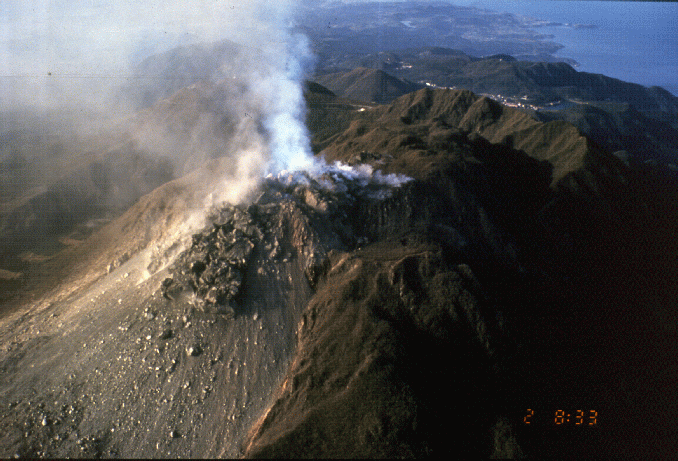
In spite of all the edicts and precautions of the Japanese Government, several devoted Missionaries still contrived to evade the vindictive vigilance of the officials, and to remain on the island in disguise. Among these was Father Spinola, who said that the day on which he put on this disguise was one of even greater happiness than that on which he entered the Society. He was indeed needed ; for cruel persecutions arose everywhere, accompanied by new and hideous tortures. Christianity was to be stamped out by any and every means. At Arima and Chimabara the people were punished with mutilations and slow torture, and on the site of the college and church of the Jesuits two hundred persons were tortured to death in a most sickening manner.

Sunday, February 12, 2012

Rene Goupil "Felled To The Ground By A Hatchet-blow"

Captured by the Iroquois near Lake St. Peter, he resignedly accepted his fate. Like the other captives, he was beaten, his nails torn out, and his finger-joints cut off. On the thirteen days' journey to the Iroquois country, he suffered from heat, hunger, and blows, his wounds festering and swarming with worms. Meeting half way a band of two hundred warriors, he was forced to march between their double ranks and almost beaten to death. Goupil might have escaped, but he stayed with Jogues. At Ossernenon, on the Mohawk, he was greeted with jeers, threats, and blows, and Goupil's face was so scarred that Jogues applied to him the words of Isaias (53:2) prophesying the disfigurement of Christ. He survived the fresh tortures inflicted on him at Andagaron, a neighbouring village, and, unable to instruct his captors in the faith, he taught the children the sign of the cross. This was the cause of his death. Returning one evening to the village with Jogues, he was felled to the ground by a hatchet-blow from an Indian, and he expired invoking the name of Jesus. He was the first of the order in the Canadian missions to suffer martyrdom. He had previously bound himself to the Society by the religious vows pronounced in the presence of Father Jogues, who calls him in his letters "an angel of innocence and a martyr of Jesus Christ." 
Link (here) to The Catholic Encyclopaedia

Saturday, February 11, 2012

Historians As A Rule Did Not Write Religious History.

 
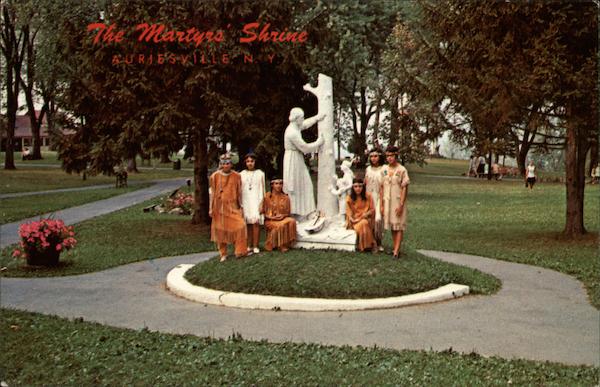
WHY CATHOLICS MAKE PILGRIMAGES TO AURIESVILLE.

"It has often been a matter of wonderment to the laymen why Catholics take so much interest in Auriesville. Lay historians make no mention of the spot, but this is accounted for by the fact that historians as a rule did not write religious history. Catholics revere the place because two of their earliest missionaries were there made martyrs to their religion. The two were Rene Goupil and Father Isaac Jogues. Both were French Jesuits who were propagating the faith among the Indians. In 1642 Goupil was murdered near the spot where the West Shore depot now stands. Father Jogues, his dear companion, was a witness to the foul assassination of his loved friend, and despite the earnest efforts of Father Jogues to give his friend a Christian burial he was unable to do so because of the treachery of the Indians. Father Jogues himself at this time was subjected to awful torture. Four years afterward Father Jogues was murdered near the same spot where his friend Goupil died. The grounds where these horrible crimes were enacted were purchased by the Jesuits and were made attractive places for Catholics to visit. There are twenty-eight acres embraced in the plot, sixteen in what is called the ravine and twelve in the Shrine ground proper."
Link (here) to the  book entitled, The Pilgrim of Our Lady of Martyrs

Thursday, June 9, 2011

Fr. Edward Billottet, S.J. (1812-1860) Martyr Of Lebanon

Zahle, Lebanon
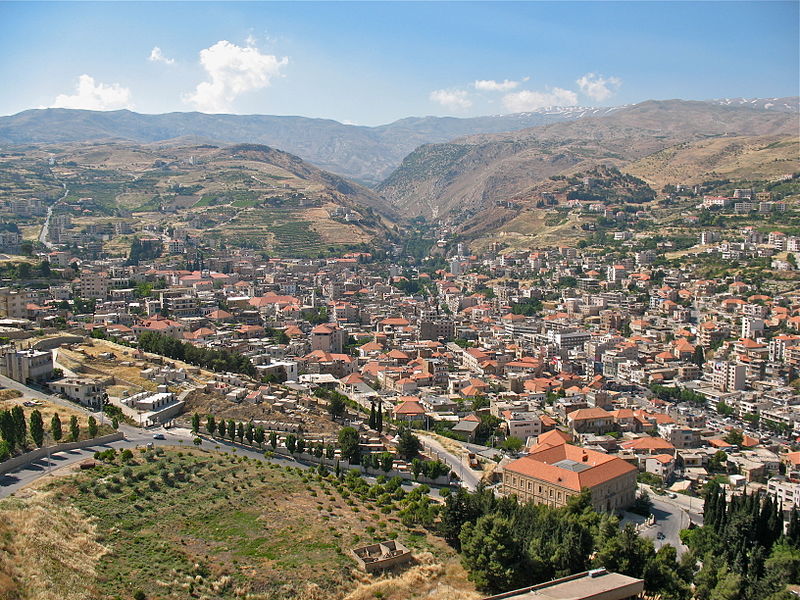
Fr. Edward Billotet’s first two years in Lebanon were spent teaching French while he studied Arabic. In 1848 he was appointed minister at the Beirut residence and later in 1850 he was made superior of the entire Lebanese-Syrian mission. As superior he increased the number of schools funded by the Propagation of the Faith and in 1853 he started an Arabic press for disseminating Christian literature. He spent a total of eight years as mission superior before he went to the Jesuit residence and church at Zahle in Feb 1859. Because the church had previously received the gift of a vineyard outside the city, the Druses, a fanatical Muslim sect in Lebanon tried to force Fr Billotet to pay taxes. But because he was a French citizen he was therefore not subject to the sultan’s taxation. As the revenue from the vineyard went to support a Christian school and a Catholic church, the Druses continued to harass Fr Billotet and tried to force him to leave the country. The Druses then began from June 1860 to massacre Maronite Christians. Within three weeks they killed 7750 Christians, destroyed 560 churches, burned 360 villages, razed 42 convents and left 28 schools in ruins. Zahle was the worst casualty because of its concentration of Catholics.....the Druses rushed upstairs they forced all seven Catholics onto the terrace.... As Fr Billotet raised his eyes to heaven and thanked God that he could offer Him this sacrifice, several bullets struck him in the breast.
Link (here) to read the full biography of Fr. Billottet  and the other 4 Jesuit martyrs of Lebanon at the Singapore Jesuit website.

Tuesday, May 10, 2011

St. Andrew Bobola, S.J.

It was during the reign of Casimir V. that the Society of Jesus in Poland gave a glorious martyr to the Church. Saint Andrew Bobola was born in 1590, of an illustrious family; in 1611 he entered the Society of Jesus; and some years later, when the plague broke out in the town of Vilna, he devoted himself to the care of the sufferers with a heroism that excited universal admiration, and well-nigh cost him his life. He was subsequently appointed to the Jesuits' residence at Bobrinsk, on the Berezina. The province of Lithuania was at this period torn by religious warfare; the clergy and bishops remained firmly attached to the orthodox faith, but a portion of the population had fallen into schism, and it needed all the apostolic zeal of their pastors to recall them to the true faith. 
Among these devoted missionaries Father Bobola was foremost, and, as an instance of the wonderful success that crowned his efforts, we are told that he converted the whole city of Janow, where, when he began to preach, there were but two Catholics. In 1657, while preaching in the neighborhood of the town, he was surprised by a band of rebel Cossacks, whose ravages at that period created general consternation throughout the kingdom. 
He was seized by them and carried to a neighboring wood, where, upon his refusal to deny his faith, the barbarians cruelly scourged him. They then dragged him to Janow between two horses, put out his eyes, burnt his sides with lighted torches, tore off the skin of his back, while the martyr continued to repeat: 'Jesus, Mary, assist me; enlighten and convert these blind men ; Lord, Thy will be done.' At last his tongue was torn out, and soon afterwards his blessed soul went to receive his reward, on the eve of the Ascension, 1657.
Link (here) to read the original story along with other exciting tales of Jesuit heroism contained in the book The Jesuits.

Monday, March 14, 2011

What Is Bound, Is Bound In Heaven


188 Japanese martyrs beatified

Christian martyrdom is the fullest expression of human freedom and reflects the supreme act of love, said a top Vatican official at a Mass beatifying 188 Japanese martyrs. "It is not the punishment or the torture that creates a martyr," but rather the fact the person suffered and died for Christ, Cardinal Jose Saraiva Martins, former prefect of the Vatican Congregation for Saints' Causes, said during the beatification Mass in Nagasaki, Japan, on November 24.
The 188 17th-century Japanese martyrs were tortured and killed in different cities between 1603 and 1639 after the Japanese government outlawed Christianity. According to Vatican Radio, more than 30,000 people attended the ceremony in the city's baseball stadium in the pouring rain to celebrate the beatification of Jesuit Father Peter Kibe Kasui and 187 companions.
After his Angelus address to pilgrims gathered in St. Peter's Square the previous day, Pope Benedict XVI said the martyrs' beatification marked a significant event for the Catholic Church and all of Japan.
The Pope asked people to "rejoice" and pray the beatified martyrs' "victory in Christ over sin and death fill us all with hope and courage”. During the Mass, which was concelebrated by 10 cardinals and bishops, Cardinal Saraiva Martins said martyrs of every age, place and time have all displayed the same dedicated faith in Jesus Christ.
Christian martyrdom "is the fullest exercise of human liberty and the supreme act of love", he said. The newly beatified, all but five of whom are lay men, women, and children, had been decapitated, crucified, burned at the stake or scalded to death in boiling water.
The beatified group included entire families who refused to renounce their beliefs. Bishop Francis Xavier Osamu Mizobe of Takamatsu, president of the Japanese bishops' commission which prepared the beatifications, said there are another 5,000 people who could have been recognised as martyrs.
He said nearly 20,000 people lost their lives in Japan because of anti-Christian persecution. It is thought that less than one per cent of almost 130 million Japanese are Christians, and only around 450,000 are Catholics.
Buddhism and Shintoism are the main religions in the country. Premier Taro Aso is reportedly the first Catholic to become prime minister. However, he rarely refers to his religion in public and did not attend the ceremony.

Link (here)

Photo is a statue of Blessed Peter Kibe Kasui, SJ

Sunday, February 6, 2011

St. Paul Miki, S.J. His Feast Day Is Feb. 6th

The Crucifixion of St. Paul Miki, S.J.
Taiko-Sama, like other heathen autocrats, did not trouble himself to examine the question carefully and justly, and enquire how far the accusation he had heard was true ; he did what might naturally have been expected from such a person in such a position; and looking at the matter, so to speak, from his heathen point of view, we cannot in the least wonder at his cruelty in putting the Franciscans and other teachers to death; for from the information he had received, he looked on them as intriguing foreigners, involved in a plot to deliver over his country to the king of Spain, and as for the native Christians, he probably thought they would only be too willing accomplices ; but, as we have before observed, he was no mere headlong persecutor, he did not like shedding blood indiscriminately ; he was what would now be considered a consistent liberal; and the principles on which he acted do not differ in this respect from those of many Catholic liberal statesmen, who have the light of a faith which he had not, and have had the grace of the sacraments to help them, which he had not, and who yet rebel against the Church and persecute the Holy

See, the religious orders, and the bishops, whom they ought to respect and defend. Taiko-Sama did not cany out his original intention of putting to death all the Christians; but he had meanwhile given an opportunity to them to Biiow of what mettle they were made, and most nobly did they behave. As soon as it was known that the Kumbo-Sama wished to have a census of his Christian subjects, all of them, men, women, and children, came forward fearlessly and put down their names as Christians, ready to be martyred if it were the will of God. Taiko-Sama, however, moved by the representation made to him by Gibunosci, the governor of Meaco, (who asked if he really wished to put to death all the Portuguese priests who had recently come to
Japan in vessels which were evidently mere trading vessels), so far relented as to spare all but the Franciscans and the tertiaries of the order, who were in the convent at the time of the seizure. On December 8th, the Feast of the Immaculate Conception, all these were imprisoned by guards being placed round the house. At Ozaca, however, on the same day, the Jesuits, as well as the Franciscans, were imprisoned by Farimundono, the governor; but there were only St. Paul Mili .and the other two lay-catechists in the Jesuit house; Father Organtin, the superior, who had recently been there, having previously left for Meaco, and thus uncousciously escaped. At the end of December, the Kumbo-Sama finally ordered that all these prisoners should have their noses and ears cut off and be taken through Meaco, Ozaca, Sakai, and lastly to Nagasaqui, where they should be crucified. The governor of Meaco, to whom was entrusted the carrying out of the sentence, mitigated it a little by only cutting off a part of the left ear of each ; but they were conducted in cars through the streets with their crime and sentence placarded, (according to the emperor's orders), which in Japan was a disgrace worse than death.
St. Peter Baptist, the Franciscan, and St. Paul Miki, the Jesuit, continued as they went along to preach, so far as they could, to the assembled multitudes. The prisoners were twenty-four in number, but there were two others, whose names we have already mentioned, put to death with them for following them and ministering to them. 
They began their painful journey through the towns of Japan in the early part of January, and it took them twentysix days ; it was on February 5th that they at length suffered the death they so much wished for. The Jesuit fathers, John Rodriguez, and Francis Pasia, came to hear their confessions, and also received the vows of the two catechists, St. John Soan of Goto and St. James Risai, who had not previously taken the habit.
The mode of crucifixion was not the same as that by which our blessed Lord suffered. The martyr was not nailed to the cross. His hands were stretched out and fastened to the transverse beam by rings or cords, and his feet rested on another transverse piece of wood. He was then transfixed by two strokes of a lance, one on each side, and was thus speedily put to death. 
And in this way did these holy and heroic men die on that day. Nothing could exceed the fervour of the native martyrs; St. Paul Miki preached to the people assembled, the two boy-martyrs, Anthony and Louis, died with exultation. St. Peter Baptist, the Spanish' Franciscan Father, preached too from his cross, and he was the last that expired. It is said that all the Christians, and even the heathens present, hurried to collect the blood of the martyrs, and some tore away their garments as relics. Two Franciscans were among the crowd in disguise, Father Marcel of Ribadeneira, and John the Poor. The bishop was dissuaded by the Jesuits from being present, but seems afterwards to have regretted his absence, as if it were a neglect of duty.
Link (here) to read the whole portion of the book entitled 

Friday, December 10, 2010

Jesuit Scholastic Murdered In Africa

Scholastic Nicolas Eklou Komla, S.J.
A Catholic seminarian of Togolese nationality, Nicolas Eklou Komla, was murdered on Sunday, December 5 on Belair Street, Mont Ngafula, on the outskirts of Kinshasa, capital of Democratic Republic of Congo. Overnight, December 4-5, the seminarian was returning on foot with some colleagues from the Jesuit school, St Peter Canisius in Kimwenza, when a masked gunman blocked their path, presumably to rob them.The assailant soon fired several rounds at the seminarian, who died several hours later. Nicolas Eklou Komla, was born on June 4, 1985 in Togo, and entered the Jesuits October 7, 2008. He made his first vows on October 2, 2010. Nicolas Eklou Komla had arrived in the DRC two months before his death to study philosophy. The funeral for the seminarian will be held on December 11 at the Church of St Mary in Kimwenza. Nicolas Eklou Komla will be buried in the cemetery at St Peter Canisius in Kimwenza.
Link (here) to Spero News 
From the Irish Jesuits
Nicolas Eklou Komla SJ, a young 24 year old Jesuit scholastic, was shot dead on Sunday 5 December  by unknown gun-men at Bel-Air, not far from the Jesuit Canisius College in Kinshasa, DR Congo. Three of his confrères managed to escape the shoooting. Nicolas was the fourth Jesuit from Kimwena-Kinshasa to die violently in the last four years. 
Link (here)
Photo (Source)

"Even if he dies before the age, just find the rest (...) On arrival at goal shortly, he covered a long road." (Wisdom 4, 7-13)
It pleased the Lord to remind Him
Eklou Komla Nicolas, S.J.

Scholastic approved the Society of Jesus
Born 04/06/1985 in Togo.
Entered the Society of Jesus on 07/10/2008
Emet first vows on 02/10/2010
Died in Kinshasa, 05/12/2010

SCHEDULE OF FUNERAL

Monday 06 to Thursday, December 9
Daily at 20:30 Worship in the Chapel of St Peter Canisius community

Friday, December 10
14h00: Closure of the body (Hospital Monkole)
15.00: Welcome to the community St Peter Canisius
17:30 Vespers
18.00 Eucharist (Chaired by Fr Rector, Father's homily Mpay)
After Vigil Mass in the Chapel St P. Canisius
                    
Saturday, December 11
10:00 am: Funeral Mass (Church of St. Mary Kimwenza)
Interment Cemetery scholasticate P. Canisius
Note: All Jesuits offer Mass for him, according to our manner of proceeding. Those who want to celebrate together muniront of a blade and a purple stole and white on Friday, Saturday.
Link (here) to Jesuits of the Central Africa Province

From the Spiritual Exercises of St. Ignatius of Loyola

From the Second Exercise On Death

Application of the touch 
Imagine in your feeble hands the crucifix, which the priest presents to you; imagine yourself touching your own  body which will soon only be a corpse. How cold your feet! Your arms, shriveled by sickness, begin to stiffen. How painfully your chest labors with your unequaled breathing, which will soon cease! Your heart which beats with a scarcely perceptible movement, your face hollowed by fever and covered with cold sweat - it is in this state you have seen your friends or near relatives dying? It is in this state that your friends and your relatives will see you before long. Make these reflection today, which your agony will soon inspire in those who witness it. End by a colloquy with our Lord dying: "Into Thy hands o Lord, I commend my spirit" Psalms 30:6


Our Father, Who art in heaven,
Hallowed be Thy Name.
Thy Kingdom come.
Thy Will be done, on earth as it is in Heaven. Give us this day our daily bread.
And forgive us our trespasses,
as we forgive those who trespass against us.
And lead us not into temptation,
but deliver us from evil. Amen.
Hail Mary,
Full of Grace,
The Lord is with thee.
Blessed art thou among women,
and blessed is the fruit
of thy womb, Jesus.
Holy Mary,
Mother of God,
pray for us sinners now,
and at the hour of death. Amen.

Link (here)

Tuesday, December 7, 2010

" Ah, my God ! ah, my God!"

A Natchez Chief  "Great Sun"
Father Paul du Poisson, S.J. was on his way to consult M. Perrier, and to adopt with him proper measures to enable the Akensas to descend to the banks of the Mississippi, for the accommodation of the voyagers. He arrived among the Natchez on the 26th. of November, that is, two days before the massacre. The next day, which was the first Sunday of Advent, he said Mass in the Parish, and preached in the absence of the Cure. He was to have returned in the afternoon to his Mission among the Akensas, but he was detained by some sick persons, to whom it was necessary to administer the Sacraments. 
On Monday, he was about to say Mass, and to carry the Holy Sacrament to one of those sick persons whom he had confessed the evening before, when the massacre began; a gigantic chief six feet in height, seized him, and having thrown him to the ground, cut off his head with blows of a hatchet. The Father in falling only uttered these words, " Ah, my God ! ah, my God!" 
M. du Codere drew his sword to defend him, when he was himself killed by a musket ball from another Indian whom he did not perceive.
Link (here)

Friday, December 3, 2010

In Condemning Us You Condemn All Your Own

St. Edmund Campion, S.J.
St. Edmund Campion, S.J. was arrested in Lyford Grange in Berkshire. He was taken to the Tower of London and tortured, but refused to give up his faith. On 14 November he was indicted with others in Westminster Hall on the fabricated charge of trying to incite a rebellion. In spite of his able defence, the jury found him guilty of treason and he was condemned to death. 
When Campion heard the sentence he said: " In condemning us you condemn all your own ancestors all the ancient bishops and kings, all that was once the glory of England." 
To his persecutors, Campion said, “Be it known unto you that we have made a league – 
all the Jesuits of the world – whose succession and multitude must over-reach all the practices of England – 
cheerfully to carry the cross you shall lay upon us and never to despair of your recovery while we have a man left to enjoy your Tyburn, to be racked with your torments or to be consumed with your prisons. The expense is reckoned, the enterprise is begun; it is of God; it cannot be withstood. So the faith was planted, so it must be restored.” 
Link (here) to Spero News

Wednesday, November 17, 2010

Jesuits Whom Meet Their Doom

Three Catholic priests who joined the Jesuit missions in 16th century Paraguay met their doom in 1628 at the hands of native Americans in what is now the South American republic. The three Jesuit priests: Roque Gonzalez de Santa Cruz, Alonzo Rodriguez and Juan de Castillo, joined the missions called 'Reductions' since it was there that the missionaries 'reduced' or converted the locals to the Catholic religion. Part of the story of these Jesuit missions is depicted in the film The Mission.
Link (here) to the full article at Spero News

Sunday, November 7, 2010

Jesuit Saints: Martyrs Like The Maccabees

The memorial of Jesuit saints and martyrs Roque Gonzalez de Santa Cruz, Alphonsus Rodríguez and Juan del Castillo speak of the same theme. They were architects of the Jesuit reductions in Paraguay.
The reductions, from the verb “reducir” is a Jesuit way in the missions: they worked with the Guarani people who lived along the Paraguay and Pilcomayao rivers. The Jesuits would like to bring the Guarani to live in towns. At the small mission of St. Ignatius, Roque Gonzalez supervised the construction of houses, the public square, the school and the church. The reductions spread to Uruguay, Southern Brazil and Panama.
To them they focused on the “insignificant” in society and empowered them. The cost, like the Maccabees, was their lives: they were bludgeoned to death by religious leaders and killed in the very chapel they built for the people. Their stories here.

Link (here) to the Jesuit blog Faith of a Centurion, authored by Fr. Jessel Gerard, S.J.

Monday, October 11, 2010

St. Nicholas Owen, S.J.

On the 22nd of March we remember St Nicholas Owen, the Jesuit who was martyred at the start of the 17th Century. Nicholas Owen is remembered, other than his martyrdom, for his outstanding skills at building priest-holes. One such home to come under his craftsmanship was Harvington Hall, located within the archdiocese of Birmingham.
Link (here) to Fr. Paul Johnson's blog from England

Sunday, October 10, 2010

Every Jesuit Could Benefit With A Lady Like This In His Corner

CARVAJAL, LUISA DE (156S-1614), Spanish missionary in England, was born at Jaraicejo in Estremadura on the 2nd of January 1568. Her father, Don Francisco de Carvajal, was the head of an old and wealthy family which produced many men of note. Her mother, Dona Maria, belonged to the powerful house of Mendoza. Both were people of pious character. The mother died in 1572 from a fever contracted white visiting the poor, and the father took the disease from his wife, and died of it. Luisa and a brother were left to the care of their grand-aunt Maria Chacon, governess of the young children of Philip II. On her death they passed to the care of their maternal uncle, Francisco Hurtado de Mendoza, count of Almazan. The count, who was named viceroy of Navarre by Philip II., was an able public servant in whom religious zeal was carried to the point of inhuman asceticism. His niece attracted his favour by her manifest disposition to the religious life; she sent her own share of dinner to the poor, ate broken meats, wore a chain next her skin, and invited humiliation; and at the age of seventeen she was instructed by the count to make a surrender of her will to two female servants whom he set over her, and by whom she was repeatedly scourged while naked, trampled upon and otherwise ill-treated. 
But when Luisa came of age she refused to enter a religious house, and decided to devote herself to the conversion of England. The execution of the Jesuit emissary priest, Henry Walpole, in 1596 had moved her deeply, and she prepared herself by learning English and by the study of divinity. A lawsuit with her brother caused temporary delay, but she secured her share of the family fortune, which she devoted to founding a college for English Jesuits at Louvain; it was transferred to Watten near Saint Omer in 1612, and lasted till the suppression of the Order. 
In 1605 she was allowed to go to England. She established herself under the protection of the Spanish ambassador, whose house was in the Barbican. From this place of safety she carried on an active and successful propaganda. She made herself conspicuous by her attentions to the Gunpowder Plot prisoners.and

Saturday, July 31, 2010

That Was Then

St. Edmund Campion, S.J.
Think for example of St Peter Canisius, who spearheaded the re-evangelisation of Germany with his catechetical works; and one remembers with pride St Edmund Campion, who even though on the run during his brief English ministry still managed to write, print and distribute the Decem Rationes, popularly known as “Campion’s Brag”, a stunningly effective work of apologetics, all the more so for being produced under the very noses of the Elizabethan authorities. Its very daring got it noticed. Again, Jesuit colleges throughout Europe, but especially in the Austrian lands, were effective in re-Catholicising territories that had been lost to the Church.
Link (here) to the Catholic Herald.

Monday, May 31, 2010

Hell On Earth Began Some 70 Years Ago

On the morning of September 1, 1939, the German battleship Schleswig-Holstein ushered in WWII when it opened fire on the 180-strong Polish contingent stationed on Westerplatte. Donald Tusk, the Polish prime minister, and Lech Kaczynski, the nation's president, were due to lay wreaths at a memorial to the garrison at 4:45am, 70 years to the minute that the ship's shells first tore into the Polish defenses.

Link (here)

The 69 Polish Jesuits who died in WWII (here)

D-Day And The Jesuit Martyrs Of WWII

United States of America's President Ronald Reagan
his speech at Normandy on the 40th anniversary of D-Day
(here)

President Franklin Delano Roosevelt's
Prayer prior to D-Day
(here)

The Normandy Invasion
(here)

The Jesuit Martyrs of WWII
(here)