Showing posts with label Jesuits in Japan. Show all posts

Sunday, May 25, 2014

The Eight Jesuits Say "We Believe That We Survived Because We Were Living The Message Of Fatima. We Lived And Prayed The Rosary Daily In That Home."

Father Hubert Shiffer was one of these eight Jesuit survivors. He was 30 when the atomic bomb exploded at Hiroshima and lived another 33 years in good health. He recounted his experiences at Hiroshima during the Eucharistic Congress held in Philadelphia (USA) in 1976. At that time, all eight members of the Jesuit community were still alive. Fr. Shiffer, on the morning of August 6, 1945, he had just finished Mass, went into the rectory and sat down at the breakfast table, and had just sliced a grapefruit, and had just put his spoon into the grapefruit when there was a bright flash of light. His first thought was that it was an explosion in the harbor (this was a major port where the Japanese refueled their submarines.) 
Then, in the words of Fr. Schiffer: "Suddenly, a terrific explosion filled the air with one bursting thunderstroke. An invisible force lifted me from the chair, hurled me through the air, shook me, battered me, whirled me 'round and round like a leaf in a gust of autumn wind." 
The next thing he remembered, he opened his eyes and he was laying on the ground. He looked around and there was NOTHING in any direction: the railroad station and buildings in all directions were leveled to the ground. The only physical harm to himself was that he could feel a few pieces of glass in the back of his neck. As far as he could tell, there was nothing else physically wrong with himself. After the conquest of the Americans, their army doctors and scientists explained to him that his body
would begin to deteriorate because of the radiation. To the doctors amazement, Fr. Schiffer's body contained no radiation or ill-effects from the bomb. Conclusion: There are no physical laws to explain why the Jesuits were untouched in the Hiroshima airblast. There is no other actual or test data where a structure such as this was not totally destroyed at this standoff distance by an atomic weapon. All who were at this range from the epicenter should have received enough radiation to be dead within at most a matter of minutes if nothing else happened to them. There is no known way to design a uranium-235 atomic bomb, which could leave such a large discrete area intact while destroying everything around it immediately outside the fireball (by shaping the
plasma). Not only did they all survive with (at most) relatively minor injuries, but they all lived well past that awful day with no radiation sickness, no loss of hearing, or any other visible long term defects or maladies. Naturally, they were interviewed numerous times (Fr. Schiffer said over 200 times) by scientists and health care people about their remarkable experience. 
The eight Jesuits say "we believe that we survived because we were living the message of Fatima. We lived and prayed the rosary daily in that home." Fr. Shiffer feels that he received a protective shield from the Blessed Mother which protected him from all radiation and ill-effects. Fr. Schiffer attributes this to devotion to the Blessed Mother, and his daily Fatima Rosary; "in that house the Holy Rosary was recited together every day." 
Of course the secular scientists are speechless and incredulous at this explanation - and they are sure there is some "real" explanation - but at the same time over 50 years later the scientists are still absolutely bamboozled when it comes to finding a plausible scenario to explain the missionary's unique escape from the hellish power of that bomb. From a scientific viewpoint, what happened to those Jesuits at Hiroshima still defies all human logic from the laws of physics as understood today (or at any time in the future). It must be concluded that some other (external) force was present whose power and/or capability to transform energy and matter as it relates to humans is beyond current comprehension; a plausibility argument for the existence of a Creator who left his "calling card" at Hiroshima. 
Link (here)

Monday, October 28, 2013

“A Copernican Revolution”

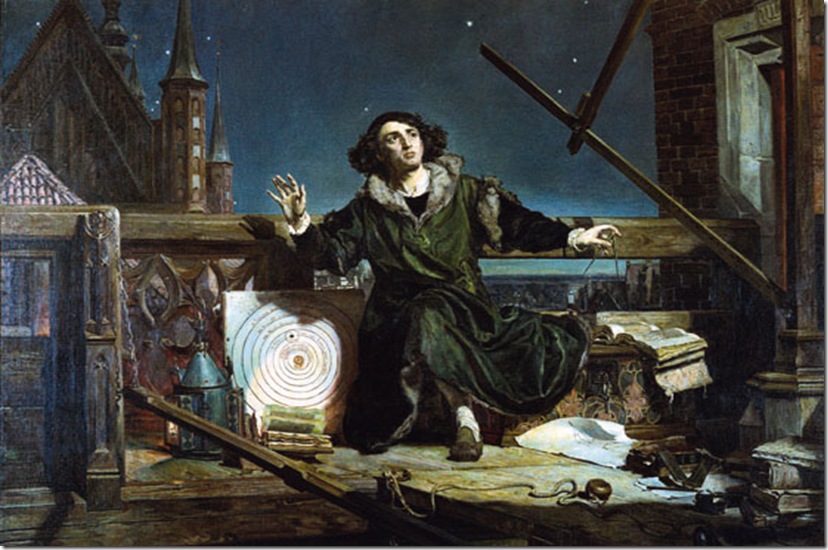
Jan Matejko's Conversations with God
In an interview with L’Osservatore Romano, Father Cristian Martini Grimaldi, an Argentine Jesuit who has served for decades as a missionary in Japan, recalled the future Pope Francis’s leadership as a Jesuit provincial. Father Grimaldi, who was sent to Japan by the future Pope, now directs the martyrs’ museum in Nagasaki.

Father Grimaldi recalled how Father Jorge Mario Bergoglio would emphasize that the Jesuits under his care must take responsibility for their actions.
In Argentine Catholic culture at the time, Father Grimaldi recounted, priests would wait for the lay faithful to come to parishes before interacting with them. Father Bergoglio, he said, instituted “a Copernican revolution”: he instructed Jesuit novices to go out and teach the catechism in poor neighborhoods and invite the poor to church. 
Link (here) to Catholic Culture

Wednesday, February 27, 2013

A Chief Curse Of Life In Japan

St. Ignatius of Loyola was so keenly interested in the fortunes of his sons, wherever they might be, that he once said he would like to know how many fleas bit them at night. Plenty of fleas bit his dearest son Francis Xavier while snatched his brief slumbers on the matted floor, for though the cleanest people in the world beat and shake the mats incessantly the fleas still thrive in such excellent cover and are, or used to be a chief curse of life in Japan.
From the book entitled, St. Francis Xavier, S.J., by Fr. James Brodrick, S.J. page 245 an Image Book

Wednesday, February 20, 2013

St. Francis Xavier, S.J., ' The Japanese Are Best Disposed Towards Our Christian Way Of Life.”


“Among all the nations of the Far East that I know, the Japanese are best 
                                             disposed towards our Christian way of life.”


Three hundred years of cruel persecution could not completely destroy the seeds Xavier had planted. All the early Jesuit and Franciscan missionaries were killed, every known Christian was martyred. But seven generations later, when missionaries were able to return to Japan, they found over 60,000 Catholics hidden in the mountains or in small fishing villages. They still sang the Ave Maria in Latin! They still practiced the daily recitation of the Rosary
Link (here) to Shrine of St. Jude

Saturday, March 31, 2012

Fr. Marcello Mastrilli, S.J. And "Hell's Mouth"

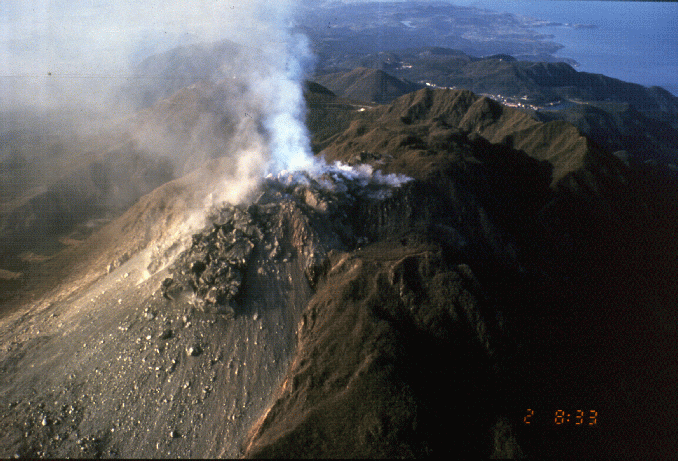
Mount Unzen in Japan
In spite of all the edicts and precautions of the Japanese Government, several devoted Missionaries still contrived to evade the vindictive vigilance of the officials, and to remain on the island in disguise. Among these was Father Spinola, who said that the day on which he put on this disguise was one of even greater happiness than that on which he entered the Society. He was indeed needed ; for cruel persecutions arose everywhere, accompanied by new and hideous tortures. Christianity was to be stamped out by any and every means. At Arima and Chimabara the people were punished with mutilations and slow torture, and on the site of the college and church of the Jesuits two hundred persons were tortured to death in a most sickening manner.

Tuesday, January 10, 2012

Fr Jerry Cusumano, S.J. And The Cave

Shinmeikutsu
Besides my daily sitting I went for sesshin (intensive Zen sitting of 9-10 hours a day for five days or more while staying at a Zen temple) .I did these sesshin under the direction of Fr. Hugo Lasalle, the German Jesuit pioneer in Zen, at Shinmeikutsu (The Cave of Divine Darkness), the Zen facility which he had recently completed.[1] I also became a disciple of his own master, Yamada Koun Roshi in 1979. However, during these early years I did not go for guidance to Yamada Koun Roshi but practiced only with Fr. Lasalle. After seven years he urged me to continue my practice with Yamada Koun Roshi in the Sanbô Kyôdan at the Zen Centre (San Un Zendo) in Kamakura. I did so and have continued there under the two Roshi who succeeded Yamada Koun Roshi after his death in 1989, namely, Kubota Ji Un Roshi for 15 years, and since 2004 to the present, Yamada Ryoun Roshi, the son of Yamada Koun Roshi. In summary, during my first 10 years in Japan I did not practice Zen. After starting Zen in earnest, during the first 10 years in my Zen practice I was consistent with daily sitting and several sesshin a year but I was off and on with regard to receiving weekly/monthly guidance. However, for the last 25 years I would characterize my practice as that of a serious lay person: sitting at least for 30 minutes a day, participating in zazenkai (one day sittings, where I receive direction from the Roshi) four or five times a month, and participating in sesshin, four or five times a year.The Sanbô Kyôdan is a religious corporation recognized by the Japanese Ministry of Education and Culture. It was founded in 1954 by Yasutani Hakuun who continued to try to synthesize the Soto and Rinzai branches of Zen as his own master, Harada Sogaku, had begun to do. Yasutani Roshi’s successor was my first Zen master, Yamada Koun Roshi. The Sanbô Kyôdan is a lay organization with no affiliation to any of the major sects of Zen in Japan. However, partly due to the influence of Fr. Lassalle, it has been very influential in the West. As one commentator has noted: “the influence of the Sanbôkyôdan on Western conceptions of Zen has been far out of proportion to its relatively marginal status in Japan.”
Link (here) to the Jesuit website 

Blogger Note: It is important to read this link (here) about Yasutani Hakuun and his anti-semitic views.

Saturday, December 3, 2011

St. Francis Xavier, S.J., Divine Mercy And The Converts Of Yamaguchi, Japan

A portion of a letter from St. Francis Xavier, S.J.

Before their baptism the converts of Yamaguchi were greatly troubled and pained by a hateful and annoying scruple---that God did not appear to them merciful and good, because
He had never made Himself known to the Japanese before our arrival, especially if it were true that those who had not worshipped God as we preached were doomed to suffer everlasting punishment in hell. It seemed to them that He had forgotten and as it were neglected the salvation of all their ancestors, in permitting them to be deprived of the knowledge of saving truths, and thus to rush headlong on eternal death.
It was this painful thought which, more than anything else, kept them back from the religion of the true God. But by the divine mercy all their error and scruple was taken away. We began by proving to them that the divine law is the most ancient of all.

Link (here) to St. Francis Xavier:Letter from Japan, to the Society of Jesus in Europe, 1552

Photo is of the Yamaguchi's St. Francis Xavier Catholic Church, it was completed in 1998. Located on a hilltop overlooking central Yamaguchi City, the striking modern design replaced an earlier church built in 1958 that mysteriously burned down in 1991. Link (here) more pictures as well.

Monday, March 14, 2011

Born A Japanese Samurai, And Truely Lived As A Jesuit


Father Paul Yachita Tsuchihashi, S.J. a former samurai warrior who lived to be one of the oldest Jesuit priests in the world, died recently at Sophia University, a Catholic college in Tokyo. He was 98 and an authority on the Chinese language.

In his youth Tsuchihashi wore the two swords signifying membership in a samurai warrior family, but he became attracted to Christianity. He entered the Jesuits at 22, was baptized “Paul” and journeyed to China to enter a Jesuit novitiate.

He pursued his studies in Paris, developing a knowledge of astronomy that led to his appointment as observatory director at the Jesuit Aurora University in Shanghai. When the order founded Sophia University in Tokyo in 1913 Father Paul returned to his homeland and remained on the faculty until his death. During World War II he was president of the university.

In recent years he had been proof reading a new 13 – volume Chinese dictionary.

"I believe I can finish the job by the time I am 100,” he said on his 95th birthday. Finding an average of mistake per page in a work which already had been checked by leading scholars, the priest corrected six of the 13 volumes before he died.

Link (here) to the magazine entitled Black Belt published in July 1965
Photo (here)

26 Martyrs

The Mass on Aug. 10 at Nakamachi Catholic Church will commemorate the construction of San Lorenzo Church, built in 1610 and torn down in 1620 after the Tokugawa shogunate (1603-1868) banned Christianity. The Japanese and South Koreans in the group said the event will be held in hopes of fostering bilateral relations through religion, in the year that also marks the 100th anniversary of Japan's annexation of the Korean Peninsula. Mitsuaki Takami, archbishop of the Catholic Archdiocese of Nagasaki, who will be celebrating the Mass, said, "I hope the Mass will provide the members with an opportunity to appreciate the devout faith in Christianity those people showed at the time, to reflect on harsh historical relations of the two countries and eventually create a better relationship." The participants got together after Cho Kenji, a 66-year-old Korean-Japanese in Shimonoseki, Yamaguchi Prefecture, who is studying the history of San Lorenzo Church, called on Christian groups in Nagasaki to organize the memorial event.
The Mass will also feature Renzo De Luca, a Jesuit priest and director of the Twenty-Six Martyrs Museum in Nagasaki. He will deliver a lecture on San Lorenzo Church and Korean Christians.
According to the Catholic Archdiocese of Nagasaki, San Lorenzo Church was built by Korean prisoners who were taken to Nagasaki and became Christians.
A Jesuit mission was based in Nagasaki at that time and many Japanese Christians also donated construction money for the church.
The church was pulled down after the shogunate banned the religion.
Link (here) to Japan Times


What Is Bound, Is Bound In Heaven


188 Japanese martyrs beatified

Christian martyrdom is the fullest expression of human freedom and reflects the supreme act of love, said a top Vatican official at a Mass beatifying 188 Japanese martyrs. "It is not the punishment or the torture that creates a martyr," but rather the fact the person suffered and died for Christ, Cardinal Jose Saraiva Martins, former prefect of the Vatican Congregation for Saints' Causes, said during the beatification Mass in Nagasaki, Japan, on November 24.
The 188 17th-century Japanese martyrs were tortured and killed in different cities between 1603 and 1639 after the Japanese government outlawed Christianity. According to Vatican Radio, more than 30,000 people attended the ceremony in the city's baseball stadium in the pouring rain to celebrate the beatification of Jesuit Father Peter Kibe Kasui and 187 companions.
After his Angelus address to pilgrims gathered in St. Peter's Square the previous day, Pope Benedict XVI said the martyrs' beatification marked a significant event for the Catholic Church and all of Japan.
The Pope asked people to "rejoice" and pray the beatified martyrs' "victory in Christ over sin and death fill us all with hope and courage”. During the Mass, which was concelebrated by 10 cardinals and bishops, Cardinal Saraiva Martins said martyrs of every age, place and time have all displayed the same dedicated faith in Jesus Christ.
Christian martyrdom "is the fullest exercise of human liberty and the supreme act of love", he said. The newly beatified, all but five of whom are lay men, women, and children, had been decapitated, crucified, burned at the stake or scalded to death in boiling water.
The beatified group included entire families who refused to renounce their beliefs. Bishop Francis Xavier Osamu Mizobe of Takamatsu, president of the Japanese bishops' commission which prepared the beatifications, said there are another 5,000 people who could have been recognised as martyrs.
He said nearly 20,000 people lost their lives in Japan because of anti-Christian persecution. It is thought that less than one per cent of almost 130 million Japanese are Christians, and only around 450,000 are Catholics.
Buddhism and Shintoism are the main religions in the country. Premier Taro Aso is reportedly the first Catholic to become prime minister. However, he rarely refers to his religion in public and did not attend the ceremony.

Link (here)

Photo is a statue of Blessed Peter Kibe Kasui, SJ

Monday, November 1, 2010

Frank Jesuit

William "Bill" Johnston, S.J. upset some people with his autobiography, "Mystical Journey: An Autobiography," which they found to be too frank and too revealing. He was quite excited when writing it, and would often say that it would be shocking to readers. I would often provoke him by saying, "Come on Bill, now at your age, you can be honest enough to write anything and everything! No need to be fuzzy or vague. Tell us clearly what you think and reveal yourself fully!"
Link (here) to read the full post at the Japanese based blog, Brittonia

Monday, September 6, 2010

A Jesuit In Tokyo

St. Ignatius Church, Sophia University Tokyo
A couple of weeks ago, I met a German Jesuit priest at a meeting in Malaysia. Fr Gunther has spent more than 40 years in Japan as a missionary. In one of my conversations with him, I was enlightened about quite a few things about Catholicism in the Land of the Rising Sun. Only about 0.5% of the population there are Catholics, which bring the number to slightly above the half million mark. Apparently, there are Japanese who have absolutely no notion that Christmas has links to the Church, let alone anything to do with Christ! As is evident in many countries, hotels and department stores in Japan do brisk business at that time of the year. Hotels tout it as a season of love (somewhat akin to Valentine’s Day) and promote hotel room packages for couples to ‘shack up’ for Christmas Eve. Department stores have sales that slash prices to pack in the shoppers. Certainly, this is not a phenomenon unique to Japan, but his following comment floored me. He once invited some Japanese to his Jesuit church in the heart of Tokyo to experience Christmas Mass, and they sniggered at him and said (with hands covering a smile, in a typical Japanese fashion) “What? Christmas has even come to the Church now? What can you possibly be selling there?”  This may seem bizarre, and I found it highly amusing. However, I couldn’t help but see that we too have shades of this kind of ignorance on our own shores. Maybe not regarding Christmas, but many other areas of life. 

Sunday, August 8, 2010

A Giant Fireball Which Vaporised Practically Everything, Except 8 Jesuits

August 6 is also an important date in world history: the fateful day on which the first atomic bomb was dropped on Hiroshima in Japan. On that day, a Monday, at 8.15 in the morning, an American B-29 bomber, Enola Gay, dropped its bomb “Little Boy”, which fell to a predetermined detonation height of about 1,900 feet above the city. It exploded with a blinding flash, creating a giant fireball, which vaporised practically everything and everyone within a radius of about a mile of the point of impact. It is estimated that up to 80,000 people were directly killed by the blast, and by the end of the year, that figure had climbed considerably higher, due to injuries and the effects of radiation. Over two thirds of the city’s buildings were completely destroyed.
But in the midst of this terrible carnage, something quite remarkable happened: there was a small community of Jesuit Fathers living in a presbytery near the parish church, which was situated less than a mile away from detonation point, well within the radius of total devastation. And all eight members of this community escaped virtually unscathed from the effects of the bomb. Their presbytery remained standing, while the buildings all around, virtually as far as the eye could see, were flattened.
Fr Hubert Schiffer, a German Jesuit, was one of these survivors, aged 30 at the time of the explosion, and who lived to the age of 63 in good health. In later years he travelled to speak of his experience, and this is his testimony as recorded in 1976, when all eight of the Jesuits were still alive. On August 6 1945, after saying Mass, he had just sat down to breakfast when there was a bright flash of light. 
Link (here) to the full article at Great Britian's Catholic Herald.

Wednesday, February 10, 2010

The Illustrious Jesuit, Father Alexander de Rhodes

Tonquin provided itself with a feeder by establishing the Seminary of Foreign Missions, in France, Japan did not, and, as a consequence, the church of Tonquin flourished while that of Japan died. Finally, forging a weapon wherewith to do battle for his cause, he pays a glowing tribute to the supposed founder of his favorite mission, Alexander de Rhodes, in the following words:
"The illustrious Jesuit, Father Alexander de Rhodes, S.J., was the Josue of the Tonquinese mission. His was a broader mind than most of his contemporaries. Driven from Tonquin (Tonkin, Vietnam), he went to Rome, whence, after advising with the Pope, he journeyed to Paris, there to inaugurate the great Seminary of the Foreign Missions."
Now we must premise that it is only by the courtesy of his sincere and warm-hearted admirer that de Rhodes can be called the Josue of the Tonquinese mission, for, in point of fact, he was not the first to enter it, never inaugurated the Seminary of the Foreign Missions, and never led his warriors, or even went back himself, to that promised land. Nevertheless, he was a noble and heroic soul, and deserves all the praise we can give him. Yet if his letters portray him rightly, he would be hurt to find himself exalted at the expense of his brethren.

Link (here) The American Catholic Quarterly Review, the article is entitled, The Failure of Native Clergy.

Link (here) to a time line of Catholic and Jesuit missionary activity in Vietnam.

Saturday, February 6, 2010

Our Lord's Own Age

SS. Paul Miki, John Of Goto, and James Kisai, MM.

The Catholic religion was introduced into Japan by St. Francis Xavier. For nearly a century and a half the Church there enjoyed peace ; the great Japanese persecution was commenced by the Emperor Taicosama, in the year 1597 ; by his order six Franciscan friars, seventeen laymen, and three Jesuits were crucified at Nangasaki. They embraced and kissed their crosses reverently and affectionately. These three Jesuits, all Japanese, were the first of their Order to shed their blood in a land which was to give so many martyrs to the Society.

Paul Miki, aged thirty-three, not yet a priest, rejoicing that he was about to die as Our Lord at Our Lord's own age, preached with such eloquence, as he was being led from city to city, that he converted many to the faith.
He continued to preach from his cross, while the Superior of the Franciscans intoned the Benedictus, and a child-martyr died singing the Laudate pueri (Praise God, ye children).

" See, father," said John of Goto, " we must prefer salvation to all things," giving to his parent the cloth from his head as a gift to his mother. Their sides were pierced by lances. "Into Thy hands I commend my spirit!" exclaimed Paul Miki. " Jesus, Mary," murmured James Kisai. John of Goto's father remained at the foot of his son's cross, embracing the wood on which he had died. John of Goto was a novice of nineteen ; James Kisai was a laybrother. These martyrs were beatified in 1627, and canonized by Pope Pius IX.

Link (here) to the portion of the book entitled, Saints of the Society of Jesus by Fr. David Andrew Merrick, S.J.

The Childhood Friend Of St. Paul Miki, S.J. Was His Exacutioner

Father Baptiste had sent a letter to the Jesuits of Nagasaki asking that, if possible, arrangements be made for administering the sacraments to the prisoners. All that the officials would grant was that Father Paez might go to one of the towns through which the captives would pass and there shrive Miki and his two companions. Paez received the vows of the two latter, thus admitting them into the Society. Father Rodriguez, who had come to Nagasaki, managed to gain access to the prisoners and to administer the sacraments to some of them. As Terasawa, the Governor of Nagasaki, who had been secretly baptised, was absent at this time, the care of the execution came upon his brother Hasaburo. He as a boy had been a playmate of Paul Miki, and for years he had seen nothing of him until he met him among the captives that he must put to death.

Friday, December 4, 2009

Japanese First Christmas Included Jesuits

CHRISTMAS IN JAPAN
By JASMIN K. WILLIAMS
December 19, 2007 --

How do you say Merry Christmas in Japan? Easy. Merry Christmas. THE big holiday in Japan is New Year's Day. The Christmas holiday was introduced to Japan by the Europeans who arrived during the 16th century. It is not celebrated as a national or religious holiday, as less than 2 percent of Japan's population is Christian. The major religion in Japan is Buddhism. If Christmas falls on a weekday, everyone still goes to work and school. But over the past few decades, the holiday has gained in popularity, with the Japanese taking up the traditions of decorating their homes, giving gifts to friends and having a holiday meal. The holiday became popular due, in part, to the Christmas products Japan manufactured for other countries. Women and young people are the biggest fans.
The first recorded Christmas in Japan was celebrated with a Mass led by Jesuit missionaries in 1552. When the missionaries were expelled in 1587, Christianity was banned and the public practice of Christmas was stopped. There was, however, a small group of Japanese Christians called kakure Kirishitan, or “hidden Christians," who continued to practice underground for more than 250 years. During the Meiji Period, from 1868 to 1912, the ban on Christianity was lifted and Christmas reappeared, but it was never the great religious holiday it is in other countries. Christmas Eve is more like Valentine's Day.
Sweethearts enjoy this big night out on the town at a fancy restaurant. Romance is in the air. There is a fabled Buddhist monk, Hotei-osho, who acts as a symbolic Santa of sorts. He brings presents for the children. He has eyes in the back of his head so children behave. Most children, however, prefer that Santa deliver the presents. Christmas is not a day of family celebration and food, as in other countries. The Christian population spends the day doing good deeds for others, especially those who are sick at home or in a hospital. The custom of exchanging gifts involves an oseibo, an end-of-theyear present. This is usually presented to teachers or people with whom you do business. Most people have a department store deliver the gifts. These are given to repay favors received during the year. These are usually not fancy or too formal. Popular choices are gift certificates, canned foods, coffee or fruit. On each oseibo, the giver includes a thin paper called a noshi on which the word oseibo is written. The oseibo is not to be confused with a Christmas gift. The traditional holiday food in Japan is Christmas cake. This is usually a sponge cake with strawberries and whipped cream.

Link (here)

Monday, September 14, 2009

Magic Jesuit

The Rev. Frank Howell, president of Sophia Junior College, Catholic priest, educator and debate team coach, finds serenity in an unexpected location amid the bustle of his busy life. He hops a train and heads to another land — Tokyo Disneyland. Rev. Frank Howell relaxes in a garden at Sophia University in Tokyo. It may seem strange that a Jesuit priest finds solace in such a glaring representation of the material world, but for Father Howell, Disney really is a Magic Kingdom. "Of course it is staged," Howell acknowledges.
"But you are surrounded by smiling people, and that has to be good for you."
Howell also appreciates the compassion that is a traditional part of Disney.
"The first time I went to Tokyo Disneyland, I was amazed how the staff focused on the front row, all the people in the audience in wheelchairs. The kindness was impressive."
For Howell, Disney and Japan are somehow connected. He was given a special backstage tour of Disney Studios in California soon before leaving the United States for Japan back in 1972. When he was growing up in Washington in the 1950s, Disney and "The Mickey Mouse Club," a popular television show for children featuring the Mouseketeers, were a symbol of childlike innocence. When his 1972 tour brought him face to face with the most famous Mouseketeer of all, Annette Funicello, Howell's appreciation of "Disney Magic" deepened. A few months later he left home to make a life in Tokyo. Teaching in Japan, Howell quickly realized, was not always a magic place for university teachers. University students were mostly tired from the hard slog of entrance exams, and their intellectual curiosity seemed to evaporate when they entered a classroom. Some of his students slept in class, and attendance was sporadic. Howell found himself engaged with and challenged by his new students only after he started coaching English debate as a club activity. To challenge his students intellectually has always fit his idea of an educator. Growing up and attending school in an international community in the U.S. capital, Howell realized early on that there were many avenues of thought.
"My father would read The Washington Post to me, articles about the Pacific War. I had the idea that Washington was the center of a very big place called the world."
Like Howell, most of his high school classmates went on to achieve doctorates. Exploring the world, its different places and views, seemed the work of an educator to young Howell. He now considers himself more of a coach than an educator. "I regret that most Japanese academics do not work with clubs; the educational possibilities are so much greater in coaching, any kind of coaching, than in standing in the classroom."

Link (here) to the full article in Japan Times

Wednesday, August 26, 2009

Prudent Flexibility


Thus Juan Masia, S.J., in a commentary on the Japanese bishops' statement, wrote that
"the Church's declaration of 'protection of life from the time of conception' most certainly does not mean that the reason for this is because this is a person from the time of conception."
Rather, he argues, the church adopts the viewpoint of protecting the process from its inception, and thus it may be possible to apply the position of the theologians mentioned above "with prudent flexibility also to exceptional cases."


Link (here) to the article entitled, Learning from the Japanese, written by Gary L. Chamberlain, originally published in Sept. 17th, 1994 in Jesuit magazine, America.

Teachings of the Magisterium on abortion (here)

Thursday, June 11, 2009

Bereft Of Christian Icons and Symbols.

In light of the Georgetown /Obama/ Jesuit Seal controversy
Perhaps Sophia University will have nothing to worry about when inviting dignitaries like President Obama, for it doesn't have any Jesuit logo, statue, or symbol to cover up! Although Sophia clearly asserts its Jesuit and Catholic identity in PR materials, the university itself is bereft of Christian icons and symbols.
Link (here) to the blog entitled Brittonia