Showing posts with label Jesuits in Lebanon. Show all posts

Thursday, June 13, 2013

Deir Taanayel

Domaine de Tanaïl
At a Jesuit monastery in the heart of Lebanon’s Bekaa Valley, a small group of dedicated workers are making dairy products from start to finish, not too different from how it was done hundreds of years ago. Every day at 6 a.m., cheesemakers in white lab coats and gloves start their work. Step by step – starting with the cows that graze on the farm – they make around 10 varieties of cheese, as well as yoghurt, butter and ice cream. The milk from the cows grazing just footsteps away is transported through pipes to large metal cooling tanks. It is then drained through bags until it reaches the right consistency, depending on the product.
“We’re well-known for our old ways,” says Rana Kadri, as she gives a tour of the facility. Each product is made in a different way to reach its final shape, she explains. Yogurt and strained yogurt – laban and labneh respectively – for example, are made at a higher temperature than the cheeses.
The Dutch-inspired hard Gouda cheese – far from a local product – is one of their main products, but for very Lebanon-specific reasons. With an aging time of up to three years, much longer than the softer dairy products, it can be stored for long periods without it going bad, an unfortunate consideration in the conflict-prone Bekaa Valley, where roads are sometimes blocked when tensions flare up. Despite the area’s reputation, there is a general feeling of pride in the rich agricultural traditions of the Bekaa Valley. Once known as the breadbasket of the Roman Empire, the area is today home to most of the country’s wineries as well as the source of a variety of fruits and vegetables.

Kadri, who has been working as the facility’s production manager for the past six months, had only recently finished college when she got the job offer to lead the artisan cheese operation in the idyllic setting of a farm in a monastery. Deir Taanayel stretches some 200 hectares and includes a stone church, a small lake and livestock including cows, goats and chickens.
A large garden that leads visitors to the entrance is something out of a rural travel book, with rows of picnic benches, bicycles for rent lined up along the main building, and a large cage with dozens of colorful exotic birds singing away. Families of stray cats have made the farm their home, having found a reliable source of food.
The monastery itself dates back to 1860, but the cheesemaking and the farm in its present form didn’t start until around 70 years ago, when the monks began the activity that would later inspire other Lebanese dairies to adopt the name Taanayel – a bittersweet result of their success. As the demand for the dairy products grew, so did their need to organize their work.

Four years ago, the monastery began a partnership with Arc en Ciel, a nearly 30-year-old Lebanese non-governmental organization that specializes in social and rural development. There are now 50 full- and part-time employees, and it remains a nonprofit operation.

Under the new management, the monastery has gone from a little-known spot to one of the must-see destinations for those visiting the area. In 2011, Deir Taanayel received a mere 15,000 visitors, while last year the number reached 80,000. This year they are expecting a total of 120,000.

“[Arc en Ciel] helped raise our standards. They run it like a business,” says Elia Ghorra, an agricultural engineer in charge of the production who began working at the monastery in 2005. “On Sundays you see all nationalities and religions having picnics here. It’s beautiful.”

The NGO has turned the nearby eco-lodge, a grouping of traditional mud houses as well as an adjacent restaurant that serves Taanayel cheese, into a youth hostel, offering a quaint place for visitors to spend the night when in the are

Thursday, June 9, 2011

Fr. Edward Billottet, S.J. (1812-1860) Martyr Of Lebanon

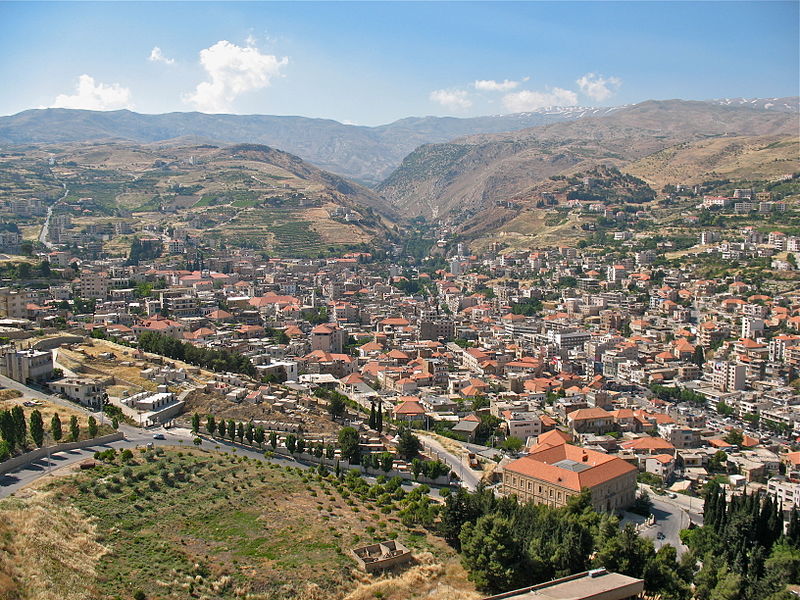
Zahle, Lebanon
Fr. Edward Billotet’s first two years in Lebanon were spent teaching French while he studied Arabic. In 1848 he was appointed minister at the Beirut residence and later in 1850 he was made superior of the entire Lebanese-Syrian mission. As superior he increased the number of schools funded by the Propagation of the Faith and in 1853 he started an Arabic press for disseminating Christian literature. He spent a total of eight years as mission superior before he went to the Jesuit residence and church at Zahle in Feb 1859. Because the church had previously received the gift of a vineyard outside the city, the Druses, a fanatical Muslim sect in Lebanon tried to force Fr Billotet to pay taxes. But because he was a French citizen he was therefore not subject to the sultan’s taxation. As the revenue from the vineyard went to support a Christian school and a Catholic church, the Druses continued to harass Fr Billotet and tried to force him to leave the country. The Druses then began from June 1860 to massacre Maronite Christians. Within three weeks they killed 7750 Christians, destroyed 560 churches, burned 360 villages, razed 42 convents and left 28 schools in ruins. Zahle was the worst casualty because of its concentration of Catholics.....the Druses rushed upstairs they forced all seven Catholics onto the terrace.... As Fr Billotet raised his eyes to heaven and thanked God that he could offer Him this sacrifice, several bullets struck him in the breast.
Link (here) to read the full biography of Fr. Billottet  and the other 4 Jesuit martyrs of Lebanon at the Singapore Jesuit website.

Thursday, March 17, 2011

Jesuit On Churches And Mosques In France

Cathédrale Notre-Dame de Chartres
If Muslims ask for Europe’s "empty" churches...
by Fr. Samir Khalil Samir, S.J.
In a press release published Friday, March 11, 2011, the "Banlieuses Respect" Collective asked authorities in charge of organization of the Church of France, to place at Muslims’ disposal "empty churches for Friday prayers". Hassan M. Ben Barek, a spokesman for the Collective, said the measure would "prevent Muslims from having to pray on the streets" and being "politicians’ hostages”.....On the other hand, a church that served as a mosque would have to be re-equipped for the needs of Muslim prayer. 
Many typically Christian elements would have to be removed and typically Muslim ones added. And above all these "empty churches" are not destined to remain empty, but on the contrary to be occupied as soon as possible by a Christian community or a monastic community, which is happening more and more throughout Europe. 
Now it seems unlikely that such a place, more or less once converted into a mosque, could be "repossessed" and turned back to church. It would be a great loss for the Muslim community and could lead to much bitterness and religious conflicts. 
The Christians would then be accused of being Islamophobic, revanchists, disrespectful of Muslim sensitivities, unbrotherly towards them, and so on. 
Finally, imagine for a moment the opposite. If in a Muslim country (Egypt or Algeria, for example) the indigenous Christians (in Egypt) or immigrant Christians (in Algeria) asked Muslims to give them a mosque, since they have many, or to lend them one for Sunday, or only for important celebrations: Christmas, Epiphany, the beginning of Lent, Easter, Pentecost and the Assumption, what would the reaction of Muslims be?  
Link (here) to the full and fascinating article at Asia News

Sunday, November 28, 2010

Worry In Lebanon

Fr. Samir Khalil Samir, S.J.
Christians are tempted to flee Lebanon as the country becomes increasingly "Islamized," according to the founder of the Center for Arab Christian Research and Documentation (CEDRAC). One-third of the nation's Christian population has left since the beginning of the 1975-90 Civil War, and a recent surge in emigration means Christians now make up just 34 percent of Lebanon's population, Father Samir Khalil, a Jesuit teacher at Beirut's St. Joseph University's CEDRAC department, told Vatican Radio last week."Christians used to make up 50 percent of the nation's population; now experts think the Christians are probably not exceeding 34 percent, which is worrying," Khalil said in the radio interview during a visit to The Holy See.
Link (here) to read the full post/article at Jihad Watch.

Monday, September 28, 2009

Jesuit Says Christian Population Declining In Islamized Lebanon

Christians are tempted to flee Lebanon as the country becomes increasingly “Islamized,” according to the founder of the Center for Arab Christian Research and Documentation (CEDRAC). One-third of the nation’s Christian population has left since the beginning of the 1975-90 Civil War, and a recent surge in emigration means Christians now make up just 34 percent of Lebanon’s population, Father Samir Khalil, a Jesuit teacher at Beirut’s St. Joseph University’s CEDRAC department, told Vatican Radio last week. “Christians used to make up 50 percent of the nation’s population; now experts think the Christians are probably not exceeding 34 percent, which is worrying,” Khalil said in the radio interview during a visit to The Holy See.
The Beirut-based researcher expressed concern that Christians in the Arab world are moving abroad to places with higher Christian populations, such as America, Europe and Australia, which is increasing the Muslim majority in countries like Lebanon.
“The same is happening [all over] the Middle East, and this is certainly a very tragic situation, and it will have great consequences in the future,”
Father Khalil warned last week on the Vatican Radio station, adding that Christians must stay in the Middle East to keep numbers up.
Large numbers of Lebanese Christians are leaving as they feel their traditional influence in their country is weakening, while an increasing number of crucial political positions are going to Muslims.

In reference to Islamic extremism, Khalil claimed the power of the influential Christian minority to counterbalance it was waning, saying:
“Lebanon has always been a bastion of religious tolerance, but now it is moving toward the model of Islamization seen in Iraq and Egypt.”
Christians have taken a backseat in recent times to dominant Sunni-Shiite relations, with key leaders Saad Hariri from the Future Movement representing most Sunni Muslims and Hizbullah of Sayyed Hassan Nasrallah leading the Shiites, while the Christian community has less unified representation, split between the country’s rival political camps – the Maronite Catholic supporters of Lebanese Forces and Phalange parties with March 14 and those backing the Free Patriotic Movement led by retired General Michel Aoun, who has formed an allegiance with Hizbullah.
Meanwhile, Pope Benedict XVI this week called a special Synod of Bishops to discuss the challenges facing the church in the Middle East.
The Synod meeting, which has been scheduled for October 2010, will address the problems that Catholic communities in the Middle East have in common, the pope said during a meeting last week with the patriarchs of seven Eastern Catholic churches, including Lebanon’s Maronite Patriarch Nasrallah Butros Sfeir.
The patriarchs, coming from across the Middle East, requested the October meeting, saying that they wished to have more frequent contact with the bishop of Rome in order to “strengthen the communion of their churches with Peter’s successor.”

Benedict specifically mentioned their relations to other faiths – by implication Islam – and the phenomenon of emigration. Catholic prelates have long warned about that the pressures of living in a Muslim society, and the economic uncertainties facing the region have prompted many thousands of young Christians to leave their homes, imperiling the future of Christianity in the region.
The pope said the 2010 meeting is designed to help plan a pastoral strategy for Christians living in a region that is ever more heavily influenced by militant Islam.

The results of a poll released last year show that nearly half of all Maronites, the largest Christian denomination in the country – making up about 22 percent of the population – said they are considering emigrating.
In the survey conducted by Information International, an independent Beirut body, many Christians cited the growing influence of March 8 faction Hizbullah in Lebanon as a reason for their decision to leave.
Over 70,000 Christians have fled since the 2006 summer war between Israel and Hizbullah, many fearing more conflict between their southern neighbor and the Shiite group.
Christians, in particular Maronite Catholics, have historically played a major role in the development of Lebanon’s political, social and cultural institutions. Under the country’s sectarian power-sharing system, the post of president is reserved for a Maronite Catholic, while the prime minister must be a Sunni, and the parliamentary speaker a Shiite.

Currently, the president, the army commander and the head of the central bank all are Maronites, and under the agreement that ended the Civil War, half of the 128 seats in Lebanon’s Parliament are reserved for Christians.

Link (here)