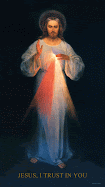
" In light of Ignatius' 'Two Standards' and 'The Mystries Done From The Garden To The House Of Annas', at any moment we can be Judas or Peter, a Christian life can be a fine line."
Last week, Pope Benedict published his latest encyclical, "Caritas in Veritate,"or "Charity in Truth.'' The latest in a century-plus of papal statements advocating for moral reforms in our world's economic and political order, this detailed document calls for greater protections for workers and the poor.
Some people get nervous when religious leaders reach beyond strictly private, spiritual matters to address public affairs such as economic justice and international cooperation. While this is an understandable reaction, the Vatican has been extremely deliberate to comment on social justice concerns in a style that is modest and constructive, ever vigilant not to exceed its expertise.
As moral voices, popes have been remarkably consistent in proposing - rather than in any way imposing - ethical approaches to public issues in a pluralistic world. Since 18 years had gone by since John Paul II issued the previous social encyclical, there was much for Benedict to analyze: the present financial crisis, for one, and trends like enhanced globalization, migration, environmental degradation and new technologies. Traditional Catholic values such as attention to the common good, social justice and human dignity are applied to current global realities in new ways by Benedict.
By Father Thomas Massaro, S.J., a native of Floral Park, is professor of moral theology at the Boston College School of Theology and Ministry.
Link (here) to read Father Massaro's full article.
The Enneagram is alleged to be a 2000 year old Sufi system of personality types from Islamic mystics who lived before the time of Christ.
The Enneagram is a circle, meant to symbolise the Cosmos and the "one-ness": this comes from a monist perspective. The Sufis are monists believing that we are all one with each other and with the universe and at the same time pantheists believing that the universe is god. So that's why they're not highly regarded in Islam, because they're kind of Heterodox.
Inside the circle is a triangle, and it connects up the points of the 9, the 3 and the 6; and it symbolises God. We should notice right away that it's God inside the cosmos, not the cosmos inside God.
There's another figure that is 6 sided and it connects from the I to the 4, 4 to the 2, 2 to the 8, 8 to the 5, 5 to the 7 and the 7 back to the I again. And there you have your Enneagram. (Ennea is Greek for "nine").
It is claimed that the Enneagram is a system revealing nine personality types and it is used in the various workshops and taught in seminaries.
2. TheCaregiver: personality type-"ego-flattery". These types will try to say nice things about you so that you can say nice things back to them.
3. TheAchiever: personality type-"ego-go". It doesn't have a real interior life, it's all in its role, and all in its functions in society rather than to an interior depth.
4. The Artist: personality type-"ego-melancholy". This type feels sad it is among so many people that are without real sophistication. They're sad and melancholic over being so artistic among so many bores.
5. TheObserver: personality type-"ego-stinge". These people want to gather in all sorts of things and never give anything back.
When driven out of their country, the Portuguese Jesuits betook themselves to Brazil, where their help was greatly needed; the Italians went to New Mexico and California; and the French missions of China and Syria benefited by the anti-clericalism of the home government; for Zikawei became an important scientific world-centre and Beirut obtained a university. The latter was, until the war broke out, a great seat of Oriental studies.
The most imposing institutions in Beirut, a city with a population of over 150,000, made up of Mussulmans, Greeks, Latins, Americans and Jews, are those of the Jesuits. They maintain and direct outside of Beirut 192 schools for boys and girls with 294 teachers and 12,000 pupils. There is, in the city, a university with a faculty of medicine (120 students) founded in 1881 with the help of the French government; its examinations are conducted before French and Ottoman physicians and its diplomas are recognized by both France and Turkey. The university has also a seminary (60 students) for all the native Rites. Up to 1902 it had sent out 228 students including three patriarchs, fifteen bishops,one hundred and fifteen priests and eighty-three friars. Its faculty of philosophy and theology grants the same degrees as the Gregorian University in Rome. Its faculty of Oriental languages and sciences, founded in 1902, teaches literary and conversational Arabic, Hebrew, Syriac, Coptic and Ethiopic; the comparative grammar of the Semitic languages; the history and geography of the Orient; Oriental archaeology; Graeco-Roman epigraphy and antiquities. Its classical college has 400 pupils and its three primaries 600. A printing-house, inaugurated in 1853, is now considered to be the foremost for its output in that part of the world. Since 1871 it has published a weekly Arabic paper, and since 1898 a fortnightly review in the same language, the editors of which took rank at once among the best Orientalists. Besides continually adding to their collection of philological papers, they contribute to many scientific European reviews.
Fr. Frank Fadner, S.J. was an expert in Russian history, a remarkable polylinguist, and accomplished artist. He taught history from 1949 to 1978 and also served as Regent of the School of Foreign Service. In 1987, James Alatis, Dean of the School of Languages and Linguistics, recollected that:
New students were often intrigued by the black gowned gentleman with the long gray beard, intelligent eyes, black cassock, beretta and flowing cape. Theories as to his identify were legion.
Two particularly memorable ones were that he was either the Metropolitan [Archbishop] of Moscow in exile or the Papal Confessor. Father enjoyed his mysterious image and would note that it wasn’t bad for a boy from Neenah, Wisconsin . . .
Honduras' powerful Roman Catholic Church has backed the ouster of President Manuel Zelaya, surrendering a chance to be an impartial mediator because it would rather take sides in order to counter the influence of Venezuela's leftist president, Hugo Chavez.
The political forces and military that toppled Zelaya on June 28 cited Chavez as a factor in their coup, saying they feared the Honduran president was adopting the Chavez brand of socialism and political tactics.
They accused Zelaya of violating the constitution by seeking to extend his rule through the lifting of presidential term limits, as Chavez has done.
Leaders of the Catholic Church, which polls show is the most respected institution in the conservative Central American country, have backed the ouster and thrown their weight behind the interim government installed by the Honduran Congress.
"The Church should have taken a more conciliatory posture," said Efrain Diaz, a political analyst with the non-governmental Center for Human Development. "This country is fractured and it needs a climate of reconciliation."
Ismael Moreno, a Jesuit priest and radio commentator who is not part of the hierarchy, put it more bluntly.
"The Church has lost all ability to mediate," he said. "It has lost all credibility."
Whether it’s true or not that a Cabinet-level official met with the Iglesia ni Cristo and the Jesuits to “push the idea of a revolutionary government” to be headed by the President, it’s well worth noting that the national security adviser (who has Cabinet rank) publicly floated the idea back in June. Norberto Gonzales suggested that the President head a troika composed of both Houses of Congress, the judiciary, and the Church—adding he’d contacted leaders of the Catholic and various Protestant churches.
In a move to unite U.S. Catholics, the newly formed American Catholic Council called today for an historic assembly of the Catholic Church in the United States. Voice of the Faithful joins this call, spurred by evidence of serious deterioration in the life of the U.S. Church today......
Another endorser is former priest Dr. Paul Lakeland, professor of Catholic Thought and Interreligious Dialogue at the (Jesuit) Fairfield University.
Dr. Lakeland was recently in the news for his public support of Connecticut bill 1098, introduced by homosexual activist state Senators Mike Lawlor and Andrew J. McDonald. Bill 1098 sought to use legislative means to restructure the governance of the Catholic Church in Connecticut. The bill was tabled after intense opposition. On March 10, 2009, the Catholic News Agency reported: “The bill, which bears resemblance to Voice of the Faithful’s Strategic Plan, is being supported by Dr. Paul Lakeland, who believes that in this case it’s appropriate to use state legislation to force the Church’s hand…Concluding his support for the bill he said,
'I see absolutely no chance whatsoever of the Institutional Church making a change in this direction without pressure from somewhere outside the Church. There’s not even the most remote likelihood that the Church would adjust in this direction itself. I think this is a way of putting pressure on them to make changes and bringing the issue into a more prominent setting.'
HIGH-PROFILE Jesuit priest Peter Norden is leaving the religious order and considering his future as a priest, burnt out and somewhat disillusioned after four decades of pastoral and social work.
Father Norden — a noted social advocate, long-time Pentridge Prison chaplain and founder of Jesuit Social Services — said yesterday his workload had become unmanageable and he had not been adequately supported by the church on organizational or personal issues.
He said that in his last year as a part-time parish priest at St Ignatius,Richmond, he did 70 weddings, 200 baptisms and 50 funerals. He also travelled interstate 30 times as policy director for Jesuit Social Services.
Over the decades he ministered to the six prisoners who died in the Jika Jika fire at Pentridge Prison in 1987 and attended several murder and suicide scenes.
"At Jika Jika most of the officers took six months off and had counselling, but no one had any concern for me," he said. "Most of the stuff I am working through is traumatic stuff from 20 years ago. In one sense it's all very exciting and challenging, but you realise you are carrying scars."
Father Norden said he was still motivated by a call to service of the community, but felt less attached to the institutional church. He said he was still thinking about whether he would remain a priest. "I feel burnt out and need a new direction."
Jesuit Provincial Steve Curtin expressed gratitude for Father Norden's "extremely stressful work, on behalf of … people at the edges of society".
Her mother was a Christian Algonquin, taken captive by the Iroquois and given as wife to the chief of the Mohawk clan, the boldest and fiercest of the Five Nations. When she was four, Kateri lost her parents and little brother in a smallpox epidemic that left her disfigured and half blind. She was adopted by an uncle, who succeeded her father as chief.
He hated the coming of the Blackrobes (Jesuit missionaries), but could do nothing to them because a peace treaty with the French required their presence in villages with Christian captives. She was moved by the words of three Blackrobes who lodged with her uncle, but fear of him kept her from seeking instruction.
She refused to marry a Mohawk brave and at 19 finally got the courage to take the step of converting. She was baptized with the name Kateri (Catherine) on Easter Sunday.
(Here) is post by Fr. James Martin, S.J. at America's In All Things blog. I am not criticizing the content of the post, however I think it is worth evaluating and pointing to something more self reflective.
There is that old saying, "If the shoe were on the other foot."
I am going to leave this first excerpt of Father Martin's post just as he published it, then below I am going to change a few words around so that we can see somethings in a little different light.
Fr. Martin is pointing to the upcoming Apostolic Visitation of The Legionaries of Christ.Fr. Martin excerpts an interview with Fr. Thomas Berg a former Legionaries of Christ priest.
"This question - whether there is a genuine institutional charism present here or not - is very serious and, as it presents itself in the case of the Legion, unprecedented in the history of the Church. I hope that the visitors will turn up useful information that will assist the Holy See in discerning the answer to that question.
Finally, I fear there may be more victims of Fr. Maciel out there. Their welfare has to become more clearly a palpable and obvious priority for the Legionary superiors. I am hopeful that the major superiors of the Legion who may be now have acquired much more information in this regard will be entirely forthcoming with the visitors."
Now slightly changed.
This question - whether there is a genuine institutional charism present here or not - is very serious and, as it presents itself in the case of the (Oregon Province of the Society of Jesus) unprecedented in the history of the Church. I hope that the visitors will turn up useful information that will assist the Holy See in discerning the answer to that question.
Finally, I fear there may be more victims of ( the 40 Oregon Jesuits) out there. Their welfare has to become more clearly a palpable and obvious priority for the (Jesuit) superiors. I am hopeful that the major superiors of the (Jesuits) who may be now have acquired much more information in this regard will be entirely forthcoming with the visitors.
Go (here) to the back stories on the abuse cases of the 40 Jesuits and Oregon bankruptcy.
Christians have been told to leave Nepal or face dire consequences from the Hindu group that claimed responsibility for the bombing of Assumption Church in Kathmandu in May.
According to Bishop Anthony Sharma, apostolic vicar of Nepal, the obscure Nepal Defense Army (NDA) made threats over the phone to pro-vicar Father Pius Perumana, director of the St John Vianney Pastoral Center at Godavari, Jesuits at the St. Xavier’s school, nuns at St. Mary’s School and the Sisters of Charity of Nazareth at Baluwatar, all in Kathmandu.
“The NDA has been threatening non-Nepalese priests and nuns. It has asked them to leave the country within one month,” the Jesuit bishop told UCA News on July 8.
Link (here) Photo is of Bishop Anthony Sharma, S.J.
Benedict XVI is, happily, incapable of dealing with something unless he deals with everything. Journalists will rapidly read this documents looking for items that are “news-worthy,” that is, ones that criticize business, the government, the media, or the Church. They will not concentrate on the overall scope of what Benedict is about here.
The encyclical is wide-ranging and seeks to say something about everything. It is known to be a document initially prepared by others from various disciplines and sectors of the Church and curia, but finally organized by the Pope, no mean feat. Benedict’s first two encyclicals were composed mostly by himself. The difference is telling in reading this document. The document has a kind of “touch on everything” feeling about it. However, what it does consider at some depth, things such as business, profit, life, and the relation of politics to metaphysics and revelation, are very good.
Benedict sets this encyclical within a broader framework so that we can see the limited but important status that public life has. The whole document is concerned with our relation to each other, especially to the poor and weak. It is stronger on what the rich owe to the poor than in what the poor must themselves do if they are to be not poor. The discussion of the other religions in their relation to issues of development is quite frank. The Pope understands that many of their basic beliefs and attitudes are incompatible with a more developed human life. But this criticism is not taken to mean that allowing freedom of religion is not the basic human duty of the state.
Link (here) to the full piece at Catholic World Report
I will give you shepherds after my own heart, who will shepherd you wisely and prudently.
Jeremiah 3:15
Last week, our Holy Father published a letter declaring this year to be a “Year for Priests”.The declaration was made on the 150th anniversary of the death of the Curé of Ars, the saintly John Mary Vianney.In the letter, Pope Benedict urged priests around the world to be priests after the Heart of Jesus.In urging priests to follow the example of the Curé, the Holy Father quotes St. John Vianney, who said, “A good shepherd, a pastor after God’s heart, is the greatest treasure which the good Lord can grant to a parish, and one of the most precious gifts of divine mercy”.
For those of us who had the grace to have Father Thomas King, S.J. as a teacher, a priest, and a friend, we certainly know the truth of the Curé’s words.Indeed, Georgetown received a great gift from the Lord in the form of Father King.
As for our beloved Father King, I am sure that he read the letter from the Holy Father.Maybe he was too humble to admit it, but let me be the first to say that all of what the Holy Father called for – priests after the Heart of Jesus – all of what the Holy Father called for was accomplished – with the grace of God, of course – by Father King.
For the students of Georgetown, who were far from their homes and their families, Father King was a pastor, a shepherd who guided us to Love, to Truth, to Jesus, to God the Father.Like the saintly Curé, Father King worked tirelessly in the fields of the Lord – day in and day out, six days of the week offering the 11:15 Mass, with Benediction on Tuesdays and his famed soirees on Wednesdays.
He headed the University Faculty for Life, and for those of us who were involved with GU Right to Life, he was always there to give the yearly prayer for those unborn who were mercilessly slaughtered by the culture of death.
As we know, as we see, Father King was a popular man, beloved by many, admired by many.Why was this?Was it his charisma?Was it the fact that he was (before my time at least) one of the best impersonators of Fred Astaire?Was it his iconic greetings – “Yo!” among others?Was it his perpetual joy?Or his perpetual youthfulness?Of course it was all of these things.
But I also like to think that it was the fact that he was a priest after the Heart of Jesus – a true prophet of the Good News, of the Gospel of Truth, of the Gospel of Life!He was an unashamed defender of the defenseless, of the innocent, especially the most innocent, those babies that were and continue to be slaughtered by the culture of death.He was an uncompromising defender of the Truth.
Six days of the week, for forty years (!), he persevered, hot or cold, rain or snow, to feed us, his sheep, with the Body and Blood of the Lamb.Even at the young age of 80, even after becoming crippled by ice, he still walked to class, teaching us about Mother Teresa, among other things, drawing very skillfully the Cave of Plato, telling us about his adventures in India.You can insert your own memories here.Whatever your memories, I’m sure they reflected his mystical love of God, his joyful and youthful demeanor, and his iconic mustache.
What was the mystique of this man?
Why was this man, Father Thomas Mulville King, why was this man so popular?He preached against abortion, against the sins of the flesh.He preached about a man who was brutally murdered and then rose from the dead three days later.He preached against everything this world holds most dear, he preached for everything this world most abhors.
And yet he was so popular, so beloved.Why was this so?
Because whether we know it or not, we are attracted to the Truth, to Good.Father King, through his self-sacrifice as a priest in God’s Catholic Church, channeled that truth, that goodness, that Eternal Truth, that Eternal Goodness.He showed us the Way.He shepherded us, against the lies of the world, against the evils of the world, keeping us on the straight and narrow.He was a candle in the darkness.Indeed, he truly was a priest after the Heart of Jesus.
Remarkably, here was a holy man, a holy priest, who dwelled among the infamously un-Catholic environment of Georgetown, who stayed true to Our Church while so many of her own priests strayed from her, continue to stray from her.
For those priests who find the Curé of Ars to be too distant an example to follow, the Lord gives you an example for these tumultuous times.In this Year for Priests, may you, the priests of God’s Catholic Church, may you all look to the life of Father King
– a sacrificial, uncompromising life – as an example of how to be a good priest, of how to be a priest after the Heart of Jesus.
May we all pray for Father King, and may Father King pray for us all, especially for the priests of God’s Catholic Church.
Amen.
Courtesy of Brian A. Nafarrete, 24 June 2009, San Diego, CA
A Short Biography
Fr Thomas King, SJ, taught theology at Georgetown University for forty years. He was featured several years ago by one of the campus newspapers as Georgetown's man of the century. He founded University Faculty for Life, and his courage and perseverance has sustained this group over the years. Known especially for celebrating Mass at 11.15 pm in the University chapel six days a week for the last forty years, his example and preaching helped many young people find their vocations in life, whether married or religious and priestly.
A prolific scholar as well as pastor, he was an expert on the Jesuit paleontologist and mystic Pierre Teihard de Chardin. Fr King wrote: "Teihard's Mass: Approaches to 'The Mass on the World'" (2005); "Teihard de Chardin" (Way of the Christian Mystcis, 2008); Teihard, Evil and Providence" (1989); "Teihard's Mysticism of Knowing" (1981); "Teihard and the Unity of Knowledge" (1983); "Letters of Teihard de Chardin and Lucille Swan" (2005). In addition, he authored: "Sartre and the Sacred" (1974); "Can the Modern World Believe in God?" (1993); "Enchantments: Religion and the Power of the World" (1989); "Jung's Four and Some Philosophers" (1999); "Merton: Mystic at the Center of America" (1992).
Born in 1929, he entered the Jesuits in 1951, was ordained in 1964, and received his doctorate from the University of Strasbourg in France. A more faithful son of the Church and St Ignatius Loyola would be hard to find
"Legendary Georgetown University theology professor, Fr. Thomas King, S. J., died last night. He was the founding president of University Faculty for Life, an academic society on whose board I sit. We will miss our beloved Fr. King."
Joseph Bottom's post (here) on Fr. King, his blog is entitled First Thoughts
Fr. King was my theology professor, in the mandatory theology course I took as a freshman at Georgetown. He’d had throat surgery of some kind, and his voice was soft and ghostly—lost in the hum whenever the air-conditioner in White-Gravenor Hall would come on.
I saw him far more rarely than I wanted, in later years: a few UFL meetings, and Tim took me by to visit him in the Quad on a trip to Washington.
But I remember the midnight Masses he would say in Dahlgren Chapel when we were undergraduates: candlelit and subdued, and as mystical as any services I’ve ever experienced—except perhaps for the Mass he would say every year in the crypt underneath the chapel in Copley Hall on the anniversary of the ordination of Teilhard de Chardin.
Scholastic Joseph Koczera, SJ writes in his post (here) Ave atque vale, his blog is entitled, City and the World.
It was with great shock and sadness that I learned, just two hours ago, of the death this evening of Father Thomas Mulvihill King. In his forty-one years on the Hilltop, Father King had an incalculable influence on several generations of Georgetown students. I owe my own vocation to the Society of Jesus to his influence and example, and I will miss him dearly as a priest, teacher, mentor and friend. I will probably post more detailed reflections on his passing later, but for now I'll simply ask you to join me in praying for the repose of his soul and for the consolation of his family and friends.
And further at his post (here)Adieux, Joseph writes
Thomas Mulvihill King was not the first Jesuit I ever met, but he was the first Jesuit I really got to know as a person. He was also the first Jesuit - as well as the first priest - whom I ever had as a teacher. He was my guide on my first visit to the Holy Land and on several student retreats at Georgetown. When Tom King died suddenly of a heart attack last Tuesday, I lost a mentor, friend and spiritual father. To say that Tom was my spiritual father is to say that he was like a Russian starets, a venerable and wise guide to the Christian life.
Blogger Note: We, Jesuits and non-Jesuits alike a have a "My Jesuit". I seems as though Fr. King was "My Jesuit" to quite a few people. When I say quite a few, I think that translates into 10's of thousands.
Fr. Mueller synthesizes some of the aspects Pope Benedict's book. Short topics which Father included are; hypostatic union, scripture studies in light of the Catholic modernist movement and Vatican II and Monotheism. Broad and big ideas that Fr. Joe discusses is, "Jesus' mission is to lead all people to the Father", "Jesus is the Sabbath" and "Benedict's 'traditional Gospel approach' is a way of undoing the sterility of the historical critical approach and allowing the real Jesus to speak to us through scripture."
Although not referenced in the talk you can envision a scholarly and supernatural approach to Jesus found in the Spiritual Exercises.
Pope Benedict has something for everyone in Caritas in Veritate—from praising profit (21) to defending the environment (48). But in these cases, as in all the others, he calls for a discernment and a purification by faith and reason (56) that should temper immoderate and one-sided enthusiasms.
Once again Pope Benedict shows himself to be a theologian of synthesis and fundamental principles. In the titles of his three encyclicals he has used only five nouns: God, Love, Hope, Salvation, and Truth—the most fundamental of realities. And in the opening greeting of this encyclical he succinctly describes the contents: “on integral human development in charity and truth.” Note that from this very greeting Pope Benedict has changed the whole framework of the debate on “the social question.” This was expected to be—and is—his encyclical on “social justice.” And indeed “justice” and “rights” find their proper place in a larger synthesis. But the priority is established from the outset, the foundation is laid, with “charity” and “truth.”
Link (here) to the full piece at Catholic World Report.
Fr. Nicolas was in Manila this past weekend to join the Philippine Jesuits celebrate their sesquicentennial, 1859-2009. He is not a stranger to our country, for he has been here for several years: first, as professor at the East Asian Pastoral Institute, a spiritual and theological renewal center in the Ateneo de Manila campus for missionaries, priests, religious sisters, and interested lay partners; second, as its director. Just before his election to his present position, he was director of the Jesuit center to direct and coordinate the Jesuit apostolate in Asia and Oceania. His visit to our country was some kind of a homecoming for him, and a prayer of thanks for 150 years of Jesuit presence in our country.
Charles III of Spain (1759- 88), a crowned head proud to be enlightened but despotic, signed away the Jesuits in all his dominions in 1767, for "weighty reasons he was locking away in his royal breast."
Six years later, political intrigue pressured the Pope to suppress the Society of Jesus an earlier Pope had approved. Those bright boys are no more, but the Society of Jesus, "the King’s good servants, but God’s first; God’s above all," resurrected to life in 1814. Today, the Jesuits all over the world continue to serve God and His people, by teaching them "letras y doctrina cristiana."
At the time, Spain felt its farthest colony needed, not costly military force, but the Jesuits. The military could conquer, but only the missionaries could win hearts. In 1859, the Jesuits were back in the country, and people were not disappointed.
Then there is Ramakrishna "Xerox", who has been arrested 21 times for selling illegally photocopied books to students; Shankara, the mixed-caste Brahmin-Hoyka student, who sets off a bomb in a Jesuit school;
In reading Jim Carney, I discovered a maverick and cantankerous streak in him. He was also stubborn. These are tendencies I have seen also in myself, so perhaps these are some reasons I am a Carney admirer. Weber and Stochl have been consummate socializers, especially Weber, who was in a class by himself, smooth like silk. Carney was not a socializer. He loved the poor people of Honduras, and eventually this was all that mattered to him.
I suppose Carney became a fanatic. He gave up his United States citizenship to become a naturalized Honduran. (There are very, very few people who ever give up American citizenship.) Carney’s interpretation of Christianity convinced him that a true follower of Jesus Christ had to be a revolutionary in the Honduran and Central American context in which he found himself as a Jesuit missionary.
Earlier this week, I was looking over a couple chapters of Carney’s book. I saw mention of John Waters and John Willmering as working in Honduras during Carney’s sojourn in the 1970s. Waters and Willmering were Jesuit scholastics at SJC during my time (1959-1965), but these two could never have carried Carney’s cross. They were nice guys. To put it bluntly, they were not man enough to do what Jim Carney did. Few of us are. If you can’t get a copy of Jim Carney’s book, you can “Google” him and get a sense of the man. Carney took the first name “Guadalupe” as part of his Honduran metamorphosis, so you can find him as James Carney, Jim Carney, or Guadalupe Carney.
Gerald M. Cattaro, Ed.D. As a professor of education, chair of the Division of Educational Leadership, Administration and Policy at Fordham, and executive director of the Center for Catholic School Leadership in the Graduate School of Education (GSE), Cattaro plays a critical role in the ongoing effort to revitalize Catholic schools.
It is a subject he knows well, and about which he is extremely passionate, having worked for 18 years as a principal at a Catholic school in Brooklyn.
“When I was in Brooklyn, we had over 250 Catholic schools. We’re down to about 130 schools now,” he said. “When I was there, I was one of four laypeople who were principals. Today, there may be 10 religious left.” One of the ways Cattaro helped bolster Catholic education, which has been battered by closing schools and rising tuition, was to organize “Paul: Prophetic Missionary and Transforming Leader,” a weeklong conference that took place from June 25 to July 1 in Vatican City, Rome.
The conference, which linked leaders of Catholic education from states as disparate as Florida, Indiana, New Orleans and New York with counterparts in the Vatican, was inspired by conversations Cattaro had with His Eminence Zenon Cardinal Grocholewski, prefect for the Congregation for Catholic Education.
Catholic school superintendents and vicars of education from the United States had the opportunity to discuss three core issues with their counterparts at the Vatican: identity, quality and affordability.
Jesuits can expand crowded cemetery, Lower Heidelberg zoning panel rules The Lower Heidelberg Zoning Hearing Board has unanimously approved the expansion of a cemetery at the Jesuit Center, a religious retreat east of North Church Road. The Rev. William P. Ryan, treasurer for the applicant, Maryland Province of Society of Jesus, testified that the 80-year-old cemetery's 200 or so burial plots are nearly all taken, with only four underground vaults remaining.
"More than half of the 360 priest-members in our province are over 65 years of age,"
he said Tuesday. Ryan said the center wants to respect the original design of Charles F. Gilette, a prominent Virginia landscape architect of the early 20th century. Scott Miller of Stackhouse Bensinger Inc., Sinking Spring, testified that plans call for about 316 new grave sites to be laid out in two half-circles. A retaining wall at one of the semicircles will have a granite columbarium, or structure of vaults, with recesses for 216 urns containing cremated remains. Resident Robert A. Montgomery testified in support of the expansion.
"Nobody knows the cemetery is there now and won't know when the expansion is finished," said Montgomery, who lives along North Church Road.
He and his wife, Susanne K., said the center has been a good neighbor to the area for the past 90 years. James E. Gavin of Masano Bradley in Wyomissing, attorneys for both the applicant and the owner, Jesuit Novitiate of St. Isaac Jogues of Wernersville, said the cemetery is a nonconforming use in the agricultural preserve zoning district but predates the township's zoning ordinance.
Laurie Goodstien at the New York Time recently penned an article on the Apostolic Visitation on the Catholic women religious in America. She is interviewed by Tom Ashbrook on the NPR radio show "Talking Point" and does a descent, but hesitant job of explaining the Apostolic Visitation. Sister Sandra Schneiders a professor at The Jesuit School of Theology at Berkeley is also interviewed. Sister Schnieders has taken a step back from the controversial quote that has propelled her to the forefront of the American Catholic left. Her basic stance is that the Vatican has not consulted womens religious orders and she is offended by that fact.
Pius IX and Leo XIII, the former having in 1870 solemnly proclaimed St. Joseph the Protector of the Catholic Church, and the latter having made his feast of 19 March one of the solemn feasts of the year, in 1883, and extended to the whole Church the feast of the Holy Familyin 1896. Lastly, in order that the faithful may studiously imitate the great virtues of the Foster-father and Guardian of the Family of Nazareth and implore his powerful assistance in these troublous times, the Pope has, after mature examination by the Sacred Congregation, approved this Litany of St.Joseph, and granted that it be inserted in the official liturgical books, and that it be recited and chanted throughout the whole Church; moreover, His Holiness has enriched it with an indulgence of three hundred days to be gained once a day and also applicable to the souls in Purgatory. The decree is duly signed by our own former Delegate Apostolic, Cardinal Martinelli, now the Prefect of the Congregation of Rites. The Catholic Church has been very sparing in the approval of litanies for universal and public use. The only litanies heretofore approved were four in number: the Litany of All the Saints, with the modified and abridged forms for the dying and the Forty Hours' Devotion; the Litany of the Holy Name of Jesus; the Litany of the Sacred Heart, approved for the whole Church in 1899; and the Loreto Litany of the Blessed Virgin. Besides, we may observe a notable difference in this Litany of St. Joseph, which is not taken from any previously in use, as is the case with the Litany of the Sacred Heart, but was made up by Rome, and in its Latin text has never more than two or three words to each invocation.
Who, next to Mary, was more beloved of Jesus Christ than St. Joseph? Who had a greater share in His divine caresses? But he was a virgin, and the guardian of Mary's virginity. Amongst the apostles, all of whom were honored with Our Lord's predilection, there was one who deserved to be called, and who in reality was, "the disciple whom Jesus loved." It was he who had made himself more perfect in purity.
St. John, at the Last Supper, with the unreserved confidence of a friend, lays his head on the bosom of Jesus, and freely questions Him, when St. Peter himself dared not speak, and the secrets of heaven were then revealed to him; but all these favors were the reward of his virginity.
Virgo permansit, et ideo plus amatur a Domino. (St. Hier.) For this, also, did Jesus dying commend to him His Blessed Mother. Ma- trem virginem virgini commendavit. (Ib.) As it were to signify that the loss of a Son, who is God, could be compensated for (if compensation were possible) only by the adoption of a son who was a virgin.
Amongst all the elect, says St. John, those alone will be chosen to compose the cortege of the Lamb on whose brow will shine the halo of virginity. They will follow Him whithersoever He shall go; and they will sing a hymn which virgins only will be permitted to sing. For them there will be joys distinct from those of all the other saints.
Gaudia a caeter- orum omnium gaudiorum sorte distincta . . . gaudia propria virginum Christi. (St. Aug. de virg.) O priest, thank God for having called you to a profession so holy and happy.
I am not a Jesuit, nor am I a cleric. I spent about 5 years under the spiritual direction of a Jesuit, 3 of those years in a weekly directed retreat in everyday life. The profound impact that the Society and the Excercises had upon my life, resulted in me, trying to deal with that impact in some way by sharing my view of Jesus Christ with others. My intention is to pull together Jesuitical and Catholic subjects that interest me. I was born on the feast day of St. Paul Miki, S.J.. I am the father of three small children and an infant, I am married to a great wife.
 Last week, Pope Benedict published his latest encyclical, "Caritas in Veritate," or "Charity in Truth.'' The latest in a century-plus of papal statements advocating for moral reforms in our world's economic and political order, this detailed document calls for greater protections for workers and the poor.