Showing posts with label Jesuit Seminary. Show all posts

Wednesday, May 15, 2013

Maureen Mancuso Earned A Master’s Degree In Divinity In 1996 From The Jesuit School Of Theology

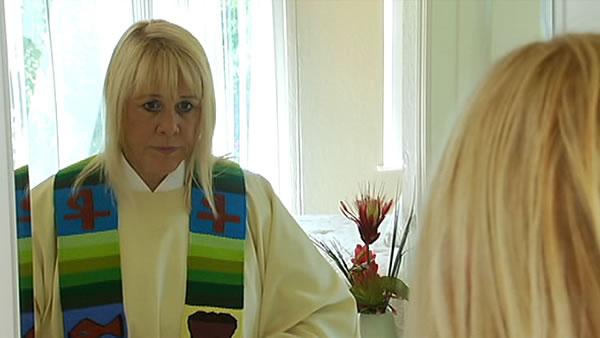
Excommunicated Catholic Maureen Mancuso
A Catholic from birth, Maureen Mancuso has always felt compelled to minister for the Roman Catholic “We feel the call by God, and God for us is a higher authority,” she said. “I think the church has to recognize that it does have the power to ordain women, and that women can be woven into the tradition.” Mancuso, 59, of San Ramon, is a member of the Roman Catholic Womenpriests, an international group that says it has ordained about 150 women as priests, bishops and deacons worldwide — including two priests who work in Los Gatos and San Francisco. 
Church. Now, she’s facing excommunication for what she will do Saturday: become the first woman of her faith ordained a priest in Northern California.
The Catholic Church says the practice goes against the church’s official canon, and women who seek the ordinations automatically are expelled from the church. Mancuso, who was born in San Francisco and is now a teacher, attended seminary and earned a master’s degree in divinity in 1996 from the Jesuit School of Theology in Berkeley. 
She had hoped that by the time she was ready, the church would allow women in the priesthood. Instead, the Vatican hardened against the idea. Mancuso joined the Womenpriests group, which began in 2002 when an anonymous Catholic bishop ordained seven women on the Danube River in Germany.
Link (here) to read the full article at California Catholic Daily

Tuesday, April 16, 2013

Fr. Juan Carlos Scannone, S.J.,"I Taught Him Greek And Literature In The Seminary

Fr. Juan Carlos Scannone, S.J
“I taught him Greek and literature in the Seminary, not Latin as some newspapers have written in recent days. Bergoglio had a diploma at the time. He came to the Seminary to study humanities. But he was my spiritual father, my rector, my provincial pastoral leader, so we had a lot of contact.” Fr. Juan Carlos Scannone is a Jesuit and director of the institute of philosophical research in the Faculty of Philosophy and Theology of San Miguel. The same faculty where Pope Francis was rector between 1980 and 1986.In an interview with Vatican newspaper, L’Osservatore Romano, Fr. Scannone paints a portrait of Pope Francis, “a deeply spiritual man.” 
“We met on a frequent basis for at least ten years. I consulted him on spiritual questions. I was a philosophy professor and he was a professor of pastoral theology,” he recalled. 
“He sent me an e-mail” after he was elected Pope and a few days ago he called a fellow Jesuit to wish him happy birthday. He may be Pope now but he is the same approachable and friendly person he always was.” “He has always been a very serious and highly intelligent man, even when it comes to manual tasks,” Fr. Scannone went on to say. “He’s a good driver, for example. He never used a driver when he was rector and then archbishop.” 

“Bergoglio is good at multi-tasking. Here in Argentina we have a word for special people like him: an orchestra man,” Scannone said.  
"This is a person who can play the piano, the trombone and the violin at the same time. I remember one time he was typing up an article, then he went to put a wash on and after that he received someone for spiritual advice. He was able to carry out a spiritual, mechanical and manual task all at the same time and to the highest level. Not everyone possesses these skills. He is very good at cooking, for example. He used to cook one of his favourite dishes is stuffed suckling pig, right here in San Miguel.”  
Fr. Scannone then remembered one occasion when Pope Francis’ great altruism really came through. “One day, a priest who had gone to Mar del Plata fell ill and was stuck there. Bergoglio, who was auxiliary bishop at the time, travelled four hundred kilometres to be by his side, 
so he was not alone. Do you see? And he was an auxiliary bishop at the time, not a simple parish priest. Here is another example: one day I went to see Cardinal Quarracino, Bergoglio’s predecessor. I went with another priest who is a friend of mine, to ask the cardinal to sign a petition for a project. He signed it and confided this to me: do you know who the best loved auxiliary bishop among the young clerics of Buenos Aires is? Bergoglio! Of course. Because it was the clergy who loved him the most.”  
“Bergoglio did a great deal to protect all those who were threatened by the regime and not only. And not just when he was rector of San Miguel,” 
the Jesuit stressed. When asked what he thought the Pope’s first moves would be, Fr. Scarrone replied: “I don’t think he will be afraid to introduce some reforms in the Church. But he will not do so suddenly; after all he does have Italian blood in him, he is the son of a Piedmontese family, so he will be very diplomatic, he will be able to introduce reforms, avoiding traumas and conflicts."
Link (here) to The Vatican Insider

Sunday, March 18, 2012

Clericus Cup Cancelled

Jesuits versus Dominicans in 2011
In America, Jesuit schools are famous for their basketball teams.  In Europe, it’s soccer.  In Rome this week the Jesuit-run Pontifical Gregorian University defeated the Dominicans of the Angelicum 3-1 to win the Clericus Cup, the trophy in a soccer league involving 16 Roman colleges that train priests and seminarians. Clericus players and fans take their soccer seriously.  Last year local authorities, reacting to neighbors’ complaints, banned the use of tambourines, drums, and loudspeakers during league games played in the morning.  Here is a video about the tournament from 2010.  (Click here if you can’t see it.)
Link (here) to dotMagis
However......
A Vatican department has withdrawn its support from a soccer tournament that pits teams from Rome’s seminaries against each other because it has lost its “educational” value. Sixteen teams from Rome’s seminaries and religious orders compete against each other in the Clericus Cup tournament, including the “Martyrs” from the Pontifical North American College, the U.S. seminary in Rome, which placed fourth in 2011. The Rev. Kevin Lixey, who heads the Church and Sport office at the Pontifical Council for the Laity, said the decision came after the Clericus Cup stopped offering programs to help seminarians reach out to youth and teach them good sportsmanship, which was part of the original intent of the tournament. “They are just organizing a soccer tournament, and they are doing a good job. But this is not what we are interested in: we want to equip seminarians for their job in the field, to help them reach youth through sport,” he said.
Link (here) to read the full article at the Washington Post.

Saturday, July 23, 2011

When God Wants You

A young Jerry Brown in boxing gloves
Reams have been written about Jerry Brown's relationship with his father. When Jerry was in his final year at St. Ignatius High School, he decided at age 17 to become a priest. He needed parental permission to enter the Sacred Heart Novitiate in Los Gatos. It wasn't forthcoming. 'Wait until next year,' his father suggested, hoping, so the story goes, that young Jerry would change his mind and eventually follow in his footsteps: university, law school and politics. 'When God wants you,' young Brown protested, 'He doesn't want you next year.' (Springfield Union, June 6, 1976)
Link (here) to the full article at Mercury News

Friday, July 22, 2011

Tomes On Theology

St. Peter's College Library
At my own small Jesuit college in Jersey City, the library has had no choice but to winnow down its books due to lack of space, not to mention the increasingly daunting task of taking care of all those dust-collecting volumes. Books do mold and a leak in the library’s roof and occasional break-downs in the air-conditioning system do not help. Furthermore, many of the books in our college library were simply not the sort of thing 21st-century students majoring in Criminal Justice, Accounting, Biochemistry and Nursing would find useful. Holdings from the libraries of now-closed Jesuit seminaries (like the one formerly in Shrub Oak, New York) found their way to us, but we really didn’t have too many readers for tomes on theology, journals about linguistics and The New Criterion. Faculty were asked to choose journals, duplicates of books are still on sale for $1 and a few volumes were discovered in boxes beside trash bins by some of my students, who hurried to rescue them.
Link (here) to read the full article

Thursday, June 9, 2011

The Former St. Francis Xavier's Novitiate

The June 3-16 Catholic Sentinel reported that the former St. Francis Xavier's Novitiate in Sheridan, Oregon, where young Jesuits were formed for decades, is now the Delphian School, a private boarding school that developed in the 1970s. The article went on to say that the school is affiliated with the Church of Scientology. Delphian school officials say that last point is a common misunderstanding. The Delphian school, they explain, uses study methods developed by L. Ron Hubbard, founder of the Church of Scientology but is not affiliated with the church.
Link (here) to read the original piece at The Catholic Sentential .

Tuesday, May 10, 2011

Jesuit Church And Seminary In New France

The religious architecture of New France provides the first examples of the use of slate roofing in Canada. The initial churches, stripped down imitations of the monumental classic architecture of 17th-century France, used foreign building materials. 
The 1666 Jesuit church built on the Place du Marche at Quebec, and designed in the form of a latin cross with a bell tower at the transept crossing, had a French-slated hipped roof. A second example was Notre-Dame-de lmmaculet-Conception established as the parish church of Quebec in 1664. Seminaries and roofing company Toronto also used French slate. At Quebec, the Jesuit College was slate covered and the second Ursuline Convent was partly roofed with slates. 
Accounts indicate that the nuns bought 38 000 slates in 1674 and paid Maltre Robert Pepin “piqucur d’ardoise” for installing both slates and shingles. In 1687, 36 000 slates, with 300 feet of lead and 60 000 nails were sent to Montreal from the port of La Rochelle in France to cover the Sulpician seminary then being built.
Link (here) to read the full article.

Monday, December 20, 2010

French Canadian Jesuits Expelled From Haiti 50 Years Ago

Haiti February 5, 1964, 15 armed security guards
(the feared ton ton macoutes) arrived and searched for five hours and then trucked the Jesuit missionaries to the Archbishop's Palace and held under house arrest. 
Fearing the deportation of their teachers and the 60 seminarians at the Great Seminary of Port Au Prince, the only seminary in Haiti.
Link (here) to read the full article in The Montreal Gazette and see a picture of the Jesuit seminary in Haiti.

Sunday, October 31, 2010

August 15th, 1946

Read the news account of Cardinal Avery Dulles as he enter the Jesuit noviciate at St. Andrews on the Hudson. Notice the anti-Catholic sentiment by Protestant leaders at the time.
Link (here) to the original St. Petersburg Times article

Saturday, October 30, 2010

The Apex Of All Jesuit Seminaries

At the apex of all Jesuit seminaries stood the Collegio Romano, founded by Ignatius in 1551. By papal bulls of 1552 and 1556 it received the right to grant doctorates in philosophy and theology as well as the privileges enjoyed by the universities of Paris, Louvain, Salamanca, and Alcalà. By 1567 the Collegio Romano had over a thousand students, and Pope Gregory XIII erected a large building to house the students and faculty. Over the years the college gradually became known as the Gregorian University in honor of that pope.
Link (here)

Wednesday, October 13, 2010

My Dad Was An AP Jesuit

Brian Dennehy
Brian Dennehy was raised in Red Hook until he was 12, when the family moved to Mineola, L.I.  "My father had gone to the seminary and took advantage of all the education before strategically announcing that he had no vocation and managed to land himself a job with The Associated Press," says Dennehy.
"He became what I like to call an AP Jesuit. 
One of those Irishmen who told me and my brothers, 'Take whatever job you want as long as it has a pension.'"
Link (here) to read the full article.

Friday, July 30, 2010

Fr. John Hardon, S.J. On Having A Good Conscience

To offer us some protein, Miss Best was kind enough to drive us every week to sit in on the theology classes she was taking with Rev. John Hardon, S.J., at St. John's University. While the man was brilliant, the classes were dull -- based as they were on impenetrable phenomenological addresses by Pope John Paul II. 
But I made the most of the question periods, probing that saintly priest with all the Faith-testing, Jesuitical questions that 16-year-old smart alecks are driven to ask. And Father Hardon parried them brilliantly, as Jesuits have done for centuries. He shot down in flames every doubt my personal Screwtape had whispered in my ear, and built up in my mind solid habits of faithful reasoning. I will be grateful to him in eternity, I hope. 
When my high school friend (not I) expressed an interest in the priesthood, Father Hardon offered advice: "I wish that I could recommend you apply to the Society of Jesus," he said in his careful way. "I love the order, and wish it could be saved. But I cannot in good conscience send any young man into its seminaries."
Link (here) to Badger Catholic

Saturday, April 24, 2010

38 Years Ago

In 1971 the St. Stanislaus Seminary closed and in 1972 the Missouri Province sold all of its land from the Florissant Seminary to The United Pentecostal Church. The Missouri Province Jesuits were given use of the Rock Building and of the cemetery land for as long as they chose to use them as an historical site and cemetery. The newer buildings were sold to the Gateway College of Evangelism. 
Link (here)
 

Former Jesuit Seminary In Peru Is Now A Hotel


Sprawling some 3,000 metres above sea level sits a 16th Century monastery, incorporating elements from its Inca and Spanish history, this historic site is has grown far from its spartan beginnings. Cuzco's famous 126-room Hotel Monasterio, one of the Orient Express properties, bills itself as the 'finest hotel in Cuzco, Peru' and with a host of awards and accolades, they've got the acumen to back up the claim.While now utterly luxurious, the architecture of Hotel Monasterio still reflects the property's 1592 origins as a home for Jesuit seminarians. The refurbished baroque construction also includes touches of Spanish Colonialism in the rooms, from key furniture pieces to the vivid use of colour.
Link (here)

Wednesday, April 21, 2010

Ignem Veni Mittere, Ego Sum Lux Mundi

A journey to the Sacred Heart Seminary's Grotto Chapel begins at the former estate of noted 19th-century Genevan, Merritt Tuttle Cole. You may be pleased to note that his Italianate home, located at the intersection of Route 31 and 3rd Street in Geneva, was the first yellow house in the town and is now home to the Kane County Government Center.

As far as first impressions go, the nondescript brick administration building is shamed by a broad expanse of lawn unexpectedly punctuated by a large Veteran's Memorial- the latter most definitely worth a look. Behind the patriotic monument lies an overgrown path sprinkled with leaves. Remains of a flagstone walkway punctuate the trail once known as the "Way of the Cross," that twice-crosses and runs parallel to a stream whose current is nothing less than brawny.

A traipse through the woods, if one is so inclined, can present a somewhat kaleidoscopic perspective; the blessed transition to spring, evidence of parallel lives led by native nameless creatures and inevitably, the remains of beer-tinged teenage trysts.

It could, quite successfully, be argued that any hike, or any experience in life, for that matter, is shaped by one's expectations and/or mood held when beginning. Yet, this theory becomes entirely moot when one jumps well outside the somewhat limiting confines of the aforementioned imaginary box and encounters an honest-to-goodness Surprise. This bona fide astonishment drastically changes the experience and offers the rare opportunity to fly by the seat of one's pants.

A brief jaunt, no more than 10 minutes, leads to a slight hill where one is rewarded with a scene more expected in the likes of romanticized medieval England.

Behold, the shrine!

Built sometime after 1925 when the property was sold to the Jesuit  order the outdoor chapel is an imposing stone structure that makes one wish for the presence of mind to have brought coconuts to imitate the sound of hooves. Its presence is extraordinary- simply astonishing, not only for its detailed artistry, but for the fact it makes one question whether there was a glitch in the time-space continuum and a red barn now graces Roman baths.
A detailed mosaic of rocks spread over three arches depicts heaven and earth, a crucifix crossed by two swords (possibly Jesuits as soldiers of Christ), a Monstrance ( chalice that holds the body of Christ), and a lighthouse. The former is bordered with the phrase, "Ignem veni mittere," which translates to "I have come to bring fire." This reference is a tad unusual, as it is normally accompanied by "in Terram", a phrase attributed to none other than Jesus when referring to baptism in the Holy Spirit and fire (Luke 12:49).
The lighthouse, or flame of divine love, is underlined by, "ego sum lux mundi," or "I am the light of the world" (John 8:12). This sentiment may be further reflected by the central arch's ceiling depicting a blue sky pierced by rays of light. The grotto's upper corners are decorated with the Greek letters alpha and omega, referring to the New Testament in which Jesus uses said characters to describe himself; as in embodying both beginning and end. Additionally, a nod to the first three letters of Jesus in Greek, the altar is inscribed with the letters "IHS."

What the Grotto Chapel specifically signified to the Jesuits (outside of the aforementioned religious imagery) and why they chose such a remarkable design may never be conclusively determined but, what it may mean to you is to be determined.
Link (here)

Saturday, February 27, 2010

Novitiate, Serving The Mid-West

The Jesuit novitiate for the provinces of Wisconsin, Detroit and Chicago is returning to its former address in St. Paul, at 1035 Summit Ave., next to the Jesuit parish of St. Thomas More Catholic Church.

The site became the home for the Wisconsin province Jesuit novitiate in 1982. Previously, it was located on Finn Street, near the Uni­ver­s­ity of St. Thomas. Around 1995, it became a tri-province novitiate, serving the provinces of Wis­consin, Missouri and English-Canada.


Last year, the Wisconsin Province novitiate joined with the provinces of Detroit and Chicago for a new tri-provincial arrangement, and the novitiate house moved to Berkley, Mich. In August, it will move back to St. Paul, said (go to page 3 >) Jesuit Father Luis Rodriguez, (pictured) assistant provincial for the Wisconsin Province.

The provinces of Wisconsin, Detroit and Chicago currently have 21 novices. The novitiate is two years. The move will take place after novices currently in their second year take vows Aug. 15 and before the new novices enter, Father Rodriguez said.

Link (here) to the original article.

Wednesday, January 13, 2010

The Collection of Western Jesuit Missions

The Collection of Western Jesuit Missions is on permanent loan from the Jesuits of the Missouri Province to the Saint Louis University Museum of art. The collection is displayed throughout the entirety of the third floor of the museum, housed in a mansion that originally belonged to the Woolworth stores corporation. The Collection of the Western Jesuit Missions is indicative of the spirit of the times surrounding the Jesuit seminary just north of St. Louis between 1823-1971. Priceless liturgical items include pre-French Revolution era silver and Baroque-era devotional art brought to the United States by famous missionary Father Pierre-Jean DeSmet, S.J..

Link (here)

Postcard of the Saint Louis Club, now the Saint Louis University of Art (here)

Tuesday, December 1, 2009

St. Stanislaus Novitiate In Macon Georgia


The residents of the historic Stanislaus neighborhood are taking action to keep their homes and the surrounding area beautiful.
Originally the site of St. Stanislaus College, owned and established by the Jesuits in 1874, the area underwent tremendous renovations after it burned in 1921.
According to Wendy Cassidy, who lives in the neighborhood and is one of the parties responsible for organizing a tour, the district is well known for its architecture. After it burned, it became the first subdivision of Macon,” Cassidy said. “It’s 42 acres and a lot of these homes have passed in one family for generations. It’s part of historic midtown in Macon now."

Link (here) to the full article
Photo (here)

Friday, October 9, 2009

16th Century Jesuit's Lasting Work, "The Propaganda"

During his Wednesday general audience, held for 40,000 people in St. Peter's Square, Pope Benedict XVI focused his catechesis on St. John Leonardi, the patron saint of pharmacists. This Italian saint, the Pope taught, can show us that God's medicine, his son Jesus, “is the measure of all things.”
St. John Leonardi, Pope Benedict recalled, was born in the Italian town of Diecimo in the year 1541. He studied pharmacology but abandoned it to focus on theology and was later ordained a priest. Together with Monsignor Juan Vives and the Jesuit Martin de Funes he helped to found the Pontifical Urban College of Propaganda Fide, in which countless priests have been formed.
Throughout his religious life, John Leonardi never lost his passion for pharmacology, convinced that "God's medicine, which is Jesus Christ Who was crucified and rose again, is the measure of all things," the Pope said.

Link (here)

More on Fr. Martin de Funes, S.J.
(here) , (here) , (here) and (here)

The Urban College in Rome is a seminary for training priests for work in mission countries. It is more popularly known as The Propaganda, because it is under the direction of the Office for the Propagation of Faith.

Photo of the "Propaganda" (here)