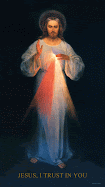
"For years - she says - I have avoided talking about my conversion to friends and relatives. Today our society is changing, the population of Hindus respect us. These days I attended Mass in the cathedral without shame along with my daughters. Now everybody knows I'm Catholic. "
Saturday, January 7, 2012
Kill Shot Fr. Prakah John, A Jesuit Priest. On 26 April 2008
Thursday, February 17, 2011
Jesuit Ordination In Nepal
Saturday, September 25, 2010
Jesuit Verses Communist
![]() |
| Binda Pandey |
Parliament has yet to decide on the proposal, but Christian leaders said they fear it is likely to be approved given that Nepal's largest political party, led by former Maoist rebels, sympathizes with the deposed king's wishes for such a ban.
Pandey is from the Communist Party of Nepal (Unified Marxist Leninist). Bishop Anthony Sharma, the first ethnic Nepalese to be ordained as a Jesuit priest,
Thursday, May 6, 2010
Ave Maria, Gratia Plena
“We pray to the Blessed Virgin Mary to intercede that peace may prevail and bloodshed be avoided, that our rulers may be illuminated and reach a political compromise to end the crisis,”said Father Pius Perumana, pro-Vicar Apostolic of Nepal. Bishop Sharma, who has led the Church in the landlocked Asian nation since 1984, has also called for weekly Eucharistic adoration. Only 6,000 of the nation’s 26.1 million people are Catholic, but the Church there is blessed with 63 priests, 24 seminarians, and 136 women religious.
Saturday, May 1, 2010
Atheistic Communist Moaists Threaten Nepalese, Catholic Church And Jesuits In Nepal
On April 28 morning, a group of Maoists entered Assumption Church, the main church in Kathmandu, and asked Fr Silas Bogati, the acting parish priest “if the spacious church could accommodate some of their supporters … for a few days.” A source who requested anonymity told UCA News the Maoists gave the priest “an hour to reply.”
Jesuit regional superior Fr Lawrence Maniyar spoke with the Maoist leaders whom he is acquainted with to help them “understand” the Church’s position. “I have just told the Maoists that the church is not like some open local temple area,” Fr Maniyar told UCA News. “If they still come to the church, I think that the gates can be closed. Then if they climb the gates, the local press can carry the story the next day.”
Friday, November 27, 2009
Paganism Today
The world's biggest animal sacrifice began in Nepal today with the (watch the horrific video) killing of the first of more than 250,000 animalsas part of a Hindu festival in the village of Bariyapur, near the border with India.
The event, which happens every five years, began with the decapitation of thousands of buffalo, killed in honour of Gadhimai, a Hindu goddess of power.
With up to a million worshippers on the roads near the festival grounds, this year's fair seems more popular than ever, despite vocal protests from animals rights groups who have called for it to be banned. "It is the traditional way, " explained 45-year old Manoj Shah, a Nepali driver who has been attending the event since he was six, "If we want anything, and we come here with an offering to the goddess, within five years all our dreams will be fulfilled."
Link (here) to the full article in The Guardian.
More (here)
Nepal also engaged the attention of the Jesuits—men whom neither barriers of everlasting snow nor the border warfare of petty mountain tribes could repress.
The valley of Nepal has " as many temples as houses, as many idols as inhabitants." It was invaded in 1765 by an army of 40,000 Chinese who came within a few miles of Katamandu ; the people applied to the British to protect them, and in 1792 Kirkpatrick was sent on an embassy for that purpose.
In 1661 Grueber and Donville, Jesuits, visited Katamandu: the King was greatly struck at seeing some mathematical instruments; observing through a telescope the fortifications of an enemy appearing quite near, he cried out that all his soldiers must be at once ready for the attack; he was agreeably disappointed when he found the apparent nearness was owing to the glass; the king offered them land and full liberty to preach.
Link (here) to the Calcutta Review, volume #5 published in 1846
Tuesday, August 18, 2009
"Rest In Peace" Fr. James J. Donnelly, S.J.
Fr. James J. Donnelly, a Jesuit priest residing in Nepal for decades, passed away at 3 am Monday morning.Fr. Donnelly came to Nepal in 1961 and taught at St. Xavier's School Godavari till 1968. From there, he moved on to teach at St. Xavier's School Jawalakhel from 1969 to 1980. He then moved back to St. Xavier's School Godavari as the principal from 1981 to 1990.

Fr. Donnelly again moved back to teach at St. Xavier's School Jawalakhel from 1992 to 2000, before retiring.
Fr. Donnelly was born in Cincinnati, Ohio and just celebrated his 80th birthday on August 5th. He was hospitalised for the past week suffering from various ailments.
Fr Donnelly was also a basketball coach and had the uncanny ability to remember the names of all students he taught.
His funeral will be held at the Church of Assumption of Dhobighat in Lalitpur at 3 pm today. He will be buried at St. Xavier's School Godavari.
A more detailed exploration of Fr.Donnelly's life (here).
Saturday, August 8, 2009
Jesuit In Nepal Knifed With A Khukuri

Loyola Students' Home "The dismissal of the boy from the hostel may be the reason behind the attack. However, this is yet to be ascertained," said the layman, who visited the priest at the hospital. Lama explained that a khukuri, a curved Nepalese knife, was used in the attack. According to Father Maniyar, police have detained "a boy from the hostel" for interrogation. An official at the Maharajgunj police station, which has jurisdiction over Baniyatar, said a 13-year-old boy was arrested in connection with the attack. "Further investigation is on. We are doing our best to ascertain the motive behind the attack," said the official, who did not give his name. The Catholic Church established a mission in Baniyatar to cater to a growing number of Catholics belonging to the poor Tamang tribal community who migrated from Dhading district, a poor, hilly region northwest of Kathmandu near the border with China. The mission was raised to a quasi-parish in 2003 and made a parish in 2007. One of three parishes in Kathmandu, it has 1,200 Catholics.
Link (here)
Tuesday, July 14, 2009
Radical Hindu Group Threatens Christians In Nepal Says Jesuit Bishop
Christians have been told to leave Nepal or face dire consequences from the Hindu group that claimed responsibility for the bombing of Assumption Church in Kathmandu in May.According to Bishop Anthony Sharma, apostolic vicar of Nepal, the obscure Nepal Defense Army (NDA) made threats over the phone to pro-vicar Father Pius Perumana, director of the St John Vianney Pastoral Center at Godavari, Jesuits at the St. Xavier’s school, nuns at St. Mary’s School and the Sisters of Charity of Nazareth at Baluwatar, all in Kathmandu.
“The NDA has been threatening non-Nepalese priests and nuns. It has asked them to leave the country within one month,” the Jesuit bishop told UCA News on July 8.
Link (here)
Photo is of Bishop Anthony Sharma, S.J.
Sunday, May 3, 2009
Adventures In Nepal
As a Jesuit Volunteer, I have been placed in the village of Godavari to teach at the St. Xavier School. Over the next two years, I will attempt to speak Nepali, to immerse in a Hindu society, to understand social justice in a new culture, to live simply in community with others, and to hopefully teach young students just a fraction of what I am sure to learn.Link (here) to Emily Roches blog entitled, A Nepali Education.
Sunday, January 18, 2009
Cleveland Jesuit In Nepal For 50 Years
Cleveland missionary celebrates 50 years in NepalJAWALAKHEL, NEPAL -- In a country about as far from Cleveland as one can get on earth, a Jesuit priest has marked an incredible milestone of dedication and service.
Father Casper "Cap" Miller, S.J. recently celebrated the completion of 50 years of missionary work in Nepal, a remote country whose northern border is the Himalaya mountain range and Mount Everest. At 75, his pace has slowed very little from the day he arrived here on September 2, 1958, as one of the first Jesuits to penetrate a centuries old barrier. This day he quickened his step to greet the fellow St. Ignatius High School alumnus who had traveled 12,000 miles to visit.
"I'm sorry I could not see you yesterday," the spry septuagenarian apologizes, "but I was on a trek."
For Fr. Miller, a trek is not a half-block stroll to the corner store. In this case it was a three-day hike across the rugged Himalayas, at elevations above 17,000 feet.
The Lakewood native has made this country and this lifestyle his home for more than 50 years, ministering to the people of Nepal and becoming part of Nepal's history.
"We started out small," Fr. Miller recalls, referring to the Jesuits' first appearance in Nepal in 1951, when they founded a Catholic school with an enrollment of 60 boys. Today they tend to the sprawling campus of St. Xavier School on the outskirts of Kathmandu, where more than 1,200 boys and girls study and where thousands more apply for the average 100 openings each year.
"We built up a lot of warm relationships with the students and their families," the gentle priest explains in what is an understatement. At St. Xavier and two other schools founded and run by the Jesuits in Nepal, generations of children have been educated and have integrated themselves into every aspect of this developing country's life.
"Live for God, lead for Nepal," is the school's motto, appropriate in a country which has dozens of political parties and just as many government changes in recent years. Thousands have been killed in insurgencies and unemployment is over 40-percent.
"There is a feeling of uncertainty here," says Father Miller of the most recent developments in his adopted country, the rise of a Maoist communist government. "There's extra stress that we haven't had before, not knowing what's going to happen day to day.
"We really have to work on the virtue of hope, and we trust in God through it all that peace will come to this country. But it won't come until there's justice, and there has not been justice for centuries."
Cap Miller's dedication to his calling is complete. He is recognized as an important figure in Nepal's recent history. He was awarded citizenship in 1971, authored an anthropological book about the country's shamans, wears the traditional topi on his head, and is one of a handful of foreigners to be honored by Nepal's king for his service to the people.
He has also helped build and oversee a vast network of social services throughout Nepal. They minister to the homeless, outcast, addicted, and the sick.
"From our side we would like to thank Cleveland for giving us Father Miller," says Navin Singh, a Nepalese management consultant who for a time lived in the United States. He credits his education under Fr. Miller at St. Xavier School for the career he pursues today.
"He came to Nepal, dedicated his whole life to Nepal, and is more of a Nepali than any citizen of this country," Singh says of the Jesuit priest. "And I believe he was destined to be here."
Nepal has great challenges ahead including a literacy rate that has only recently fallen below 50 percent, the recent overthrow of a 250 year monarchy, and the rise of the Maoist government.
"This has been an unjust feudal society so social transformation is quite necessary, but it's happening very painfully," Father Miller observes from his simple Jesuit Residence on the grounds of St. Xavier.
"I think people are suffering but if the outcome is social justice then that gives me hope."
The gentle Jesuit rarely makes it back to Northeast Ohio, but his thoughts are never far from his hometown. "One thing I haven't retained is my Cleveland accent," he jokes. "People don't recognize that I have a strange accent. "But what I do retain is my love of the water, of the lake. I grew up in Lakewood and I love the outdoors and the beauty of the trees, the outdoor life. And I retain so many happy memories of my school days there, especially my time at St. Ignatius High School."
When he can, Father Miller still treks through the majestic Himalayas, sometimes for days with the clouds miles beneath him. "We are all one people, children of the same God," he reminds his visitor.
"That's one thing I've found among the Hindus and Buddhists here. They'll say 'there's only one God, Father,' the illiterate people in the village. So we all agree on that. My prayer is that I'll be able to remain usefully here in Nepal."
It has been a prayer that for more than 50 years has been answered every day.
Link (here) to the original article with video of Fr. Miller, S.J. being interviewed
Photo is the entrance to St Xavier's, see more photos (here)
Books by Fr. Miller
Decision Making in Village NepalFaith Healers in the Himalaya
Jesuits in Nepal
Portuguese Jesuit Fr. John Cabal who passed through Nepal in the Spring of 1628 (here)
Nepal's 50 Ruppe coin commemorating "St. Xavier's Golden Jubilee, Nepal 1951—2001." (here)
Jesuit Home In Nepal Helps Disabled And Poor Children 'Stand On Their Own Feet' (here)
Jesuit Priest Anthony Sharma Appointed First Bishop Of Nepal (here)
Jesuit Center In Nepal Helps Addicts Lead New Lives (here)
Time Magazine article entitled Jesuit Growth from Feb 11th, 1952 (here)
Catholic History of Nepal
Roman Catholicism in Nepal (here)
Short History of the Catholic Church in Nepal (here)
Monday, November 24, 2008
In The Middle Of Nowhere
On 2008-11-20
KATHMANDU (UCAN) -- Knowing that somebody cares is a great pick-me-up for Sher Bahadur Gurung as he sits in a wheelchair enjoying the sun on a cold November morning.
St. Xavier's Social Service Centre in Nakhipot, on the southern outskirts of Kathmandu, can accommodate 16 mentally and physically challenged men like Gurung, whom society has effectively discarded.
Gurung uses a wheelchair to move around the grounds, unable to walk due to a spinal problem and leprosy. "Whatever has been happening in my life is God's will," the Hindu man told UCA News on Nov. 13.
"This center has given me fresh hope of reuniting with my family," said Gurung, who comes from Rupandehi district, 300 kilometers west of Kathmandu. His wife is working in Saudi Arabia, and their three young daughters live with her parents back home.
Gurung was working as a gatekeeper at a cinema hall when he was struck with yellow fever, which led to spinal problems. He then contracted leprosy while recuperating from the fever, he recounted.
The Jesuit-run center also looks after 85 poor and disabled boys at a separate facility nearby and runs Freedom Center, a rehabilitation facility for alcoholics and drug abusers. These services began in 1976 on the initiative of Jesuit Father Thomas Gafney, an American missioner who was murdered in 1997 in an unsolved crime.
Father Lawrence Maniyar, who heads the Jesuits in Nepal, told UCA News Dilip Kumar Toppo, a Jesuit seminarian, runs the facilities. Funds come from the Nepal Jesuit Society, occasional foreign donations and the small contributions some of the people using the services can afford.
According to Lal Bahadur Thami, 23, the nighttime caretaker of the men's facility, some residents and former residents eke out a living selling cigarettes, tobacco and sweets on the streets.
"The center helps by training them to make envelopes, candles and chalk," added Thami, who formerly lived at the Jesuit-run home for disabled and poor boys.
Every Sunday, groups of students from St. Xavier's College in Kathmandu visit the men and organize recreational activities. Some take the men for short walks around the grounds, the caretaker related.
"This is to make the men feel they have people who care for them," he said. "Protestant pastors also visit and talk to the inmates about Jesus Christ."
Suresh Khadki, 33, feels the center has finally given him a "new lease on life," but he longs to go back to his family in Kathmandu and live a normal life.
"I have done a lot of repenting here and back in jail," said Khadki, who killed his father 15 years ago in a drunken rage and went to prison for it.
"My family members don't want me back, while my fellow inmates at the jail once thrashed me so badly that I lost my mental balance and finally landed here," he recounted.
Another inmate, Gorakh Thapa, a 39-year-old Protestant, told UCA News his hopes of him returning home have faded, but he thanks God and the Jesuits for being there for him when he "needed them most."
"I heard my parents are no more, and I don't know of any relatives who may be around, so I am happy here," said Thapa, who was crippled by polio. He added that he has peace of mind now "in a society that looks down upon disabled and homeless people."
Gurung too feels good when pastors visit him and pray for him. He said he hopes to become a Christian one day and lead a normal life with his family.
He recalled that a Christian neighbor back home told him his ailments would be cured if he went to church and prayed earnestly. "I started going to the church and have felt a lot better since then," Gurung continued, with tears in his eyes.
Pastors at a Protestant church referred him to the center, he added, thanking God for this.
END