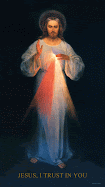
This is reason number 9 out 23, original published at the Homiletic and Pastoral Review

Link (here) to read the full list at Courageous Priest
 An unfamiliar side of the Protestant revolt was the disgraceful way in which the self-appointed reformers of the Church’s morals allied themselves against her doctrine and practice of celibacy.
 In a rhetorical passage of his “Babylonian Captivity,” Luther pleaded with “the prisoners of the monastic life” to break the chains which bound them to their monasteries and to serve Christ with the untrammeled liberty of the children of God.If any of them still hesitated to accept the responsibilities of marriage, he argued, let them remember that this is only a ruse of the devil who would have them reverse the order of divine providence and obey man rather than God.
 We all know that the Second Vatican Council in the end strongly supported the spiritual tradition of priestly celibacy in Presbyterorum ordinis, #16, and that Pope Paul VI strengthened this still further with his encyclical of June 24, 1967, Sacerdotalis caelibatus. Surely along with Humanae vitae it was his most unpopular and "politically incorrect" encyclical.
  For those who have experience in directing souls meet many cases where it is quite clear that God has in a special manner not only prepared particular people for the priestly or religious life. but by a divinely sent attraction has made manifest this purpose of His,
 But what now is clear, is that this interior impulse of the Holy Ghost need not first be ascertained before a person is allowed to begin the formative training of the clerical or religious life; by all means let him start, if he has the two essential requisites—fitness, both natural and supernatural, and an upright intention.Whatever else may be lacking ought very soon, or at least before the irrevocable step is taken, be made apparent during the novitiate or in the seminary. In point of fact, however, one can go very near to reconciling the views of those who for some time were at variance amongst themselves as regards the constituents of a vocation. For, the " fitness" demanded by the Church is rather an extensive term. In the natural order it might well be expected to cover e. g. (i) a combination of initiative and submission to authority; a submission moreover which goes further than mere external and temporary compliance with the instructions of another: it should approach the attitude of a well-trained child toward its parents; (2) a certain stability and fixedness of purpose in departments of life other than the priestly or religious state; (3) cheerfulness of character and a disposition which enables one to pull well with others; more especially would this be the case where there is question of life in a community; (4) some degree of what, for want of a better word, may be called " spiritual-mindedness "; i. e. the consecrated life must make some sort of appeal to the person concerned; for, though the service of God does and must entail sacrifice voluntarily accepted, a distaste for the religious life cannot in itself indicate that the living of such a life is the holocaust which He demands; (5) health, intellectual fitness, and all that is covered by the word " mores congruentes " of Canon 974.
Those who would make further demands and who would say that there is needed in addition an interior drawing, or a mysterious something which is to be discerned only by the spiritual expert when examining the case in the confessional, ought really to be satisfied.For, the presence of the qualities just enumerated would surely indicate a preparation intended and helped by God in a special manner; and the " right intention " would seem to be sufficient proof that there is the "interior drawing of the Holy Ghost"; else how account for its being there ? As we shall see later, the mere fact that one can possibly show the natural growth of a vocation is no proof that this is not from God, for He intends it to grow according to ordinary psychological principles.
 In August 1990. A Jesuit scholastic, while writing about Mother Teresa and Jesuits, dropped in to see her not knowing that she was in retreat. She did see him. While he apologized for disturbing her, she just smiled and said,
 “I will always have time for Jesuits.”When she heard that the scholastic was from Calcutta, she became almost chatty and continued,
“Being a priest is not enough, being a good priest is important…. The Jesuit vocation is a very special type of religious vocation, called to a great spirituality. The Society has given many saints to Mother Church. You are called to aim at nothing less….”
Link (here) to a neat site on Mother Theresa