Friday, April 18, 2008

Jesuit On 40,000,000 Abortions Since Roe V. Wade

Imperfect choices
Conference at St. Mary’s Cathedral in San Francisco explores why Church leaders do not endorse political candidates.
An excerpt.
.
That the Catholic Church’s social teaching, more than Church leaders and, certainly, much more than partisan politics, should guide Catholics in the political and social arenas was the theme of an April 3 conference at The Cathedral of St. Mary of the Assumption in San Francisco, said the April 11 Catholic San Francisco, the newspaper of the San Francisco archdiocese. Jesuit Father George Schultze also addressed the conference. In an interview with Catholic San Francisco after the conference, Schultze, an adjunct professor at St. Patrick’s Seminary in Menlo Park, said that, although there are many public policy issues dealing with intrinsic moral evils,

abortion is the preeminent moral issue since it involves the direct taking of human life and the direct involvement of someone in the act. Then, he said, there is “the gravity of the moral evil in the tens of millions of abortions that have taken place since Roe v. Wade.”
Schultze said to conference participants, “I want to make clear that if there are 40 million people who have lost their lives, what do we say to God and what do we say to the 40 million?”
Link to the full California Catholic Daily article (here)
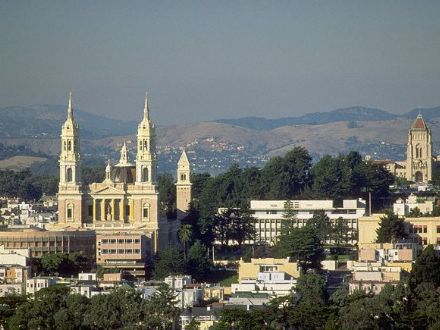
Picture is of St. Patrick’s Seminary in Menlo Park

Fr. Gregory Lucy, S.J. To Retire At Spring Hill College

Spring Hill College President To Retire
Rev. Greg Lucey announces plan to step down
By Bob Grip
MOBILE, Ala. -- Spring Hill College President, Gregory Lucey, S.J. announced plans to retire Friday. He says he expects to remain on the job until June, 2009. Rev. Lucey, who is 75, said the College's Board of Trustees had already formed a search committee to find his successor. It is the Board's intention that the next President will also be a Jesuit priest. In the 11 years since becoming President of the College, Spring Hill has experienced tremendous growth in the expansion of its physical plant and in fundraising.
Link (here)

Jesuit University Presidents Speak After The Holy Father's Address, One Of Inspiration And One Of Relief

College educators say they're encouraged, challenged by pope's words
By Carol Zimmermann
An excerpt.

Weeks prior to the address, media reports had speculated that the pope might come down hard on college presidents for hosting events or speakers not in line with Catholic teaching. Instead, in the words of one president, they were given a "gentle reminder" that academic freedom should not be pursued at all costs.


"It was certainly nothing of the scolding that some alarmists had hoped," said Jesuit Father Jeffrey von Arx, president of Fairfield University in Connecticut.


Jacqueline Powers Doud, president of Mount St. Mary's College in Los Angeles, said she never bought into the reports of a possible reprimand and "didn't think the pope would use this platform to deliver harsh criticism. "He acknowledged there are challenges," she said, but at the end he also "urged us to be witnesses of hope." Patricia McGuire, president of Trinity College in Washington, also said she had not anticipated a scolding and said his words of affirmation "have given us an opportunity to say we're proud of our work." Like her colleagues, she planned to carefully read his address and also was convinced it would provide a springboard for further dialogue among college presidents and other educators. "This is a moment of renewal," she said.


John DeGioia, president of Jesuit-run Georgetown University in Washington, called the pope's remarks "inspiring, moving and a powerful personal experience."He recalled the tremendous opportunity to be with colleagues and witness the crowd of young people gathered outside as part of "a huge celebration. There was a wonderful spirit to the place yesterday." Later DeGioia said he felt the pope's validating conviction and "deep sense (that) what we do matters."


The superintendent of schools for the Archdiocese of Washington said the pope's message affirmed her work and the mission of Catholic schools in the region. Patricia Weitzel-O'Neill said Pope Benedict stressed the need for truth in education during his address to educators at Catholic University. The pontiff emphasized Catholic education is much more than knowledge, she said. "It is about sharing the truth."

Link to the full article (here)

Thursday, April 17, 2008

Newman President On Fidelity Of Those In Catholic Higher Education

Will Benedict Scold Catholic College Presidents?

Some have predicted that Pope Benedict may instead only focus on celebrating Catholic education. There is reason for celebration: The dozen new Catholic colleges and universities founded in the U.S. over the last 40 years, most of them featured in The Newman Guide to Choosing a Catholic College, are enthusiastically Catholic and academically superb. Many other historically Catholic colleges like CUA are rediscovering their roots. Scandals like The Vagina Monologues and pro-abortion commencement speakers are on the decline.
Nevertheless, while Pope Benedict is unlikely to dwell on negatives, he is also unlikely to ignore the need for reform. His address to the Society of Jesus in February is a case in point: With praise for their good works, Pope Benedict reminded the Jesuits of their special vow of obedience to him and their obligation to teach authentic Catholic theology. His displeasure with the order’s failings in these areas was apparent.
The presidents of those Catholic colleges and universities that clearly do not conform to the Vatican’s standards are understandably nervous, or at least embarrassed. The protest against “mindless dogmatism” by Patricia McGuire, president of the District’s Trinity University, in Sunday’s Washington Post ( “Freedom and Faith on Campus,” 4/13/08) is especially telling. Too many Catholic college presidents elevate scientific evidence over theological truths which were revealed by God, as if the latter truths cannot be defended.


Link (here)

Provincial On The GC35

Embracing our charism and serving the Church
Father Thomas J. Regan, SJ
.
An excerpt.

One of the true highlights of the congregation occurred on Feb. 21 when Pope Benedict XVI received all the delegates in a private audience at the Vatican. The audience was held in the “Sala Clementina,” a room in which popes have received guests since 1595! The meeting was extremely warm and cordial.

In his allocution, the Holy Father invited us to “build bridges of understanding and dialogue” and to set out once again in the tracks of our Jesuit predecessors. He specifically mentioned the great missionaries Matteo Ricci and Robert de Nobili, and urged us to draw upon not only their same courage and intelligence, but also and equally their profound motivation of faith and enthusiasm to serve the Lord and his Church.
In response to his letter and allocution, the congregation wrote to the Holy Father to thank him for his expressions of affection and support and to answer the issues that he raised. To mark both the beginning and the closing of the general congregation, the delegates gathered for a concelebrated Mass at the Gesù, the mother church of the society in Rome which contains the tombs of St. Ignatius, Father Pedro Arrupe and a number of other Jesuit saints and blesseds. At the final liturgy the members recited a grateful “Te Deum” in thanksgiving for the many rich blessings that the Lord has granted to the society throughout its history. We departed Rome praying that Jesuits throughout the world may respond both faithfully and generously to the congregation’s call to renew our charism and be authentically “contemplatives in action,” seeking to find God in all things!
Link to the full article in the Pilot (here)

Jesuit Magazine And Numbers

On American tour, pope puts his stamp on Catholic education
In a speech at Catholic University Thursday, he'll ask schools to strengthen their Catholic identity.

A national study released last year, "American Catholics Today," revealed how parishioners themselves define Catholic identity. Asked to rank the importance of 12 elements of Catholicism, more than 75 percent
chose four aspects: helping the poor, belief in the resurrection of Jesus, church sacraments, and the Virgin Mary, according to an article in America magazine, a Jesuit weekly.
In the same study, however, three-fifths of respondents said that one could still be "a good Catholic" and practice birth control, approve of abortion in some instances, remarry after divorce, cohabit in an unapproved marriage, and miss mass routinely.

Link here to Christian Science Moniter article (here)

Surprised Jesuit

Father Jim Martin, a Jesuit who has been our analyst this week on the air and who is the Associate Editor of America Magazine, a church publication, has been surprised the Pope has tackled so directly the biggest controversy facing the church.

But he acknowledges that, even in his directness, the Pope is likely ticking off both victims and arch conservatives within the church who cringe at the public mea culpa.

I would hardly pretend to be an expert on religion expert, and certainly not very knowledgeable about Catholicism, but it's not surprising to me the Pope addressed the sex abuse scandal. If his political goals for his organization are to create a stronger if smaller cadre of Catholics, more fervent with fewer internal polemics -- then solving this crisis is imperative for this 81-year-old Pope during his tenure. And it has been a crisis --
$2 billion in lawsuit settlements to thousands of victims; and it's no coincidence that while that money has been doled out, parishes and Catholic-run schools have closed.
So, as not just the spiritual head of the church but also as the CEO, it's smart business to get all this behind, and move on -- financially and, in the vernacular of the Church, spiritually. How many more times will he address the scandal? And will he end up meeting with the victims? That would send a huge signal as well
Link (here)

Jesuit, Avery Cardinal Dulles On "The Saved And The Damned"

The Population of Hell
by Avery Cardinal Dulles May 2003
Copyright (c) 2003 First Things (May 2003).
An excerpt.
.
The constant teaching of the Catholic Church supports the idea that there are two classes: the saved and the damned. Three general councils of the Church (Lyons I, 1245; Lyons II, 1274; and Florence, 1439) and Pope Benedict XII’s bull Benedictus Deus (1336) have taught that
everyone who dies in a state of mortal sin goes immediately to suffer the eternal punishments of hell.
This belief has perdured without question in the Catholic Church to this day, and is repeated almost verbatim in the Catechism of the Catholic Church (CCC §1022, 1035). Several local councils in the Middle Ages, without apparently intending to define the point, state in passing that some have actually died in a state of sin and been punished by eternal damnation.
Read the full article (here)
More from the Summa (here)
Hat Tip to MDV

Fr. Charles Currie President Of The Association Of Jesuit Colleges and Universities

Catholic universities must encourage the open exchange of ideas, even when positions diverge from traditional church teachings. They too, are eagerly-awaiting the pope's remarks - the first papal lecture to educators in two decades - hoping for a message that embraces the complexity of Catholic education in a changing America.


"It has always been a delicate balance, and there are tensions at times,"


said the Rev. Charles Currie, president of the Association of Jesuit Colleges and Universities. "I think he will be encouraging the good work that Catholic schools are doing and at the same time he will be challenging us to pursue an identity and balance the complex nature we are immersed in. We are doing a good job, but we're not perfect." Before becoming pope three years ago, Cardinal Joseph Ratzinger earned a reputation as a vigorous "enforcer" of Catholic orthodoxy. In the past year, the former theology professor from Germany has spoken of an "educational emergency," noting a failure of society to teach young people the truth of the faith. While many observers expect the pontiff to challenge


Read the lengthy article in Baltimare Sun (here)

Jesuit, Fr. Steven Privett On The Holy Fathers Visit To America

Pretty much ignored in the U.S. today
Pope meets with heads of Catholic colleges and universities
Presidents of U.S. Catholic colleges and universities have been “summoned” to a meeting with Pope Benedict XVI today in Washington, D.C., during the pontiff’s visit to the United States, said the April 15 Los Angeles Times. Superintendents of Catholic schools are urged to attend the meeting as well. What will the pope say at this meeting?
Will he celebrate U.S. Catholic education or criticize it for a lack of adherence to Church teaching and tradition? "He understands universities, and I think he really understands how Catholic universities serve the church,"
Jesuit Fr. Stephen Privett, president of the University of San Francisco, told the Times. But while Privett said the pope "will be very comfortable with this group," he will challenge them to promote more strongly their institutions’ Catholic identity. Bishops, priests, and laity have been critical of Catholic universities for hosting dissident speakers (such as pro-abortion politicians), hiring theological faculty who dissent from Church teaching, and permitting plays such as the Vagina Monologues on campus. For instance, Privett’s USF had pro-abortion congresswoman and Speaker of the U.S. House of Representatives, Nancy Pelosi, deliver last year’s commencement address to undergraduates at the university’s McClaren College of Business. One of the university’s theology professors is openly homosexual and, though a Catholic, in 2006 was ordained a priest in the Celtic Christian Church.
Read the full article (here)

Quote Of The Day: Fr. James Martin

Fr. James Martin on the Holy Father Benedict XVI, editor of America, a Jesuit magazine.

"But he's a brilliant theologian and a sterling preacher."

Read the full article (here)

Wednesday, April 16, 2008

Quote Of The Day: "We Are Not Crazy Baby Killers."

H-yas for Choice board member Heather Brock said.

“And to let people know that we’re not crazy baby killers.”

Read all about Georgetown's, "H*yas for Choice" (here)

Crazy baby killer at Yale University, "I did it for arts sake"

Tuesday, April 15, 2008

Jesuit Could Have Said Alot Of Different Things About The Holy Father And George W. Bush

It's the first time that Bush has left the White House to greet a foreign dignitary, and the first official papal visit to the United States since the establishment of full diplomatic relations between the United States and the Vatican 24 years ago. "

Obviously, it shows the deep respect that the president has for the pope and also the recognition that there's a lot of Catholic voters out there," said Father Thomas Reese, a Jesuit

and senior fellow at Georgetown University's Woodstock Theological Center. Walking on a red carpet, the president warmly greeted the pope shaking his hand after he emerged from his plane, nicknamed Shepherd One. As he was getting into the back of his limousine, the crowd at Andrews Air Force Base in Maryland sang a few bars of 'Happy Birthday' to the pope, who turns 81 on Wednesday.

Link to the full ABC News article (here)

Georgetown Chaplain On The Visit Of The Holy Father

Imam Yahya Hendi, a leading advocate of interfaith dialogue and chaplain at the Jesuit-founded Georgetown University,

had met John Paul and said he would participate in the interfaith gathering, because "I believe in the power of love and the power of dialogue." Hendi will also be among the thousands of people at a ceremony for the pope Wednesday at the White House. But Hendi said that he and other Muslims were concerned that the pope wasn't visiting a mosque or meeting with leaders who represent the millions of Muslims living in the U.S. "Since he came to office, things have happened that have been used on both sides to build up walls," Hendi said. "I think this could be a good opportunity for Pope Benedict to help people to build bridges."
Read the lengthy article (here)
Here is an Imam with a different view (here)

Jesuit Money Matters

John P. Watters is Chairman and CEO of iSIGHT Partners,
a Global Risk Mitigation company based in Dallas, Texas. Earlier, Mr. Watters was Chairman and CEO of iDEFENSE until its successful acquisition by Verisign in 2005. In the 15 years prior to entering the risk management business with the iDEFENSE acquisition, Mr. Watters was Chairman and CEO of several large diversified investment companies managing principal investments totaling more than $300M. He has served on over 20 corporate and non-profit Board of Directors. He has been actively involved in supporting scholarships for inner-city children in Dallas.
Currently he serves on the Investment Committee of the Jesuit Foundation in Dallas and is the Chairman of its Investment Committee since 2000.
Mr. Watters graduated from Santa Clara University, and attended the London School of Economics.

Link (here)

Jesuit On Baptism,"The Road To Everlasting Life"

Baptism, the Sacrament of Regeneration and the Supernatural Life
.
by Fr. John A. Hardon, S.J.
As we begin our conferences on the seven sacraments, our plan is to introduce each conference with some of the modern misunderstandings on each sacrament. I say misunderstandings. But they could better be called blatant errors that we used to call heresies. What makes these errors so serious is that they are being openly taught and promoted by professedly Catholic writers and speakers. One prominent writer has some unusual insights in his book, Doors to the Sacred. On the grounds that there has been a development of doctrine in the Catholic Church, he affirms that “the Catholic hierarchy seems to have accepted the notion that Baptism is necessary for joining the Church but it is not necessary for salvation.” He further writes that, “Contemporary theology and religious education texts now speak of Baptism as incorporating a person into the life of Christ which is continued in the Church, and talk about its causing the forgiveness of original sin is slowly disappearing.” Almost five centuries of Protestant thought have deeply penetrated Catholic minds. In a standard analysis of Roman Catholicism, the author is very clear. “Rome”, he says, “has perverted the meaning of Baptism so that instead of accepting it as a symbolical ordinance and an outward sign through which Christ and the benefits of the new covenant are represented and conveyed to the believer and received by faith, it is represented as working in a magical way to produce baptismal regeneration and securing automatically the forgiveness of all past sins, and as absolutely necessary to salvation.” As we go through our reflections on Baptism, we shall see how to cope with these domestic and alien critics of what we believe is the sacrament of regeneration and the supernatural life. Baptism is not only the first of the seven sacraments; it is also the basic sacrament. How?

Unless a person is baptized, none of the other six sacraments can be received. Only a baptized person can be confirmed. Only a baptized person can receive absolution in the sacrament of Confession. Only a baptized person can receive the sacrament of Matrimony. Only a baptized man can be validly ordained a priest. Baptism first gives a person the supernatural life, whereas the other sacraments provide for the restoration, or growth, or healing, or communication of the supernatural life.

As we shall see, the moment we are conceived in our mother’s womb, we receive the principle of the natural life of our body, called the soul. When we are baptized, our soul receives its principle of the supernatural life. This foundation of supernatural existence is conferred by the sacrament of Baptism. Baptism clearly shows what the Catholic Church understands by the sacraments. They actually give, cause if you will, the grace which they signify. There need be no deliberate contribution from a newborn child. The sacrament itself confers grace from God just because the infant is baptized.


Read Jesuit Fr. John Hardon's lengthy and wonderful piece on Baptism, entitled
Baptism, the Sacrament of Regeneration and the Supernatural Life
.
Hat Tip to Mr. Sammy R.

Sunday, April 13, 2008

We Have Started To Evaluate Liturgy - A Monstrous Act!


We sit in the pews and ask ourselves, was that Holy Mass, or wasn't it? I go to church to see God and come away like a theatre critic.

.

Fr. Ray Blake of the blog Saint Mary Magdalen read his full post (here)

The Missing Jesuits At America Magazine

Where are the missing Jesuits at America Magazine?
I tried a little experiment with the search engine at America Magazine. I wanted to find out how many times Jesuit Frs. Fessio (Started the largest Catholic publishing company in the world), Pacwa (the most watched Jesuit in the world, ever, on EWTN) and (RIP)Hardon (Prolific author, one of the nation's greatest catechists and world renowned spiritual director. He the spiritual director and confessor to Mother Teresa) where mentioned in America. In the last twenty years these three are some of the most popular Jesuits in the country. These three are also the most high profile conservative Jesuits of the ten provinces in North America.
.
First I tried Fr. Mitch Pacwa, S.J.
.
Here are the results.
.
Just 2 articles mention Fr. Mitch.
.
First, Prof. Gaillardetz lumps Fr. Mitch in his anti-catholic apologetic diatribe, of the most popular and effective lay Catholic evangelizers of the last twenty years.
.


Apologetics has enjoyed renewed interest among Catholics of North America in the past 25 years. One sign of this is the burgeoning popularity of the so-called new apologists, figures like Scott Hahn, Gerry Matatics, Karl Keating, Mitch Pacwa, S.J., Peter Kreeft and Patrick Madrid. Their distinctive approach to Catholic apologetics lies in its determination to address the contemporary challenges of Protestant fundamentalism on the one hand, and what they see as the false irenicism and intellectual anemia of liberal Catholic theology on the other.
.
Second, 6 years ago a small snippet in the catch all, Sign of the Times.
.
Signs of the Times
CNS and Staff FEBRUARY 4, 2002
Jesuit Priest to Fill in at EWTN for Ailing Mother Angelica
Mitch Pacwa, S.J., who taught at the University of Dallas, is taking on a permanent role at the Eternal Word Television Network, which will include filling in for the ailing Mother Angelica. Mother Angelica, 78, remained in fair condition at a Birmingham, Ala., hospital after suffering a stroke, her second, on Dec. 24.
.
Just one article mentions the late Fr. John Hardon, S.J.
.
Fr. John is just a footnote in an article 5 years ago about Mother Teresa.
.


Blessed Is She
By Patricia A. Kossmann OCTOBER 13, 2003
I t was on a balmy day in early autumn, some 20 years ago, that I was privileged to meet Mother Teresa personally. She was in the United States making visitations to some of her Missionaries of Charity communities. At this particular time she was at their house on 145th Street in the South Bronx. Actually, I was the guest of the late Eileen Egan (1911-2000), the well-known pacifist and a longtime acquaintance of Mother Teresa, with whom she traveled more than 30 years around the world. Doubleday was publishing Egan’s biography of Mother Teresa, entitled Such a Vision of the Street (which, regrettably, is no longer in print). We left from my offices at Doubleday, then located on Park Avenue, and were chauffeured to the Bronx by the late John A. Hardon, S.J. (1914-2000), who was then a spiritual adviser to the sisters.
.
Now for Fr. Joseph Fessio, S.J. he gets just 3 mentions.
.
Here 6 years ago Fr. Fessio gets his nose rubbed in his ousting at USF.
.
Signs of the Times
CNS and Staff MARCH 18, 2002
Vatican Backs U.S.F. on Institute; Ignatius Press Launches School
After the Vatican backed the University of San Francisco’s control of the St. Ignatius Institute, Ignatius Press announced that it was forming Campion College, a two-year college “embodying both the spirit and the curriculum of the original St. Ignatius Institute.” The St. Ignatius Institute was founded in 1976 by Joseph D. Fessio, S.J., a theology professor at the Jesuit-run University of San Francisco from 1975 to 1992.
.
Signs of the Times
CNS and Staff APRIL 16, 2001

Joseph D. Fessio, S.J., a co-founder of the institute who was fired by an earlier president for financial mismanagement, said the move was the result of a longtime effort by professors outside the institute, particularly Jesuit theology professors, to gain control over the institute, which they saw as “too narrow and too extremist.” Father Fessio said that he had met with Cardinal Joseph Ratzinger, prefect of the Congregation for the Doctrine of the Faith, about the situation and that he had appealed to Pope John Paul II to intervene. Father Frank Case, an assistant to the Jesuit general superior in Rome, said that as of March 29 he had no indication that the Vatican was considering Father Fessio’s request. The Jesuit superior general’s position is that the dispute is a matter that must be resolved locally, Father Case said.
.
Here in a Jesuit pile-on from the same time frame of USF fiasco.
.
April 02, 2001
By Fr. Fred Kammer, S.J. (Writing as head of Catholic Charities USA and now the outgoing Provincial of the New Orleans Province)
A frequently reappearing attack article relished by conservative commentators like the Rev. Robert Sirico, Joseph Fessio, S.J., and the Rev. Richard John Neuhaus, as well as the columnists Michael Novak and George Will, was written in 1999 by The City Journal’s Brian Anderson. Anderson visited two of 1,400 local Catholic Charities sites, then carefully wove together myths and half-truths garnered from many of the same archconservative sources and declared that we in Catholic Charities had lost our soul to government. Why? Because we had supported increasing the minimum wage, confronting racism, community organizing, parish social ministry and so forth. Furthermore—horrors!—we opposed welfare reform in its 1996 form.
.
However,
Rogue theologian, Teilhard de Chardin, SJ get 39 mentions in past 8 years.
.
The quaint, but archaic movement of the 60 and 70's, Liberation Theology gets 229 mentions in the past 8 years.

Jesuit Blogger Mark Mossa, SJ : Kills His Blog, ... AND I LET MYSELF BE DUPED

Farewell
Wednesday, April 09, 2008

I began blogging after finding myself victim to a certain amount of slander (see “When Jesuits Attack”) for writing a not wholly complimentary review of a book by George Weigel. In my subsequent dialogue with the author of the post—who publicly apologized for making uncharitable presumptions about me merely based on that review—
I thought I saw an opportunity, an opportunity to bridge a gap between people of different perspectives in the Church. So, I threw my hat into the fray and it was fun, for a while.
It even appeared that I might make some progress in this endeavor and perhaps even accomplish some goals that I had set for myself in becoming aware of the various dimensions of the Catholic blogosphere—
trying to encourage some positive discourse, and hoping to offer a counterweight to the negative and unfair caricature of the Society of Jesus which obtains in many a corner of that blogosphere.
And, at first, there seemed to be some hope of success at this, and there are still a coterie of bloggers (you know who you are) that give me hope in this regard. Yet, I’ve grown tired of swimming against the tide. The most negative of Catholic blogs still continue to be the most popular and, like myself, the more positive bloggers seem to be posting with far less frequency.
The recent General Congregation has only provide more fodder for negative speculation among those who hate the Society of Jesus, and indeed some who claim to love it. And, finally coming full circle, in a sense, I recently again found myself the victim of slander, falsely accused of being uncharitably slanderous myself, and not by a stranger like in the first case, but this time by a friend, by someone who should have known better.
That almost no one, it seems, found this hard to believe, just demonstrates what we have come to expect in the Catholic blogosphere. Charity, it seems, is not among those things. It has become—and perhaps always has been—a poisonous atmosphere which I no longer desire to be a part of. Nonetheless I have made some good friends as a result of my time here, and for this I am most grateful. Some of those friends were able to be with me at my diaconate ordination, and some will also be guests at my ordination to the priesthood in June.
It is this result of my time blogging which I can most celebrate. I may not have succeeded in convincing anybody of anything, the Catholic blogosphere may be nastier than ever, but I can celebrate a community of good friends with whom I have had the privilege of journeying in these years, and whose friendship I hope to maintain.
But it will be in other ways. Recent months have been difficult for me, and the episode I describe above was just the tip of the iceberg. But the blessing and grace has been that it has forced me to examine what is most important in my life right now. In a little over two months I will be ordained a priest, and there are few things more important than that right now. It is a fulfillment of God’s will toward which I have been working for nearly 11 years. It promises new challenges and new opportunities. What a privilege it will be to invite both strangers and friends to worship, and to be able to offer them reconciliation with God!
To focus on these most important things, some other things, I realize, must go by the wayside. At this point, continuing this blog is more a temptation than a real contribution. And I hope it has been a contribution, at least to some.
In my prayer these months as I prepare for ordination, I will also pray for you, my friends, who have in various ways been Christ to me these three and a half years. Please also pray for me. As I “silence” this blog, I do so in the hope of enjoying the silence which Alfred Delp invokes when describing ordination:
In that great moment of our life when we go to be ordained, we kneel before the bishop and he silently lays his hands upon us.
He is silent. You feel the blessed and creative burden of this hand through your entire being. And the congregation is silent. And this silence will surround the priest.
This keeping silent, the still hands of the silent bishop, calls forth the priest from his former homeland. It calls him forth from his previous refuges, and sequesters him and encompasses him with this silence, this stillness in which he will be consecrated, so that it will accompany him all his life. This silence must surround us. We guard people's secrets in silence. We call our heart to be silent, so that it does not love where it should not love. Our will for power must be silent, because we are sent forth to be the hands of the Lord in blessing. Silent, too, must be our will for all the other things that, otherwise, could shelter and anchor and secure a life in this world. The silence accompanies us, because it is always the sign that the Lord God has come especially near. This silence does not and must not belong only to the priest.
It is shared with all. May you also know the nearness of God in such silence. Thanks.
Link to ... I Let Myself Be Duped, Mark's post entitled Farewell

Saturday, April 12, 2008

16th Century Portuguese Jesuit: Luis Frois

My Friend Frois
The novel explores the life and times of the 16th-century Portuguese missionary, Luis Frois. It is composed of a series of letters to and from Frois. Hideyoshi was uniting Japan during this turbulent period that is referred to as the Sengoku Jidai, or Period of the Warring States. He met Oda Nobunaga himself and witnessed many of the events that shaped what was to become Japan for some 250 years. Frois was given the name Policarpo, was born in 1532. He became an apprentice scribe in the Secretaria Real (the Royal Secretariat) in Lisbon, and in 1548, age 16, entered the Society of Jesus there, taking the name Luis.
In March of that year he departed for India, arriving in Goa in October. He was never to see his family again. He soon met Father Francis Xavier, as well as a Japanese convert from Kagoshima named Jiro.
Frois worked for some years under the Provincial of India as the person in charge of reporting on East Asia to the church in Europe; and in 1563, age 31, he arrived in Japan for the first time, at Yokoseura, Nagasaki. In 1565 Frois journeyed to Kyoto, but with the downfall of his protector, Shogun Ashikaga Yoshiteru, he was forced to take refuge in Sakai. It was in 1569 that he met Nobunaga at Nijo Castle and received permission to proselytize. He spent the ensuing years in missionary work while writing The History of Portuguese Territories in East India. In 1581, in the capacity of interpreter, he accompanied Visitor General Alessandro Valignano on the latter’s travels in Japan, and was welcomed in Kyoto and Azuchi by Nobunaga. Nobunaga died the following year. Alessandro ValignanoIn 1583, at age 51,
Frois began writing his History of Japan on the order of Vice Provincial of Japan Gaspar Coelho. Part One of the history was completed in 1586. In that year, Frois traveled to Arima, Amakusa, Nagasaki, Ohmura, Hirado, Sakai, Osaka and Kyoto in the company of the Vice Provincial. Hideyoshi promulgated the edict on the expulsion of the missionaries in 1587, and Frois was given this order by his envoy. From then on, Frois devoted himself to writing his history.
In 1590, at age 60, Frois was sent to Macao, accompanying Visitor General Valignano. Three years later he returned to Nagasaki; and two years after that, in 1597, the persecution of Christians began in earnest in Japan. Frois’ last report was on the fate of the twenty-six martyrs crucified in Nagasaki. That year—1597—Frois died at the church in Nagasaki.


Link to the full post My Friend Frois, Inoue Hisashi in a blog entitled Japan Focus

Former French Jesuit Discovered The Mouth Of The Mississippi

Mouth of the Mississippi found
In mid-February 1682, French explorers, René Robert Cavelier, Sieur de la Salle (Nov. 21, 1643-Mar. 19, 1687), a former Jesuit, and his lieutenant, Henri de Tonti (1649 or 1650-Sept. 1704), lead an expedition from New France departing in canoes from the mouth of the Illinois River with 24 Frenchmen and 25 Native Americans. Travelling down the Mississippi River, their party reaches the mouth of the Mississippi and the Gulf of Mexico near modern-day Venice, Louisiana, on April 7 having established peaceful relations with the Chickasaw, Quapaw, Taensa, Natchez, and Koroa nations along the way. On April 9, La Salle formally claims the Mississippi River and all of its tributaries for King Louis XIV of France, naming the entire Mississippi basin, from the Alleghenies to the Rocky Mountains, "La Louisiane" in honor of the King.
Thanks and a tip of the beret to The Frog Blog of Louis la Vache

Thanks and Le Roy!


New Jesuit Deacons For Zimbabwe and English Provinces

London: Deacons ordained at Farm Street
11 April 2008
Bishop Alan Hopes, Auxiliary in the Westminster Archdiocese, ordained Sumeth Perera and Dominic Tomuseni to the diaconate on 5 April. The ceremony at Farm Street Church in London followed the ordination to the diaconate of Stephen Patterson in Spain last month. Dominic and Sumeth are both in their third year of studies for their Bachelor of Divinity at Heythrop College in London. 34-year-old Sumeth comes from Sri Lanka; he entered the Society of Jesus in 1993.
Dominic (36) is a member of the Zimbabwe Province, having entered the Society in 1997. He worked in vocations promotion and youth work in Guyana, and also as a teacher at the Marian Academy in the capital, Georgetown, before starting his studies in London in 2005.
Stephen Patterson entered the Society of Jesus in 1997 at the age of 31. Originally from Oldham in Lancashire, he trained as an electrician before taking up studies at Campion House, Osterley.
He was ordained deacon on 15 March at St Francis Xavier's Church at the Centro de Foramacion Padre Piquer run by the Jesuits in Madrid.
In his homily at the Farm Street event, Bishop Hopes reflected on the triple ministries of the deacon: as a minister of the Word, of the altar, and of loving service to others. He told Dominic and Sumeth that they should 'seek out ways in which [they] may find and serve Jesus Christ in others and their needs'.
© Independent Catholic News 2008
Photo is from the inside of Farm Street Church. Help with who the saint is?

Link (here)

Italian Jesuit Reflects On 50 Years As A Missionary In India

Lopsided Growth Stagnates Indian Church, Says Italian Missioner
By T.S. Thomas
MANGALORE, India (UCAN) -- Lopsided policies have stunted the Indian Church, says Jesuit Father Victor Piovasan, 81, who recently left for his native Italy after serving in India for 58 years. The Italian missioner, who came to India in 1950, spent most of his life teaching at St. Joseph's Seminary in Mangalore, a Christian stronghold 2,290 kilometers south of New Delhi. He was ordained a priest in 1958 after studies in India and Sri Lanka.

He later specialized in Christology, earning a pontifical degree in Rome. During his teaching career the Jesuit came to be known as the "walking Vatican" for his contributions in educating people about the teachings of the Second Vatican Council (1962-1965).

He also strove to implement council teachings in the Indian Church. Father Piovasan spoke to UCA News on April 3, on the eve of his departure for his home country, where he said he wants to spend his last days with his people. He shared his views on priests, new concepts in evangelization and inculturation in India. The interview follows:

.
UCA NEWS: Are you happy to go back to Italy?
FATHER VICTOR PIOVASAN: I have spent the best part of my life for India. I began my mission here as a newly ordained priest and I am going back as an old man.

For the past 49 years, I have been teaching theology in St. Joseph's Seminary, Mangalore.

I am happy that at least I leave behind some 1,000 priests and 11 bishops in the Indian Church as my students.

.
How proud are you of their performance in the Indian Church?
I am happy that I taught them. But I am not happy about their performance. One of the greatest tragedies in the Indian Church is the overpopulation of priests. Too many priests and too many institutions have stagnated the Church's growth.

Many priests have forgotten their call as pastors and missioners, and reduced themselves to mere managers, directors and organizers. They want to control everything. India has thousands of priests, but do they do justice to their priestly vocation?

I tell you, the Indian Church has become another political organization, where everything is defined in terms of power. The number of Church buildings and its institutions is growing, the number of dioceses is growing, and so is the number of bishops and priests. But we don't see a proportionate growth of the Church in India. A handful of foreign missioners (in the past) have brought more conversions than thousands of the Indian priests.

.
Are you not belittling Indian priests?
No. I have been always a critic. They will not misunderstand me. I meant to say that they must become more missionary-oriented, more humble, more witnessing, more spiritual, and more passionate for Jesus.

You see, Mother Teresa (Blessed Teresa of Kolkata) has evangelized more Indians than all the Indian priests and bishops put together. They must understand that. She did not do evangelization by preaching from the pulpit.

She converted people through her personal witnessing of Christ and through her love and service for the poor. Let each priest become another Mother Teresa. The Indian Church will grow more and I will stop my criticism then.

.
How do you expect more conversions given the violent fanatic opposition to this?
I did not mean the number game. I do not believe in increasing the number of baptized Christians. Evangelization for me is spreading the Good News of Jesus. The most effective way is through personal witnessing.

Mother Teresa did not baptize any one, but she has evangelized millions. There is tremendous scope for such an evangelization in India.

We can spread Christ's kingdom by showing how we live, love, serve and forgive those who sin against us. Those who accept Jesus as their master are Christians even if they are not baptized.

.
Does this mean that something is lacking in seminary formation?
Yes, I feel so. In the past decades, there were many discussions on the missionary formation of priests and Religious. But in reality, the outcome of such discussions was hardly implemented. Nor are seminarians interested in such a formation. Just as in any other Indian university, the emphasis in seminaries is on intellectual formation.

Here everything gets structuralized. As a result, priests who come out of seminaries do not like to come out of the structure. Mere assisting in the Sunday ministry is not enough for the seminarians.

They must be given opportunities to visit villages, live with the poor, engage in social service and realize the agony of life outside. This is still missing in seminary formation.

.
Is a lack of inculturation also affecting evangelization in India?
Where is the inculturation now? If at all there are some efforts in this line, who follows them? I tell you, whatever was done, has failed to reach the ordinary laypeople.

Very often nuns were the only consumers of such efforts. Any inculturation coming from above will not reach the laypeople.

Let it come from people and let the Church simply accept its growth and integration. Inculturation should not be enforced; it should be allowed to grow naturally from the bottom.

.
Don't you think Western missioners are responsible for the Indian Church's Western look?
To a great extent, yes. We come with our background and we must have committed the mistake of enforcing our culture directly or indirectly on the Christians here. But situations have changed now. The Church in India is in Indian hands now. A change is inevitable.

.
What other challenges does the Indian Church face?
The Church in India did not grow much because we hardly utilized the resources of our laity, did not even recognize them. I tell you, the Church will not grow unless we involve laity in evangelization. It will not grow if we continue to show our superiority over women. It will not grow if we continue fighting for supremacy in the name of rites.

It is so frustrating for me to see these struggles of power, male domination and personal survival. More than 90 percent of Church activities in India are done by the Religious sisters. But do we recognize them?

If they start an English-medium school and it does well, the bishop will take it over. Or if a bishop has an English-medium school in a particular locality, he will not allow the sisters to start another. Is this the work of the bishop? They are more worried about the administration of their jurisdiction than spiritual formation of their sheep.

.
What would you advise the Church in India as you leave the country?
Recognize the laity. Encourage them to build up Christian communities as communities of love, service, forgiveness, sharing and caring. Hand over the keys of our institutions and power to the laity or at least involve them in the management.

Don't keep them out and watch their activities with suspicion. If they go wrong, the Church will collapse. Maybe our institution will grow, popular devotions will grow, but faith will come down. And we will fail in converting others with our witness. The Church is not for the laity; they are the Church.

The greatest structure of the Church is its parish and not the diocese or archdiocese. Let the Indian Church begin to grow from parish communities and let laypeople take the lead.
END

Link (here)

"Notre Dame Not As Radical As Georgetown, Fordham and Boston College"

Rev. John I. Jenkins, Catholicism, Inc.
By NAOMI SCHAEFER RILEY
The Wall Street Journal
April 12, 2008
.
Father Jenkins says the situation is not so clear cut:


"Liberation theology is a label for a family of views and concerns . . . [a set of] theological reflections in light of certain social and economic conditions."


In other words, no violent revolutionaries here. Despite the large presence of liberal faculty members, Father Jenkins complains that in some circles, the school is not considered radical enough. People on the left say that "we're too tied to the Republican party. We don't advocate enough for women's ordination. You name the socially divisive issue and we're criticized that we're not on the front on [it]."

And it is true that on the spectrum of Catholic universities, Notre Dame is considered somewhat middle of the road – still less radical than its Jesuit brethren like Georgetown, Fordham and Boston College. But that may be changing. Father Jenkins recently made headlines with his decision to allow the college to sponsor a performance of Eve Ensler's "Vagina Monologues" during the week leading up to Easter.


He is not the first Catholic college president to accede to campus demands for this play, but his nod of approval is deeply symbolic.


The local bishop, John D'Arcy, condemned the play as "an affront to human dignity, as Catholic teaching understands it."


But Father Jenkins defended his decision to go forward with it (providing an academic panel was convened afterward) on the grounds that "a Catholic university is a place to confront controversial issues and a Catholic teaching should be sympathetically presented."

.

Read the riviting Wall Street Journal article (here)

Quote Of The Day: Francis Cardinal Arinze

“Get the children for first communion and say to them, somebody votes for the killing of unborn babies, and says, I voted for that, I will vote for that every time and these babies are killed, not one or two, but in millions, and that person says I am a practicing Catholic, should that person receive communion next Sunday? “The children for first communion will answer that at the drop of a hat. You don’t need a cardinal to answer that.”

Read the whole article (here)