Showing posts with label On The Counter Reformation. Show all posts

Friday, April 18, 2014

St. Ignatius, As The Servant Of God

Saint Ignatius came back from St. Paul's this bright Easter week in April, on a Friday, one of the greatest men of modern days. The world, if it has not recognized the saint, has recognized the society he formed, and the place he filled in it. When he stood on the threshold of their house, his institute numbered but a few; yet it had made good progress for the short time of its existence. Besides the professed fathers, some were studying in Paris, and about twelve were in Rome. They had survived persecution and turned bitter enemies into ardent friends, and they had separated to go where the successor of St. Peter had pointed out. They had done wonders of charity; and the church had now acknowledged them as a new development of the love of God.
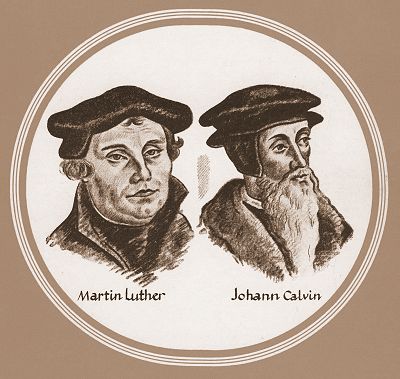
With Luther and Calvin, a new trial had fallen upon Christendom, and the Society of Jesus was just what the Church at that moment wanted.
A cry had arisen against religious orders. And this cry was met, not by a cowardly hiding of the evangelical councils as a cause of offence, but by the confirmation of a new order, which was to live in the world's sight, and whose enclosures were to be nothing less than the boundaries of the earth. Ignatius, as the servant of God, now began his generalship, by setting his house in order and writing the constitutions. We look on these acts with a peculiar interest.
Link (here)

Sunday, November 17, 2013

His Excellency The Marquis of Pombal, "The Slayer Of The Jesuits"

POMBAL.
"EL MATADOR DOS PADRES."
In one of the principal squares of Lisbon may be seen the statue of King Joseph Emmanuel, son of John V., Don Sebastian Carvalho y Melho, Count d'Oeyras, Marquis de Pombal. The relative position of the figures ought to have been reversed. The minister was the tyrant of the monarch, as well as the scourge of his subjects. In the present notice we shall limit ourselves to giving an account of the manner in which the Marquis de Pombal earned his title of "Slayer of the Fathers," after enumerating the causes of his enmity against the Company of Jesus.
King of Portugal. At the foot of the statue is represented his Minister of State,
Pombal, who was a "philosophic" atheist and an encourager of the Calvinists, had certain reasons of private ambition for wishing to introduce Protestantism into Portugal. While pretending outwardly to be the enemy of the English, he was secretly doing all in his power to bring about a marriage between the Princess de Beira and the Duke of Cumberland —a marriage which would have eventually entitled the latter to the crown of Braganza. Like the rest of the Portuguese, the Jesuit Fathers were naturally opposed to English and Protestant domination in their own country. They were confessors to all the royal family, and Pombal regarded them as the chief obstacle in the way of his designs—an offence which he never forgave them.
.........Pombal was a great builder of prisons. The number of his victims demanded considerable accommodation, for at one particular time in Lisbon he had more than four thousand prisoners of state, and this in a capital of (at that period) one hundred and fifty thousand inhabitants. Dona Eleanora, the Dowager Marchesa de Tavora, was separated from her children. Masters and servants, men and women, disappeared as if the earth had swallowed them up. In letters of the time we find that Pombal was enraged on discovering that some poor ameliorations had been made in the dreadful state of the captives by the pity of subalterns. Besides the De Tavora family a large number of hidalgos had also been arrested and thrown into dungeons that same night. 
Among them was the greatest noble of Portugal, Don Jose de Mascarenhas y Lancastre, Duke of Aveiro and cousin to Dona Eieanora. Several of the Jesuit fathers, amongst whom was the confessor of the Prince Don Pedro, Father Hyacinth da Costa, were also suddenly carried off to prison.
All Lisbon was paralyzed with terror. A hand of iron weighed upon the city. In the streets nothing but mercenary soldiers were to be seen, and the king no longer went out of his palace. Whoever dared to express doubt as to the guilt of the arrested persons, or the least pity for them, was summarily arrested also. According to the laws of Portugal accused persons had a right to be judged by their peers. Pombal denied his victims the benefit of this right. He created a tribunal composed of creatures of his own, and entirely devoid of legal authority. 
This tribunal lie named the "Court of Mistrust," and over it he appointed himself president. As it was not yet, apparently, so much a question of the Jesuits as of the nobility, the French Encyclopaedists were somewhat offended at these monstrosities, and we hear of the "bad effect" produced in the philosophic world of Paris by the frightful vagaries of Pombal, whom, nevertheless, it was desirous to excuse as far as possible, on account of his "generous ideas." Not content with presiding, Pombal took upon himself the "examination" and "instruction " of the cases. It was he who gave the verdict and pronounced the sentence, which still exists, written by his own hand. 
And how was the examination conducted? By intimidation of every kind, shamelessly employed, by "testimony invented," and witnesses forced by torture to assent to accusations which they were never allowed to retract, and thus furnishing a reason for a judicial carnage the attendant horrors of which are, perhaps, unparalleled in the history of any civilized nation. The Tavora family, as well as the other accused, remained silent under the fearful torments to which they were subjected, with the sole exception of the Duke d'Aveiro, who, in the extremity of agony, half dead as he was, and not knowing what he said, assented to whatever was put in his mouth, and thus accused his fellow-prisoners and— the Jesuits. Pombal, on hearing this, uttered an exclamation of ferocious joy. He had obtained what he wanted. What this implied we shall see further on. No sooner had the unfortunate Duke d Avei'ro recovered his senses than, learning what he had done, he retracted, declaring that excess of torment alone had wrenched from him accusations against persons who were innocent. It is needless to say that his earnest entreaties had no effect in inducing Pombal to allow his retractation. Sentence of death was pronounced against the De Tavora family, their relations and friends, as well as all their numerous domestics and dependants, on January 12, 1759. Pombal, fearing the popular indignation, had the scaffold prepared by night, outside the city, in the ■ Plaza of Belem, which was occupied by two regiments of mercenaries. 
The platform, lighted by torches, rose eighteen feet from the ground. The square and the river side were so thronged with soldiers that the spectators took refuge on the Tagus, where from hundreds of boats and other craft arose a mingled murmur of groans and curses. Thus passed the night of January 13. With the first gray sign of dawn arrived the numerous domestics of the Duke d'Aveiro. These were all bound to stakes at one corner of the scaffold and burnt alive. 
Then followed the Marchesa Eleanora de Tavora, alone; a rope round her neck, a crucifix in her hand, and her garments torn into rags by the torture. Pombal was there; for his Memoirs give, with a sort of infernal satisfaction, the full details of which he was an eye-witness on this night. With calm dignity Dona Eleanora mounted the scaffold, pressing to her heart the image of her God. The executioner approaching to bind her feet, she said to him gently : " Man, I pray you not to forget who I am. Do not touch me except to kill me." The man knelt down before her (Pombal himself relates it). Dona Eleanora was of those races who leave no service, even the last, without its recompense. Drawing her ring from her finger, she held it out to him, saying: " Every work deserves its reward. This is all I have, and 1 give it you that you may do your duty well." The executioner rose and did his duty. After this first noble blood had reddened the block the aged Marquis de Tavora, Dona Eleanora's husband, was beheaded, and next the husband of that Dona Teresa who had brought death and destruction on the noble house into which she had been welcomed as a beloved daughter. Then followed the other sons of Dona Eleanora— the youngest of whom was not twenty years old—her daughters, and her son-in-law; then the long file of officers and servants of her household, who died in their torments like brave men and Christians. Last of all, his garments nothing but tatters, came the Duke d'Aveiro, whose racked limbs could scarcely support him. He was fastened on the wheel; and for nearly an hour he struggled with this ghastly instrument of death, which slowly crushed his bones, while the clamor of his appalling agony could be heard even in Lisbon. The butchery at last consummated, the scaffold with all that was upon it was set on fire, and crumbled, with the half-burnt corpses, into the Tagus. After what has been related it matters little to know that all the friends and relations of these victims were kept in prison, their palaces and mansions razed to the ground, and the very sites they had occupied sown with salt. The arms of the De Tavora and their so-called " accopiplices " were effaced in the Hall of the Knights at Cintra, where their escutcheons still remain veiled with black, like the portrait of Faliero in the Ducal Palace at Venice. This last fact is remarkable, because the iniquitous judgment of January 12, 1759, has for long years past been annulled. Pombal lived long enough to feel even in this world the hand of God. All his victims were rehabilitated during his lifetime by decree of the High Court, solemnly given on April 7, 1781 ; and by this same decree Pombal was disgraced.
Link (here) to Catholic World

Friday, November 15, 2013

The Lords Of Georgetown

Lord Nicholas Windsor
For those who are unaware of the splendid track record of Lord David Alton and Lord Nicholas Windsor, This link will take you to the presentation given by Lord Nicholas Windsor, Jan Graffius and David Alton at Georgetown University's Berkley Centre, Washington DC. The session was hosted and moderated by Professor Tom Farr. The presentation describes the purpose of the Christian Heritage Centre Project, the Collections held at Stonyhurst,and the challenges to contemporary religious freedom. Please share it with others.
they are both tireless warriors in defence of the unborn, doing much great work in Europe and the United Kingdom for the culture of life. Lord Nicholas Windsor, a cousin of the Queen, converted to Catholicism a few years ago and has been an indefatigable crusader for the pro-life cause ever since. Lord Alton has been supporting the pro-life cause in the House of Commons and the House of Lords for several decades.
Link (here) to the St. Austin Review

Sunday, September 15, 2013

Cardinal Avery Dulles, S.J. "Little Or No Encouragement From Catholic Clergy"

Asked whether spreading the faith was a high priority of their parishes,75 percent of conservative Protestant congregations and 57 percent of African American congregations responded affirmatively, whereas only 6 percent of Catholic parishes did the same. Asked whether they sponsored local evangelistic activities, 39 percent of conservative Protestant congregations and 16 percent of African American congregations responded positively as compared with only 3 percent of Catholic parishes. Converts to Catholicism often report that on their spiritual journey they received little or no encouragement from Catholic clergy whom they consulted.
Link (here) to Ralph Martin's disturbing look at Catholic de-Sacramentalization. In this essay you will find Cardinal Dulles' quote.

Tuesday, July 23, 2013

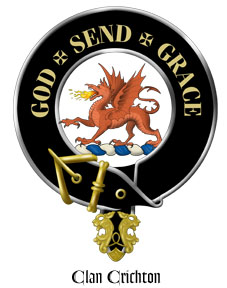
William Crichton, S.J.. "Gulielmus Crichtonius, Societatis Jesu Presbyter"

William Crichton, a learned member of the Society of the Jesuits, who, after a life devoted to the propagation of his faith, died at Leyden, in the year 1596. Of the talents, travels, and misfortunes of this author, the following account is preserved by Dempster :

“ Gulielmus Crichtonius, Societatis Jesu presbyter eruditus et pius, quinquaginta annis religiosé in eadem sociemte transactis, perigrinando, docendo, scribendo, indefesso labore cives suos, hæresi abdieata, Catholicæ Bc. clesias unire annisus est; vir probissimae conversationis, etiam a sectariis, judicatusi Majesmtis regiæ acerrimus propugnator; quippe cum Anglus quidam ei detexisset Elisabetham Angliæ reginam velle se, quacunque ratione, e medio tollere, intercessitl et quantum fieri potuit ab incepto retmxit. Petrus Mathmus, lib. VI. Hist. Gallic. nan-an II. Eoque beneficio Regina dev-incta, cum ille, ex itinere Scotico mari interceptus, in Turrim Londinensem conjiceretur, e vestigia liberum dimisit; ultro confessa, non posse improbum ease, cui curæ esset Regig dignitas et nnimanun salus. silean t ergo perditæ haereticorum voces clamantium, a societate in principes simrios armari; cum hic Jesuita, hostium etiam confessione, longe ab eo fuerit consiiio." Ejus sunt, Excerpta ex SS. Patribus. In primam partem D. Thomas. Lib. I. Theologia Scholastica contra Sectafios. De legitimol Jacobi VI. scotiæ Regis, titulo ad Regni Anglicani successionem. Qua librm Levanli acriptai m pniculum mail, extra omnea Regi; Hhpaniw ditiorm nleguhu: Pro hispani vero in idem regni-m jure, scripta-t Roberta: Penoniur, Jmn‘tu Anglia:Casus Conscientia obiit Lugduni Galliarum, MncxvL Multis annis Collegium Lovanii Scotorum rexit .
Link (here) to Life of the Admirable Crichton.

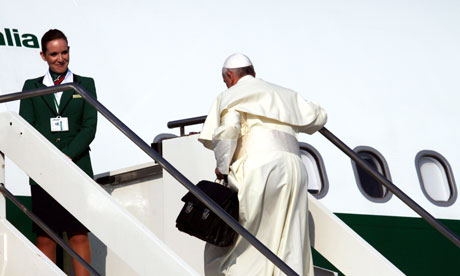
The Voyage Of Pope Francis

Brazil continues to be the country with the largest number of Catholics, 123 million. But if half a century ago nearly all of the population was Catholic, in the following decades the percentage decline has been very stark. From 92 percent of Brazilians in 1970 to 65 percent in 2010. Vice versa there has been a substantial rise, over the same span of time, in the number of Protestants, from 5 to 22 percent. In absolute terms, while the Catholics have stood still for twenty years at a little over 120 million, in spite of the increase in the population, the Protestants are still increasing. From 26 million in 2000 they have risen to 42 million in 2010.
By "Protestants" are meant not so much the Lutheran, Calvinist, Methodist Churches, those of the "historical" stock, which make up less than a fifth of the total, but mainly the Pentecostal and Evangelical Churches, some of which - like the Universal Church of the Kingdom of God and the God is Love Pentecostal Church - were born in Brazil itself.
Over the past few decades the followers of other religions have also increased, in particular those of the Afro-Brazilian Candomblé and Umbanda. From 6 million in 2000 they have become 10 million in ten years.And those affiliated with no religion have also grown, including the agnostics and atheists. In 1970 they were fewer than one million. In 2010 15 million. All of these changes apply in a roughly equal way to both men and women, both educated and less educated. They are more pronounced in the segment of the population under the age of 50. But above all they impact the cities much more than the countryside. While in the rural areas Catholicism continues to be embraced by 78 percent of the population, the figure is only 62 percent in the cities, where the Pentecostals and Evangelicals reap the most conversions and the agnostics and atheists are on the rise. In Rio de Janeiro, the destination of the voyage of Pope Francis, Catholics are now a minority among the citizens, just 46 percent. It comes as no surprise that the pope's objective is that of infusing into the Brazilian Church - and by extension into the Churches of Latin America - the missionary vitality capable of overturning this tendency to decline.
Link (here) to Sandro Magister's full article

Fr. Kenneth Baker, S.J., "It Seems To Me That We Have Neen Witnessing A Steady Protestantization Of The Catholic Church"

We have reason to rejoice at the revised, much more complete readings that we now have in the Lectionary over a three-year period. When Vatican II put great stress on the role of Scripture in the Mass, and both increased and lengthened the readings, we witnessed a move away from the traditional “sermon” to the “homily.” The sermon tended to concentrate on faith, morals, explaining the Creed, whereas the homily now tends to be an “explanation” of the scriptural readings for the day. The explanation usually is in the form of a rudimentary exegesis, or it moves into biblical theology, that is, a theme from the Bible is developed, suggested by the day’s readings. Such procedures are good. We needed a return to Scripture, and that is what we have had for the past 40 years. But in the meantime, there has been, in my view, a serious neglect of instruction of the faithful in the fundamentals of the Catholic faith in a systematic way in most of our parishes. Also, 
there is little or no connection between the homilies from one Sunday to the next. As a result, more and more Catholics simply do not know what their Church teaches on such basic questions as original sin, mortal and venial sin, the Incarnation, the Trinity, heaven, hell, purgatory, the Real Presence, bodily resurrection, and so forth. Millions of Catholics are confused—and that confusion has led to division. It seems to me that we have been witnessing a steady Protestantization of the Catholic Church, in the sense that each person, on the principles of sola scriptura and private interpretation, decides for himself/herself what the Bible and the Catholic faith mean. 
There are now about 20,000 different forms of Protestantism; and we now seem to have several different forms of Catholicism, not officially but de facto.
Link (here) to the full article at HPR by Fr. Kenneth Baker, S.J.

Wednesday, July 17, 2013

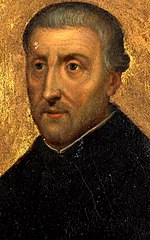
Jesuit Blessed To Become Saint Peter Faber, S.J.

'MOTU PROPRIO' FOR THE WELL-BELOVED JESUIT'

One of Francis's decisions that is certainly personal is that of proceeding - as revealed in "Avvenire" by the journalist and friend of the current pope Stefania Falasca - with the canonization of the Savoyard Peter Faber, one of the founders of the Society of Jesus, now venerated as blessed.
The reasons for this intention are easy to identify in the evident analogy between the way in which Faber carried out his mission during the terrible period of crisis for the Church occasioned by the Protestant Reformation and the way in which pope Bergoglio today intends to fulfill the task of successor of Peter.
Faber, in fact, the historians recount, counter posed the witness of his own life and his insistence on a thorough internal reform of the Church to the theological controversies and to every illusion of being able to impose the authentic faith by force. And in doing so he earned the esteem of saints who nonetheless are considered seasoned champions of the Catholic Counter-Reformation, like Francis de Sales and Peter Canisius. In all probability, the canonization of Faber will take place without the usual ceremony but with a simple pontifical act that will certify the so-called canonization "equivalent." This is a procedure ordinarily used for personages who lived in past centuries and whom the pope, by virtue of his authority, decides to elevate to the rank of saint without the miracle attributed to their intercession, which is instead necessary in normal causes. This procedure has been used, for example, by Benedict XVI for Hildegard of Bingen, by John XXIII for Gregorio Barbarigo, by Pius XII for Margaret of Hungary, by Pius XI for Albert the Great.
Link (here) to Vatican Diary

Tuesday, July 2, 2013

Protestant Tim Challies Vilifies St. Francis Xavier, S.J.

In 1545 Xavier requested that an inquisition be installed in Goa in order to try and punish anyone who had converted to Catholicism and later apostacized. This inquisition would be established only in 1560, several years after his death, but it would be a terrible one. While records were destroyed after the inquisition was formally abolished in 1812, it is thought that more than 16,000 people were brought before it. Many of these lost their lives while many more received lesser punishments in a time so notorious that 
Voltaire would write, "Goa is sadly famous for its inquisition, which is contrary to humanity as much as to commerce. The Portuguese monks deluded us into believing that the Indian populace was worshiping the Devil, while it is they who served him."  
The Reformers protested against Rome’s false gospel and the Roman Catholic Church responded by entrenching herself in her doctrine and by beginning a great wave of persecution against Protestants. The rift has never healed and, until Rome abandons her unbiblical gospel of grace plus human effort, it never will.
Link (here) to the blog of Reformed protestant Tim Challies
Saturday, June 15, 2013

Protestant Timothy George "Our Francis, Too"

Dr. Timothy George
Since the Roe v. Wade Supreme Court decision of 1973, Catholics and evangelicals in the United States "death penalty" for the unborn. In 2005, he admonished his fellow believers in Argentina to "defend the unborn against abortion even if they persecute you, calumniate you, set traps for you, take you to court, or kill you. No child should be deprived of the right to be born, the right to be fed, the right to go to school." Likewise, Francis of Assisi was known for his passion for spreading the Good News, once making a trip deep into North Africa to declare Christ to a sultan. One of the great challenges of Pope Francis will be to energize Catholic leaders for the New Evangelization—to study the Scriptures, renew the disciplines of the faith, and boldly proclaim the love of Christ. As important as interfaith dialogue may be, real evangelization requires something more: unambiguous witness for Jesus Christ as the Way, the Truth, and the Life, the one and only Savior. The sex abuse scandals, by no means limited to the Catholic church, have besmirched Christian witness in the 21st century. Both outside and inside the church's walls, there is much that makes us wince and turn away. But reform and renewal can come only as we face squarely the evil within us and around us and seek the repentance that comes only as a gift. I believe that Pope Francis, a Jesuit, would agree with the first of Martin Luther's 95 Theses: "When our Lord and Master Jesus Christ said, 'Repent,' he willed for the entire life of believers to be one of repentance."
have worked side by side to advocate for the sanctity of life. The pro-life community will have a strong ally in the new pope. He has referred to abortion as the
Link (here) to Christianity Today to read the entire article by Baptist Protestant Professor  Timothy George is dean of Beeson Divinity School, an interdenominational, evangelical theological school within a Baptist university (Samford University, Birmingham, Alabama), and an executive editor of Christianity Today.

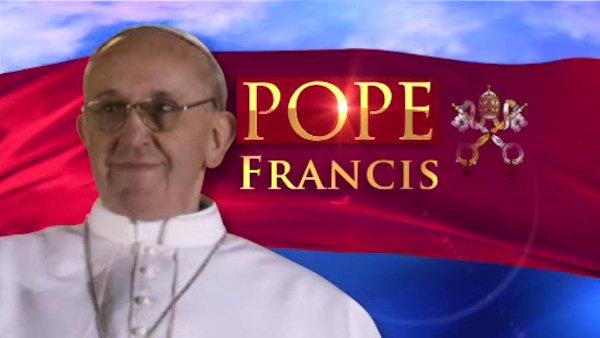
The Counter Reformational Pope Francis

Every pope in the Catholic Church’s past has had a mastery over Catholic rhetoric—the pope always says washing the feet of young women incarcerated at a nearby prison. This was the first time the pope has ever washed the feet of women—not to mention that one of them was a Serbian Muslim, which is another break in papal tradition. This type of servant leadership is precisely what has connected the new pope to our younger, more cynical generation. He is breaking the rules in the right places: where they shouldn’t exist. As Pope Francis accepts his role, a new generation of evangelicals accepts theirs. As young evangelicals have rejected the megachurch and the televangelist and embraced a more rugged, grassroots Christianity, these actions by the pope fit perfectly. He has refused to live in the massive papal quarters in Rome and has chosen to live in the guesthouse, instead. One of his first actions as pope was to cancel his newspaper subscription at his home in Buenos Aires.
the right thing. But Pope Francis has decided to lead with his actions. Before delivering his message at the Holy Thursday Mass (an extremely important mass in Catholic tradition), Pope Francis spent time on his knees,
These small things go beyond his radical, public acts of humility and reveal his dedication to simplicity. Evangelicals have grown in their love of the simple things. Public evangelicals like Shane Claiborne and David Platt have fascinated crowds and sold hundreds of thousands of copies of books about these principles. As Pope Francis leads in simplicity and continues to dedicate himself to living in this way, it will only increase his popularity.
The pontiff’s simplicity carries over to his language, too. Catholics have always had trouble connecting their message to young people. Many who grew up in the Catholic Church struggled to connect with its liturgy and message. To a newcomer, it’s often overwhelming.
But Pope Francis’ language is accessible and concise, which works perfectly with the Twitter-speak of young Christians like me. His quotes are simple and yet profound: “The Church is a love story, not an institution” and “War is madness. It is the suicide of humanity.” 
As many reject the King James Bible and the complex, irrelevant theological language of the past, they embrace the succinctness of Pope Francis’ words. It is important here to realize that the pope is popular with evangelicals not because he’s doing what they already do, but rather because he is doing what they are not doing but wish to begin doing. As I scour the landscape of evangelical leadership (authors, speakers, mega-church pastors), it is difficult to find a man like Francis. 
In the age of best-selling books and church auditoriums that rival arenas, we do not see many leaders take the route of Pope Francis. And perhaps this is why we enjoy him so much: He is leading us in a way we are not leading ourselves right now. Pope Francis is popular not for what he does, but how he does it. He’s popular not for what he says, but how he says it. These are character issues we are seeing displayed; he is adopting an attitude, not an office. I pray we would not be afraid to be led by a servant like Pope Francis. For if we cannot be led by a servant, how can we be led by Jesus? 
I see Pope Francis respected because he reminds us of Jesus, which unfortunately is a bit of a surprise when seen in public religious leadership. He is a breath of fresh air. He did not see the office of pope as something to be grasped, but instead made himself nothing, taking on the very nature of a servant, which is an imitation of Jesus Christ (Philippians 2:5-11). 
This adoption of servanthood has turned critics into followers. Because it’s difficult to be critical of someone who serves the poor and spends time with the victims of the world’s worst violences.
Link (here) to the Protestant Relevant Magazine and read the piece by Protestant pastor Chris Nye

Tuesday, May 28, 2013

Southern Baptist Professor Molly T. Marshall On St. Ignatius Of Loyola

Molly T. Marshall
St. Ignatius of Loyola sent people on mission with this instruction: “Go, set the whole world on fire and in flame.” Fueling destruction was not on his mind. He had already seen enough of the travesty of war, having been seriously wounded in the Battle of Pamplona in 1521. Rather, he was concerned with fomenting desire for God and passion for the gospel. History tells us that his Society of Jesus was an ardent mission movement, proclaiming grace and forgiveness in places newly discovered in the 16th century.
Stirring into flame this “holy longing” to love God and serve expansively depends upon receptivity to the Spirit of God. It is the Spirit within who wills to work through us for God’s good purposes. Yet, many Christians regard the listing ways of the Spirit with suspicion, perhaps because we can never control holy presence.
The celebration of Pentecost is gaining ground among Baptists as we become more acquainted with the rhythms of the Christian year. Wearing hues of orange and red, hearing Scripture read in several languages, viewing moving streamers, reminiscent of wind, flames and tongues, will add a rather exotic touch to worship this coming Sunday. The more liturgical pastors will wear their bright red stoles, looking combustible as they seek once more to describe the coming of the Spirit.........Anywhere persons are growing in generosity, as St. Ignatius prayed, to “give without counting the cost.” Anywhere persons are laboring without expecting any reward other than to hear, “Well done, good and faithful servant.” Is God’s Spirit as active today as in the early fervor of proclaiming the resurrected Lord? Yes, if we are willing to make room for the Spirit. The Holy Spirit is God present with us, transforming us to live into the patterns of resurrection so that our hearts burn within us for the sake of the world as we travel in Christ’s company. Come Holy Spirit; set our hearts on fire.
Link (here) to read Molly T. Marshall full piece

Thursday, May 23, 2013

Catholics Seem To Have Forgotten How Greatly The Protestants Feared The Jesuits

Hammer of Heretics
John Donne, as Protestant controversialist, singled out the Jesuits for special opposition in Ignatius His Conclave. Now that the religious controversies of the Reformation and Counter-Reformation are largely submerged in an ocean of indifference, even Catholics seem to have forgotten how greatly the Protestants feared the Jesuits.   The dread of Jesuit sophistication is well expressed, in Edmund Spenser’s Faerie Queene, when Errour vomits forth literature:
Therewith she spewed out of her filthy maw
A flood of poison horrible and black,
Full of great lumps of flesh and gobbets raw
Which stunk so vilely, that it forced him slack
His grasping hold, and from her turn him back:
Her vomit full of books and papers was,
With loathly frogs and toads, which eyes did lack.
When St. Robert Southwell arrived in England in 1586, intercepted communications identified him only as RobertusElizabethan authorities took the newcomer for elder Jesuit Robert Parsons—and were terrified at the very thought of the Catholic havoc he might cause.  St. Peter Canisius was feared throughout the German-speaking world as the Catholic “Hammer of Heretics.”  And he did hammer them, too.
Link (here) to Crisis Magazine to read the full article.

Wednesday, May 1, 2013

Fr. Robert Nash, S.J., "Protestants Are Hankering For The Doctrine, Which Was Filched From Them By Unscrupulous Men In The Sixteenth Century."

The Jesuits chapel at Rathfarrnham Castle
When I return tonight to Rathfarnham Castle where I live, I shall go into our chapel there and kneel to pray for a while. I am pretty sure to find other Jesuits there in prayer also. Now here is a group of men, — a mere handful of the more than four hundred million Catholics scattered across the world, [in 2013, there were 1,200 million Catholics in the world] — and they are absolutely convinced of this, that Jesus Christ is really, truly, and substantially present on that altar before them, under the Eucharistic Species. 
They are kneeling at His feet as truly as Mary His Blessed Mother knelt before Him in the crib at Bethlehem; as truly as if they were on their knees by His side when He passed the whole night in prayer on the mountain; as truly as if they were close to Him when He preached from Peter's boat to the crowds drawn up along the shore; as truly as if they were on Calvary itself, on the ground soaked in His Precious Blood. 
We are not asking you necessarily to believe this. All we want to stress is that if the Catholic doctrine of the Real Presence were true, it would be extraordinarily comforting and beautiful. It would infuse new life and meaning into the apostle's phrase: "Jesus Christ, yesterday, today and the same forever." A beautiful faith! 
A Protestant once said to a Catholic friend of mine: "If I believed what you Catholics believe about the Blessed Eucharist, I think I'd never be off my knees." Father Peter Gallway, a Jesuit who lived many years in London, was accustomed, even in his very old age, to remain long hours every night before the Blessed Sacrament. 
You would find him at midnight, and far into the small hours of morning kneeling, or seated, there in the darkness, seemingly, like his divine Master, spending the whole night in the prayer of God. A younger priest once made bold to ask him how he occupied himself during all that time. What did he do or say or think? The old man smiled. “I suppose, Father, I may as well tell you very simply. I stay there quite quietly, and occasionally I say just one single word, — `God,' or, sometimes, 'Jesus.'" That was all. The overwhelming truth of that Presence filled and satisfied his hungering soul. 
The beauty of it. The solid consolation of it. The unfailing source of joy it is to the soul that realises. "Hold Him and keep Him for your friend," counsels a Kempis, "who, when all others forsake you, will not abandon you nor suffer you to perish in the end." Is it possible to doubt that the Catholic's conviction that in the Blessed Eucharist he can most literally obey this injunction, must inundate his soul with joy? The beauty of it! But what most of all consolidates his happiness is the unfaltering assurance that it is true. 
It is no wonder that many Protestants are hankering for the doctrine, which was filched from them by unscrupulous men in the sixteenth century. One sees signs of this nostalgia, for instance, in several Anglican Churches, which set up an altar, and keep a lamp always burning, and genuflect, and celebrate "Mass." All this is evidence of their longing, their hunger, for the Real Presence. They are painfully conscious of what the late Monsignor Knox (himself a convert from Anglicanism) described as "The Real Absence" in their Church. Their efforts to fill it are beyond all praise. Catholics are certain that these efforts can be successful when they seek the Real Presence where alone It can be found.

"Would that thy creed were sound, thou Church of Rome!
For thou hast power to soothe the heart, thou Church of Rome!
With thy unwearied watch and varied round
Of service in thy Saviour's holy Home."
 
Link (here) to the full discourse by Fr. Robert Nash, S.J.

Wednesday, April 24, 2013

St. Ignatius Said, “Hierarchical And Catholic.”

And so the Church was a Mother, the Mother of more children, of many children. It became more and more of a Mother. A Mother who gives us the faith, a Mother who gives us an identity. But the Christian identity is not an identity card: Christian identity is belonging to the Church, because all of these belonged to the Church, the Mother Church. Because it is not possible to find Jesus outside the Church. 
The great Paul VI said: “Wanting to live with Jesus without the Church, following Jesus outside of the Church, loving Jesus without the Church is an absurd dichotomy.” 
And the Mother Church that gives us Jesus gives us our identity that is not only a seal, it is a belonging. Identity means belonging. This belonging to the Church is beautiful. And let us ask the Lord for this parresia, this apostolic fervor that impels us to move forward, as brothers, all of us forward! Forward, bringing the name of Jesus in the bosom of Holy Mother Church, and, as St. Ignatius said, “hierarchical and Catholic.” So be it.
Link (here) to Fr. Z

Wednesday, April 10, 2013

Thorns And Champions

The news of a Jesuit being elected Pope sent shock waves through my system, as I’m sure it did to many others. The Jesuits have garnered an ambiguous reputation this past century, especially in conservative Catholic circles, much due to a loosening grasp on their origins. At least in America today, Jesuits are equated with higher education. 
They are the thorn in the side of conservative Catholics and the champions of the liberal, political activist Catholics. But what will Pope Francis, a humble, morally conservative Jesuit, mean for this order? As a former student of a Jesuit university and a current teacher at a school originally founded by Jesuits, I offer one theory.
To put it simply, I see Pope Francis returning the Jesuits to their original foundation: dedicated defenders of the Church in a world that opposes Her at every turn. St. Ignatius of Loyola lived during the height of the Protestant Revolt when the Church was being attacked from all sides. After being severely injured in battle, Ignatius dedicated himself as a soldier for Christ and His Church. He came from such a militaristic background that he considered his new order, the Society of Jesus, to be the “shock troops” in service of the Pope—to defend him, his authority (which was being called into question), and the Church in the battle against Protestantism.
While I mean no disrespect to the priesthood of any Jesuit, they have become in recent years closely associated with progressive and liberal ideologies, which make many orthodox Catholics cringe at the mere mention of the Society of Jesus. Pope Francis himself has recognized that many Jesuits have fallen away from their original calling. 
While he was bishop of Buenos Aires, he criticized his fellow Jesuits for supporting liberation theology (communism under the guise of Christianity) and has called them to return to their roots of service to the Church and defense of Her teachings.
  1. He will call his brother Jesuits back home and remind them of their vow of obedience to him. The Jesuit vow of obedience to the Pope was what set them apart at their founding. They were fully devoted to defending the Pope and promulgating his teachings and those of the Church around the world. Pope Francis will prompt a resurgence of loyalty to the papacy and the Church, especially in a world where he is under constant surveillance and his every move is questioned, analyzed in high definition, and critiqued.
  2. Second, he will remind them that their duty is first and foremost to Christ and His bride, the Church. In his first few weeks as Pope, Francis has shown no indication of backing down on Church teachings. He lives a very radical life of love and justice, one that has captured the attention of the mainstream media, but never has he spoken out against fundamental Church teachings that liberals abhor. This example of being a Pope of service and love while holding fast to Church teachings will show his fellow Jesuits that living a life of social justice and love of God’s people does not mean compromising the faith and moral foundations of the Church.
  3. I believe that Pope Francis will muster a new wave of young Jesuits in order to do battle with the secularism that runs rampant in our world today. His aforementioned dedication of service to God’s people and to Church teaching, not to mention his love of science, will inspire young men around the world to join the ranks of the Society of Jesus so that they can go out and teach the world through word and deed about God and His Church.
Let us pray for our Pope Francis!
Link (here)  to Truth and Charity

Monday, April 8, 2013

The Jesuit Church Of St. Micheal In Passau

In the shadows of the Stephan's Cathedral is St. Michael, the former Jesuit Church, situated on the bank of the Inn river. It was probably constructed with twin baroque-styled towers by Pietro Francesco and Carlo Antonio Carlone, the architects of St. Stephan's Cathedral, between 1670 and 1677. After a complaint by the Bishop, who wished to preserve the architectural dominance of the cathedral, this Jesuit church ended up less ostentatious than originally planned. Weber made this sketch of the church in 1983.

The interior stucco work, created by Giovanni Battista Carlone and his workshop, is reminiscent of the cathedral. Most notable of the furnishings is the high altar done by the Jesuit architect from Breslau Father Christoph Tausch, in 1712, with an altarpainting by Carlos Innocenzo Carlone in 1714. The black and gold side alters were completed by the local artists, Johann Seitz and Matthias Högenwald from Passau in 1678. Other paintings in the church are the works of Johann Spillenberger, Frans de Neve, Bartolomeo Altomonte and others. The splendid pulpit completed in 1715 is presumably the work of Jospeph Matthias Götz. The casing for the organ was carved by Joseph Hartmann in 1715. The seminary buildings now house the Catholic theological faculty of the university. On the southern wall of the church is the chapel dedicated to Franz-Xaverius decorated uniformly in the style of Early-Rokoko in 1725.

East of the complex is the massive seminar building complex of the former Jesuit college. It is separated into three buildings. The former monastery building is currently a Humanistisches Gymnasium,a college preparatory school with emphasis on the Classics. It was founded in 1612 and has a number of rooms decorated with stucco from the 17th and 18th century. The "Old School Building" which was renovated in 1912 to the current Philosophy and Theology Department of the university. It has an observatory tower. The third building "Seminary" is the old trade school with its cloistered walk. There is the State Library which evolved from the former Jesuit library between the Gymnasium and Observatory. The main reading room is decorated in stucco from 1725. The library has valuable manuscripts (Vornbach Bible of 1421), a coin collection and incunabulum dating back to the 15th century.
Link (here) 

Wednesday, April 3, 2013

What Counts Is What It Can Accomplish

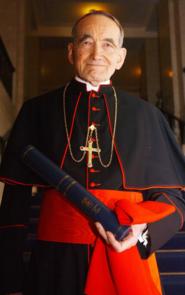
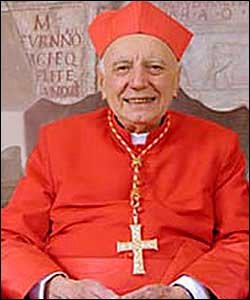
Cardinal Tomas Spidlik, S.J.
While neighbouring Poland remains deeply Roman Catholic, only one million Czech citizens declared
themselves Catholic in a 2011 census. Five million had no religion while 3.6 million said they were atheist. Very few Czechs are aware of the positive achievements of the Jesuit order in their homeland, such as the setting up of around three dozens schools.
Jesuit priest Father Bohuslav Balbin (1621-1688), a historian and writer, was a patriot who wrote several history books on his country and promoted the Czech language.
And respected Jesuit Cardinal Tomas Spidlik (1919-2010), an expert on spirituality in eastern Christian countries, "contributed to the theological dialogue between the East and the West," said Sebek. With its passion for science, the order also opened an observatory at the top of a tower at the Clementinum college, a masterpiece of Baroque architecture in Prague, where temperatures have been recorded every day since 1775. 
"And we must not forget about the numerous Jesuits incarcerated in Nazi concentration camps and in Communist prisons, whose fate is largely forgotten today. It would be good if this could change," historian Sebek notes. 
Fr. Petr Kolar S.J. sees plenty of work for Jesuits nowadays. "Pity that there are so few of us. There are so many things to do, like helping the marginalized or the Roma minority," he told AFP in an austere room at the Jesuit headquarters in central Prague, next to the Baroque church of Saint Ignatius de Loyola, a Spanish priest who founded the Society of Jesus in 1534. "The order's image isn't important. What counts is what it can accomplish," he added with a smile.
Link (here) to Naharanet

Friday, March 8, 2013

The Company Of Any Jesuit, Seminarie Or Otherwise Evil Affected Persons

Berkeley Castle in the town of Berkeley, Gloucestershire, UK
Licence to George, Lord Berkeley, to travel 
"beyond the seas with six servants and forty pounds in money, for one year, on condition that he travel not in any country that is not in league or amity with England nor use the company of any Jesuit, Seminarie or otherwise evill affected persons" to the State.
 Dat. 31 July, 2 Charles I. [1626} Signed at the top " Charles R."; with paper signet.
Link (here)

Thursday, February 28, 2013

Fr. Gustave Weigel, S.J., On Billy Graham

"What to Think of Billy Graham" is the title of an article in America, 4 May 1957, by Father Gustave Weigel, S.J. a student of modern Protestant theologies. This is perhaps the most competent evaluation of Dr. Graham and his "crusades" that I have seen, but, unfortunately, much of it would be lost on many people. Father Weigel is a learned and widely-read man and a deep thinker. His tribe is not great. Nevertheless, there is much in the article that is clearly and simply expressed. Father Weigel sees three elements in Dr. Graham's popularity: "current interest in religion; the revival tradition; Graham's streamlining of the revival framework." The last two elements are explained at some length. Father Weigel pays generous tribute to Dr. Graham's sincerity: 
"The man himself is not eccentric in any way whatever. No one has ever questioned his seriousness and sincerity. Nor can he be accused of preaching the gospel for filthy lucre's sake." 
Then Father Weigel raises the fundamental question of authority. What right has Dr. Graham to tell anyone what is Christian truth? Mr. High, in the first books mentioned above, labours mightily in chapter two to explain how Dr. Graham "can be so sure." This is not such a difficult question. It is individual and personal, and the answer to it explains Dr. Graham's sincerity. But does Dr. Graham tell us with authority what the Bible means - what is the authentic and complete message of the inspired Scriptures? Certainly not. 
"Graham's sincerity is no guarantee of the accuracy of his understanding." What has he, then? "He says, in effect, that he has found his own life transformed by an act of trust in the message he has sincerely extracted from Bible-reading.
This comes down to saying: "It is true because it worked for me." Father Weigel's examination of the question is much more extensive than I have indicated. He tries to examine every aspect and to show exactly what is involved. There can be no satisfactory answer to Fr. Weigel's arguments.