Showing posts with label Jesuits in Spain. Show all posts

Friday, March 7, 2014

St Alphonsus Rodriguez,S.J., The Jesuit Doorkeeper And Mystic

At the request of his mother, Alphonsus married the virtuous Maria Suarez. His married life of four years was marked with much suffering. His business suffered, and two of the couple’s three children died in infancy. He was widowed at the age of 32 and his mother died soon aftewards. He sold the business and moved in with his sisters; they helped Alphonsus raise his son, and taught their brother prayerful meditation. When his son died, Alphonsus decided to follow his call to the priesthood.
Alphonsus wanted to become a Jesuit. Twice he was refused admittance due to his older age, but providence came to his rescue. He entered the novitiate at the age of thirty-seven, and after six months, he was instructed to go to the Jesuit college of Montesion in Palma on the island of Majorca off the coast of Spain, to complete his novitiate training. At the end of his novitiate, he was assigned various duties and was made doorkeeper at the college. He remained in this office for 46 years.
Nothing could be more insignificant in the eyes of the world and more monotonous in itself than such a life. By his deep interior spirit that animated him, Alphonsus transformed and transcended it with his: fervent spirit of prayer, deep union with God, devotion to Mary, especially the Rosary, which allowed him to live constantly in the presence of God even in the most difficult times. His spirit of obedience was remarkable. His love for his fellowmen and his spirit of penance inspired many to follow him. People in high positions came to him in their troubles and difficulties to seek his advice. He exercised a powerful influence for good upon his own Brothers, many of whom reached a high degree of sanctity. Of these the greatest was St Peter Clever, a fellow Jesuit, whom Alphonsus prepared to become the apostle of Slaves in the New World. Many owed their vocation to priesthood and religious life to him. The last year of his life, was one of great suffering. He died on October 31, 1617, with the name of Jesus on his lips.
As a humble porter, Alphonsus was always appreciated for his kindness and holiness; however, it was only after his death that his memoirs revealed the quality and depth of his prayer life. It was then that others learned that the humble Jesuit who had been gifted by God with remarkable mystical graces, ecstasies and visions of our Lord, our Lady and the saints.
Alphonsus was beatified in 1825, and was canonized by Pope Leo XIII on 15 January, 1888 together with his spiritual disciple, St Peter Claver. St. Alphonsus is the patron saint of Majorca, Spain.
Link (here) to Catholic Fire

Monday, January 6, 2014

Fr. Juan Masiá Clavel, S.J., "Abortion and Abortion"

Fr. Juan Masiá Clavel, S.J.
(Madrid), the Spanish Jesuit and Bioethicist Juan Masiá Clavel has again defended the killing of unborn children. For years, Father Masiá distinguishes between "abortion and abortion" (see separate report Jesuit Justifies Abortion - And What do the Bishops and Rome do
"There are situations where it is irresponsible not to perform abortion," the Jesuit wrote on New Year's Day on his blog, which is connected with the Spanish daily El Pais. 
Critics accuse the Jesuits of being abortion apologists. All knew it, but no one has taken action. Although Father Masiá is talking about extreme cases, the context of his Speeches on abortion serve at the same time for the justification of prenatal infanticide. Thus the criticism of Info Catolica and the Spanish church historian and Catholic blogger Francisco de la Cigoña on the most recent blog entry by Father Masiá
Link (here) to more at The Eponymous Flower

Sunday, July 14, 2013

Defrocked Jesuit Priest Jesus Aguirre y Ortiz de Zarate,

In 1978 the Duchess of Alba, Spain’s richest and most titled woman, her full name is Maria del Rosario Cayetana Alfonsa Victoria Eugenia Francisca Fitz-James Stuart y de Silva and she is a duchess seven times over. scandalized the nation by marrying defrocked Jesuit priest Jesus Aguirre y Ortiz de Zarate, her former confessor. Aguirre administered the Alba estate until his death in 2001. 
Link (here) to The Telegraph

Saturday, February 16, 2013

The Birth Place Of St. Francis Xavier, S.J..

Castillo de Javier / Javier Castle - Navarra, Spain

Xavier ranked very low in the hierarchy of Spanish castles, a mere unblooded corporal among magnificent battle-scarred generals and field marshals. But in renown the little sentinel of Navarre has outstripped all the hoary giants of the Spanish hills. Very few people except Spaniards or inveterate travelers in Spain will have heard of the cloud-capped Penafiel or tremendous Coca, but everybody has heard of Xavier. It would hardly be an exaggeration to say the name has has become a household word the world over, a magic evocative name, conjuring up visions of galleons, catamarans and brown junks tossing on tropical seas, of hot Indian plains and stifling Malayan jungles, of explosive, sun-drenched Indonesian islands of a China and Japan as unmapped and mysterious as the dark side of the moon. A child born within the gloomy battlements of Xavier on April 7, the Tuesday of Holy Week in the year 1506, was to make all the difference. He was christened Francis, a name before unused in his family of habitual Michaels, Jeromes, Matins, Peters and Johns, perhaps because of his arrival in Holy Week reminded his devout mother of the saint who had borne the wounds of Christ in his living flesh.
An excerpt from the book entitled, "Saint Francis Xavier" by Fr. James Brodrick, S.J.

Friday, February 1, 2013

The Maxims Of St. Peter Claver, S.J.


1. 
Man's salvation and perfection consists in doing the will of God, which he must have in view in all things, and at every moment of his life; the more he accomplishes this divine will, the more perfect he will be.

2. 
To do the will of God, a man must despise his own; the more he dies to himself, the more will he live to God. But to acquire this double advantage we must love God, and the more we purge the heart of self-love, the more shall we love God.

3. 
To love God as he ought to be loved, we must be detached from all terrestial love ; we must love nothing but Him; or if we love anything else, we must love it only for His sake.

4. 
Let a man direct all his thoughts, words, and actions, solely to the glory of God, incessantly striving for submission to His will, insomuch as to desire neither evil nor good, unless God wills it; and in whatever trials he may be placed, the peace of his soul cannot then be troubled.

5. 
To derive true profit from whatever happens, a man should be silent amidst reproaches, injuries, and ill-treatment, whether there be any fault on his side or not; and when people contend with him, let him prefer silence to victory.

6. 
To make rapid progress in virtue a man must carefully guard his tongue, and let truth, peace, and edification be in all his words. Let him say much in few words; and that he may always speak well, let him always speak either of God or with God.

7.
 Let him prefer nothing to obedience, no matter who commands; submitting to all creatures for the sake of God, and doing all that is required of him with great peace of mind. If however he cannot do all, and is asked the reason, let him be content with simply saying that he could not; and whatever may be said, let him answer nothing—no, absolutely nothing: whatever reproaches may be made, let him be silent, accepting all for the sake of God; provided there be nothing contrary to God, or to obedience. This is indeed the way in which to vanquish self."

Link (here) to the Maxim's of St. Peter Claver, S.J.

Monday, November 5, 2012

For A Long Time Catholicism A "Religion Of Fear And Terror"

What hell is not
Nevertheless, we must talk about it.  For a long time the Church in its pastoral work has placed too much (sometimes, nearly exclusive) stress on this topic, 
thus generating a ‘religion of fear and terror’.  Basic responsibility and honesty require us to clear up misunderstandings that have done so much harm and to put things in their proper place. First of all, let us say that hell is not a ‘positive’ act, in the sense of something positively desired by God.  It is not a creation of God, a place established to punish the wicked.  
If hell were that, then it would call God’s justice seriously into question.  Hell would mean condemning non-eternal beings to eternal punishment for non-eternal actions.  Not only would God’s justice be called into question, so would his mercy.  All this is so clearly evident that we need not go into further arguments: the punishments of hell would not, shall we say, be a good ‘letter of introduction’ for divine mercy. 
In the ‘prayer for the conversion of the gentiles’ that Saint Francis Xavier composed, we read: ‘Eternal God, creator of all things, … Behold, Lord, how to thy dishonour hell is daily replenished with [the souls of the infidels]…’   
Hell is truly an insult to God.[1]  Like the ancient prophet of Israel, Xavier seems to be telling his God, in a final, supreme effort to convince him, ‘If you don’t do it for us, then at least do it for the honour of Your Name’ (cf. Ezekiel 36:22) – since he was convinced that, when all is said and done, the honour of God’s Name (his very reality) and the good of what has been created by God are one and the same thing.
Link (here) to the British Jesuit's online journal Thinking Faith. The piece is written by Fr. Josep Giménez Melià SJ

St. Ignatius of Loyola on Hell (here)
Doctor of the Universal Church St. Robert Bellarmine, S.J. on Hell (here) , from his classic work, "The Art of Dying Well"
The Catechism of the Catholic Church on Hell (here)

Thursday, March 29, 2012

Cervantes Was Jesuit Educated

Miguel de Cervantes Saavedra (source)
Miguel de Cervantes Saavedra was born in Alcalá de Henares in 1547 and died in Madrid in 1616. His father Rodrigo de Cervantes was a doctor of few means. Nothing is known of his mother Leonor de Cortinas.
It appears that Cervantes studied with the Jesuits in Córdoba or Seville and perhaps in Salamanca. It is fairly certain that he was a pupil of López de Hoyos in Madrid. In 1569 he went to Italy as part of Cardenal Acquaviva's retinue and after signing up as a soldier in 1570 fought in the battle of Lepanto aboard the galley Marquesa. 
For the rest of his life he would boast of the several wounds that he received in his hands and in his forehead. Subsequently, he fought in the Corfú, Navarino, and Tunis campaigns. On his way back to Spain in 1575, the galley El Sol was attacked by Turkish ships and Cervantes was taken captive to Algeria. During his five years of captivity he wrote the Epístola a Mateo Vázquez. Juan Gil obtained Cervantes's freedom in 1580 in exchange for 500 ducats. Once back in Spain, he became a tax collector for the Invincible Armada. He had one daughter, Isabel, from his liaison with Ana de Villafranca. He married Catalina de Salazar y Palacios in 1584. He was twice imprisoned for embezzlement and for not paying his debts. He went to jail in 1603 when the corpse of Gaspar de Ezpaleta was found on his doorstep, but he was released for lack of evidence. From 1613 one of his books will appear every year until the last one, Persiles, with its dedication in which he takes leave of his readers signed three days before his death, on April 23, 1616. 
Link (here) Cevantes Project 2001

Friday, November 18, 2011

James Joyce On Spanish Jesuit

Fr. Juan Mariana de Talavera, S.J.
.....that the rights of property are provisional and that in certain circumstances it is not unlawful to rob. Everyone would act in that belief. So I will not make you that answer. Apply to the Jesuit theologian Juan Mariana de Talavera who will also explain to you in what circumstances you may lawfully kill your king and whether you had better hand him his poison in a goblet or smear it for him upon his robe or his saddlebow. Ask me rather would I suffer others to rob me or, if they did, would I call down upon them what I believe is called the chastisement of the secular arm? 
Link (here) to read the portion of the James Joyce quote from the semi-autobiographical novel entitled, A Portrait of the Artist as a Young Man. 
Joyce refers to Jesuits nine times in this book, see them (here) 
The notorious g@y Jesuit Fr. Robert Carter credits this book for his conversion to the Catholic faith.

Sunday, November 6, 2011

Br. Jaun de Bustamante, S.J. "The Printer"

The Old Gate of The College of St. Paul
In 1556, King Joao III of Portugal dispatched a group of Jesuits with a printer and a printing press to Abyssinia at the request of its emperor. When the ship put in at Goa, the emperor changed his mind and now this Portuguese colony was suddenly left with a press and a printer. 
The printer was Juan de Bustamante, a Jesuit Brother from Valencia, who was accompanied by an Indian assistant trained in printing in Lisbon. Bustamante, Gupta goes on write, 
set up the press at the College of St.Paul in Goa, and it was under the imprint of the college that most of the early publications were issued. 
Link (here) to The Hindu

Tuesday, November 1, 2011

Garabandal's "Dark Side"


Four girls from the small town of Garabandal, near Santander, had repeated visions of both the Virgin and St. Michael and were given prophecies to disclose to the rest of the faithful. On June 18, 1961, while picking apples at a local orchard, the girls heard a "thunderclap" and saw a beautiful figure enveloped in light which they thought was an angel sent to punish them for stealing fruit. Over the course of the following twelve days, the girls would have visions of the same angel, dressed in blue and with pinkish wings, whom they took to be St. Michael the Archangel. The angel told them that they would soon be seeing the Virgin, and they did so after the eight visitation. The Blessed Mother appeared in garb that would be immediately recognizable to any school-age child in a Catholic country: a white dress with a blue mantle, a starry crown, and a scapular at her waist. The heavenly patroness told the girls to inform their elders that sacrifice and penance were in order to avert imminent punishment. 
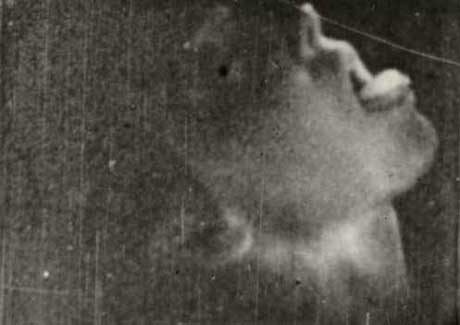
The thousands gathered in Garabandal to see the miracle were hoping for something more substantial, however, and in the wee hours of October 19, 1961 those present saw the famous miracle of the communion wafers manifesting itself on Conchita's opened mouth (and of which photographs have been reproduced in countless journals and religious tracts). 
Garabandal's "dark side" -- if it can indeed be said to have one -- came about a few months earlier when theologian Luis Andreu lost his life in a car crash. Andreu had seen the four girls in their ecstatic trances and had been forced to proclaim aloud the miraculous nature of what he was seeing. When asked exactly what the miracle was, he told his friends that he was overwhelmed with joy at what the Virgin had shown him and that it was the happiest day in his life. Shortly after, he fell silent, much to the concern of those around him. The priest had died. When news of Father Andreu's death reached the young visionaries, they claimed that they had seen the Virgin looking at him at one point, as though saying: "you shall soon be with me". The death of this respected religious caused the bishopric of Santander to forbid members of the clergy from visiting Garabandal without permission from Church authorities. Worshippers were advised that they too must cease their visits, and the tide of pilgrims to the mountain village was stemmed for a while. But there was another death in the works... In 1965, Monsignor Vincente Puchol assumed the bishop's crook at Santander and was even more stringent in his prohibitions against any veneration of Garabandal, issuing a terse pronouncement: 
"there has never been any apparition of the Blessed Virgin, nor of the Archangel Michael, nor of any other heavenly personage. There has been no message, and all of the events which have transpired at said location have a natural explanation." It was this rejection of the miracle of Garabandal that many believed cost the bishop his life: he died while driving his car, allegedly screaming "God, what's wrong with me?!" before the collision. 
The car crash occurred on the same day as the feast of St. Michael the Archangel. Another (here) Jesuit father, Jozef Warzawski, wrote a comprehensive study on the phenomenon entitled El Mito de Garabandal (Madrid: Ed. Studium) accepting the reality of the events which occurred at the site but ascribing them all to demonic forces.
Link (here) to Conspiracy Journal 617

Thursday, July 14, 2011

Jesuits Receed From Toledo Spain

San Ildefonso in Toledo, Spain
After centuries (except for the periods of abolition and expulsion - for instance, during the Second Republic),
the last Jesuits are leaving the Primate Archdiocese of Spain, Toledo. There are no new members to replace them in the staff of the majestic Iglesia de San Ildefonso (Iglesia de los Jesuitas). As F.J de la Cigoña, who reports this, asks: what places will they abandon next? Loyola (Azpeitia, Guipúzcoa)? Xavier (Navarre)?
The first Jesuit to visit Toledo, in 1535-36, was Loyola himself, a few years before going to Rome and after definitively leaving Azpeitia on his return from Paris, where he and his companions had taken the Montmartre vow.
Link (here) to Rorate Caeli

Wednesday, June 8, 2011

Phenomenon Of Violence

Fr. Ignacio Ellacuria, S.J.
The following is from "Freedom Made Flesh, the Mission of Christ and His Church," by the Rev. Ignacio Ellacuria, SJ, rector of the University of Central America, San Salvador, who was murdered last week (November 1989).
We must unmask certain attitudes that are now widespread in the face of the global phenomenon of violence. We must make a distinction between the different forms that violence assumes, to enable us to talk about one kind of violence that is always evil and condemnable, and another kind of violence that on occasion may be absolutely necessary even though it undoubtedly entails evils. Given the circumstances, the latter kind of violence may be not only tolerable but even required.
Link (here) to the LA Times

Sunday, May 22, 2011

Friedrich von Hugal On Cardinal Juan de Lugo, The 17th Century Spanish Jesuit

Cardinal Juan de Lugo, S.J.
We all greatly require criticism, stimulation, reproof, of our most intimate and cherished convictions; and it is our reciprocal duty, with tact and restraint, to try to serve our fellows similarly. Hegel, perhaps most probingly among all Protestant philosophers, has exposed in general this impoverishing formalism of Kant "the Philosopher of Protestantism." But I believe the true scheme, as concerns religion, to have been best developed by Cardinal Juan de Lugo, the Spanish Jesuit, who wrote in Rome under the eyes of Pope Urban VIII., at the end of the seventeenth century. De Lugo first lays down that, according to Catholic doctrine, God gives light, sufficient for its salvation, to every soul that attains to the use of reason in this life. He next asks,  What is the ordinary method by which God offers and renders possible this salvation and he answers that, though God doubtless can work moral miracles, these do not appear to be the rule, and are not in strictness necessary; that the human soul, in all times and places, has a certain natural affinity for, and need of, truth; and again, that the various philosophical schools and religious bodies throughout mankind all contain and hand down, amid various degrees of human error and distortion, some truth, some gleams and elements of divine truth. Now what happens as a rule is simply this: the soul that in good faith seeks God, His truth and love, concentrates its attention, under the influence of grace, upon these elements of truth, be they many or few, which are offered to it in the sacred books and religious schools and assemblies of the Church, Sect, or Philosophy in which it has been brought up. It feeds upon these elements, the others are simply passed by; and divine grace, under cover of these elements, feeds and saves this soul. I submit that this view admirably combines a sense of  man's profound need of tradition, institution, training, with full justice to the importance of the dispositions and acts of the individual soul, and, above all, with a keen sense of the need of special graces offered by God to the several souls. And such a view in no way levels down or damps the missionary ardour. Buddhism does not become equal to Mohammedanism, nor' Mohammedanism to Judaism, nor Platonism to Christianity, nor Socinianism, or even Lutheranism, to Catholicism. It merely claims that everywhere there is some truth; that this truth comes originally from God; and that this truth, great or little, is usually mediated to the soul, neither by a spiritual miracle nor by the sheer efforts of individuals, but by traditions, schools and churches. We thus attain an outlook, generous, rich, elastic; yet also graduated, positive, unitary, and truly Catholic.
Link (here) to read the portion of the book entitled,  Essays and Addresses on the Philosophy of Religion by Austrian Catholic writer and apologist Friedrich von Hügel

Monday, January 24, 2011

The Communist Mob Amused Itself By Throwing Stones At The Big Stone Crucifix

Colegio Nuestra Señora del Recuerdo in Charmartin
From the Milwaukee Journal dated March, 1931

The Jesuit headquarters was first attacked and burned, then the mob turned its attention to the church adjoining the headquarters and this was burned after it was sacked.  While the church was burning, members of the mob amused itself by throwing stones at the big stone cross. Every time a stone struck the cross the crowd cheered wildly. Many valuable historic documents were destroyed with Jesuit building.
         From there the mob surged to the new Carmelite monastery of St. Teresa in the Plaza Espana, near the former Royal Palace which was also burned, all of the monks escaped. Firemen only made feeble attempts to save the buildings and then were blocked by rioters. After the monastery was destroyed the rioters moved on the Jesuit seminary (Collegiate Church of San Isidro)  in the center of Madrid.  Gasoline was again poured on the woodwork, torches were put to the structure and the seminary and soon the college for priests, soon was a mass of flames.
        While the Jesuit seminary was still blazing the mob went onto the Franciscan school in the Cuatro Caminos and set that afire. Most of the monks were led out by the police.  The mob set on four who fled by a rear door, but they took to their heels and gained shelter in a nearby building.
           By this time other mobs were attacking numerous Catholic institutions, hurling stones and using brickbats and wielding iron bars to break doors and windows.  Other places set on fire were the Marist College in Bravo Murillo st... the Jesuit school (Colegio Nuestra Señora del Recuerdo) at Charmartin de la Rosa and the Salesianos church.
Link (here) to read the much longer account.
"Execution" of the Sacred Heart of Jesus by Communist militiamen at Cerro de los Ángeles near Madrid, on 7 August 1936, was the most infamous of the widespread desecration of religious property. The photograph in the London Daily Mail had the caption the "Spanish Reds' war on religion." Link (here)

Thursday, November 25, 2010

Holy Father On The Jesuit Cardinal "Master Of Justice" Urbano Navarrete Cortés, S.J

The Holy Father and Cardinal Urbano Navarrete Corte, S.J.
Pope Benedict spoke at the funeral Mass of Cardinal Urbano Navarrete on Nov.24, remembering the Spanish Jesuit – who died at the age of 90 this week – as an “educator of true justice.” After the Wednesday general audience, the Pope moved to the St. Peter’s Basilica where the funeral Mass for Cardinal Navarrete was being celebrated by Cardinal Angelo Sodano, dean of the College of Cardinals. In his homily, Pope Benedict called Cardinal Navarrete, who was dean of the Faculty of Canon Law at the Pontifical Gregorian University and rector of the school, a "master of justice.” The 90- year-old cardinal passed away on Nov. 22. Remarking on the family life and upbringing of the cardinal, who was one of six children, Pope Benedict said that his parents “created a climate of profound Christian faith in their family.” With three of the Navarrete children becoming Jesuits and two professing vows as nuns, the Pope noted how the family was given “the courage to bear witness to their faith, not putting anything before the love of Christ and doing everything for the greater glory of God.”
Link (here) to CNS

Sunday, October 10, 2010

Jesuit Roses

The well-known Jesuit, Brother Alphonsus Rodriguez, (here) used to say his Rosary with such fervor that he often saw a red rose come out of his mouth at each Our Father and a white rose at each Hail Mary. The red and white roses were equal in beauty and fragrance, the only difference being in their color.
Link (here) to read the rest of the post at the Lewis Crusade

Tuesday, September 14, 2010

St. Teresa Of Avila On Fr. Paul Hernadez, S.J.

St. Teresa of Avila
A father of the Society of Jesus, Paul Hernandez, to whom I used to go for confession when I was there making arrangements for the foundation in Malagon,1 and who was very desirous to see a monastery of out order built there, when he heard of his illness went to speak to him, and showed him that it would be a very great service rendered to our Lord if he founded the monastery, that he could establish in it the chaplains and chapelries, and that the solemnities and other observances which he was resolved to institute in one of the parishes of the city could be kept in the monastery. He was now so ill that he saw he had not time enough to arrange the matter, so he left it all in the hands of his brother, Alonzo Alvarez Ramirez; that done, God took him to Himself. He did very right, for Alonso Alvarez is a most discreet man, fearing God, given to almsdeeds, and accessible to reason; of him, for I have had much to do with him, I can say this as an eyewitness in all truth.
Link (here) to the autobiography of St. Teresa of Avila
Link (here) to all of her mentions of the Society of Jesus 

Thursday, June 17, 2010

Spanish Jesuit In Cagayan de Oro

Spaniard Fr. Jorge Beneito, S.J. lived in Peru for most of his Jesuit life. He arrived in Cagayan de Oro last June 12 and will be teaching Scriptures and Christology. He says he is getting used to the warm weather in Cagayan de Oro, also after having been in Manila for the past 4 months. He lived in the cool and mountainous area of Cuzco in Peru. Father Jorge hopes to stay in Cagayan de Oro until February 2011
Link (here) to the blog of St. John Vianney Theological Seminary in the Philippines.

Wednesday, March 3, 2010

The Plato Of The Society Of Jesus

Gabriel Vasquez, S.J., 1551-1604, taught at Rome and Aleali, mainly theology, which he has bequeathed to us in a great commentary on the Summa Theologiae of St. Thomas Aquinas, with philosophy interspersed. If Francis Suarez was the Aristotle of the Society of Jesus, Vasquez was the Plato. He and Suarez were rivals in the schools. Vasquez is always good reading, brilliant, suggestive, more lively, too, than Suarez, but less sure-footed. By this time the Summa Theologiae of St. Thomas had replaced the Sentences of Peter Lombard as the text-book in the schools. At the opening of his commentary on the Summa, Vasquez has an interesting defence of scholastic theology against the allegations brought against it in the sixteenth century. Many of his remarks may serve as an apology for scholastic philosophy in our time.

Thursday, February 25, 2010

Jesuit Father Miguel José Herranz, Who Helped Blessed Cándida María de Jesús Respond To Her Call To Found A Congregation.

A profound experience of God's love led Blessed Cándida María de Jesús to correspond to that love with generosity and decisiveness.This was the description of the Spanish nun and founder given by Pope John Paul II at her beatification in 1996. Now, Blessed Candida is set to become one of the Church's newly recognized saints; Benedict XVI announced last Friday that she will be canonized Oct. 17.

Juana Josefa Cipitria y Barriola was born in Spain in 1845. She was always sensitive to the needy and abandoned and felt at an early age that she was "for God alone."
In 1868, at age 23, she met Jesuit Father Miguel José Herranz, who helped her respond to her call to found a congregation. Thus it was that in 1871, the Congregation of the Daughters of Jesus was born.
During her beatification, John Paul II would recall how the future saint expressed "her charity to her neighbor in the foundation of the Congregation of the Daughters of Jesus, with the charism of Christian education, of children and youth."

Saving many souls

The congregation is devoted to education in all its forms, and inspired in the spirituality of St. Ignatius. The Daughters of Jesus offer Ignatian spiritual exercises.

The founder always endeavored to pay great attention to her religious, to the beneficiaries of her works, to priests, to students and to the neediest.

One day she told one of her students: "You will be a Daughter of Jesus." And indeed, young Maria Antonia Bandrés y Elósegui would join the congregation, and would be beatified on the same day as her founder.

Link (here) to the full article.