Showing posts with label Devotion To The Sacred Heart. Show all posts

Tuesday, April 29, 2014

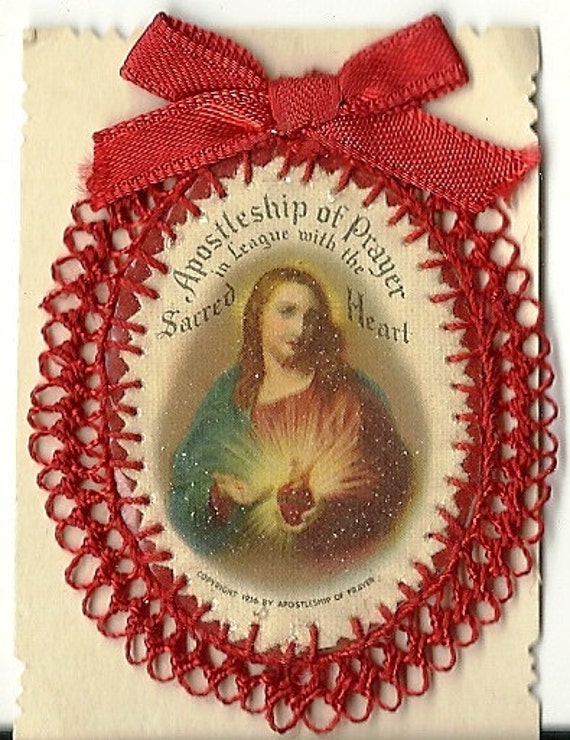
The Work Of The Apostleship Of Prayer In 1948


Some 60 Jesuit priests, summoned from every part of the world, have been in conference in Rome for a week, discussing the work of the Apostleship of Prayer, the League of the Sacred Heart. The meetings were presided over by the Father-General of the Society of Jesus, who is the Director of the Apostleship.  Among those present were an ex-inmate of Dachau concentration camp, Fr. Leo de Coninek, and Fr. P. Eugene Murphy, the originator of the famous Sacred Heart programme. the 143 minutes' religious feature on the American radio, now carried by 513 stations,. totalling 1.539 broadcasts per week. This programme can be heard on Vatican Radio every Friday at 7.15 (Summer 7 ime) on 31.06 and 19.87 metres wavelength. Also present were Fathers who have organised the Men's League of the Sacred Heart in Belgium, with remarkable success. The delegates and Fr. Leonard Boase, S.J., National Secretary of the Apostolate in England were received in audience by the Holy Father at Castelgandolfo, on Saturday, September 25.
Link (here)

Tuesday, June 18, 2013

The Guard Of Honor

"to find a way in which ordinary people could draw closer to Christ's Heart even while immersed in their
everday activities. She had the inspiration that each person, in whatever walk of life, could dedicate one hour to the Sacred Heart of Jesus each day while engaged in their regular duties.  In this way ordinary actions could be sanctified and a gift of love made to the Heart of Christ."

Link (here) to read more from Fr. James Kubicki, S.J.

Friday, October 12, 2012

Canonization Of Jesuit And His Devotion to The Sacred Heart Of Jesus

Later this month, Pope Benedict XVI is slated to canonize Father Jacques Berthieu, a French Jesuit who was martyred in Madagascar in 1896. Fr. Berthieu will be canonized alongside six other blesseds in an Oct. 21 ceremony on World Mission Sunday at the Vatican. The priest was born in 1838 and grew up with six siblings in a pious farming family in central France. He was ordained to the priesthood for Diocese of Saint-Flour in 1864. Fr. Berthieu then felt called to join the Society of Jesus, and did so in 1873. While in the novitiate, he became devoted to the Sacred Heart of Jesus, which had been popularized by the Jesuit St. Claude de la Colombiere. Before finishing his novitiate, he was assigned to the missions in Madagascar in 1875. In a letter to a friend dated July 28, 1875, he wrote that “I have been designated as a future apostle to the Malagasy (Madagascar)...probably to never return, which is fine with me.” The French priest became a highly successful missionary, nearly tripling the number of mission stations on the north of the island.
Link (here) to EWTN to read the full piece.


Friday, June 29, 2012

Friends

Gerbrand van den Eeckhout's The Last Supper
At the Last Supper, according to the Gospel of John, Jesus said: "I no longer call you slaves, because a slave does not know what his master is doing. I have called you friends, because I have told you everything I have heard from my Father" (John 15: 15). Friends are not under obligation to begin or to continue a friendship. 
Friends freely choose one another. And they like one another. Have you ever thought of God liking you? Friends like to spend time together; they enjoy one another's company. They share the same interests. Jesus, who has a human and divine heart, chooses you, likes you, enjoys you, and shares your interests and concerns. Yet friendship must be mutual. Jesus calls us friends because he likes us. What about us? How do we respond? Do we accept his friendship or reject it? Do we like him? We would not be here at the All-Night Vigil if we rejected his friendship, yet we do encounter obstacles to our friendship. At times we do not enjoy Jesus' company. We don't share his interests, desires, and concerns the way friends do. This is what we call "sin." 
But there is another, more subtle obstacle to our friendship with Jesus. Fear. Friends don't fear one another. Jesus became human and revealed his Sacred Heart to us in order to cast out fear. It's as though he said: "See my Heart. It's out there, visible and vulnerable. It's open to you. It's on fire, not cold and apathetic. It's wounded for you." Before calling his apostles (and us) "friends" at the Last Supper, Jesus said: "No one has greater love than this, to lay down one's life for one's friends"
Link (here) to the Apostleship of Prayer's Fr. James Kubicki, S.J. 

Friday, June 15, 2012

Cor Tuum Afficitur


A partial indulgence is granted to those who recite this prayer. A plenary indulgence is granted if it is publicly recited on the feast of the Most Sacred Heart of Jesus. This prayer was prescribed to be recited on this feast by Pope Pius XI .

IESU dulcissime, cuius effusa in homines caritas, tanta oblivione, negligentia, contemptione, ingratissime rependitur, en nos, ante altaria tua provoluti, tam nefariam hominum socordiam iniuriasque, quibus undique amantissimum Cor tuum afficitur, peculiari honore resarcire contendimus. MOST sweet Jesus, whose overflowing charity for men is requited by so much forgetfulness, negligence and contempt, behold us prostrate before Thee, eager to repair by a special act of homage the cruel indifference and injuries to which Thy loving Heart is everywhere subject.
Attamen, memores tantae nos quoque indignitatis non expertes aliquando fuisse, indeque vehementissimo dolore commoti, tuam in primis misericordiam nobis imploramus, paratis, voluntaria expiatione compensare flagitia non modo quae ipsi patravimus, sed etiam illorum, qui, longe a salutis via aberrantes, vel te pastorem ducemque sectari detrectant, in sua infidelitate obstinati, vel baptismatis promissa conculcantes, suavissimum tuae legis iugum excusserunt. Mindful, alas! that we ourselves have had a share in such great indignities, which we now deplore from the depths of our hearts, we humbly ask Thy pardon and declare our readiness to atone by voluntary expiation, not only for our own personal offenses, but also for the sins of those, who, straying far from the path of salvation, refuse in their obstinate infidelity to follow Thee, their Shepherd and Leader, or, renouncing the promises of their baptism, have cast off the sweet yoke of Thy law.
Quae deploranda crimina, cum universa expiare contendimus, tum nobis singula resarcienda proponimus: vitae cultusque immodestiam atque turpitudines, tot corruptelae pedicas innocentium animis instructas, dies festos violatos, exsecranda in te tuosque Sanctos iactata maledicta atque in tuum Vicarium ordinemque sacerdotalem convicia irrogata, ipsum denique amoris divini Sacramentum, vel neglectum vel horrendis sacrilegiis profanatum, publica postremo nationum delicta, quae Ecclesiae a te institutae iuribus magisterioque reluctantur. We are now resolved to expiate each and every deplorable outrage committed against Thee; we are now determined to make amends for the manifold offenses against Christian modesty in unbecoming dress and behavior, for all the foul seductions laid to ensnare the feet of the innocent, for the frequent violations of Sundays and holydays, and the shocking blasphemies uttered against Thee and Thy Saints. We wish also to make amends for the insults to which Thy Vicar on earth and Thy priests are subjected, for the profanation, by conscious neglect or terrible acts of sacrilege, of the very crimes of nations who resist the rights and teaching authority of the Church which Thou hast founded.
Quae utinam crimina sanguine ipsi nostro eluere possemus! Interea ad violatum divinum honorem resarciendum, quam Tu olim Patri in Cruce satisfactionem obtulisti quamque quotidie in altaribus renovare pergis, hanc eandem nos tibi praestamus, cum Virginis Matris, omnium Sanctorum, piorum quoque fidelium expiationibus coniunctam, ex animo spondentes, cum praeterita nostra aliorumque peccata ac tanti amoris incuriam firma fide, candidis vitae moribus, perfecta legis evangelicae, caritatis potissimum, observantia, quantum in nobis erit, gratia tua favente, nos esse compensaturos, tum iniurias tibi inferendas pro viribus prohibituros, et quam plurimos potuerimus ad tui sequelam convocaturos. Would that we were able to wash away such abominations with our blood. We now offer, in reparation for these violations of Thy divine honor, the satisfaction Thou once made to Thy Eternal Father on the cross and which Thou continuest to renew daily on our altars; we offer it in union with the acts of atonement of Thy Virgin Mother and all the Saints and of the pious faithful on earth; and we sincerely promise to make recompense, as far as we can with the help of Thy grace, for all neglect of Thy great love and for the sins we and others have committed in the past. Henceforth, we will live a life of unswerving faith, of purity of conduct, of perfect observance of the precepts of the Gospel and especially that of charity. We promise to the best of our power to prevent others from offending Thee and to bring as many as possible to follow Thee.
Excipias, quaesumus, benignissime Iesu, beata Virgine Maria Reparatrice intercedente, voluntarium huius expiationis obsequium nosque in officio tuique servito fidissimos ad mortem usque velis, magno illo perseverantiae munere, continere, ut ad illam tandem patriam perveniamus omnes, ubi Tu cum Patre et Spiritu Sancto vivis et regnas in saecula saeculorum. Amen. O loving Jesus, through the intercession of the Blessed Virgin Mother, our model in reparation, deign to receive the voluntary offering we make of this act of expiation; and by the crowning gift of perseverance keep us faithful unto death in our duty and the allegiance we owe to Thee, so that we may all one day come to that happy home, where with the Father and the Holy Spirit Thou livest and reignest, God, forever and ever. Amen.


Link (here)
HT to Fr. Z (here)

Miseries Of Our Neighbors


“Let us seek to make our life the life of the Eucharistic Heart of Jesus, well convinced that we must fill our hearts with the spirit of faith and charity if we want to do good to our souls, to alleviate the grave needs that surround us, and to relieve the many corporal and spiritual miseries of our neighbors”
Link (here) to read more from Fr. James Kubicki, S.J.

Unconditional

Sacred Heart of Jesus. CHARLES CHAMBERS
The love of Christ is unconditional. Jesus loves us just as we are, but he loves us too much to leave us that way. We need discipline and perseverance and training in holiness if we are to climb the mountain to heaven. Going where we want for church because it suits us and makes us feel good is counter productive. This doesn’t mean we must endure the worst church in the world simply because it will teach us patience and fortitude. However, we are called to be patient and strong when things do not always go our way.
The love of God is sweet and tender, but it is also astringent and tough. We have to be sweet and salty at the same time. We have to be flexible but not brittle.
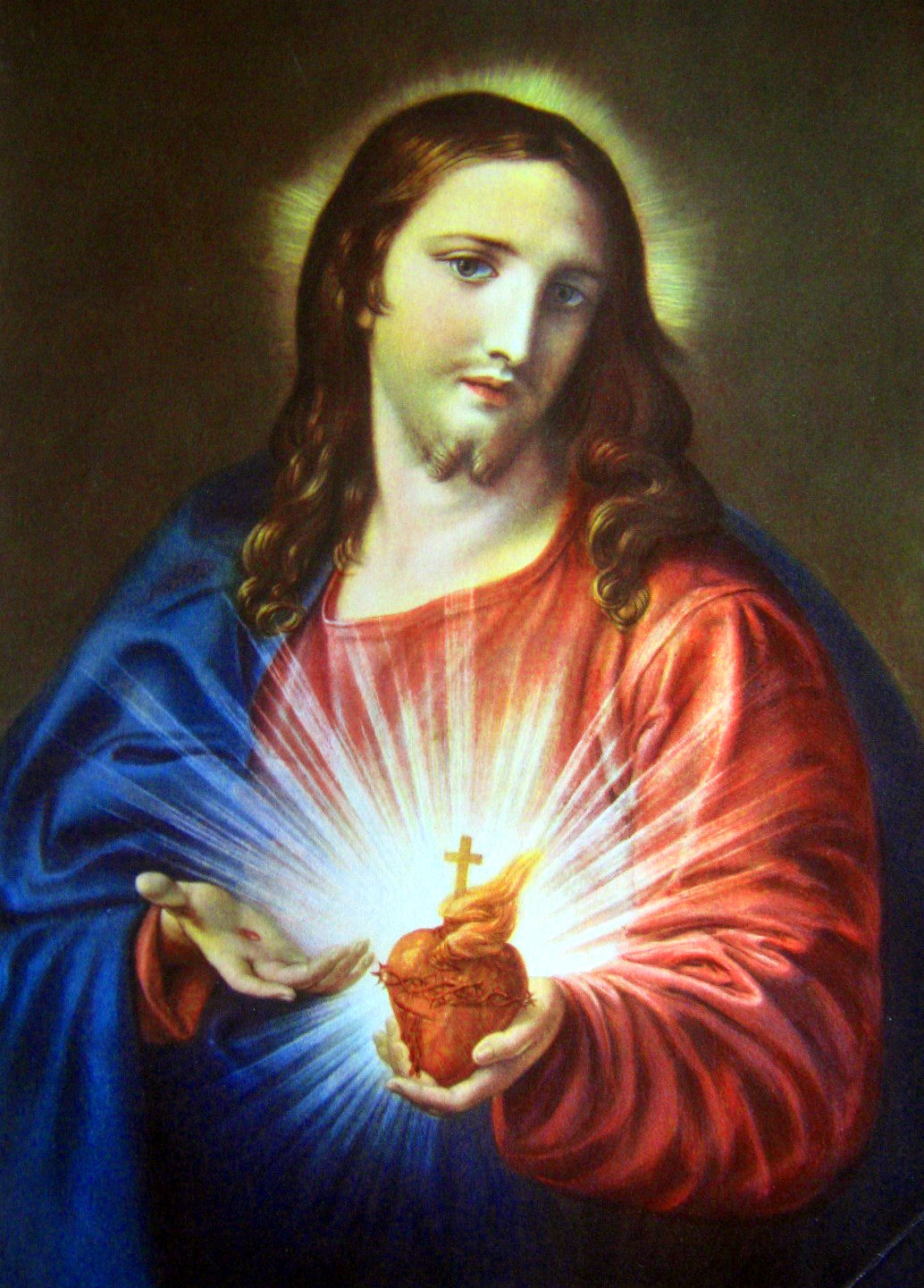
The qualities we need are pictured in the sacred heart of Jesus. Meditate on the image for a moment. The heart is exposed so we must be vulnerable. The heart is red and warm so we must be passionate, but the heart is also entwined with thorns–which means we must endure the crown of thorns and gather up our suffering and the suffering of the whole world into this sacred heart. It is also a heart that is on fire–a fire that warms and inspires, but also a fire that purifies and burns away all that is wood, hay and stubble–all the worthless trash in our lives.
Link (here) to Fr. Dwight Longnecker's Standing on My Head

Sacred Heart And Batoni

Today is the Solemnity of the Most Sacred Heart of Jesus, so a very happy feast day to all readers! Last year I wrote on the importance that I attach to this feast, and how theologically rich I find it. Given that so many churches and schools are dedicated to the Sacred Heart, it is clear that historically devotion to the Sacred Heart has played a central role in Catholic life. Therefore, it seems to me, the more we can promote this devotion today, the more we promote the Church and its mission.One difficulty I do have with the Sacred Heart, though, is the iconography. Pompeo Batoni was the most wonderful painter, and famous for his portraits of various English grand tourists which are still to be found in most art galleries in the western world. But he was also responsible for the picture of the Sacred Heart that hangs in the Church of the Gesù, in Rome. Naturally enough, it is this Sacred Heart that is Batoni’s most reproduced picture, which may have something to do with the Jesuit promotion of the devotion.
Link (here) to The Catholic Herald

Friday, March 30, 2012

St. Claude de la Colombiere's Prayer; "Trust In God"

Father De La Colombiere's Prayer
My Lord and my God, I know well that Thou watchest over those who centre their every hope in Thee, and that they can stand in need of nothing who look to Thee for their all. Wherefore am I resolved to live henceforth without dread, and to sink in Thy bosom all my cares and all my sorrows. Man may rise against me, sickness may rob me of strength and means to serve as I would wish, I may even forfeit Thy grace through sin ; but never shall I forego my trust in Thy mercy. I will cling to it with my life's last breath. The Evil One may endeavor in vain to wrest it from me ; but nothing shall avail to shake this my steadfast trust.
Let others look to creatures, to wealth and talent for happiness; let them rely on the guiltlessness of their lives, the rigor of their penance, the number of their good works, or the earnestness of their prayers ; for me, Lord, my trust is my very trust itself. That trust in Thee has never, nor will it ever, deceive a soul.. I am therefore assured that I shall enjoy eternal happiness, since I so steadfastly hope for it, and since I look to Thee for it, my God.
I am aware, and but too well aware, alas ! how weak and fickle I am ; I well know that temptation miy wreck the most sturdy virtue ; I have seen the stars of the heavens fall and the pillars of the firmament shaken ; but all that dismays me not, when Thou, my God, art with me; and with me wilt Thou ever abide as long as I shall hope in Thee. In Thee shall I fend shelter from every ill, nay, more, I am assured always to hope, since I hop e even for this ever-enduring hope.
In fine, O my God, I am sure I cannot hope too much in Thee, nor receive less from Thee than that for which I hope. And so I hope;that Thou wilt be my stay in the steepest pathways, that Thou wilt ward off from me the most dangerous thrusts, that Thou wilt so nerve my weakness that it triumph over my most redoubtable foes.
I hope, yes, I am certain, that Thou wilt ever love me. I hope also to love Thee with an undivided and a boundless love. And that my love, by one effort, may reach the supreme degree, I hope, O my God, for Thy very self and from Thyself alone.
I hope that after having loved, served and adored Thee while time lasts, I shall have the happiness of seeing and enjoying Thee throughout all eternity.
Link (here)

Wednesday, March 28, 2012

"Sacred Heart Of Jesus, I Give My Life To You."

Admiral Jeremiah Denton blinking in Morse Code "torture"
Admiral Jeremiah Denton knew the one he served and the one he served did not let him down. He served the Sacred Heart of Jesus. You can see a video of him that is in the national archives. Just click on "Contents" and scroll down to the last entry under "Scenes from Hell." He was shot down over North Vietnam on July 18, 1965 and wasn't released until February 17, 1973. Of his almost eight years in prison, he spent four of them in solitary confinement. The video shows him being interviewed by a reporter in North Vietnam. All during the interview he blinked his eyes in a way that seemed strange to those who later saw the footage. His blinks were Morse Code and spelled out the word "torture."

How did Admiral Denton survive? Fr. Jim Willig, in his book about his struggle with cancer, "Lessons from the School of Suffering," quoted Admiral Denton :
When I was in prison in Vietnam in solitary confinement, my captor would continually torture me. One day I was tied to a rack. A young soldier was ordered to torture me and break me. During this torture, when I honestly felt I was at my breaking point, a beautiful prayer came instantly to my mind, even though I wasn't praying. The prayer was "Sacred Heart of Jesus, I give my life to you." So, I prayed that prayer over and over again. The more I prayed it, the more I felt I truly was giving my life to the Lord. Then this peace came over me like a warm blanket, and I no longer felt pain--only peace. The soldier torturing me saw this transformation in my face and stopped his torture. He went to his commanding officer and said, "I'm sorry. I can't do this." And they let me go back to my cell. From that day on, I continued to use that prayer of peace, "Sacred Heart of Jesus, I give my life to you."

I talked with Admiral Denton about this and he said that what struck him as unusual is that he had learned prayers to the Sacred Heart as a child and they all used the word "thee," but the prayer that came to his mind out of the blue used the more familiar "you."

Admiral Denton gave his life to the Sacred Heart who did not let him down. Now we will declare whom we will serve. We will give our lives, our love, our all to the Sacred Heart of Jesus who gave His life, His love, His all to us. We will consecrate ourselves to both the Sacred Heart of Jesus and the Immaculate Heart of Mary because these two Hearts beat as one for the salvation of everyone. We want our hearts to beat as one with their Hearts.
Link (here) to the full post by Fr. James Kubicki, S.J. his blog is entitled Offer It Up!
Blogger Note: Admiral Denton attended the Jesuit's Spring Hill College in Alabama

Wednesday, March 21, 2012

Jesuit On The Wafer War

Barbara Johnson
Barbara Johnson parents were aging and were connected to an unfamiliar church, one they were too infirm to even visit. Johnson and her three siblings, spread around the region, didn’t know the parish, its culture or its members. Nor did they know its pastor, the Rev. Thomas LaHood, who last month in a church bulletin compared gay marriage to slavery. What’s next for Fr. Marcel Guarnizo is unclear. In his statement, he questioned the Washington archdiocese’s handling of the case and its allegations of his intimidation. 
Some Catholic commentators noted how unusual it is for a priest to publicly contradict and criticize his superiors. Doctrine dictates that priests are to be submissive to their bishops. “If I was Cardinal Wuerl, I’d buy him a one-way ticket to Moscow,” said the Rev. Thomas Reese, a Washington Jesuit and former editor of the prominent liberal Catholic magazine America. “These days, arch-conservative priests feel much more comfortable attacking their bishops than do liberals because they feel they’ll get support from conservative Catholic blogs and maybe some in the Vatican.” 
While Guarnizo has been fiercely attacked by liberal Catholics and non-Catholics, conservative Catholics have rushed to defend his decision to deny Johnson Communion. That Johnson ultimately received the sacrament from a lay minister that day hardly seems to matter at this point.

Wednesday, November 30, 2011

The Catholic "Counter-Revolution." The Sacred Heart

Jean Cottereau, nicknamed Jean Chouan
The War of the Vendee brings to the screen the powerful and largely unknown story of the valiant, six-year struggle of the people called the War in the Vendée ( Guerre de Vendée ) in a small section of western France to restore their Holy Religion and their King". 
In 1793, after enduring three and a half years of mounting persecution of the Church by the architects of the French Revolution, a small band of faithful peasants and nobles began a Catholic "counter-revolution." 
Steeped in the influence of St. Louis de Montfort, and wearing their rosaries and emblems of the Sacred Heart, their sacrifices resulted in countless martyrdoms — and ultimately won the restoration of religious freedom for all of France.

Wednesday, July 27, 2011

"The Heart of Jesus is both passionate and wounded. 
The passion of Jesus for us led to His Passion."
Link (here) to the full post on the Sacred Heart of Jesus 
by Fr. James Kubicki, S.J.

Tuesday, July 12, 2011

"Soul Of My Saviour"

There are many great hymns written in honour of the Sacred Heart . Among them a tune by the Jesuit William Maher, who also gave us the tune of 'Soul of my Saviour'. The words are a translation of a German original says Monsignor Philip Whitmore , an expression of the international flavour of this devotion .Monsignor Whitmore also explains how these hymns make a strong appeal to our emotions : "....We pray to the Heart of Jesus to touch our cold, ungrateful hearts , and to set them aflame with love for Our Saviour. "  
Listen to this programme produced by Veronica Scarisbrick (here) at Vatican Radio

Monday, June 6, 2011

Colombiere On Confidence In God

Men may deprive me of worldly goods and of honors; sickness may take from me my strength and the means of serving Thee; I may even lose Thy grace by sin: but my trust shall never leave me; I will preserve it to the last moment of my life, and the powers of hell shall seek in vain to wrest it from me. "In peace in the self -same I will sleep and I will rest." 
Link (here) to the full text of the prayer by Saint Claude de la Colombiere, S.J.

Sunday, May 8, 2011

Fr. Joseph Dias, S.J. On Baptismal Names

Fr. Joseph Dias, S.J.
A Jesuit priest in Mumbai is campaigning for children to be baptized with traditional Christian names to maintain their identity. Father Joseph Dias claims his campaign has received support from Pope Benedict XVI. “The pope recently warned parents against giving children celebrity-inspired names and urged them to turn to the Bible for inspiration instead,” he said today. 
Father Dias quoted the pope as saying in a recent homily that “every baptized child acquires the character of the Son of God, beginning with their Christian name, an unmistakable sign that the Holy Spirit causes man to be born anew in the womb of the Church. A name is an indelible seal that sets children off on a lifelong journey of religious faith.” 
The baptismal name should give a person a Catholic identity and it can be a powerful motivating factor, giving a “purpose and direction” to his or her life, he said. Father Dias said he has been counseling parents to give meaningful Christian names instead of naming their children after perfumes, Russian ballerinas, pop stars and regions. “Children are not merchandise or commodities or places,” said the priest, who is the assistant director of REAP (Reach Education Action Program, which aims to empower slum children and women through education), a Jesuit initiative in Mumbai. The priest said he was surprised to come across children named Aspirin, John Kennedy, Prince Albert, Ben-Hur, Brooklyn, Diana, Adelaide  and Diamond.
Link (here) to the full article UCANEWS

Wednesday, February 23, 2011

Blessed Bernardo Francisco De Hoyos, S.J. And "The Great Promise" Of The Sacred Heart

Blessed Bernardo Francisco De Hoyos, S.J.
In September 1731 Bernardo was sent to the College of St Ambrose in Valladolid to begin his course in theology. Soon after his arrival he visited the chapel. At the end of April 1733, Bernardo received a letter from his friend, Fr Augustine Cadaveraz in Bilbao, requesting him to translate from Latin the chapter relating the institution of the feast of Corpus Christi in Fr Joseph de Gallifet’s book On Devotion to the Sacred Heart of Jesus (1726).3 On 3 May, Bernardo took the book from the house library to his room and immediately began to read it. It threw open to Bernardo, for the first time, the unexplored vistas of the Sacred Heart. For all his earlier visions of the Sacred Heart, it was only now that he became completely aware of the Divine Heart. He felt so enthused that he knelt before the Blessed Sacrament and offered to work at diffusing this devotion. For two days, the idea that this offering was more binding than he had first thought grew and grew. The third day, again before the Blessed Sacrament, the Saviour confided that He had picked him to spread devotion to His Sacred Heart.
On 4 May 1733 Bernardo received this decisive mission from Jesus: “I wish for you to spread the Devotion to My Sacred Heart throughout all of Spain.” From then on, Bernardo did not live for anything else. On 14 May he obtained what is known as the “Great Promise” from the Sacred Heart of Jesus: “This will always be my place of rest. I will make my home here – the place where I have desired and chosen to be. I will reign in Spain with more veneration than in other places.” 
Bernardo connsecrated himself to the Sacred Heart of Jesus on 12 June 1733, using the same formula written by St Claude La Columbière fifty years earlier. The College of St Ambrose, now a Basilica was established as the National Shrine of the Great Promise in 1941.
“Bernardo was the first among Spanish Jesuits to grasp intuitively the transcendent nature of the cult of the Sacred Heart as means of personal sanctification and effective apostolic tool. For him the cult of the Sacred Heart is in substance the cult of the love of Jesus, Incarnate Word, Redeemer, which reveals in itself the love of the Most Holy Trinity loving us with a heart of flesh in virtue of the hypostatic union, and presenting the heart as a symbol of this love to animate us to imitate him and love him in return.” 
On the occasion of the beatification, Fr Adolfo Nicolás, Superior General of the Society of Jesus noted: "Bernardo de Hoyos's passion for the Heart of Jesus faithfully corresponds to the devotion that St Ignatius felt for Jesus poor and humble, before whom he asks that our affections be moved in order to accompany Him in each step of His life: ‘As companions with him on mission, his way is our way, so that in what we do in the world there must always be a transparency to God’ (GC35, D2, nn 14, 10).” Bernardo’s last words before he died were: "Oh, how good it is to dwell in the Heart of Jesus!" 
Link (here) to the full biography of Blessed Bernardo Francisco De Hoya, S.J.

Saturday, February 19, 2011

As Old As The Belief In The Hypostatic Union


The special and formal devotion to the Heart of Jesus, which is now so popular in the Church, owes its origin to a French Visitation nun, St. Margaret Mary Alacoque, who lived in the latter part of the seventeenth century. Her biographers relate that our Lord Himself appeared to her and declared that this worship was most acceptable to Him; and her director, the famous Jesuit, Father Claude de la Colombiere, preached the devotion at the Court of St. James's, and zealously propagated it elsewhere. The most popular book in defence of the new devotion was that of Father Joseph de Gallifet, S. J., "De Cultu SS. Cordis Jesu in variis Christiani orbis partibus jam propagato." It was published with a dedication to Benedict XIII. and with the approval of Lambertini (afterwards Benedict XIV.); the French translation appeared in 1745, at Lyons. On February 6, 1765,1 Clement XIII. permitted several churches to celebrate the feast of the Sacred Heart, which was extended in 1866 to the whole Church. It is generally kept on the Friday (in the U. S. as other countries) after the Octave of Corpus Christi. In England, Italy, France, Netherlands, Germany, Spam and Portugal, indeed throughout the Catholic world, the devotion and the feast found a ready and enthusiastic acceptance. However, the worship of the Sacred Heart encountered keen opposition, particularly from the Jansemsts. They who practised it were nicknamed "Cardiol a tree" or "Cordicolse," and charged with Nestorianism, as if they worshipped a divided Christ, and gave to the created humanity of Christ worship which belonged to God alone. The Jansenist objections were censured as injurious to the Apostolic See—which had approved the devotion, and bestowed numerous indulgences in its favour—by Pius VI. in his condemnation of the Jansenist synod of Pistoia. This condemnation was issued in the bull "Auctorem fidei," bearing date August 28, 1794. A further approval of the devotion was The Congregation of Rites had refused to sanction the feast in 1697 and 1729.implied in the beatification of Margaret Mary Alacoque in 1864. The bull "Auctorem fidei" contains the following explanation of the principle on which the devotion rests, an explanation which is at once authoritative and clear. The faithful worship with supreme adoration the physical Heart of Christ, considered "not as mere flesh, but as united to the Divinity." They adore it as "the Heart of the Person of the Word to which it is inseparably united." It is of course absurd to speak of this principle as novel; it is as old as the belief in the hypostatic union, and it was solemnly defined in 431 at the Council of Ephesus. 
All the members of Christ united to the rest of His sacred humanity and to the eternal Word are the object of divine worship. If it be asked further, why the heart is selected as the object of special adoration, the answer is, that the real and physical heart is a natural symbol of Christ's exceeding charity, and of his interior life. 
Just as the Church in the middle age3 turned with singular devotion to the Five Wounds as the symbol of Christ's Passion, so in these later days she bids us have recourse to his Sacred Heart, mindful of the love wherewith he loved us "even to the end." Nothing could be made of the fact, if it were a fact, that the devotion actually began with Blessed Margaret Mary, for though the doctrine of the Church cannot change, she may, and does from time to time, introduce new forms of devotion. But the special devotion to the Heart of our Saviour is as old at least as the twelfth century, while early in the sixteenth the Carthusian Lansperg recommended pious Christians to assist their devotion by using a figure of the Sacred Heart.
Link (here) the Catholic Dictionary
Go (here) to the Protestant Dictionary view of the Sacred Heart of Jesus

Wednesday, October 6, 2010

Devotion Of The Shepards

O Most Holy Heart of Jesus, I cannot love you as the Blessed Mother loved you. I feel bad about it. I would like to love you, as the chaste Joseph did. 
At least, O Lord, make me love you with simplicity and affection equal to that of the devout shepherds. How happy will I be when I will really begin to love you! 
How fortunate I will be when, enkindling my accent, I will be able to applaud around you with the choirs of angels, saying: “Glory to God in the highest, and peace on earth to men of good will!”
.
Link (here) to the full post dedicated to the memory of Blessed Louis Guanella by Fr. James Kubicki, S.J. his blog is entitled Offer It Up.

Wednesday, September 22, 2010

The Message

I'm giving a weeklong retreat to thirteen of the Sisters. It's a retreat I haven't given in a few years and it's based on the 33 invocations in the Litany of the Sacred Heart. On almost every Sunday at noon the Pope, wherever he is--at home in St. Peter's Square or at his summer home at Castel Gandalfo or on the road somewhere--prays the Angelus with the faithful. But before doing so, he gives a little message. At various times from 1985 to 1989, Pope John Paul spoke about the invocations of the Sacred Heart Litany. His Angelus Message on Sunday, July 1, 1984 was entitled "In the Heart of Christ there is a synthesis of all the mysteries of our faith." And in his Angelus Message of June 27, 1982 he said: "This prayer, recited and meditated, becomes a true school of the interior life, the school of the Christian." 
Link (here) to the blog entitled, Offer It Up by Fr. James Kubiki, S.J.