Showing posts with label Jesuits and the Arts. Show all posts
Showing posts with label Jesuits and the Arts. Show all posts
Monday, June 24, 2013


Thursday, January 17, 2013
Fr Saju George Moolamthuruthil S.J. preforms the Hindu dance Bharatanatyam in a German Catholic church, watch the video (here) at Catholic Church Conservation
Thursday, November 15, 2012
From The Chapel Of The Jesuit Infirmary In Rome

A mosaic of Mary and Joseph presenting the child Jesus to Simeon decorates the chapel of the Jesuit infirmary in Rome June 8. The Vatican's Congregation for Divine Worship and the Sacraments is establishing an office to promote the development and use
of appropriate liturgical art, architecture and music.
Link (here) to the Catholic Register
Link (here) to the Catholic Register
Sunday, July 22, 2012
Peace Jesuit Anarchist Sub Base Comic

Poor Richard's Mammoth Sunflower Practical Growing Guide
For Jesuit Priests, Catholic Nuns and other Anarchist Infiltrator Peace Activists (of TERROR!)
Link (here) to the original website mocking Jesuit Fathers Kelly and Bischel
Tuesday, July 10, 2012
Katie Holmes Registers As A Parishoner At A Jesuit Parish In New York City
 |
| Katie Holmes with daughter Suri |
Five years after revealing that she had started to study Scientology,
Katie Holmes has officially returned to the Catholic faith, registering
as a parishioner at the Church of St. Francis Xavier in New York City. “Everyone is thrilled to have Katie join us,” a member of the church's
choir told me. “She has not yet attended a service, but when she does
she will be welcomed with open arms.” The church, located on 16th Street between Fifth and Sixth Avenues, is
known for inclusive thinking and its welcoming of many gay and lesbian
Catholics. Its mission statement indicates that the Roman Catholic
Church parish “strives to be a prophetic, welcoming community, inclusive
witness to the presence of Christ Jesus in our midst.” Its website
proclaims that it is a respectful community, “where seekers and their
questions are welcomed, where injustice is challenged, where the poor,
the alienated and marginalized find a home, and where people are
refreshed, reconciled and renewed.” Cruise and Holmes just issued a joint statement saying, "We want to keep
matters affecting our family private and express our respect for each
other's commitment to each of our respective beliefs and support each
other's roles as parents." The New York parish is no stranger to celebrity faces: Nancy Pelosi was
seen worshipping there while serving as speaker of the U.S. House of
Representatives
Link (here) to the Huffington Post
Tuesday, July 3, 2012
There Is No School Like The Old School
 |
| Fr. William O'Malley, S.J. |
Heads were spinning at Fordham Prep after a gruff but beloved teacher
— known to horror fans for his role in the film “The Exorcist” — was
cast out. Administrators exorcised themselves of Father William
O’Malley, a theology teacher at the Jesuit high school for the past 20
years, because they felt his old-school style was out of date. “Father
O’Malley’s style was probably more abrasive than we are used to and
something we discussed with the principal over the years,” Father Kenneth Boller, president of Fordham Prep, told The Post. “He has a
somewhat confrontational style, and the times change and the [teaching]
styles change,” he said. “His effectiveness, in view of the principal,
has diminished. We thought it was time for him to end his career on an
up note after completing a successful year.” O’Malley, 80, played Father Joe Dyer in the 1973 demonic-possession horror flick. As an author, Father O'Malley has published 37 books, Choosing to Be Catholic, Why Be Catholic?, God: The Oldest Question, Meeting the Living God, Building Your Own Conscience, and The Fifth Week are among them. His book, Help My Unbelief, won a Catholic Book Award in 2009
Link (here) to the NY Post
Saturday, May 26, 2012
German Jesuit And Pigs
 |
| Schweine am Kreuz: Anzinger-Ausstellung |
Father Friedhelm Mennekes SJ, founder
and long-time director of the Art Station Sankt Peter has also commented
to the newspaper about the cancelling of the exhibition. He pointed
to the rich tradition of the crucifixion motif, to the derision that
Christianity once had suffered through the representation of a crucified
donkey, and also to the "Jewish pig" in Cologne Cathedral. All these
elements played into Anzingers work- he himself had exhibited a
butterfly crucified by Markus Lüpertz in St. Peter's. "I hope that the
cancellation was not a case of anticipatory obedience to ecclesiastical
authority," said Mennekes in conclusion. (Cathcon- no wonder the Jesuits
are the worst hit of the orders after the Council. They were set up
on army lines by St Ignatius with a specific oath of obedience to the
Pope. Now they are a bunch of ecclesiastical anarchists no longer of
capable of fighting) It is precisely this fear Guido Schlimbach tried to dispel when talking
to the "Kölner Stadt-Anzeiger" . The Art Station is after all not an
art hall, but a house of God: "We derive life from the whole life of the
community." A crucified pig in oil next to a crucifix is not easy in
this context - and as Anzinger totally refused to compromise, the
cancellation could not be avoided. "I'm sure," said Schlimbach,
"Mennekes would not have put on the exhibition." (Cathcon- see his
comments above which go in the opposite direction.)
Read the whole story at Catholic Church Conservation (here)
Friday, March 9, 2012
Leonard Bernstein's Jesuit Friends

Apparently Justice Department official Robert Mardian -- later of Watergate fame -- circulated a memo saying that Leonard Bernstein was being assisted in creating the piece by "show business personalities in New York and Los Angeles," and that "'Jesuit friends of the composer' are serving as advisors" -- among these, war protester Father Daniel Berrigan. And this, Mardian thought, might presage a clever anti-American PR coup: "One could surmise," wrote Mardian, that "Bernstein has requested Father Berrigan compose words for the 'Mass' in Latin and it would follow an anti-war theme." Thus Bernstein was suspected of trying to get "high-ranking Government officials" who "probably are not conversant in Latin" to applaud anti-war sentiments at the gala premiere. (So far as we can tell, the Latin bits in Mass are from the Catholic liturgy.)
Link (here) to the Village Voice.
Monday, February 6, 2012
"Young Jesuit" By Titian
 |
| Source of Picture |
This curious picture represents a boy in a dark silk dress, with one hand on his breast, and the other holding a glove and a couple of arrows. The head is raised, the eye turned towards heaven; and the impression created is that of a childish ecstasy, produced by causes to which the figure itself gives no clue.On close examination it appears that Very little of Titian's work, except some parts about the ear and cheek of the boy, has been preserved; a large piece has been added to the left side of the canvas, and the hand and arrows look like modern repaints. Some mysterious agency has thus apparently changed the original form of the piece. By a fortunate combination of circumstances the key to the mystery has been furnished in a curious and unforeseen manner. The "young Jesuit" of Vienna reappears without the arrows in a picture of the Berlin Museum, where he is seen standing at a table, on which some books are lying, and the cause of his ecstasy is explained by the attitude and gesture of a bearded man near him, who points with the fore finger of his right hand towards heaven.
Link (here) to Titian: His Life and Times
Blogger Note: Some source material states that the subject is St. Alouisus Gonzaga, S.J.
Monday, November 21, 2011
The Fake Jesuit
His name was Father Arthur Scott, he was dressed in the outfit of a Jesuit priest with a Society of Jesus lapel pin, and he bore a gift......Mark Augustus Landis had dressed as a Jesuit priest because he had been taught by one in London, and was amused by the reaction. “I’ve helped out a lot of people. They come up to me at airports and tell me of their problems. There’s not much to being a priest. Some comforting words, that sort of thing. And a blessing.”
Link (here) to read the fascinating article at FT by John Gapper
Sunday, September 25, 2011
Fordham During The Twenties
The Playshop at Fordham University
By Fr. Robert I. Gannon, S. J.
WHEN CELLINI wrote about himself, pride led him on; in the "Confessions" deep humility was St. Augustine's motive; sheer love of chatter gave Samuel Pepys; while old Ben Franklin seems to say in Poor Richard's Almanac, "Take heart! If a man like this can succeed, anybody can."
In jotting down these few words, at the editor's request, "The Playshop of Fordham University," our motive is ry like Benjamin Franklin's. Not that our success is a parable to his. We have, in fact, accomplished very ;le. Professor Baker, in his Harvard Workshop, need t look to us for rivalry. What has been done, however, s been so helpful, so pleasant and so easy that, like boys a new swimmin' hole, we are impelled by the most elentary good-fellowship to chant in a chorus to all pass-by, "Come on in; the water's fine!" ^mong the passers-by, I am sure, will be many men and men interested in Catholic colleges and academies where ire talent and opportunity for development can be found in in Fordham. If they will only reflect for the short K they are reading these words on the value of the work the student, to his college and to the Catholic Little eater of the future, they will lose no time in starting ocal Playshop of their own.
[f they do so, and then link practice with their theory, :y will be experimenting with nothing new in pedagogy, 'en Dickens' "Do-the-boys School" in that, at least, was reast of the times. "Spell horse!" said Squeers. "H-O-R-S-E." "Correct! Now go out and feed him." e Ratio Studiorhim, anticipating this Yorkshire master two or three centuries, said in effect, "What is a speech? bat is a poem? Now go home and write one!" It is ar, then, that when the freshmen took up the technique the one-act play in class, their Jesuit professor mur
mured almost unconsciously: "Now go home and write one!" He said it, however, only to a few.
He formed, in other words, what is known to the Ratio as an "Academy." Out of one hundred and sixty-five men, about fifteen were invited to organize themselves as a playwriting group, which in time out of class might meet for mutual suggestions and encouragement. The meetings were most informal. No lectures were given, smokes were passed about. Everyone had his say on every one else's work, and then the director always outlined the next step in the operations.
These steps were simple and obvious enough. After the analysis of standard one-act plays came a special study of Dialogue. It is amazing what difficulty some people find in reproducing perfectly normal, natural conversation, no dialect, no passion—just what he said and what she said. All this, however, was preliminary. Soon we were writing dialogues and monologues, dramatizing short stories, rewriting standard one-act plays after making essential changes—sketching scenarios and finally plunging into original one-act plays. .
In conjunction with all this we were fortunate in having an enthusiastic band of players, "The Mumes and Mummies," on whom we might experiment. They wer.e free— after producing "She Stoops to Conquer" in December, 1921—and, with time out for repetitions and examinations, worked with the Playshop until the end of the year. This means that every two weeks, behind closed doors, a monologue, a dialogue and a dramatized short story, coached by the students themselves, were offered for criticism. A sort of debate always followed, some confining their remarks to the writing, some to the acting; some encouraging those concerned, some expressing themselves quite frankly. The directors then endeavored to make a few suggestions and
the play was repeated with the necessary changes and modifications. There was nothing marvelous about the whole program, but it was interesting and helpful.
Now, those of a practical turn of mind may be interested in the mechanical and financial aspect of our meetings. They are held in the College Theater with its modern, roomy and well-equipped stage. This is quite accidental, however, as a barn or a garret would be quite sufficient for experimental work of this type. For scenery we have the usual stock sets with a variety of drops, but our joy and our comfort is the good old "cyk" or cyclorama of drapes which can be made to suggest everything because it doesn't look like anything. For costumes we "fake" what we can and rent the rest. The "make up" is smeared on by the ambitious director, with results that, if not always appropriate, are sure to be colorful. With these economies, the expenses for one night's work, including "hard" cakes and pop for the faithful stage crew, never come to as much as eight dollars, and are sometimes no higher than three.
The first green fruits of all this planting were seen on March 21, 1922. That evening, more to encourage ourselves than to astonish them, we came before the friends of the college in a Prize Play Contest. Six plays were offered-— all of them dramatized, short stories limited to twenty minutes each. The program was as follows:
"His Father" Godfrey Schmidt, '25
"The Masterpiece" Frank Walsh, "25
"Heat" James Cancagh, "25
"The Proposal" Gordon LasMude,'25
"Yellow" Paul Collins, 25
"The Ace of Spades" Edward Lyman, "25
Three invited judges passed on the merits of the plan and awarded the prize to James Cancagh, '25, for "Hea: This little tragedy, at the invitation of the managemeii was afterwards produced at one of the Keith theaters New York.
This year, 1922-23, we have welcomed upper-classnr, into the Playshop and, greatly encouraged, have set to work on original plays. Except for the time when all our energies were given to a production of Henry VIII we hare continued our regular private sessions, with more or Jess success. Ten plays of varying merit have been produced this season in the bosom of the family. None of the work can approach the best output of the Harvard workshopsome of it is very ordinary indeed—but the progress is unmistakable and the benefit to those who write and dire* the plays, as well as those who act in them, is as great as the pleasure they derive from their task.
Link (here)
Link (here)
Wednesday, July 13, 2011
Jesuits Find Michelangelo
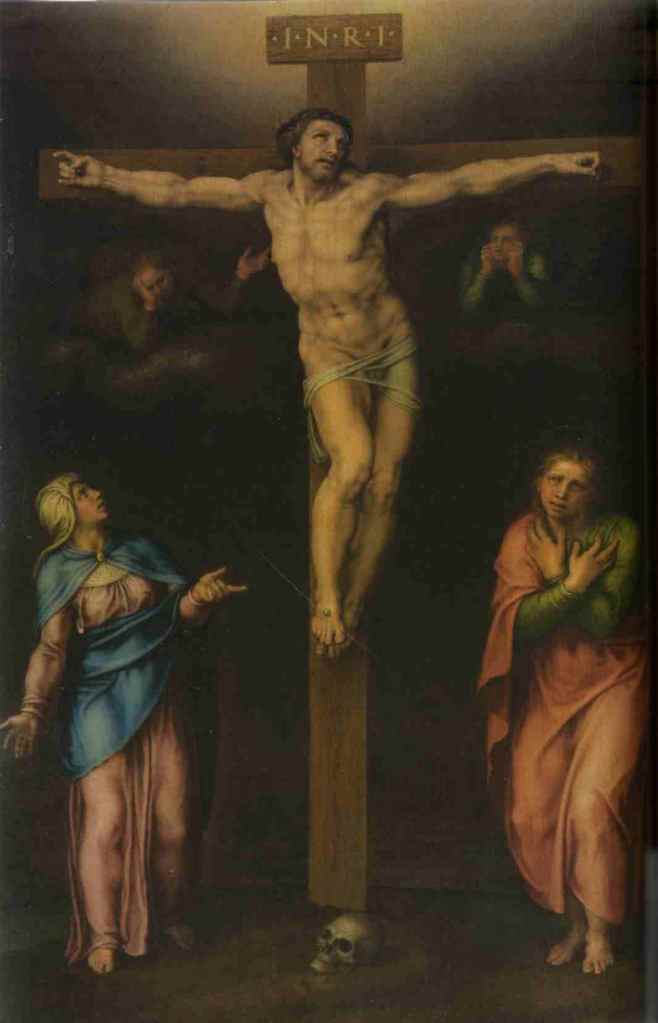
Infrared technology has revealed that the painting at Campion Hall, previously believed to have been the work of Michelangelo's lesser-known contemporary Marcello Venusti, was likely painted by Michelangelo himself, says Antonio Forcellino. The painting, bought at an auction in the 1930s, has been removed from the residence and sent to a museum for safekeeping."It's a very beautiful piece, but far too valuable to have on our wall any more," the master of Campion Hall tells the BBC. "Its value in the three years I've been master has gone up tenfold, even if it's not by Michelangelo. No doubt the art historians will argue the points to and fro."
Link (here)
Tuesday, May 10, 2011
The Jesuit Church Of Saint Paul Saint Louis In Paris France

Link (here) to the book Churches of Paris
Saturday, April 2, 2011
The Three Companions.

Link (here) to read the rest of the story at the Spokesman Review
Tuesday, March 15, 2011
42,000 Photos Taken By One Irish Jesuit
 |
| Fr. Francis Browne, S.J. |
The book, entitled Fr Browne Yeats features nearly 42,000 prints by Fr Francis Browne, S.J., a native of Sunday's Well in Cork City, from when he was just a seventeen-year-old photographer in 1897 to shortly before his death in 1960.Coupled with the poetry of WB Yeats, the book features the Fr Browne’s pictures of people, panoramic scenes, ships, trains and landscapes - all shot on his primitive Kodak Box Camera.
Link (here) to the full story at Clerical Whispers
Buy the book (here) at The Sacred Heart Messenger Publications
Buy the book (here) at The Sacred Heart Messenger Publications
Thursday, February 17, 2011
Fr. Saju George "The Dancing Jesuit"

A picture of Fr. Saju George, S.J.
however this 6 minute video is
....umh......well...
you decide (here)
Thursday, November 18, 2010
Forged Jesuit
 |
| The impostor Jesuit with one of his forgeries |
Link (here)
Friday, November 5, 2010
Jesuit Ballet
Debut author and former dancer Judith Rock’s 17th-century Paris mystery, The Rhetoric of Death, features Jesuit ballet; yes, you read that right. It’s the physicality, the “appearance is everything” nature of the period that captivated her.
Link (here) to the Library Journal
Wednesday, October 20, 2010
"Deceive The Eye"
..........space artificially expands thanks to an 18th-century trompe l'oeil mural using a European treatment of perspective introduced by Jesuit missionaries.
Link (here) to the Wall Street Journal
Link (here) to the Wall Street Journal
Thursday, July 22, 2010
The Art At Seattle University
 |
| St. Ignatius of Loyola Chapel - Seattle University |
As a relatively young city, Seattle doesn't have a large number of major art collections in public or private hands. Though our art benefactors have been generous and shown a fine eye for great art, Seattle can't stand up to the magnificent art collectors and collections in cities like San Francisco, New York, or even Los Angeles.
So local art lovers have to do a little more legwork to enjoy the pleasures of seeing art. One great source for viewing art is to take in the fine art collections in the corporate or organizational world. To take in one of these fine collections, start at Seattle University's central campus on Capitol Hill.
So local art lovers have to do a little more legwork to enjoy the pleasures of seeing art. One great source for viewing art is to take in the fine art collections in the corporate or organizational world. To take in one of these fine collections, start at Seattle University's central campus on Capitol Hill.
Link (here) to the Sun Break blog with lots of pictures of Seattle University art collection and new chapel.
Subscribe to:
Posts (Atom)