Showing posts with label Jesuits and Angels. Show all posts

Monday, May 12, 2014

The Dark Angel Worship Cancelled At Harvard

UPDATED: May 12, 2014, at 8:15 p.m.
The Harvard Extension School Cultural Studies Club has dropped its sponsorship of a re-enactment of a Satanic “black mass” ritual, which was scheduled to occur Monday evening at Cambridge Queen’s Head Pub. A spokesperson for the Satanic Temple, which was facilitating the black mass, said that the organization no longer plans to hold a black mass this evening.
The Harvard Extension School Cultural Studies Club originally said that it planned to relocate its reenactment of a Satanic black mass ritual, scheduled for Monday night, to an off-campus site, citing in an email that “misinterpretations about the nature of the event were harming perceptions about Harvard and adversely impacting the student community.”
The club wrote in its email around 5 p.m. that they planned for the event to be held at The Middle East nightclub in Central Square at 9 p.m. But Clay S. Fernald, the general manager of The Middle East, said Monday evening that the nightclub will not host the event, and that negotiations with the Harvard Extension Cultural Studies Club had fallen through.
Link (here) to The Crimson 
St. Ignatius of Loyola and the Discernment of Spirits (here)

A Jesuit Professor At Harvard On The Black Mass At Harvard

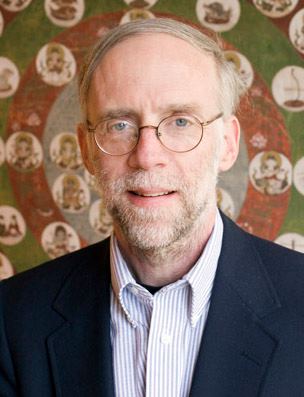
Fr. Francis Xavier Clooney, S.J.
I am the Parkman Professor of Divinity at Harvard Divinity School, Director of the Center for the Study of World Religions, and a Roman Catholic priest. On all three counts, I am concerned about the plan for a black mass hosted by the Harvard Extension Cultural Studies Club on Monday, May 12. The club explains: “Our purpose is not to denigrate any religion or faith, which would be repugnant to our educational purposes, but instead to learn and experience the history of different cultural practices. This performance is part of a larger effort to explore religious facets that continue to influence contemporary culture.”
If only the organizers had said more on which “religious facets that continue to influence contemporary culture” are highlighted in the performance of a black mass. This is, after all, a practice that, as far as its murky history reveals, seems often to have included the inversion and blaspheming of Catholic sacramental practice, as well as actual worship of Satan. 
Will these dimensions be present in Monday’s enactment? And what’s next? The endeavor “to learn and experience the history of different cultural practices” might in another year lead to historical reenactments of anti-Semitic or racist ceremonies familiar from Western history or parodies that trivialize Native American heritage or other revivals of cultural and religious insult. Such events would surely raise legitimate concerns among all of us at Harvard; no one should be surprised if Catholics are concerned right now.
Link (here) to the full article Fr. Francis Xavier Clooney, S.J.

Monday, March 10, 2014

Cardinal Jean Guenolé Marie Daniélou, S.J. On The Angels Of Earth And The Angels Of Heaven

Saint Trophim at Arles
St. Ephrem sees the angels, "taking up the soul (after it has left the body) and carrying it through the upper  air." This belief is responsible for the numerous representations of angels on the funeral monuments. These continue up to the Middle Ages. The front gate of Saint-Trophime at Arles pictures a soul being carried by an angel into the bosom of Abraham. In the dialogues of St. Gregory the Great, so filled with allusions to the invisible world, the angels often come to serve the saints at the hour of their death. The witnesses who were assisting at the death of the pious Stephan saw the angel 
"without being able to express what they had seen because they were so struck with fear." 
The death of the saints appears as a mystery full of sacred terror. The hymns of the angels fill the soul with so divine a joy that does not notice the sufferings of death. And during its voyage toward heaven, the angels scatter the demons who try to bar the soul's advance. Secondly, the angels of heaven, the guardians of Paradise, are asked to permit the soul to enter there. Here once again we find that there are two groups, the angels of earth and the angels of heaven. Just as the liturgy invokes the angels who lead the soul into Paradise, it also contains allusions to those who welcome the soul there. The Apostalic Constitutions contain a prayer for the dead which is drawn up in this manner: 
"Cast thine eyes upon this servant. Forgive him if he has sinned and make the angels well-disposed toward him." 
St. Ephrem pictures the confusion of a man confronted by heavenly powers, "when the armies of the lord show themselves and when the divine commanders bid him leave the bodies behind. he shakes, he trembles at the unaccustomed sight of these figures, these choirs which he has never seen before. All of us, trembling, say to each other: 'Pray that your soul leave your body in peace. Pray that it find the angels well-disposed.'" This is an echo of the the liturgical prayer of the Constitutions. Gregory of Nyssa insists on this point to demonstrate the necessity of Baptism: 
"I do not know whether, once it has left the body, the angels will receive the soul which has not been illuminated and adorned with grace of regeneration. For how could they, if it does not bear the seal and has no sign of its quality? Probably it is borne upon the air, wandering and vagabond." 
This twofold aspect of the relation between death and the angels is expressed in the prayer which an early apocryphal writer puts into the mouth of Saint Joseph at his death: "But now O my Lord, let your holy angel keep close to my soul and my body until they separate from each other without pain. Do not permit that the angel who was attached to me since the day you formed me up to now should turn toward me, his countenance smouldering with anger, when we are on our way along the round that leads to you. Do not allow my soul to be stopped by the keepers of the gate and do not put me to shame before your fearful tribunal. Do not loose against me the floods of the river of fire in which all souls are purified before they see the glory of your divinity, O God, You who judge each one in truth and justice."

Sunday, March 9, 2014

Pope Francis On The Duel Between Jesus And Satan

Francis spoke of the Gospel of the first Sunday of Lent, which every year presents the story of Jesus'  temptation in the desert, when the Holy Spirit descended upon Him after His baptism in the Jordan, urging Him to openly confront Satan in the wilderness for forty days, before beginning His public ministry:
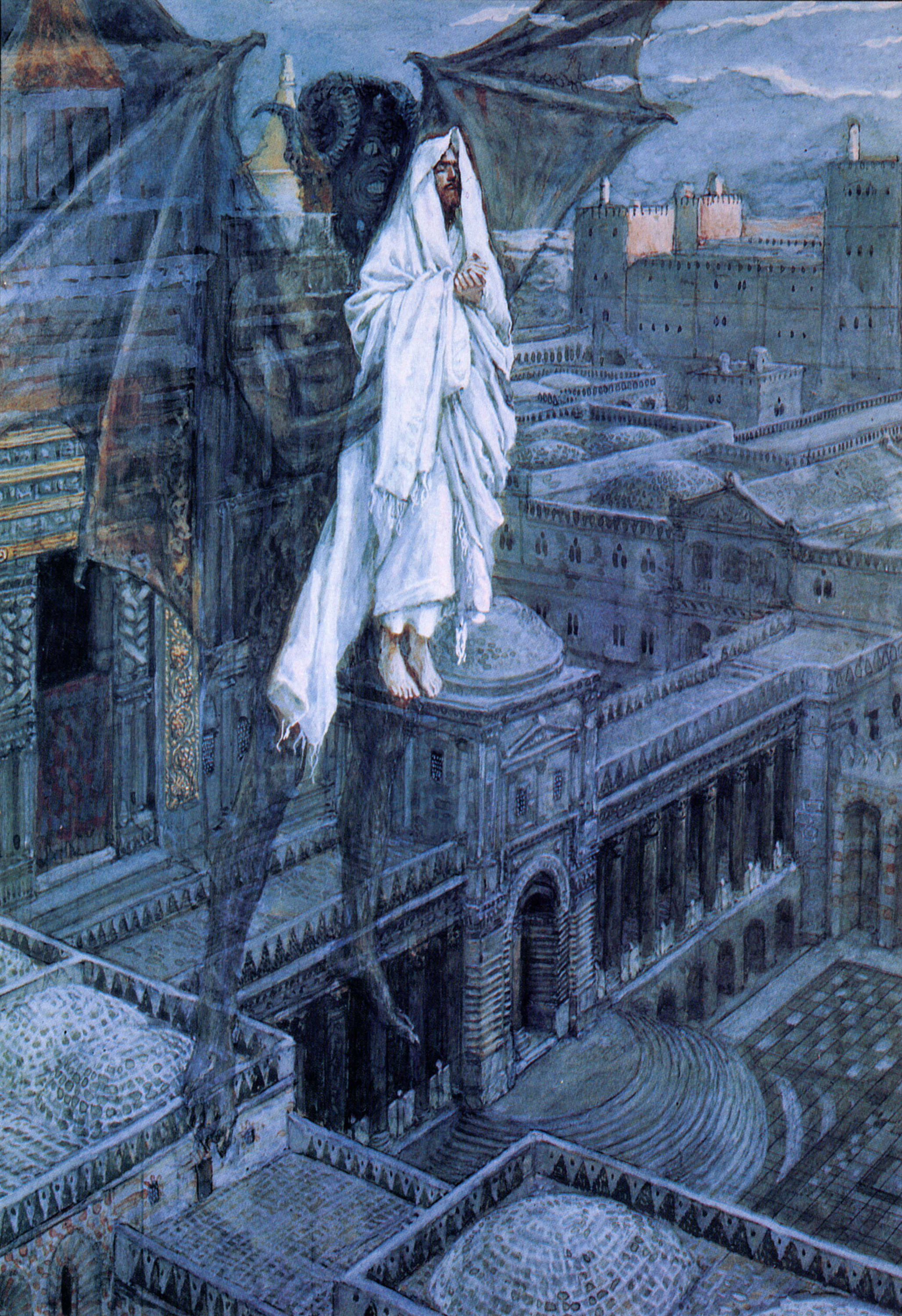
"the tempter tries to divert Jesus from the Father's plan, in other words from the path of sacrifice, love the offering of Himself in expiation.  He tries to make Him choose the easy path of success and power. The duel between Jesus and Satan is a rally of quotations from the Holy Scriptures. The devil, in fact, to divert Jesus from the way of the cross, presents Him with false messianic hopes: economic well-being, indicated in the ability to turn stones into bread;  a lifestyle of the miraculous and spectacular seen in the idea of throwing Himself off the highest point of the temple of Jerusalem, to be saved by angels, and finally a shortcut to power and domination, in exchange for Him openly worshipping Satan. There are three groups of temptations: we too know them well".
Jesus, the Pope explained, 
"firmly rejects all these temptations and reiterates His determination to follow the path set by the Father, without any compromise with sin and with the logic of the world. Notice how well Jesus answers Satan, not entering into a dialogue as Eve had done in the Garden of Eden . Jesus knows that you cannot dialogue with Satan, because he is too cunning.   This is why Jesus, instead of entering into a dialogue like Eve, chooses to take refuge in God's Word and responds with the power of this Word.  We should remember this when we are tempted: do not argue with Satan, always defend ourselves with the Word of God.  And this will save us ".
In his response to Satan, the Lord reminds us, first, that "man does not live by bread alone, but by every word that proceeds from the mouth of God" (Mt 4:4; cfrDt 8.3), and this gives us strength, supports us in our battle against the worldly mentality that lowers man to the level of his most basic needs, causing him to lose his hunger for what is true, good and beautiful, the hunger for God and His love. Also remember that "It is also written: 'Do not test the Lord your God'" (v. 7), because the road of faith also passes through darkness, doubt, and is nourished by patience and perseverance. Finally remember that "it is written:" The Lord, your God, shall you worship and Him alone shall you serve '"(v.10), that is, we have rid ourselves of idols,  of vain things, and build our lives on the essentials. These words of Jesus will then been translated into actions. His absolute faithfulness to the Father's plan of love will lead Him after about three years to the final showdown with the "prince of this world" (Jn 16:11), the hour of the passion and cross, Jesus will return and there His is the final victory, the victory of love! "
Dear brothers, the Pope concludes, 
"is a fitting occasion for all of us to undertake a journey of conversion, by sincerely taking this Gospel passage into consideration. Let us renew the promises of our Baptism: renouncing Satan and all his works and seduction, to walk the path of God "to arrive at Easter in the joy of the Spirit" (cf. Collect, I Sunday of Lent Year A)".
Immediately after the Marian prayer, the Pope greeted, as usual, the various groups present in St. Peter's Square, recalling the campaign launched by Caritas International against hunger in the world, and announced the beginning of the usual spiritual exercises for the Roman Curia, which will begin this afternoon at the house of the Divine Master in Ariccia, a small hill top town South of Rome.  The retreat will end Friday, March 14th: "I hope that the Lenten journey which has just begun will be a fruitful one for you all and I ask you to remember me and my collaborators of the Roman Curia in your prayers, as we begin this evening a week of Spiritual Exercises . Thank you. Have a good Sunday and a good lunch. Goodbye".
Link (here) to Asianews.it

Tuesday, January 21, 2014

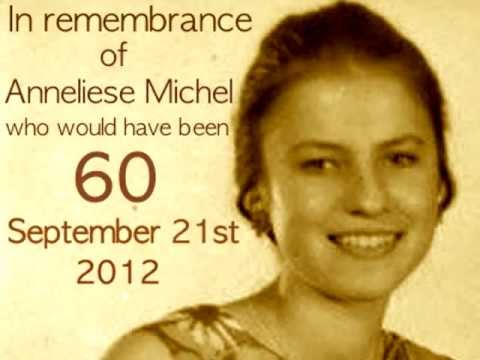
German Jesuit At The Center Of "Anneliese Michel Exorcism"

"In November 1972 Anneliese Michel, a young student at the University of Wurzburg, West Germany, was taken by her parents to see the parish priest in her hometown of Klimgenberg. She had developed some worrisome signs of abnormal behavior at the university-refusing to eat, flying into violent rages, screaming, and trying to attack those around her-and her parents were deeply concerned. In the priest's view, Anneliese was possessed by demons, and he recommended a ritual exorcism.
As Roman Catholic procedure requires, the case was investigated by a leading authority on exorcism and demonic possession, Father Adolf Rodewyk, an 81-year-old Jesuit. Father Rodewyk agreed with the priest’s diagnosis, and on his recommendation the regional bishop, Father Josef Stangl, gave permission for the exorcism to take place. The exorcists chosen for the task were the Reverend Arnold Renz and the Reverend Ernst Alt
By then Anneliese had been receiving medical treatment for epilepsy for four years. On July 1, 1976, after several months of exorcism, Anneliese died of malnutrition and dehydration at the age of 23. She weighed 70 pounds. On march 2 1987, the two exorcists and Anneliese’s parents were charged of negligent homicide, on the grounds that they had allowed the girls death without seeking medical help for her. Bishop Stangl, and Father Rodewyk, who seem not to have known that medical was being withheld, were not charged. In April 1978 the two priests were found guilty and were given suspended prison sentences of six months. For the Roman Catholic Church, the death of Anneliese Michel was a nightmare come true, demonstrating the dangers inherent in the ritual of exorcism and the murky distinctions between priestly and medical responsibility.
In Father Rodewyk’s own handbook on possession and exorcism, originally published in 1963 and translated into English under the title Possessed by Satan, priests are urged to consider medical explanations for apparent possession. One section of the book, in fact is titled “ Lets not Always Think of Possession!” Father Rodewyk, outlining the bishop’s responsibilities says that he “may appoint a commission of theologians and physicians to undertake a further investigation” and warns that the exorcists “Must guard against playing the role of physician when encountering physiological symptoms.” He quotes the authoritative Roman Ritual (of exorcism): “ The exorcist should avoid giving or recommending any sort of medication to the possessed; that is the physician’s task.” 
Although such statements clearly suggest that physician may sometimes be needed before and during an exorcism, there is no stipulation that a doctor must be in attendance. This deficiency in church procedure was corrected, at least in Germany, after the conviction of the two priests in the Michel case. In May 1978 the German Bishops’ Conference ruled that in future no exorcisms would be permitted unless a doctor was present.
Link (here)

"The Mysteries of the Unexplained" (Printed in 1990)

This story is the basis of the movie entitled, The Exorcism of Emily Rose.
Saint Ignatius of Loyola, "An enemy of the dark spirit" (here) 

Saturday, June 29, 2013

Fr. Malachi Martin On Perfect Possesion

According to the late Father Malachi Martin, perfect possession is the state in which a human being has lost complete control to a spiritual being. As a Jesuit diplomat and scholar, Father Martin served three popes and taught at prestigious universities. As a veteran of thousands of exorcisms, Father Martin’s observations from his direct experiences are worth noting:
  • There is a difference between oppression and possession.
  • In his lifetime, he saw an 800 percent increase in possessions.
  • Fifty percent of people diagnosed as insane are actually possessed.
  • Exorcisms were only performed on request and after medical and psychiatric evaluation.
  • The possessed have all been found to have created an opening for evil to enter.
  • Playing with a Ouija board was one of the most common conduits for demonic entry.
  • Channelling was another activity that opened the practitioner to demonic influences.
  • Cases of perfect possession are hopeless, there is no deliverance for them.
  • The purpose of the demonic is to destroy the possessed.
  • The overriding energy of the demonic is hatred that defies language.
  • More than one psychiatrist left his profession after witnessing an exorcism.
  • Many atheists converted to Christianity after witnessing an exorcism.
  • Many participants in exorcism die in the months following the ritual.
  • Exorcisms can last a few hours to a few months.
  • The exorcised spirits are not destroyed, they are simply evicted from the possessed.
  • Demonic spirits are all around us at all times.
The more I learn about the psychopath, the more similarities I see with the possessed. Before man came up with the psychological disciplines, abusive and violent people, were considered possessed and treated accordingly. As many people on the planet have been guided into ever more secular societies, evil has, unsurprisingly prevailed with unprecedented success.
Link (here) to  Every Day Red Flags
Link (here) to listen to Art Bell's interview of Fr. Malachi Martin for one hour

Monday, June 24, 2013

Fr. Raymond J. Bishop, S.J. And His Diary

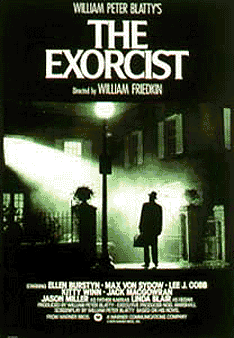
Many consider the 1973 "The Exorcist" the scariest movie of all time....If the mere thought of the famousflick gives you the chills, consider this: It's directly based on a true incident that happened in St. Louis. The real story that inspired the famous book and movie happened in 1949. It began in Maryland, ended in St. Louis, and involved several Jesuits from Saint Louis University. Father Raymond J. Bishop, S.J. kept a day-by-day account of the exorcism. Click here to read the diary. When Pat McGonigle's series on the history of the exorcism in St. Louis was airing last fall, he received a phone call from a woman that he can't forget. Read Pat's blog about what the woman said that still gives him chills months later.
Link (here) to KDSK channel 5 out of St. Louis to watch the video interview.

Sunday, June 2, 2013

Fr. Michael J. Watson, S.J. "Each Human Being Has An Angel To Stand Ever By His Side"

Each human being has an Angel to stand ever by his side and help him to resist temptation and win the Kingdom of Heaven. How much we owe our Guardian Angels! They preserve us from many unknown dangers to soul and body. They defend us against the demons. They breathe holy thoughts into our soul; they prompt us to deeds, even heroic deeds, of virtue, in the Divine service, and they fling their mighty strength around us when we are dying and so save us from the last attacks of our spiritual foes. Full of zeal and jealous are they for God's honour, for the interest of those committed to their care, and for the innocence of the young. "Beware," says Our Saviour, "of giving scandal to those little ones; for their Angels always behold the face of My Father who is in heaven." Saint Bernard tells us that we owe our Angels profound respect for their presence, and confidence in their love and power to protect us, as well as gratitude for the great benefits, which they confer. The heavenly spirits look upon themselves as our elder brothers; nay, to speak in our human way, they are passionate lovers of all whom God has charged them to guard.
Saint Paul says: "Are they not all ministering spirits, sent to minister for them who shall receive the inheritance of salvation?" (Hebrews 1:14). And in the 90th Psalm of the Vulgate (or Psalm 91 in the Hebrew), the Holy Ghost declares: "No evil shall approach unto you, neither shall the scourge come nigh your dwelling. For He has given His angels charge over you, to keep you in all your ways: in their hands they shall bear you up, lest haply you dash your foot against a stone." 
Through this angelic guardianship, "you shall walk upon the asp and the basilisk; the lion and the dragon shall you trample under foot." Thus do they watch over each individual soul, even if that soul is in a state of sin, and they act as protectors to hamlets, cities and kingdoms. In the Book of Exodus (13:21) we see how, in the desert, an Angel of God went before the people to show the way by day in a pillar of cloud, and by night in a pillar of fire, that he might be the guide of their journey at both times. We may, indeed, say that this earth of ours is full of innumerable spirits to defend all who are specially dear to God. When an army, with horses and chariots, beset the city of Samaria to slay the prophet Eliseus (Elisha), and the prophet's servant cried out in terror, Eliseus prayed: "Lord, open his eyes that he may see." And the Lord opened the eyes of the servant and he saw, and behold the mountain was full of horses and chariots of fire round about Eliseus. And the prophet said: "Fear not, for, as you see, there are more with us than with them." (2 Kings, chapter 6. The Vulgate calls the book ‘4 Kings’.). 
Link (here) to read the full piece on angels entitled, The Holy Angels of God, by Fr. Michael J. Watson, S.J.

Wednesday, May 29, 2013

Fr. James Schall. S.J., "Sin Begins With Things Only Slightly Off-Center"

Pope Francis has said that the Devil “hates” us. Blunt words. Francis is not talking about some inert “lack.” He is talking about a positive hating of the good because it is good. Only persons can hate. Lucifer is an angelic being who rejects God by calling good evil, by convincing other rational beings to change good into evil. Classical ethics and moral philosophy gave us accounts of virtues and vices. Usually two vices existed for every virtue, a too much and a too little. We find in the writings of Plato a sense that our vices are not just foibles or mistakes but objects of judgment. Plato rightly worried that the world was created in injustice if the vices were not ultimately punished. This consideration led him to propose the immortality of the soul to guarantee that no one could get away with doing evil, even if he died in human glory but covered with sins.
Christianity provided a more profound explanation of evil, though one not necessarily disagreeing with Plato. Christ affirmed that the Devil’s kingdom could not stand if it had dissention within its rank. This information means, as I understand it, that we find both a logical sequence of disorders, or deviations from the good, as Aristotle understood, and an active presence. This logic works through willing human beings who find themselves assenting to a step-by-step deviation from the good, each worse than the one before.
Those familiar with spiritual literature recall that the Church Fathers warned monks that sin begins with things only slightly off-center. Yet things do not stand still. Either the evil is recognized and corrected or the next logical step away from the good is taken. Eventually this leads to calling of evil good, all in the name of pursuing some good but in a manner contrary to reason or the commandments. 
Link (here) to read the full piece by Fr. James Schall, S.J. at The Catholic Thing


Sunday, May 12, 2013

Gird Yourself, And Put On Your Sandals


SAINT PETER AND HIS GUARDIAN ANGEL.

(Acts of the Apostles, Chapter 12.)

And at the same time, Herod the king stretched forth his hands, to afflict some of the Church. And he killed James the brother of John with the sword. And seeing that it pleased the Jews, he proceeded to take up Peter also. Now it was in the days of the azymes. And when he had apprehended him, he cast him into prison, delivering him to four files of soldiers to be kept, intending after the Pasch to bring him forth to the people. Peter, therefore, was kept in prison. But prayer was made without ceasing by the Church unto God for him. And when Herod would have brought him forth, the same night Peter was sleeping between two soldiers, bound with two chains: and the keepers before the door kept the prison. 
And behold an Angel of the Lord stood by him: and a light shined in the room: and he striking Peter on the side raised him up, saying: Arise quickly. And the chains fell off from his hands. And the Angel said to him: Gird yourself, and put on your sandals. And he did so. And he said to him: Cast your garment about you, and follow me. 
And going out he followed him, and he knew not that it was true which was done by the Angel: but thought he saw a vision. And passing through the first and the second ward, they came to the iron gate that leads to the city, which of itself opened to them. And going out, they passed on through one street: and immediately the Angel departed from him. And Peter coming to himself, said: Now I know in very deed that the Lord has sent His Angel, and has delivered me out of the hand of Herod, and from all the expectation of the people of the Jews. And considering, he came to the house of Mary the mother of John, who was surnamed Mark, where many were gathered together and praying. And when he knocked at the door of the gate, a damsel came to hearken, whose name was Rhoda. And as soon as she knew Peter's voice, she opened not the gate for joy, but running in she told that Peter stood before the gate. But they said to her: You are mad. But she affirmed that it was so. Then said they it is his Angel. But Peter continued knocking. And when they had opened, they saw him, and were astonished. But he, beckoning to them with his hand to hold their peace, told how the Lord had brought him out of prison and he said: Tell these things to James and to the brethren. And going out he went into another place. Now when day was come there was no small stir among the soldiers, what was become of Peter. And when Herod had sought for him, and found him not; having examined the keepers, he commanded they should be put to death: and going down from Judea to Caesarea, he abode there. And he was angry with the Tyrians and the Sidonians. But they with one accord came to him, and having gained Blastus, who was the king's chamberlain, they desired peace, because their countries were nourished by him. And upon a day appointed, Herod being arrayed in kingly apparel, sat in the judgment-seat, and made an oration to them. And the people made acclamation, saying: It is the voice of a god, and not of a man. And forthwith an Angel of the Lord struck him, because he had not given the honour to God: and being eaten up by worms, he gave up the ghost. But the word of the Lord increased and multiplied. And Barnabas and Saul returned from Jerusalem, having fulfilled their ministry, taking with them John, who was surnamed Mark.
Link (here) to The Holy Angels of God by Fr. M. J. Watson, S.J.

Wednesday, May 30, 2012

Order And Disorder

St. Micheal the Archangel defeating Satan
St. Ignatius of Loyola’s Spiritual Exercises is, basically, a guide for retreat directors. It outlines a series of meditation topics, methods of prayer, and principles to help in the process of “the discernment of spirits.” The first set of principles for discernment deal with interpreting the experience of spiritual consolation and spiritual desolation. He goes into great detail defining those terms and describing what he means by them. He does this in order to help retreatants and retreat directors learn to identify and process what is going on inside the soul as a person seeks to follow God more closely. In the first two rules for the discernment of spirits, he makes two critical observations. First, he points out that two “spirits” are interested in influencing our souls: The good spirit (God, and God’s messengers, like the angels), and the evil spirit (the devil and his minions). God wants to lead and guide and draw each one of us closer to himself; the devil wants to obstruct our progress towards God, and, if possible, turn us away from God entirely. But both “spirits” have to work within the confines of human nature, influencing us from within our souls, where we experience feelings, attractions, repugnance's, thoughts, memories, desires… In reflecting on and interpreting those interior experiences, we exercise our freedom and make decisions, and our decisions either bring us closer to God or distance us from him. 
This is why St. Ignatius considers it so important to be able to identify the source of those interior experiences; we need to know whether they are being stirred up by the enemy of our soul in an effort to thwart our spiritual progress, or whether they are nudgings and whisperings from our Lord. 
Second, he distinguishes two basic states in which particular individuals can find themselves. On the one hand, a person can be on the path of sin, living life by seeking happiness in any number of idols instead of in a relationship of obedience and love towards God. On the other hand, a person can be on the path of holiness, seeking to grow in friendship with God and to purify their souls from inordinate attachments that impair that friendship.
Link (here) to read the full post by Fr. John Bartunic at the blog entitled, Catholic Spiritual Direction