Showing posts with label Jesuits in Portugal. Show all posts

Sunday, November 17, 2013

His Excellency The Marquis of Pombal, "The Slayer Of The Jesuits"

POMBAL.
"EL MATADOR DOS PADRES."
In one of the principal squares of Lisbon may be seen the statue of King Joseph Emmanuel, son of John V., Don Sebastian Carvalho y Melho, Count d'Oeyras, Marquis de Pombal. The relative position of the figures ought to have been reversed. The minister was the tyrant of the monarch, as well as the scourge of his subjects. In the present notice we shall limit ourselves to giving an account of the manner in which the Marquis de Pombal earned his title of "Slayer of the Fathers," after enumerating the causes of his enmity against the Company of Jesus.
King of Portugal. At the foot of the statue is represented his Minister of State,
Pombal, who was a "philosophic" atheist and an encourager of the Calvinists, had certain reasons of private ambition for wishing to introduce Protestantism into Portugal. While pretending outwardly to be the enemy of the English, he was secretly doing all in his power to bring about a marriage between the Princess de Beira and the Duke of Cumberland —a marriage which would have eventually entitled the latter to the crown of Braganza. Like the rest of the Portuguese, the Jesuit Fathers were naturally opposed to English and Protestant domination in their own country. They were confessors to all the royal family, and Pombal regarded them as the chief obstacle in the way of his designs—an offence which he never forgave them.
.........Pombal was a great builder of prisons. The number of his victims demanded considerable accommodation, for at one particular time in Lisbon he had more than four thousand prisoners of state, and this in a capital of (at that period) one hundred and fifty thousand inhabitants. Dona Eleanora, the Dowager Marchesa de Tavora, was separated from her children. Masters and servants, men and women, disappeared as if the earth had swallowed them up. In letters of the time we find that Pombal was enraged on discovering that some poor ameliorations had been made in the dreadful state of the captives by the pity of subalterns. Besides the De Tavora family a large number of hidalgos had also been arrested and thrown into dungeons that same night. 
Among them was the greatest noble of Portugal, Don Jose de Mascarenhas y Lancastre, Duke of Aveiro and cousin to Dona Eieanora. Several of the Jesuit fathers, amongst whom was the confessor of the Prince Don Pedro, Father Hyacinth da Costa, were also suddenly carried off to prison.
All Lisbon was paralyzed with terror. A hand of iron weighed upon the city. In the streets nothing but mercenary soldiers were to be seen, and the king no longer went out of his palace. Whoever dared to express doubt as to the guilt of the arrested persons, or the least pity for them, was summarily arrested also. According to the laws of Portugal accused persons had a right to be judged by their peers. Pombal denied his victims the benefit of this right. He created a tribunal composed of creatures of his own, and entirely devoid of legal authority. 
This tribunal lie named the "Court of Mistrust," and over it he appointed himself president. As it was not yet, apparently, so much a question of the Jesuits as of the nobility, the French Encyclopaedists were somewhat offended at these monstrosities, and we hear of the "bad effect" produced in the philosophic world of Paris by the frightful vagaries of Pombal, whom, nevertheless, it was desirous to excuse as far as possible, on account of his "generous ideas." Not content with presiding, Pombal took upon himself the "examination" and "instruction " of the cases. It was he who gave the verdict and pronounced the sentence, which still exists, written by his own hand. 
And how was the examination conducted? By intimidation of every kind, shamelessly employed, by "testimony invented," and witnesses forced by torture to assent to accusations which they were never allowed to retract, and thus furnishing a reason for a judicial carnage the attendant horrors of which are, perhaps, unparalleled in the history of any civilized nation. The Tavora family, as well as the other accused, remained silent under the fearful torments to which they were subjected, with the sole exception of the Duke d'Aveiro, who, in the extremity of agony, half dead as he was, and not knowing what he said, assented to whatever was put in his mouth, and thus accused his fellow-prisoners and— the Jesuits. Pombal, on hearing this, uttered an exclamation of ferocious joy. He had obtained what he wanted. What this implied we shall see further on. No sooner had the unfortunate Duke d Avei'ro recovered his senses than, learning what he had done, he retracted, declaring that excess of torment alone had wrenched from him accusations against persons who were innocent. It is needless to say that his earnest entreaties had no effect in inducing Pombal to allow his retractation. Sentence of death was pronounced against the De Tavora family, their relations and friends, as well as all their numerous domestics and dependants, on January 12, 1759. Pombal, fearing the popular indignation, had the scaffold prepared by night, outside the city, in the ■ Plaza of Belem, which was occupied by two regiments of mercenaries. 
The platform, lighted by torches, rose eighteen feet from the ground. The square and the river side were so thronged with soldiers that the spectators took refuge on the Tagus, where from hundreds of boats and other craft arose a mingled murmur of groans and curses. Thus passed the night of January 13. With the first gray sign of dawn arrived the numerous domestics of the Duke d'Aveiro. These were all bound to stakes at one corner of the scaffold and burnt alive. 
Then followed the Marchesa Eleanora de Tavora, alone; a rope round her neck, a crucifix in her hand, and her garments torn into rags by the torture. Pombal was there; for his Memoirs give, with a sort of infernal satisfaction, the full details of which he was an eye-witness on this night. With calm dignity Dona Eleanora mounted the scaffold, pressing to her heart the image of her God. The executioner approaching to bind her feet, she said to him gently : " Man, I pray you not to forget who I am. Do not touch me except to kill me." The man knelt down before her (Pombal himself relates it). Dona Eleanora was of those races who leave no service, even the last, without its recompense. Drawing her ring from her finger, she held it out to him, saying: " Every work deserves its reward. This is all I have, and 1 give it you that you may do your duty well." The executioner rose and did his duty. After this first noble blood had reddened the block the aged Marquis de Tavora, Dona Eleanora's husband, was beheaded, and next the husband of that Dona Teresa who had brought death and destruction on the noble house into which she had been welcomed as a beloved daughter. Then followed the other sons of Dona Eleanora— the youngest of whom was not twenty years old—her daughters, and her son-in-law; then the long file of officers and servants of her household, who died in their torments like brave men and Christians. Last of all, his garments nothing but tatters, came the Duke d'Aveiro, whose racked limbs could scarcely support him. He was fastened on the wheel; and for nearly an hour he struggled with this ghastly instrument of death, which slowly crushed his bones, while the clamor of his appalling agony could be heard even in Lisbon. The butchery at last consummated, the scaffold with all that was upon it was set on fire, and crumbled, with the half-burnt corpses, into the Tagus. After what has been related it matters little to know that all the friends and relations of these victims were kept in prison, their palaces and mansions razed to the ground, and the very sites they had occupied sown with salt. The arms of the De Tavora and their so-called " accopiplices " were effaced in the Hall of the Knights at Cintra, where their escutcheons still remain veiled with black, like the portrait of Faliero in the Ducal Palace at Venice. This last fact is remarkable, because the iniquitous judgment of January 12, 1759, has for long years past been annulled. Pombal lived long enough to feel even in this world the hand of God. All his victims were rehabilitated during his lifetime by decree of the High Court, solemnly given on April 7, 1781 ; and by this same decree Pombal was disgraced.
Link (here) to Catholic World

Sunday, March 24, 2013

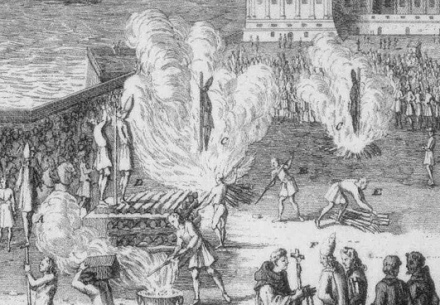
Gabriel Malagrida, S.J. "Strangled At An Auto-da-fé, And Burnt At The Stake"

A depiction of the execution of Fr. Gabriel Malagrida, S.J.
Pope Francis is the first Latin American pope. He is also the first jesuit to become pope. The Jesuits and Brazil have a long history which the jesuits have certainly not forgotten. During the 18th century, it was from Brazil that the jesuits were first expelled. The frontier between Brazil and what would later become Argentina was one of the key locations of the conflict which pitted the jesuits against the crowns of Portugal and Spain.
The Treaty of Madrid, of 1750, was the first negotiated settlement of the land frontiers in South America between the two Iberian powers. Portuguese claims to the inland frontier were upheld. In return they ceded to Spain the Colonia do Sacramento, on the northern bank of the rio de la Plata. The land of the seven jesuit missions, previously under the control of Spain, would become Portuguese. The treaty envisioned the evacuation of the Uruguayan jesuit missions and their Guarani neophytes, as well as over a million head of cattle, across the Uruguayan river. The Jesuits opposed this, and the jesuit missions took up arms. A joint Spanish and Portuguese military force was sent to defeat them. Pombal, who was the principal minister in Lisbon, and his brother, who was the governor of Para, were also in conflict with the jesuit missions in the Amazon. As with the Guarani in the south, in the Amazon Pombal intended to emancipate the Indians and to encourage their intermarriage with European settlers. This collided with the most basic philosophical tenet of the protectionist Indian policy of the jesuits. But Pombal was supported by the Brazilian colonists with whom the jesuits had long been in conflict over access to Indian labour. The Lisbon earthquake of 1755 aggravated the situation. In 1758, a failed assassination of the king of Portugal provided Pombal with an excuse to crack down on aristocratic and jesuit opposition. 
The Jesuit Gabriel Malagrida was, in 1761, accused of complicity and was sentenced by the Inquisition. He was the last person to be burnt at the stake in Lisbon. Pombal sponsored a virulent public campaign throughout catholic Europe against the Jesuits. In 1773, pope Clement XIV, a Franciscan friar, suppressed the Jesuits.
When he died unexpectedly the following year it was rumoured that he had inadvertently taken poison disguised in his chocolate drink. Pope Francis knows this Jesuit history. As do the cardinals who elected him. They joked that the new pope should take the title of Clement XV. 
Link (here)

Tuesday, July 3, 2012

Town of Elvas And Its Fortifications

Elvas, Portugal
The site, extensively fortified from the 17th to 19th centuries, represents the largest bulwarked dry ditch system in the work. Within its walls, the town contains barracks and other military buildings as well as churches and monasteries. While Elvas contains remains dating back to the 10th century A.D., its fortification began when Portugal regained independence in 1640. The fortifications designed by Dutch Jesuit Padre João Piscásio Cosmander represent the best surviving example of the Dutch school of fortifications anywhere. The site also contains the Amoreira Aqueduct, built to enable the stronghold to withstand lengthy sieges.
Link (here) to the UNESCO website

Thursday, May 17, 2012

Fr. Mariano Pinho, S.J "Fatima Jesuit"

The consecration of the human race to the Immaculate Heart of Mary, accomplished by Pope Pius XII on October 31, 1942, was the result of the requests, not of Sr. Lucy, but of another Portuguese woman, Alexandra da Costa, known by the name of Alexandrina of Portugal, who was born in Balasar, a village situated between the cities of Porto and Braga, on March 30, 1904, a Good Friday. At the age of 14, in order to defend herself against the perverse intentions of three men who had entered the house where she was in the company of two other girls, she jumped out of a window 12 feet high, and as a result of the fall suffered damage to her spinal column that immobilized her in a painful martyrdom that lasted until her death on October 13, 1955. It was to this victim that our Lord gave the order to obtain from the Pope the consecration of the world to the Immaculate Heart of Mary. The first request dates from July 31, 1935, and Alexandrina, who was already a voluntary victim of the Eucharist, offered herself as well as "victim for the consecration of the world to our little Mother in Heaven." Our Lord having urged her to obtain this consecration for more than a year, finally her spiritual director, Fr. Mariano Pinho, S.J., transmitted this request for the consecration of the world on September 11, 1936, to His Holiness Pope Pius XI by the intermediary of his Secretary of State, Cardinal Pacelli. The Holy See then ordered the Apostolic Nunciature of Lisbon to initiate an inquiry into the matter. On July 11, 1937, the Provincial of the Jesuits wrote to the Nuncio, relating to him the conclusion of the investigation:
On the basis of the information gathered, it is not possible to doubt the sincerity or the virtue of the young woman. But since she does not show any outward sign that can prove the divine origin of the locutions that she says she hears, the possibility of illusion still remains.

It was Fr. Pinho who was charged with preaching the spiritual retreat to the Portuguese bishops at Fatima in June 1938; at the end of the retreat, the bishops wrote a collective letter to Pope Pius XI:
Read the letter and the rest of the story (here)

Thursday, July 28, 2011

St. Ignatius of Loyola And The Moor

St. Ignatius of Loyola and the Moor
While he travelled alone, engaged in his meditations, he was accosted by a man of the unbelieving Moorish race which had once occupied almost the whole of Spain, and which though subjugated still remained in considerable numbers in the southern and western parts of the Peninsula,
Christians in outward show, but secretly followers of Mahomet. The two travellers having saluted one another, and Ignatius having told the Moor the place whither he was going, they entered into a discussion concerning the Blessed Virgin. Though the Moor admitted that she had conceived without loss of her virginity, he denied that she remained a virgin after the birth of her Son. 
Ignatius, as a good Catholic, could not comprehend how in matters of faith, it was possible to admit one portion of the truth and reject another, and tried in vain to bring him to a better state of mind by reasons and comparisons, speaking with such vehemence that his opponent, who saw with what sort of a person he had to deal, deemed it prudent to take himself off, and so without a word more suddenly turned aside to a town that was near. Well was it for him that he did so, as Ignatius was on the point of taking him more seriously to task than he ought perhaps to have done, or than the other could have imagined. Scarce had the Moor left him, than, indignant at the blasphemy spoken against the Holy Virgin, he doubted whether he ought not even then to hasten in pursuit of him and wash out the injury in his blood. This, as he soon reflected, was to act more like the knight-errant than the apostle, and so a conflict arose within him, his feelings on the one side urging him to punish the guilty upon his own private authority, whilst reason told him on the other that he had no right to do so, and between these he knew not how to decide. In his doubt he resolved to leave the matter to God; and having arrived at a place where two ways parted, one of which led into the town whither the Moor had gone, he let fall the bridle on the mule's neck, and left it to choose which way to go. "If it takes the road," he thought, "which the blasphemer is gone, it is a token that I ought to pursue and punish him." The mule, however, took the way towards the mountain, and thus his conscience was set at rest, and he continued his journey without further thought of vengeance.
Link (here) to the full account and the book entitled, The Life of the St. Ignatius of Loyola by Fr. Genelli, S.J.

The Good Things, The Graces, The Gifts Received.

"It seems to me, in light of the divine Goodness, though others may think differently, that ingratitude is one of the things most worthy of detestation before our Creator and Lord, and before all creatures capable of his divine and everlasting glory, out of all the evils and sins which can be imagined. 
For it is a failure to recognize the good things, the graces, the gifts received. As such, it is the cause, beginning, and origin of all evils and sins. 
On the contrary, recognition and gratitude for the good things and gifts received is greatly loved and esteemed both in heaven and on earth."

-St. Ignatius in a letter to Simon Rodrigues, March of 1542. 
Link (here) to Give Me To Your Son

Friday, May 20, 2011

Fr. Emanuel Alvarez, S.J.

The Jesuit, Emanuel Alvarez of Lisbon (1526—1583),
produced in 1572 a Latin Grammar, which has been extolled as the first in which the fancies of the ancient grammarians were laid aside. It was the  text-book in all the Jesuit schools, and has often been reprinted, the latest edition being that of Paris in 1879.

Link (here)

Saturday, November 27, 2010

Father Gaspar Baertz "The Jesuit Of Arabia Felix "

THREE YEARS AT ORMUZ 
Father Gaspar Baertz had to bear one of those bitter trials which often await an Apostolic labourer. All of a sudden his toils seemed to have been crowned with success; and then, as quickly, his hopes were dashed to the ground. He was in the middle of a Lenten sermon, when the King of Ormuz sent for him. He left the pulpit at once, and was received by the King with all the honours wont to be paid to illustrious visitors. After a few compliments, the King withdrew into his private cabinet, taking with him only his Portuguese interpreter and the astonished Father, whom he forced to sit down on the royal throne, while he cast himself on his knees at his feet, reverently kissed his hand, and then took a lowly chair by his side. The upshot of the conversation explained all these demonstrations of respect.
The King declared that he was convinced of the truth of the Catholic Faith, and would there and then have asked for baptism, if he had not feared a revolution and rebellion in his States. He only waited till more of his nobles were converted, and till the Catholic forces could afford him their protection, to carry out his intentions. Father Gaspar, full of joyful gratitude, could not gainsay the delay. Precipitation would have been followed by the total ruin of the Faith. 
The fanaticism of the Mahometans and pagans would have been roused, the neighbouring sovereigns of Arabia and Persia would have been only too glad to have intervened with prospective views of plunder, if not of conquest . One suggestion, however, Father Gaspar made, and on which he insisted— that the King, while keeping his intentions strictly private, should order a public discussion to be held between the chief Mahometan doctors and himself. But so long an audience could not escape notice, and report quickly spread far and wide that the King was already received into the Church. At first, the goodwill that Father Baertz had gained, the impression which his life and teachings had produced, made the rumoured conversion be received with general satisfaction.
There was a sort of movement which at one time seemed to augur that twenty-five thousand Moors would follow their sovereign's example, and a great number of the aristocracy went so far as to choose their name of baptism, and to settle on their godfathers and godmothers.

Saturday, September 20, 2008

Too Jesuit?

The tremors of All Saints' Day, 1755, were felt around Europe in the most literal sense. Waters rose and fell in Scottish lochs; Morocco was pummelled; in Portugal itself, a tsunami swept away a quay and 50,000 people died, either under rubble or in fire, to say nothing of the children, whose already high mortality rate would have been increased by starvation and disease. To the pious sages of the time, God was saying something, but nobody could agree what. Was Lisbon the Age of Enlightenment's Sodom and Gomorrah? To Protestants, the city was too Roman Catholic; to the Catholics of Lisbon, the place was too Jesuit. And then there were the Optimists.

Link (here)