Saturday, May 11, 2013

Cardinal O'Malley Says No To Boston College And Prime Minister Edna Kenny And Yes To The Unborn

Cardinal Sean P. O’Malley, the archbishop of the Boston Archdiocese, said today he would not attend Boston College’s commencement because the scheduled speaker, Irish Prime Minister Enda Kenny, supports controversial abortion-rights legislation in his country. In a statement released this afternoon, O’Malley said the Catholic Bishops of the United States have urged Catholic institutions not to honor government officials whose views on the issue are inconsistent with the teachings of the Catholic church. The Irish legislation would permit abortions if there is a real and substantial threat to the mother’s life, including from suicide.
“Since the university has not withdrawn the invitation and because the Taoiseach [prime minister] has not seen fit to decline, I shall not attend the graduation,’’ O’Malley said in a statement. “It is my ardent hope that Boston College will work to redress the confusion, disappointment and harm caused by not adhering to the Bishops’ directives.’’
He added, “although I shall not be present to impart the final benediction, I assure the graduates that they are in my prayers on this important day in their lives, and I pray that their studies will prepare them to be heralds of the Church’s Social Gospel and ‘men and women for others,’ especially for the most vulnerable in our midst.’’ By tradition, the Boston archbishop delivers the final benediction at BC’s commencement each spring. The college is scheduled to award Kenny an honorary Doctor of Laws degree at the ceremony, which will be held May 20 at Alumni Stadium. 
Link (here) to Boston.com

Favor Of Giving Me Some Counsel

Jesuit priests at the time of their solemn and final profession in the Society of Jesus promise:
I also promise that I will never strive for or ambition any prelacy or dignity outside the Society; and I will to the best of my ability never consent to my election unless I am forced to do so by obedience to him who can order me under penalty of sin. And moreover, if I shall find out that anyone [another Jesuit] is seeking to secure anything of the two aforementioned things or is ambitioning them, I promise that I will communicate his name and the entire matter to the Society or its Superior.
This is based upon the Jesuit Constitutions S.J., (Part X, N°6 [817]), and the experience of St. Ignatius as found in several strong letters in which he fought against Jesuits being made bishops.  But now that we have a Jesuit pope, the question is: knowing our tradition, and knowing how St. Ignatius fought strongly against Jesuits becoming bishops, will the pope appoint Jesuits to be bishops?  The second question: how does a Jesuit  who is made a bishop or cardinal regard the General of the Jesuits? To cover this possibility, the Jesuit promises:
In addition, I promise that if despite the third vow, I should happen to be ordained a bishop, I shall not refuse to listen to the General of the Society, if he, personally or through someone else of the Society, will do me the favor of giving me some counsel.
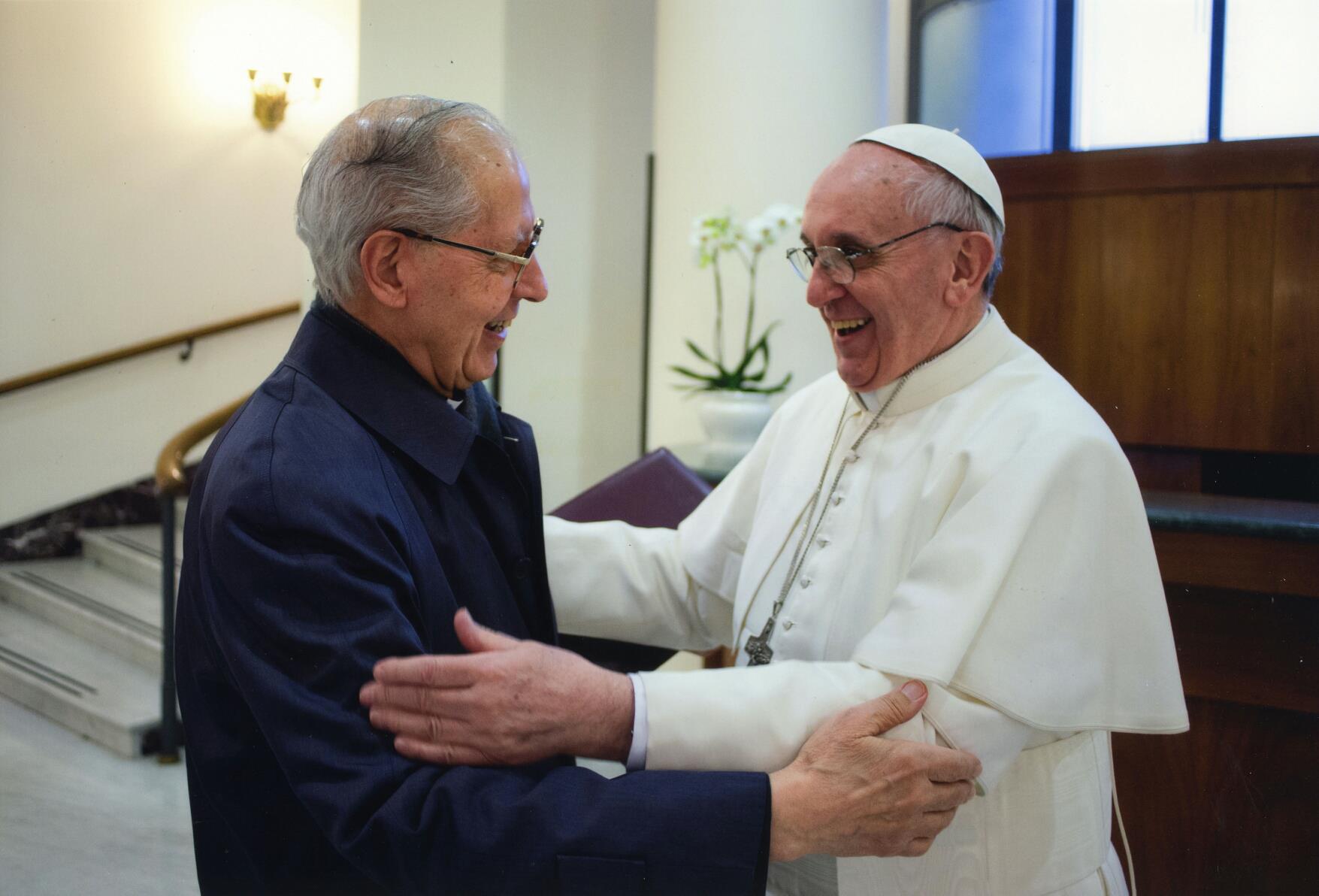
This, of course, does not deal with the possibility of a Jesuit becoming the pope! And what is his relation to the General of the Society? But as we have already soon, soon after being named pope, Pope Francis contacted and had a very cordial meeting with Fr. Adolfo Nicolas, the General of the Society.
Link (here) to America Magazine to read the post by Fr. Peter Schineller, S.J.

Friday, May 10, 2013

The Pool Of Jesuits With The Right Resume Is Rapidly Shrinking

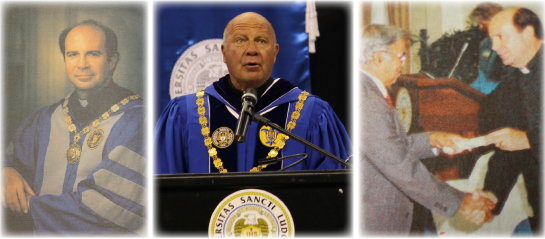
For 25 years, St. Louis University has been led by the Rev. Lawrence Biondi. And for nearly two centuries,
it has been led by Biondi’s Roman Catholic order, the Jesuits. Soon, it may be led by neither. Biondi recently announced that he intends to retire, and university officials are saying little about the specifics surrounding his departure. But one thing its board of 50-plus trustees will have to consider is whether to replace Biondi with another Jesuit priest. That is, if they can find one to take the job. 
The “biggest challenge” for a Jesuit institution selecting a new president is that the pool of Jesuits with the right resume is rapidly shrinking, said the Rev. Thomas Gaunt, executive director of the Center for Applied Research in the Apostolate at Jesuit-run Georgetown University. “You’re looking at a pretty tiny group of guys,” he said. “And the right one might not be available.”  
SLU does not make its bylaws public. But the most recent version — obtained and published online by the university’s faculty senate — makes it clear that the next president can come from outside the order that founded the school. The bylaws were amended either in 2006 or 2010 to eliminate the first sentence in Article III, Section 3: “The President shall be a member of the Society of Jesus.” Striking that requirement likely has a lot to do with simple math. The 1960s saw the peak of Jesuit membership in the U.S., with about 7,000 priests. By 1982, that number had diminished to 5,500. Today there are about 2,500 American Jesuits.
Link (here) to The Huffington Post

Fr. Raymond Schroth, S.J., " But Recently As The “War” President, Barack Obama Has Morphed Into An Indifferent, Pragmatic Utilitarian"

Fr. Raymond A Schroth, S.J.
Barack Obama has changed...In his major speeches — Inaugural Addresses, State of the Union, etc. and in“war” president he has morphed into an indifferent, pragmatic utilitarian. The man who once taught Constitutional law seems to have forgotten the relationship between law and morality, his heart-felt campaign for gun control— he has come across as a Christian humanist, a man of compassion, deep feeling, high democratic ideals. But recently as the
He seems to have shelved the basic Christian principle of “Do unto others as you would have them do unto you,”....To an almost odd degree, President Obama has assumed responsibility for every drone assassination. I was personally appalled as it became clear that no attempt was made to arrest Osama bin Laden and bring him to trial.
 Even the Navy Seal who personally shot the unarmed Osama again and again told Esquire magazine this was either the greatest or worst moment of his life. In the aftermath the fact that Obama had killed bin Laden was touted as proof that Obama was a strong leader....Following the killing of Osama bin Laden, the White House proceeded down its list of “High Value Targets” to Anwar al-Awlaki, a New Mexico born American, Al Queda propagandist living in Yemen, sentenced to death without trial by President Obama. The president was so anxious to kill— not arrest— him that he would not let “collateral damage” interfere. So on the morning of September 30, as Awlaki and American Pakistani journalist Samir Khan, and cohorts piled into cars and drove out, drones with Hellfire missiles, with other aircraft and helicopters standing by, fired one into Awlaki’s car and a fireball burned their bodies beyond recognition...
Perhaps a year from now Al Queda will have drones that can zero in on prominent or just ordinary Americans. Operated from secret command posts abroad, they will hover over baseball fields, universities, shopping malls, and churches with Hellfire missiles of their own. 
The moral authority we think we once had as a democratic “City on the Hill” will have been compromised perhaps beyond recall. After all, when we kill the enemy’s innocent children, we have invited the enemy to do the same.
Link (here) to read the full opinion piece entitled, Do Unto Others, in the Jesuit publication America Magazine, by Fr. Raymond Schroth, S.J.

Fr. Albert Power, S.J., " The Catholic Church Needs A Much Larger And More Energetic Band Of Fire-fighters"

Fr. Albert Power, S.J.
Encouraging Vocations.

Now, it is clearly our duty to do all we can to help in fostering and developing vocations — both to the priesthood and to religious life — in children and young people under our care. The success of the Church depends greatly on the number and fervour of her priests and religious. Jesus calls them especially to be the salt of the earth. Just as salt preserves food from decay, so, by aiming at a life of holiness, and by making available to others the supernatural means of sanctification provided by Christ, priests and religious help to check the tendency to corruption, which is inherent in fallen human nature. It is true that on every man and woman lies this duty of resisting moral decay and sin, and anyone living a practical, Catholic life does actually and effectively promote this health-giving process. But, still, just as there are doctors and nurses specially devoted to safeguarding the public health, even though each individual has his own personal duty in the matter, so, in the spiritual world, there must be those who specially concentrate on the work of promoting the health of the soul. And what a splendid purpose in life it is! And how many more would take up the toilsome work of Priest or Brother or Nun, if only they understood better the excellence and nobility of the calling! In every human heart, not utterly perverted by self-indulgence and sin, there exists a longing after higher things; as is evidenced by the splendid response made when a sudden call to heroic sacrifice is made — for example, in time of war.
Saint John Bosco said: "I know young people well; a large proportion of them have, in germ, the vocation to a higher life." 
That germ it is our duty to develop. And at no time was it more urgent than today, when such wonderful opportunities are opening up for the conversion of heathen nations. The Catholic Church is at a turning point in her career. Mankind is being gradually linked up into a closer union by new methods of rapid transit and communication, and the barriers that hitherto walled off the uncivilised peoples of the globe are being broken down. Unexampled opportunities for disseminating knowledge are placed at the disposal of all who care to make use of them. 
The enemies of Christianity are making use of them with restless energy, to attack our religion; and the Catholic Church needs a much larger and more energetic band of fire-fighters to check the progress of the conflagration of evil doctrines and evil practices at present sweeping the world and threatening to engulf our civilization.
Those fighters are chiefly Priests, Brothers and Nuns and we should strain every nerve to recruit their ranks, which, especially in certain European countries, have been sadly depleted since the great wars of this century. Catholic parents should be led to consider it their greatest honour and privilege to devote to the service of God and the welfare of society one or more of their children. In no nobler way can they contribute to the extension of God's Kingdom on earth.
Link (here) to the full article entitled, Love Is Calling by Fr. Albert Power, S.J.

Thursday, May 9, 2013

Latin Mass At Loyola University Chicago

Photos of a recent EF Mass celebrated at Loyola University Chicago this past Saturday,
May 4th in the Ignatius House Chapel of the Jesuit Residence.
The celebrant was Fr. Robert John Araujo, S.J. 
Link (here) to The New Liturgical Movement

Pope Francis, If He Is Tough On Anybody, Will Be Most Tough On The Jesuits

The Superior General meets with the Holy Father
We have had a change of papal regime. Benedict is the greatest mind in the public order today. He is also probably the greatest mind ever to be pope, and there have been some great ones, including his predecessor John Paul II. The measure to which students and faculty do or do not read Benedict is the measure of the universality of any institution. I have argued some of this in my book, The Modern Age. I think the reasons that Benedict gave for resigning were valid, though I wished he would stay on for another decade. But he did not think that he was able to do that. Several folks have noted that my reasons for resigning were pretty much the same ones that Benedict gave—no connection implied! It is good that we have a Latin American pope. Something like forty percent of the world’s Catholics is in Latin America. My impression of the Latino students that I had at Georgetown over the years is that they were some of the most dynamic and culturally adjusted people to faith and reason that I had ever met. It is nice to have a pope who is also a Jesuit; provided that we remember that he is first pope, and only incidentally a Jesuit or anything else. Jesuits are not supposed to want to be popes or bishops or anything else elevated.
This tradition does not mean there is anything is wrong with such offices. Rather it means other things need to be done that such offices would impede. But such hierarchical offices are of the very structure of the Church that Christ established. Jesuit vows were not designed as a critique of some mistake in Christ’s founding. Moreover, I suspect that Pope Francis, if he is tough on anybody, will be most tough on the Jesuits, as we would expect if we are men worthy of the tradition of St. Ignatius.
As many have pointed out, since Pope Francis has left no real paper trail, as previous popes have done, it difficult to read him. His interest in the poor and the humble ought not to lead us to think that he wants everyone to be poor so he can care for them, or that he wants everyone to be proud so he can be humble by comparison. He seems to be a very likable and honest man. He does not have a lot of other baggage. His desire is to serve the Lord. 
Link (here) to the full article at Catholic World Report by Fr. James Schall, S.J.

Wednesday, May 8, 2013

Jesuit Father Gerry Blaszczak, the secretary for the service of faith for the Society of Jesus, discusses Pope Francis' frequent mention of the devil and how it reflects the pope's Ignatian spirituality.
Link (here) to watch the video

Primary Focus Of The Teaching

Within a few years of the founding of St Ignatius College in 1870, an unidentified librarian made an extensive shelf-list catalogue of the library’s holdings. The c.1875 catalogue lists approximately 5500 titles, encompassing over 8000 volumes. It is broken down into six sections that reflect the primary focus of the teaching at the time (Pantology, Theology, Legislation, Philosophy, Literature, and History).
Link (here)

Wherein He Saw Christ Like The Sun

Carl Heinrich Bloch's Transfiguration

CONCERNING THE EXERCISES AND CONSTITUTIONS.

After this, I asked the pilgrim about the Exercises and Constitutions, that I might understand how he had written them. He replied that the Exercises had not been composed all at once, but that when he noticed anything profitable to himself he noted it down in any way which seemed likely to be of use to others, such as the method of examination of conscience by drawing lines and the like. 
In particular he declared that the method of election arose from that changeable state of mind he perceived in himself when he lay sick at Loyola of his broken leg. He told me he would answer my question about the Constitutions in the evening. He sent for me the same day before we had supped. 
At this time his countenance was as of a man abstracted from outward things beyond the common. He made a protestation which came nearly to this, that it showed with what simplicity and good intention he told these things, declaring that he knew for certain that he had exaggerated in nothing, and that, though he had often offended our Lord, yet he had never consented to mortal sin since he began to serve Him; yea, rather, his devotion and ease in finding God had continually increased up to this present, when it was greater than in all his life before; and now he could find God whensoever and as often as he would, and many visions were vouchsafed to him, the greater number like unto those before mentioned, wherein he saw Christ like the sun; and this came upon him often, tending to confirm him when he was speaking of matters of great moment.
Visions fell often to his lot when he celebrated the Sacrifice of the Mass, and again with exceeding frequency when he was fashioning the Constitutions. And this he could the more easily affirm for that he had written down daily what things were done in his soul, and he was even then looking out what he had written. 
Even as he spoke he showed me a moderately large bundle of papers collected out of his writings, and read me a good number of them. 
The greater part were visions confirming some of the Constitutions. In these he saw sometimes God the Father, sometimes the Trinity of Persons, sometimes the Most Blessed Mary, [now interceding, now approving. He spoke 'of two points in particular, in the determining whereof he had spent forty days, saying Mass daily, and with daily abundance of tears. 
The question was whether our church should have revenues, and whether the Society could make use of them. The method he observed in drawing up the Constitutions was to say Mass day by day, showing and offering to God each point whereof he treated, and praying about it. He offered his Mass and made his prayer always with tears. I wanted to read all those papers of the Constitutions, and besought him to let me have a short loan of them, but he would not.
Link (here) to The Testament of Ignatius Loyola: Being "Sundry Acts of Our Father Ignatius ... " By Saint Ignatius (of Loyola), Luis González de Cámara

One Million Visitors

Today this blog has received it's millionth visitor. Thank you for your support.

Tuesday, May 7, 2013

I Look For Threads Of The Spiritual Exercises

Fr. Bernard McGuckian, S.J., the Apostleship of Prayer director for Ireland, has been visiting me for the past few weeks.  In the course of various conversations he said that for the first time in his 76 years he can say that he understands the particular spirituality of the pope. The reason is that Pope Francis was formed in the Spiritual Exercises of St. Ignatius as was Fr. McGuckian and every other Jesuit, including myself.  Now, as I read various homilies and talks of Pope Francis, I look for threads of the Spiritual Exercises.
Link (here) to read the full post Fr. James Kubicki, S.J., his blog is called Offer It Up!

Choosing Only What Will Conduce Most Surely To The End For Which We Were Made

The "Spiritual Exercises" of St. Ignatius, though contained in a very small volume, are strictly Exercises, of application and will on the part of him who makes them; and a great measure of discernment and prudence, with a high degree of what the world calls talent, as well as pious fervour, in him who conducts them. They were not completed at once; Ignatius himself said that he wrote them in fragments, as his own experience suggested what was useful for others. He had in this way written the Method of Examination of Conscience; and in the Manner of Election he recalled what had been the contest of the good and evil spirits within himself, while he was lying on his bed at Loyola. not simply meditations or prayers. They require an effort. Whoever would understand these "Exercises" must go through them with a full and docile desire to appropriate them on his own behalf. He will then learn, by God's grace, the wonderful power which they contain under the extremest simplicity of language. They are not to be made in a cut and dried manner; they need a certain adaptation to each one's character or circumstances, and good judgment accompanied with zeal on the part of the director. Besides these qualities, some particular gift seems necessary; for St. Ignatius found only B. Pierre Favre, out of all his associates, completely possessed of it. Next to him he estimated Salmeron; then Villanueva and Domenech; and for the first part, which is designed to inspire repentance in the soul and a horror of sin, he greatly esteemed the eloquence and fervour of Francisco de Strada.
The "Exercises" extended at first over more than four weeks; they are often now condensed into the space of eight days. At the commencement Ignatius has placed the few lines which he meant to be the foundation and the summary of the whole:—
Man is created to praise, reverence, and serve God, and thus to save his own soul. All other things are created for the sake of man, and to aid him in the attainment of his end; therefore he should use them only with this object, and withdraw himself from them when they would lead him from it. We must then make ourselves indifferent to all created things, where a choice is left us; so that we should not desire health more than sickness, riches more than poverty, honour more than contempt, a long life more than a short one, and so of all the rest; desiring and choosing only what will conduce most surely to the end for which we were made.
When this great primary truth has been grasped, that the one only use of all earthly creatures is to help man on his way to God, we are invited to consider the extreme folly of using them for any other purpose. The nature and dreadful consequences of sin are set before us in the fall of the angels, and of our first parents, and of any single soul overtaken by the just judgment of God, and then we are told to examine and judge our own past lives in the light of this revelation. Contrition, with its included firm resolve to serve our Creator of the first week of the Exercises. The second week starts from this point of efficacious good desires. It also has a fundamental principle. We are not left to find out for ourselves the way of virtue. A perfect model is placed before our eyes. In the opening contemplation of the Kingdom of Christ, the soldier-saint bids us follow our great Captain to the battlefield, and he is careful to let us know from the outset that for generous souls there is within reach and at their choice a higher service and more complete devotion,—the way of the Counsels. The Divine condescension is brought vividly to mind as we dwell upon the great mysteries of the Incarnation and Nativity and Infancy of our Lord; and then in the very famous contemplation of Two Standards, which is said to have peopled monasteries, we are shown on the one hand the clever schemes of Satan for the ruin of souls, and on the other the well-ordered process by which grace works out their sanctification. The whole life of Christ is then passed in review, and definite instruction is derived from His example and words for the most momentous decision, the central point of the Exercises, the choice of a state of life for those who are free to choose, the choice of a more perfect fulfilment of existing duties for those whose sphere of activity is already fixed beyond their power to change it. The practical bent of the mind of St. Ignatius is shown by many little details of advice, but perhaps most of all by the two very remarkable considerations which are meant to test the fulness of sincerity and the degree of generosity with which we mean to give ourselves to the service of our God,—the Three Classes of Men and the Three Degrees of Humility. The third week leads us to the foot of the cross, and in the contemplation of that greatest act of love confirms the resolutions we have made. The fourth week animates us with the prospect of the reward exceeding great, as shown in the risen life of Christ.
more faithfully, is the fruit
The truly sublime Contemplation for obtaining Spiritual Love may be said to gather together and to crown the whole series of the Exercises. It brings us back to the principle from which all started, but it sheds upon it a brighter light from Heaven than our eyes could have endured without the preparation of those intervening weeks. It seemed to us at first that creatures, even if we made a right use of them, could at best only move onward with us, helping instead of hindering; but now we see that they of themselves have the power to bring us into closest communion with God, who lives and moves and is in them and us. The following prayer is the Saint's petition for the love of God :— 
Take and receive, O Lord, all my liberty, my memory, my understanding, and my will. All that I am, and have, Thou hast given me. O Lord, I give it back to Thee: dispose of all according to Thy good pleasure. Give me only Thy love and Thy grace, for this is sufficient for me.
Ignatius, in his rules for the spiritual life, drew largely from the sayings of the Fathers of the Desert, especially of Abbot Serapion. The work of Garcias de Cisneros, who had been Abbot of Montserrat, was probably known to him, but there is no similarity to give any ground for the accusation of plagiarism. The "Exercises" originated in Manresa, and were perfected by the experience of Ignatius when he began to teach. Whoever uses them must own that only Divine inspiration could have shown Ignatius such secrets of the human heart—such remedies, such stimulants, and such aids.
At the end of some editions of the "Spiritual Exercises" are placed some general admonitions, translated by Father André des Freux into Latin verse. We give them here in prose:— Resist no one, however much your inferior; it is better to be the vanquished than the victor. Try to obey blindly in all things, and willingly submit your own judgment to any one. 
Do not remark the faults of others, and hide them when they are seen; accuse yourself of your own, and desire them to be known. Whatever you do, say, or think, consider in the first place whether it be for your neighbour's good, and pleasing in the sight of God. Preserve always your liberty of soul; neither allow any person or cause to oppress it. Do not lightly bind yourself in friendship with any man, let faith and reason prove what is best.
Diligently exercise the mind and body in good actions. Be a fool in the opinion of man, and so you will be wise before God. Turn over these things in your mind in the morning and at evening; and when you go to rest, fail not in prayer. Hitherto he had enjoyed great peace of mind and conscience, together with a sense of buoyant exultation which had carried him over all obstacles.
All at once, without any transition or perceptible cause, Ignatius was assailed by terrible trials of more than ordinary debility, he was entering the church in which it was his custom to hear mass, a voice seemed to say to him, "How will you be able to support this for forty years or more?" For the moment a horrible dread came over him; then recognising the source from which the insidious question had proceeded, he replied, "Can you promise me, O wicked one, another single hour of life? And what are forty years of suffering compared with the ages of eternity?" For the time the enemy fled, but only to renew his assault with greater malignity. and temptations. One day when, in a state
Henceforth the Saint was subject to continual and sudden alternations of joy and sadness; sometimes his soul was left in utter gloom and desolation, and then again it was in a glow of happiness and content. So sudden, yet so complete, were the vicissitudes through which he passed, that, to use his own expression, it was like putting off one garment and putting on another; and, astonished at his own experiences, he said to himself, "What is this new phase of existence into which I have entered?"
Link (here) to St. Ignatius Loyola and the early Jesuits By Stewart Rose
It Was Sad And Disheartening

St. Ignatius of Loyola presiding at Mass at Rome's Jesuit Collegio at the Gesu'.
It was strange and foreign. Even though I was very familiar with the Tridentine Mass from my childhood, it seemed remote and distant. The Mass seemed to focus on the priest whose words for the most part could not be heard (they were in Latin anyway!) and who rarely faced the people. The choir performed well and their singing overrode the priest, who had to wait several times until they finished singing. In my mind I could not but think back to the Second Vatican Council, and all that the Council and subsequent documents tried to bring about – active participation, emphasis on the important things, vernacular, elimination of accretions and repetitions, etc. It was sad and disheartening. What happened? Why would the Catholic faithful seek out and attend this older form of the Mass? Is the Tridentine Mass an aberration? What does it say about the reforms of Vatican II? After the Mass, I was tempted to talk with some of those present. But I decided not to as I feared I would have been negative and perhaps controversial. My feelings were still very raw. One thing I know: I myself will never freely choose to celebrate the Tridentine Mass.
Link (here) to the April 2012 article at America Magazine

Fr. Lawrence Biondi, S.J. To Retire From St. Louis University After 25 Years

The Rev. Lawrence Biondi, S.J. announced Saturday that he will step down as president of Saint Louis University once a new president is selected. Father Biondi has served as president for 25 years, but in the last year has been the subject of no confidence votes and considerable criticism from students and faculty members who have said he has ignored their concerns, and who have questioned his management decisions. Father Biondi and the board had until Saturday indicated no intent to change course. The university's announcement did not reference the recent controversies.
Link (here) to IHE

Irish Abortion Advocate To Speak At Boston College

While Ireland’s Catholic bishops and the pro-life movement are fighting desperately to keep the government the head of the same government.  Irish pro-life leaders say they are incredulous at the news. Niamh Uí Bhriain of Ireland's Life Institute told LifeSiteNews that the Jesuit college should withdraw its invitation. The Catholic Action League of Massachusetts also condemned the college for selecting Republic of Ireland Taoiseach (Prime Minisster) Enda Kenny as its 2013 Commencement Speaker. The university will also confer an honorary Doctor of Laws degree on Kenny during commencement exercises on May 20th. On April 30th, Kenny's coalition government introduced legislation with the Orwellian title "The Protection of Life during Pregnancy Bill 2013," which would legalise abortion in Ireland under the guise of preventing the suicide of pregnant women. As there is no gestational age limit to the measure, criticis say it would mean abortion on demand, under threat of suicide, through all nine months of pregnancy.
honoring
from enacting legislation to permit abortion, Boston College, a Catholic institution in Massachusetts, is
Link (here) to Lifesite

Monday, May 6, 2013

New Jesuit Bishop In Oakland Will Shepard The Jesuit School Of Theology At Berkeley

The Cathedral of Christ the Light in Oakland, California
Said to be a "low-key, humble" cleric, the Gregorian-trained pick – Fr. Michael Barber S.J., a Navy chaplian before taking up the Boston post in 2010. chaplain who likewise studied at Oxford – previously served as a spiritual director at the San Francisco seminary, St Patrick's at Menlo Park,
With the appointment, Barber – the fourth diocesan head named by Francis on these shores – becomes the first US Jesuit named a bishop by the first-ever Jesuit Pope. Ordained for the Company in 1985, the nominee professed his final vows in 2005. 
For purposes of context, the last time a simple priest was named to a Stateside post of this size came at a similarly early point in the last pontificate, when Msgr Kevin Vann – then a pastor in Springfield, Illinois – was tapped in May 2005 as coadjutor of Fort Worth, then a 400,000-member fold, which nearly doubled in size over the subsequent decade due to migration, birthrates and, well, just being Texas church. Yet while Vann was intended to have a period of apprenticeship under Bishop Joseph Delaney, the long-reigning prelate died the day before his successor's ordination, suddenly placing the provided ordinary-in-waiting on the cathedra with no prep. Back to the Bay, as indicated yesterday by the Oakland's apostolic administrator – Seattle's retired Archbishop Alex Brunett, who was parachuted into the diocese's reins amid the intensity of Cordileone's transition to "The City" – 
Barber will be ordained in an astonishingly short timeframe, the rites set for Saturday, 25 May at 11am in the postmodern Cathedral of Christ the Light, dubbed by locals on its 2008 opening as the "Space Egg." The diocese carved out of San Francisco in 1962, the fifth bishop of Oakland will be the first appointee to the post who requires episcopal ordination before taking office. 
A wildly diverse fold with a long history as a progressive bastion – not just among the secular clergy, but given the presence of institutions like the Jesuit School of Theology at Berkeley – beyond the challenges of the fold's broad ideological and cultural spreads, a notable hurdle Barber inherits is the remaining debt on the cathedral's $190 million construction cost, which is still said to extend into significant eight figures.
Link (here) to the full blog post at Whispers in the Loggia

Saturday, May 4, 2013

Fr. Michael Barber, S.J. Named Bishop Of Oakland

 Next Bishop of Oakland, Fr. Michael Barber, S.J.
Pope Francis named a Boston-based priest with long-time ties to the Bay Area as the Bishop of Oakland, where the future bishop emphasized that he would lead a path more pastoral than political. Until now, Rev. Michael Barber had been the director of spiritual formation at a Boston seminary. In his first comments to diocesan staff in Oakland on Friday, Barber spoke of spending time in soup kitchens serving food, washing dishes, visiting jails and otherwise "getting my hands dirty." 
Barber, 58, is the first Jesuit bishop named by Francis, the first Jesuit pope. Oakland's bishop-elect said it was Francis' example he sought to follow, "to show, symbolically, that the church is there to serve the poor and the marginalized." The message is a notable contrast to that of his predecessor in Oakland, Salvatore Cordileone, the current San Francisco Archbishop. Cordileone has made the politics of marriage a central part of his leadership stretching back to his advocacy of Proposition 8, which seeks to ban same sex marriages. 
In the Catholic hierarchy, bishops run a diocese and often have auxiliary bishops to help them. It's extremely unusual for a simple priest, like Barber, to be named a bishop of a diocese. Barber will be the first non-auxiliary bishop to become Oakland's bishop when he is ordained by Cordileone on May 25. Barber said politics was not a driving concern for him. "I'm a pastor first," Barber said in an interview. "It's up to lay people to lead political movements in the church, to be elected representatives. I'm here ... to bring the message of love and Christ." Cordileone was traveling and unavailable Friday. But he released a statement saying that he knew Barber "to be a man of keen intellect, unswerving integrity and great love for Christ and his Church." Barber, who was born in Salt Lake City and grew up partly in San Francisco as the child of Bay Area natives, taught at St. Patrick's Seminary in Menlo Park for 8 years, directed the San Francisco Archdiocese' School of Pastoral Leadership and was a volunteer at San Quentin State Prison, where his brother was a chaplain. 
Link (here) to the liberal and secular San Francisco Gate for the full story.

Jesus Called Fishermen To Be Fishers Of Men, Fishers Of People, And The Bait That They Used Was The Witness Of Lives That Attracted People To Jesus.

In a homily, Pope Francis said that the "inconsistency on the part of pastors and the faithful between what they say and what they do, between word and manner of life, is undermining the Church's credibility." Evangelization, in other words, depends upon the consistency between word and action. We often think of evangelization as going door to door and engaging people in conversation about the faith. I like to say that Jesus called fishermen to be fishers of men, fishers of people, and the bait that they used was the witness of lives that attracted people to Jesus. 
Every moment of life is precious. Our lives may seem mundane and unimportant, but they aren't. Every moment is an opportunity to grow in holiness and to witness to that holiness by the way we live. 
Pope Francis spoke about this, calling it the "middle class of holiness" and offering the example of his namesake who called his followers to preach the Gospel and, if necessary, to use words. Here's the exact quote:
"We should all ask ourselves: How do I bear witness to Christ through my faith? Do I have the courage of Peter and the other Apostles, to think, to choose and to live as a Christian, obedient to God? To be sure, the testimony of faith comes in very many forms, just as in a great fresco, there is a variety of colours and shades; yet they are all important, even those which do not stand out. In God’s great plan, every detail is important, even yours, even my humble little witness, even the hidden witness of those who live their faith with simplicity in everyday family relationships, work relationships, friendships. There are the saints of every day, the “hidden” saints, a sort of “middle class of holiness”, as a French author said, that “middle class of holiness” to which we can all belong. ... Let us all remember this: one cannot proclaim the Gospel of Jesus without the tangible witness of one’s life. Those who listen to us and observe us must be able to see in our actions what they hear from our lips, and so give glory to God! I am thinking now of some advice that Saint Francis of Assisi gave his brothers: preach the Gospel and, if necessary, use words. Preaching with your life, with your witness."

Link (here) to the full blog post by Fr. James Kubicki, S.J. at his blog Offer It Up

Friday, May 3, 2013

China’s Most Famous—And Most Powerful—Catholic Bishop Has Died.

China’s most famous—and most powerful—Catholic bishop has died. When I last saw him in 2011, I knew “Old beloved friends.” He had not seen those faces in more than six long and eventful decades. 
He asked me to bring more photographs of “Catholic Shanghai before the Communists”; I do have more images to give him, but now he is perhaps seeing the real faces of his “beloved friends,” and I will file them away for posterity. Bishop Aloysius Jin Luxian, SJ (1916-2013), was one of the most gentle and charming people I have met, and he was also among the most enigmatic, and as I thumb through his dossier I vacillate between admiration, disagreement, speculation, and sometimes disappointment.
As I said in my 2010 interview with Bishop Jin for Ignatius Insight, with Jin there are “no easy answers.” I would like to offer a few remarks here about why Bishop Jin’s recent death, at the age of 97, is probably one of the most noteworthy events in the history of Catholicism in China.
then that age was finally catching up with Shanghai’s remarkable and indefatigable prelate. As we sat together, I handed him a pile of rare photographs of him and his fellow Jesuits, images that dated before his arrest in 1955. Pausing for some time as he looked over the first photograph, he said in a low voice,
Link (here) to Anthony E Clarke Ph.D.'s full bio-piece at Catholic World Report

The Story Of A Life Of Entire Devotedness

THE LIFE OF ST. FRANCIS DI GERONIMO
Little, we imagine, has hitherto been known in England about St. Francis di Geronimo, but henceforth it will be impossible to plead the want of an accessible and highly readable Life in the vernacular in excuse for ignorance. Miss Clarke has drawn up from the best Italian and French lives, and from the processes for his beatification and canonization, a narrative which is quite a model of even and interesting narrative, of clearness and simplicity of arrangement, and of judicious selection. In the career of any missionary there must necessarily be a frequent recurrence of events extremely like one another. He has to preach over and over again the same truths, to inculcate the same duties, to reprove the same vices, to remedy the same abuses, and to minister to the same needs, spiritual and corporal, of the poor or other sufferers. And if he is a wonder-worker, as St. Francis was in a very remarkable degree, much art is required in both the choice and grouping of the miracles, if interest and curiosity are not to be stifled by repetition and monotony. The Life under review avoids all tedium, and leads the reader on without fatigue to ever growing knowledge of the Saint and the characteristics of his work. The style is clear, graceful and attractive, by its easy flow and utter absence of pretentiousness. We trust that Miss Clarke may enrich our Catholic literature with many more such instructive biographies; she will thus render an inestimable service alike to devotion and the spiritual life. St. Francis' life, in spite of his indefatigable labours, was prolonged to seventy-four years, forty-six of which were spent in the Society. 
Born in 1642, he held at the age of twelve the offices of sacristan and catechist in a house of the Theatines near his home. At sixteen, his vocation to the priesthood being unmistakable, he received the tonsure, followed five years later by minor orders, and after three more years of study by the priesthood at the age of twenty-four. Four years later (1670), with the reputation already of a holy priest, he entered the Society, and his Master of Novices was heard on the day of his admission to say frequently,  
"This is a happy day for the Society of Jesus. We have received a holy priest into our midst: he will be an example to all his fellow-novices, and a perfect model for their imitation." The prediction was more than verified, but early in the second year of his noviceship as the companion of the veteran missioner, Father Bruno, he began the active career which with minor exceptions was to occupy him for the remainder of his life. 
Almost from the beginning of his religious life, St. Francis conceived an ardent desire to devote himself to foreign missions, and those, as he earnestly and repeatedly petitioned Father Oliva, the General of the Society at the time, where he might have most chance of suffering martyrdom. Encouraged at first by his Paternity in this desire, he was destined in the end to the disappointment of his hopes. Naples was to be his Indies. There his labours were to multiply to such an extent that we are told ten Jesuit Fathers were required after his death to fulfil the various functions he performed. Numerous and striking as were the miracles he wrought, wonderful as were his predictions, perhaps the greatest wonder of his life was the ascendency he gained over the hearts of men by his unwearying charity and precious gift of sympathy. He does not seem to have been gifted with remarkable ability; he had no special aptitude for oratory; his style was never particularly elegant, nor judged by ordinary rules of rhetoric could it be called eloquent, yet its effects were astounding wherever he went. He could have said like St. Paul: "My speech and my preaching was not in the persuasive words of human wisdom, but in the showing of the spirit and power." He was simple, earnest, vivid in illustration, and above all full of the love of God and man, and like the great Apostle of the Gentiles " all things to all men." 
Hence, though for his greater trial his labours were for a time restricted to one class of men by his ecclesiastical Superiors out of the idea that one who dealt principally with the greatest sinners amongst the poor was unfitted for the task of exhorting or directing the educated and refined, or of instructing the clergy or the devout, it was soon discovered that there was no class, learned or unlearned, rich or poor, worldly or devout, into whose special wants he could not enter to the full. 
But what he did, how he laboured, how he was tried and proved by mortifications and disappointments, how he lived down all obloquy and mastered all hearts in every rank of life,—for the details of all this we must refer our readers to the biography itself, where they will find the story of a life of entire devotedness perservered in through more than forty years, externally not diversified by much that the world calls eventful, yet rich in wonders, in labours, and in fruit. And they will find that story told with a freshness, vividness and charming simplicity which will ensure its perusal to the very end.
Link (here) to The Month

Wednesday, May 1, 2013

It Was The Same Spirituality That Had Led Campion And Sherwin To Tyburn And Francis Xavier To The Ends Of The World

At the heart of St Ignatius Spiritual Exercises is the choice between the Two Standards or Banners, one belongs to Christ, the other to the Prince of this World. Those doing the exercise must make the choice. The Church itself and its leaders, as must all Christians must make the choice which ultimately is Christ or the Devil. Now what was it Francis has said about prayer: Whoever does not pray to God, prays to the devil!
In his meditation of the second week of the Spiritual Exercises Saint Ignatius of Loyola presents to us "On the Two Standards" telling us we are faced with making a choice: "The one of Christ, our Commander-in-chief and Lord; the other Lucifer, mortal enemy of our human nature." Loyola places in front of us the choice of how we are going to live our lives, either for Christ or against Christ, either for good, or for evil. Why sell our soul for money, power and fame when the Lord offers us a life that's attractive and beautiful through the virtues of spiritual --and possibly in actual poverty, contempt for worldly honor and humility against pride? Poverty, whether spiritual and/or actual, obedience and humility are virtues that lead to all other virtue and everlasting life in Jesus Christ.
 I am beginning to think of Pope Francis as being rather like an old fashioned Jesuit missioner. Those who knew those two Jesuits Fr Hugh Thwaites and Fr John Edwards, both of whom died in the last few months, who I can't help thinking of as the last of the English Jesuits, might understand from them something of Pope Francis' spirituality. At their heart was the choice that they had made to stand under the standard of Christ.
They had a "stripped down" attitude to life summed up in Fr Hugh's battered old car, or Fr John's simple hitting between the eyses preaching. Both were men who were hungry for souls, who could distill the faith into a few short words, both lived it uncomprisingly themselves, both desired it to be contagious, and both were men of profound devotion (and to be honest both were devout but ghastly liturgists, Jesuits, for the most part, don't understand liturgy).
But most importantly they expected those they came in contact with to make the choice for Christ, they would encourage, speak about the sweetness and the joy of the Cross. There was nothing flabby or efete about their spirituality, it was the same spirituality that had led Edmond Campion and Bl. Ralph Sherwin to Tyburn and Francis Xavier to the ends of the world. It also led them to be despised by many of their own brethren, and to be regarded as saints by the poor they gave their lives to serve.
Link (here) to read the full piece at Fr. Ray Blake's Blog

“Commitment To Nondiscrimination.”

The president of Gonzaga University has reversed an earlier decision and now says a campus chapter of the Knights of Columbus can receive official club status. The Catholic university in Spokane first denied that recognition because the Knights do not admit women or non-Catholics.
President Thayne McCulloh's decision allows the Knights of Columbus council to use the university's name in its title, use school facilities and fundraise on campus. Official club status also makes the group eligible for money from the university and student fees.
The initial denial of official status received a quick response. Parents, alumni and members of the wider Catholic community accused the university of religious intolerance toward the school’s own faith.
Gonzaga spokeswoman Mary Joan Hahn says this summer, the university plans to revise its criteria for recognizing campus organizations. “I think one of the things that's happened through this process is a deeper appreciation that we need some clarity around these things.” The director of student activities originally denied the Knights of Columbus club status in March, citing the university's “commitment to nondiscrimination.”
Link (here)

Fr. Thomas Reese, S.J., "In The Book, The Communion Issue Came Up Not In The Context Of Abortion, But Of Injustice."

In On Heaven and Earth, the book he co-authored with Rabbi Abraham Skorka, Cardinal Bergoglio "One could deny communion to a public sinner who has not repented, but it is very difficult to check such things." One should note that he said, "could" not "must." And as an experienced pastor, he stressed the difficulty of checking whether a person is "a public sinner who has not repented." Many American bishops, like Cardinals Francis George and Donald Wuerl, have taken similar positions. At the same time, Bergoglio said it would be wrong for someone to receive Communion who "rather than uniting the people to God, warps the lives of many people." Such a person "cannot receive communion; it would be a complete contradiction."
wrote,
In the book, the Communion issue came up not in the context of abortion, but of injustice. He referred to those "who have not only killed intellectually or physically, but also have killed indirectly through the poor use of resources by paying unjust wages." He called them hypocrites because "in public they may form welfare societies, but they do not pay their employees a wage corresponding to their work or they hire them 'under the table.' "
So if you are paying your employees off the books with no payroll taxes,  Pope Francis would consider you a "pretend" Catholic suffering from spiritual hypocrisy and schizophrenia. He acknowledged that there are many such people "who hide within the Church and do not live according to the justice that God proclaims." If you are such a person, he would want you to ask yourself whether you are ready for Communion. Archbishop Bergoglio was especially suspicious of "pretend" Catholics who were public figures looking for a photo op at the Communion rail. In such circumstances, "I do not give communion myself; I stay back and I let the ministers give it because I do not want those people to come to me for the photo op."
Link (here) to an editorial analysis of the piece by Fr. Thomas Reese, S.J. at Fr. Z's WDTPRS

Fr. Robert Nash, S.J., "Protestants Are Hankering For The Doctrine, Which Was Filched From Them By Unscrupulous Men In The Sixteenth Century."

The Jesuits chapel at Rathfarrnham Castle
When I return tonight to Rathfarnham Castle where I live, I shall go into our chapel there and kneel to pray for a while. I am pretty sure to find other Jesuits there in prayer also. Now here is a group of men, — a mere handful of the more than four hundred million Catholics scattered across the world, [in 2013, there were 1,200 million Catholics in the world] — and they are absolutely convinced of this, that Jesus Christ is really, truly, and substantially present on that altar before them, under the Eucharistic Species. 
They are kneeling at His feet as truly as Mary His Blessed Mother knelt before Him in the crib at Bethlehem; as truly as if they were on their knees by His side when He passed the whole night in prayer on the mountain; as truly as if they were close to Him when He preached from Peter's boat to the crowds drawn up along the shore; as truly as if they were on Calvary itself, on the ground soaked in His Precious Blood. 
We are not asking you necessarily to believe this. All we want to stress is that if the Catholic doctrine of the Real Presence were true, it would be extraordinarily comforting and beautiful. It would infuse new life and meaning into the apostle's phrase: "Jesus Christ, yesterday, today and the same forever." A beautiful faith! 
A Protestant once said to a Catholic friend of mine: "If I believed what you Catholics believe about the Blessed Eucharist, I think I'd never be off my knees." Father Peter Gallway, a Jesuit who lived many years in London, was accustomed, even in his very old age, to remain long hours every night before the Blessed Sacrament. 
You would find him at midnight, and far into the small hours of morning kneeling, or seated, there in the darkness, seemingly, like his divine Master, spending the whole night in the prayer of God. A younger priest once made bold to ask him how he occupied himself during all that time. What did he do or say or think? The old man smiled. “I suppose, Father, I may as well tell you very simply. I stay there quite quietly, and occasionally I say just one single word, — `God,' or, sometimes, 'Jesus.'" That was all. The overwhelming truth of that Presence filled and satisfied his hungering soul. 
The beauty of it. The solid consolation of it. The unfailing source of joy it is to the soul that realises. "Hold Him and keep Him for your friend," counsels a Kempis, "who, when all others forsake you, will not abandon you nor suffer you to perish in the end." Is it possible to doubt that the Catholic's conviction that in the Blessed Eucharist he can most literally obey this injunction, must inundate his soul with joy? The beauty of it! But what most of all consolidates his happiness is the unfaltering assurance that it is true. 
It is no wonder that many Protestants are hankering for the doctrine, which was filched from them by unscrupulous men in the sixteenth century. One sees signs of this nostalgia, for instance, in several Anglican Churches, which set up an altar, and keep a lamp always burning, and genuflect, and celebrate "Mass." All this is evidence of their longing, their hunger, for the Real Presence. They are painfully conscious of what the late Monsignor Knox (himself a convert from Anglicanism) described as "The Real Absence" in their Church. Their efforts to fill it are beyond all praise. Catholics are certain that these efforts can be successful when they seek the Real Presence where alone It can be found.

"Would that thy creed were sound, thou Church of Rome!
For thou hast power to soothe the heart, thou Church of Rome!
With thy unwearied watch and varied round
Of service in thy Saviour's holy Home."
 
Link (here) to the full discourse by Fr. Robert Nash, S.J.