Tuesday, March 12, 2013

Ignatius Saw His Soul Depart Out Of This Life, Surrounded With A Marvellous Splendour;

Monte Cassino
Ignatius, as soon as he had arrived in Rome, presented himself with his companions to the Pope; they were already known to him, and that in a favourable light. The Sovereign Pontiff agreed to their petition, and commanded Faber and Laynez to give provisionally public lectures, the first on Holy Scripture, and the second on Dogmatic Theology, at the Sapienza, which is the name of the University of Rome. Ignatius at the same time began to give the Spiritual Exercises publicly to the people, and to several persons in particular, amongst whom was Cardinal Contarini, uncle to Peter Contarini, accounted by Maffei one of the most learned men of the time. This illustrious Cardinal took Ignatius for the director of his conscience, and said that he had found in him the guide he had been long seeking for. The Procurator of the Emperor, Peter Ortiz, wished to make trial of the qualities that Contarini praised in the Saint. He retired to Monte Cassino, to go through the Exercises in the most complete solitude, and invited Ignatius to accompany him thither. The impression they made on this celebrated Doctor was so strong, that he would have entered into the Society of Ignatius if the latter had not dissuaded him from this step on account of his age and the important commission with which he was charged. 
It was during the time Ignatius was at Monte Cassino that he was apprized of the death of James Hozez, who had been the last to enter into the new Society, and was now the first struck down by death. He died at Padua, the victim of his zeal, death having found him on that field of battle which he had freely chosen as his portion. At the moment of his death Ignatius saw his soul depart out of this life, surrounded with a marvellous splendour; and another time while assisting at Mass, at the moment that the Priest said the words, Confiteor. . . et omnibus Sanctis, he again saw him in the company of many others. 
He was in this manner consoled for the loss he had sustained, and had, moreover, the happiness of soon replacing, by another disciple, the one whom God had taken away from him.
Link (here) to the Life of St. Ignatius of Loyola by Fr. Genelli, S.J.

The Essence Of The Liturgy

I have a couple of quibbles here.  First, Joseph Ratzinger wrote The Spirit of the Liturgy, not Benedict XVI.  So the Pope doesn’t say these things; Ratzinger said them.
Second, I hope that Ratzinger was not universalizing what seems to me to be a rather German sentiment. To universalize why he thinks people applaud at mass seems rather dangerous.  Or rather, I should put it this way: Ratzinger warns against applause that is “because of human achievement,” and then the author of the article seems to assume that all applause in the liturgy is because of human achievement.  Maybe that is where my quibble is.
I go to an African-American church on Sundays.  There is a lot of applause, and I am part of it.  I also grew up going to masses in Mexico and on the border, all of which were filled with applause (and liturgical dancing for that matter, though I hate the term).  But I think the author of this piece may be too sharply distinguishing grace and nature.  Applause can sometimes be just for the “human achievement.” Fine, now the mass has become a concert.  And then sometimes the priest will say, “Let’s give God a hand!” and that kind of applause is for God (which I don’t think our author would like).  But sometimes applause breaks out, and it is both for God and for the choir who sang to God and for the whole experience.  I often feel that I am applauding both the choir’s effort to praise God and God himself at the same time.  Grace and nature overflow into each other.  Nor have I found that the spirit of the liturgy is broken at my parish because of this applause.  The consecration is very somber.  So is communion time, even with all the clapping. Sometimes clapping is just another way of praising God.
Link (here) to read Mr. Nathan O'Halloran, S.J. at Whosoever Desires
Link (here) to Taylor Marshall and (here) Fr. Z on the subject

Marquette University Cancels FemSex Workshop

Fr. Scott Pilarz, S.J
Marquette University began hosting a 12-week FemSex workshop on campus. After protests, the University pulled its support. The group has continued meeting off campus. Last week, 53 professors signed a public letter to University President Fr. Scott Pilarz, S.J., Provost John Pauly published in the Marquette Tribune protesting the University's decision. They claim that the workshop's mission is consistent with that of the University's new Gender and Sexuality Resource Center (GSRC). "FemSex directly supports the GSRC’s mission to 'provide a space dedicated to the pursuit of dialogue, growth and empowerment around issues of gender, sex and sexuality,'" said the letter. "The GSRC has not only the right but also the responsibility to host FemSex and similar programming."
Link (here) to The Cardinal Newman Society

Monday, March 11, 2013

Fr. Henri de Lubac, S.J. On Pope Benedict XVI And Fr. Hans Kung

Fr. Henri de Lubac, S.J.
Western Europe is considered a religiously barren place these days. The reality, however, is more complex. Books written by two Catholic theologians recently rocketed up Germany’s bestseller list. That testifies to Europe’s ongoing interest in religious matters. But the books’ real importance lies in their authors’ rather different visions of Catholicism’s purposes and future — not just in Europe, but also beyond. One of the theologians is Benedict XVI. The other is the well-known scholar Fr. Hans Kung. His text, Can the Church Still Be Saved? [1], was published the same week as the second volume of Benedict’s Jesus of Nazareth [2]. Though usually viewed as polar opposites, Benedict and Kung have led curiously parallel lives. Both are native German speakers. They are almost the same age. For a time, both taught at the same university. During the Second Vatican Council, they served as theological advisors with reputations as reformers. More-attuned participants at Vatican II, however, immediately noticed differences between Kung and the-then Fr. Joseph Ratzinger. 
One such person was the Jesuit Henri de Lubac, a French theologian no one could dismiss as a reactionary. In his Vatican II diaries, de Lubac entered pithy observations about those he encountered. Ratzinger is portrayed as one whose powerful intellect is matched by his “peacefulness” and “affability.” Kung, by contrast, is denoted as possessing a “juvenile audacity” and speaking in “incendiary, superficial, and polemical” terms. Fr. de Lubac, incidentally, was a model of courtesy his entire life. 
Something about Kung clearly bothered him. After Vatican II, Ratzinger and Kung took very divergent roads. Ratzinger emerged as a formidable defender of Catholic orthodoxy and was eventually elected pope. Kung became a theological celebrity and antagonist of the papacy. Now both men are in the evening of their earthly days. What, many wonder, occupies their minds at this time of life? In this regard, Jesus of Nazareth and Can the Church Still Be Saved? are quite revealing.
From Jesus of Nazareth’s first pages, it’s clear Benedict is focused on knowing the truth about Christ as He is rather than who we might prefer Him to be. Through a deep exposition of Scripture many evangelical Protestants will admire and a careful exploration of tradition the Eastern Orthodox will appreciate, 
Benedict shows Christ is who the ancient Church proclaims Him to be — not a political activist, but rather the Messiah who really lived, really died and who then proved his divinity by really rising from the dead.
Link (here) to read the rest of the article at Catholic Exchange.

Ex Corde Ecclesiae

It is unlikely that there was any collaboration between San Francisco’s archbishop and the University of San Francisco when Vincent Pizzuto was selected to chair the Department of Theology and Religious Studies Department in 2012. Pizzuto was “ordained” a priest in 2006 in the Celtic Christian Church, which is not in communion with Rome. His church’s website states that Pizzuto has presided at same-sex weddings, and his published work—including “God Has Made it Plain to Them: An Indictment of Rome’s Hermeneutic of  Homophobia,” in the Winter 2008 edition of Biblical Theology Bulletin—is openly critical of Catholic teachings. Still, Pizzuto not only teaches Catholic theology at USF, he also heads the theology department—supervising other theology professors in the department who are teaching Catholic theology. It is difficult to believe that USF and the presiding bishop are working collaboratively in implementing Ex Corde Ecclesiae. Just a few months ago in November, Princeton philosopher Peter Singer, the world’s most prominent promoter of infanticide, was the main attraction at a Fordham University conference titled “Conference with Peter Singer: Christians and Other Animals, Moving the Conversation Forward.”
Link (here) to read Anne Hendershott full article at Crisis Magazine

Sunday, March 10, 2013

Fr. Thomas Reese, S.J., "We Cannot Even Call Protestant Communities Churches Any More.”

Somehow or another I heard about the council, and two of us went to the superior and asked for permission to have copies of the documents of Vatican II. He had a meeting with his consultors to decide whether or not we could have copies. The decision was that the two of us could have them because we had asked, but they would not be made generally available to the other seminarians. “Within a month they were mandatory reading,” Reese laughed again. “Even though there were struggles and arguments and fights” during the council, Reese said, “there was a feeling that history was on the side of the progressives and that we were moving forward, that it was pretty much unstoppable and things were going to get better in the church year after year.” Reese said, “This pretty much stopped with the papacy of John Paul II,” who saw “the documents of Vatican II as what was important, not the spirit.”
Currently a senior fellow at the Woodstock Theological Center at Georgetown University in Washington, Reese was a source of concern for the Vatican during his seven years as editor in chief of the Jesuits’ weekly magazine, America. He resigned that post in 2005 following curial criticism of his openness to exploring sensitive church topics, from same-sex marriage and stem cell research to reception of Communion by Catholic politicians who support legal abortion. Before becoming pope, Cardinal Joseph Ratzinger, as head of the Congregation for the Doctrine of the Faith, and Pope John Paul II “put their interpretation on the documents ... and often it was the conservative, minority interpretation of the council,” 
 Reese said. “Today the fear is not only that the brakes have been put on, but that the gearshift has been put into reverse. We see changes in the areas of collegiality, liturgy, and ecumenism, where we cannot even call Protestant communities churches any more.” Meanwhile, critics of “the spirit of Vatican II” charge that it is played like a get-out-of-doctrinal-orthodoxy-free card. Ratzinger, now as Pope Benedict XVI, forwards the argument for a “hermeneutic of continuity” that underscores interpretation of the council documents themselves.
Link (here) to the full article at NCR

Screaming Match

Jesuit Father Richard Ryscavage, director of Fairfield University's Center for Faith and Public Life and a professor of sociology and anthropology, oversaw the colleges study. He told Catholic News Service that both efforts are part of the Jesuits' worldwide focus on migration of the past five to six years.
He said other components in the United States include a project in Long Island to develop a model for debating immigration at the parish level -- framing it from the perspective of faith. "How to make it a little less of a screaming match," is how Father Ryscavage put it.
Another effort is a collaboration just beginning with the Red Cross to figure out at what level institutional or economic breakdowns lead people to decide to leave their homes, and then work at fixing it, Father Ryscavage said.
Link (here) to US Catholic

Dahoam

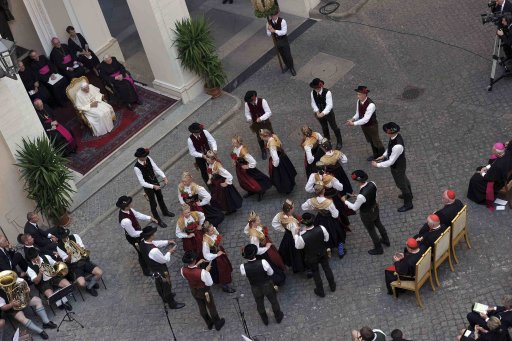
The present pope, we know, is a man of many talents. We usually think of these talents as primarily intellectual, even his taste in music is classical. No one ever told us that he was a marksman, albeit mediocre, or that he could yodel. The idea of yodeling the hymn ‘Andachtsjodler’ would go over big oncountry and western stations of the old school, no doubt. Google has many sung versions of this quite beautiful hymn that anyone can listen to. After listening to it, I can see why the pope added “if we can” as the music is quite lovely. On August 3, Cardinal Reinhard Marx of Munich arranged at the Pope’s Villa at Castel Gandolfo for an evening of music and friendliness in theHoly Father’s honor. In his remarks, the Pope said that he was truly dahoam, which means in German to be “at home.” He kidded Cardinal Marx a bit over the word: “I must compliment Cardinal Marx because he always pronounces the word (dahoam) so well.” The Holy Father took the occasion to recall his homeland. Bavarian culture is “a joyful culture.” It is not “rowdy” but it is “full of fun.” Anyone who has been to an Oktober Fest in Munich will have a suspicion of what this means.  Of the Bavarians, Benedict says, “we are not a boorish people.” He does not mean “amusement,” that they merely amuse themselves. The people are “joyful.” Benedict then reflects on why this joyful characteristic might be present in Bavaria.  “The joyfulness of the Bavarian culture is based on the fact that we are in tune with Creation.” That is an expression mindful of the English title of one of Josef Pieper’s books: A Theory of Festivity: In Tune with the World.  The good is ultimately “a person.” This is where true joy can only be located. For the Bavarians, Benedict adds, there is joy that God gave them a very beautiful land.  In such a place, it is easier to recognize the grandeur and goodness of God. But God did not just give the Bavarians a naturally beautiful land. Following the admonition of Genesis, He expected them to make it more beautiful. Benedict puts it this way: “Through the culture of the people, through their faith, their joy, their songs, their music and art it has become beautiful because the Creator did not want to make it beautiful by himself, but also with the help of men and women.”
Link (here) to the full article by Fr. James Schall, S.J. entitled Pope Benedict XVI, the "Mediocre" Marksman


Saturday, March 9, 2013

There’s Only Been One Theologian Publicly Chastised

Fr. Jon Sobrino, S.J.
So, is the long-awaited “Reagan Revolution” in Catholicism at hand? In thinking that through, five bits of perspective may be helpful. First, a cascade of disciplinary moves all at once can produce a misleading sense of proportion.
Measured over the full seven years of Benedict’s papacy, the total number of occasions when Rome has called someone on the carpet remains relatively limited. There’s only been one theologian publicly chastised by the Vatican on Benedict’s watch, the Jesuit liberationist Fr. Jon Sobrino of El Salvador in 2007. 
A handful of other cases, such as Sr. Elizabeth Johnson in the United States or Fr. Andres Torres Queiruga in Spain, have been handled by local bishops, and a few writers for publications sponsored by religious orders have had their wings clipped at Rome’s behest. Second, when discipline has been imposed, even by recent historical standards it’s often been fairly light. No one’s had their license to teach theology publicly yanked, as happened to Hans Küng in 1979, nor has anyone been fired from a teaching post at the Vatican's direction, as happened to Charles Curran at the Catholic University of America in 1987. For the most part, official censure of theologians these days typically takes the form of bad book reviews. Beginning in the 2000s, the Congregation for the Doctrine of the Faith informally adopted a policy of preferring to target ideas rather than people, on the belief that gag orders or firings often take the focus off the content of the case and put it on process. In the main, this approach has continued under Benedict XVI. (In Sobrino’s case, the congregation criticized the content of two of his books, but did not impose disciplinary measures.)
Link (here) to John Allan's full piece in "The Fish Wrap"

Friday, March 8, 2013

“Sent To The Frontiers, Under The Roman Pontiff”.


Reduction of Our Lady of Saint Ana
The South American country has been at the center of one of the biggest events of the pontificate of Benedict XVI. The Society of Jesus and the World Youth Day (WYD), in fact, have worked together for months at an exhibition on " Jesuit Reducciones" (Missions) in Paraguay. The exhibition speaks of the past and present, of how the Jesuits have been and are “sent to the frontiers, under the Roman Pontiff”.

The "reducciones" of Paraguay (1609-1769) were settlements of Guarani Indians promoted by the fathers of the Society of Jesus in the lands conquered by Portugal and Spain, with the desire to preserve their identity as people and vassals of the Crown.  The Indians, who lived according to their ancient customs, in the mountains, in small very distant groups, , came together through the initiative of the Jesuits to form settlements of about 5,000 people each. “Many will remember the “reducciones” in the film “Mission”, directed by Roland Joffe (1986), starring Robert De Niro and Jeremy Irons”, observes the Catholic news agency Zenit.

The “reducciones” have a complex context which during their exposure is analyzed in greater detail.  It has to do with the '"encomienda", a colonizing system which often disguised slavery, and the strong desire of evangelizing missionaries and collaborators who, in their mission, were not always able to respect the identity of the Guaraní, but managed to defend their freedom and dignity, because on many occasions “reducciones” were the only way to safeguard them.  Up to 30 “reducciones” of Guaraní peoples exited, stretching between the Parana and Uruguay rivers, in a vast territory that included regions that today are part of Paraguay and also Argentina, the south and south-east of Brazil, the south-east of Bolivia and Uruguay. The Jesuit “reducciones” did not stop with the Guaraní, because there were also people like the Moxos (1682) and Chiquitos (1691) of Bolivia, the Maynas (1637) of Ecuador and Peru and the Orinoco (1730) of Venezuela.

Weigal and Churchmice

Given the continuing confusion caused by Jesuit Father Thomas Reese’s assertion that the Note positioned Benedict XVI “to the left of Nancy Pelosi”
Link (here) to George Weigal's full piece entitled, Desperate Churchmice.

The Company Of Any Jesuit, Seminarie Or Otherwise Evil Affected Persons

Berkeley Castle in the town of Berkeley, Gloucestershire, UK
Licence to George, Lord Berkeley, to travel 
"beyond the seas with six servants and forty pounds in money, for one year, on condition that he travel not in any country that is not in league or amity with England nor use the company of any Jesuit, Seminarie or otherwise evill affected persons" to the State.
 Dat. 31 July, 2 Charles I. [1626} Signed at the top " Charles R."; with paper signet.
Link (here)

Worth Knowing And Worth Keeping

THE commandments are God’s Law. The observance of God’s Law means man’s happiness here and hereafter. Most people think of the commandments in terms of hereafter. The fact is they are the only means of happiness here. God made man to be happy and showed him how to be happy by giving him the commandments. When the world was made up of only two people, it was a happy world. But they spoiled it. They broke God’s rule of happiness, His commandments. It has been an unhappy world ever since. For men have followed the folly of the first man and woman and have tried to make a happy world by ignoring God’s Law. The result has been failure. God’s Law is a plan for human living, a way for human happiness. So God’s Law is worth knowing and worth keeping. 
The commandments were first given to Moses for the Jewish People. In their centuries-old history, they were happy when they kept them, unhappy when they violated them. When our blessed Lord came to Earth He proclaimed the commandments and made their meaning clear. His Church, which is His Living Voice and His Living Self, continues to proclaim them and explain them. There are ten commandments. Their message is love of God and love of fellow man. 
Love means action. If you love Me, keep My commandments. (John 14:15) Love means life, true life, a share in God’s Life. If any man love Me, My Father will love him, and we will come to him, and dwell with him. (John 14:23) We only really live when God lives in us. St. Paul expressed it: “I no longer live alone; God lives in me.” (See Galatians 2:20) Our Savior made it clear that we cannot live alone. Life without love is death. And there is no true love without the love of God as beginning, middle and end.
Link (here) to read the full article on the Ten Commandments by Fr. Gerald C. Treacy, S.J.

Thursday, March 7, 2013

A Spiritual Son Of St. Ignatius

The Holy Father Pope Benedict XVI delivered the eulogy at the end of the funeral of Cardinal Tomas Spidlik S.J., who died on 16 April at the age of 90. The funeral Mass was celebrated in St. Peter's Basilica by Cardinal Angelo Sodano, dean of the College of Cardinals.

  "The will of Jesus coincides with the will of God the Father and, along with the action of the Holy Spirit, represents a kind of secure, strong and sweet 'embrace' of man, leading him to eternal life"
, said the Pope.
  "I believe that the great men of faith live immersed in this grace, that they have the gift of perceiving this truth particularly clearly, and that they can thus undergo harsh trials, just as Fr. Tomas Spidlik did, without losing their trust; rather, they retain a sense of humour, which is certainly a sign of intelligence but also of inner freedom".
Benedict XVI went on: "In this context, there was an evident resemblance between the late cardinal and the Venerable John Paul II: both were wont to make jokes though having suffered difficult, and in some ways similar, personal circumstances in their youth. Providence led them to meet and work together for the good of the Church, with the particular aim that she might learn to breathe fully 'with both her lungs', as the Slavic Pope liked to say.

  "This free and ready spirit had its objective foundation in the Resurrection of Christ", the Holy Father added. 
"The hope and joy of the risen Jesus are also the hope and joy of His friends, thanks to the action of the Holy Spirit. Fr. Spidlik demonstrated this regularly in the way he lived, and his witness became ever more eloquent with the passing of the years because, despite his advanced age and inevitable health problems, his spirit remained fresh and youthful. What is this, if not friendship with the risen Lord?"
In choosing "ex toto corde" (with all my heart) as his motto, the cardinal placed "his life within the commandment to love, inscribing his entire existence in the primacy of love and of charity". The words "phos" and "zoe" (light and life) on the cardinal's coat-of-arms "are names of God", the Pope explained. "Thus the man who fully 'ex toto corde' accepts the love of God, accepts light and life, and becomes in his turn light and life in humankind and in the universe".

  Benedict XVI concluded his eulogy by recalling Cardinal Spidlik's membership of the Society of Jesus (Jesuits). "In other words", he said, "he was a spiritual son of St. Ignatius who placed the contemplation of God in the mystery of Christ at the centre of faith and spirituality. In this symbol of the heart, East and West come together, not in a devotional but in a profoundly Christological sense" 
Link (here) to the Vatican Press Office.

Superior General And Holy Father Speak Of Radical Change In Priestly Formation

Superior General Adolfo Nicolás also told the provincials that Pope Benedict XVI sought the help of the Society for the integrated formation of priests and stressed the need for a radical change in priestly formation during a “one-on-one” meeting he had with the pope.
Link (here) to Jesuit.org

Holy Father Names Jesuit Bishop In Puerto Rico

Bishop Alvaro Corrada del Rio, S.J.
Pope Benedict XVI has appointed Bishop Alvaro Corrada del Rio of Tyler, Texas as bishop of the Diocese of Mayaguez on Puerto Rico’s west coast. Bishop Corrada, a Jesuit, was born in the Santurce district of the Puerto Rican capital of San Juan on May 13, 1942. He is the seventh of 14 siblings. He was appointed an auxiliary bishop of Washington in 1985, becoming the first Puerto Rican native to be named a bishop for the U.S. mainland, according to the U.S. bishops’ conference. He served as apostolic administrator of Caguas, Puerto Rico in 1997 and was named Bishop of Tyler in 2000. Bishop Corrada succeeds Bishop Ulises Aurelio Casiano Vargas, whose retirement-age resignation Pope Benedict has accepted. The Diocese of Mayaguez has 502,515 people, about 80 percent of whom are Catholic. It has 66 priests, 26 permanent deacons and 132 vowed religious. Bishop Corrada studied at Jesuit seminaries in Poughkeepsie, New York; Shrub Oak, New York; and New York City. He earned a bachelor of arts degree from Fordham University and was ordained a priest in 1974. After ordination he completed course work for a doctoral degree in theology at the Institut Catholic in Paris. He has taught at Colegio San Ignacio in Rio Piedras, Puerto Rico and at Xavier High School in New York City. In the late 1970s he served as a retreat master and director of the marriage renewal movement at Casa Manresa Retreat House in Aibonito, Puerto Rico. He was assistant pastor at Nativity Parish in New York City from 1979 to 1982 and then served as pastoral coordinator of the New York-based Northeast Catholic Hispanic Center from 1982 to 1985. He has counseled Hispanic inmates at Riker’s Island Prison Center in New York and has served as a lecturer at the Metropolitan Museum of Art.
Link (here) to Catholic News Agency

Thus Shall You Pray

In the Our Father, we have not merely a plan for addressing God, a formula of prayer, but a command: ‘Thus shall you pray’. Prayer is the expression of our attitude towards God. Our Lord says, ‘This is the way you’ve got to ask God for things — this is the way you’ve got to think of God and address him; the way I wish you to approach him.’  Take the Lord’s Prayer in that sense. ‘What is God to you?’ says our Lord; and he begins ‘Father’.  Saint Thomas Aquinas says that we are entitled to take as intended for us every meaning of our Lord’s words and actions which they will legitimately bear. Therefore, we must take God as an ideal father. ‘I am your Father; I want you to think of me as your Father; and not merely to think of me but to know that I am your Father.’ Look at a little child and his father; he receives all he has and is from his parents, but quite soon goes on independently of them. But that is not the way between me and God.
At no instant of my existence am I independent of God. My existence is the result of God’s will that I should exist. I could not be thinking about it if God wasn’t thinking of me at this very moment. I’m never out of his sight, will, thought. I am utterly dependent on him for every single thing I can give a name to in myself. God goes on giving all the time. He does not cast out gifts as you throw grain to chickens, for some to get a lot and some to get none. Although his gifts pass into my hands, they never leave his hands. Any good thing we can say of creatures we can say in an infinite degree of God. As a child thinks there is no one more beautiful than his mother or more magnificent than his father, so that is the way we have got to think about God. 
Who feeds the birds of the air, paints the flowers, gives them their lovely form? God your Father! And if God clothes the fields like this and cares for the little sparrow, what about you? God is my Father to whom, with complete, utter, and absolute confidence I turn, because I know that he has nothing but my happiness in his heart. Like a child, I shed tears because I have not got what I want, and even stamp my foot, but I know this is only a passing thing. I am going to rely on God, never mind what anybody says. ‘They say.’ — Who say? Let them say! The concept of a father, parent, one from whom we receive things, is multiplied infinitely in God. So I want to be thanking God for everything, as if it were happening at this very instant: my very being — not long ago, but now, he is keeping me in existence. I should have an attitude of thankfulness — inexhaustible — for everything. What have we that we have not received — are not receiving? So the first idea of the Lord’s Prayer is the thought of God giving and giving and going on giving. 
We call it the ‘Our Father’, and it seems to bring it closer to us than the title, ‘The Lord’s Prayer’, although that is good, as it reminds us that God has given it to us. But it is ‘Our Father’ which should create the atmosphere of the immeasurable closeness of God to us. Think what you owe to God: your very existence he is giving you at every moment. Many people go through life thinking of God as a benevolent being, like a Constitutional Sovereign. No, that is completely off the line. I am as much to God as if I were his only creature. The dependence of the creature on the Creator has no parallel in this life, and you can never understand a thing unless you have something to compare it with. Nothing in this world is dependent as we are dependent on God. 
Some people are terrified by that and say they feel suffocated! But Saint John said, ‘God is love’. So I must not think of God as an ‘All’ producing these little creatures and going on producing them, but as One who is love. All his acts are love; and it is out of his love for me that he designed me and goes on creating me. God is simple. In Him, everything is one in some mysterious way we cannot understand, and therefore everything is involved in that love of his for me. You may say that is reading a lot into God’s title of Father. Our Lord invites us to think of God as Father, in whom we have our being. We have a word for it — Creator: Creation does not mean forming something out of something else, but out of the will of God, and the will of God is the love of God. I am, and everything else is or does because at this instant God wills it to be so. And when I say ‘why?’ the answer is love. 
Fatherhood implies love; it is the utterance of love, the starting point, the aim of love. Love has a host of different degrees. It is an expression of will: ‘I wish this, I prefer that, I love this more than the other’. All these different words we use are degrees of love, meaning that love is the expression of the will. I only exist from instant to instant because from instant to instant, (though there is no time with God) God loves me. Since the Incarnation, there is specially a bond of love tending towards identification. ‘With an everlasting love I have loved you.’  
‘The fear of the Lord is the beginning of wisdom.’ But fear must not be taken to mean fear in the craven sense. We are inclined to think we must be afraid of offending God — that God sees our faults and weaknesses more than our good, and that therefore our attitude must be one of always asking forgiveness. But what is the attitude of a really good father and mother? Are they always looking out for faults? ‘What is he up to now?’ No: they think of the good things in their child, take pleasure in him. So God takes pleasure in us. I am an object of delight to God, and he looks on me with a smile, as it were. I know I am dirty, that I have torn my clothes, and my hands are grubby, but God does not look out for that. ‘My delight is to be with the children of men.’ That is what gives me the sort of liberty with God that the saints had. We know there are bad parents who are always metaphorically slapping their children, who are always correcting them and so on, but we all know too how children can be injured by that sort of nagging. The really good parent does not nag, but gives the most loving explanation of what the child does. The reaction is that they obey their parents more. I am happy in the knowledge that God judges me so lovingly. ‘Perfect love castes out fear’; and therefore, God, representing himself as a father, says: ‘Don’t be afraid of me but trust me to the very limit’. Our Lord says: ‘Think of him, talk to him as a father; I who am one with the Father tell you that is the right attitude.’ I am giving something to God that he would not have without me. I am giving him his Fatherhood of me. I can say, ‘You are my Father, therefore I am your child’. I don’t like those prayer books that ask us to look upon ourselves as grains of dust or worms! I cannot at the same time call myself a beloved child of God and a worm. I want to imbue myself with the conviction that God is my loving Father. People setting out on the spiritual life think what it is going to involve: a long frightening vista of mortification, self-denial, humility, charity. What a labour in the saints! What marvelous perseverance and courage and faith and hope had to be brought into play every instant of their lives; and I am discouraged and say ‘It can’t be!’
One has heard of people saying they wished they did not believe in God because it was a torment to think how perfect they ought to be, and how frightfully difficult it was. And so, looking forward to growth in holiness, getting closer to God, I always have the idea that the growth is on my part, that I have got to labor for it, and that God is there but I have got to shorten the distance between us. Well, if (instead) I get this idea of God eagerly getting to me, if I think of Christ’s idea of the Father, I know that God is laboring to get to me; and why he has to labour is because it is I who make the obstacles. ‘If only you’d “be still” and let me come to you!’ one can imagine God saying. 
No one ever suggested that the Christian life was an easy one — that sanctity was easy to attain. The ‘Our Father’ shows us the closeness and immeasurable love between us and God — God who loves us as a Father loves his children; who will not let us go; up to the limit of our free wills drawing us. There we have the establishment between God and ourselves of an intimacy such as is feebly paralleled by the relationship between a child and its parents. Anyhow, our Lord says ‘Father’, and without any further comment leaves it to us.
Link (here) to the full reflection on the Our Father by Fr. R. H. J. Steuart, S.J.

Tuesday, March 5, 2013

Lead Us Not Into Temptation — But Deliver Us From Evil

The clause in the ‘Our Father’ that presents itself is ‘Lead us not into temptation’. The beginning of the ‘Our Father’ is a prayer, not so much that his will might be done directly as that we may really and truly wish it to be done. I ask to be enlightened, that my will may be strengthened, that I may always want to do ‘Your will’; I want it as perfectly as I know I shall want it in heaven.

From ‘Give us this day our daily bread’ onwards, we pray for protection from sin, from the danger of falling away from God. We are so liable to be drawn away by the fascination of trivialities. I ought to want even to deprive myself of perfectly innocent pleasures in this world if thereby God’s will be better done. And I want, too, to be protected from falling into sin. Why is it that we ask, ‘Forgive us our trespasses’? Why is it that we make that petition? Because we are aware that since sin came into the world it has spread itself all over the world. As God saw the world, he saw that it was good; it is an utterance of himself, and any man not seeing this is absolutely inexcusable. The world was good and was meant to be good, but through that thing which you would think was impossible, sin, the goodness of the world has been perverted, distorted; just as a razor or knife may be perfect, and may yet on account of its keenness be misused, so all the beauties, marvels of the world may be lethal weapons if misused. Sin is, in a way, the misuse of what is good.

Saint John says: ‘If any man thinks he is without sin the same deceives himself and the truth is not in him’. The sense of sin is one of the greatest forces of sanctification. Why are we sceptical about saints who said they were sinners when they had attained a heroic degree of sanctity? Was it a pose, a mistake, that made them say: ‘If only the world knew what I am really it would stamp me in the mud’? The saints knew that even the highest human perfection is tainted with sin, just because we are in a world filled with sin.

What is sin? Sin is idolatry — the substitution as the object of my will of something which is not God. ‘Why did you do that?’ — Because it appealed to me. ‘Did you know that doing it meant thrusting the will of God aside — at least for the time being?’ That is the main difference between mortal sin and venial sin. In mortal sin, I deliberately turn aside from God altogether, for the sake of the gratification of the thing I want to do. In venial sin it is not so much that I substitute something for God as that I want it with him. The average man will say: ‘I will not do anything that will make me lose God, but I do want a lot of things besides God so long as I don’t lose him’. But the saint says: ‘I don’t want anything at all besides God’. ‘What have I in heaven and besides You what do I desire upon earth?” Every time I sin, to the extent to which it was a deliberate sin, the whole world is the worse for it; moreover, it is a matter which has been proved over and over again, that constant giving way to sin produces a general deterioration in one’s will towards God. That is why reasonably frequent confession is such a healthy thing, because it is a sort of divine check on that deterioration.

Our Lord’s dealing with the Syro-Phoenician woman teaches us that we are to go to him with our petitions, as a child to a father. Ask what you like, but always ask with submission to God’s Will. Let it be a childlike appeal to a Father: ‘Don’t let me do things that displease and hurt you — don’t let me get into bad ways — don’t let me be led into temptation’. The time comes in the life of a sinner when self-indulgence is so great that he cannot stop; ‘Don’t let me get like that, Father’.

This last part of the ‘Our Father’ ought to come very close home to us. We are prone to choose sin; we are prone to choose evil; silly, nasty things even, instead of God. But I don’t want to do anything which is evil before God. I am sorry for all those things that have been done; that even in a small detail I have preferred something to God: ‘Let him that thinks he stands take heed lest he fall’ (1 Corinth 10:12). And I pray (as he wants me to pray) that God in his mercy will not allow too great a strain to come upon my will, and that he will protect me from evil and the Evil One. ‘Ne permittas me separari a te’ (‘Never permit me to be separated from You’).

So I implore God not to put too great a strain on me: not to let me get into too difficult a situation. I know that God is merciful and loving; he won’t let the situation be too much for me. That is why I say: ‘Lead us not into temptation and deliver us from evil’, or, as some translations have it, ‘from the Evil One’.

However modern we are, it won’t do to forget there is an Evil One. It is not as if two gods, a good and an evil, were contesting for me. No, the devil is a creature as I am, but one entirely perverted to evil, and moreover with powers of expressing himself and various activities in comparison with which ours are like the physical strength of a baby as against a boxer. What chance has a man got against a tiger?

Yet I don’t want you to think of the devil as a gigantic monster prowling round, but as a personal force directed to my harm and nothing else. On the other hand, don’t let us attribute omnipotence to the devil. The devil cannot read our minds; but still he is an extremely dangerous adversary, more dangerous than our own concupiscence. A subtle, entirely spiritual enemy, almost, it seems to us, unlimited in power, a force directed to my destruction. Well, now, is not that ‘deliver us from evil’ absolutely necessary? What can I do about it? O God, protect me from this army directed against me. From this thing that ‘walks in darkness, and the horror of the night and the arrow that flies by day’. And the answer? ‘He has given his angels charge over you lest you dash your foot against a stone.’
Link (here) to the full article by R. H. J. Steuart, S.J.

Monday, March 4, 2013

The Stone Of Unction

Jesus laid upon the "Stone of Unction"
A few years ago a little boy was dying, aged nine and a half. His mother, broken-hearted, was kneeling by the bedside. “When you go up to heaven, son,” she said, “you’ll ask Our Lord to send something to mother, won’t you? And what will it be?" There was a short pause and then the child, gasping for breath and holding mother’s hand, managed to murmur: “When I go up to heaven, I’ll ask Our Lord to send you much — suffering and pain!” Of course, the mother was dumbfounded, but the little lad continued:  
“Yes, mother. I’ve noticed that He kept a lot of it for Himself, and gave a lot to His own Mother whom He loved. It must have a great value then. If He couldn’t find anything better for His Mother could I ask Him anything better for you?” 
Often when the cross presses heavily upon our shoulders we are inclined to ask querulously what have we done against God to deserve to be punished so. Such a question dies away on our lips if we kneel on Calvary in the thirteenth station. Nicodemus and Joseph are taking out the nails from the hands and feet; for Jesus is dead. Reverently they lower the sacred Body and Mary stands there in mute agony to receive It into her arms. Between them, they bear this treasure over to the “Stone of unction” — a table of hard stone, convenient for the work of embalming. Some horsemen, tradition says, pass by while the friends of our Lord are washing His wounds and embalming the Body, and horrified at the sight of His mangled condition, they stop to ask what He has done to deserve this. The answer is that He has done all things well, but He has submitted to this unparalleled butchery because He loved. That is the only explanation. And as Mary sits there watching, holding His sacred head between her hands, pressing the wounds to her heart — now His hands, now His lips — ask her, and the answer is the same. Mary loved, and Mary’s love too must be subjected to love’s most searching test — readiness to suffer for the sake of the one loved. 
She must share in men’s salvation; she must be given opportunity to show her love for them, and for the Father’s glory, so she too is permitted to suffer to a degree impossible for us to fathom or guess. 
You can ask any chance acquaintance to perform a service that costs little or nothing — to open a door or drop a letter in the post-box. But if your request is going to make demands on his spirit of self-sacrifice — if it implies that he must hand you a large sum of money, or necessitates his denying himself a holiday or a free day, or if it will mean that he must endure for you hunger or thirst — if your request is going to include any of these things you are not going to turn to a chance acquaintance. 
If you have a true friend and his adoption tried, to him you will go, confident that he will do what you want, even at such a cost to himself. And your confidence is built up on the knowledge you have that sacrifice is the test of love. We prove our love for Christ by prayer,  by works of zeal, by organising sodalities and similar associations, but there is a proof more sure than all these or any of these.
 It is especially when He turns to us and asks us to suffer that He shows He can depend upon us to give the proof par excellence.
Link (here) to They Crucified Him by Fr. RobertNash, S.J.

Sunday, March 3, 2013

Fr. Albert Power, S.J., "Papacy Is A Tribute To The Unshakeable Strength Of The Catholic System"

Pope Benedict XV
think of the two doctrines that are most characteristic of Catholicism and that have been exposed to the fiercest attacks of her enemies - namely, the authority of the Pope and the Real Presence of Christ in the Eucharist; and see whether these doctrines play a less intense part in the life of the Church in the twentieth century than they did in past ages. I think I am safe in saying that at no period of the Church's history have these two factors of Catholicism - the Papacy and the Eucharist - been so strongly emphasized, so honourably recognized, so passionately clung to and defended as they are today.
A vivid and palpable proof of the part which faith in the Eucharist plays in Catholic life is furnished by the great International Eucharistic Congresses of the past forty years, held in capital cities all over the civilized world. The success of these Congresses surpassed the wildest dreams of those who suggested them. Never in the long history of the Church have there been - at least outside of Rome - such magnificent public demonstration of Catholic belief in the Real Presence of Christ. That same intense belief is also responsible for the extraordinary increase in daily Communion since the great Eucharistic decree of Pope Pius X. made frequent reception easy for all the faithful.
Then, too, the events of the past fifty years, especially the happenings during the Great War and the world wide recognition of the splendid work and influence of Pope Benedict XV., and of our present Holy Father, PiusXI.; furthermore, recent events connected with the restoration of the temporal power and the recognition of the fact that the Pope, as head of a vast spiritual organization, including in its ranks men of every nation under heaven, must himself be quite independent, owing allegiance to no temporal sovereign, in order that he may be an impartial ruler of all - these events emphasize the unique position accorded to the Pope even by non-Catholics the world over. When we add to this the deep and special reverence and submission shown to him by the three hundred millions of his own subjects, one may well ask: On what foundation does this extraordinary dignity of the Pope rest - this majesty authority recognized in one man alone of the whole human race? The answer is: On the Catholic doctrine of the Pope's right to teach and rule as the successor of St. Peter. It is Catholicism that gives him his strength, and the honour paid by the whole world to the Papacy is a tribute to the unshakeable strength of the Catholic system, of which the Pope is the living embodiment. 
Link (here) to read the full piece by Fr. Albert Power, S.J.

Saturday, March 2, 2013

Fr. Bakewell Morrison, S.J., "The Sign Of The Cross"

“Why do we Christians so often and so obviously make the Sign of the Cross, and what is the dogma?” And we are seeing something of the efficiency which the Church hopes we will introduce, or increase, in our own usage. We might right now try making the Sign of the Cross on ourselves, first remembering the purifying and cleansing meaning of the salt which has been tinged into the holy water, at its blessing. We first dip our fingers in the blessed and blessing water. Then we make the sign and say the words. Cardinal Newman  has notable verses on the sign.

“Whene’er across this sinful flesh of mine I draw the sacred sign,

All good thoughts stir within me, and renew

Their slumbering strength divine;

Till there springs up a courage high and true to suffer and to do.

And who shall say, but hateful spirits around,

For their brief hour unbound,

Shudder to see, and wail their overthrow?

While on far heathen ground

Some lonely saint hails the fresh odour, though

Its source he cannot know”

(Verses on Various Occasions, xxvii Oxford, 1832).

We can, as we all too well know, grow weary at our prayers. We can become suspicious of vain repetitions, as they may be dubbed. Yet Pius XII so strongly urges us to remember that “progress in the Christian life does not consist in the multiplicity and variety of prayers and exercises of piety, but rather in their helpfulness towards spiritual progress of the faithful and constant growth of the Church universal.” So we may well try to make the simple Sign of the Cross be in a way the first of prayers, and have it spring into luxuriant meaning. Then with this tiny prayer of words and a sign we mightily increase in understanding and so grow in force of will. We do need right constantly to remember: “It is not he that says, ‘Lord, Lord!’ But he that does the will of My Father!” And, if our wills are to be at one with God’s, our intellects are to be rich and well stored from God’s, knowing the faith and hope that is in us, and eager for God’s charity.
Link (here) to the full article by Fr. Bakewell Morrison, S.J. entitled, "I Use the Sign of the Cross"

Fr. John Navone, S.J., "Faith Directs Itself To Reason, And That Reason Is A Reality That Is Not Invented By The Human Mind."

John Paul II, in his encyclical Ex Corde Ecclesia, asserts that Christian professors and teachers must “set the content, objectives, methods and results of their (teaching and) research within the framework of a coherent (Christian) world vision.” 1 Richard John Neuhaus states that “A Christian university will settle for nothing less than a comprehensive account of reality. Not content with the what of things, it wrestles with the why of things; not content with knowing how, it asks what for. Unlike other kinds of universities, the Christian university cannot evade the hard questions about what it all  means. Therefore, theology and philosophy are at the heart of a Christian university.” 
Christian faith is a guide to philosophy. Not all philosophies reach the reality that is. Faith directs itself to reason, and that reason is a reality that is not invented by the human mind. We did not fabricate the mind we have that thinks. We are to use it. We invent neither it nor reality.
Surely something has to be said about the wonderful intelligibility of the universe, as assumed and verified by science, in the full context of God as primary cause. Part of the mileage theology gets from the scriptural datum, that the human images the divine, is the insight that our understanding of the universe is the exercise of a created logos mirroring the divine Logos. It is a step from this realization to Augustine’s notion that it is the graced logos in us that is capable to recognize the Logos in Jesus Christ.
Link (here) to the full article by Fr. John Navone, S.J. at Homiletic and Pastoral Review

Friday, March 1, 2013

Jesuit Doctor Of The Church On Papal Spiritual Supremacy

St. Robert Francis Romulus Bellarmine, S.J.

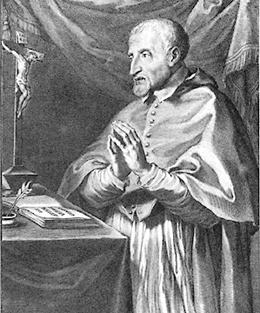
Early in the 17th century, Saint Robert Bellarmine, S.J. found himself at the center of an international controversy over clerical exemption. Several years earlier, in 1599, he was pressured into justifying exemption on more solid natural law grounds rather than treating it as mere human invention. Clerical exemption was a central issue in the Venetian Interdetto controversy of 1605-07, when Pope Paul V excommunicated Venice for violating ecclesiastical prerogatives. Bellarmine was caught in the middle. On one side were theologians ,like Paolo Sarpi, who argued that clerical exemption was of human origin and, therefore, clergy were subject to secular law. On the other side were papalists, who defended the divine origin of clerical privilege, like the Spanish jurist, Francisco Pena. Though he disapproved of the Interdetto, Bellarmine was drawn into the debate on the side of Rome, primarily to defend himself: first, against critics like Sarpi, who used his own theories to limit papal temporal power; and, second, against Pena, who blamed him for providing theoretical ammunition to the Venetians. This, argues Tutino, was a challenge for Bellarmine, whose insistence on the separate jurisdictions of temporal and spiritual authority, left unclear under what conditions a pope’s intervention into earthly affairs, on behalf of souls, might be justified.
The Venetian Interdetto was only one of several international crises that marked Bellarmine’s career. The second was the growing threat of royal absolutism to the spiritual jurisdiction of the Church. Bellarmine decided to refute the absolutist claims, contained in: The True Law of Free Monarchies (1603) by King James I. Tutino argues that Bellarmine saw this text as a new political and theological challenge to the Church—and to his own political theology. James’s Protestant-sounding arguments were aimed at strengthening the crown at the expense of the Church, and constituted a new kind of heresy, one that went beyond the claims of his Tudor predecessors. The Stuart monarch was not merely a threat to the Catholics of England. His vision, of absolute temporal sovereignty over the spiritual authority of the Church, could spread across the continent. Indeed, the king directed his ambassadors to distribute copies of his book to receptive state officials in Catholic, as well as Protestant, capitals. The danger posed by James was not limited to his book, however. The controversy over the “Oath of Allegiance,” offered Bellarmine a new opportunity to defend papal spiritual supremacy. Imposed in January 1606, after the Gunpowder Plot was foiled, the Oath required English Catholics to deny the pope’s power to excommunicate and depose the king, asserting the latter’s primacy over spiritual affairs. James was not the only one from across the English Channel to defy Bellarmine. Scotsman, William Barclay, was the leading “divine right” theorist of his day, according to John Locke, and a professed Catholic, who taught civil law in France until his death in 1608. Barclay’s De potestate Papae was published in England the following year. Widely praised at the Sorbonne and elsewhere, his book explicitly challenged Bellarmine’s theory of potestas indirecta by denying the incommensurability of the temporal and spiritual jurisdiction, thereby elevating the sovereign to the same level as the pope. Bellarmine once again had to defend potestas indirecta, while fending off papalist critics like Pena, who believed his theory of papal primacy too modest to be effective against the enemies of Rome. Bellarmine’s refutation of Barclay is published in Tutino’s On Temporal and Spiritual Authority.
Link (here) to read the full article at Homiletic and Pastoral Review by John M. Vella

Pere Jean Leunis, S.J.

Pilgrims from across Europe will be retracing the steps of a 16th century Jesuit through Europe this April, as they prepare to celebrate the 450th anniversary of the Christian Life Community (CLC).
In 1556 Jean Leunis made a pilgrimage from Liege in Belgium to Rome to meet Saint Ignatius and to join the Society of Jesus. Six years later in Rome, Leunis founded 'Prima Primaria', which was the origin of the Sodality of Our Lady and the CLC. The 2013 pilgrimage - 450 years later - will be to emulate Leunis' journey to the foundation of what is known as the Ignatian lay companions.
The Pilgrimage is a great Catholic time-honoured tradition that came from the very roots of the Church. In a general way it reminds us that we are essentially pilgrims in life. Those who are influenced by Ignatian spirituality in particular follow Jesus in a particular road under the flag of the Eternal King, with the Spiritual Exercises of St Ignatius representing an internal pilgrimage divided in four stages or 'weeks' to find God's Love and answer His call. As part of the celebration of the Jubilee year of the 450th anniversary of the Ignatian Lay Communities, there will be one pilgrimage in four short stages, beginning in Belgium on 6 April. Further stages will take place in Switzerland and France, before the pilgrimage concludes in Rome with a Solemn Mass at which the Superior General of the Jesuits, Fr Adolfo Nicolás SJ, who is also the World Ecclesiastical Assistant of CLC, will officiate. 
It was in 1563 that Jean Leunis, a Jesuit teacher, gathered a group of students of the Roman College for spiritual advancement, leading to the foundation of the Marian Congregation - or Sodality of Our Lady: a sodality is a group within the Universal Church which engages in a specialized task or common mission. The boys of the original Sodality agreed to daily mass, weekly confession, monthly Communion, a half-hour of meditation each day and to some other pious exercises. 
They would also commit themselves to some form of service to the poor. Today, the Christian Life Community is an international association of Christians, men and women, adults and young people, of all social conditions, who want to follow Jesus Christ more closely and work with Him for the building of the Kingdom. Membership is made up of small groups, which are part of larger communities organized regionally and nationally, and which together form one World Community. The CLC is present in all five continents, in almost 60 countries - including the UK
Link (here) to ICN

Thursday, February 28, 2013

Fr. Gustave Weigel, S.J., On Billy Graham

"What to Think of Billy Graham" is the title of an article in America, 4 May 1957, by Father Gustave Weigel, S.J. a student of modern Protestant theologies. This is perhaps the most competent evaluation of Dr. Graham and his "crusades" that I have seen, but, unfortunately, much of it would be lost on many people. Father Weigel is a learned and widely-read man and a deep thinker. His tribe is not great. Nevertheless, there is much in the article that is clearly and simply expressed. Father Weigel sees three elements in Dr. Graham's popularity: "current interest in religion; the revival tradition; Graham's streamlining of the revival framework." The last two elements are explained at some length. Father Weigel pays generous tribute to Dr. Graham's sincerity: 
"The man himself is not eccentric in any way whatever. No one has ever questioned his seriousness and sincerity. Nor can he be accused of preaching the gospel for filthy lucre's sake." 
Then Father Weigel raises the fundamental question of authority. What right has Dr. Graham to tell anyone what is Christian truth? Mr. High, in the first books mentioned above, labours mightily in chapter two to explain how Dr. Graham "can be so sure." This is not such a difficult question. It is individual and personal, and the answer to it explains Dr. Graham's sincerity. But does Dr. Graham tell us with authority what the Bible means - what is the authentic and complete message of the inspired Scriptures? Certainly not. 
"Graham's sincerity is no guarantee of the accuracy of his understanding." What has he, then? "He says, in effect, that he has found his own life transformed by an act of trust in the message he has sincerely extracted from Bible-reading." 
This comes down to saying: "It is true because it worked for me." Father Weigel's examination of the question is much more extensive than I have indicated. He tries to examine every aspect and to show exactly what is involved. There can be no satisfactory answer to Fr. Weigel's arguments.