Showing posts with label Doctor of the Church. Show all posts

Wednesday, July 17, 2013

St Robert Bellarmine, S.J., " For It Was Fitting That If The Son Of God Wished To Become Son Of Man He Should Be Born Only From A Virgin,"

Lodovico Carracci "The Trinity with the Dead Christ"
The first testimony is the confession of Peter from the revelation of God the Father, Matthew ch.16, Thou art the Christ, the Son of the living God.” Note here that Peter asserts that Christ is the true and natural Son of God, for that is why he added ‘living’, because it is proper to living things to generate for themselves something a like in nature. And it is confirmed from other places, for in John ch.3 Christ is said to be “the only begotten Son,” Romans ch.8 he is called “proper Son,” I John ch.5 he is called “true Son,”  Colossians ch.1 and Hebrews ch.1 he is called “natural” for he is called the image or the type of the paternal hypostasis, which does not belong to adoptive sons. Again in the same place he is called a Son such that with respect to him the angels are called servants, who however are otherwise adoptive Sons of God, and indeed chiefly so. Next, Christ is accused of having preached that he was the Son of God, John19, “For we have a law and according to the law he ought to die, because he made himself the Son of God.” And it is certain that he was not accused of having made himself adoptive or metaphorical Son of God, for even the Jews say, “We have one Father, God,” John ch.8. And yet Christ did not dilute this accusation but as it were admitted it, and in that confession he wished 39 But if he is true, proper, only begotten, natural Son, then he is begotten of the substance of the Father; but he did not receive a part of the substance, because God is without parts, therefore he received the whole of it, therefore he is one God in number with the Father. The Transylvanian ministers and Blandrata reply that Christ is true and proper Son of God because he was conceived from the Holy Spirit, and they prove it from Luke ch.1 where it is said, “The Holy Spirit will come upon you and the virtue of the Most High will overshadow you, and therefore the holy thing that is born from you will be called the Son of God.” But on the contry, for even Adam, Eve, and all the angels were not born of the seed of man but are directly the work of God. How then is he called only begotten Son? Second if for this reason Christ is Son of God because he was conceived in the womb of a virgin by the work of the Holy Spirit, then he could be called the Son of the Holy Spirit; but Scripture never says this, nay on the contrary it says that the Spirit proceeds from the Son, John ch.15 and elsewhere. Third, this is not to be natural and true Son, for God did not generate Christ from his own substance in the womb of a virgin but from the substance alone of the Virgin; hence in Hebrews ch.7 Christ is said to be without father and without mother, that is, without father on earth and without mother in heaven, as all the Greeks and Latins expounded. To the place of Luke ch.1 I say with Ambrose, Gregory, Bede, Bernard that the virtue of the Most High is the Word of God which descended into the womb of the Virgin, and there put on flesh, and therefore the Son of Mary is called the Son of the Most High. It can also be said that conception from the Holy Spirit is a sign, not a cause, that Christ is called Son of God. For it was fitting that if the Son of God wished to become Son of Man he should be born only from a virgin, and if a virgin were to give birth, she should give birth only to God, as St. Bernard rightly said. Further, Jacob Palaeologus, who, although he was one of the chief doctors of the new Samosatans, at length at Rome, as we said above, was converted to the true faith, not only made no account of our argument but turned it back against us by means of this reasoning: any true Son of God cannot be true God; but Christ is true Son of God, therefore he is not true God. And this syllogism (as I have often heard from him) he used to boast was a very firm demonstration, even though I said to him that the major proposition of the syllogism is so false that the contrary is most true. For as the true son of man is true man, the true son of a lion is true lion, and in all others in like manner, so too the true Son of God must be true. 
Link (here) to the full book by St Robert Bellarmine, S.J.  entitled,  Disputations about Controversies of the Christian Faith against the Heretics of this Age, first published at Ingolstadt in 1581,1593 and republished several times thereafter.
The Latin text can be downloaded from Google books: 

Friday, March 1, 2013

Jesuit Doctor Of The Church On Papal Spiritual Supremacy

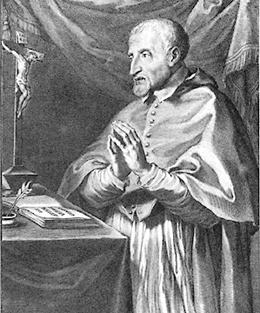
St. Robert Francis Romulus Bellarmine, S.J.

Early in the 17th century, Saint Robert Bellarmine, S.J. found himself at the center of an international controversy over clerical exemption. Several years earlier, in 1599, he was pressured into justifying exemption on more solid natural law grounds rather than treating it as mere human invention. Clerical exemption was a central issue in the Venetian Interdetto controversy of 1605-07, when Pope Paul V excommunicated Venice for violating ecclesiastical prerogatives. Bellarmine was caught in the middle. On one side were theologians ,like Paolo Sarpi, who argued that clerical exemption was of human origin and, therefore, clergy were subject to secular law. On the other side were papalists, who defended the divine origin of clerical privilege, like the Spanish jurist, Francisco Pena. Though he disapproved of the Interdetto, Bellarmine was drawn into the debate on the side of Rome, primarily to defend himself: first, against critics like Sarpi, who used his own theories to limit papal temporal power; and, second, against Pena, who blamed him for providing theoretical ammunition to the Venetians. This, argues Tutino, was a challenge for Bellarmine, whose insistence on the separate jurisdictions of temporal and spiritual authority, left unclear under what conditions a pope’s intervention into earthly affairs, on behalf of souls, might be justified.
The Venetian Interdetto was only one of several international crises that marked Bellarmine’s career. The second was the growing threat of royal absolutism to the spiritual jurisdiction of the Church. Bellarmine decided to refute the absolutist claims, contained in: The True Law of Free Monarchies (1603) by King James I. Tutino argues that Bellarmine saw this text as a new political and theological challenge to the Church—and to his own political theology. James’s Protestant-sounding arguments were aimed at strengthening the crown at the expense of the Church, and constituted a new kind of heresy, one that went beyond the claims of his Tudor predecessors. The Stuart monarch was not merely a threat to the Catholics of England. His vision, of absolute temporal sovereignty over the spiritual authority of the Church, could spread across the continent. Indeed, the king directed his ambassadors to distribute copies of his book to receptive state officials in Catholic, as well as Protestant, capitals. The danger posed by James was not limited to his book, however. The controversy over the “Oath of Allegiance,” offered Bellarmine a new opportunity to defend papal spiritual supremacy. Imposed in January 1606, after the Gunpowder Plot was foiled, the Oath required English Catholics to deny the pope’s power to excommunicate and depose the king, asserting the latter’s primacy over spiritual affairs. James was not the only one from across the English Channel to defy Bellarmine. Scotsman, William Barclay, was the leading “divine right” theorist of his day, according to John Locke, and a professed Catholic, who taught civil law in France until his death in 1608. Barclay’s De potestate Papae was published in England the following year. Widely praised at the Sorbonne and elsewhere, his book explicitly challenged Bellarmine’s theory of potestas indirecta by denying the incommensurability of the temporal and spiritual jurisdiction, thereby elevating the sovereign to the same level as the pope. Bellarmine once again had to defend potestas indirecta, while fending off papalist critics like Pena, who believed his theory of papal primacy too modest to be effective against the enemies of Rome. Bellarmine’s refutation of Barclay is published in Tutino’s On Temporal and Spiritual Authority.
Link (here) to read the full article at Homiletic and Pastoral Review by John M. Vella

Thursday, February 24, 2011

The Holy Father On The Great Jesuit Doctor Of The Church

St. Robert Bellarmine, S.J.
At his weekly public audience on February 23, Pope Benedict XVI spoke about the contributions of St. Robert Bellarmine (1542-1621), and especially his work defending the integrity of the Church. A highly influential figure in the Church during the time of the Reformation, St. Robert Bellarmine defended Catholicism against attacks and encouraged genuine reform, the Pope said. “With great clarity and the example of his own life, he clearly teaches that there can be no true reform of the Church unless this is first preceded by personal reform and conversion of heart on our part.” The great theological works of St. Robert Bellarmine—who was named a Doctor of the Church by Pope Pius XI—examined the nature of the institutional Church, the Pope observed. His work illustrated “the relationship between the interior richness of the Church and her visible exterior features.” While serving as a Vatican official, diplomat, and teacher, the Jesuit scholar did not neglect his own interior life, the Pope said. “His burden of office did not, in fact, prevent him from striving daily after sanctity through faithfulness to the requirements of his condition as religious, priest and bishop.” 
Link (here) to Catholic Culture

Saturday, February 12, 2011

Jesuit In The Middle Of The Counter Reformation

At his weekly public audience on February 9, Pope Benedict XVI spoke about St. Peter Canisius (1521- 1597), the Dutch-born Jesuit who was known as the “2nd apostle to Germany” and named a Doctor of the Church by Pope Pius XI in 1925.
As a theologian working in Germany during the years of the Protestant Reformation, St. Peter Canisius “took part in many civic and theological disputes,” the Pope pointed out. He was remarkable, Pope Benedict added, for his ability “to harmonize fidelity to dogmatic principles with the respect due to each individual.” “In a historical period of deep confessional contrasts, he avoided severity and the rhetoric of anger, something fairly rare in discussions among Christians at that time,” the Pope said. 
The great theologian’s approach, and his determination to revitalize the faith, offer models for today, the Pontiff added. St. Peter Canisius produced a large body of written work, offering guidance for individual prayer and participation in the liturgy as well as catechetical works that became widely used. His own personal piety, the Pope observed, offers evidence that Catholic teaching is most fruitful “only if the preacher is a personal witness of Jesus and knows how to become his instrument.” 
Link (here) to the article at Catholic Culture.