Friday, April 11, 2008

Fr. Joseph Fessio, S.J. And Life At Ave Maria University

High-profile priest on the inside and on the outside of life at Ave Maria
A year after his firing and re-hiring by Ave Maria University, the Rev. Joseph Fessio remains happy, but acknowledges differences with school administration
By LIAM DILLON
Friday, April 11, 2008
The publishing house founded and operated by the Rev. Joseph Fessio owns a home in Ave Maria town, which has a view of Ave Maria University’s oratory outside its window.

The home has become an East Coast base for Fessio’s company, Ignatius Press, which is the principal United States publisher of the writings of Fessio’s friend, teacher and mentor Pope Benedict XVI. It’s been a little over one year since Fessio, 67, was fired as Ave Maria’s provost and re-hired a day later in a newly-created position without administrative duties.

The house’s location serves as an apt metaphor for Fessio’s position at Ave Maria, and perhaps even his entire professional life. Where before Fessio was central to the school’s daily operation, he now is on its fringes, devoting much of his time to projects independent of the university. His nebulous role at the school continues a pattern that has held for much of Fessio’s colorful career: In many ways he’s the ultimate church insider, but his relentless outspokenness and promotion of his views has often put him outside the smaller systems he’s trying to effect.

“In a lot of ways Father Fessio is a kind of entrepreneur,” said Ignatius Press President Mark Brumley, who corresponds with Fessio a couple times a day.

“You often have people who are very passionate, very intelligent, very committed, who often rub up against people who take that the wrong way.” In the past year, Fessio said his relationship with Ave Maria University President Nick Healy has become virtually nonexistent. Fessio now acknowledges the two didn’t agree on liturgical matters prior to his dismissal. Fessio’s university office space is a shared room in the corner of the academic building. Though he’s asked for one, Fessio hasn’t been given a reason for his dismissal, other than “irreconcilable administrative differences,” the ambiguous statement which Fessio recently paraphrased from a March 2007 university press release.

At the same time, Fessio lives and works out of a university dormitory. Ignatius Press is a supporting partner in a theater company that plans to build a $2 million town theater that will primarily benefit university students.

University students and alumni appreciate his continued dedication to the school and its students. “He’s a spiritual father of course as a Catholic priest, but he looks out for everyone as a father, too,” said Mary Delgado, 24, a 2006 university graduate who now works for Fessio’s theater company. “His contribution is priceless and so precious to us.” And, Fessio said, he is happy. “It’s a great blessing to be at the university, to be living where the students are,” Fessio said. “To be able to say Mass, hear confessions, counsel students, teach a couple classes, but not have all the meetings and reports and responsibilities that I had before. I think providentially it’s been something that’s been a benefit for me.”

It’s hard to put into context Fessio’s influence in the Catholic world, particularly in the American church. The pope, then-the Rev. Joseph Ratzinger, was Fessio’s thesis director at Germany’s University of Regensburg in 1975. Fessio, who grew up in the San Francisco area, wrote his thesis on the Rev. Hans Urs von Balthasar, considered one of the major Catholic theologians of the 20th century.

Fessio’s publishing house has helped publicize Balthasar’s work in addition to Ratzinger’s. Ignatius Press is wildly successful for a small publishing company, printing 1.6 million books and videos this past year primarily out of a small office in San Francisco. “If (Fessio) had done nothing other than establish Ignatius Press, he would go down as someone of historic consequence in the church in America,” said the Rev. Richard John Neuhaus, a Catholic magazine editor named one of the 25 most influential Evangelicals in the country by Time magazine and a member of Ave Maria University’s Board of Regents. But Fessio has done much more than that.

A prominent Vatican journalist, John Allen, called Fessio “orthodoxy’s ultimate champion” in a 2000 biography of Ratzinger. Allen added, “It is difficult to find many American Catholic controversies in the last 20 years in which Fessio has not been involved.”

Allen cited Fessio’s fingerprints in Rome’s rejection of a Bible translation approved by American Catholic bishops that used non-gendered terminology. Fessio also supported an effort to rebuke a lengthy pastoral letter by Cardinal Roger Mahony, archbishop of Los Angeles. And Allen was writing before one of Fessio’s more famous dust ups.

Fessio, a Jesuit, had founded a small, conservative enclave at the University of San Francisco, called the St. Ignatius Institute. The institute taught an Ave Maria-style Catholic education and served, Fessio said, as an “implicit criticism” of practices at the rest of the university, which is Jesuit-run. In 2001, after 25 years in operation, the university’s president removed two directors of the institute close to Fessio, contending the program was too “isolationist.” Fearing the dismantling of the institute, Fessio appealed to Ratzinger, then a high-ranking Vatican official, and then-Pope John Paul II. Through Ignatius Press, Fessio, along with a former St. Ignatius director, opened a college with a curriculum similar to the institute’s. Its location was just a few blocks from the University of San Francisco’s campus. Fessio’s Jesuit superiors ordered him to stop working at the new college and reassigned him to a hospital chaplaincy in the Los Angeles area, a move Fessio believed to be a banishment.

Neuhaus has remained sharply critical of the university’s handling of the situation. “It’s one of the truly sad and scandalous events in recent Catholic history that the university killed an effort of such prominence and importance,” Neuhaus said. Fessio is unapologetic about his behavior at USF.

Link to the full article (here)

Science Got It Wrong Again

Shock: First Animal on Earth Was Surprisingly Complex
LiveScience StaffLiveScience.com Thu Apr 10, 2008
Earth's first animal was the ocean-drifting comb jelly, not the simple sponge, according to a new find that has shocked scientists who didn't imagine the earliest critter could be so complex.The mystery of the first animal denizen of the planet can only be inferred from fossils and by studying related animals today. To get to the bottom of that, scientists analyzed massive volumes of genetic data to define the earliest splits at the base of the animal tree of life.The tree of life is a hierarchy of evolutionary relationships among species that shows which groups split off on their own evolutionary path first.The new study surprisingly found that the comb jelly was the first animal to diverge from the base of the tree, not the less complex sponge, which had previously been given the honor.

Link to the full article (here)
Fr. Joseph Fessio, S.J. on the Church and its position on evolution (here).

Thursday, April 10, 2008

Georgetown Pro-Abortion Students Brings In Extremist Panel Group

H*yas hold Choice Week Group highlights more than just abortion
by Alisha Crovetto
On Tuesday, about 50 students and teachers stopped by a H-yas for Choice table in Red Square to guess the number of condoms in a large jar. The game was one of many activities, from a pro-choice panel discussion to a sex-education trivia night, that H-yas for Choice has sponsored this week as part of the second annual Choice Week at Georgetown.

H*yas for Choice is tabling throughout the week in Red Square for Choice Week.
HILARY NAKASONE
“Choice Week is really just to get the idea of choice out there,” H-yas for Choice board member Heather Brock (COL’ 10) said. “And to let people know that we’re not crazy baby killers.” The theme of the week, “to defend and redefine choice,” was emphasized by Nicole Cramer (COL ’08) during Monday night’s pro-choice panel. “Pro-choice is not pro-abortion,” Cramer said before introducing the panel. “I don’t think anyone is pro-abortion.” The panel speakers included individuals from Population International, the Center for Health and Gender Equity, the National Latina Institute for Reproductive Health and Spiritual Youth for Reproductive Freedom.

The speakers focused on how to help individuals both within and outside the U.S. who lack adequate sexual health services and protection. Discussion ranged from the use of female condoms to the implications of having a Republican or Democratic presidency.

“HFC is interested in far more than abortion rights, former H-yas for Choice member and recent graduate Julia Marter (COL ‘07) said. “The bulk of what we do focuses on reproductive health—helping Georgetown students make sure they don’t get STI’s or have an unintended pregnancy in the first place.”

Tonight, H-yas for Choice will collaborate with the College Democrats to show the movie Jesus Camp, which explores the political role of Evangelical Protestantism. “We try to join up with other groups that are legit because we don’t get funding,” Brock said, explaining that because the University does not recognize or fund H-yas for Choice, attempting to show a movie and provide pizza is difficult without the help of another student organization.

Despite the lack of University funding, many H-yas for Choice members are pleased with the success of Choice Week so far.


“For the most part, the University administration has been very hands-off,” H-yas for Choice board member Greg Baltz (SFS ‘10) said. “I would say this year’s Choice week has been more successful than last year in terms of positive responses from students and event attendance.” According to Baltz, members from Georgetown’s Right to Life group also attended the H-yas for Choice panel, and tape recorded it, although only for “personal edification,”


according to GU Right to Life President Caitlin Barr. “Obviously, we disagree with some of the sentiments expressed during the week,” Barr said. “But this year’s choice week doesn’t seem to be focused really at all on abortion, more on sex-ed and contraception and we don’t really take a position on those sort of things. We get pigeonholed about just being about abortion too, when we actually are against the death penalty, euthanasia and stem cell research as well, and I sympathize with [H-yas for Choice’s] desire to not be pigeonholed.”


“Even if certain days are better attended than others, we think it is important enough just to have Choice Week and for the student body to know that it is there for them,” Marter said. “And as of [Wednesday] our signs had not yet been torn down, and that is a plus!”


Link (here)
More great analysis at Some Wear Clerics, post entitled, There Is No Rift

This is what Hoyas for Choice advocates (here) . Thank you Fr. Ray Blake at Saint Mary Magdalen blog

Bishops Irish Was Up, With Jesuit Ecumenist

Dublin archbishop regrets predecessor's negative attitude toward Jesuit ecumenist
Dublin, Apr. 10, 2008 (CWNews.com) - Dublin's Archbishop Diarmuid Martin has apologized to the Jesuit head of an ecumenical effort for the trouble the priest endured because of "some misunderstandings on the part of my predecessors," the Irish Times reports.


Speaking at the launch of a new book by Father Michael Hurley, SJ, the founder of the Irish School of Ecumenics, Archbishop Martin said that Archbishop Charles McQuaid, who had headed the Dublin archdiocese from 1940 to 1971, had been unsympathetic to the creation of the school and the work of Father Hurley.


Despite the skepticism of the late archbishop, Jesuit superiors backed Father Hurley's efforts, and over time Archbishop McQuaid becaome "less negative and more sympathetic," Archbishop Martin said. He praised Father Hurley for continuing his ecumenical work, noting that the Jesuit priest had been "anguished" by the negative attitudes he had earlier encountered.


Link (here)

A Jesuit That Likes Old And Edgy Liturgy

The Other Side of Ancient Liturgy
I found this on Mike Aqualina's blog, The Way of the Fathers.
Wednesday October 04th 2006
If you’ve read anything by Jesuit Father Robert Taft — or, better, if you’ve ever heard him speak — you know it can be a wild ride. He’s brilliant. He seems to have read all the ancient sources and committed them to memory, in the original languages.

A longtime professor of liturgy and patristics at the Pontifical Oriental Institute in Rome, he served the early years of his priesthood in Baghdad. During civil unrest in the late 1950s, he traveled the Iraqi countryside observing the liturgies of the Syriac-speaking villages and monasteries. And there he got hooked on liturgics. Since then, he’s written about three dozen books and several hundred articles on the ancient liturgies and the Fathers. He is a Catholic priest of both the Latin and Byzantine rites.

It would be an understatement to say that Father Taft is outspoken. He has a first-rate mind, and he speaks it with force and wit. If you don’t believe me, read his 2004 interview with John Allen. It is the very image of the loose cannon rolling down the tilting deck of the barque of Peter. I’m sure it sent several dozen ecumenists into damage-control mode for weeks afterward. His academic work has been a little more restrained in expression, but no less certain in its conclusions. But his most recent book — Through Their Own Eyes: Liturgy as the Byzantines Saw It — now that’s another story. This is a book that combines the academic rigor of the published Father Taft with the frankness of his live lectures. Indeed, the book is made up of edited transcripts of his 2005 Paul G. Manolis Distinguished Lectures at the Patriarch Athenagoras Orthodox Institute in Berkeley, California. It’s a book by turns moving and entertaining.

Father Taft sets out to give us a “bottom-up” view of the Byzantine liturgy, as it was experienced by the congregations of late antiquity, rather than explicated by the mystagogues. The situation was, as he points out, “not all incense and icons.”

Citing the Great Fathers, he evokes free-ranging congregations where young men and women trolled the crowd for romance. Chrysostom complained that the women at church were no different from courtesans, and the men like “frantic stallions.” Chrysostom also noted that people were talking throughout the liturgy, and “their talk is filthier than excrement.” Old Golden Mouth went on to report that the rush for Communion proceeded by way of “kicking, striking, filled with anger, shoving our neighbors, full of disorder.”


Read the full piece (here)

Wednesday, April 9, 2008

The Feast Day Of Blessed Ralph Ashley, S.J.

Bl. Ralph Ashley, SJ Feast Day
Today is the feast day of Blessed Ralph Ashely, SJ who was a English Jesuit brother who was martyred on April 7, 1606. Here is a brief bit of information on him from the Catholic Online web site:


Ralph Ashley d.1606, martyr. An Englishman, he served as cook at Douai College, went to Valladolid, Spain in 1590, became a Jesuit laybrother and returned to England in 1598. He served and was captured in 1604 with Fr. Edward Oldcorne. He was frightfully tortured during two years of imprisonment in the Tower of London then was executed at Worchester on Apr. 7. He was beatified in 1929.


.
May Blessed Ralph Ashley pray for us!
Link to Jesuit Brother News ( here )
Picture of the Tower of London

Polish Jesuits Take Over An Anglican Church To Celebrate The Catholic Mass For Poles

Polish Catholics celebrate year at Anglican church
A year ago at Easter, the Polish Jesuit Community in Willesden Green got permission to use the Anglican church of St Francis of Assisi. The great influx of Poles into this area of London since 2004 had forced the Polish Jesuits who administer the chapel on Walm Lane to look for a larger church to accommodate all worshippers.
On Sunday, the Polish Community marked the first anniversary of using that church in Willesden Green by celebrating Mass. Among the guests were Bishop Alan Hopes, the British Jesuit Provincial, Fr Michael Holman SJ, the Polish Provincial from Warsaw, Fr Dariusz Kowalczyk SJ, the parish priest of St Andrew and St Francis Church, Rev Scott Anderson, the former President of Republic of Poland, Ryszard Kaczorowski, with his wife, and MP for Brent East, Sarah Teather.
In his introduction to the Mass, Bishop Alan said: "It is the Mass which unites all of us with Jesus Christ and with one another whatever our cultural or language differences may be. On behalf of the Cardinal (Cormac Murphy-O'Connor), I would like to say how much your presence is welcomed by the Church in England and Wales, and especially here in the Diocese of Westminster. You have enriched the Catholic community here with a particular spirituality and with your example of commitment to the Lord Jesus Christ and his Church. Over the years you will become more and more integrated with the local Church and will become a valuable part of the evangelizing missionary work to bring others to know and love the Lord'. Bishop Alan and all invited guests were very impressed by the huge number of young Poles attending the Mass and the high standard of English the Polish children were speaking. There was an unseasonal fall of snow that day, but Polish Jesuits' Superior, Fr Jerzy Bialek SJ said: "The winter weather didn't spoil the joyful community spirit this Sunday. All guests were very happy to be together enjoying the barbeque prepared by the parishioners afterwards."

Link (here)

Can We Expect Different Results In The Aftermath Of The Vagina Monologues And Teeth

Binge drinking and girls on a seesaw
How a Loyola Marymount University fraternity focuses on rape awareness
The Sigma Chi Fraternity at Loyola Marymount University of Los Angeles last month held its Derby Days, a fundraiser featuring a week of events, including a comedy night, an auction, and a St. Patrick’s Day dance. This year’s Derby Days opened with a “Take Back Night” on March 10, in which four current or former LMU students, all female, related stories about their firsthand experience with rape. A representative from the Santa Monica Rape Treatment Center also spoke at “Take Back Night.” The center, affiliated with UCLA Medical Center, was one of the Derby Days’ beneficiaries – receiving the first $1,000 of the monies received. The rest of the money went to a scholarship fund.
According to its web site, the Rape Treatment Center “provides comprehensive, free treatment for sexual assault victims.” Such treatment includes “24-hour emergency medical care and forensic services, counseling and psychotherapy, advocacy, and accompaniment services.” Among its other services, the center offers “prevention/education programs for children, adolescents, and college students.” As part of its medical care, the center provides treatment for pregnancy resulting from rape. According to the center’s web site, clients can have “immediate treatment to prevent the risk of a pregnancy.”
These treatment “options,” it says, “are most effective if you seek care within 72 hours after the assault.” Clients may “decide to wait to see if you become pregnant as a result of a sexual assault.” If they do become pregnant, “a health care provider can discuss your options with you.” The web site does not say what those options are; but the reference to 72 hours indicates that the center distributes Emergency Birth Control, which says the EBC web site, may be taken up to three days (72 hours) after having sex.
Writing in the March 3 issue of the Loyolan, LMU’s student newspaper, senior theology major Jeremy Tratner writes that, while “spreading rape awareness” and raising money for organizations that help rape victims are noble and commendable, Sigma Chi’s doing so suggests a “contradiction,” since the fraternity is associated with the “rape culture.” “Binge drinking,” says Tratner, “exemplifications of sexualized roles (think of theme parties) and an overt display of misogynistic music and its tendencies (sexually derogatory tunes synchronized to young women bouncing on a seesaw) are not conducive of an organization that focuses its philanthropy on ‘rape awareness.’"
Tratner refers to the Derby Days’ “Sigsaw,” a seesaw on which girls sit for 24-hour periods. A Sigma Chi representative, Dave Maricondo, told the March 3 Loyolan that sitting on the Sigsaw “is not the most comfortable thing on campus, but girls do it. If I had to venture a guess, it probably has something to do with gaining points toward their sorority.”
.
Link to the full article in the California Catholic Daily (here)
Vagina Monologues at LMU (here)
Sexually themed play called Teeth preformed at LMU (here)
.
Note to Jeremy, comparison of Sigma Chi to the military's prosecution of the war of liberation of Iraq is not morally equivalent. It is not sinful to prosecute a just war. It is sinful to promote licentousness.

Imagine What Father Reese Would Say At The Mount After The Feeding Of The Five Thousand?

Thanks, Carl (From Amy Welborn)
Oh, sure, I’m a dreamer. But, really, it’s so pathetic. And, of course, there has to be an obligatory complaint issued by Fr. Thomas Reese, S.J.: But Benedict, however “charming,” is still stifling theologians who challenge ideas about Catholicism, says Thomas Reese, a Jesuit priest and former editor of the Jesuit-owned magazine America. Reese lost that job just after Ratzinger was elected pope; conservative Catholics had long complained that America gave too much voice to dissenting views on sensitive issues from sexuality to salvation. Reese, now a senior fellow at the Woodstock Theological Center at Georgetown University, says Catholic theologians are concerned that
“the Vatican insists we continue to explain the gospel in the language of the 13th century.”
No, not at all, Fr. Reese: the Vatican simply asks that you proclaim the gospel in keeping with the clear teaching of the Church. And the comment about the 13th century is nonsense, as Fr. Reese has to know (and if he doesn’t, well…). Has he read anything by the Holy Father? For example, Pope Benedict wrote the following in Spe Salvi: A self-critique of modernity is needed in dialogue with Christianity and its concept of hope. In this dialogue Christians too, in the context of their knowledge and experience, must learn anew in what their hope truly consists, what they have to offer to the world and what they cannot offer. Flowing into this self-critique of the modern age there also has to be a self-critique of modern Christianity, which must constantly renew its self-understanding setting out from its roots. (par 22)


Read Amy Welborn's entire post (here)

Tuesday, April 8, 2008

Fat Chance, Obama!

Will Senator Obama Use Iraq to Win the Catholic Vote?
By Deal W. Hudson 4/9/2008
Inside Catholic (http://www.insidecatholic.com/)
Will Catholic voters overlook his position on other life and justice issues?
WASHINGTON, D.C. (Inside Catholic) - An editorial in the Jesuit's America magazine recently predicted that Sen. Barack Obama will profit by the upcoming visit of Pope Benedict XVI to the United States. The moment the Holy Father denounces the war in Iraq, it will provide a "big opening for Sen. Obama," according to (leftist extremist) Michael Sean Winters.

Winters argues that Obama can "invoke the foresight of John Paul II, a man still revered among American Catholics," while contrasting himself to Sen. Hillary Clinton, President Bush, and, most importantly, Sen. John McCain.

Winters is undoubtedly right. The question is whether Catholic voters can be persuaded to overlook his extreme stances on the life issues, all of which are opposed to Catholic teaching, in order to register their protest against an unpopular war and those who supported it -- namely, John McCain. Winters may not be right, however, when he predicts that "Pope Benedict will put the Iraq War, and the thinking that got us into that war, back at the center of political discussion." Such an eventuality, according to Winters's thinking, will advance Obama's cause among Catholic voters.


Read the full Deal Hudson article (here)

Schall On Benedict

The Papal Visit
Fr. James V. Schall, S.J.
April 8, 2008

Ignatius Insight
"Revolution and utopia—the nostalgia for a perfect world—are connected; they are the concrete form of this new political, secularized messianism. The idol of the future devours the present; the idol of revolution is the adversary of reasonable political action aimed at making concrete improvement to the world." -- Joseph Cardinal Ratzinger, "Political Visions and Practical Politics." "As a theologian, I do not regard philosophy as being, ultimately, a study which we pursue for philosophy's sake. Yet...the integrity of the faith depends on rigor of philosophic thinking such that careful philosophizing is an irreplaceable part of theological work!" -- Joseph Cardinal Ratzinger, "Afterword to the English Edition of Eschatology. Several of my friends have wondered if Schall could provide tickets for them to attend events of the upcoming papal visit. My reply is that "Alas, Schall is still waiting for the call himself."
Contrary to unfounded rumors, Schall does not communicate with Rome on a daily basis about high level policies. But I have read enough of the works of the present pope to be certain that he has already pretty well charted out just what he intends to say, to whom, where, why, and when.
Every papal visit, certainly since John Paul II, is a major happening in the country visited by the reigning pontiff. Often it is a world event of major and lasting significance, as were John Paul II's visits to Poland and Benedict's "Regensburg Lecture." No one quite knows what to do with a pope, of course, except to follow proper diplomatic protocol. He is a religious figure who speaks comfortably about Greek, not to mention German, philosophy to those who have either forgotten it or never knew it.

Benedict, in the few years since he became pope, has talked with most major political, religious, and cultural figures in the world, as well as with diplomats, artists, sports figures, and many ordinary people.

We know that a visiting pontiff will meet with the head of state, along with leading political figures. He will visit the local and national hierarchy. He will address the priests and religious in nearby parishes, monasteries, and convents. He will greet members of the laity. Talks to and often prayers with members of other Christian churches and members of other religions will be on the agenda.
I would not be surprised, depending on security as most things do, if there were not a concert of classical music presented for this pope who himself plays Mozart.
I did see an article in the Washington Times about the choral music being practiced for the musically adept pope. The pope will lecture to academic representatives and students. He will make some effort to visit "unimportant" people, the poor, and those who work for them. A number of addresses will be presented on many topics.

A pope is unavoidably a very visible man. He is charged, by his office, with "strengthening" the brethren, which is usually understood to mean the bishops, who usually need it and want it.

Above all, this pope explains things, if we are listening.Hopefully, the visit will pass without security incident. Wherever he goes, there will be heavy protection. As is also the case with presidents and prime ministers, he is no longer free to wander about looking at the sights. Yet, he will see and be shown many sights that few of us will ever see. I have been a subscriber to L'Osservatore Romano, English, ever since it first came out. In each edition, we always find a charming photo of the pope with people, young, old, and in-between, visiting Rome, in an audience, or in some other occasion. The papacy is like no other office in the world. It is urbi et orbe, to the city and, through that city, the eternal city, to the world. In some sense, it is already everyone's home.
With Benedict XVI, moreover, we have a man who is undoubtedly the most learned man in public life anywhere in the world. He is easily the equal of any academic on any campus anywhere. The passage I cited in the beginning about the relation of theology to philosophy is meant to remind us that the Catholic Church is also an enterprise of intelligence, perhaps never more so than now.
It knows no "unexamined" philosophies, including its own. A pope has to speak of profound things to learned people and, lest we forget, the same profound things to ordinary people. But to everyone, he has to speak of why he, in his office, exists. The pope is technically also a "Head of State." He basically stands before the world for what is the core of revelation to our kind. He relates this revelation to those who hear it, even to those who don't or won't.

Though he will speak of peace and love and justice, he will also speak, as he has been of late as in Spe Salvi, of the four last things.

He talks of eternal life, of how modern thought, as a deviation from its Christian origins, seeks to accomplish the core of revelational promises by inner-worldly political or scientific means, something that is, when spelled out, impossible, impractical, and, indeed, immoral.

Link to the whole Ignatius Insight post (here)

Monday, April 7, 2008

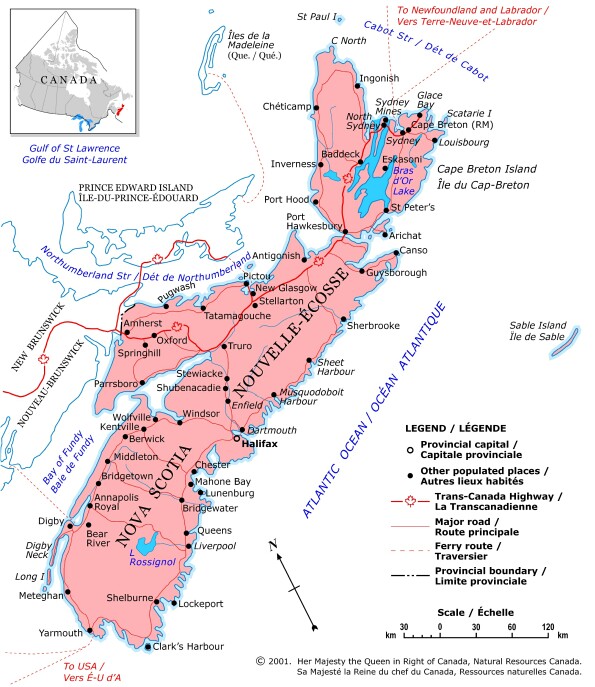
Nova Scotia: The Jesuit Missionaries, In A Canadian Logging Town

Long lumbering history in Greenfield
By Mark Roberts / Advance
The pioneer settlers of the early 1800s in Greenfield, Queens County recognized the Medway River was full of fish, a means of transportation, and beautiful. But it was not long before they realized it could also provide waterpower for industry.

In 1832, the falls (just below the present bridge) were harnessed, supplying the water power to drive a "single" sawmill, utilizing an early type of up-and-down saw. This made it possible to saw wide boards still found in many older buildings. This mill, located at the head of the falls, was in action both day and night for a frantic period, because the new settlers were anxious to have their logs sawn into lumber so they could get their houses built.It was not long before other mills appeared down the river, from Charleston to Port Medway. A water-powered shingle mill was constructed in 1845. In 1856 a gang mill was built on the west side of the Medway, below the bridge. The contract was signed to build the mill, which included an edging table the cost 87 pounds. Residents' names appearing on the contract were Joseph Shankel, Simeon Hunt, Phebram Ramey, James Tilbert, Robert Harlow, Allen Freeman, Luluanus Morton and Enoch Stedman. Whitman Freeman signed as witness to the transaction. The gang-mill was sold in 1894 to the Davidson Lumber Company, Bridgewater, which announced plans for expansion. At the time the mill produced 12,000 board feet of lumber each day. There was also a plan to build a branch railway line to Liverpool to hook up with the Halifax and Southwestern Railroad, which was being constructed from Halifax to Yarmouth. A trail was blazed from Greenfield to Liverpool. But the somewhat grandiose plan fell through to take the lumber from Greenfield to Liverpool wharves and thence to markets far a field. When it failed to materialize, the mill then went back to the original owners, who, for some unknown reason, would not use the mill's edger. The Davidson Company scrapped their plans, and the Company moved to Osburn, Nova Scotia. The Greenfield owners used the mill less and less, and finally it fell into disrepair and burned. Pine lumber was among the first resources to be exported to the "West Indies" - the Caribbean. Lumber and other products were transported to Liverpool in the early years by teams of oxen, loaded on ships and later were moved by train as well as by ship. Earlier, however, in 1868, a two-storey grist and shingle mill was built on the east side of the river below the present bridge. History tells us farmers brought their grain to the grist mill from an area that covered 25 miles. The mill owner received a percentage for grinding. The venture lost money so it was remodelled to saw shingles only. It was destroyed by fire in 1905. Other small mills were built along the river and around the lake, but they were small, one-man affairs and didn't last.In 1906, after the destruction of the shingle mill, Walter Freeman, Park Freeman and Gus Freeman built a water-wheel powered shingle mill on the east side. By 1914, many improvements had been added and that year a rotary saw was installed. The Freeman mill has given employment to the village and the family has been building, and re-building mills, almost continuously, since 1832. It was not always easy. The first of the modern mills was demolished by Hurricane Edna in 1954. It was re-built, but a year later the mill was swept down the river by the devastating flood of 1955. Undaunted, Harry Freeman, Sr., built once again in 1956, below the Bruce Hunt property, and later moved across the road to the present location and completely modernized with more space for storage yards and expansion, safely removed from the river hazards since water power was no longer in use. Disaster struck again in September, 1990.A fire swept through this modern mill, but it was not long before Harry Senior's son, Harry, rebuilt the plant. Mr. Freeman is proud of the fact, and rightly so, that his own employees re-built the damaged section of the mill and had it back in operation within three months - on the third week of January, 1991. A Herculean task! Through the years, the Freeman mills have been powered by water, gas, diesel and electricity. The present complex includes a computer - controlled lumber drying kiln, a necessity for a successful operation today. Some early residents of Greenfield farmed the not-so-rich soil of the area. They grew their own produce and raised sheep. Mrs. Erue Ramey was one of the few who raised black sheep. These produced a grey wool, for which she was noted. Her wool was always in great demand for knitting under garments - instead of the white wool used in those days. After the arrival of the early families, it soon became obvious that the bustling community needed a bridge across the Medway River. The first one was built across the lower side of the Lake Pool, well above the present bridge. Piers filled with rocks were used to support the platform. Each spring, unfortunately, when the Ponhook Lakes shed their ice cover and flowed down river, the crush of ice took the top off the platform.Verbal history tells us that the reason the bridge was first built in that vulnerable area was because the Liverpool-Nictaux road followed what is now known as the 16 mile road (Chapel Hill Drive). On the east side of the river the road was known as the Wellington Road, which went through the Hunt gravel pit, across the Plains and over the hill at the LaBelle intersection to Wellington. A second wooden bridge was built in the approximate location of the present bridge in Greenfield, around 1900. On this one, the engineers used iron guards, shaped like flat-irons, facing up stream to deflect the ice away from the piers. In 1914, an iron bridge replaced the wooden bridge, and finally the present modern bridge was erected. Native history played a large part in Greenfield. In 1840, the government of Nova Scotia designated land for an Indian Reserve on the west side of the river, chiefly for a burial ground and chapel, sacred to the natives of the valley.

During the year 1859, a Catholic Chapel had been erected by Jesuit priests to serve the First Nations population.

The site was by the Lake Pool on the Medway, above the present bridge, and was called Chapel Hill. It is said that Mass was held here , but the entire building was never completed. Many grave mounds can still be seen on the grounds where the chapel once stood.
Link (here)

Sunday, April 6, 2008

Philosophy Of Meaning

Hate message can’t defeat human spirit
The most important book I have ever read was assigned to me by a Jesuit priest at the University of Scranton. Father Bernard Supp, S.J. taught us philosophy. He told us of the unimaginable power of the unbreakable human spirit. He made us understand, as human beings, we are capable of achieving anything if we discover our spirit within. To assist us in our self discovery he gave us each a copy of “Man’s Search for Meaning” by Viktor E. Frankl. Yellowed and tattered, my copy of Frankl’s book is always here on my desk. Frankl wrote, “He who has a why to live for can bear with any how.” The human spirit is powerful, enduring and unbreakable.
.
Kevin Blaum is associate director of admission at Wyoming Seminary in Kingston where he also teaches government. Blaum spent 26 years as a Pennsylvania state legislator and was a Wilkes-Barre City Councilman.
Photo of Frankl
Link (here)

Saturday, April 5, 2008

A Jesuit On Celebacy

What makes celibacy a way to love?
By Father Warren Sazama, SJ
I BLANCH WHEN I hear people say to me almost breathlessly, “Oh, Father, you priests make such sacrifices!” I matter-of-factly respond, “Yes, but no more than other people who make a serious commitment with their lives.” That a healthy man with options chooses to live his life without sex, a wife and children and can live a happy, full life that way seems unthinkable to many. But, do you know what? Jesus did. And,

Jesus invited his disciples to give up marriage for the sake of Godʼs reign (Mt 19:12). Moreover, he promised a hundredfold return in happiness and fullness for those who do (Mt 19:29, Lk 18:29-30). In my experience and in that of many celibate brothers and sisters, heʼs right.

Before going on to the positive aspects of celibate loving, Iʼd like to clarify my statement that all people who make serious commitments with their lives make sacrifices. With a 50 percent divorce rate in this country, I think we all know that a successful marriage involves a lot of work, not a little pain and suffering, and much sacrifice. I was a high school chaplain and counsellor for 19 years, and Iʼm in awe of the sacrifices parents make for their children – from changing diapers in the middle of the night to financial sacrifices which often entail giving up many things they might like to have for themselves, to putting up with rebellious teenagers who think they know it all and think their parents know nothing. When I look at the sacrifices married couples and parents have to make, the sacrifices Iʼve made can seem almost easy in comparison. This is not to say, of course, that marriage and parenthood donʼt also involve many rewards and satisfactions, but so do religious life and priesthood, and the joys and freedom of loving in a celibate fashion. Marriage is one particular way of loving. Some people feel called to love in a more universal way that is particularly suited to a life of ministry. Celibacy is a way of loving.

I did my theology studies at the Jesuit School of Theology in California, which is part of an ecumenical consortium of theological schools. Quite a few of the Protestant seminarians there were what they sympathetically referred to as “Preachersʼ Kids”. Many lamented that their father, who was a minister, often seemed to be there for everyone but them. This should not be too surprising; there is an inherent tension between ministry and the commitment of marriage.

Loving celibately frees one to love more broadly without worrying about neglecting oneʼs spouse and children. Itʼs hard to imagine Jesus with a wife and children saying he canʼt go to preach the good news in the next town because he has to take the children to soccer practice and his wife has a job in Bethsaida so they canʼt move right now. Ministry calls us to a more universal, free form of loving than marriage readily allows. What is the “hundredfold” that Jesus promises in return for sacrificing family, sex and marriage for the sake of Godʼs reign? Probably the easiest way is to answer from my personal experience.

I cannot imagine a more meaningful life. By the grace of God, Iʼve been able to make a significant difference in many peopleʼs lives. People experience that they have a claim on me – that Iʼm theirs – because of my celibate form of loving. My former students often come back for advice, the celebration of special moments in their lives, support in difficult times, and not infrequently they become adult friends.

The joy of experiencing God working through me and using me to help someone grow closer to God and experience the liberation of the Gospel is the ultimate high for me that never seems to lessen over the years. Being celibate gives me a special relationship with God as my spouse. My celibate way of loving frees me to love so many more around the world than I otherwise could imagine. As a member of a religious community, I have been gifted with many wonderful older brothers and spiritual fathers to learn from and be inspired by, younger brothers to mentor and receive energy from, and lifelong friends and companions.

Is celibacy for everyone? Obviously not. It is a special calling. As a vocation director, I talk to young people who feel called to love in this more free, expansive way. I experience it in myself. But others feel called by God to love as a married person, and this clearly is also a wonderful way of loving that the church blesses with a special sacrament.

But for those called to a celibate way of loving, this can be, if lived well, a joyful, rich, very meaningful way to live life in union with God and in the giving of oneself to others to help build the reign of God on earth.

Link (here)

What Happens When Every Member Of Your Family Looses Its Faith, Including Your Own

Read Joe Garcia's blog Ad Majorem Dei Gloriam he has hit on some profound subject material in his post entitled, "Hold That Thought" .

Movie Review Of: "The Mission"

Talk About Movies: “The Mission”
Matthew Lickona and Ernie Grimm discuss current and classic films from a Catholic perspective
The Mission Directed by Roland Joffé Starring Robert DeNiro, Jeremy Irons 1986, 126 minutes, English, color, United Kingdom Bishop's rating: A-III (adults)
Ernie:
First let me welcome and thank you, John Teresa, for standing in for Matthew, who is on a vacation/pilgrimage to Rome.
Now, to The Mission... just as he admired Saint Thomas More in his Man for All Seasons, Robert Bolt, who also wrote The Mission, clearly admired the self-sacrifice displayed by these Jesuit missionaries.
And how could one not admire men who face the peril of climbing the Iguacu Falls only to face near certain death at the hands of Indians who have already killed one of their priests? But the problem is, Bolt -- who was not a believer -- didn't understand that it was a desire to save the souls of these Indians that propelled these missionaries up the falls to face death. He portrays the missions primarily as communes, and the movie lapses into a sort of apologia for communistic ideals.
John:
Thank you Ernie, it really is my pleasure. In last Sunday’s readings, Acts 2:42-47, -- Divine Mercy Sunday I might add -- didn’t we hear, “They devoted themselves to the teaching of the apostles and to the communal life, to the breaking of the bread and to the prayers.” Didn’t we also hear, “All who believed were together and had all things in common; they would sell their property and possessions and divide them among all according to each one's need.” If we read history into the film, perhaps you can make that assessment viewing with 21st century eyes, but if we view it in historical context, why wouldn’t a tribal people live in close community? That is hardly a lapse into materialism.
The desire to save souls was certainly conveyed when Father Gabriel took the cross of the martyred Jesuit, and climbed the falls. He was excoriated by Don Cabeza for asserting the primacy of the soul during the tour of great mission of San Miguel.
It was conveyed later in the film when he gave the martyr priest's cross to Father Mendoza before the battle. This is a powerful film that intersects many dimensions of our faith. To limit it to an apologia for communistic ideals is too narrow an interpretation.
Ernie:
I'm not arguing against the idea that communal life was the best idea for the Guarani Indians who had always lived communally. I'm lamenting the fact that the missions/communes were portrayed as ends in themselves.
We get precious little of religious life, liturgy, or even prayer in this movie. Instead, we get shots of planting crops, building shelters, picking bananas, making violins. There is some singing of the Ave Maria, but it's portrayed more as art than as worship. Just about the only time we see anybody in prayer is when the cardinal from Rome is using prayer as an excuse for indecision.
Near the end, we do see Father Gabriel leading the Indians of San Carlos in a Eucharistic procession. But the cynic in me can't help but notice that they're following the Eucharist -- which the writer of this screenplay thinks is nothing more than bread -- unto their deaths. And at the end, the cardinal writes to the pope that the priests who died at San Carlos still live while he (the cardinal) is dead. But it's not because they're in heaven, but because "they live on in the memory of the living." The only way the Marxist message in this movie could have been clearer is if he'd said, "There is no heaven, only communal paradise on earth."
John:
I don’t think you are a cynic. I think you are skeptical, as well you should be about Bolt’s intentions. However, let me try to assuage your skepticism.
This is not a movie specifically about religious life. It is also about pride, sin, justice, injustice, politics, economics, genocide, transformational forgiveness, mercy, love, and redemption. Like you, I was troubled by the cardinal’s ending lines. I was also troubled by Father Gabriel’s defense of the Guarani’s infanticide.
During the tribunal he gave the root cause, but failed to comment on this act’s moral and spiritual repercussions for both the Guarani and the colonists. But there were relatively few scenes about the missions and communal life. The majority of the film was about Father Mendoza and his transformation from slave trader and mercenary to priest. The pride that killed his brother and left no room for God’s redemption was slowly drained away as he dragged his sin behind him in a torturous assent to the Guarani. Atop the falls, exhausted, covered in the filth of his sin, Mendoza encounters them. The same man who apologetically retrieved Father Gabriel’s broken oboe from the water, grabs the knife that Mendoza used to kill his brother, and holds it to his throat. Proud to his last moment Mendoza awaits just revenge without fear, but instead the man cuts the rope freeing him. The knife that was an instrument of murder, and could have been an instrument of justice, is instead an instrument of mercy. This act breaks Mendoza’s pride, and frees him from his past as his armor slips beneath the water. He weeps in grief and joy as he can now accept God’s divine mercy. A few materialist lines might cloud the film for some, but despite Bolt’s non-belief this is a profoundly Christian film.
Link (here)

Friday, April 4, 2008

Jesuit Avery Cardinal Dulles Steps Down At Fordham After 20 Years

Cardinal Dulles gives farewell speech as Fordham's McGinley professor
By Angelo Stagnaro


NEW YORK (CNS) -- Warmth and congeniality characterized Cardinal Avery Dulles' farewell address April 1 as the Laurence J. McGinley professor of religion and society at Jesuit-run Fordham University.
Cardinal Dulles, a Jesuit theologian, ended his 20-year series of annual McGinley lectures, from 1988 to 2008, with a short summation of his theology and his ministry and a synopsis of his previous lectures. The 89-year-old cardinal has addressed theological issues and spoken on secular issues such as politics, human rights and the death penalty.
The cardinal is now confined to a wheelchair and incapable of prolonged speech as a result of post-polio syndrome, which he originally contracted when he was in the Navy 62 years ago, so Jesuit Father Joseph P O' Hare, Fordham's former president, gave his presentation for him. Father Robert P. Imbelli, a New York archdiocesan priest, who is associate theology professor at Jesuit-run Boston College, presented an analysis of the cardinal's speech. The priest referred to himself as a "Jesuit 'in pectore,'" or "in his heart," which refers to the pope's privilege of naming cardinals whose names he keeps a secret. Cardinal Dulles' presentation took place at Fordham Preparatory School's Leonard Theatre on the university's campus. In his lectures, which have always been well attended, the cardinal has defended Catholic orthodoxy and explored oft-debated topics.
He said his principal aim in his lectures was "to present and classify the existing opinions" and "to criticize views that are inadequate." He always tried "to incorporate the valid insights of all parties to the discussion, rather than perpetuate a one-sided view that is partial and incomplete," he said. "I think of myself as a moderate trying to make peace between (opposing) schools of thought. While doing so, however, I insist on logical consistency. Unlike certain relativists of our time, I abhor mixtures of contradiction," Cardinal Dulles said.
He began his theological lectures "by asking what others, especially authoritative voices, had to say about pertinent questions," he said. If everyone agreed, "it is sufficient to note the consensus," he added.If a spectrum of opinions existed, "I sought out the best arguments in favor of each major position," he continued.
He said his intention was "to give an informed judgment as to which positions are sound and which should be rejected." In each case, "I am willingly adhering to the testimony of Scripture and perennial Catholic tradition," he said. The cardinal admitted he never strove for originality. "Very few new ideas, I suspect, are true. If I conceived a theological idea that had never occurred to anyone in the past, I would have every reason to think myself mistaken," he said.
In the presentation Cardinal Dulles reconfirmed his faith, his orthodoxy, his spirituality and his commitment to the Society of Jesus. He also offered a final word against the materialism, relativism, subjectivism, hedonism, scientism and superficial anti-intellectualism he said is found in modern society. "Western thought," he said, "followed in the path of cognitive realism for many centuries before the revival of agnosticism in the Renaissance."
The cardinal repeated Pope John Paul II's admonition that philosophy should seek to "resume its original quest for eternal truth and wisdom." "Science, we all know, does not rest on a treasury of revealed knowledge handed down in authoritative tradition," the cardinal said. "Science has wonderfully increased our powers to make and to destroy, but it does not tell us what we ought to do and why." It does not tell us where the universe came from, or why we exist, or what our final destination is.
And yet some scientists speak as though their discipline were the only kind of valid knowledge," he said. Even as an undergraduate student 70 years ago, he felt the "oppressive nature of a culture that had no place for objective moral norms and meaning." It was this desperation for enlightenment, the cardinal admitted, that set him "on the path that led through ancient Greek philosophy to Catholic faith." "Christian revelation brought a tremendous increase of light. God alone, I learned from the New Testament, was good and true in an unqualified sense," he said. "And the same God in all his beauty and majesty became one of our human family in Jesus Christ, the truth, the way, and the life."
"The most important thing about my career, and many of yours, I feel sure, is the discovery of the pearl of great price, the treasure hidden in the field -- the Lord Jesus himself," he said.
In summation, the cardinal, also in the voice of Father O'Hare, poignantly referred to his present weakened state not as a negative or a detriment, but instead, a sign of the triumph of love. "Suffering and diminishment are not the greatest of evils, but are normal ingredients in life, especially in old age. They are to be accepted as elements of a full human existence," he said. "As I become increasingly paralyzed and unable to speak, I can identify with the many paralytics and mute persons in the Gospels, grateful for the loving and skillful care I receive and for the hope of everlasting life in Christ," he said.
"If the Lord now calls me to a period of weakness, I know well that his power can be made perfect in infirmity," he added. "Blessed be the name of the Lord!"
The grandson of a Presbyterian minister, Cardinal Dulles entered the Catholic Church in 1941 while studying at Harvard Law School. After serving his country during World War II in the Navy, he joined the Jesuits in 1946 and was ordained in 1956. He has written 22 books and has more than 30 honorary doctorates.


Link (here)

Fr. Atlas: Portuguese Jesuit Cartographer Ludivico Teixeira

Mapping history
By Chris Reagle
Fri Apr 04, 2008
MATTAPOISETT - Imagine a world where you were literally at the center of it and everything beyond it was a complete mystery. Is the world flat or round? Does it have any shape at all? Now imagine trying to figure out how to navigate the unknown. That was the dilemma of early cartographers as they mapped the New World, whatever that was. People with even a passing interest in maps may be interested in knowing that the Mattapoisett Free Public Library is now in possession of at least eight ancient and historically significant maps of parts of the world, thanks to the donation of a former local man with a passion for cartography. In the library, and under the stern gaze of a portrait of George Purrington Jr., the venture capitalist who donated the money for the construction of the library in 1904,

Betts laid out the maps that span several centuries on a long wooden table. One is dated 1584 and is considered the first published map of the Azores by Ludovico (Luis) Teixeira, a Portuguese Jesuit priest and royal cartographer to Spain. In addition to his work in the Azores, Teixeira was the first European to map Japan

, Betts said. “This map was published in Abraham Ortelius’ Theatrum, (neat)' which is generally considered to be the first world atlas,” he said.

Link (here)

Mick Jagger And The Jesuit: Fr. Thomas Corbishley, S.J.

Shine a Light
By John Mulderig
Catholic News Service (http://www.catholicnews.com/)
NEW YORK (CNS) -- Veteran rockers the Rolling Stones perform some of their most familiar songs as well as lesser-known original numbers and cover material in the high-energy documentary "Shine A Light" (Paramount Classics/Shangri-La/CPI). The film captures parts of two performances by the age-defying quartet of Mick Jagger, Keith Richards, Charlie Watts and Ronnie Wood at New York City's Beacon Theatre in fall 2006. Songs range in mood from the heart-pounding 1981 hit "Start Me Up" to the meditative 1964 ballad "As Tears Go By," said to be the first song Jagger and Richards ever wrote together and one which they seldom perform. Featured guests include singer-songwriter Christina Aguilera, bluesman Buddy Guy and White Stripes vocalist Jack White. In addition to the music, there are amusingly chaotic pre-production scenes and clips of old interviews, some by now thoroughly ironic. One snippet, from the British television series "World In Action," shows Jagger, freshly released from a 1967 drug charge, incongruously sitting down with establishment figures, among them a( here , here, here and here ) Jesuit ( Fr. Thomas Corbishley S.J. ) priest. While Christianity of the broadcasting evangelical variety is mocked in the lyrics of Jagger and Richards' "Far Away Eyes," the titular tune, played over the credits, invokes the blessings of "the Good Lord," apparently in tribute to deceased Stones guitarist Brian Jones. Other selections reflect a lifestyle not much given to temperance.
Link (here)
.
Fr. Thomas Corbishley, S.J. (here) , (here) , (here) and (here)
.
Cardinal Cormac Murphy-O’Connor speech on Fr. Corbishley's and the free exercise of religion. (here) Hat Tip to Fr. Ray Blake at St. Mary Magdalene Blog.

Thursday, April 3, 2008

Some Jesuits Out Of Synch With Church: Line Up With Pro-Abortion Obama

Deal Hudson: Catholics Organize to Elect Barack Obama
By Deal W. Hudson 4/4/2008
Inside Catholic
A well-organized effort is advancing behind the scenes to create a coalition of Catholics -- dissatisfied with the Iraq War, angry toward George W. Bush, and pushing "social justice" issues -- to win the Catholic vote in November 2008.
WASHINGTON, D.C. (Inisde Catholic) - Lately there's been much talk about the endorsements for Sen. Barack Obama made by two Catholic leaders: Republican pro-life jurist Doug Kmiec and Democratic pro-life Senator Bob Casey Jr.of Pennsylvania. But these endorsements are just the tip of the iceberg. A well-organized effort is advancing behind the scenes to create a coalition of Catholics -- dissatisfied with the Iraq War, angry toward George W. Bush, and pushing "social justice" issues -- to win the Catholic vote in November 2008. To know who the players are in the Catholic push for Obama, one has only to look at a brochure for "The Convention for the Common Good" to be held in Philadelphia during July 11-13. Organizers have already invited both presidential candidates to speak to what they estimate to be 600 attendees. The brains behind the convention are Catholics in Alliance for the Common Good and NETWORK, a national Catholic social-justice lobby.
(Also listed as a sponsor is the AFL-CIO.) The goal of the convention is "to move politics beyond selfishness and division to the common good." The convention will propose and ratify a "Platform for the Common Good" and ask the candidates, presumably Senators Obama and McCain, to sign it. The final morning of the three-day meeting, they will discuss how to "mobilize for action for Election 2008." The convention Web site invites attendees to "come help build a platform that addresses many of the pressing social justice issues of the day -- health care, poverty, economic justice, immigration, global warming, and promoting a culture of life." Look for Catholics in Alliance with the Common Good to take a leading role in gathering Catholic support for Obama. Led by co-founder Alexia Kelley, a graduate of Harvard Divinity School, CACG has been steadily gaining visibility since its founding in 2004. Kelley worked for nearly ten years at the Catholic Campaign for Human Development of the USCCB. She raised some eyebrows by taking the job of religion outreach director at the Democratic National Committee during the Kerry campaign while still leading CACG. Like Kelley, the other seven staff members are impressively credentialed for their tasks.
It's clear that Catholics in Alliance with the Common Good maintains close ties to the Democratic Party and the USCCB, where Kelley and one other staffer used to work. The other organizer of the July convention is NETWORK, a Catholic organization founded in 1971 by 47 sisters to lobby Congress and "strive to close the gap between rich and poor and to dismantle policies rooted in racism, greed and violence." (A.K.A. Socialism at best, Communist at worst)
NETWORK claims to represent 100,000 people and declares some of its issue priorities to be economic equity, global peace and security, reordering budget priorities, and Hurricane Katrina recovery. NETWORK does not lobby Congress on the non-negotiable life issues, however. It is listed on the "Roman Catholics for Obama" Web site as having endorsed Senator Obama, giving him a 100 percent rating "based on the organization's assessment of 12 votes according to the principles of Catholic Social Teaching." Archbishop Charles Chaput of Denver might be surprised to find that he is quoted extensively on the home page of the "Roman Catholics for Obama" Web site. It states, "We acknowledge that Senator Obama's position on abortion is in conflict with the vision of the Church," and then offers the following quotation from a letter by the archbishop: "So can a Catholic in good conscience vote for a pro-choice candidate? The answer is: 'I can't, and I won't.' But I do know some serious Catholics -- people whom I admire -- who may. I think their reasoning is mistaken, but at least they sincerely struggle with the abortion issue, and it causes them real pain. And most important: They don't keep quiet about it; they don't give up; they keep lobbying their party and their representatives to change their pro-abortion views and protect the unborn. Catholics can vote for pro-choice candidates if they vote for them despite -- not because of -- their pro-choice views." "Roman Catholics for Obama" interprets Archbishop Chaput's statement as giving them ecclesial permission to vote for a pro-abortion candidate.
But they are obviously ignoring the most salient part of the statement where the archbishop says, "They don't keep quiet about it; they don't give up."
Chaput's words hardly describe NETWORK advocates and, thus far, what Catholics in Alliance for the Common Good is promoting. The same goes for the other sponsor organizations of the convention to be held in July. As the presidential campaign hits its stride, the debate between Catholics will be a reprise of 2000 and 2004 -- namely, whether Catholics will vote for a pro-abortion extremist who is unwilling to defend traditional marriage. The one mitigating factor of 2008 will be the ability of pro-Obama Catholics to set anti-war, anti-Bush sentiment churning among Catholic voters looking for a reason to return to the Democratic Party of their forebears.
.
Picture of Pax Christi Protestor (here)
More on Jesuits and the Obama connection: Theology Liberated: Black Liberation Theology and Liberation Theology (here) , Obama ear-marks money for Jesuits (here) , Weston Jesuit professor supports Obama (here) and Obama speaks at St. Peter's rally (here)

Wednesday, April 2, 2008

Weigel: Keenan Redux

'Gay marriage' and Father Keenan, once again
By George Weigel
I regret having to revisit this matter, but as a point of personal honor has been raised, I must. In early 2003, the Commonwealth of Massachusetts engaged in a vigorous public debate over the definition of marriage. A proposed constitutional amendment defining marriage as the stable union of a man and a woman, H. 3190, was introduced in the Massachusetts legislature. On April 28, 2003, three Catholic priests, including Jesuit Father James Keenan (now of Boston College), testified against H. 3190. Father Keenan began his testimony as follows: "I am here today to testify against H.3190 because it is contrary to Catholic teaching on social justice." Father Keenan concluded his testimony on the same note: "...as a priest and as a moral theologian, I cannot see how anyone could use the Roman Catholic tradition to support H. 3190." On June 2, 2003, staff members of the Massachusetts Catholic Conference [MCC] issued a "Memorandum by MCC Staff on the Erroneous Testimony on Catholic Teaching" that had been given at the April 28 hearing.
.


The memorandum made the following points:

In the course of his argument against the Massachusetts marriage amendment, which he claimed would "deny 'gays and lesbians' the 'full range of human and civil rights,' Father Keenan erroneously stated that '[t]his same position has been endorsed by the United States Catholic Bishops.'"


Father Keenan and his fellow-witnesses did not inform the MCC, "the official representative of the Catholic Bishops of Massachusetts before the state legislature," of their proposed testimony beforehand, nor did they inform the committee that they were speaking without the knowledge or approval of the MCC.


All three priests who testified, including Father Keenan, "mischaracterized the teaching of the Catholic Church generally, while two [including Father Keenan] mischaracterized the position of the Catholic Bishops specifically," by attempting to buttress their position with the U.S. bishops' statement, "Always Our Children."


As a result of Father Keenan's testimony and that of his fellow-witnesses, "members of the committee expressed their confusion about the Catholic Church's position on the [marriage] amendment, on same-sex marriage, and on their moral responsibility as legislators."

The MCC staffers also noted that, based on their conversation with committee members, "the testimony left the false impression that the priests were speaking from authority, and that their private opinions represented the official position of the Catholic Church...." Father Keenan's Boston College colleague, Jesuit Father David Hollenbach, has now denounced as "malicious slander" a recent column in which I wrote that Father Keenan's testimony had argued that "the principles of Catholic social doctrine did not merely tolerate 'gay marriage,' they demanded it." That was arguably too telegraphic an interpretation of Father Keenan's rhetorical dexterity, both in his testimony and in a subsequent "clarification" issued after public criticism of his position. So here is my emendation, based entirely on the public record: In his 2003 testimony before the Massachusetts state legislature, Father Keenan argued that a constitutional amendment defining marriage as the stable union of a man and a woman offended Catholic social justice principles and ought to be rejected. In the course of his testimony, Father Keenan misrepresented the teaching of the American bishops, appealed to a theologically dubious magisterium of theologians, failed to tell the legislators the Massachusetts bishops' position on H. 3190, and neglected to inform the legislators of recent, authoritative Vatican statements on the subject --- all of which created the impression among legislators that justice required the rejection of any legal definition of "marriage" as the stable union of a man and a woman. The Web site of MassEquality, a pro-"gay marriage" group (www.massequality.org/ supporters), lists Father Keenan's name under the tag line, "Support for marriage equality can be found everywhere," and provides a link to Father Keenan's April 28, 2003 testimony. Permit me to pose two questions:


---Will Father Hollenbach now publicly damn MassEquality for "malicious slander?"


---Will Father Keenan ask MassEquality to remove from its Web site what Father Hollenbach evidently regards as a malicious and slanderous misinterpretation of his testimony?


George Weigel is a senior fellow of the Ethics and Public Policy Center in Washington, D.C.


Link (here)

Majerus Now Takes A Shot At The Mormons

Rick Majerus: Have You No Decency?
April 2, 2008
STLOG, MARCH 25, 2008
blogs.riverfronttimes.com unloads over Rick Majerus' take on Mormons — especially their underwear.

Rick Majerus: Have You No Decency?
I lived in Utah while Rick Majerus was coach at the University of Utah. Anyone who ever saw the guy, spoke to the guy or heard of the guy, knew immediately he has a singular, spectacular grasp on being an absolute moronic imbecile. He is a walking piece of garbage. But, he is proof that mentally handicapped individuals can coach basketball at the D-1 level.


JC
During my four years at BYU, I had a front-row seat to Majerus' genius as he and his Utes stomped us year after year after year. However, I agree with Andrew Perkins. His "magic beanie" comparison is spot-on. Mocking the garment is going too far. The garment is a sacred thing to Mormons. As a Mormon, it offends me to hear Rick Majerus make light of something that represents something very personal and special to me.Unnamed
People will say what they will say. General authorities have been saying for years that members need to stop being offended and get over their egos (in not so many words). Mormons and Jews — and anyone else whose sacred cows can be damaged by a snarky comment — will always be offended by something. You can't control other people's snark, only your reaction. If it's personal and special to you, just smile and carry on. No one is under an obligation to respect someone else's beliefs.


Observer
Just what a Jesuit school needs: a crazy, loudmouth coach reinforcing the stereotype that Jesuits specialize in stomping on other religions. You don't hear BYU coaches using their media access to catalog the countless peculiarities of the belief system at SLU.


Grow Up Majerus
What is particularly hurtful about the comment is that Majerus coached dozens of Mormons while at the U of U. For example, Britton Johnsen served an LDS mission shortly after helping Utah to the 1998 championship game. Because he coached Mormons, he knows very well that garments are not worn during athletic contests. And he knows we do not consider them "magic," but a reminder of our commitment to God, much like other Christians who choose to wear a crucifix. By stooping to religious bigotry, Majerus not only attacked his former archrival (BYU), he insulted many of his own players who gave their all to him on the court.


Dave
It's really just a matter of perspective. With the myopic LDS world view, garments are a sacred and protective piece of religious indoctrination given during our initiatory prior to our endowment. But to the world at large, they look silly. When you consider the nipple symbols cribbed from masonry, the faith-promoting rumors of their protection, and their utter backward appearance, they appear funny to the outside world. The reality is, undergarments have been attributed magical properties through the years. Unless you're willing to equally condemn those making fun of Tom Cruise and Scientology, you're probably a bit prejudiced yourself.


Link to River Front Times blog piece (here)

Tuesday, April 1, 2008

Jesuit Abused Children As Young As Four Years Old From California Province

The lone Jesuit accused of abuse in the Diocese of Oakland was the Rev. Jerold Lindner, who was named in a 2003 lawsuit by a girl who said he molested her at Corpus Christi in Piedmont while he was serving at St. Ignatius Prep School in San Francisco. The lawsuit contends that from the 1950s to the 1980s, Lindner "abused and molested his 5-year-old nephew in Arizona and Berkeley," "sodomized and molested two brothers, ages 4 and 7," "orally copulated and sodomized his 11-year-old nephew" and "molested three nieces." Lindner has been accused by 10 men and women in Southern California, Phoenix and the Bay Area, the Los Angeles Times reported. Lindner has denied the allegations, but he was part of a secret $625,000 settlement in 1997, according to the Los Angeles Times.
Link (here)