Monday, January 28, 2008

American Assistancy

Fr. Cooke, U.S. Delegation Meet Superior General
Canisius President and members of the American Jesuit assistancy in Rome meet Rev. Adolfo Nicolas, S.J.
BUFFALO, NY – Canisius College President Rev. Vincent M. Cooke, S.J., and members of the American Jesuit assistancy in Rome, recently met with the newly-elected superior general of the Society of Jesus, Rev. Adolfo Nicolas, S.J. Father Cooke is one of 34 Jesuits from the United States and 225 delegates from around the world who make up the General Congregation, which elects a new superior general of the Society of Jesus, the largest religious order in the Roman Catholic Church. Father Nichols was elected on January 19 but the General Congregation will remain in session for several more weeks as the whole assembly works on proposals in relation to the governing of the Society. Father Rev. Adolfo Nicolas, S.J., is the former provincial of Japan and president of the Jesuit conference of East Asia and Oceana. He was selected as the 30th superior general of the Jesuits and succeeds Rev. Peter-Hans Kolvenbach, S.J., who resigned on January 14 after 25 years of service. To read more about the 35th Jesuit General Congregation, click here. Canisius College is one of 28 Jesuit colleges in the nation and the premier private college in Western New York. Canisius prepares leaders – intelligent, caring, faithful individuals – able to pursue and promote excellence in their professions, communities and service to humanity.
Link (here)

Sunday, January 27, 2008

Check Out Gloria TV

Jesuit videos (here)
Sacred Heart of Jesus devotional video (here)

What Went Wrong In Boston?

An excerpt from an excerpt.

The Faithful Departed
The Collapse of Boston's Catholic Culture
by Philip F. Lawler
The following is the introductory chapter of Phil Lawler's book, which will be formally released next month-- February 2008-- by Encounter books. It is available now for pre-release orders on Amazon.com.


Among those Catholics, about 80% attended Mass every week, and heard the doctrine of the Church proclaimed in sermons regularly.
Many attended parochial schools, where their attitudes toward the world were shaped by the Sisters of St. Joseph and other religious orders.
When the Holy Name Society organized a parade, 10,000 men marched through the streets of downtown Boston.
A growing number attended Catholic colleges; Boston College and Holy Cross were attracting some of the brightest young men from the families of Irish and Italian immigrants.
Lay Catholics joined the Knights of Columbus, the Women's Sodality and the Altar Guild. They met their future spouses at CYO dances and Newman Club social hours. They identified themselves readily as Catholics, and on religious matters they identified Cardinal O'Connell as their leader. .......


Yet again, the most conspicuous examples of this attitude have been shown in Massachusetts.
In the 1950s, an Archbishop of Boston discouraged a priest from his energetic public preaching of a defined Catholic dogma, because some people found that dogma offensive.
A decade later the same archbishop— now a cardinal— announced that Catholic legislators should feel free to vote in favor of legislation that violated the precepts of the Church. In 1974 his successor encouraged Catholic parents not to send their children to parochial schools.
And in 1993 yet another Boston archbishop instructed the faithful that they should not pray outside abortion clinics.
In each of these remarkable cases, the Archbishop of Boston obviously thought that he was serving the cause of community peace. But just as obviously, he was yielding ground, and encouraging the Catholic faithful to yield as well.


Link to the Spirit Daily piece (here)
Photo credit of St. Mary Star of the Sea School, one of Boston areas old Catholic Schools. (here)
Boston College history page (here)

Doctor Death: The Face Of Evil

Museum of Contraception and Abortion Opens to Controversy
A unique kind museum opened in Vienna this week. Everything inside revolves around contraception and abortions, and the museum attempts to go beyond any other collection in any other nation. The initiator of this museum is Christian Fiala, a doctor who has directed a clinic for abortions and family planning in Vienna for the past 10 years. Fiala is seen as a missionary for womens health and is the chairman of the International Association of Abortion and Contraception Specialists. Displayed in two rooms are items Fiala has collected over the decades. The first room is devoted to contraception, and it displays the wide variety of items used over the centuries to prevent pregnancies. The first birth-control pill is displayed next to ancient condoms made of pig bladders. In the doorway to the second room, pregnancy tests, which were developed in the 1960s, are hanging. This leads into the abortion room. Up until about 1900, abortions were so dangerous that it was safer for women to carry the child to term and then kill it after it was born. Visitors can even listen to recordings of abortion providers discussing how up until 30 years ago it was still a life-threatening procedure.
Link (here)
Watch video of Dr. Deaths employees (here)

Mary during the Flagellation of our Lord


I SAW the Blessed Virgin in a continual ecstasy during the time of the scourging of her Divine Son; she saw and suffered with inexpressible love and grief all the torments he was enduring. She groaned feebly, and her eyes were red with weeping. A large veil covered her person, and she leant upon Mary of Heli, her eldest sister,* who was old and extremely like their mother, Anne. Mary of Cleophas, the daughter of Mary of Heli, was there also. The friends of Jesus and Mary stood around the latter; they wore large veils, appeared overcome with grief and anxiety, and were weeping as if in the momentary expectation of death. The dress of Mary was blue; it was long, and partly covered by a cloak made of white wool, and her veil was of rather a yellow white. Magdalen was totally beside herself from grief and her hair was floating loosely under her veil.
When Jesus fell down at the foot of the pillar, after the flagellation, I saw Claudia Procles, the wife of Pilate, send some large pieces of linen to the Mother of God. I know not whether she thought that Jesus would be set free, and that his Mother would then require linen to dress his wounds, or whether this compassionate lady was aware of the use which would be made of her present. At the termination of the scourging, Mary came to herself for a time, and saw her Divine Son all torn and mangled, being led away by the archers after the scourging: he wiped his eyes, which were filled with blood, that he might look at his Mother, and she stretched out her hands towards him, and continued to look at the bloody traces of his footsteps. I soon after saw Mary and Magdalen approach the pillar where Jesus had been scourged; the mob were at a distance, and they were partly concealed by the other holy women, and by a few kind-hearted persons who had joined them; they knelt down on the ground near the pillar, and wiped up the sacred blood with the linen which Claudia Procles had sent. John was not at that time with the holy women, who were about twenty in number. The sons of Simeon and of Obed, and Veronica, as also the two nephews of Joseph of Arimathea—Aram and Themni—were in the Temple, and appeared to be overwhelmed with grief. It was not more than nine o’clock A.M. when the scourging terminated.

_______
* Mary of Heli is often spoken of in this relation. According to Sister Eminerich, she was the daughter of St. Joachim and St. Anne, and was born nearly twenty years before the Blessed Virgin. She was not the child of promise, and is called Mary of Heli, by which she is distinguished from the other of the same name, because she was the daughter of Joachim, or Heliachim. Her husband bore the name of Cleophas. and her daughter that of Mary of Cleophas. This daughter was, however, older than her aunt, the Blessed Virgin, and had been married first to Alpheus. by whom she had three sons, afterwards the Apostles Simon, James the Less and Thaddeus. She had one son by her second husband, Sabat, and another called Simon, by her third husband, Jonas. Simon was afterwards Bishop of Jerusalem.
Link to Chapter 23
Link to the full book, The Dolorous Passion of Our Lord Jesus Christ
Blessed Anne Catherine Emmerich
A short video of The Passion

Jesuit Speaks On The Election Of The Superior General

The new General meets the press.

Just short of a week after his election as Superior General of the Society of Jesus, Father Adolfo Nicolás gave his first official press conference yesterday. The new General touched on a range of topics, from the state of relations between the Vatican and the Jesuit Order to the ways in which the decades he spent in Japan changed his outlook. He also spoke candidly and humorously about the unaccustomed attention he has received from the media since his election:
Father Nicolás said that since his election, he had been reading the newspapers more than usual and has found some of the comments about his election entertaining, some absolutely false and others right on the mark.
He said that a Spanish newspaper had been looking for his report card from a school he attended only one year at the age of 10. "It's terrible, that year I failed two subjects - geography and another that I don't remember," he said.Other newspapers, he said, have tried to imply that there is "a theological distance between me and (Pope) Benedict XVI," when, in fact, Father Nicolás' own theological studies included the then-Father Ratzinger's textbooks, which "were highly interesting and had a newness and an inspiration that all of us recognized.""The distance is a theory in the imagination of those who have written it," the superior general said.He said he had read several articles comparing him to Father Pedro Arrupe, who led the Jesuits [from] 1965-83, and Father Peter-Hans Kolvenbach, his immediate predecessor."However, no one has yet said I'm 10 percent Elvis Presley, although one could say this and it wouldn't surprise me. But I think this is all false," he added.
Father Nicolás also responded directly to concerns regarding Jesuits' obedience to the Pope, a topic that the Holy Father himself has raised in recent days and which many commentators had hoped the new General would address.

"The Society of Jesus wants to cooperate with the Vatican and obey the Holy
Father,"
the General said. "This has not and will not change. We were
born in this context, and this is the context that will determine our
actions."

Father Nicolás also stated that his immediate priority as leader of the Society is "to listen to what the General Congregation wants, how we will respond to the conversation and challenges the Holy Father addressed to us and which we are taking very seriously in our reflections, how to respond to help the Church, not ourselves."
What specific response will the 35th General Congregation offer to the needs of the Church today and to the Society's own internal challenges?

At this point, it's too soon to say. As a Jesuit, I have no "insider information" to rely upon beyond occasional electronic reports, the content of which differs little from that which is available to the general public. As has been the case with previous General Congregations, the story behind the decrees of GC35 will not really be known until the Congregation concludes and the various delegates return to their home provinces and start to share their impressions and reflections more fully.

I look forward to reading the documents that will be produced by this Congregation, and I look forward to hearing more about the process from the delegates that I know. In the meantime, I'll be praying for the work of GC35, and I hope you'll join me in doing so. AMDG.
.
Link to Jesuit Joe Koczera's blogs entitled, SJ ,The City and the Word (here)
Joe also has a retired blog called Noviciate Notes (here)
Photo credit of Joe at Think Jesuit (here)

The Divine Mercy And The Sacred Heart Of Jesus

This from Mark Mallett's blog. Mark is Catholic lay evangelist from Canada.

THE "END TIME" DEVOTIONS
While the revelations of the merciful Heart of Jesus to St. Margaret Mary Alacoque (1647-1690 A.D.) and St. Faustina Kowalska (1905-1938) were separated by three centuries, they have a common theme: devotion to the Heart of Jesus will be a sign of the end times.


I understood that devotion to the Sacred Heart is a last effort of His Love towards Christians of these latter times, by proposing to them an object and means so calculated to persuade them to love Him. —St. Margaret Mary, Antichrist and the End Times, Fr. Joseph Iannuzzi, p. 65


This devotion was the last effort of His love that He would grant to men in these latter ages, in order to withdraw from the empire of Satan which He desired to destroy, and thus to introduce them into the sweet liberty of the rule of His love, which He wished to restore in the hearts of all those who should embrace this devotion. —St. Margaret Mary, http://www.sacredheartdevotion.com/
Jesus appeared to St. Faustina with rays of light pouring from His Merciful Heart. From her Diary:


I am prolonging the time of mercy for the sake of [sinners]…. While there is
still time, let them have recourse to the fount of My mercy… He who refuses to
pass through the door of My mercy must pass through the door of My justice.
—Diary of St Faustina, 1160, 848, 1146

And recall again the words of St. John Bosco in his famous dream of the two pillars:

There will be chaos in the Church. Tranquility will not return until the Pope succeeds in anchoring the boat of Peter between the Twin Pillars of Eucharistic devotion and devotion to Our Lady. —Forty Dreams of St. John Bosco, compiled and edited by Fr. J. Bacchiarello, S.D.B.


The call to the Bastion is a call to look to the Eucharist, which is the Sacred Heart of Jesus. To entrust our whole beings to Him who is our refuge. We now see these devotions to His Heart converging in our times.
The call, then, is to prepare for the end of this age.
Mark Mallett's website (here)
St. Claude de la Colombière, S.J. (here)

For The Same Reason A Married Man Should Wear His Wedding Ring

From Karen Hall's blog.

Given the title of my new blog, I thought this article was well worth sharing: Why Do Priests Wear Black?"
The article traces the entire history of clerical garb. It was all interesting to me. If you don't share my fascination for such things, and you just want to cut to the chase, here what you need to read:
The symbolism of the cassock is as follows; The Roman collar symbolizes obedience; the Sash or cincture around that waist, chastity; and the color black, poverty. Moreover, black is a color of mourning arid death for the priest, the symbolism is dying to oneself to rise and serve the Lord as well as giving witness of the Kingdom yet to come.
The Code of Canon Law still requires "clerics are to wear suitable ecclesiastical garb in accord with the norms issued by the conference of bishops and in accord with legitimate local custom" (No. 284). In our very secular world, the wearing of clerical garb continues to be a visible sign of belief and of the consecration of one's life to the service of the Lord and His Church.
Read the entire article here.
The photo is from Henniger's Church Goods and Liturgical Vestments (here)

Former Avignon Jesuit Noviciate Is Now Hotel

Hôtel Cloitre Saint Louis Avignon

This former Jesuit noviciate is a haven of peace at just a few minutes' walking distance from the Pope’s Palace and located in the old city of Avignon. The hotel has 80 rooms located in a 16th century part, which has kept piously the spirit of that period and into a contemporary wing inspired by the well known French architect Jean Nouvel.

Links: Travel site (here) , photo gallery (here) and book reference (here)

Basketball Is Not A Sacrament And It Will Not Get You To Heaven

A short portion of a sport editorial justifing the coaches postion. The writer does not forget to jab and insult the Church with his celebacy statement. Not finished, he then insults the integrity of Archbishop Burke.
.
Majerus well within his rights
January 27, 2008
By Ron Kremer

Burke must recognize Majerus' right to form his own opinions and to occasionally disassociate himself from the Catholic ideals of the university where he works. His free time is just that -- his. He is not on call 24 hours a day, seven days a week. Nor is it likely he is the only one on staff at St. Louis ever to speak out on abortion.
The issue is one of many in Catholicism to fall under scrutiny. Some have wondered why priests aren't allowed to marry.
Does that condemn them to a life in purgatory? I would hope not. Majerus should be applauded for taking his job as a coach and teacher to heart.
He chooses to engage in topics of relevance. And in what better arena is there to wage debate than on a university campus?
He is part of a larger think tank than is outlined in an ordinary basketball handbook. Yes, he is also a man of some influence. He uses that influence every day in every way imaginable, whether he is casting his enormous shadow on the sideline, needling an official, or demanding a level of excellence from one his players during a routine workout. He is recognized as a giant in the coaching world because he dutifully tends to his flock.
Burke is the attention-getter here. He first thrust himself in the spotlight in 2004 when he said he would deny Holy Communion to John Kerry, then a Democratic presidential nominee, because of Kerry's support of abortion.
Now, Burke wants to speak with St. Louis University president Lawrence Biondi about Majerus. Clearly, Burke is envious of Majerus' everyman's charm. Burke wants equal air time.


Link (here)

Saturday, January 26, 2008

The Meeting, The Committee And The Dialogue

New head of Jesuits meets with Pope at Vatican
2008-01-26
ROME (AP) - The new leader of the Jesuits met Saturday with Pope Benedict XVI and told him the religious order would study the pontiff's invitation to confirm their «total» adhesion to Catholic teaching, including on divorce, homosexuality and liberation theology. The Jesuits have had a tense relationship with the Vatican on issues of doctrine and obedience. The Vatican occasionally disciplines Jesuit theologians and issues reminders of the their vows of obedience to the pontiff. The Rev. Adolfo Nicolas, a Spanish missionary and theologian with extensive Asian experience who was elected as superior general Jan. 19, had a «warm and friendly conversation» with the pontiff, the Jesuits said on their Web site. Shortly before Nicolas' predecessor, Dutch priest Peter-Hans Kolvenbach, handed in his resignation for reasons of age, he received a letter from Benedict in which the pope said it could be «extremely useful» if the Jesuits reaffirm «total adhesion to Catholic doctrine.
The pope wrote Kolvenbach that he was particularly concerned about "those neuralgic points which today are strongly attacked by secular culture," according to the text released by the Jesuits. The pope cited "aspects of the theology of liberation, and various points of sexual morality, especially ... the indissolubility of marriage and the pastoral care of homosexual persons", the letter said.
Church teaching forbids divorce. It also says homosexual acts are sinful. In past decades, some of the Jesuits' work with the poor in Latin America left the Vatican worried that some Jesuits were embracing liberation theology and Marxist political movements. Kolvenbach, elected leader in 1983, was widely credited with improving the Jesuits' tense relations with the Vatican.
The Jesuits said Benedict was pleased to hear from Nicolas that Jesuits had formed a committee to study his letter to Kolvenbach.
The meeting was also an opportunity for Nicolas to «reaffirm his personal respect» for the pope «as well as the esteem of the whole Society of Jesus,» as the Jesuit order is formally known. The Vatican announced that Benedict and Nicolas had met in a private audience but gave no details of their talks.
Benedict and Nicolas also discussed Japan, where the Jesuit had served for 33 years. Nicolas has said the West doesn't have a monopoly on meaning and spirituality and that Asia has much to offer the Church.
The pope encouraged the Jesuit leader to continue with dialogue with culture and evangelization and to ensure a thorough formation of young Jesuits, said the religious order, which is one of the largest in the Church. Founded in the 16th century by St. Ignatius Loyola, the Jesuit order has been dedicated to missionary work and education, and runs universities throughout the world.
Link (here)

More On SLU: Bishop, Jesuit, Coach, Abortion, Basketball and the Vagina Monologues

Joe Adorjan was on SLU's Board of Trustees when the school sold its hospital to Tenet Healthcare in 1998 over the adamant objections of then-Archbishop Justin Rigali. Still a member of the SLU board today, Adorjan said he would be surprised if the school decided to punish Majerus. Speaking for himself, Adorjan said he does not think Majerus should be disciplined.
"My personal view is that he is an employee of the university and the university is run by a lay board," he said. "I think that's the coach's personal opinion and he's totally entitled to his personal opinion, as would be any employee of any other organization."
SLU identifies itself as a Catholic institution, but neither Burke nor any religious creed has direct control over the school.
While SLU often proudly states its Jesuit tradition, less than 3 percent of its faculty members or staff is Jesuit, and less than half of its students identify themselves as Catholic.
In a speech in 2006 accepting the Citizen of the Year award, which is sponsored by the Post-Dispatch, Biondi said SLU welcomes everyone, regardless of their religious beliefs, race or sexual orientation.
"On our campus, we encourage competing ideas and ideologies," he said. "Sometimes that means hosting speakers, events or plays that some may find inappropriate on a Catholic college campus. But as soon as censorship begins at any university, where does censorship then end?"
Despite the protests of some Catholic groups, the school has held the controversial play the "Vagina Monologues," with its frank discussion of homosexuality, on campus. But last year, administrators refused to sponsor the play, so it was performed off-campus.
Link (here)

The New Jesuit Saint

Father Nicolas said he hoped the Jesuits would follow the principles of Mohandas Gandhi, "who said that when you speak of something you must first ask, 'Is it true?' because if it is not true, then it is not interesting. Second, 'Is it gentle, charitable, kind?' and third, 'Is it good for others?'"
.
I thought it was the "Society of Jesus" not the "Society of Gandhi"?
.
Link (here)

This Is Not An Easy Article To Read

The New Jesuit Mission
by Dr. Jeff Mirus, January 25, 2008
.
This is an excerpt of a much larger piece.
.
The Pope and the Jesuits
You have to be a certain age to remember these things, but even my youngest readers may remember Benedict XVI’s admonition a few days ago to the 35th General Congregation of the Society of Jesus, just before they elected their new Superior. Benedict said “it could prove extremely useful that the general congregation reaffirm…its own total adhesion to Catholic doctrine, in particular…the relationship between Christ and religions…” (see Emphasizing the Black in “Black Pope” and Benedict XVI’s Letter). As we will see, one might almost believe the Holy Father was asking the Jesuits not to elect somebody like Fr. Adolfo Nicolás.
But elect him they did, and according to Fr. Nicolás, Christianity is in crisis in Asia “because our message is not made visible in our life.” If this referred to the hypocrisy of Christians who undermine the gospel by their sins, it would be wholly unobjectionable. But unfortunately Fr. Nicolás defines the Christian message as “compassion and service” (which “unknown thousands” already exemplify in “Other Religions”) and “forgiveness and service” (which in the Church has “given way to a complicated system of controls”).
A key sentence reads as follows:
The natural field for this crisis is the Pastoral field, where, to our own shame and consternation, norms and obligations seem to occupy much more space in preaching and directives from the Pastors than joy, hope and freedom; where learning (often less than intelligible and seldom interesting) doctrines occupies more space than communion, service and hospitality.
.
Forgetting the Good News
This passage captures the quintessential loss of faith characteristic of modernist theologians.
The message of Christianity is here reduced to an amorphous blend of service and compassion directed toward a worldly salvation from unfortunate social conditions. This notion of salvation is often called “liberation” (Benedict also asked the Jesuits to adhere to Catholic doctrine regarding “some aspects of the theology of liberation”). Fr. Nicolás argues that Catholic theology “has failed to integrate serious knowledge with the more liberating ways of religious wisdom.” He asserts that “the real spiritual Masters of all ages are more keen in teaching the way to God than in giving answers to questions about God,” and claims that Asia “has produced an incredible wealth of such ‘Ways’.”
Religion is, apparently, all about praxis and not at all about truth.
Read the full article entitled The New Jesuit Mission at Catholicculture.org

Friday, January 25, 2008

Not Me

Father Adolfo Nicolas compared the relationship between the Jesuit order and the Holy See to a marriage, observing there are always tensions between loving couples.
But as in a marriage, he added, the Jesuits and the Pope are wholly dedicated to the same goal: the welfare of the Church.
Downplaying suggestions that the Jesuit order is at loggerheads with Pope Benedict XVI (bio - news), Father Nicolas recalled that he had studied the works of then-Father Joseph Ratzinger years earlier and found them inspirational. Theological disagreements between himself and the Holy Father, he insisted, exist only "in the imaginations of those who have written" on that topic.

Thursday, January 24, 2008

Blog Watch: War, Drink, and The Church

War, because life is a battle; Drink, because life is a joy; The Church, because life finds its meaning in Her.
A New Old Pamphlet
I recently came across the title of a pamphlet authored by the great Jesuit classicist Fr. Raymond V. Schoder, S.J. Its title was so Bellocian and so engaging that I actually took the time to contact Loyola University Chicago's archives to try and track it down. The title of the pamphlet--which is described as "lively"--is entitled:"Pity the Greekless: The Sad Story of Egbert, an Unalert Sophomore" I take it that the pamphlet was written back in the 1940's around the time when Schoder wrote his famous books A Reading Course in Homeric Greek. (The texts from which I learned ancient Greek in high school.) Recently these books were updated and republished. I have heard that they are substantially the same with slight additions thus retaining the excitement, charm, and erudition of the original Jesuit authors. Though there aren't plans to teach Homeric Greek (yet!) at Chesterton Academy, you can be sure that Fr. Schoder's scholarship will aid and assist our students in appreciating, understanding, and loving the great works of Homer. I'll update you as soon as I get Father's pamphlet--which promises to be a joy to read!
Update:
Loyola University Chicago's archives confirmed that they have the pamphlet and a copy will be waiting for me when I visit Chicago this weekend!

I Want To Be A Jesuit

How Do You Know What Your Vocation Is?
Brothers and Sisters in Christ,It's good to be back writing again for this blog, after a long semi-absence due to illness this fall and winter.After reading some of the recent posts, I thought I'd adress a topic that would be of use to many of us, which is the topic of discernment.
For those of you who are either second-guessing your vocation, or unsure if you're called to the priesthood and/or religious life, I was once in your boat as well, for many years.
When I was 15 I first felt called to the priesthood, but I ran from the calling for 4 years, because I did not feel worthy of such a calling, and I was scared. I decided I would do things my way and become a doctor and serve the Lord that way. High School came and went, and even though my grades were good, I still felt empty and sad inside. I knew something wasn't right, and over freshman year in college I tried to figure that out.
After meeting some seminarians at St. John Vianney Seminary, the college seminary at the University of St. Thomas in Minnesota, where I was (and still am) studying, I realized over time that God calls ordinary men to serve Him in extraordinary ways, and that I shouldn't feel unworthy of such a calling.
I realized where I was called, but I was still in the habit of trying to do things my way, and so I entered discernment with the Archdiocese of St. Paul and Minneapolis, but I was turned down by the vocations director for formation at St. John Vianney College Seminary. I was devastated, I thought the vocations director was being unfair, but, while sitting at Mass that same day at noon, the song "Deep Within" by David Haas touched me. Now, I'm not a huge fan of David Haas' music, but there are a few songs that have touched me that he wrote, and one of them is Deep Within. Its message was that if you follow God, He will lead you to where He is calling you. Later that day,
I remembered my parents had spoken of the Jesuits as a possible order to look at. I have now been in discernment with the Jesuits for 10 months, and have gone on a Come and See Weekend with them, and visited the Jesuit novitiate here in Saint Paul, Minnesota several times.
I have friends there, and the priests and novices there love it when I visit. I have never been happier in my life, and there is something about that religious order that resonates with me in a way that SJV did not. Now that I look back on my experience with SJV, there was something there that made me feel uncomfortable, whereas with the Jesuits I have no anxieties other than the prospect of not being accepted by them, but that's a risk I'm willing to take. So, to those of you uncertain of or second guessing your vocations, the only way to find your vocation is spiritual direction, an active prayer life, and service work.
.
My recommendations are as follows:
1. Find an old priest you can trust to be your spiritual director and guide you on your vocational journey. You'd be amazed at how much a spiritual director can help you
2. Attend Mass daily as often as possible: The Eucharist bestows profound grace that is essential in any vocational discernment
3. Pray the Liturgy of the Hours: I'd be happy to help you learn how to pray them if need be, and your spiritual director could show you how as well. The Liturgy of the Hours is essential to the life of any priest or religious
4. Trust what God seems to be telling you through the inner workings of your heart: If you're not sure if your feelings are from God or from something else, ask your spiritual director or a trusted friend, priest, or religious.
5. Take comfort from the words of our late Holy Father, Pope John Paul the Great:"Let Yourself be summoned by the love of Christ, recognize his voice which rings in the temple of your heart. Have no fear of the fact that the response He requires is radical, because Jesus, who first loved you, is ready to give what he asks of you.If He asks much it is because He knows that you can give much."
6. I'm in the same predicament as you are, and so are the other members of this blog. We don't know for sure where we are called, we are just following where God seems to be leading us, so don't be afraid to ask if you need someone to talk to. We're all in the same boat, and myself and the other members of this blog are here to support each other and our fellow brothers and sisters in discernment.
7. Trust that God will lead you to where He is asking you to serve Him. If you don't, you'll never find your vocation.
8. Realize that discernment takes time: I learned it the hard way, and I'm still not 100% sure where God is leading me. However, I'm willing to follow Him wherever He may lead me in life, and if that means becoming a Jesuit, that's fine. If that means being someone's dad someday, then that's fine too. May God bless your discernment, and grant unto you the grace and means to follow wherever He may be leading you, now and eternally.Your friend and brother in Christ and companion on the road of discernment,

Land O Lakes Jesuit

+ Ad Maiorem Dei Gloriam +

Link to Holy Vocations blog post entitled How Do You Know What Your Vocation Is?

Huuhhhhmmmmmm...........

Majerus told the St. Louis Post-Dispatch Thursday that he can't believe the condemnation he's received, including Burke's saying he should be denied communion. "I'm very respectful to the archbishop, but I rely on my value judgments, thanks to my education at Marquette, which is a Jesuit institution, just like St. Louis," he said.
"That Jesuit education led me to believe that I can make a value judgment. And my value judgment happens to differ from the archbishop's,"
Majerus and told the newspaper. "I do not speak for the university or the Catholic Church. These are my personal views. And I'm not letting him change my mind," he added.

Jesuit Priest, Tried, Convicted And Labeled A" Coward"

But Judge Svet would have none of it, calling Fr. John Dear, S.J. a "renegade priest," "a coward" and "no Gandhi." "Mr. Dear, you frankly are a phony," Svet said. "You preach nonviolence but you are the same man who took a hammer and a can of paint against a U.S. aircraft."
Link to the full article (here)

This Why You Hire A Lawyer When You Are On Trial

Majerus, raised a Catholic, graduated from the Jesuit-based Marquette University in Milwaukee, and he’s always been curious about all forms of religion. He once accompanied Huntsman Sr. on an around-the-world trip, and

during the incredible journey he took advantage of the opportunity to pray in mosques, and in Buddhist temples, and in any place where he could learn about another culture’s religion. “I don’t think anyone has the market cornered on religion,”

Majerus told me Wednesday night. “It’s a deeply personal thing. And I never want to impose my views on someone else. I will share my views, certainly. But not impose them, as if I have all the answers, and that I am always right. So I want to discover all that I can. Maybe there is something I don’t know.” The polarizing Burke, on the other hand, has adopted a zero-tolerance policy. According to Burke, it’s the Catholic Church’s way… or the proverbial highway. Those who don’t comply strictly with the Vatican’s teachings aren’t about to receive a warm welcome from the Archbishop. Majerus doesn’t understand that. He believes churches should be inclusive. He doesn’t understand why any church would take a hostile position that could drive worshipers, or potential worshipers, away. “Again, this is just my personal view, but it makes me sad to think that anyone would be made to feel unwelcome or unwanted when they walk through the doors of a church,” he said. Majerus quotes from the play, “Inherit the Wind,” which is a fictional account of the 1925 Scopes Monkey trial that essentially pitted creationists against evolutionists.

Link to the lengthy article in STL.com (here) , worth the read.

Wednesday, January 23, 2008

Courage: A Jesuit's Perspective on Abortion

This is just a snipet of a lengthy op ed piece by William Blazek, SJ in the Washington Post.
.
Dr. William Blazek, a Jesuit scholastic and physician, is a board certified specialist in Internal Medicine and a Research Scholar in the Center for Clinical Bioethics at Georgetown University School of Medicine. He teaches ethics and clinical skills as an Adjunct Assistant Professor while preparing for ordination to priesthood in the Roman Catholic Church.
.
Last Spring, I asked several medical students in a seminar whether they rejected Catholic teachings regarding reproduction and artificial contraception. Several raised their hands. I prompted them to articulate the position and to give their critique of it. Conversation languished for some while. None in that group of graduating physicians had an answer, yet these well-educated role models were willing to publicly disagree with an argument they could not explain.
At a recent Christmas party, a gentlemen identifying himself as a Catholic biologist was railing for research that would result in the death of frozen human embryos.
He justified the exploitation, “because they are just sitting there.” I advised him that the Church’s reverence for the protected status of a human person is not based on level of activity but on an intrinsic dignity. He agreed to consider that.
.
Link to On Faith article entiled, A Jesuit's Perspective on Abortion by William Blazek, S.J. (here)
Hat Tip to JJ
See St. Bellermine Blog (here)

Marquette, O Marquette!

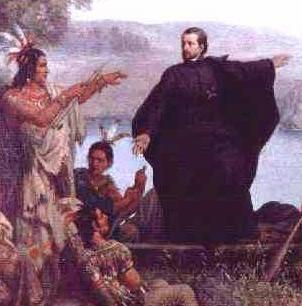
Father Marquette National Memorial
The Father Marquette National Memorial is located in Straits State Park, just west of I-75, off U.S. 2. Father Jacques Marquette, a French Jesuit missionary, established Michigan's earliest European settlements at Sault Ste. Marie and St. Ignace in 1668 and 1671. He lived among the Great Lakes Indians from 1666 to his death in 1675.

Historical Center
720 Church Street
Saint Ignace, MI 49781
Tel No:
( 517 ) 373-3559
Email:
Contact this Business
Map:
Click Here

Abortion Cake At Georgetown Law School

You just can't make this stuff up! From the blog-o-sphere

Tuesday was the anniversary of Roe v. Wade. Law Students for Choice- a beleaguered student group if ever there was one (you try being pro-choice at a Jesuit school- our insurance doesn’t even cover birth control)- had a table celebrating the uh…celebrated Supreme Court case. They also had a cake. I heard about the cake while standing in line at the salad bar; “You’re eating abortion cake? And how does that make you feel about yourself?” Pretty damn good I would imagine. It’s free cake, after all.

Link (here) Original post deleted by blog author. Updated post (here) at the Seventh Year.
Cake is not the one mentioned, but I think it makes the point.

Jesuit Missions: To The People Known As Ong

Jesuit-educated Ong lived among the Mangyan tribal folk and helped them with their ancestral domain claims. A hydro-geologist, Ong also helped the Mangyan find water sources. But he was not there as a technical man, he was there to teach and also to learn “to love and to serve.” Couple India and Javier Legaspi brought back to life a people’s fine craft of weaving and made the world notice. This not only gave communities livelihood, this restored the people’s confidence and pride in their heritage.

Link (here)
Photo credit of Mangyan lady (here)
I can not find a good link on the Ong. Please attach a link in the combox. Thank You.

When Can We Start Praying For Rain?

A colossal waste of time and spiritual capital.
Jesuits put climate change on the agenda
Climate change and its effects on future generations will headline this year’s Jesuit Lenten Seminar Series. The Australian Jesuit newsletter Province Express reports the seminar entitled Climate Change: Who Pays the Price? will bring together expert speakers who will discuss the political, social and religious perspectives of the issue. Being held in Melbourne (Xavier College) on 5 March and on 6 March in Sydney (Marist College, North Sydney)speakers include: Executive Director of the Australian Conservation Foundation Don Henry, President of the Welfare Rights Centre in Sydney Michael Raper, Associate Director for Jesuit Refugee Service Australia Sr Maryanne Loughry and Chair of Catholic Earthcare Australia Bishop Christopher Toohey.
Link (here)