Saturday, April 19, 2008
Theologians Create Truth?
Jesuit On 1960's Church Design For Indian Catholic Church
Bright fibreglass windows, arches shaped like onion domes and a statue of Jesus Christ bearing resemblance to tribal art are some of the unique features of a church in Jharkhand
Dumka (Jharkhand):
Father Claudious Tauro, secretary of the Jesuit Santhal Society of Jharkhand, said. The building of the church in keeping with tribal art was part of 'inculturation', a practice that helps churches adopt a number of local traditions and practices to make it easier for people to relate to Christianity.
Source: Indo-Asian News Service
Jesuit Mission Trail And Martyrs Shrine
Trail explores southern shore of Georgian BayWAUBAUSHENE, Ont. - A newly paved 20-kilometre trail offers walkers and cyclists a way to explore historic areas along the south shore of Georgian Bay. The Tay Shore Trail runs from Waubaushene to the Wye River and the outskirts of Midland. It passes by Sainte-Marie Among the Hurons, which recreates a famous 17th-century Huron-Jesuit mission. Nearby is Martyrs' Shrine, a tribute to the French Jesuits who were martyred during the Huron-Iroquois wars. The completion of the trail in 2007 was "the culmination of over a decade's worth of effort by Tay Township council, staff and residents," said Tay Mayor Scott Warnock. An abandoned CN Rail corridor was secured for the multi-used trail. Free trail guidebooks can be picked up at municipal offices at 450 Park St. in Victoria Harbour and at libraries in Victoria Harbour and Waubaushene.
Link (here)
Friday, April 18, 2008
Jesuit On 40,000,000 Abortions Since Roe V. Wade
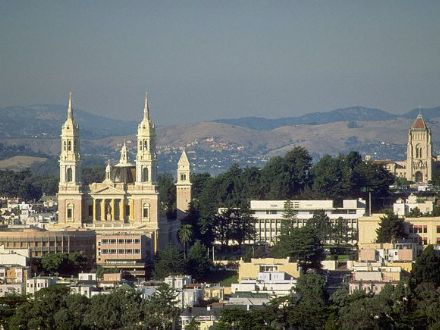
Imperfect choicesConference at St. Mary’s Cathedral in San Francisco explores why Church leaders do not endorse political candidates.
An excerpt.
That the Catholic Church’s social teaching, more than Church leaders and, certainly, much more than partisan politics, should guide Catholics in the political and social arenas was the theme of an April 3 conference at The Cathedral of St. Mary of the Assumption in San Francisco, said the April 11 Catholic San Francisco, the newspaper of the San Francisco archdiocese. Jesuit Father George Schultze also addressed the conference. In an interview with Catholic San Francisco after the conference, Schultze, an adjunct professor at St. Patrick’s Seminary in Menlo Park, said that, although there are many public policy issues dealing with intrinsic moral evils,
abortion is the preeminent moral issue since it involves the direct taking of human life and the direct involvement of someone in the act. Then, he said, there is “the gravity of the moral evil in the tens of millions of abortions that have taken place since Roe v. Wade.”Schultze said to conference participants, “I want to make clear that if there are 40 million people who have lost their lives, what do we say to God and what do we say to the 40 million?”
Fr. Gregory Lucy, S.J. To Retire At Spring Hill College
Spring Hill College President To RetireRev. Greg Lucey announces plan to step down
By Bob Grip
MOBILE, Ala. -- Spring Hill College President, Gregory Lucey, S.J. announced plans to retire Friday. He says he expects to remain on the job until June, 2009. Rev. Lucey, who is 75, said the College's Board of Trustees had already formed a search committee to find his successor. It is the Board's intention that the next President will also be a Jesuit priest. In the 11 years since becoming President of the College, Spring Hill has experienced tremendous growth in the expansion of its physical plant and in fundraising.
Jesuit University Presidents Speak After The Holy Father's Address, One Of Inspiration And One Of Relief
College educators say they're encouraged, challenged by pope's words"It was certainly nothing of the scolding that some alarmists had hoped," said Jesuit Father Jeffrey von Arx, president of Fairfield University in Connecticut.
John DeGioia, president of Jesuit-run Georgetown University in Washington, called the pope's remarks "inspiring, moving and a powerful personal experience."He recalled the tremendous opportunity to be with colleagues and witness the crowd of young people gathered outside as part of "a huge celebration. There was a wonderful spirit to the place yesterday." Later DeGioia said he felt the pope's validating conviction and "deep sense (that) what we do matters."
Thursday, April 17, 2008
Newman President On Fidelity Of Those In Catholic Higher Education
Will Benedict Scold Catholic College Presidents?An excerpt.
Nevertheless, while Pope Benedict is unlikely to dwell on negatives, he is also unlikely to ignore the need for reform. His address to the Society of Jesus in February is a case in point: With praise for their good works, Pope Benedict reminded the Jesuits of their special vow of obedience to him and their obligation to teach authentic Catholic theology. His displeasure with the order’s failings in these areas was apparent.The presidents of those Catholic colleges and universities that clearly do not conform to the Vatican’s standards are understandably nervous, or at least embarrassed. The protest against “mindless dogmatism” by Patricia McGuire, president of the District’s Trinity University, in Sunday’s Washington Post ( “Freedom and Faith on Campus,” 4/13/08) is especially telling. Too many Catholic college presidents elevate scientific evidence over theological truths which were revealed by God, as if the latter truths cannot be defended.
Provincial On The GC35
Embracing our charism and serving the ChurchIn his allocution, the Holy Father invited us to “build bridges of understanding and dialogue” and to set out once again in the tracks of our Jesuit predecessors. He specifically mentioned the great missionaries Matteo Ricci and Robert de Nobili, and urged us to draw upon not only their same courage and intelligence, but also and equally their profound motivation of faith and enthusiasm to serve the Lord and his Church.In response to his letter and allocution, the congregation wrote to the Holy Father to thank him for his expressions of affection and support and to answer the issues that he raised. To mark both the beginning and the closing of the general congregation, the delegates gathered for a concelebrated Mass at the Gesù, the mother church of the society in Rome which contains the tombs of St. Ignatius, Father Pedro Arrupe and a number of other Jesuit saints and blesseds. At the final liturgy the members recited a grateful “Te Deum” in thanksgiving for the many rich blessings that the Lord has granted to the society throughout its history. We departed Rome praying that Jesuits throughout the world may respond both faithfully and generously to the congregation’s call to renew our charism and be authentically “contemplatives in action,” seeking to find God in all things!
Jesuit Magazine And Numbers
On American tour, pope puts his stamp on Catholic educationIn a speech at Catholic University Thursday, he'll ask schools to strengthen their Catholic identity.
chose four aspects: helping the poor, belief in the resurrection of Jesus, church sacraments, and the Virgin Mary, according to an article in America magazine, a Jesuit weekly.In the same study, however, three-fifths of respondents said that one could still be "a good Catholic" and practice birth control, approve of abortion in some instances, remarry after divorce, cohabit in an unapproved marriage, and miss mass routinely.
Surprised Jesuit
Father Jim Martin, a Jesuit who has been our analyst this week on the air and who is the Associate Editor of America Magazine, a church publication, has been surprised the Pope has tackled so directly the biggest controversy facing the church.But he acknowledges that, even in his directness, the Pope is likely ticking off both victims and arch conservatives within the church who cringe at the public mea culpa.
$2 billion in lawsuit settlements to thousands of victims; and it's no coincidence that while that money has been doled out, parishes and Catholic-run schools have closed.So, as not just the spiritual head of the church but also as the CEO, it's smart business to get all this behind, and move on -- financially and, in the vernacular of the Church, spiritually. How many more times will he address the scandal? And will he end up meeting with the victims? That would send a huge signal as well
Jesuit, Avery Cardinal Dulles On "The Saved And The Damned"
The Population of Hellby Avery Cardinal Dulles May 2003
Copyright (c) 2003 First Things (May 2003).
everyone who dies in a state of mortal sin goes immediately to suffer the eternal punishments of hell.This belief has perdured without question in the Catholic Church to this day, and is repeated almost verbatim in the Catechism of the Catholic Church (CCC §1022, 1035). Several local councils in the Middle Ages, without apparently intending to define the point, state in passing that some have actually died in a state of sin and been punished by eternal damnation.
Fr. Charles Currie President Of The Association Of Jesuit Colleges and Universities
Catholic universities must encourage the open exchange of ideas, even when positions diverge from traditional church teachings. They too, are eagerly-awaiting the pope's remarks - the first papal lecture to educators in two decades - hoping for a message that embraces the complexity of Catholic education in a changing America.
"It has always been a delicate balance, and there are tensions at times,"
Jesuit, Fr. Steven Privett On The Holy Fathers Visit To America
Pretty much ignored in the U.S. todayPope meets with heads of Catholic colleges and universities
Presidents of U.S. Catholic colleges and universities have been “summoned” to a meeting with Pope Benedict XVI today in Washington, D.C., during the pontiff’s visit to the United States, said the April 15 Los Angeles Times. Superintendents of Catholic schools are urged to attend the meeting as well. What will the pope say at this meeting?
Will he celebrate U.S. Catholic education or criticize it for a lack of adherence to Church teaching and tradition? "He understands universities, and I think he really understands how Catholic universities serve the church,"Jesuit Fr. Stephen Privett, president of the University of San Francisco, told the Times. But while Privett said the pope "will be very comfortable with this group," he will challenge them to promote more strongly their institutions’ Catholic identity. Bishops, priests, and laity have been critical of Catholic universities for hosting dissident speakers (such as pro-abortion politicians), hiring theological faculty who dissent from Church teaching, and permitting plays such as the Vagina Monologues on campus. For instance, Privett’s USF had pro-abortion congresswoman and Speaker of the U.S. House of Representatives, Nancy Pelosi, deliver last year’s commencement address to undergraduates at the university’s McClaren College of Business. One of the university’s theology professors is openly homosexual and, though a Catholic, in 2006 was ordained a priest in the Celtic Christian Church.
Quote Of The Day: Fr. James Martin
"But he's a brilliant theologian and a sterling preacher."
Read the full article (here)
Wednesday, April 16, 2008
Quote Of The Day: "We Are Not Crazy Baby Killers."
“And to let people know that we’re not crazy baby killers.”
Read all about Georgetown's, "H*yas for Choice" (here)
Crazy baby killer at Yale University, "I did it for arts sake"
Tuesday, April 15, 2008
Jesuit Could Have Said Alot Of Different Things About The Holy Father And George W. Bush
It's the first time that Bush has left the White House to greet a foreign dignitary, and the first official papal visit to the United States since the establishment of full diplomatic relations between the United States and the Vatican 24 years ago. "Obviously, it shows the deep respect that the president has for the pope and also the recognition that there's a lot of Catholic voters out there," said Father Thomas Reese, a Jesuit
Georgetown Chaplain On The Visit Of The Holy Father
Jesuit Money Matters
Currently he serves on the Investment Committee of the Jesuit Foundation in Dallas and is the Chairman of its Investment Committee since 2000.Mr. Watters graduated from Santa Clara University, and attended the London School of Economics.
Jesuit On Baptism,"The Road To Everlasting Life"
by Fr. John A. Hardon, S.J.
As we begin our conferences on the seven sacraments, our plan is to introduce each conference with some of the modern misunderstandings on each sacrament. I say misunderstandings. But they could better be called blatant errors that we used to call heresies. What makes these errors so serious is that they are being openly taught and promoted by professedly Catholic writers and speakers. One prominent writer has some unusual insights in his book, Doors to the Sacred. On the grounds that there has been a development of doctrine in the Catholic Church, he affirms that “the Catholic hierarchy seems to have accepted the notion that Baptism is necessary for joining the Church but it is not necessary for salvation.” He further writes that, “Contemporary theology and religious education texts now speak of Baptism as incorporating a person into the life of Christ which is continued in the Church, and talk about its causing the forgiveness of original sin is slowly disappearing.” Almost five centuries of Protestant thought have deeply penetrated Catholic minds. In a standard analysis of Roman Catholicism, the author is very clear. “Rome”, he says, “has perverted the meaning of Baptism so that instead of accepting it as a symbolical ordinance and an outward sign through which Christ and the benefits of the new covenant are represented and conveyed to the believer and received by faith, it is represented as working in a magical way to produce baptismal regeneration and securing automatically the forgiveness of all past sins, and as absolutely necessary to salvation.” As we go through our reflections on Baptism, we shall see how to cope with these domestic and alien critics of what we believe is the sacrament of regeneration and the supernatural life. Baptism is not only the first of the seven sacraments; it is also the basic sacrament. How?
Unless a person is baptized, none of the other six sacraments can be received. Only a baptized person can be confirmed. Only a baptized person can receive absolution in the sacrament of Confession. Only a baptized person can receive the sacrament of Matrimony. Only a baptized man can be validly ordained a priest. Baptism first gives a person the supernatural life, whereas the other sacraments provide for the restoration, or growth, or healing, or communication of the supernatural life.
Baptism, the Sacrament of Regeneration and the Supernatural Life
Sunday, April 13, 2008
We Have Started To Evaluate Liturgy - A Monstrous Act!

The Missing Jesuits At America Magazine
By Richard R. Gaillardetz FEBRUARY 2, 2004
CNS and Staff FEBRUARY 4, 2002
Mitch Pacwa, S.J., who taught at the University of Dallas, is taking on a permanent role at the Eternal Word Television Network, which will include filling in for the ailing Mother Angelica. Mother Angelica, 78, remained in fair condition at a Birmingham, Ala., hospital after suffering a stroke, her second, on Dec. 24.

By Patricia A. Kossmann OCTOBER 13, 2003
I t was on a balmy day in early autumn, some 20 years ago, that I was privileged to meet Mother Teresa personally. She was in the United States making visitations to some of her Missionaries of Charity communities. At this particular time she was at their house on 145th Street in the South Bronx. Actually, I was the guest of the late Eileen Egan (1911-2000), the well-known pacifist and a longtime acquaintance of Mother Teresa, with whom she traveled more than 30 years around the world. Doubleday was publishing Egan’s biography of Mother Teresa, entitled Such a Vision of the Street (which, regrettably, is no longer in print). We left from my offices at Doubleday, then located on Park Avenue, and were chauffeured to the Bronx by the late John A. Hardon, S.J. (1914-2000), who was then a spiritual adviser to the sisters.
CNS and Staff MARCH 18, 2002
After the Vatican backed the University of San Francisco’s control of the St. Ignatius Institute, Ignatius Press announced that it was forming Campion College, a two-year college “embodying both the spirit and the curriculum of the original St. Ignatius Institute.” The St. Ignatius Institute was founded in 1976 by Joseph D. Fessio, S.J., a theology professor at the Jesuit-run Univ
ersity of San Francisco from 1975 to 1992. CNS and Staff APRIL 16, 2001
By Fr. Fred Kammer, S.J. (Writing as head of Catholic Charities USA and now the outgoing Provincial of the New Orleans Province)
Jesuit Blogger Mark Mossa, SJ : Kills His Blog, ... AND I LET MYSELF BE DUPED
Farewell I thought I saw an opportunity, an opportunity to bridge a gap between people of different perspectives in the Church. So, I threw my hat into the fray and it was fun, for a while.It even appeared that I might make some progress in this endeavor and perhaps even accomplish some goals that I had set for myself in becoming aware of the various dimensions of the Catholic blogosphere—
trying to encourage some positive discourse, and hoping to offer a counterweight to the negative and unfair caricature of the Society of Jesus which obtains in many a corner of that blogosphere.And, at first, there seemed to be some hope of success at this, and there are still a coterie of bloggers (you know who you are) that give me hope in this regard. Yet, I’ve grown tired of swimming against the tide. The most negative of Catholic blogs still continue to be the most popular and, like myself, the more positive bloggers seem to be posting with far less frequency.
The recent General Congregation has only provide more fodder for negative speculation among those who hate the Society of Jesus, and indeed some who claim to love it. And, finally coming full circle, in a sense, I recently again found myself the victim of slander, falsely accused of being uncharitably slanderous myself, and not by a stranger like in the first case, but this time by a friend, by someone who should have known better.That almost no one, it seems, found this hard to believe, just demonstrates what we have come to expect in the Catholic blogosphere. Charity, it seems, is not among those things. It has become—and perhaps always has been—a poisonous atmosphere which I no longer desire to be a part of. Nonetheless I have made some good friends as a result of my time here, and for this I am most grateful. Some of those friends were able to be with me at my diaconate ordination, and some will also be guests at my ordination to the priesthood in June.
It is this result of my time blogging which I can most celebrate. I may not have succeeded in convincing anybody of anything, the Catholic blogosphere may be nastier than ever, but I can celebrate a community of good friends with whom I have had the privilege of journeying in these years, and whose friendship I hope to maintain.But it will be in other ways. Recent months have been difficult for me, and the episode I describe above was just the tip of the iceberg. But the blessing and grace has been that it has forced me to examine what is most important in my life right now. In a little over two months I will be ordained a priest, and there are few things more important than that right now. It is a fulfillment of God’s will toward which I have been working for nearly 11 years. It promises new challenges and new opportunities. What a privilege it will be to invite both strangers and friends to worship, and to be able to offer them reconciliation with God!
To focus on these most important things, some other things, I realize, must go by the wayside. At this point, continuing this blog is more a temptation than a real contribution. And I hope it has been a contribution, at least to some.In my prayer these months as I prepare for ordination, I will also pray for you, my friends, who have in various ways been Christ to me these three and a half years. Please also pray for me. As I “silence” this blog, I do so in the hope of enjoying the silence which Alfred Delp invokes when describing ordination:
In that great moment of our life when we go to be ordained, we kneel before the bishop and he silently lays his hands upon us.It is shared with all. May you also know the nearness of God in such silence. Thanks.He is silent. You feel the blessed and creative burden of this hand through your entire being. And the congregation is silent. And this silence will surround the priest.This keeping silent, the still hands of the silent bishop, calls forth the priest from his former homeland. It calls him forth from his previous refuges, and sequesters him and encompasses him with this silence, this stillness in which he will be consecrated, so that it will accompany him all his life. This silence must surround us. We guard people's secrets in silence. We call our heart to be silent, so that it does not love where it should not love. Our will for power must be silent, because we are sent forth to be the hands of the Lord in blessing. Silent, too, must be our will for all the other things that, otherwise, could shelter and anchor and secure a life in this world. The silence accompanies us, because it is always the sign that the Lord God has come especially near. This silence does not and must not belong only to the priest.
Saturday, April 12, 2008
16th Century Portuguese Jesuit: Luis Frois
My Friend FroisIn March of that year he departed for India, arriving in Goa in October. He was never to see his family again. He soon met Father Francis Xavier, as well as a Japanese convert from Kagoshima named Jiro.Frois worked for some years under the Provincial of India as the person in charge of reporting on East Asia to the church in Europe; and in 1563, age 31, he arrived in Japan for the first time, at Yokoseura, Nagasaki. In 1565 Frois journeyed to Kyoto, but with the downfall of his protector, Shogun Ashikaga Yoshiteru, he was forced to take refuge in Sakai. It was in 1569 that he met Nobunaga at Nijo Castle and received permission to proselytize. He spent the ensuing years in missionary work while writing The History of Portuguese Territories in East India. In 1581, in the capacity of interpreter, he accompanied Visitor General Alessandro Valignano on the latter’s travels in Japan, and was welcomed in Kyoto and Azuchi by Nobunaga. Nobunaga died the following year. Alessandro ValignanoIn 1583, at age 51,
Frois began writing his History of Japan on the order of Vice Provincial of Japan Gaspar Coelho. Part One of the history was completed in 1586. In that year, Frois traveled to Arima, Amakusa, Nagasaki, Ohmura, Hirado, Sakai, Osaka and Kyoto in the company of the Vice Provincial. Hideyoshi promulgated the edict on the expulsion of the missionaries in 1587, and Frois was given this order by his envoy. From then on, Frois devoted himself to writing his history.In 1590, at age 60, Frois was sent to Macao, accompanying Visitor General Valignano. Three years later he returned to Nagasaki; and two years after that, in 1597, the persecution of Christians began in earnest in Japan. Frois’ last report was on the fate of the twenty-six martyrs crucified in Nagasaki. That year—1597—Frois died at the church in Nagasaki.
Former French Jesuit Discovered The Mouth Of The Mississippi
Mouth of the Mississippi foundIn mid-February 1682, French explorers, René Robert Cavelier, Sieur de la Salle (Nov. 21, 1643-Mar. 19, 1687), a former Jesuit, and his lieutenant, Henri de Tonti (1649 or 1650-Sept. 1704), lead an expedition from New France departing in canoes from the mouth of the Illinois River with 24 Frenchmen and 25 Native Americans. Travelling down the Mississippi River, their party reaches the mouth of the Mississippi and the Gulf of Mexico near modern-day Venice, Louisiana, on April 7 having established peaceful relations with the Chickasaw, Quapaw, Taensa, Natchez, and Koroa nations along the way. On April 9, La Salle formally claims the Mississippi River and all of its tributaries for King Louis XIV of France, naming the entire Mississippi basin, from the Alleghenies to the Rocky Mountains, "La Louisiane" in honor of the King.
New Jesuit Deacons For Zimbabwe and English Provinces
London: Deacons ordained at Farm StreetBishop Alan Hopes, Auxiliary in the Westminster Archdiocese, ordained Sumeth Perera and Dominic Tomuseni to the diaconate on 5 April. The ceremony at Farm Street Church in London followed the ordination to the diaconate of Stephen Patterson in Spain last month. Dominic and Sumeth are both in their third year of studies for their Bachelor of Divinity at Heythrop College in London. 34-year-old Sumeth comes from Sri Lanka; he entered the Society of Jesus in 1993.
Dominic (36) is a member of the Zimbabwe Province, having entered the Society in 1997. He worked in vocations promotion and youth work in Guyana, and also as a teacher at the Marian Academy in the capital, Georgetown, before starting his studies in London in 2005.Stephen Patterson entered the Society of Jesus in 1997 at the age of 31. Originally from Oldham in Lancashire, he trained as an electrician before taking up studies at Campion House, Osterley.
He was ordained deacon on 15 March at St Francis Xavier's Church at the Centro de Foramacion Padre Piquer run by the Jesuits in Madrid.In his homily at the Farm Street event, Bishop Hopes reflected on the triple ministries of the deacon: as a minister of the Word, of the altar, and of loving service to others. He told Dominic and Sumeth that they should 'seek out ways in which [they] may find and serve Jesus Christ in others and their needs'.
© Independent Catholic News 2008