Tuesday, May 20, 2008

Jesuit Cardinal Criticizes Left Wing Anti-Catholic Administration In Argentina

non-prophet
Posted by: Diogenes
Cardinal Jorge Bergoglio, the Archbishop of Buenos Aires, has been outspoken in critcism of the Argentine government. Now Madame President is slapping back:
Buenos Aires, May 15, 2008. CNA
The government of Cristina Kirchner has decided to "chastise" Church officials in Argentina for their criticism of its policies by announcing

it will cancel a 198 year-old tradition and replace the traditional Te Deum prayer of May 25 at the Cathedral of Buenos Aires with a "multi-religious" ceremony in northern Argentina.

Previously the Te Deum has traditionally been prayed at the Cathedral in Buenos Aires to mark important political changes that took place in the country on May 25, 1810. No Argentinean bishop has responded publicly to the decision by the Kirchner administration, but the president of Campus Ministry for Buenos Aires, Father Guillermo Marco -- who until recently was spokesman for the Archdiocese of Buenos Aires -- told Noticias Argentinas news agency that the move was in response to criticism of the administration by Cardinal Jorge Bergoglio. Cardinal Bergoglio's protests against the maneuvering of the Kirchners -- especially as regards erosion of the rights of the Church -- have an extensive history.

So why isn't Bergoglio hailed as a prophet? Because the government whose excesses he opposes is not a right-wing government, whence the drama of conflict lacks the cinematic appeal that is essential to the story-line.

He's not prophetic; he's just an obstructionist with a miter. As it happens, Bergoglio is a Jesuit, although the Society of Jesus seems uncharacteristically bashful in its public congratulation of his efforts on behalf of the Church. Will he be picking up honorary degrees at Georgetown and Boston College this year? You make the call. GJBJ says, "Highly doubtful!"

Link (here)

Is America Magazine Fair Minded? Men For Others, Or Just Certain Others?

Christian group raps Jesuit critique of Israel
Christians for Fair Witness on the Middle East, led by Sister Ruth Laut OP, denounced an editorial in America Magazine. Rev. Bruce Chilton of Bard College it is part of a trend that questions the legitimacy of the Jewish state.
Monday, May 19, 2008By Spero News
Christians for Fair Witness on the Middle East strongly rebuked the Jesuit-edited " America Magazine" for the editorial "Israel at 60" in its May 26 edition.
Saying that the editorial asks whether Israel can be both Jewish and a democracy, Rev. Dr. Bruce Chilton, an Episcopalian priest and the Bernard Iddings Bell Professor of Religion at Bard College said "This is part of a disturbing trend to question the legitimacy of a Jewish state." . "Arab Israelis have equal rights under the law. That discrimination still exists is wrong and requires change -- but if the existence of discrimination against a minority population means that a nation is not a democracy, then there is no democracy on the face of the earth."

"That America ignores efforts like this calls its motives and judgment into question," according to Fr. James Loughran, a Roman Catholic priest and Director of the Graymoor Ecumenical & Interreligious Institute.


According to a statement released by Christians for Fair Witness, a poll commissioned by the Knesset Channel asked Israelis if as part of a negotiated agreement establishing a Palestinian state, there would be justification to demand that Arabs relocate to Palestinian territory. "That is quite different from a unilateral expulsion, which is what the America editorial implies. Why the willingness to latch onto any glimmer of a negative Israeli image and distort and magnify it for America's readers?" asks Sr. Ruth Lautt, OP, Fair Witness National Director. The poll, according to Fair Witness, showed that a majority of Israelis were either totally against relocation or believed that relocation should be based upon loyalty to the Jewish state or proximity to the new Palestinian state; 29 percent believed that all Arabs should relocate.

"America's attempt to paint inter-ethnic hostility as existing only on Israel's side is offensive to fair-minded people," says Rev. Dr. Peter Pettit of Muhlenberg College.


"In light of 60 years of declared war, one might ask how many Jews remain as voting citizens in neighboring Arab states. If Israelis see virtue in having current Israeli Arabs affiliate with a Palestinian state, is that anything more insidious than a pragmatic assessment of social bonding? If queried, where might a majority of Palestinians suggest that Jews live under a two-state solution? "

Link (here)

Monday, May 19, 2008

"You Are My Witnesses That I Am Dying For The Catholic Faith."

Bl. Ignatius de Azevedo, S.J. (Portuguese: 1527-1570) was one of the Forty Martyrs of Brazil who met their death off the Canary Islands at the hands of Huguenots. Ignatius had worked in Rome as procurator for India and Brazil, then the Superior General, Francis Borgia assigned him to Brazil as Visitor to find how Rome could help the Jesuits working there. The answer was more Jesuits, so Ignatius went to visit the Spanish and Portuguese provinces of the Society to seek volunteers for the Brazil mission and succeeded in gathering 49 young Jesuit volunteers.

The 40 martyrs In spite of the clear danger of pirate ships they sailed off in two ships. Ignatius expressed his feeling: "If the Huguenots should capture us, what harm can they do? The most they can do is to send us speedily to heaven."

On July 15, 1570 as they were heading into the Port of Palms, near the Canary Islands, one of the two ships, with 40 Jesuits aboard, was overtaken by five faster pirate ships under the command of a French Huguenot, formerly a Catholic, now a declared enemy of Jesuits. When the pirates boarded the ship and saw

Fr. Azevedo in the center of the ship holding a painting of the Virgin Mary, a pirate slashed him with a sword as he protested: "You are my witnesses that I am dying for the Catholic Faith." The pirates picked up his body and hurled him overboard with the painting still held tightly in his hands.

They then hacked to death the rest of the 39 Jesuits and threw them all into the sea, leaving unharmed the rest of the passengers. (Ban, Cor, Ham, JLx, Tyl)
Painting is not of the actual incident, but I think best represents the post and what these heroic unarmed Jesuits faced.

University Of San Fransisco And The Politics Of AIDS

“Role model for USF students”
Jesuit university honors openly homosexual AIDS ambassador who promotes condom use
Among those receiving honorary degrees at University of San Francisco commencement ceremonies this past weekend was Ambassador Mark Dybul, an open homosexual with a same-sex partner about whom he makes no secret. Dybul has served as U.S. Global AIDS coordinator under President George W. Bush.

At his swearing-in ceremony in October 2006, Secretary of State Condoleeza Rice welcomed Dybul’s family members, including his partner, Jason Claire, and Claire’s mother, whom Rice called Dybul’s “mother-in-law.”


Laura Bush was present at the swearing in, looking on while Dybul’s partner held the Bible on which Dybul placed his hand while taking the oath of office. According to a USF press release, the university honored Dybul “for his work at the forefront of the international fight against HIV/AIDS as the U.S. global AIDS coordinator.” According to the release, “Dybul is a role model for USF students as someone with the knowledge and skills needed to succeed, and the values and sensitivity to be men and women for others.” "Dr. Dybul's life and work reflect USF's core value of advancing a 'culture of service that respects and promotes the dignity of every person,'" says the citation awarded to him, according to the press release.

Jesuit-run USF is not the first Catholic organization to have recognized Dybul. In February, he was one of two recipients of the first Mother Teresa International Humanitarian Award. The event was organized by the United Nations Program on HIV/AIDS (UNAIDS) and the Catholic Bishops' Conference of India Health Commission.


Cardinal Telesphore Toppo, a past president of the Indian Conference of Catholic bishops, presented the awards. Dybul has been a defender of President Bush’s ABC HIV/AIDS prevention program, which has been criticized for its emphasis on abstinence. “ABC (Abstain, Be faithful, correct and consistent use of Condoms) is good public health, based on respect for local culture -- it is an African solution, developed in Africa, not in the U.S.,” Dybul said in an April 13, 2006 “Ask the State Department” Internet forum. ABC, he said, “provides comprehensive information so people can decide how to protect themselves.”

Sunday, May 18, 2008

Martyred Jesuit, Was Hanged, Beheaded, Bowelled And Quartered

Bl. Peter Wright (†1651)
Blessed Fr Peter Wright, S.J., of Slipton, Northamptonshire, England suffered for his priesthood, his vows of religion and his Catholic Faith at Tyburn on 19 May, 1651. His execution on Whit Monday took place before over 20 000 spectators, as Bishop Challoner relates: Having celebrated Mass with great devotion, the time drew near when he was to go down in order for execution. Hearing the knocking at the iron grate, he took it as a summons from Heaven, and cried out:
.
I come, sweet Jesus, I come.
When Fr Wright was called out to the hurdle, he went with so much alacrity and speed that the officers could scarce keep pace with him; then being placed on the hurdle he made a short act of contrition; and in the midst of mutual embraces was absolved by Fr Cheney, and then drawn away to Tyburn through the streets crowded with an innumerable multitude of people. He was drawn on the hurdle more like one sitting than lying down; his head was covered, his countenance smiling, a certain air of majesty, and a courage and cheerfulness in his comportment, which was both surprising and edifying, not only to the Catholics who crowded to ask his benediction, but to the Protestants themselves, as many publicly declared. Thirteen malefactors were appointed to die with him, to whom the father endeavoured to give seasonable advice for the welfare of their souls, but was continually interrupted by the minister, and therefore desisted, betaking himself to silent prayer, in which he employed about an hour, standing with his eyes shut, his hands joined before his breast, his countenance sweet and amiable, and his whole body without motion as one in deep contemplation. When the minister took occasion to tell him it was not yet too late, and that he might save his life if he would renounce the errors of Popery:

If I had a thousand lives I would most willingly give them all up in defence of the Catholic religion. The hangman having fitted the rope to his neck, the confessor made a short speech to the spectators: Gentlemen, this is a short passage to eternity; my time is now short, and I have not much to speak. I was brought hither charged with no other crime but being a priest. I willingly confess I am a priest; I confess I am a Catholic; I confess I am a religious man of the Society of Jesus, or as you call it, a Jesuit.
This is the cause for which I die; for this alone was I condemned, and for propagating the Catholic faith, which is spread through the whole world, taught
through all ages from Christ's time, and will be taught for all ages to come.
For this cause I most willingly sacrifice my life, and would die a thousand times for the same if it were necessary; and I look upon it my greatest happiness, that my most good God has chosen me most unworthy to this blessed lot, the lot of the saints. This is a grace which so unworthy a sinner could scarce have wished, much less hoped for. And now I beg of the goodness of my God with all the fervour I am able, and most humbly entreat Him that He would drive from you that are Protestants the darkness of error, and enlighten your minds with the rays of truth. And as for you Catholics, my fellow soldiers and comrades, as many of you as are here I earnesdy beseech you to join in prayer for me and with me till my last moment; and when I shall come to Heaven I will do as much for you. God bless you all; I forgive all men. From my heart I bid you all farewell till we meet in a happy eternity.


Having spoken to this effect, he again recollected himself a while in prayer, and then the cart was drawn away, and he was suffered to hang till he quietly expired. His dead body was cut down, beheaded, bowelled, and quartered. His friends were permitted to carry off his head and quarters which were translated to Liege, and there honourably deposited in the college of the English Jesuits. He suffered aged 48, and after 22 years of religious life. He was beatified in 1929.
Blessed be God in His Angels and in His Saints, †
Thank you Fr. Z for the Hat Tip, reader go to the link (here) and read the comments section in Fr. Z's blog, What Does The Prayer Really Say, they are interesting.

Link (here)

Vocations, Vocations, Vocations

Guiding students toward a life path
By Rich Barlow May 17, 2008
You'd expect the Jesuit-run Boston College to guide students seeking to be Jesuit priests. But at a time when a priest and nun shortage bedevils the Roman Catholic Church across its religious orders and dioceses, BC is taking, if you will, a more catholic approach.
Since November, Manresa House has been doing business on a leafy residential street near the Chestnut Hill campus. Jointly run by BC and the Jesuits' New England province, the house provides counseling for students considering the religious life, even if their spirituality is pulling them toward the Franciscan hood or Augustinian auspices or duty as a diocesan priest.
(The New England Jesuits do, however, use the second and third floors of the house to lodge nonstudent out-of-towners on overnight retreats to specifically contemplate the Jesuit call.) The comfortable living room, with sofa and plush rug, bore artifacts on a recent visit attesting to the sacred and secular: On a table sat a brochure about "Ignatian Spirituality" next to a chocolate Easter bunny.
The Rev. Jack Butler, a burly man with an iron handshake who runs the house, proudly wore university-emblazoned garb (a BC sweatshirt) but also had his undone Roman collar protruding. As part of his job at Manresa, he said he must sometimes suppress his inner Jesuit.
"Personally, Jack Butler hopes with my whole heart that you look at the Society of Jesus and want to be a Jesuit," he says. "But maybe God wants you to be a Benedictine." The Catholic church has scores of religious orders - clergy or laity, men and women - who follow prescribed religious rules in pursuit of the order's mission, be it service or the contemplative life. (BC officials estimate that about 20 students entered the priesthood each year in the 1960s; that's down to three or four a year today.) BC sophomore Nathaniel Hibner saw the religious life in his mind's rearview mirror during high school in Ohio. A lawyer's life loomed, but the object in the mirror turned out to be closer than it looked after he heard engaging Jesuit professors in class and Butler in the Sunday pulpit. He came by Manresa House for a sit-down and has been reading literature and hearing speakers discuss the religious life at the house ever since. Those speakers dispelled his misconception that all are certain they want to join the ministry before they enter it. He was struck by "the joy I've always found when I see them, especially when they interact with one another." A political science major, Hibner plans to continue his reflection after college during a Peace Corps stint. If it was human ministers who attracted him to ministry, the ambience in which he pondered mattered, too. Butler's campus office was "a little more sterile environment" than Manresa, where students can relax on the sofa, have their pick of a chair, or just snack sitting on the floor, and "there's a lot more space, a lot more openness."
Butler juggles his campus and Manresa duties with his job as vocation director for his order in New England, which means that "anybody who's interested about being a Jesuit has to come through me, or you don't become a Jesuit in New England." That's typically a full-time job, but BC and the New England province negotiated an arrangement under which they share Butler's services.
That deal, in turn, switched on a mental light bulb at the BC administration. As a Jesuit-run school with 14,000 undergraduate and graduate students, what could the school do to promote the mission and ministry of the church? Manresa House - named for a town in Spain where Catholics come to pilgrimage - was born as a formalized college commitment to Catholic vocations, complementing an informal meeting group run by BC President William Leahy for students pondering the priesthood, Butler says. Through a spokesman, Leahy says that, given his school's Catholic roots, "we want to do everything we can to foster vocations to the priesthood and religious life." That commitment confronts "a world today that doesn't necessarily value the decision for ministry," says Butler, citing the call for celibacy in America's sexualized culture. The revelations of sexual abuse of children by priests weren't exactly an effective recruiting poster, either. About half of the people who've cycled through Manresa have raised the scandal as a concern about entering ministry, according to Butler.
The reaction is different, depending on a seeker's age. (Manresa House sees potential priests from college age up to 50.) "The students have this wonderful idealism - 'Those guys that did those horrible acts, they weren't faithful. [But] we're going to get it right.' " Older advisees worry more about how they'll be perceived as priests in the scandal's wake. That pragmatism comes with age, says Butler; the oldsters are also the ones "that are often asking me: How does insurance work?"
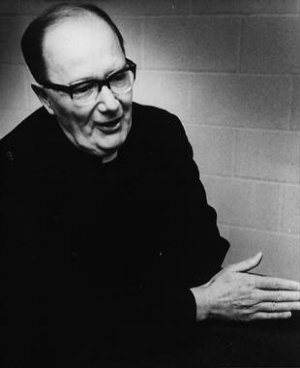
Since Manresa's debut, Butler has advised perhaps 10 students, while another 22 people have stayed overnight while considering the Jesuits. Guiding people toward their life's path doesn't always mean exhorting them to the religious life. "My job is to help you find your deepest desires," says Butler. If, after counseling a person, her desire is to marry and help raise a family, "I'd say, phenomenal, I've done my job. I've helped you discern your vocation."
Photo is of Fr. Jack Butler, S.J.
Link (here)

My Yoke

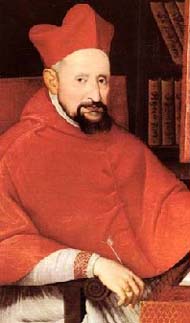
St. Robert Bellarmine - The Yoke Of Jesus
Saint Robert Bellarmine, S.J.
The Yoke of Jesus "Sweet Lord, you are meek and merciful." Who would not give himself wholeheartedly to your service, if he began to taste even a little of your fatherly rule? What command, Lord, do you give your servants? "Take my yoke upon you," you say. And what is this yoke of yours like? "My yoke," you say, "is easy and my burden light." Who would not be glad to bear a yoke that does no press hard but caresses? Who would not be glad for a burden that does not weigh heavy but refreshes? And so you were right to add: "And you will find rest for your souls." And what is this yoke of yours that does not weary, but gives rest? It is, of course, that first and greatest commandment: "You shall love the Lord your God with all your heart." What is easier, sweeter, more pleasant, than to love goodness, beauty, and love, the fullness of which you are, O Lord, my God?"


Your Crown of Life, Greater ThanWealth, Sweeter Than Honey

Is it not true that you promise those who keep your commandments a reward more desirable than great wealth and sweeter than honey? You promise a most abundant reward, for as your apostle James says: "The Lord has prepared a crown of life for those who love him." What is this crown of life? It is surely a greater good than we can conceive of or desire, as Saint Paul says, quoting Isaiah: "Eye has not seen, ear has not heard, nor has it so much as dawned on man what God has prepared for those who love him."


On the Ascent of the Mind to God by Saint Robert Bellarmine

Link (here)

Thank You, John Micheal at St. Robert Bellermine Blog

Saturday, May 17, 2008

The Jesuits And "Our Lady Of The Rose"

Our Lady of the Rose, other terms of endearment
By Monina Allarey Mercado
Philippine Daily Inquirer

05/18/2008
WHAT A DISCOVERY IT IS TO BE young again.
We discover youth while on a pilgrimage to Antipolo all the way from Makati. It is still cool in the early morning of May 9 when we toddle up the slight incline to the Antipolo Cathedral. We are a scraggly procession, mostly old or middle-aged men and women, no more than 400, filing out of buses and cars to accompany the image of Nuestra Señora de la Virgen from the church of Poblacion in Makati. This image of Our Lady has been venerated since 1718 in what is now St. Peter and Paul Church, just off the Bel Air villages. The Jesuits brought the original image, made of ivory, from Mexico. In the cool churchyard beneath the tipolo trees, our procession pauses with the image of Nuestra Señora de la Rosa, which rests on a small dais. We reach out to touch her hands and vestments. We crowd around her and grin like children for pictures. It is a rare chance to be close to the antique image, which is enshrined on the high altar.
Our Lady’s smile
Of particular interest is the smile—about ready to chuckle—on the face of Nuestra Señora de la Rosa. She smiles because she is holding the Child Jesus. She smiles because we are fussing over her and her Baby. When the Spanish colonial regime ended, the American forces made a garrison out of the Poblacion church in old Makati in l899. There was no time to remove the statue of Our Lady when the American troops marched in. The carved ivory faces and hands of Mother and Child disappeared. When the loss was discovered, the parishioners lost no time in mourning. They commissioned an artisan to carve new faces out of wood. We no longer know the artisan’s name but we know his joyful heart. He crafted that merry, ready-to-chuckle smile on Our Lady’s face—the smile that delights us today.
Lithograph
To the Antipolo shrine we come bearing a gift. It is an enlarged scanned print of the lithograph of two images—that of Nuestra Señora de la Paz y Buen Viaje and that of Nuestra Señora de la Rosa.
Done in 1749, the lithograph was by Laureano Atlas, commissioned as the frontispiece of the Jesuit chronicles written by Pedro de Murillo, SJ.
The gift is from Fr. Estellito Villegas, parish priest of the church of Poblacion, Makati. A devotee of Our Lady since he was a seminarian, Father Villegas notes the historical impact of the lithograph that depicts the two Marian images. They are both in ancient and famous shrines venerated since the 1700s, when the old highway linking Antipolo and Makati each to each was the Pasig River.
Everyday little graces
During our pilgrimage, I walk with Vilma Ruzir, now in her 50s. Vilma has lived in Poblacion since her grandmother’s time when she was dedicated to the Virgen de la Rosa. The devotion is carried on to her own children and grandchildren now, Vilma says. They are prayerful. I also walk with Buboy Rivera, the historian of the shrine. When asked what miracles the Virgen de la Rosa does, Buboy replies: “Nothing spectacular, nothing noticeable. Just everyday little graces that even surprise me.” The Marian shrines are now linked by highways and overpasses. Through this access, pilgrims by the thousands continue to go every day and every year. The Antipolo shrine is arguably more popular, being ingrained in the Filipino piety. To us pilgrims, Father Villegas says that Our Lady is the constant and loving guide and companion, always ready to lead to God. Today hundreds of young people trek to the Antipolo hills twice a year—on the eve of Good Friday and the eve of May l. From dusk into the dawn, they walk from as far as Quiapo and from as near as Quezon City.
Terms of endearment
It is a quiet throng, in small groups, sometimes accompanying an image of Mary. The pilgrims’ way to Antipolo is marked with bas relief carvings of the 20 mysteries of the rosary. Just a note for whose who wonder why there are so many titles and names for Our Lady. She is only one person: Mary. She is the mother of Jesus, true God and true man. She has many names, all terms of endearment.
That is how love is: Can’t say enough.
She is named Nuestra Señora de la Rosa, Our Lady of the Rose, because the rose is the most beautiful flower. She is named Our Lady of Antipolo because that was where her image was found—on top of a tipolo tree hundreds of years ago. In Baclaran, another famous shrine, she is called Our Lady of Perpetual Help, because that is what she does—always helpful. And because she is always our mother, we are always young.
Link (here)
Photo credit (here)

One Smart Jesuit

Pope presented with Italian versions of works by Jesuit expert on human intelligence
Vatican City, May 17, 2008 / 01:57 am (CNA).- As Pope Benedict XVI was presented with the Italian versions of the works by Jesuit Father Bernard J.F. Lonergan, a Canadian expert on human intelligence, the L’Osservatore Romano published an interview emphasizing the important contribution of the Jesuit priest to research in this field.

Father Lonergan, who is a brilliant but unknown scholar, has a reputation for his “commitment of service to the Church. And, above all, for his openness. I remember he was attentive to his students and gave suggestions and clarifications to each one,” said Jesuit Father Natalino Spaccapelo, who is curator of the “Collected Works of Bernard Lonergan.”


Father Spaccapelo told LOR that Father Lonergan “is probably one of the most studied authors in the world, especially so in the socio-economic sphere.” In “Insight,” Father Lonergan’s most important work, he did not propose a theory, “but rather he returned to the definition and clarification of the human structure, a structure of thought that can be traced back not to a certain historical period or to a certain society, but rather to the whole human being. ‘Insight’ is the instrument for understanding how intelligence operates in different fields of knowledge, to which he has dedicated himself with amazing meticulousness.” “Starting from the concept that conscience is a melody that is articulated in the different contexts of human life, Lonergan has put forth research on studying how human intelligence operates—always with the same structure—in the scientific, humanist, philosophical, historical and theological methods,”

Father Spaccapelo continued. He went on to note that Father Lonergan’s works are very popular at Catholic universities in Italy.


One particular teaching of Longeran’s that has gained traction “holds that the modern world has formulated knowledge on the basis of concepts, when what is needed is for knowledge to be reformulated on the basis of what precedes concepts,” as “building knowledge on concepts makes it immobile, while building it on intelligence makes it dynamic and forward progress.”

Link (here)

Friday, May 16, 2008

A Jesuit. Polish And A Saint

ST. ANDREW BOBOLA, MARTYR
FRIDAY, MAY 16, 2008
Andrew Bobola is a Polish-born martyr. He was born in Sandormir, Poland, in 1591 to a noble family. He was ordained a Jesuit in 1622 and three years later became a parish priest in Vilna, Lithuania, where he had studed. He had also served as superior of the Jesuit community. He worked with the sick and during a plague outbreak, but he is best known as a successful missionary to the Orthodox. He did this for almost 20 years, preaching along the roads and bringing whole villages to Catholicism. However, he was captured after mass on May 10, 1657 by the Cossacks and brutally tortured. Six days later, he was beheaded and died a martyr, refusing to denounce his Catholic faith. His tomb was opened in 1808 and his body was found incorrupt. He is now entombed in a Jesuit church in Krakow, Poland. He was canonized by Pope Pius XI in 1938.
Link (here)

Thursday, May 15, 2008

Ignatian Or Teilhardian?

Spirituality offers hope for end to ecological crises
Jesuit says relationship with God the Creator must be restored
By LASHA MORNINGSTAR
WCR News Editor St. Albert
The solution to today's ecological crisis lies in a deeper spirituality, says an Ontario-based Jesuit.
The crisis exists because "we aren't aware really (of the relationship between God the Creator and his creation) and we deny the existence of God," says Father Jim Profit.
"We treat creation simply as material that therefore is something that can be exploited, "
Profit said in an interview. "A solution to the ecological crisis, is to try to deal with this on a spiritual level so we restore our relationship with God as creator - God as creating still - restore that and then experience the awe and the majesty of creation itself. "Once we are conscious of that experience, I think we would probably be more conscious of our exploitation and therefore our actions would change." Profit and Sister Maureen Wild will lead a five-day workshop beginning June 9 called Colloquium for a Spirituality of Earth Healing Within a Christian Framework. The event will be held at Star of the North Retreat Centre. "What we hope to do is talk about our relationship with God and our relationship with God in creation itself, " says Profit, "and to also tie this in with our Christian tradition." While this may seem new, it's not, says Profit.
Christian tradition "We have a very strong Christian tradition that emphasizes our relationship with God experienced through the cosmos, through creation itself."
Profit comes armed with an agriculture degree in his resume and suffused with a love of the sea that surrounds his Prince Edward Island birthplace. Spring "is the beauty of life again, reclaiming life. That becomes our experience then." - Fr. Jim Profit Once we become more conscious of how we exploit the earth, our actions should change, he says. But even with such an expanded awareness, when one goes back to live in our disposable, money-first culture, it can be "very discouraging and we can feel quite alone. "But there are at least two ways that are helpful. "One is the experience of community, and also to foster community." The St. Albert workshop, he said, will try to build a sense of community. And what about the despair? "The only way that we can deal with that despair and that sort of pessimism is through our faith. And it is through that spiritual connection again, and for me it is through my experience of the resurrection when we celebrate at Easter, that death is not the end of the story and it is the life that comes from death.

"When we contemplate the evolutionary story of creation we get told the same message. It is a story that is full of crisis. Life has been always able to respond to those crises." (Teilhardian warning)

Profit just has to gaze out of a Loyola House window situated at the Ignatius Jesuit Centre's 600 acres of farmland, woods and wetlands near Guelph, Ont., to share his next example. The seasons tell us the same thing. We are currently enjoying spring after a fairly hard snow. And yet it is the beauty of life again, reclaiming life. That becomes our experience then. "When we experience suffering, when we experience death, we have the expectation that this is not the end of the story and somehow, in the mystery of all of this, life will come about." People working together Profit has been leading these workshops for nine years and says his hope comes from people coming together "and that God will work through that." Profit's roots too sustain him. "In a five-mile stretch in P.E.I. I had seven relatives who were farmers and we are surrounded by the sea. I realized my primary relationship with God was through the sea and through the farms of my relatives." Did this immersion in God's creation nourish his discernment? Profit pauses and then replies. "I was exposed to the Jesuits here at Guelph (while he was going to school). And the farm here was certainly one of the influences. "I think I was attracted to the Jesuits because of their community, their experience of spirituality and commitment to social justice."

The Spiritual Exercises of St. Ignatius plus native spirituality allowed Profit to "really name my primary experience of God with procreation. I think native people provided me with the rituals and the symbols to speak to that." And he tells of an experience he had with sacred fire. (syncratism)

"It was early on in this experience and what surprised me was no one needed to tell me what the symbols and rituals meant. I just sort of had an intuition because they really spoke to my experience." Asked if he has an aboriginal ancestry, Profits says no, but that his

"Celtic spirituality filters through. It is Canada. This is the land that we live and breathe. So it would make sense that native spirituality would speak to us."

Hope and commitment Profit is also part of a Mysticism of the Earth: An Ignatian Ecology Retreat Aug. 1 to 9 to be held at Loyola House. Ignatius of Loyola, the founder of the Jesuits, developed exercises that have been adapted to address the ecological issue. "The beauty of these retreats we do is that it is not the end of the experience," assures Profit.

"I hope (participants) will have a powerful prayer experience of God as Creator and leave with an experience of hope and a commitment of how they can act and make a difference."

As Profit notes at the conclusion of a reflection article, "I know I do not labour alone, because God labours for me, in all of creation."

Link (here)

Canadian Jesuits Help Rehab Their Old School

Jesuits help convert building at Concordia
$1-million gift. Donation will help turn structure into conference centre

ALAN HUSTAK
The Gazette
May 15, 2008
The Jesuits of Upper Canada will donate $1 million to Concordia University to help convert what used to be the Refectory Building of Loyola College into a conference centre.The announcement, to be made today, is believed to be the largest donation to a Canadian university by a religious order. "The contribution reflects the Jesuit tradition of giving back to the community and will contribute to a lasting Jesuit presence at Concordia University," said Jean-Marc Laporte, the head of the Jesuits of Upper Canada. The $4-million conference centre, tucked behind the main building on Concordia's Loyola campus in Notre Dame de Grâce, will be known as Jesuit Hall. It will be used for lectures by eminent Jesuits or lay scholars from a range of liberal arts disciplines, including religious studies, philosophy, journalism and communications.


The Refectory Building opened in 1916 when the college was still a private Roman Catholic boys' school. It was where resident students and priests ate their meals, and included a kitchen, scullery and an infirmary on the second floor. The Jesuits gave up their college in 1974 when Loyola merged with Sir George Williams University.


The Refectory Building became classrooms for Concordia's music department. The Scottish baronial-style brick building, designed by the Montreal architectural firm of Peden McLaren and Murray, features six-metre-high ceilings and sparkling leaded-glass windows. Its new incarnation will house an alumni centre, a lounge, a kitchen with catering facilities and multi-purpose meeting rooms. The project's architect, Jim Donaldson, said he wants to turn the 92-year-old building into "the type of facility where you just go in and you say 'Wow!' and you are overwhelmed by the marriage of contemporary and old." The Jesuit order, more properly known as the Society of Jesus, was founded in 1540 and pioneered groundbreaking teaching methods that challenged medieval scholarship.Today, there are an estimated 20,000 Jesuits worldwide, and more than 300 Jesuit priests in Canada.


Link (here)

Wednesday, May 14, 2008

Aussie Jesuit Promoted To Provincial

Provincial for the Australian Jesuits.
Fr Adolfo Nicolás, the recently-appointed Superior General of the Society of Jesus, made the announcement yesterday, Province Express reports.
Fr Curtin said he felt "humbled" to have been placed in such a privileged position among his Jesuit brothers. "There are great challenges, it is true, but I feel a peace which I recognise is pure grace," said Fr Curtin. Fr Curtin joined the Jesuits in 1985 at the age of 28. He has worked as a teacher, pastoral worker and counsellor, spending time working with the marginalised in Australia and overseas. He worked for five years with the Jesuit Refugee Service Asia/Pacific, first as Assistant Regional Director and then as Regional Director.


A great deal of his work was with refugees from Burma but he also travelled extensively in South-east Asia managing projects in Indonesia, East Timor, Thailand, Cambodia and Nepal. Since 2001, Fr Curtin has been Director of Jesuit Mission.


With his knowledge of South-east Asia, Steve was given the task of broadening Jesuit Mission's support to newer mission areas while also maintaining support for the original overseas work of the Australian Jesuits in Hazaribag in India. Fr Curtin has served as Chair of the Board of the Jesuit Refugee Service and on the Boards of the Loyola Institute and the Australian Jesuit Foundation. In his new role, Fr Curtin will oversee the Jesuits' ministries in Australia, which includes educational institutions, social ministries, parishes, spirituality centres and other works. One of the challenges facing the Society, Fr Curtin said, is bringing Jesus' Gospel of love and reconciliation to families and communities.


To find love, forgiveness and inner freedom in this world, he said, we need to begin with a conversion of heart. "I am happy to be facing the challenge of conversion with my Jesuit brothers, with such good and dedicated lay companions and so many other friends of deep faith," he said. "I will rely on them and on the help of God."


Fr Curtin will replace Fr Mark Raper as head of the Australian Jesuits on July 31, when Fr Raper will be able to move full time into his new role as President of the Jesuit Conference of East Asia and Oceania. "Mark's leadership has been immensely loving and thoughtful," said Fr Curtin, paying tribute to his predecessor.


"My goal is his goal and the goal of Ignatius and St Paul, 'that Christ may live in our hearts through faith and that we may give glory to God whose power working in us can do infinitely more than we can ask or imagine'


." "I am happy to serve and humbled to have been placed in a position, which in the Jesuits, because our governance is spiritual, is a particularly privileged position of trust."


Link (here)

Henri de Lubac And Benedict XVI

Cardinal Henri de Lubac, S.J.
Benedict's 'Grey Eminence'
by Samuel Gregg D.Phil.
Following Benedict XVI's recent visit to America, there was some grumbling from social justice activists that the pope said relatively little about matters ranging from climate change to third-world debt.
This reflects, they suggested, the pope's disinterest in "real" issues. From his papacy's beginning, Benedict has indeed proved remarkably reluctant to enter into detailed discussion of policy questions.
There are two reasons for this. First, just after being elected pope, Benedict reaffirmed that the Catholic Church does have non-negotiable positions on particular matters, most notably the protection of innocent human life, marriage, and religious liberty properly understood. But Benedict also reaffirmed the Church's teaching that, as far as other policy issues are concerned, lay Catholics are free to make their own prudential judgments, guided, of course, by Catholic principles. Even within the Catholic Church, it is not well-understood that Catholics enjoy remarkable liberty to take a variety of positions on most policy questions. The second reason for Benedict's disinterest in policy details, however, ultimately reflects his view about how Catholics ought to approach social-political questions.
In this regard, perhaps the greatest influence upon Benedict's social thought--his grey eminence--is a French Jesuit theologian who died 17 years ago. Born in 1896, Henri de Lubac experienced the twentieth century's upheavals at first hand. He fought in the trenches of World War I, participated in the French Resistance during World War II, worked as a theological expert at Vatican II, and served as friend and intellectual interlocutor to both Karol Wojtyla and Joseph Ratzinger. Like Ratzinger, de Lubac was considered somewhat avant-garde before Vatican II.
He consequently experienced considerable unpleasantness at the hands of overzealous church officials. But after Vatican II, de Lubac--like Ratzinger--emerged as a formidable defender of Catholic orthodoxy. De Lubac also continued to endure harassment for his views. This time, however, the odium theologica came from heterodox theologians such as Hans Kueng whose agenda amounted (as it still does) to dissolving Catholicism into a secularized, hyper-politicized, bureaucratized, and doctrinally-empty pseudo-Christianity. But Ratzinger and de Lubac's similarities go beyond this. They shared the conviction that the road to Church renewal is not immersion in whatever happens to be the latest intellectual fashion.
Authentic renewal, de Lubac held, could only occur by going back to the original sources of Christian inspiration--most notably, Scripture grounded in the Church's Tradition as well as the Church Fathers--and then using this as a basis to think about the present.
This, de Lubac argued, was the best way to articulate a distinctly Christian message to the modern world. A good example of how this applied to social issues is de Lubac's book, Catholicisme: Aspects sociaux du dogme (1938). In his Memoirs, Ratzinger recalls the impact this text had on his own thought. Indeed, it is directly cited in Benedict's encyclical Spe Salvi. Catholicisme draws upon Scripture and early and medieval Church Fathers to think through what the nature of the Church itself suggests about the individual's place in society.
The beauty of this approach is that it brings to the surface ideas that cannot be neatly categorized as "right" or "left." Rather, it produces a distinctly Christian perspective that explodes our increasingly sterile secular political categories.
This method was on display during two recent speeches delivered by Pope Benedict. One was his United Nations address in which Benedict politely but firmly noted that the very notion of human rights was first conceptualized by Catholic theologians and only ultimately made sense when grounded in a biblical vision of man. This is a way of talking about rights that cuts through the morass of much contemporary rights-talk, which is reflected in the typically incoherent statements about rights produced by most international organizations. The second speech was Pope Benedict's recent May 3rd address to the Pontifical Academy of Social Sciences. Here the pope reflected upon the nature of subsidiarity and solidarity. Drawing upon Scripture and commentaries from Augustine and Aquinas,
Benedict reminded his audience that the ultimate purpose of these principles is not efficiency or equality. Rather, it is "to place men and women on the path to discovering their definitive, supernatural destiny."
Neither solidarity nor subsidiarity, Benedict stated, have purely "horizontal" (i.e., earthly) meaning. They also have "vertical" (i.e., transcendental) significance. Solidarity, Benedict wrote, is ultimately about helping others to encounter life in all its fullness, something only completely realized through life in Christ. Subsidiarity, Benedict maintained, "liberates people from a sense of despondency and hopelessness, granting them the freedom to engage with one another in the spheres of commerce, politics and culture". But above all, Benedict added, subsidiarity makes "space for love which always remains the most excellent way." None of this is to suggest that Benedict or de Lubac thinks that politics or public policy is unimportant. Their point is that if you truly believe in the truth found in the sources of orthodox Christianity, then you will think and act as if the transcendental destiny (heaven or hell) that everyone can freely choose for themselves is real, and such considerations will shape every moral decision you make, including your political choices. That's the core of Benedict's social message. It's hard to imagine a more radical one.

Tuesday, May 13, 2008

Philippine Jesuits And Politics

Going beyond the disappointment
By Boyet Dy
Philippine Daily Inquirer

05/13/2008
The “Guidelines for Communal Discernment and Action” that was circulated by the Philippine Province of the Society of Jesus Commission on the Social Apostolate last Easter Sunday was the Philippine Daily Inquirer’s “Talk of the Town” on April 6 and April 13.
This should be a welcome development; as stated in the accompanying endorsement letter from Jesuit Provincial Fr. Danny Huang, the invitation was precisely that “communities and institutions read, reflect, pray over and discuss these Guidelines.” I was able to read critical reactions to the Guidelines. It seems that the overriding sentiment is disappointment over the Guidelines’ failure to join calls for resignation.
I should have been disturbed too. I was Ateneo Student Council president when the “Hello, Garci” scandal broke out and, at that time, we called for President Gloria Macapagal-Arroyo’s resignation. I have even recently reiterated my call for Ms Arroyo to resign within my own circles at the height of Jun Lozada’s whistle-blowing. I maintain that calling for her resignation and punishing her and her family members and minions who brazenly drag their weight around are legitimate and appropriate demands because of their accountability to acts of corruption and abuse of power that ultimately undermine hard-won institutions, delay reforms that demand time and crush the hope of the Filipino people. Nevertheless, I was not disappointed by the Guidelines. It seems that the disappointment is misplaced since it is premised on two misinterpretations. One weighty “if.” Closely revisiting the Guidelines will reveal that calling for Ms Arroyo’s resignation is not categorically excluded.
In the analysis of the “Arroyo Resign” position, the last sentence provides nuance by saying that “while this position is one of principled moral conviction, it ceases to be a real political option if GMA [Ms Arroyo] … will not resign voluntarily.” There is a weighty “if” in that phrase, making the expressed caveat conditional, not absolute.
To my mind, it means that while the “Arroyo Resign” position is by no means being junked, it should also by no means steer us away from doing the other equally important democratic work of strengthening institutions and empowering citizens now—especially because calls for resignation still continue to fall on deaf ears. I find this prudent because in the thick of demanding her resignation, I am reminded that I might lose sight of the other democratic work that cannot afford to wait and that in fact must be in place if and when she does resign, so that regime change will be authentic and structural. One can even argue that attending to the democratic work of institution-building and citizen empowerment, even as one persists in exacting ultimate accountability, can precisely be a process of “ripening” so that the resignation call becomes increasingly irresistible, forceful and definitive. A set of guidelines.
Rereading Father Huang’s endorsement letter puts everything in perspective because it unambiguously states that: “The following Guidelines are not a ’statement’ or a ’manifesto’ of a ‘Province position or stand’… but provides a substantive analysis, based on Catholic moral and social doctrine, of our present national situation and the various options and courses of actions taken or advocated in response to that situation.”
If a reader approaches the Guidelines with the expectation of knowing the Jesuits’ stand on Ms Arroyo’s presidency, then the reader will certainly be disappointed because the rubric for assessment is irrelevant to the document’s purposes. Assessed using the correct lenses, the set of guidelines is a valuable document because it was able to paint the complexity of the current situation and remind us of the cornerstone principles that we should use in responding to the complexity. However, the document’s shortcoming, which may be the central source of the misinterpretations, is that in advocating specific action areas, it was conspicuously silent on the resignation question. It was thus not able to clarify that its proposed action areas are the immediate but certainly not the only steps that can be taken in response to the continuing crisis, especially as developments continue to unfold. This is perhaps the reason why it might have come off that the resignation route has been excluded by the Guidelines not only for now, but for always. The real challenge. The difficulty is that these misinterpretations have colored the way the Guidelines has been subsequently appreciated by the critics, resulting in the disproportionate emphasis on and re-framing of the aspects of the Guidelines that reinforce the misinterpretations.
With this has come a downplaying of other important considerations contained in the Guidelines, such as prioritizing the poor, which has become doubly urgent as we confront a ballooning food crisis. At the least, we have seen that the Guidelines did elicit critical reflection and conversation, as it was meant to do. My only hope is that these resultant conversations will be healthy ones that will broaden our perspectives, and not contribute to the hardening of diverging positions, leading to even deeper divisions. In the end, we are one against the evils of this administration and not each other.
The challenge is to go beyond the disappointment—and our differences—and continue exploring ways of how we, who are concerned about the excesses of Malacañang, can come together to rise from these dark times, in the true spirit of Easter.

Link (here)
Photo is of Fr. Danny Huang, S.J.

A Jesuit Astronomer And Those "Little Green Men"

Vatican says little green men are part of Creation Richard Owen in Rome

The Vatican's chief astronomer has said that belief in aliens is not at variance with Christianity and that any extra terrestrials would form "part of God's Creation". Father Jose Gabriel Funes, a Jesuit, yesterday told L'Osservatore Romano, the Vatican newspaper, that "It is possible to believe in God and in extra-terrestrials".


He said Christians could "admit the existence of other worlds and other forms of life, even those more evolved than ours, without necessarily questioning faith in the Creation, the incarnation and the redemption of mankind".


Father Funes, head of the Vatican Observatory, or Specola, said although many astronomers "lost no opportunity" publicly to profess their atheism, it was "a myth that astronomy favours an atheistic vision of the world". He said astronomy "does not favour the view of a Godless world. In fact, I think it is those who work at the Specola who bear witness to the fact that it is possible to believe in God and work with science in a serious way".
He said that the Observatory, formerly housed at Castelgandolfo, the papal summer residence in the hills south of Rome, would inaugurate its new headquarters in a monastery in nearby Albano next year. The Vatican Observatory also operates a 1.8 metre telescope at Mount Graham in Arizona in the United States.

Father Funes said that just as there existed a "multiplicity of creatures on Earth", so there could exist "other beings created by God, including intelligent ones. We cannot place limits on God's creative freedom."


St Francis of Assisi had described our fellow creatures on Earth as our brothers and sisters, "so why can we not also speak of our extra terrestrial brothers? They too would be part of Creation". He said that aliens, like humans, would be able to benefit from the redemption offered by Jesus Christ and "the mercy of God".
Link (here)

De Smet's Home Church In Belgium Under Protection From Terrorists

Police Protection for “Mohammed Pulpit”
From the desk of Thomas Landen on Tue, 2008-05-13 20:43
Belgian police is protecting a 17th century pulpit in the Flemish town of Dendermonde. The pulpit in the Catholic church of Our Lady dates from 1685, two years after the battle of Vienna when the Christian armies of the Polish King John III Sobieski defeated the Turks poised to overrun Europe. The sculpted wooden pulpit, made by Mattheus van Beveren, depicts a man subdued by angels and represents the triumph of Christianity over Islam. The man is generally thought to be Mohammed. He is holding a book which is generally assumed to be the Koran. Two years ago, on April 16, 2006, during the height of the Danish cartoon affair, this website published a photo of the pulpit to show that there is a long tradition of depicting Mohammed in European iconography. Last Friday the Turkish newspaper Yeniçag reprinted our picture on its front page with the caption “Stop this hideous insult.” Yeniçag demands that Belgium remove the pulpit. The paper writes that “We have had the crusades and now they are still trying to humiliate us. This is as bad as the Danish cartoons and Geert Wilders’s Fitna movie in the Netherlands. Even Pope Benedict does nothing to stop these humiliations.” Since Friday, we have received threats while the authorities in Belgium, which has a large population of Turkish immigrants, fear that the pulpit and the church may be attacked. The Belgian press reported today that the police is guarding Dendermonde’s Our Lady church to prevent vandalism to church and pulpit. Dendermonde, a town in Flanders, the Dutch-speaking part of Belgium, lies halfway between Brussels and Ghent.

It is the birthplace of the famous American missionary Peter John (Pieter Jan) De Smet (1801-1873), the head of the Jesuit missions among the Indians of the Northwestern USA and a friend of Sitting Bull, Kit Carson and other heroes of the 19th century American West. On his return trips to his Flemish home town, Father De Smet used to preach from the pulpit which is currently under police protection.

According to the Belgian press the pulpit controversy has been deliberately caused by this website, which is being described as “pretending to be neo-conservative” but run by “neo-fascists.” Piet Buyse, the mayor of Dendermonde, told the media that he deplores that the pulpit “figures on websites which aim to provoke negative reactions from Muslims.” The mayor said that the depicted man represents an unbeliever and may also be Luther or Calvin. Aimé Stroobants, the custodian of Our Lady in Dendermonde, told the newspaper De Standaard that the figure on the pulpit “cannot possibly be Mohammed” because “He is wearing a Persian dress, while we know that the Prophet came from the Arab Peninsula. For all we know the depicted man might even be a Jew.” Meanwhile, radical Muslims in Italy are still demanding the destruction of an early Renaissance fresco in Bologna's Church of San Petronio, painted by Giovanni da Modena in 1415. The fresco depicts Mohammed being tortured in Hell.


Link to original blog post from The Brussels Journal, entitled "Police Protection for Mohammed Pulpit"

Monday, May 12, 2008

Cardinal Newman Society Beats The Jesuit University System

The politics of commencement
Catholic colleges avoiding controversial honorees
By Michael Paulson, Globe Staff
May 12, 2008
House Speaker Nancy Pelosi is one of the nation's most powerful Catholics, but this year the only commencement address she gave was at one of the eight campuses of Miami Dade College. Senator John F. Kerry is headlining three commencements this year - the Massachusetts College of Liberal Arts, UMass Lowell, and Wheelock College - but it's been nine years since he's done one at a Catholic institution, Boston College Law School.
As for the scion of the nation's most famous Catholic family, Senator Edward M. Kennedy, ( Jesuit Ivy )his major commencement address this year is at Wesleyan University, founded by Methodists.
After repeatedly getting criticized by conservative Catholics, and after years of pressure from the Vatican and some American bishops, Catholic colleges and universities are now shying away from politicians - especially those who, like Kennedy, Kerry, and Pelosi, support abortion rights - as commencement speakers and honorary degree recipients. Instead, the schools are scrutinizing the public records of potential honorees for evidence of open dissent from key church teachings, especially on abortion, and they are choosing noncontroversial church insiders or nonpolitical figures for their most prominent honors. "I think there's a concerted effort to use the moment of naming people who reinforce the Catholic identity of our institutions, and I'm pleased by that," Cardinal Sean P. O'Malley of Boston said in an interview.
At the College of the Holy Cross, where the local bishop boycotted commencement five years ago because the speaker was Chris Matthews, an alumnus and television personality who had voiced sympathetic opinions about abortion rights, this year the speaker is Dr. Kevin M. Cahill, a specialist in tropical medicine who had worked with Mother Teresa.
Boston College, which in the past has given honorary degrees to abortion rights supporters such as Senator Warren B. Rudman and Attorney General Janet Reno, this year chose as commencement speaker the Pulitzer Prize-winning author David McCullough. Catholic University of America graduates will hear from Carl Anderson, the Supreme Knight of the Knights of Columbus, a Catholic fraternal organization, and his wife, Dorian.
And the University of Notre Dame, which once spurned complaints from several cardinals and gave its highest honor, the Laetare Medal, to the abortion rights-supporting Senator Daniel Patrick Moynihan, this year chose as its commencement speaker Cardinal Theodore E. McCarrick, the very prelate who chaired a task force urging colleges not to have abortion rights-supporting politicians ascommencement speakers or honorary degree recipients.
"I think that Catholic administrators at Catholic colleges are much more attentive to the selection process than they may have been in the past, and there is a growing awareness that these types of invitations are related to Catholic identity and mission," said Bishop Robert J. McManus of Worcester, who is chairman of the education committee for the US Conference of Catholic Bishops. "I call it truth in advertising," McManus said. "Why would you honor a person, whether Catholic or non-Catholic, that has publicly contradicted the positions of the church?" The issue of honorary degrees and commencement speakers has been the most visible manifestation of two decades of tension between Catholic universities and the church hierarchy over what it means to be a Catholic university in the United States.
In 1990, Pope John Paul II released a document, Ex Corde Ecclesiae, in which he declared that "Catholic teaching and discipline are to influence all university activities." Some Catholic academics balked at the implications for academic freedom, and, in particular, at a hotly debated measure that requires Catholic theologians to seek approval from local bishops for their teaching.
That requirement, approved in 2001 by the US bishops, has been widely, although not universally, ignored. "There was some pushback within the academic community, because of what they perceived as external influence," said the Rev. David M. O'Connell, president of the Catholic University, in Washington, D.C. But, O'Connell said, "it gave an impetus to a broader discussion about what Catholic identity and mission mean." In 2004, the presidential candidacy of Kerry, a Catholic Democrat who supports abortion rights, led to the creation of a task force of bishops examining how the church should relate to such politicians.
That task force failed to settle the prickly question of who should decide whether such politicians should receive Communion, but it was clearer about commencement, declaring, "The Catholic community and the institutions which are a part of our family of faith should not honor those who act in defiance of our fundamental moral principles."
Since that time there has been an obvious impact on commencement ceremonies. The Cardinal Newman Society, a conservative organization that each year scrutinizes the hundreds of men and women who are given honorary degrees by the nation's 225 Catholic colleges and graduate institutions, has identified a dwindling number of honorees who dissent from the church on key moral teachings - 24 in 2006, 13 in 2007, and six thus far this year.
"When a Catholic college administrator deliberately chooses a person who is publicly opposing the church, it raises serious flags, and very often the schools choosing those commencement speakers have problems across the board in terms of applying their Catholic identity to what they do," said Patrick J. Reilly, the president of the Cardinal Newman Society.
Reilly's organization is itself controversial for its tactics, and many college administrators resent its role. "Some groups with a certain ideological perspective have focused on these decisions and, I think it's fair to say, orchestrated campaigns to embarrass institutions or put them in a negative light," said the
Rev. John I. Jenkins, president of the University of Notre Dame. Jenkins, despite honoring McCarrick this year, is being criticized by the Newman Society for also honoring Marye Anne Fox, the chancellor of the University of California San Diego, who has supported that institution's embryonic stem-cell research.
Jenkins said he, like other Catholic university administrators, does not quiz potential honorees about their beliefs. "I think it would be inappropriate to interrogate someone for an honorary degree, but it's appropriate to look at their public record, to see how does that life size up," he said. Even O'Connell, who heads one of the more conservative Catholic institutions in the nation, acknowledges the decisions are often difficult. In 2004, he barred the actor Stanley Tucci, who had supported abortion-rights organizations, from speaking. But O'Connell says the question of who can speak on campus is a difficult one. "Suppose I wanted to have a conference on the environment, and a senator is an expert on the environment, but is prochoice, can I bring him onto campus?" O'Connell asked.
The change in approach is exemplified at Fairfield University, a Jesuit school in Connecticut. In 1991, a philosophy professor, the Rev. Thomas J. Regan, criticized the choice of the singer Billy Joel as commencement speaker because of the lyric, "You Catholic girls start much too late."
Last year, Regan, was himself chosen as Fairfield's commencement speaker. And this year, the college's president is giving the speech himself, after declaring four years ago that he intended to limit commencement to "speakers who have a close relationship to Fairfield and to the kind of education we stand for." "It's not a matter of, 'I have to be careful of the Cardinal Newman Society,' or what the bishop thinks, but from listening to a lot of awful commencement addresses from famous people," said
Fairfield's president, the Rev. Jeffrey P. von Arx. There are still colleges courting controversy, including, this year, Regis College in Weston, which chose as its speaker an active alumna, state House Majority Whip Lida E. Harkins, who supports abortion rights. Regis's president, Dr. Mary Jane England, said Harkins's position was not an issue, and that she simply tries to select people "for their commitment to social justice." Harkins said she had no conversations with Regis about her stance on abortion,
but that she considers herself a Catholic and a proud Regis alumna and is planning to reflect in her commencement speech on the civil rights issues that dominated her time at the college in the mid-1960s. But Regis is an exception. The Rev. D. Paul Sullins, a professor of sociology at Catholic University, noted that while his university "has never honored any real Catholic dissenter," in past years there have been speakers whose primary claim to fame was not their Catholicism. This year, though, the university chose the head of the Knights of Columbus. "It doesn't get more Catholic than that," he said.
Michael Paulson


Link (here)

Sunday, May 11, 2008

Ignatian, But Not Jesuit: The Servants of Jesus and Mary

A congregation directed towards youth
SJM - Servi Jesu et Mariae
.
SJM- where are we from and what is our purpose?
Our community was acknowledged as a Congregation of Papal Right in 1994 and is called the Servi Jesu et Mariae (SJM). We call ourselfes the Servants of Jesus and Mary as we wish to dedicate our lifes in a special way to the service of God and his holy Mother.
The first members of the SJM when it was founded in 1988 saw their apostolic task as being totally available for service to young people.
A focal point of this work was apostolic work in the Scout Movement and group work in the Catholic Scout Movement of Europe (Katholische Pfadfinderschaft Europas - KPE).
.
Our Spirituality
“To the Greater Glory of God”- this was the moto of Saint Ignatius of Loyola under whose rule we try to live - this is the programme of our apostolate and our spirituality. In this sense, our congregation is to be seen as a community of people in Holy Orders, brothers and priests with a missionary zeal, who make the center of their life the spreading of the word of God.
Shaped by the spirit of the Ignatian Spiritual Exercises, we would like to carry Christ’s banner into the world and thereby lead young people back to the church.
In this sense, we understand life according evangelical precepts as a reply to the call of Christ the King, who calls upon us to follow him in good spirits and to live, in even greater freedom, for Him and His Kingdom completely.
.
A Life in accordance with the Gospel
All members of the SJM therefore make three vows: poverty, chastity and obedience, in order to bind themselves ever closer to Christ in the service for His church. In poverty, there is a link between a simple modest life style and and a certain adventurious and pioneering spirit, which demands from us to seek again and again new shores and even to disregard our conveniences and to go everywhere, where we could hope for the honour of God, as it is written in our Rule. Poverty means, with this in mind, above all mobility and freedom for service to the benefit of souls. In the context of the scout movement, this means the readiness to be able to renounce the comforts of the consumer market and to share a simple life in nature with the boys and girls entrusted to us.
Even if the vow of chastity does not need to be explained any further, it is nevertheless, of central importance, as it links us in a special way even closer to Christ.
Obedience binds us to a special loyalty towards the Pope and the teaching office of the church. We see the Bishop of Rome as Christ’s Vicar on earth, who acts as a guarantor of church unity and who is the Rock to which we must hold firm. It is for this reason that the members of the SJM endeavour “to live in special loyalty to the Pope and his highest teaching office, in order to prove themselves as precious members in the preservation of Church unity and the purity of the faith.” (from the Papal Foundation Decree) Concretely this means, that we are give obedience to the superiors in all things that are not sins.
.
Our Prayer life
According to the model of the Jesuit Order, our community does not have common prayer in choir, so that they can be freer and more mobile for their apostolate. For this reason, it is even more important for each individual member to have a deep inner life of prayer, at whose centre there is the Eucharist, and which is seen in a frequent adoration of the Blessed Sacrament of the Altar.
We have one hour of contemplation and inner prayer daily, which is referred to by Theresa as “a dwelling with a friend”, in order to get to know Christ better so that we can love Him even more. A successful apostolate is only possible if we do this ! Over and above this, the members of the SJM pray a daily rosary together.
A important constituent of our Spirituality is the dedication to the Sacred Hearts of Jesus and Mary, whose servants we wish truly to be. This dedication is renewed daily and lived through by each individual member.
.
The Liturgy
The centre and highlight of the day is the celebration of the Holy Mass - the renewal of celebrating the Christ’s Sacrifice on the Cross. This is the reason why the SJM sees in the dignified manner of Sacrifice of Christ in both Roman Rites according to the Missal of 1962 (Old Rite) and the Missal of the Pope Paul VI (New Rite), an important contribution toward liturgical renewal in the sense of the continuing tradition of the Church.
.
How many are we? And what do we do?
At this point in time our Congregation has about 50 members, of which about 25 are priests. We are working in several parishes in the German speaking area, but do not limit our apostolate to this countries; we are currently also active in Kasachstan, Albania, Rumania, Ukraine and in France.
Besides the care of souls in parishes, we also offer retreats, religious training groups and catechism. We are specially concerned with children and youth work. Those who know young people will understand how many tasks exist in this area. We run a boarding school and are engaged in the group work of the Catholic Scout Movement of Europe.
We do not shy away from facing questions from young people who we meet in sports fields, in schools or parties and elsewhere. Over and above that, some individual members are engaged in the protection of unborn life and work in the press apostolate and in philosophical and theological teaching activities.
Link (here)
Hat Tip to MDV

New Jesuit Rector Has Interesting Solutions To The Vocational Crisis Within The Society

Third-parties bring new tenor to debate
By: Michael Baldwin
April 30, 2008
After one year and one month of directing Seattle University’s goals for Jesuit Catholic mission and ministry, Patrick Howell, SJ, will become rector for the Jesuit community on July 31.

The Jesuit Superior General appointed Howell as rector last week to replace Peter Ely, SJ, for the next six years. Ely will take a year-long sabbatical before returning to Seattle U. A rector is the religious superior in the Jesuit order, and will guide the Jesuit community’s spirituality and faith at Seattle U and two other Northwest towns, Anacortes and Mount Vernon.

“We Jesuits fondly welcome him as our next religious superior,” wrote Stephen Sundborg, SJ, president of Seattle U, in a campus-wide email. Howell, who did not plan on entering into Jesuit leadership when he became a Jesuit in 1961, said he was surprised upon hearing of his new appointment. “I didn’t see myself as rector last week,” said Howell. Finding new Jesuits to bring into Seattle U will be a priority Howell will engage when he assumes his rector duties in July. While Seattle U has 25 resident Jesuits and three satellite Jesuits, national Jesuit numbers and enrollment declined steadily since 1971, according to Howell and his U.S. Jesuit directory. Now, all 28 U.S. Jesuit universities struggle to restock their communities with Jesuits. He said Jesuit leadership did not begin to manage the declining numbers until 15 years ago. Now, because of their delayed response, there are both fewer Jesuits and fewer Catholic lay people, or non-ordained people, in administration and education positions. Three of the Jesuit universities provide recent examples of this trend: Le Moyne University, in Syracuse, New York and Georgetown University in Washington, DC do not have a Jesuit president. “We need to be more intentional in Jesuit leadership formation,” said Howell.

Despite the problem of finding new Jesuits, Howell contends the Oregon Province has substantial enrollment compared to many other provinces. Despite being what Howell calls “great” Catholic provinces where 50 percent of the population is Catholic, Boston and New York experienced several years with no new Jesuits. ( Maryland , New England and New York )

Meanwhile, California, Oregon and the South maintained steady Jesuit populations.

Howell said there half the number of priests from when he entered in the Society of Jesus in 1961, yet there are two-and-a-half times more Catholics. This leads to increasing lay person leadership. Several issues factor into fewer men becoming Jesuits, according to Howell, including a more secular culture in Europe and America. “We [the Society of Jesus], put too much emphasis on celibacy,” said Howell, “to the detriment of access to the Eucharist and sacrament.” Howell believes this could be circumvented by relying on women more than the church does.

He also sees the Jesuits’ ecumenical ventures as a way to help form strong communities and encourage an attitude toward social justice in staff and students. “We have dedicated teachers at Seattle U,” said Howell. “We’re helped by rubbing shoulders with Protestants, Jews and Muslims.” Ecumenism is an actively promoted belief of Howell’s. In 2000, he was a scholar-in-residence at Tantur Ecumenical Institute in Jerusalem, and later he became dean of the School of Theology and Ministry, and began making the courses more ecumenical. He founded and is the editor of the Seattle Theology and Ministry Review, a journal of articles about ministry, ecumenism and interfaith dialogue. “We have a better articulation of our mission: ecumenism, interaction with culture and society, justice and peace,” said Howell. Howell hopes to further his ecumenism as rector at Seattle U. Over the next six years, Howell will guide the spiritual formation of the 25 Jesuits based from Seattle U’s Arrupe House. He will also observe the enrollment and development of new Jesuits with the hope of integrating them into Seattle U’s community.
Link (here)