Monday, May 16, 2011
Jesuit On Planetary Conjuncture
Sunday, November 7, 2010
Jesuits On The Day Of The Dead
• In Guatemala, in addition to the traditional visits to grave sites of ancestors, Catholics celebrate the Day of the Dead by flying giant kites and preparing fiambre, which is cooked only during this day of the year.
• Nearby, in Nicaragua, people sleep together with their relatives as they spend the whole night remembering and praying for their beloved dead.
• In Ecuador, the indigenous gather in the cemetery with offerings of food for the day-long remembrance of their ancestors. At the end of the day they play Piruruy, a special game with “dados”. Ceremonial foods include colada morada, a spiced fruit porridge that derives its deep purple color from the Andean blackberry and purple maize. This is typically consumed with guagua de pan, a bread shaped like a swaddled infant, which can be made savory with cheese inside or sweet with a filling of guava paste.
• In Haiti, syncretistic Catholics intermingle Roman Catholic observances with voodoo traditions, such as the loud playing of drums and bellowing of chants in cemeteries all night long in order to awaken Baron Samedi, the Loa of the dead, and his mischievous offspring, the Gede.
• In Bolivia, Catholics celebrate Dia de los ñatitas (Day of the Skulls) on November 9. Traditionally, the skull of one or more family members is kept at home to watch over the family and protect them during the year. On November 9, the family crowns the skull with fresh flowers, offering it cigarettes, coca leaves, alcohol, and other items in thanksgiving for the year’s protection. The skulls are also sometimes taken to the central cemetery in La Paz for a special Mass and blessing.”
Friday, October 2, 2009
The Jesuit House in Parian
The Jesuit House in Parian is definitely a lost treasure, not too many people know it still exists! It’s now a warehouse owned by a Filipino-Chinese family, a depot for the family’s hardware business.There are some lucky few who were able to get inside, I did attempt to enter but was discouraged by what I’ve seen, a snobbish rude fellow manning its tall metal gate and rusting scraps of metal, wires and crude dripping on the floor – thick dust and industrial supplies are all over the place. I just took some photos then left.
Link (here) to the full blog post, the blog is entitled With One's Past
Monday, August 17, 2009
Former Jesuit Turned Investment Banker On The Death Of Cory Aquino
As we watched the funeral cortege of President Corazon "Cory" Aquino, the question came to mind: Was she the leader who embodied in her life the principles she professed? Did her life exemplify her core values of simplicity and honesty? The hundreds of thousands of people who lined up to visit her wake, crowded and slowed down her cortege gave us the verdict. A450 year-old company, the Society of Jesus, preached the same tenet. Chris Downer, a Jesuit turned investment banker,
Link (here) to the full article.
Tuesday, April 14, 2009
His Specialty—And Passion—Happens To Be Liberation Theology
Alfred Hennelly. (RIP 2001) “H-e-double n-e-double l-y.” Got it.
In 1951, at the age of 22, as a Jesuit Scholastic, he came to the Philippines to teach at the high school of the Ateneo de Manila. He stayed, and taught, for six years. Hennelly then returned to the United States, and was ordained a priest in 1960. He continued his studies in theology in Germany and Austria, earned his Ph.D. from Marquette University, and in 1966 went to teach at Fordham University, where he continues to be a full professor of theology.
Ah, theology. Very ... complicated stuff. Father Hennelly smiles.
It is a dry but good-humored smile. He is asked, what kind of theology do you specialize in (if theologians can be said to be specialists on particular topics). Again, the smile, why yes, theologians do specialize. His specialty—and passion—happens to be liberation theology.
This delights the interviewer, who tells himself that the irony of interviewing a theologian devoted to the cause of liberation theology, in a home which exemplifies many of the quixotic conditions that led to the development of this kind of theology in the first place, is delicious indeed; but then I decide to drop the matter as impolitic and potentially disturbing, considering the fact that this theologian also happened to be an honored guest.
Liberation theology doesn’t exactly make for lively cocktail-party conversation, particularly when it has been (violently, all too often) construed as communismby the sort of people who like to attend cocktail parties (and are violently allergic to anything smacking of the color red) in the first place.
Link (here) to the full piece
Saturday, January 31, 2009
Cultural And Religous Intersection

Link (here)
More (here)
A little Jesuit history
The three members of the Compañia de Jesus (Society of Jesus) were meticulously preparing the Bagobo, Tiruray and Moro-Maguindanao dictionaries (here)
Wednesday, December 3, 2008
Jesuit Mapped The Philippines In The 18th Century

Dumaguete City traces its roots as far back to 1572 when Diego Lopez Povedano called it Dananguet; its present name Dumaguete was first used by Jesuit Cartographer Murillo Velarde in 1734 in his writings.
Wednesday, July 2, 2008
My Uncle Pedro Is A Jesuit
Despite the F-Bombs, bad taste in music and an unnatural man crush on U.S. Rep. Dennis Kucinich it is a pretty neat travelogue with a Jesuit as main character .My Uncle Pedro (Walpole) is a Jesuit Priest here, though he spends all of his time working on ESSC (Environmental Science for Social Change), AFN (Asia Forest Network) and APC (
Link to the lengthy post (here)
Monday, June 30, 2008
Miracles Can Happen
An excerpt.
One morning, we prayed a beautiful prayer for the beatification of Fr. Pedro Arrupe, which spoke of Fr. Arrupe's "boundless optimism." I am grateful that, despite all our limitations and difficulties, our Conference of Jesuit major superiors in East Asia seems to have been given a share of that "optimism" as we face the future of our mission.
.
Read more of Jesuit Fr. Daniel Huang's writings at En Todo Amar y Servir.
Saturday, May 17, 2008
The Jesuits And "Our Lady Of The Rose"
Our Lady of the Rose, other terms of endearmentBy Monina Allarey Mercado
WHAT A DISCOVERY IT IS TO BE young again.
We discover youth while on a pilgrimage to Antipolo all the way from Makati. It is still cool in the early morning of May 9 when we toddle up the slight incline to the Antipolo Cathedral. We are a scraggly procession, mostly old or middle-aged men and women, no more than 400, filing out of buses and cars to accompany the image of Nuestra Señora de la Virgen from the church of Poblacion in Makati. This image of Our Lady has been venerated since 1718 in what is now St. Peter and Paul Church, just off the Bel Air villages. The Jesuits brought the original image, made of ivory, from Mexico. In the cool churchyard beneath the tipolo trees, our procession pauses with the image of Nuestra Señora de la Rosa, which rests on a small dais. We reach out to touch her hands and vestments. We crowd around her and grin like children for pictures. It is a rare chance to be close to the antique image, which is enshrined on the high altar.
Our Lady’s smile
Of particular interest is the smile—about ready to chuckle—on the face of Nuestra Señora de la Rosa. She smiles because she is holding the Child Jesus. She smiles because we are fussing over her and her Baby. When the Spanish colonial regime ended, the American forces made a garrison out of the Poblacion church in old Makati in l899. There was no time to remove the statue of Our Lady when the American troops marched in. The carved ivory faces and hands of Mother and Child disappeared. When the loss was discovered, the parishioners lost no time in mourning. They commissioned an artisan to carve new faces out of wood. We no longer know the artisan’s name but we know his joyful heart. He crafted that merry, ready-to-chuckle smile on Our Lady’s face—the smile that delights us today.
Lithograph
To the Antipolo shrine we come bearing a gift. It is an enlarged scanned print of the lithograph of two images—that of Nuestra Señora de la Paz y Buen Viaje and that of Nuestra Señora de la Rosa.
Done in 1749, the lithograph was by Laureano Atlas, commissioned as the frontispiece of the Jesuit chronicles written by Pedro de Murillo, SJ.The gift is from Fr. Estellito Villegas, parish priest of the church of Poblacion, Makati. A devotee of Our Lady since he was a seminarian, Father Villegas notes the historical impact of the lithograph that depicts the two Marian images. They are both in ancient and famous shrines venerated since the 1700s, when the old highway linking Antipolo and Makati each to each was the Pasig River.
Everyday little graces
During our pilgrimage, I walk with Vilma Ruzir, now in her 50s. Vilma has lived in Poblacion since her grandmother’s time when she was dedicated to the Virgen de la Rosa. The devotion is carried on to her own children and grandchildren now, Vilma says. They are prayerful. I also walk with Buboy Rivera, the historian of the shrine. When asked what miracles the Virgen de la Rosa does, Buboy replies: “Nothing spectacular, nothing noticeable. Just everyday little graces that even surprise me.” The Marian shrines are now linked by highways and overpasses. Through this access, pilgrims by the thousands continue to go every day and every year. The Antipolo shrine is arguably more popular, being ingrained in the Filipino piety. To us pilgrims, Father Villegas says that Our Lady is the constant and loving guide and companion, always ready to lead to God. Today hundreds of young people trek to the Antipolo hills twice a year—on the eve of Good Friday and the eve of May l. From dusk into the dawn, they walk from as far as Quiapo and from as near as Quezon City.
Terms of endearment
It is a quiet throng, in small groups, sometimes accompanying an image of Mary. The pilgrims’ way to Antipolo is marked with bas relief carvings of the 20 mysteries of the rosary. Just a note for whose who wonder why there are so many titles and names for Our Lady. She is only one person: Mary. She is the mother of Jesus, true God and true man. She has many names, all terms of endearment.
That is how love is: Can’t say enough.
She is named Nuestra Señora de la Rosa, Our Lady of the Rose, because the rose is the most beautiful flower. She is named Our Lady of Antipolo because that was where her image was found—on top of a tipolo tree hundreds of years ago. In Baclaran, another famous shrine, she is called Our Lady of Perpetual Help, because that is what she does—always helpful. And because she is always our mother, we are always young.
Tuesday, May 13, 2008
Philippine Jesuits And Politics
By Boyet Dy
The “Guidelines for Communal Discernment and Action” that was circulated by the Philippine Province of the Society of Jesus Commission on the Social Apostolate last Easter Sunday was the Philippine Daily Inquirer’s “Talk of the Town” on April 6 and April 13.
This should be a welcome development; as stated in the accompanying endorsement letter from Jesuit Provincial Fr. Danny Huang, the invitation was precisely that “communities and institutions read, reflect, pray over and discuss these Guidelines.” I was able to read critical reactions to the Guidelines. It seems that the overriding sentiment is disappointment over the Guidelines’ failure to join calls for resignation.I should have been disturbed too. I was Ateneo Student Council president when the “Hello, Garci” scandal broke out and, at that time, we called for President Gloria Macapagal-Arroyo’s resignation. I have even recently reiterated my call for Ms Arroyo to resign within my own circles at the height of Jun Lozada’s whistle-blowing. I maintain that calling for her resignation and punishing her and her family members and minions who brazenly drag their weight around are legitimate and appropriate demands because of their accountability to acts of corruption and abuse of power that ultimately undermine hard-won institutions, delay reforms that demand time and crush the hope of the Filipino people. Nevertheless, I was not disappointed by the Guidelines. It seems that the disappointment is misplaced since it is premised on two misinterpretations. One weighty “if.” Closely revisiting the Guidelines will reveal that calling for Ms Arroyo’s resignation is not categorically excluded.
In the analysis of the “Arroyo Resign” position, the last sentence provides nuance by saying that “while this position is one of principled moral conviction, it ceases to be a real political option if GMA [Ms Arroyo] … will not resign voluntarily.” There is a weighty “if” in that phrase, making the expressed caveat conditional, not absolute.To my mind, it means that while the “Arroyo Resign” position is by no means being junked, it should also by no means steer us away from doing the other equally important democratic work of strengthening institutions and empowering citizens now—especially because calls for resignation still continue to fall on deaf ears. I find this prudent because in the thick of demanding her resignation, I am reminded that I might lose sight of the other democratic work that cannot afford to wait and that in fact must be in place if and when she does resign, so that regime change will be authentic and structural. One can even argue that attending to the democratic work of institution-building and citizen empowerment, even as one persists in exacting ultimate accountability, can precisely be a process of “ripening” so that the resignation call becomes increasingly irresistible, forceful and definitive. A set of guidelines.
Rereading Father Huang’s endorsement letter puts everything in perspective because it unambiguously states that: “The following Guidelines are not a ’statement’ or a ’manifesto’ of a ‘Province position or stand’… but provides a substantive analysis, based on Catholic moral and social doctrine, of our present national situation and the various options and courses of actions taken or advocated in response to that situation.”If a reader approaches the Guidelines with the expectation of knowing the Jesuits’ stand on Ms Arroyo’s presidency, then the reader will certainly be disappointed because the rubric for assessment is irrelevant to the document’s purposes. Assessed using the correct lenses, the set of guidelines is a valuable document because it was able to paint the complexity of the current situation and remind us of the cornerstone principles that we should use in responding to the complexity. However, the document’s shortcoming, which may be the central source of the misinterpretations, is that in advocating specific action areas, it was conspicuously silent on the resignation question. It was thus not able to clarify that its proposed action areas are the immediate but certainly not the only steps that can be taken in response to the continuing crisis, especially as developments continue to unfold. This is perhaps the reason why it might have come off that the resignation route has been excluded by the Guidelines not only for now, but for always. The real challenge. The difficulty is that these misinterpretations have colored the way the Guidelines has been subsequently appreciated by the critics, resulting in the disproportionate emphasis on and re-framing of the aspects of the Guidelines that reinforce the misinterpretations.
With this has come a downplaying of other important considerations contained in the Guidelines, such as prioritizing the poor, which has become doubly urgent as we confront a ballooning food crisis. At the least, we have seen that the Guidelines did elicit critical reflection and conversation, as it was meant to do. My only hope is that these resultant conversations will be healthy ones that will broaden our perspectives, and not contribute to the hardening of diverging positions, leading to even deeper divisions. In the end, we are one against the evils of this administration and not each other.The challenge is to go beyond the disappointment—and our differences—and continue exploring ways of how we, who are concerned about the excesses of Malacañang, can come together to rise from these dark times, in the true spirit of Easter.
Saturday, May 10, 2008
New Jesuit, New Blog
Loyola House of studies, Ateneo de Manila University, Quezon City Philippines
Here is one of his latest posts.
Photography and the Spiritual Exercises
Thursday, May 8, 2008
Jesus and the World
Jesus combined prayer with ‘Let us go elsewhere, to the neighbouring country towns, sothat I may preach there too. Because that is why I came’ (Mark 1:38)
Points for my reflection:
1. How can I be more for the world and not of the world?
2. How can I attain courage to be always available to people?
Tuesday, May 6, 2008
Professor At The Jesuit University Defends The Wearing Of Dresses By Men During Liturgical Processions
Archbishop wants dancing after Santacruzan stopped05/07/2008
MANILA, Philippines - After banning gays from dressing as women during the Santacruzan, Manila Archbishop Gaudencio Cardinal Rosales is now discouraging holding "dances" at town plazas to cap the procession.
Rosales, in a statement posted on the Catholic Bishops Conference of the Philippines website Wednesday, reminded organizers that the Virgin Mary is at the center of the activities of the Santacruzan. "We should not set aside the fact that our beloved Blessed Virgin Mother Mary is the center of these activities and celebrations. We should give importance to Mary and reflect on her life. Everything we do in this time is for our devotion to her," he said."There are new practices in the different villages, but if these do not conform with the lessons we learned from the Virgin Mary, let us not give them importance," he added.Rosales also reminded parishes in Manila to keep the purity of Marian devotion in the wake of a brewing controversy on the barring of gays from participating in the "Santacruzan." The prelate earlier scolded leaders of one parish for allowing gays dressed as ladies to participate in Santacruzan parade. "I told them that it is not right because that's (Santacruzan) a procession. You are destroying the purity of the devotion," he said.
Santacruzan recalls the search for the Holy Cross by Queen Helena and her newly converted son Emperor Constantine the Great. They found it in Jerusalem and brought it to Rome to joyous thanksgiving.On the other hand, Rosales stressed he is not discriminating against homosexuals but only wanted to preserve the solemnity of the processions. "We should keep sacred what is sacred," he said as he admonished parishes not to allow male homosexuals to play Saint Helena and other female roles traditionally given to local beauty queens.
"The procession is religious. (But) what the parishes do is organize a parade. That's an insult to the Blessed Mother ... Instead of pious young women, gay men are paraded, which makes (the procession) ridiculous," he added.For their part, leaders of the gay community said that "Marian devotees" among them deserved a place in the tradition. Jonas Bagas, secretary general of Lesbian and Gay Legislative Advocacy Network in the country (Lagablab), said the Church should be "liberal about this." Danton Remoto, a professor at Jesuit-run Ateneo de Manila University, said most gay participants were low-income types who had spent for expensive gowns they would wear in the procession "out of the goodness and love in their hearts for the Virgin Mary." "There is really no intention to malign the Catholic Church," Remoto said. - GMANews.TV
Sunday, March 30, 2008
Jesuit Innovation Increses Rice Production
System of rice intensificationMOST people know Robert “Obet” Verzola as a University of the Philippines engineer who pioneered information technology in this country in the 1970s. Others know him as an election watchdog whose critiques of past polls he has backed up with copious statistics.
But this engineer cum inventor turned social activist is also an enthusiastic proponent of SRI—short for “system of rice intensification.”It was almost four years ago when Verzola guested at the weekly Kapihan sa Sulo media forum to help drum up support for SRI, which was to be the topic of a conference at UP Los Baños in October 2004. Unsurprisingly, SRI did not get much of a response from the government—and the vested interests in the commercial farming sector whose megaprofits stood to be eroded if Filipino farmers adopted this innovation in rice production. It is now 2008—and our collective indifference to SRI has begun to haunt us. While the authorities are correct in denying the existence of a rice shortage, the fact remains global supplies of this and other cereals have become increasingly tight due to a confluence of factors. And experts agree that the supply situation can only get tighter in the years ahead. Obviously, the time has come for the government—particularly Secretary Arthur Yap and the Department of Agriculture—to give SRI a second look.
Jesuit inventor
Online sources tell us that SRI, as a method of increasing rice yields,
was invented in 1983 by a Jesuit priest, Henri de Laulanie, in Madagascar—although full testing of the system occurred only some years later. It was Norman Uphoff, director of the International Institute for Food, Agriculture and Development at Cornell University in Ithaca, New York, from 1990 to 2005 who helped spread SRI from Madagascar to other countries.In 1993 Uphoff met officials from Association Tefy Saina, the NGO set up in Madagascar in 1990 by Father de Laulanie to promote SRI. Uphoff saw for himself the success of SRI for three years when Malagasy farmers—whose previous yields averaged two tons per hectare—began to harvest eight tons per hectare with SRI. Uphoff was quickly persuaded of the merits of the system, and in 1997 he started to promote SRI in Asia. As of 2007 the beneficial effects of SRI methods have been documented in 28 countries, most recently in Bhutan, Iraq, Iran and Zambia. Governments in the largest rice-producing countries—China, India and Indonesia—are now said to be supporting SRI extension. In India, SRI concepts and practices have reportedly also been applied with success to such crops as sugar cane, finger millet and wheat. In 2004 Verzola published “SRI: Practices and Results in the Philippines.” The paper reviewed the range of practices and results from field trials of SRI in the Philippines, based on the reports of groups, institutions and individuals that have tried SRI and on personal interviews with SRI practitioners and researchers.
Verzola, who is also secretary general of Philippine Greens, found the then-current average yield of SRI trials to be 6.13 tons per hectare—or 104 percent more than the national average of three tons per hectare. Meanwhile, return on investment ranged from 78 to 452 percent. Worldwide, Verzola said, yield gains from SRI have ranged from 14 percent in China to 209 percent in Gambia.The practices that attained these yields include: younger seedlings; one seedling per hill and wider spacing between hills; avoiding seedling root damage; moist, not flooded, rice fields; regular use of mechanical weeder; and compost instead of chemical fertilizers.
Verzola noted that the Philippine government’s hybrid rice program included some SRI practices, like single seedlings and wider planting distances. “This suggests that some of the reported hybrid rice yield gains are due to the SRI effect and not to changed genetic potential,” he added. Verzola proposed a scientific conference on SRI, more research on SRI practices, nationwide verification trials, widespread farm-scale trials, and a review of the government rice program to include SRI in the DA budget. That was four years ago—and little has been heard from the government on the SRI proposal.
SRI critics
To be sure, SRI has its share of detractors. According to online sources, SRI proponents point to other benefits aside from yield increase. These include resistance to pests and diseases, resistance to abiotic stresses like drought and storm damage, more output of polished rice when SRI paddy (palay or unmilled rice) is processed, less chemical pollution of soil and water resources. Critics, nonetheless, have focused on yield—alleging that claims of increase are due to “poor record keeping and unscientific thinking.” They objected to what they called a lack of details on the methodology used in trials and a lack of publications in the peer-reviewed literature. Online sources acknowledged that systematic trials that will satisfy scientific critics remain to be done—although researchers at the International Rice Research Institute in Los Baños, Laguna, and Cornell were last reported to be planning a joint evaluation. Instead of finger-pointing, our leaders could find better use for their—and our—time by supporting efforts to increase rice production through methods like SRI. This time around, let them put their money where their mouth is.
Friday, March 7, 2008
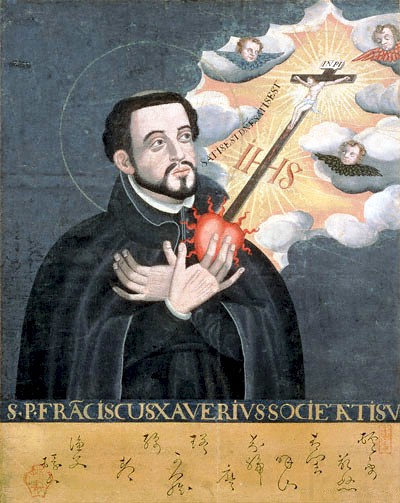
"The Apostle Of The Indies", St. Francis Xavier, S.J.
Visits of religious relics in West VisayasOn March, the relics of St. Therese of the Child Jesus will again visit Iloilo. This will be its second time in Iloilo thru the sponsorship of the Carmelite sisters of Jaro, the saint being a Carmelite nun. It first time was during the Great Jubilee year 2000. The relics consists of a piece of the habit of this saint.
Other relics that had visited West Visayas:
In 1950, the uncorrupted hands of St. Francis Xavier thru the Society of Jesus reached the cities of Iloilo and Bacolod. This relic is part of the uncorrupted body this saint called "The Apostle of the Indies" now in India.
In 2000, there was the bloodied glove of San Padre Pio displayed in the Jesuit Chuch Santa Maria in Iloilo City. Lastly, the heart of Blessed Hannibal di Francia exhibited at Archbishop's Palace in Jaro in 2003 accompanied by his miracle child, Charisse Nicoloe Diaz of Zarraga, Iloilo.
Incidentally, there are other relics in the churches in Iloilo like those of Santa Monica in Pavia and Santa Ana in Molo. There is also a reliquary gifted by the Church to Don Manuel Arguelles who was mainly responsible for building the famous Jaro Cathedral and belfry during the Spanish time. This reliquary had relics of many saints.
Religious relics of the saints are classified into three:
a. Primary relics – part of his/her body
b. Secondary relics – an article which had touched his body, and
c. Tertiary relics – an article which had touched a secondary relic.
Wednesday, March 5, 2008
Australian Provicial Promoted To President Of East Asia And Oceania
In these closing days of General Congregation 35, as drafts, documents and decisions are being finalised, it is only to be expected that Fr General Nicolás might hand down an appointment which affects us closer to home.
Fr General has appointed the Australian Provincial Fr Mark Raper to succeed him as President of the Jesuit Conference of East Asia and Oceania, based in Manila.The Province offers Mark our sincere congratulations as he takes on this significant role for our region. The timing of this announcement comes at an interesting stage as the Australian Province has begun initial proceedings in the search for the Provincial to succeed Mark later in the year. Mark will be returning to Australia at Easter, and will then be able to give a better indication of the timing for relinquishing his present position and taking up residence in Manila. I would like to quote from Mark's notes which he passed on to the Provincial Office earlier in the week.
This new mission corresponds to our vision of the mission of the Australian Province. We have already made significant personnel commitments in Asia. All the provinces and regions which form part of Conference of East Asia and Oceania, especially the newly established regions, understand that they are part of a larger community. We need one another's support in order to achieve our common mission. Consequently across Asia many Jesuits now live and work beyond their national and province boundaries.The conference has many common projects which need to be consolidated for the medium and long term, such as the new programs in Burma and East Timor, and the growing activities in China and Vietnam. ‘Moreover, the Society in Asia has much to offer other parts of the world. If we work together well, quite a lot of people can be considerably helped. The openness demonstrated in our Province by Jesuit and lay members to collaboration with one another across our ministries, and increasingly across Asia and the Pacific, gives me greater confidence in undertaking this new mission.' The Congregation is in its final days-significant direction will be given to the Society in its ministries into the future. We thank Mark Raper and Geoff King for their full contribution to proceedings in Rome and wish our Provincial well for the remainder of this momentous year for him.
By Acting Provincial Father Michael Ryan SJ
Sunday, March 2, 2008
Fool For Christ
On this feast of St. Ignatius, and in the light of today’s Gospel in which Jesus proclaims the craziness of the Cross, I believe we are called to remember that however intelligent or talented or competent we are, we, Jesuits and members of the Ignatian family, are called first of all to foolishness. It is not enough that we be known for excellence, important though that may be. I think that in our time, it is more important that we be known as “fools for Christ.” I have not invented this phrase.It is at there, at the heart of the Spiritual Exercises of St. Ignatius. In the consideration on the Three Degrees of Humility, which are really the three degrees of love, Ignatius describes the most perfect kind of humility this way: “I desire more to be thought worthless and a fool for Christ, who first was taken as such, rather than to be esteemed as wise and prudent in this world.” SPEX 167
Sunday, February 24, 2008
Jesuit Makes Statement In Phillipines That Carries Weight
1986! 2001! 2008?By Fr. Joaquin G. Bernas, S.J.
MANILA, Philippines - Why have I not joined the clamor for the resignation of President Macapagal-Arroyo? The reason is not because I am of the same mind as the Assumption schoolmates of the President. Nor is the reason because I do not find Jun Lozada credible, even if he is a self-confessed sinner. I do. Neither is the reason because I believe Gen. Avelino Razon or Sec. Eduardo Ermita or Ignacio Bunye and other apologists of the President. I find that difficult to do. My simple reason is that I do not see her voluntarily relinquishing her office. President Ferdinand Marcos did not voluntarily leave office. He was ousted from office. Joseph Estrada did not voluntarily surrender his office. He was pressured out of it. Resignation is a voluntary act. Gloria Macapagal-Arroyo will not resign. One clear lesson I am sure she has learned from the experience of Marcos and Estrada is that for her to leave office now would mean jumping from the frying pan into the fire. Out of office she loses her immunity from suit and she becomes fair game. I do not see her wanting to go into exile in Hawaii or to settle in her own Tanay.
Sunday, February 17, 2008
Jesuit Celebrates Mass With 5,000 People
5,000 attend Mass for Lozada at De La Salle
Rodolfo “Jun” Lozada Jr. conceded he is no saint and that he merely wanted to save his soul that was tainted by years of public service under the Arroyo administration. “I was trying to save my soul. I didn’t know that it would save this country’s soul,” said Lozada, a witness in the Senate’s inquiry into the controversial broadband network deal. He spoke after Mass on Sunday at De La Salle school in Greenhills, San Juan City, organized by former President Corazon Aquino. Some 5,000 people attended, including former House Speaker Jose de Venecia Jr., opposition members and business leaders. ...............
Fr. Manuel “Manoling” Francisco, the Jesuit priest who officiated the Mass, said the clerics and the De La Salle brothers will continue protecting Lozada from harassment from those he implicated in the scrapped $330-million project.
Tuesday, February 5, 2008
Little Dark Jesuit Kid: On Ash Wednesday
{Many people are asking me about ash wednesday and the season of lent so i decided to post this one from our Jesuit Ordo. Hope this helps. May you have a meaningful and Christ-centered Lenten season this year.}
Arthur W. Nebrao, Jr., SJ
Zamboanga City and Bilibid Prisons, Philippines http://www.jvpfi.org/, http://www.jesuits.ph/ and er2ol.blogspot.com
Traditionally, the ashes for the Ash Wednesday service come from burning the palm fronds from the previous year’s Palm Sunday celebration. They are made by burning palm fronds which have been saved from the previous year's Palm Sunday, the Sunday before the Easter. They are then blessed by a priest.Ashes are a biblical symbol of mourning and penance. In Bible times the custom was to fast, wear sackcloth, sit in dust and ashes, and put dust and ashes on one's head.Blessed ashes having been used in God's rituals since the time of Moses (Numbers 19:9-10, 17).They also symbolize death and so remind us of our mortality. Thus when the priest uses his thumb to sign one of the faithful with the ashes, he says, "Remember, man, that thou art dust and unto dust thou shalt return," Getting self-ashed:Of course, it is easier to purchase them from a religious supply house. However, if you burn the palm fronds yourself, don’t add any other ingredient—just burn the ashes plain. Add a little oil to the ashes so that they will stick to people’s foreheads.Don’t overestimate how much you need! It is amazing how far a small amount of ashes will go!Lent is a preparation for the celebration of Easter. For the Lenten liturgy disposes both catechumens and the faithful to celebrate the paschal mystery: catechumens, through the stages of Christian initiation; the faithful, through reminders of their own baptism and through penitential services.
Some Notes on the Lenten Season