Showing posts with label Jesuit Cardinal. Show all posts

Monday, March 10, 2014

Cardinal Jean Guenolé Marie Daniélou, S.J. On The Angels Of Earth And The Angels Of Heaven

Saint Trophim at Arles
St. Ephrem sees the angels, "taking up the soul (after it has left the body) and carrying it through the upper  air." This belief is responsible for the numerous representations of angels on the funeral monuments. These continue up to the Middle Ages. The front gate of Saint-Trophime at Arles pictures a soul being carried by an angel into the bosom of Abraham. In the dialogues of St. Gregory the Great, so filled with allusions to the invisible world, the angels often come to serve the saints at the hour of their death. The witnesses who were assisting at the death of the pious Stephan saw the angel 
"without being able to express what they had seen because they were so struck with fear." 
The death of the saints appears as a mystery full of sacred terror. The hymns of the angels fill the soul with so divine a joy that does not notice the sufferings of death. And during its voyage toward heaven, the angels scatter the demons who try to bar the soul's advance. Secondly, the angels of heaven, the guardians of Paradise, are asked to permit the soul to enter there. Here once again we find that there are two groups, the angels of earth and the angels of heaven. Just as the liturgy invokes the angels who lead the soul into Paradise, it also contains allusions to those who welcome the soul there. The Apostalic Constitutions contain a prayer for the dead which is drawn up in this manner: 
"Cast thine eyes upon this servant. Forgive him if he has sinned and make the angels well-disposed toward him." 
St. Ephrem pictures the confusion of a man confronted by heavenly powers, "when the armies of the lord show themselves and when the divine commanders bid him leave the bodies behind. he shakes, he trembles at the unaccustomed sight of these figures, these choirs which he has never seen before. All of us, trembling, say to each other: 'Pray that your soul leave your body in peace. Pray that it find the angels well-disposed.'" This is an echo of the the liturgical prayer of the Constitutions. Gregory of Nyssa insists on this point to demonstrate the necessity of Baptism: 
"I do not know whether, once it has left the body, the angels will receive the soul which has not been illuminated and adorned with grace of regeneration. For how could they, if it does not bear the seal and has no sign of its quality? Probably it is borne upon the air, wandering and vagabond." 
This twofold aspect of the relation between death and the angels is expressed in the prayer which an early apocryphal writer puts into the mouth of Saint Joseph at his death: "But now O my Lord, let your holy angel keep close to my soul and my body until they separate from each other without pain. Do not permit that the angel who was attached to me since the day you formed me up to now should turn toward me, his countenance smouldering with anger, when we are on our way along the round that leads to you. Do not allow my soul to be stopped by the keepers of the gate and do not put me to shame before your fearful tribunal. Do not loose against me the floods of the river of fire in which all souls are purified before they see the glory of your divinity, O God, You who judge each one in truth and justice."

Sunday, September 15, 2013

Cardinal Avery Dulles, S.J. "Little Or No Encouragement From Catholic Clergy"

Asked whether spreading the faith was a high priority of their parishes,75 percent of conservative Protestant congregations and 57 percent of African American congregations responded affirmatively, whereas only 6 percent of Catholic parishes did the same. Asked whether they sponsored local evangelistic activities, 39 percent of conservative Protestant congregations and 16 percent of African American congregations responded positively as compared with only 3 percent of Catholic parishes. Converts to Catholicism often report that on their spiritual journey they received little or no encouragement from Catholic clergy whom they consulted.
Link (here) to Ralph Martin's disturbing look at Catholic de-Sacramentalization. In this essay you will find Cardinal Dulles' quote.

Wednesday, July 3, 2013

Cardinal Jean Daniélou, S.J., "It Destroys The Very Base On Which The Religious Life Is Built"

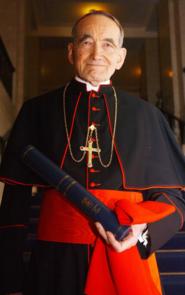
 Cardinal Jean Daniélou, S.J.
The August 7-11 meeting in St. Louis, Missouri of the Leadership Conference of Women Religious remindsus of the sober words of Cardinal Jean Daniélou, SJ in 1972. The LCWR featured a keynote speaker whose theme was “Conscious Evolution,” which is as removed from the Pope and the Magisterium as science fiction is from Albert Einstein. In the National Catholic Reporter on August 6, 2012 Alice Popovici wrote of the LCWR keynote speaker: “Barbara Marx Hubbard, an evolutionary thinker who is to speak this week before the Leadership Conference of Women Religious, is not Catholic or part of any mainstream religion. But she says she has faith in the future.”  

By sharp contrast, Daniélou warned in an interview on Vatican Radio on October 23, 1972:
One of the greatest threats to religious life today is the mass of disputable theological opinions. In minimizing the supernatural aspect of God’s gift, in minimizing everything that pertains to the action of the Spirit, it destroys the very base on which the religious life is built. That is why it is important today to seek out spiritual directors and theologians from those who represent the true thinking of the Church. There must be a care to have a deep unity with the sovereign Pontiff and with the orientations given by him the Sovereign Pontiff, in particular those which concern religious life.
As to a union with the Sovereign Pontiff, the LCWR rejected even the presence of the canonical pontifical delegate:
Archbishop J. Peter Sartain of Seattle, who has been charged by the Vatican with responsibility for supervising a reform of the Leadership Conference of Women Religious (LCWR), has been told by the group’s leaders that his presence ‘would not be helpful’ at the LCWR’s annual assembly this week.
On the subject of the crisis in religious life, again in 1972 Daniélou spoke thus:
Vatican II declared that human values must be taken seriously. It never said that we were entering in to a secularized world where the religious dimension would be no longer present in civilization. It is in the name of a false secularization that religious men and women give up their religious habit and abandon the adoration of God for social and political activities. And this is, furthermore, counter to the spiritual need manifested in the world of today. (Why the Church?, p. 166-167)
Robert A. Connor succinctly summarizes the cardinal’s lifetime work:
After his short spell as a military chaplain ended with the fall of France in 1940, he devoted himself to the study of the Fathers of the Church, and with Fr. Henri de Lubac was one of the founders of Sources Chrétiennes, a popular yet scholarly series of key writings from the patristic period. Over the years, Daniélou produced a flow of books and articles on the worship and theology of the Early Church. Such was his reputation and influence that Blessed Pope John XXIII named him as a theological expert for the Second Vatican Council. In 1969 he was made a cardinal by Pope Paul VI, and elected to the Académie Française.
Why would a patristics scholar of Daniélou’s stature get involved in current Church events at such a popular level? 
Link (here) to the full piece by Fr. Brian Van Hove, S.J., entitled,  The Lasting Legacy of Cardinal Daniélou

Thursday, April 4, 2013

Cardinal Avery Dulles, S.J., "Reexperience The Revelation Of God"

Cardinal Avery Dulles, S.J.
The Catechism of the Catholic Church is the boldest challenge yet offered to the cultural relativism that
currently threatens to erode the contents of Catholic faith. According to a widely prevalent view, religious truth consists in an ineffable encounter with the transcendent. This encounter may be expressed in symbols and metaphors, but it cannot be communicated by propositional language, since it utterly surpasses the reach of human concepts. All statements about revelation, moreover, are said to be so culturally conditioned that they cannot be transferred from one age or one cultural region to another. Every theological affirmation that comes to us from the past must be examined with suspicion because it was formulated in a situation differing markedly from our own. Each constituency must reexperience the revelation of God and find language and other symbolic forms appropriate to itself.
Mystical empiricism of this type inevitably devalues specific beliefs. It makes light of the efforts of previous generations to formulate the faith in creedal and dogmatic assertions. In this perspective the traditional view that a dogma is a divinely revealed truth is no longer taken seriously. The struggle to maintain doctrinal consensus in the universal Church is viewed as a threat to the creativity of local churches.
This sophisticated relativism, widespread though it may be among intellectuals, has had only limited impact on the mass of the Catholic faithful and is firmly rejected by the hierarchical leadership of the Church. Pope John Paul II and Cardinal Joseph Ratzinger, who are the intellectual equals of any other religious thinkers of our day, have consistently opposed this trend. In their view divine revelation can be formulated, at least in part, in irrevocably and universally true creedal and dogmatic propositions. Recognizing the need to defend the doctrinal patrimony of the Church from present-day skepticism and relativism, many leaders of the Church became convinced that the time had come for a new universal catechism.
Link (here) to the lengthy piece by the Jesuit Cardinal Avery Dulles at First Things

Wednesday, April 3, 2013

What Counts Is What It Can Accomplish

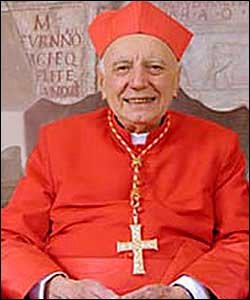
Cardinal Tomas Spidlik, S.J.
While neighbouring Poland remains deeply Roman Catholic, only one million Czech citizens declared
themselves Catholic in a 2011 census. Five million had no religion while 3.6 million said they were atheist. Very few Czechs are aware of the positive achievements of the Jesuit order in their homeland, such as the setting up of around three dozens schools.
Jesuit priest Father Bohuslav Balbin (1621-1688), a historian and writer, was a patriot who wrote several history books on his country and promoted the Czech language.
And respected Jesuit Cardinal Tomas Spidlik (1919-2010), an expert on spirituality in eastern Christian countries, "contributed to the theological dialogue between the East and the West," said Sebek. With its passion for science, the order also opened an observatory at the top of a tower at the Clementinum college, a masterpiece of Baroque architecture in Prague, where temperatures have been recorded every day since 1775. 
"And we must not forget about the numerous Jesuits incarcerated in Nazi concentration camps and in Communist prisons, whose fate is largely forgotten today. It would be good if this could change," historian Sebek notes. 
Fr. Petr Kolar S.J. sees plenty of work for Jesuits nowadays. "Pity that there are so few of us. There are so many things to do, like helping the marginalized or the Roma minority," he told AFP in an austere room at the Jesuit headquarters in central Prague, next to the Baroque church of Saint Ignatius de Loyola, a Spanish priest who founded the Society of Jesus in 1534. "The order's image isn't important. What counts is what it can accomplish," he added with a smile.
Link (here) to Naharanet

Friday, March 22, 2013

The Old-School Argentine Jesuit Is Now Benedict’s Successor

When Pope Francis stepped out onto the central loggia of St. Peter’s on the night of March 13, I thought of the man I had met in his Buenos Aires office 10 months before: 
Cardinal Jorge Mario Bergoglio, SJ, who was looking forward to laying down the burden of leadership and devoting himself to prayer, reflection and study. Now, because Benedict XVI decided to renounce the Chair of Peter and do what Cardinal Bergoglio wanted to do, the old-school Argentine Jesuit is now Benedict’s successor. 
His acceptance of the cross that is the papacy was an act of humble obedience by a man who had bent his will to the divine will for over a half-century. What kind of man is he? Some impressions from an hour’s conversation last May:
A man of God. The new pope struck me then as someone who lived from the inside out: a man whose rich interior life was the basis of his public life; a leader whose decisions grew from prayer and discernment, not calculation.
A man of profound humility. I had long been interested in getting to know then-Cardinal Bergoglio, but I had the hardest time getting him to talk about his own life and experiences. I didn’t detect shyness in this, or false modesty, but a true evangelical humility. Pope Francis will not have the effervescence of a John Paul II; but like the Polish pope who created him cardinal, Jorge Bergoglio has spent his life saying, not “Look at me,” but rather, “Look to Jesus Christ.”
A man of keen and realistic intelligence. Pope Francis is not the university professor that John Paul II and Benedict XVI had been in their pre-papal lives. And while that model of preparing-for-the-papacy served the Church well for 35 years, it’s not the only possible model. 
Now, rather than a professor who learned how to be a pastor, the Church has been given a pastor who has long experience of being a pastor. Nonetheless, I was struck last May by Bergoglio’s sharp mind, his familiarity with issues throughout the world Church, and his prudence in judging people and situations. He was, for example, completely realistic and lucid about the Church’s situation in Latin America. 
Rather than complaining about evangelical Protestant “sheep-rustling,” as more than a few Latin American churchmen do, the archbishop spoke with insight and conviction about the imperative of Catholicism rediscovering the power of the Gospel through personal conversion to Jesus Christ.
Link (here) to the full article by George Weigel

Thursday, March 7, 2013

A Spiritual Son Of St. Ignatius

The Holy Father Pope Benedict XVI delivered the eulogy at the end of the funeral of Cardinal Tomas Spidlik S.J., who died on 16 April at the age of 90. The funeral Mass was celebrated in St. Peter's Basilica by Cardinal Angelo Sodano, dean of the College of Cardinals.

  "The will of Jesus coincides with the will of God the Father and, along with the action of the Holy Spirit, represents a kind of secure, strong and sweet 'embrace' of man, leading him to eternal life"
, said the Pope.
  "I believe that the great men of faith live immersed in this grace, that they have the gift of perceiving this truth particularly clearly, and that they can thus undergo harsh trials, just as Fr. Tomas Spidlik did, without losing their trust; rather, they retain a sense of humour, which is certainly a sign of intelligence but also of inner freedom".
Benedict XVI went on: "In this context, there was an evident resemblance between the late cardinal and the Venerable John Paul II: both were wont to make jokes though having suffered difficult, and in some ways similar, personal circumstances in their youth. Providence led them to meet and work together for the good of the Church, with the particular aim that she might learn to breathe fully 'with both her lungs', as the Slavic Pope liked to say.

  "This free and ready spirit had its objective foundation in the Resurrection of Christ", the Holy Father added. 
"The hope and joy of the risen Jesus are also the hope and joy of His friends, thanks to the action of the Holy Spirit. Fr. Spidlik demonstrated this regularly in the way he lived, and his witness became ever more eloquent with the passing of the years because, despite his advanced age and inevitable health problems, his spirit remained fresh and youthful. What is this, if not friendship with the risen Lord?"
In choosing "ex toto corde" (with all my heart) as his motto, the cardinal placed "his life within the commandment to love, inscribing his entire existence in the primacy of love and of charity". The words "phos" and "zoe" (light and life) on the cardinal's coat-of-arms "are names of God", the Pope explained. "Thus the man who fully 'ex toto corde' accepts the love of God, accepts light and life, and becomes in his turn light and life in humankind and in the universe".

  Benedict XVI concluded his eulogy by recalling Cardinal Spidlik's membership of the Society of Jesus (Jesuits). "In other words", he said, "he was a spiritual son of St. Ignatius who placed the contemplation of God in the mystery of Christ at the centre of faith and spirituality. In this symbol of the heart, East and West come together, not in a devotional but in a profoundly Christological sense" 
Link (here) to the Vatican Press Office.

Thursday, November 22, 2012

Jesuit Cardinal Says, "Tired"

Cardinal Carlo Maria Martini, S.J. described the Church in Europe and America as “tired,” and asked “Where among us are the heroes from whom we can draw inspiration?” The burning “coals” of the Church, Martini continued, were hidden under piles of ashes; indeed, there is “so much ash on top of the coals that I am often assailed by a sense of powerlessness. How can the coals be freed from the ashes so as to reinvigorate the flame of love?” 
The cardinal went on to propose, quite rightly, that true reform in the Church is always reform inspired by Word and Sacrament. But then, at the end of the interview, came the money-quote: “The Church is 200 years behind. Why in the world does it not rouse itself? Are we afraid? Fear instead of courage?” To which one wants to reply, with all respect, “Two hundred years behind what?” 
 A western culture that has lost its grasp on the deep truths of the human condition? A culture that celebrates the imperial autonomous Self? A culture that detaches sex from love and responsibility? A culture that breeds a politics of immediate gratification and inter-generational irresponsibility, of the sort that has paralyzed public policy in Italy and elsewhere? “Why in the world,” to repeat the late cardinal’s question, would the Church want to catch up with that? As for the question, “Where are the heroes?” Cardinal Martini seemed unaware of, or puzzled by, or perhaps even unhappy with, the heroic witness of the man who created him cardinal after naming him successor to St. Ambrose in Italy’s most prestigious see: John Paul II, whose faith and courage continue to inspire the liveliest parts of the Catholic world in Europe and America. (John Paul, for his part, gave Martini’s commentary on the First Letter of Peter to the cardinals gathered for the pope’s silver jubilee in 2003, as an appendix to a replica of the Bodmer Papyrus copy of the “first encyclical.”) Nor was John Paul alone as an exemplar of Christian heroism during the Martini years in Milan: years in which, to take but two examples, Blessed Jerzy Popieluszko became the martyr-priest of Solidarity and Blessed Mother Teresa of Calcutta completed her singular witness to the “flame of love” the cardinal thought buried under ashes. For all his brilliance, Cardinal Martini, like many on the Catholic left, never seemed to grasp that the secular culture with which Vatican II hoped to open a dialogue was not the secular culture that emerged in Europe in the aftermath of the upheavals of 1968. 
Link (here) to read the full piece by George Weigel

Friday, October 5, 2012

“Indoor Snowfall”

Jesuit Cardinal Jean Daniélou
Perhaps in the tradition of Jesuits such as Robert Bellarmine and Augustine Bea, Jean Daniélou was expressly made bishop and cardinal in 1969 by the Pope. Not surprisingly, a flood of protest pamphlets descended from the clerestory and marred the Mass of ordination. The battle was engaged. Newspapers carried the photo of the “indoor snowfall” in the sanctuary of the church where the ordination took place. Friends of Daniélou reported that same year, 1969, that he had refused these ecclesiastical awards. However, Pope Paul VI had personally ordered him under obedience to accept being made bishop and cardinal “so that you might suffer with me for the Church.” The son of Saint Ignatius of Loyola, Jean Daniélou, might have added, “If this be the case, then together we will proceed, both of us to suffer for Christ.”
Link (here) to "The Lasting Legacy of Cardinal Daniélou"

Sunday, May 13, 2012

French Jesuit Cardinal, "The Life Of Prayer Is Abandoned And The First Consequence Of This State Of Confusion Is The Disappearance Of Vocations"

I think that there is now a very grave crisis of religious life, and that one should not speak of renewal, but rather of decadence. I think that this crisis is hitting the Atlantic area above all. Eastern Europe and the countries of Africa and Asia present in this regard a better state of spiritual health. This crisis is manifesting itself in all areas. The evangelical counsels are no longer considered as consecrations to God, but are seen in a sociological and psychological perspective. We are concerned about not presenting a bourgeois facade, but on the individual level poverty is not practiced. 
The group dynamic replaces religious obedience; with the pretext of reacting against formalism, all regularity of the life of prayer is abandoned and the first consequence of this state of confusion is the disappearance of vocations, because young people require a serious formation. And moreover there are the numerous and scandalous desertions of religious who renege on the pact that bound them to the Christian people. The essential source of this crisis is a false interpretation of Vatican II. 
The directives of the Council were very clear: a greater fidelity of religious men and women to the demands of the Gospel expressed in the constitutions of each institute, and at the same time an adaptation of the modalities of these constitutions to the conditions of modern life. The institutes that are faithful to these directives are seeing true renewal, and have vocations. 
But in many cases the directives of Vatican II have been replaced with erroneous ideologies put into circulation by magazines, by conferences, by theologians. Vatican II declared that human values must be taken seriously. It never said that we should enter into a secularized world in the sense that the religious dimension would no longer be present in society, and it is in the name of a false secularization that men and women are renouncing their habits, abandoning their works in order to take their places in secular institutions, substituting social and political activities for the worship of God. 
And this goes against the grain, among other things, with respect to the need for spirituality that is being manifested in today's world. A false conception of freedom that brings with it the devaluing of the constitutions and rules and exalts spontaneity and improvisation. This is all the more absurd in that Western society is currently suffering from the absence of a discipline of freedom. The restoration of firm rules is one of the necessities of religious life. An erroneous conception of the changing of man and of the Church. Even if these change, the constitutive elements of man and of the Church are permanent, and bringing into question the constitutive elements of the constitutions of the religious orders is a fundamental error. 
Link (here) to read the full 1972 interview with Cardinal Jean Daniélou, S.J.

Saturday, May 12, 2012

Cardinal Jean Daniélou, S.J. "A False Interpretation Of Vatican II"

Cardinal Jean Daniélou, S.J.
Mimì Santoni, the prostitute, saw Jesuit Cardinal Jean Danielou fall to his knees with his face on the floor before he breathed his last. And to her "it was a good death, for a cardinal." He had gone to bring her money to pay for a lawyer capable of getting her husband out of prison. It was the last of his works of charity carried out in secret, on behalf of despised persons in need of help and forgiveness. The Jesuits conducted exhaustive investigations to discover the truth. They ascertained his innocence. But they also shrouded the case in a silence that did not dispel the suspicions.  The rupture between Daniélou and his other Jesuit confreres in Paris and the rest of France was in effect the true origin of the neglect that fell upon this great theologian and cardinal.  A rupture that preceded his death by at least two years.  Since 1972, in fact, Daniélou had no longer been living in the residence of "Etudes," the leading cultural magazine of the French Jesuits, where he had lived for decades. He had moved to a convent of sisters, the Daughters of the Heart of Mary.  The clash had been precipitated by an interview with Daniélou on Vatican Radio in which he harshly criticized the "decadence" that was devastating so many men's and women's religious orders, because of "a false interpretation of Vatican II." The interview was interpreted as an accusation brought against the Society of Jesus itself, the superior general of which at the time was Father Pedro Arrupe, who was also the head of the union of superiors general of religious orders. The Jesuit Bruno Ribes, director of "Etudes," was one of the most active in making scorched earth around Daniélou. The positions of the two had become antithetical. In 1974, the year of Daniélou's death, Ribes positioned "Etudes" in open disobedience with respect to the teaching of the encyclical "Humanae Vitae" on contraception. And he collaborated with other "progressive" theologians – including the Dominicans Jacques Pohier and Bernard Quelquejeu – in the drafting of the law that in that same year introduced unrestricted abortion in France, with Simone Veil as health minister, Valéry Giscard d'Estaing as president, and Jacques Chirac as prime minister. The following year, 1975, Father Ribes left the helm of "Etudes." And afterward he abandoned the Society of Jesus, and then the Catholic Church.
Link (here) to read the full story at Chiesa

Sunday, March 11, 2012

Cardinal Avery Dulles, S.J. On The Passing Of Fr. Leonard Feeny

I regret that I did not make notes on some of Leonard Feeney’s conversation. His table talk was brilliant and memorable. He would teach us to look on the world with fresh eyes and to delight as he did in the variety of God’s creation. 
He was particularly fascinated by the animals, as appeared in many of his poems. One of them, written for children, begins characteristically: "Moo is a cow/ When she makes a bow/ To a meadow full of hay./ Shoo is a hen/ When she’s back again/ And you want her to go away." 
As a spiritual director Father Feeney carefully trained his disciples. Although he was capable of sharp admonitions and rebukes, his general practice was to lead by positive encouragement. He was generous in praising others, both in their presence and when they were absent. When he noticed faults in the members of the group, he would correct these in a good-humored way, with playful mimicry, rhymes and puns. (For his views on the value and limits of the pun it would be worthwhile to read his little article, "How Much Do I Like a Pun?" [Am., 9/26/36].) 
Father Feeney’s light-hearted mockery extended not only to members of the Center but to the public figures of the day. Parodying their rhetoric and mannerisms, he would deliver with mock solemnity imaginary speeches such as Al Smith on the fallacies in Descartes’s philosophy ("putting Descartes before the horse"), Fulton Sheen on merits of Coca-Cola ("Ho, everyone that thirsteth for the pause that refreshes!") and Franklin Roosevelt on the decline of sacramental religion ("Some of our underprivileged are having to get along on two paltry sacraments, or even none"). 
In other imitations he presented Katherine Hepburn reporting a championship prizefight and Eleanor Roosevelt broadcasting the events of Good Friday. We listened to these imitations with our sides splitting, almost sick with laughter. Then at a crucial moment Father Feeney would be likely to remove his clerical collar, put it over his head like a wimple and begin to speak in the broken English of Mother Cabrini.
Link (here) to the 1978 obituary in America Magazine of Fr. Leonard Feeney written by Fr. Avery Dulles, S.J. 

Saturday, March 10, 2012

Cardinal Albert Vanhoye, S.J. "You See His Delicate Love For The Lord "

Cardinal Albert Vanhoye, S.J.
It is clear that for the Christian it is necessary to begin with the Gospel, to delve into it in meditation, in prayer, to apply it to your own life. This is the first essential thing. But the Gospel itself points to the Old Testament. Jesus is the promised Messiah. So, it is helpful to read the prophetic texts, especially the messianic ones. The Psalms are useful for prayer, but it must be said that they do not always have the Gospel spirit. A distinction has to be made, then. Some Psalms are full of curses against enemies, they are very far from Jesus' precept about loving enemies and praying for them. It is clear that it is necessary for the faithful to have the assistance of aids that present the texts and place them at the intellectual level of the faithful, their capacity to understand and live.
Then among the Gospels there is a difference between the Synoptics and John's Gospel. From the point of view of the faithful the most interesting Gospel is Mark's, which is very lively, which tells of miracles in a very detailed way, etc. The Gospel of Matthew gives a richer teaching and so it is necessary to always return to it to be filled again with the evangelical spirit. On the other hand, John's Gospel goes deeply into the faith in a marvelous way. It is necessary to really meditate on John's Gospel, to grasp it in faith and love for the Lord. Luke, too, is very interesting. It is the disciple's Gospel. 
It would also be possible to start with Luke's Gospel, which occupies itself more with the disciple's relationship to the Lord Jesus. The great discourses of Matthew are broken up in Luke's Gospel. The beatitudes, instead of being expressed in the third person are addressed directly to the disciples: "Blessed are you poor… ." This is an example. Then Luke relates himself to Jesus in a very delicate way, especially in the account of the Passion. There you see his delicate love for the Lord very well; his way of softening the most cruel, most offensive things.
Link (here) to Zenit

Thursday, February 9, 2012

Gonzaga On Purgatory And Heaven

St. Aloysius Gonzaga, S.J. and St. Cardinal Robert Bellarmine, S.J.
A very affecting incident was his leave-taking with Father Corbinelli. This was the old priest, whom he had so long and carefully tended. Both were now dying, and neither could go to see the other, so they sent daily greetings. But this was not sufficient,' for on the eighth day before his death, the father requested to be allowed to see Aloysius for the last time. Upon hearing this, Aloysius instantly begged the infirmarian to dress him and carry him in. 
This was done, and the mutual joy of the two dying religious was beautiful to behold. They talked of the heavenly home to which they were both shortly going, exhorted each other to bear sufferings patiently and begged for each other's prayers. Finally, when Aloysius was about to leave, the aged priest begged his blessing. Of course Saint Aloysius was frightened at this proposal, and protested that it was by 'no means fitting for him, a mere scholastic, so young and unworthy, to presume to bless a priest. 
On the contrary, it was the part of the other, as a priest and the older person, to give the blessing. Nevertheless Father Corbinelli persisted in his request and bade the infirmarian not to move Aloysius till he had complied. He felt he was in the presence of a saint, far superior to himself in spiritual perfection. The infirmarian added his voice to that of the Father, till at last Aloysius yielded to their solicitations, endeavoring at the same time to co-ordinate his aged friend's requests and his own sense of humility. 
So, taking holy water and signing himself and the priest with the sign of the cross, he said: "My father may God, ever Blessed, bless us both, and fuflll your holy desires; pray for me, and I will pray for you." Aloysius was carried away and shortly after this the father died. 
They wished to keep the news from the saint, but it was impossible. On the night of his death he appeared thrice to Aloysius in a dream, the first time to tell him that he was in his agony, the second to beg Aloysius' prayers to help him to bear his terrible sufferings, and the third time to say that he was dead. So vivid was the impression that the saint was unable to sleep any more that night. He afterwards said to Father Bellarmin that Father Corbinelli had but passed through purgatory ; and so confidently did he asserts it that it was taken as undoubted truth. More than once his friends exhorted him to pray for his own recovery, knowing full well the power of his prayers. But he firmly refused, answering in the words of Saint Paul, he would prefer to pray for his immediate death, so anxious was he to reach his eternal home. So far did he carry this desire that he feared to be detained in purgatory for it. 
Once he asked his confessor, Father Bellarmin, if he thought anyone ever went directly to heaven. That father replied that he firmly thought so, and furthermore was certain Aloysius would. 
On hearing this the saint fell into an ecstasy, in which he remained all night, although as he afterwards said, it seemed to him but one moment. In the morning he announced that he would die in eight days—on the octave of Corpus Christi.
Link (here) to the book entitled, The Life of St. Aloysius Gonzaga

Tuesday, February 7, 2012

Abundance Of Divine Light

St. Aloysius Gonzaga, S.J.
Passing over the names of many grave, learned, and pious divines, names carrying much weight in their day, we may rest satisfied with the testimony of the great Robert Bellarmine, whose high reputation for spiritual gifts and theological science is still fresh in our times. As Aloysius's confessor, we have had occasion to record his opinion more than once in the course of the saint's life. It may here be added that he was in the habit of saying that so long as Aloysius was at the college, he did not fear that any evil could happen to it; and in a discourse delivered before the whole community in the year 1608, he has left on record an attestation truly remarkable, as coming from one whose own soul was so sublimely illuminated. 
"When I gave," he said, "the Spiritual Exercises of St. Ignatius to Luigi, I discovered in him such abundance of divine light, that I must confess that, at my advanced age, I learned from this youth how to meditate." 
When raised to the Cardinalate, the venerable prelate not only continued his yearly practice of repairing to the College church of the Company to venerate the tomb of Aloysius on his anniversary, but used to make a devout visit to the room whence he had taken his flight to Heaven, and there would shed tears of tenderness in memory of their last parting. Viewing this apartment as a hallowed spot, he did not think it ought to be used any longer as a common infirmary, and the superiors readily acquiesced in his desire. 
Heaven itself seemed to signify its approval, for many times was sweetest music heard to issue from it. No research could ascertain the source of these melodious strains; whence it was piously inferred that they proceeded from choirs of angels who descended to consecrate with their songs the spot from which their loved companion had left the earth to take his place in their glorious ranks. 
When the Holy See had declared Aloysius to be in the possession of eternal glory, the cardinal had this room converted into a chapel at his own expense. He rendered his crowning testimony by desiring to be laid after death at the feet of "the blessed Aloysius," once his spiritual son, but, in the spirit of obedience, left the disposition of his body to the will of his superiors; and they, to confer upon him the greatest honour within their power, deposited him in the same
Link (here) to the book entitled, The Life of St. Aloysius Gonzaga, S.J.

Friday, January 13, 2012

Somes Notes From The 1974 General Congregation Of The Society Of Jesus

On liturgical abuses
Cardinal Paolo Dezza, S.J.
Fr. Paolo Dezza, S.J. particularly has liturgical laws in mind - e.g. tampering with liturgical forms and language ("in not a few places the lack of observance of these norms is frequent".)

On dissension
If the pilgrim Church stands in need of purification "the best way to improve it is not public criticism and controversy" but "suitable ways to bring correction and remedy without a great deal of noise and provoking scandals." Fr. Pedro Arrupe, S.J. is called upon as a witness to the fact that in St. Ignatius' voluminous correspondence which contributed so effectively to Church reform "there is not a word of criticism against ecclesiastical superiors. "

On Jesuit Formation
Young Jesuit aspirants should be formed for "a deep and solid faith" strong enough to resist modern temptations and life's difficulties. The young should participate responsibly in their formation but we should not permit students to cancel the action of the educator. A young religious is not mature at the beginning of the process nor does he have experience. He must be solidly formed in philosophy and theology as required by Sapientia Christiana. Philosophy is especially important as a gateway for theological training and, respecting all theological specialties, there should be no neglect of training in a systematic theology so that "our scholastics receive that complete and organic knowledge of the fundamental points of Catholic doctrine"

Saturday, January 7, 2012

Honoris Causa

The Red Galero
Whenever the consistory rolls around, I’m always curious to see which scholarly octogenarians receive the red hat honoris causa.  
Seeing a Jesuit among the cardinal-designates is always significant, inasmuch as it suggests the sort of theological service the Holy Father hopes for from the Society of Jesus.  
This year’s consistory singled out for honorable mention Fr. Karl J. Becker, S.J., emeritus professor of theology at the Gregorian University in Rome. 
.
Read more about the new Jesuit Cardinal (here) from Fr. Aaron Pidel, S.J. at Whosoever Desires a Jesuit authored blog

Friday, November 4, 2011

John Nelson Darby's Jesuits

Dispensationalism is a method of Bible interpretation which was first devised by John Nelson Darby (1800-1882), and later formulated by the controversial American Cyrus Ingerson Scofield [sometimes referred to as Cyrus Ingersoll Scofield] (1843-1921), and is also known as Pre-millennial Dispensationalism. Although Darby was not the first person to suggest such a theory, he was, however, the first to develop it as a system of Bible interpretation and is, therefore, regarded as the Father of Dispensationalism. The origin of this theory can be traced to three Jesuit priests; (1) Francisco Ribera (1537-1591), (2) Cardinal Robert Bellarmine (1542-1621) one of the best known Jesuit apologists, who promoted similar theories to Ribera in his published work between 1581 and 1593 entitled Polemic Lectures Concerning the Disputed Points of the Christian Belief Against the Heretics of This Time, and (3) Manuel Lacunza (1731–1801). The writings of Ribera and Bellarmine, which contain the precedence upon which the theory of Dispensationalism is founded, were originally written to counteract the Protestant reformers' interpretation of the Book of the Revelation which, according to the reformers, exposed the Pope as Antichrist and the Roman Catholic Church as the whore of Babylon.
Link (here)

Monday, May 23, 2011

The 15 Marks Of The Church As Defined By St. Robert Bellarmine, S.J.


The 15 Marks of the Catholic Church

developed by

St. Robert Bellarmine, S.J.

1542-1621,

Doctor of the Church and Cardinal:


<1>

The Church's Name, Catholic, universal, and world wide, and not confined to any particular nation or people.

<2>

Antiquity, in tracing her ancestry directly to Jesus Christ.

<3>

Constant Duration, in lasting substantially unchanged for so many centuries.

<4>

Extensiveness, in the number of her loyal members.

<5>

Episcopal Succession, of her Bishops from the first Apostles at the Last Supper to the present hierarchy.

<6>

Doctrinal Agreement, of her doctrine with the teaching of the ancient Church.

<7>

Union, of her members among themselves, and with their visible head, the Roman Pontiff.

<8>

Holiness, of doctrine in reflecting the sanctity of GOD.

<9>

Efficacy, of doctrine in its power to sanctify believers, and inspire them to great moral achievement.

<10>

Holiness of Life, of the Church's representative writers and defenders.

<11>

The glory of Miracles, worked in the Church and under the Church's auspices.

<12>

The gift of Prophesy found among the Church's saints and spokesmen.

<13>

The Opposition that the Church arouses among those who attack her on the very grounds that Christ was opposed by His enemies. The Unhappy End, of those who fight against her.

<15>

The Temporal Peace and Earthly Happiness of those who live by the Church's teaching and defend her interests.

Link (here)

Sunday, May 22, 2011

Friedrich von Hugal On Cardinal Juan de Lugo, The 17th Century Spanish Jesuit

Cardinal Juan de Lugo, S.J.
We all greatly require criticism, stimulation, reproof, of our most intimate and cherished convictions; and it is our reciprocal duty, with tact and restraint, to try to serve our fellows similarly. Hegel, perhaps most probingly among all Protestant philosophers, has exposed in general this impoverishing formalism of Kant "the Philosopher of Protestantism." But I believe the true scheme, as concerns religion, to have been best developed by Cardinal Juan de Lugo, the Spanish Jesuit, who wrote in Rome under the eyes of Pope Urban VIII., at the end of the seventeenth century. De Lugo first lays down that, according to Catholic doctrine, God gives light, sufficient for its salvation, to every soul that attains to the use of reason in this life. He next asks,  What is the ordinary method by which God offers and renders possible this salvation and he answers that, though God doubtless can work moral miracles, these do not appear to be the rule, and are not in strictness necessary; that the human soul, in all times and places, has a certain natural affinity for, and need of, truth; and again, that the various philosophical schools and religious bodies throughout mankind all contain and hand down, amid various degrees of human error and distortion, some truth, some gleams and elements of divine truth. Now what happens as a rule is simply this: the soul that in good faith seeks God, His truth and love, concentrates its attention, under the influence of grace, upon these elements of truth, be they many or few, which are offered to it in the sacred books and religious schools and assemblies of the Church, Sect, or Philosophy in which it has been brought up. It feeds upon these elements, the others are simply passed by; and divine grace, under cover of these elements, feeds and saves this soul. I submit that this view admirably combines a sense of  man's profound need of tradition, institution, training, with full justice to the importance of the dispositions and acts of the individual soul, and, above all, with a keen sense of the need of special graces offered by God to the several souls. And such a view in no way levels down or damps the missionary ardour. Buddhism does not become equal to Mohammedanism, nor' Mohammedanism to Judaism, nor Platonism to Christianity, nor Socinianism, or even Lutheranism, to Catholicism. It merely claims that everywhere there is some truth; that this truth comes originally from God; and that this truth, great or little, is usually mediated to the soul, neither by a spiritual miracle nor by the sheer efforts of individuals, but by traditions, schools and churches. We thus attain an outlook, generous, rich, elastic; yet also graduated, positive, unitary, and truly Catholic.
Link (here) to read the portion of the book entitled,  Essays and Addresses on the Philosophy of Religion by Austrian Catholic writer and apologist Friedrich von Hügel