Showing posts with label Jesuits in Mexico. Show all posts

Monday, October 29, 2012

On The Life Of Fr. Luis G. Verplancken, S.J.

The nurse stopped before a wall decorated with enlarged photos converted into pictures. They were images of Tarahumara children, wrinkled like old men and women , with sparse hair, arms without muscles, bellies swollen by misery or skin so taut that all their ribs were showing as if they were washboards. A sign identified one of the "little skeletons" with the name of Lorena. Next to it, another photo taken months later shows a small chubby and smiling girl held up by a priest. It is Lorena. "When her father came for her and we brought her to him, he said to us: 'No, this is not my daughter.' He did not recognize her", commented the nurse smiling. Then he continued to walk through the Santa Teresita Clinic in Creel, the most famous town in the Tarahumara Sierra. The priest, who in these and many other photos, holds the undernourished and sometimes agonizing Tarahumara children, is the Jesuit Luís Guillermo Verplancken, the creator of the mountain clinic which, according to the calculations of one priest, at one time, managed to save the lives of more than 400 children a year. Saturday at 6:00, overcome by cancer, this man died who had lived for 52 years dedicated to the Tarahumara Indians or "Rarámuris" as they call themselves and who became in institution in the mountains. He not only made a hospital for the Raramuris from where medical brigades for giving attention and taking care of the community went out. He also founded two boarding schools where the students learned in their language and in Spanish. He created the first craft store where the Indians can sell their products. He translated the Bible to Raramuri. He built a museum of sacred art and several temples. He dug more than 50 wells in isolated communities and in others he implemented systems to capture rain water. He collaborated with the Arareko community on the creation of an artificial lake which is a tourist destination. With the donations he obtained annually he filled warehouses which, during the years of drought, have served as food banks and shelters distributed throughout the mountains. He delivered scholarships, materials for homes and until his last day, obtained financing for all his works. He endured four weeks of agony, three in Chihuahua and one in Santa Teresita, the clinic which he built in 1979 and, as he explained was founded when he discovered that more than 75% of the Raramuri children were dying before five years of age from malnutrition, tuberculosis or respiratory and gastrointestinal illnesses. Verplancken was born in 1926 in Guadalajara and entered the Company of the Jesus in l943. He was assigned to Creel in l952. Thirteen years after his arrival, he began to operate a small clinic with eight beds for infants and five for adults, which soon became insufficient for the number of sick people who arrived after walking several hours looking for a doctor. In these years, Creel was no more than a commons without basic services, a train station, the stop before the Copper Gorge. In l979, the Santa Teresita Clinic had already been established. It was equipped with 75 beds, a pharmacy, X rays, laboratory, dining room, operating room, emergency area, pediatric, dental, maternal and nutritional services, an area for adults and cabins for the volunteers and family of the patients. So that it would function, he first piped water to the town. Later, he would also install electricity. The first years were difficult. there were not enough doctors or nurses , so he asked all the people he was meeting if they could volunteer for a few days, a week, a month or whatever. This is the only clinic in the state of Chihuahua where the Raramuris can be consulted in their language and fed their own foods. Here tortillas, beans, "pinole" (a drink made from ground corn) things they know, are found. Luis always looked for these things so they wouldn't feel like strangers. "It took years to create confidence among the Raramuri so that they would come and give birth in the clinic, because they did this out in the mountains. Besides, they knew that they were not going to be bound to here. And although he created it thinking of the children, each time more adults came to be tended to", said Richard Lapuente, the Superior of the Jesuits of the Diocese of Tarahumara and who was with the priest during his last days. Yesterday next to his wooden coffin congregated the Governor of Chihuahua, Patricio Martínez, inhabitants of Creel, family members, young volunteers or ex-volunteers of his projects, rural teachers, nuns, priests, benefactors of Chihuahua and many Raramuris. One of them, Gerardo Marín, a 15 year old, was looking from a corner at a group of children who were singing "Aminá Siné Rawé", a song of thanks and farewell to a man with a beautiful heart "natemáame semático suraká." He was looking as if he was upset. Later he explained why, "I feel a great affection for him because I arrived at the clinic as a very ill newborn, and thanks to the clinic, where I stayed for two months, I survived the illness. Later he gave me to my mother".
Link (here) to the original article by Marcela Turati

Jesuits On The False Tarahumara Famine In Mexico

According to the Jesuits in Creel, the crisis was both exaggerated and mismanaged. "Certainly there was a very serious drought, but the indigenous always live in a situation of poverty and malnutrition, and this year wasn't really that different," said Guillermo Estrada, director of the Santa Teresita Clinic in Creel. "The difference is, the false reports of the suicides really brought a lot of public attention. We were overwhelmed with food, but the stories about massive deaths and famine like in Africa were false." Avila, who has worked for 37 years with the Tarahumara, also is a human-rights activist, a role that has brought death threats. He works out of a small office, watched by security cameras, next to the Catholic Church on Creel's main square. Here tour guides pester tourists, and a few Tarahumara peddle handicrafts. Avila said his appeals for help to the state government last fall fell on deaf ears. And, when relief finally arrived, he said, it was without good planning or consultation. "In late January, the government began to distribute food, just handing it out of trucks without figuring out if it was needed it or not," he said.
Link (here) to the full story at Chron.com

Sunday, May 13, 2012

Mother Teach Me How To Be A Priest

“Manuel was born in the same hour that Fr. José Camacho died. Upon hearing the news, I prayed to God that my son could replace him at the altar. …
When little Manuel began to talk, we prayed together for the great grace of a vocation to the priesthood. … 
On the day of his First Holy Communion and on all the major solemnities, he renewed this prayer. … At the age of 17, he joined the Society of Jesus.”
Link (here) to read this incredible post at the blog entitled, Spiritual Motherhood for Priests.

Thursday, July 14, 2011

Jesuit Chronicles

A Bronze Fo Dog
The remains of the goods found probably belonged to the San Felipe galleon, which sailed carrying a large cargo of Chinese porcelain from the Ming Dynasty and which disappeared without a trace in 1576, maritime historian Edward Von der Porten said. The Asian sculpture, located underwater by means of signals from a metal detector, 
coincides with descriptions noted in the 18th century by Jesuit missionaries such as Fr. Fernando Consag at an earlier moment and later by Fr. Miguel del Barco, Junco said. "The goods we are studying coincide with the notes of Fr. Miguel del Barco, who in his chronicles says that some Indians brought to one of the missions a bronze candlestick in the shape of a dog," the archaeologist said. "The object we found is probably similar to the one described by the priest, or it could be the lid of a censer," Junco said. 
The so-called "Dogs of Fo" - the Chinese word for Buddha is Fo - actually represent lions and were considered protectors of sacred sanctuaries, usually Buddhist temples.

Link (here) to the full article at Fox News

Tuesday, June 7, 2011

Cardinal Archbishop of Mexico City, Norberto Rivera Carrera, "Affront To Christian Values"

Cardinal Norberto Rivera Carrera
According to an open letter published on May 25 by the Jesuit provincial superiors (see English translation following article), the Miguel Agustín Pro Juarez Center for Human Rights (PRODH), is “a constant engagement in favor of the right to life of all” which “merits our support.”  The letter also claims that the PRODH’s center’s then-director,  
“is a religious with an excellent reputation with the Church” whose “expertise is recognized in the Church in Mexico.” The superiors add that Fr. Arriaga “acts in conformity with the directives which are given to him by his Jesuit superiors.”  
However, the Cardinal Archbishop of Mexico City, Norberto Rivera Carrera, had already expressed a very different view of the organization, in a letter to the Canadian bishops which was published following the Jesuit communique.  PRODH
“does NOT represent the sentiments of the Church and has been characterized by its support and encouragement of groups and activities that are an affront to Christian values,” the Cardinal wrote, 
according to a translation of part of his letter published by the Toronto Catholic Register. “With respect to the theme of defence of life, the organization has supported pro-abortion groups and promoted the purported woman’s right over her body, against unborn life,” the Cardinal added. When LifeSiteNews asked the Jesuit superior of Francophone Canada, Jean-Marc Biron, to discuss the proof gathered by this news agency of PRODH’s pro-abortion activities, Brion’s press secretary responded by saying that “we are not going to grant you an interview either on or off the record."
Link (here) to read the full article at Lifesite

Wednesday, June 1, 2011

Controversial Jesuit Removed From PRODH In Mexico

Fr. Luis Arriga Valenzuela, S.J.
.....the provincial leaders of the Jesuit order in Canada and Mexico issued a statement defending Arriaga and PRODH on Wednesday of last week, Arriaga’s exit was announced only two days later on the PRODH website. “Luis Arriaga Valenzuela ends his term as director of the PRODH Center,” the site’s headline reads in Spanish, and added that the “new leader” is to be Jesuit priest José Rosario Marroquín Farrera. No mention was made of Arriaga’s next destination.  In the transition ceremony, Fr. Arriaga gave a speech defending his administration of PRODH, and openly endorsed his organization’s ongoing association with the pro-abortion All Rights for Everyone Network (Red Todos los Derechos para Todas y Todos) which is also listed by "D&P" as one of its grant recipients. The network is openly pro-abortion, and includes as one of its members the group “Catholics for the Right to Decide.” Arriaga also revealed during the speech that PRODH has been a member of the coordinating committee of the organization for the past year. Fr. Arriaga’s exit marks the end of a 22 year career with PRODH. Since Arriaga rose to the leadership position of the organization in 2007, PRODH signed multiple pro-abortion “human rights” declarations, urging the decriminalization of abortion in Mexico in accordance with Mexico City’s abortion-on-demand law, which permits and even finances abortions for any reason during the first 12 weeks of pregnancy. 
Link (here) to read the full article at Lifesite.

Wednesday, April 6, 2011

Mexican Jesuit Organization Publicly Supports Abortion

Fr. Luis Arriaga, S.J.
Archbishop Terrence Prendergast of Ottawa announced that Father Luis Arriaga, a fellow Jesuit and director of Centro Prodh (the Miguel Pro Centre) in Mexico City, would not be making scheduled presentations at the diocesan center and local parishes because of the “Centre’s support of groups espousing abortion.” According to press reports, Centro Prodh is a partner of the Canadian Catholic Organization for Development and Peace (CCODP), the official international development organization of the Church in Canada. CCODP had sponsored Father Arriaga’s appearances in Canada as part of its Share Lent campaign. 
“Since the Centre’s support of groups in favor of abortion rights in Mexico is incompatible with the Church’s defense of the right to life from conception to natural death and the mission of Development and Peace, and in order to remove any doubt about this commitment, the speaking engagements of Fr. Arriaga have been cancelled,” 
the Ottawa archdiocese announced.
Link (here) Lifesite to read the full article.

Thursday, September 23, 2010

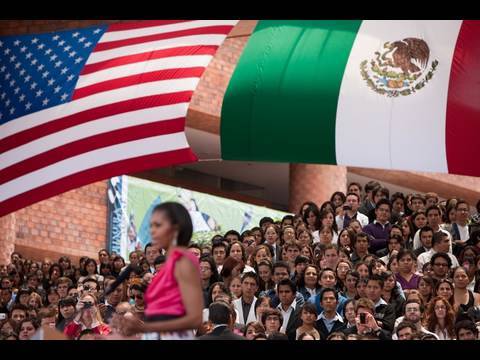
Jesuit University In Mexico Offers "Unique" Forum

Michele Obama at Universidad Iberoamericana
I offered to organize a Forum of Intergenerational Discussion on S@xual Health at the private Jesuit University where I study Psychology: the Universidad Iberoamericana in Mexico City. The institution was interested in, and accepted to house, the Forum. After weeks of organization, it took place on Friday September 3rd, one day before the World S@xual Health Day. The Forum began with a message delivered by Patricia Uribe, Director of the National Center of Gender Equality and Reproductive Health. Later, Eusebio Rubio (Past President of the WAS) introduced the concepts of “s@xual health” and “s@xual rights,” Esther Corona (Executive Coordinator of the WAS) explained the global panorama of the World Sexual Health Day and Nadine talked about the activities in Mexico. The intergenerational discussion began with the tremendously smart and funny intervention of Guadalupe Loaeza, one of Mexico’s most popular writers. She told her “s@xual autobiography," which began decades ago, when she was expelled from a religious middle school after telling her classmates about “the way babies are made." 
Link (here) to read the full blog post

Sunday, September 19, 2010

Blessed Miguel Pro, S.J. And Graham Greene

Graham Green
Baxter recalls making a find quite unexpectedly at the famous antiquarian bookstore, Maggs. They had only a few Greene editions of note. One in particular caught Baxter’s attention: an inscribed first edition of  The Lawless Roads without a dustwrapper for 150 pounds.
It wasn’t a very collectible item and without the dust jacket worth even less. But Baxter, now fully into Graham Greene, spotted something the bookshop had missed. It was dedicated, in that spidery Greene hand to the Jesuit priest (Fr. Miguel Pro) the author had dedicated “The Power and The Glory”   (here) to, making it at once precious.
Baxter snapped it up. 
Link (here) to Deccan Herald 
.
An excerpt to Graham Green's prologue in the book entitled, The Lawless Roads.
Blessed Miguel Pro, S.J.
In July 1926, Father Miguel Pro landed at Veracruz. He was twenty-five years old and a Jesuit. He came back to his own country from a foreign seminary much as Campion returned to England from Douai. We know how he was dressed when a year and a half later he came out into the prison yard to be shot, and he may well have worn the same disguise when he landed (the equivalent of Campion's doublet and hose): a dark lounge suit, soft collar and tie, a bright cardigan. Most priests wear their mufti with a kind of uneasiness, but Pro was a good actor. He needed to be. Within two months of Pro's landing, President Calles had begun the fiercest persecution of religion anywhere since the reign of Elizabeth. The churches were closed, Mass had to be said secretly in private houses, to administer the Sacraments was a serious offence. Nevertheless, Pro gave Communion daily to some three hundred people, confessions were heard in half-built houses in darkness, retreats 'were held in garages. Pro escaped the plain-clothes police again and again. Once he found them at the entrance to a house where he was supposed to say Mass; he posed as a police officer, showing an imaginary badge and remarking, 'There's a cat bagged in here', and passed into the house and out again with his cassock under his arm. Followed by detectives when he left a Catholic house and with only fifty yards' start, he disappeared altogether from their sight round a corner - the only man they overtook was a lover out with his girl. The prisons were filling up, priests were being shot, yet on three successive first Fridays Pro gave the Sacrament to nine hundred, thirteen hundred, and fifteen hundred people
Link (here) to the full prologue on St. Miguel Pro, S.J. 

Friday, July 30, 2010

South Of The Border

In fluent English, Hernandez explained how he had been stopped by U.S. immigration inspectors at the border at Tijuana as he returned home from a trip to his native state of Veracruz in east-central Mexico for his great-grandfather's funeral. Instead of being at work in Seattle, Hernandez was among about 75 men having a hearty breakfast at the "comedor," or dining room, run by the Kino Border Initiative, a collaborative effort of the Jesuit provinces of California and Mexico, the Diocese of Tucson, Ariz., the Archdiocese of Hermosillo, Mexico, Jesuit Refugee Service and the Missionary Sisters of the Eucharist.
Link (here) to the full article at The Tidings

Monday, June 21, 2010

PRODH

"PRODH was founded in 1988 by members of the Society of Jesus in Mexico, as a response to the climate of increasing state repression against social activists, Church leaders and political dissidents. The Jesuits created this centre as a means of fighting for the human rights of the general population, which at that particular time, was experiencing great suffering under an authoritarian regime.
Link (here)

Thursday, January 28, 2010

Jesuits Bring The Devotion Of Our Lady Of Guadalupe To Northern Italy

The devotion to the Madonna of Guadalupe, to whom the inhabitants of Santo Stefano have erected a statue on the nearby Mount Maggiorasca, has had a great historical and religious relevance for centuries. In 1531 the Virgin appeared at Guadalupe, a small town near the City of Mexico to a religious native, and successive appearances gave the story credibility.
The devotion of the Madonna quickly spread, not only in Mexico and South America, but also in Spain and subsequently in Italy. In 1802, an image of Our Lady of Guadalupe was exhibited in the church of S. Pietro, Piacenza by some Jesuit priests. An inhabitant of Santo Stefano, Antonio Domenico Rossi, who was in Piacenza at the time, brought a sacred image of the Virgin back to Val d'Aveto.
The devotion spread to the d'Aveto population and became celebrated among the faithful. In 1811, Cardinal Giuseppe Doria donated the beautiful picture (go here >) (that is still venerated today) to his church and parish of Santo Stefano. The painting depicts the Virgin with dark hair with her face leaning towards her right shoulder, standing with her hands joined in prayer. The King of Spain had donated the icon to Andrea Doria. Before becoming property of the Doria Palace in Genoa, it was said to have been carried aboard a galley during the battle of Lepanto.

Link (here) to the original PDF located on the upper left hand quarter of page 31

Tuesday, September 15, 2009

The Former Jesuit College Of San Luis Gonzaga In Zacatecas, Mexico


The outstanding Museo Pedro Coronel is named for the local painter and sculptor who died in 1985 leaving behind an art collection that's now housed in a 17th century mansion which used to be the Jesuit, St. Gonzaga College. The museum is impressive for its big names (Picasso, Chagall, Miró), its diversity (art from Tibet, Africa, Nepal, and pre-Hispanic Mexico) and its humility.

Link (here)

More pictures (here)

Map (here)

Wednesday, July 1, 2009

Slovenian Jesuit

There is also a proud, if seldom known, record of contributions made to America by Slovenian missionaries. Mark Anton Kappus, a Slovenian-born Jesuit missionary, scholar, and superior of Jesuit missions in the enormous territory of Sonora and Pimeria Alta in northern Mexico and southern Arizona, came to America in 1687 and returned to Europe in 1701 to report that California was not an island, as it then had been generally believed.

Link (here)

Tuesday, June 9, 2009

The Mexican Jesuits Tried To Pirate Brother Kamel

Father Horacio de la Costa’s book The Jesuits in the Philippines on page 440 mentions the additional difficulty that those men found in Mexico and the Philippines. He quotes a letter by Father Adam Kahl (hispanized as Adam Kaller).

Two of the Bohemian Jesuits were well-known. One was Father Pablo Clein (Paulus Klein), rector of the Jesuit college in Manila, and the spiritual director and protector of Mother Ignacia del Espiritu Santo, knowns as the foundress of the RVM Sisters. Father Clein should really be given the credit, at least as co-founder, but the RVM refuse to recognize that fact. He was born in Eger, Bohemia, 1652, and arrived in the Philippines as a priest in 1678. Father de la Costa did not know where and when he died.

More famous was the lay brother Jorge Camel (George Kamel), born in Brun, Moravia, 1661. He arrived in Manila 1687 and died in Manila 1706. He was a botanist and as infirmarian in the Jesuit college, he discovered medical properties in several plants. His articles written in Latin were published in London in the bulletin of the royal society. It was in his honor that the greatest botanist, Carl Linnaeus, named the camelia flower.

In Cordova, Argentina, the Jesuit church has a roof like an inverted keel. I was told that the brother who built the church had been connected with shipbuilding in Flanders.

Father de la Costa on that same page 440 mentions that the Mexican Jesuits tried to pirate Brother Kamel on the latter’s way to the Philippines. They recognized his skill as a botanist.

Link (here)

Friday, April 17, 2009

Jesuitly Overwhelming

Standing in the church of St Francis Xavier Catholic Church the former Jesuit seminary at Tepotzotlén, Mexico, the eye is dazzled by a seething mass of elaborate wood-carved ornament, coated in flashy gold leaf. Ledges project from the riot of scrolls, pilasters and acanthus-leaves, supporting brightly painted statues of the Holy Family and Roman Catholic saints. These are early 18-century altarpieces, five of them, reaching from floor to ceiling and dominating the church interior. The effect is overwhelming.

Link (here)

More (stunning link) (here)

Monday, February 23, 2009

Padre Miguel Agustin Pro, S.J.


Loyola Producciones presenta la pelicula que narra la vida de
Miguel Agustín Pro, Sacerdote Jesuita.

Translation.
Loyola Productions presents the film tells the
life of Miguel Agustin Pro, Jesuit Priest.

Link (here) to the video in Spanish at Gloria TV

Friday, February 20, 2009

Swedish Jesuit And Others On The Various Forms Of Secularism

Secularism and other Enlightenment ideals. The ideal of secularism can be briefly summarised as holding that the best course of action in politics and other civic fields is that which flows from disparate groups’ and religions’ common understanding of the “good”. By implication, Church and State should be separated, and the laws of the state should generally only cover the “common ground” of beliefs between the various religious groups that might be present — for example the prohibition of murder, etc.
From the secularists’ point of view, it was possible to distinguish between political ideas and structures that were religious and those that were not. Catholic theologians in the mainstream argued that such a distinction was not possible, that all aspects of society had to be organized with the final goal of heaven in mind.
This was a direct counter to the thread of Humanism that had been in the forefront of intellectual thought since the Renaissance and the Scientific Revolution. The roots of secularism they traced to those English philosophers who attempted to create a “universal religion” based on the “common denominator” of all other religions; it was largely spread through the secret societies of the Enlightenment, including the Freemasons, the Illuminati, and the Carbonari, and its greatest threat, in the writings of this school, was the spectre of Democracy.
Link (here)


An interesting book excerpt on the subject from Malachi Martin's,
The Jesuits
(here)

In a Very Secular France, Nicolas Sarkozy Is Breaking a Taboo

By Sandro Magister
.
An excerpt.
In Sweden, Germany, and France – the most secularized areas of Europe – there would seem to be signs of “a reversal of this tendency, with growing interest in religious matters.”

These words were written in regard to Sweden by Jesuit Fr. Ulf Jonsson, professor of philosophy at the University of Uppsala, in an article published in the May 6, 2006 edition of “La Civiltà Cattolica,” the authoritative Jesuit magazine printed with the prior scrutiny of the Vatican authorities.

In the article, entitled “Nuove prospettive per la religione in Svezia? [New prospects for religion in Sweden?],” Jonsson documents that “in spite of the fact that the number of participants at religious ceremonies is still very low, there is renewed attention to religion, and to Christianity in particular, in the media and public opinion: this was unthinkable in the past, when religion was relegated to the private sphere.”

Link (here)

The next time you hear that Religion caused “X” amount of violence, remind them the 20th century was the age of secularism, and the bloodiest age of human history. It was not a coincidence

Link (here)

A Jesuit victim of extremist Secularism was Blessed Miguel Pro, S.J.


Secularists for love of religion

By Joseph Cardinal Ratzinger

An excerpt.

American society was built in great part by groups that had fled from the system of state Churches in place in Europe, and had found their own religious accommodation in free communities of faith outside of the state Church.
The foundation of American society is therefore constituted by the free Churches, for which – because of their religious approach – it is essential that they not be state Churches, but founded on a free union of individuals.
In this sense, one can say that at the basis of American society there is a separation between state and Church that is determined, even demanded by religion; a separation, therefore, that is motivated and structured quite differently in comparison with the one imposed, under the banner of conflict, by the French Revolution and by the systems that followed it.
The state in America is nothing other than the free space for different religious communities; it is in its nature to recognize these communities in their particularity and in their non-statal identity, and to let them live.
It is a separation that intends to let religion be itself, that respects and protects its vital space distinguished from the state and from its ordinances, it is a separation conceived of positively.

Link (here)

Tuesday, February 10, 2009

The Mission of San Ignacio


The Mission of San Ignacio is a simple 18th-century Jesuit church about three miles east of Creel; nearby are several Tarahumara settlements, notably in the Valle de los Ranas (Valley of the Frogs) at the Cueva de Sebastián (Sebastian’s Cave).
Link (here)

Wednesday, January 14, 2009

Spanish For All Saints: The Todas Santos 18th Jesuit Mission In Mexico

Todos Santos (not to be confused with the surfers' island off the coast of Ensenada) scribbled itself onto several pages in my notebook as I explored more of the area than necessary for my Baja assignment. The history fascinated me. Attracted by the two substantial pozas (natural springs) fed by underground rivers that originated in the Sierra de la Laguna, Jesuit padres had established a farm community and chapel called Todos Santos ("All Saints") here in 1724 to supply the mission community at La Paz with fruits, vegetables, wine and sugar cane. By 1731, Todos Santos was producing 200 burro-loads of panocha--raw brown sugar--annually, along with figs, pomegranates, citrus and grapes.

Two years later, Father Sigismundo Taraval founded Misi-n Santa Rosa de las Palmas at the upper end of the arroyo a bit more than a mile inland from the Pacific. By the mid-1700s, Todos Santos had outgrown La Paz. The town, renamed Nuestra Se-ora del Pilar de Todos Santos in 1749, remained an important mission settlement until secularization in 1840. Anglo whalers visiting Todos Santos in 1849 praised the town as "an oasis" with "friendly and intelligent people." In the post-mission era, Todos Santos thrived as Baja's sugar cane capital, supporting eight sugar mills by the late 1800s.

Link (here)

Photo is of Todos Santos Mission