Showing posts with label German Jesuit. Show all posts

Monday, April 28, 2014

Fr. Otto Pies, S.J., "The Most Admirable Priest-Rogue" In The Dachau Concentration Camp

The most admirable priest-rogue was a Jesuit former master of novices named Otto Pies. Released from Dachau in the Spring of 1945 as the Americans were advancing, 
he disguised himself as an S.S. officer and came back to the camp with a truckload of food - rousted God knows where in those bitterly foodless days. He drove into the camp, into the priests' wired-off compound, and then drove off with 30 of the priests hidden in the back. 
Two days later, when 5,400 prisoners - 88 of them priests - were led off into the Alps to be lost in the snow, Otto Pies came back in the same uniform and truck and picked up more.
Link (here)

Sunday, March 23, 2014

I Think That Is What Pope Francis Wants Too

Fr. Martin Maier, S.J.
Fr Martin Maier SJ gave the address, which received a rousing clap at the conclusion from the congregation. He said of Romero that, “the heart of Romero’s spirituality and his pastoral action was the Option for the Poor”, adding that “it is also at the heart of Pope Francis’ spirituality”. Fr Maier felt the key insight of Romero was “conversion to the poor, and I think that is what Pope Francis wants too”. A German Jesuit and liberation theologian, he spent many years in El Salvador, and continued serving while persecution was strife. He continues to visit El Salvador, including teaching a theology course and ministering at the weekends at the same parish where he was originally a parish priest.
Amongst the people at the service who knew Archbishop Romero personally was El Salvador’s Ambassador to Britain, Werner Matias Romero. In a word of thanks at the end he reported that, “in an exciting year 2014 for El Salvador, where we went to the polls twice and elected a new president, I am hopeful that Archbishop Romero will continue to be our inspiration”.
There had been bidding prayers for El Salvador and for trouble spots of the world, particularly Syria and the Middle East, the Ukraine and the Russian Federation. Also, there were prayers for the work of the Archbishop Romero Trust and the ministry of the Church of St Martin in the Fields in favour of the poor and dispossessed.
Link (here)

Tuesday, January 21, 2014

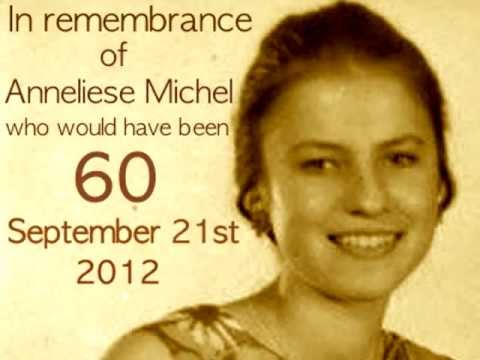
German Jesuit At The Center Of "Anneliese Michel Exorcism"

"In November 1972 Anneliese Michel, a young student at the University of Wurzburg, West Germany, was taken by her parents to see the parish priest in her hometown of Klimgenberg. She had developed some worrisome signs of abnormal behavior at the university-refusing to eat, flying into violent rages, screaming, and trying to attack those around her-and her parents were deeply concerned. In the priest's view, Anneliese was possessed by demons, and he recommended a ritual exorcism.
As Roman Catholic procedure requires, the case was investigated by a leading authority on exorcism and demonic possession, Father Adolf Rodewyk, an 81-year-old Jesuit. Father Rodewyk agreed with the priest’s diagnosis, and on his recommendation the regional bishop, Father Josef Stangl, gave permission for the exorcism to take place. The exorcists chosen for the task were the Reverend Arnold Renz and the Reverend Ernst Alt. 
By then Anneliese had been receiving medical treatment for epilepsy for four years. On July 1, 1976, after several months of exorcism, Anneliese died of malnutrition and dehydration at the age of 23. She weighed 70 pounds. On march 2 1987, the two exorcists and Anneliese’s parents were charged of negligent homicide, on the grounds that they had allowed the girls death without seeking medical help for her. Bishop Stangl, and Father Rodewyk, who seem not to have known that medical was being withheld, were not charged. In April 1978 the two priests were found guilty and were given suspended prison sentences of six months. For the Roman Catholic Church, the death of Anneliese Michel was a nightmare come true, demonstrating the dangers inherent in the ritual of exorcism and the murky distinctions between priestly and medical responsibility.
In Father Rodewyk’s own handbook on possession and exorcism, originally published in 1963 and translated into English under the title Possessed by Satan, priests are urged to consider medical explanations for apparent possession. One section of the book, in fact is titled “ Lets not Always Think of Possession!” Father Rodewyk, outlining the bishop’s responsibilities says that he “may appoint a commission of theologians and physicians to undertake a further investigation” and warns that the exorcists “Must guard against playing the role of physician when encountering physiological symptoms.” He quotes the authoritative Roman Ritual (of exorcism): “ The exorcist should avoid giving or recommending any sort of medication to the possessed; that is the physician’s task.” 
Although such statements clearly suggest that physician may sometimes be needed before and during an exorcism, there is no stipulation that a doctor must be in attendance. This deficiency in church procedure was corrected, at least in Germany, after the conviction of the two priests in the Michel case. In May 1978 the German Bishops’ Conference ruled that in future no exorcisms would be permitted unless a doctor was present.
Link (here)

"The Mysteries of the Unexplained" (Printed in 1990)

This story is the basis of the movie entitled, The Exorcism of Emily Rose.
Saint Ignatius of Loyola, "An enemy of the dark spirit" (here) 

Tuesday, June 18, 2013

Fr. Karl Rahner, S.J., " Happy 75th Birthday Martin Heidegger"

Fr. Karl Rahner, S.J. sends a "Happy Birthday" message to his former philosophy professor and NAZI sympathizer Martin Heidegger. Listen to it in German (here)

Karl Rahner, S.J, On The Issue Of The "Unchangeable" Teachings

In 1948-9 Karl Rahner, S.J. returned to the theology faculty at Innsbruck and taught on a wide variety of topics which were to become the essays published in Schriften zur Theologie (Theological Investigations). The Investigations is not a systematic presentation of Rahner’s views, but, rather, is a diverse collection of essays on theological topics characterized by his probing, questioning search for truth. 
Rahner was to develop difficulties with Rome. His outspoken, frank approach to issues and his creative, challenging and non-traditional approach to theology often got him into trouble with the authorities who tended to be more traditionally minded, especially on the issue of the "unchangeable" teachings of the Catholic Church. 
In 1962, however, with no prior warning Rahner’s superiors in the Order told him that he was under Roman pre-censorship, which meant that he could not publish or lecture without prior permission. The basic objections of the Roman authorities focused, essentially, on Rahner’s views on the eucharist and Mariology.
Link (here) to the Boston University website

Friday, May 24, 2013

Pope Francis A Great Encouragement

Head of the Progressive Front coalition (FAP in Spanish) Hermes Binner met with Pope Francis at the end “Here and there” by German Jesuit Florian Paucke who lived in the province of Santa Fe, run by Binner from 2007-201, during the 18th century. Following the meeting with the Pope, FAP’s head granted an interwiew to Argentina’s media saying that Bergoglio's election to lead the world’s 1.2 billion Catholics “is a great encouragement for the Argentine society.” Although not a Catholic himself, Binner -who will be running for office in October’s legislative elections-, considered the pontiff an example for peace and a proof that Argentina can “come up” with “strong leaderships.” After St. Peter’s audience, Francis’ agenda included also receiving governor of the province of Chacho, kirchnerite Jorge Capitanich who said the Pope sent his blessing to all Chaco’s people.
of the weekly general audience in St Peter's square at the Vatican. The socialist leader handed ex Argentine cardinal Jorge Mario Bergoglio a copy of the book
Link (here) to the Buenos Aires Herald

Thursday, May 23, 2013

Catholics Seem To Have Forgotten How Greatly The Protestants Feared The Jesuits

Hammer of Heretics
John Donne, as Protestant controversialist, singled out the Jesuits for special opposition in Ignatius His Conclave. Now that the religious controversies of the Reformation and Counter-Reformation are largely submerged in an ocean of indifference, even Catholics seem to have forgotten how greatly the Protestants feared the Jesuits.   The dread of Jesuit sophistication is well expressed, in Edmund Spenser’s Faerie Queene, when Errour vomits forth literature:
Therewith she spewed out of her filthy maw
A flood of poison horrible and black,
Full of great lumps of flesh and gobbets raw
Which stunk so vilely, that it forced him slack
His grasping hold, and from her turn him back:
Her vomit full of books and papers was,
With loathly frogs and toads, which eyes did lack.
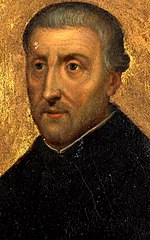
When St. Robert Southwell arrived in England in 1586, intercepted communications identified him only as Robertus.  Elizabethan authorities took the newcomer for elder Jesuit Robert Parsons—and were terrified at the very thought of the Catholic havoc he might cause.  St. Peter Canisius was feared throughout the German-speaking world as the Catholic “Hammer of Heretics.”  And he did hammer them, too.
Link (here) to Crisis Magazine to read the full article.

Monday, February 18, 2013

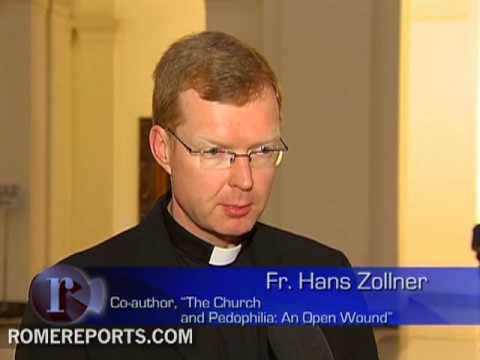
Fr. Hans Zollner, S.J., "He Gave A Brilliant Talk Which Took Many Of Us By Surprise Because Of Its Openness"

As prefect of the Congregation for the Doctrine of the Faith got in the way. It was so opposite to who Pope Benedict really is. Whoever has worked with him, whoever has encountered him personally, as we did two weeks ago when we presented the proceedings of the symposium to him, knows that he’s the most humble, most sensitive person. He’s very much aware of who’s in front of him, so he really takes the individual into account. That’s so contrary to the public image of the “panzer cardinal” and so on … a very rigid, conservative person. He has his convictions, but he’s much more open-minded.
He encountered the Jesuit professors here at the Gregorian in 2006, and he made a statement that was so profoundly encouraging to develop theology. I was there in 2008 when he addressed the Jesuit General Congregation members, made up of 220 Jesuits, and some of them were fairly apprehensive. 
He gave a brilliant talk which took many of us by surprise because of its openness, and its deep understanding of the needs of the church today. He praised Fr. [Pedro] Arrupe, he praised our work for social justice, he gave credit to the Jesuit Refugee Service, he singled out the pioneering work of dialogue with culture of Matteo Ricci, and he called us to go to the frontiers, acknowledging that going there means being at the edge, in difficulties, and not always having the right answer. It was both deeply consoling and challenging. The public image and the reality are just so different. For instance, bishops with a story of scandals, most of them personal, have been asked to step down. That’s happened in Europe, in Latin America, in Africa, and in other places.
Link (here) to National Catholic Fishwrap to read the full interview of Fr. Hans Zollner, S.J.

Thursday, January 17, 2013

Regardless Whether It Is In The Hands Of Hitler Or A Jesuit Priest

"This war is not against Hitler or National Socialism but against the strength of the German people, which is to be smashed once and for all, regardless whether it is in the hands of Hitler 
or a Jesuit priest." 

Tuesday, October 16, 2012

Planets

Fr. Karl Rahner, S.J.
Karl Rahner lived on two different planets. Yet the Jesuit theologian’s analysis was virtually identical. “We are at the beginning of the little flock,” Rahner said in his book The Shape of the Church to Come (Crossroad), published around the same time. Rahner, however, adds a crucial warning. The “little flock” does not mean “little sect.” The little flock is called to profess the Christian faith and the cross, not to defend “cozy traditionalism and stale pseudo-orthodoxy,” not to live “in fear of modern society.”
Link (here) to the US Catholic

Wednesday, August 1, 2012

Radical New Interpretation Of St. Thomas Aquinas

"holed up in the Vatican armed with some Swiss Guard halberds to await the coming collapse of the modern world."
Further to the right are the fundamentalist vigilantes who each week fill the pages of the National Catholic Register with field reports on what they call the “guerrilla warfare” that faithless liberal theologians are waging against the Pope—the fifth column theory. Then there are those who denounce the treacherous betrayal of the Church by none other than the Pope himself, Paul VI, who intentionally let communist moles into the Vatican—the Antichrist theory popularized by the former Jesuit Malachi Martin. These Catholic survivalists seem to believe they have no choice but to hole up in the Vatican armed with some Swiss Guard halberds to await the coming collapse of the modern world.1 
 What separates Karl Rahner from even the most intelligent of conservative Catholic theologians and what makes his thought so radically innovative lies not primarily in his theology but in his philosophy, the theory of knowledge and being that he forged in the Thirties while studying under Martin Heidegger. In the spring of 1934, just two years after becoming a Jesuit priest, Rahner registered for a doctorate in philosophy at the University of Freiburg, and over the next four semesters he attended virtually every lecture course and seminar that Heidegger gave. He was in the classroom when Heidegger echoed Nietzsche’s condemnation of Christianity as “Platonism for the masses” and when he asserted that “a faith that does not constantly expose itself to the possibility of unfaith is no faith at all but a mere convenience.” The effect of Heidegger’s teaching was overwhelming. Thirty years later Rahner would remark that “although I had many good professors in the classroom, there is only one whom I can revere as my teacher, and he is Martin Heidegger.” 
The experience proved to be an academic disaster for Rahner. In the spring of 1936 he presented as his doctoral dissertation a radical new interpretation of Aquinas’s theory of knowledge from the viewpoint of Heidegger—and he was promptly flunked by the conservative Thomistic philosopher, Martin Honecker, who was his dissertation director. Rahner withdrew from philosophy and eventually took his PhD in theology. Nonetheless the would-be dissertation was published in 1939 as Geist in Welt (Spirit in the World) and was immediately and immensely successful. The book reshaped the foundations of the Thomistic theory of knowledge and being, and it provided the groundwork—as much Heideggerian as Thomistic—for the new theology that Rahner has continued to pour forth since the end of World War II. 2
Link (here) to read the full article at NYBooks

Friday, July 6, 2012

Fr. Karl Rahner, S.J. Verses The Real Presence

Fr. Karl Rahner, S.J.
In the sixteenth century the rise of Protestantism produced a crisis of faith in the Catholic Church. Whole nations were lost to the Catholic Faith mainly because Catholic leaders especially bishops and theologians were seduced by the so-called reformers. There never was a Protestant reformation, that is in plain Anglo-Saxon a lie, there was only a Protestant rebellion.
Thank God there was a Catholic reformation. Reformers like Teresa of Avila, John of the Cross, Ignatius Loyola – that is what the Church needs today. Dear Lord how she needs these saintly courageous reformers today. These bishops and theologians, I am now speaking of the sixteenth century, denied that Christ had instituted the Sacrament of Holy Orders and thus conferred upon priests the power to change bread and wine into His own body and blood, and this is the heart of the crisis in the Catholic church today. It is the sixth Chapter of Saint John’s Gospel but now on a global scale.
Pope Paul VI uses two words to summarize this Eucharist Crisis, they are transignification and transfinalization. These terms are a synthesis of the widespread radical ideas pervading once Catholic circles as we enter the third millennium – how well I know. What I will do now is identify the two principal leaders of this devastating Eucharistic error. The error of transignification. This is the view that Christ’s presence in the Eucharist means when the consecration at Mass is performed only a change of meaning or significance of the bread and wine takes place. Their substance do not change only a change of meaning or significance of the bread and wine takes place their substance does not change. The consecrated elements are said to signify all that Christians associate with the Last Supper. The bread and wine acquire a higher meaning than merely food for the body. But they remain bread and wine. 
We get some idea of how deeply this error has penetrated Catholic thought, when we read what Karl Rahner writes about the Eucharistic consecration. Rahner therefore is the first of the two master teachers of profound error on the Real Presence. I will quote now from Rahner’s language, not always so clear, I chose the clearest part that I could find. Quote Karl Rahner, “the more recent approaches suggest the following considerations, one has to remember that the words of institution indicate a change. But not give any guiding line for the interpretation of the actual process. As regarding transubstantiation it may be said, the substance, essence, meaning and purpose of the bread are identical but the meaning of a thing can be changed without changing the matter. The meaning of the bread has been changed through the consecration something which served profane use now becomes the dwelling place and the symbol of Christ who is present and gives Himself to His own.” unquote Karl Rahner. 
 From the Encyclopedia of Theology edited by Rahner and defining the meaning of transubstantiation. What takes place through the Eucharistic consecration the significance the meaning attached to the bread changes but the bread remains bread. Rahner’s ideas are permeating the Eucharistic theology of whole nations.
Link (here) to read the full talk by Fr. John A Hardon, S.J.

Tuesday, June 19, 2012

Avant Garde Statement

Fr. Karl Rahner, S.J
Catholic theologians of note were making statements that went far beyond anything said in the aula of St. Peter’s. Fr. Jean Danielou, S.J., expressed himself as being in favor of the ordination of deaconesses “without delay and therefore before the end of the Council.” Avant garde as his statement may seem, it was not made in a theological vacuum. In 1962 Fr. Haye van der Meer, S.J., with Fr. Karl Rahner as his mentor, completed a doctoral thesis at Innsbruck titled “Theologische Uberlegungen uber die Thesis: subiectum ordinationis solus est mas” (“Theological Reflections on the Thesis: the male alone is fit for ordination”). The author considers the usual arguments for excluding women from ordination — arguments from Scripture and traditional theology — and concludes that there is no valid reason for continuing the exclusion. Moreover, he claims that Canon 968, Section 1, limiting ordination to a vir baptizatus, requires clarification. The canon has ordinarily been interpreted as forbidding the ordination of women, but it seems more likely that what it forbids is the ordination of non-baptizatus. Thus ordination of a femina baptizata was never contemplated by the framers of the canon; so they could scarcely have intended to legislate against it.

At about the same time that Fr. van der Meer was working on his dissertation in Innsbruck another Jesuit, Jose Idigoras, was pursuing a similar investigation at the Catholic University in Lima, Peru. Adapted excerpts from his doctoral thesis, “La Mujer dentro del Orden Sagrado” (“Woman in Relation to Holy Ordination”), were printed in the widely circulated Informations Catholiques Internationales in 1963 and 1965. Idigoras also examines the usual antifeminine arguments and, like van der Meer, concludes that the church not only may but must admit women to orders if it is to be true to the gospel and to St. Paul’s obviously doctrinal statement (opposed to the discriminatory disciplinary statements) that in Christ “there is neither male or female” (Gal. 3:28).

A North American, Fr. Charles R. Meyer of the Mundelein seminary faculty in the Chicago archdiocese, takes up in an article in a recent issue of Chicago Studies (excerpted in the popular Catholic Digest) the problem of whether, as Fr. Idigoras claims, some of St. Paul’s female assistants were genuinely ordained deaconesses — a problem which is crucial, since the Catholic Church regards admission to the diaconate as so related to ordination that women could not be capable of the diaconate unless they were also capable of the priesthood. Fr. Meyer’s study concludes:
We must, I think . . . admit that the theologians and canonists of our time have been . . . guilty of some dishonesty in treating the question of the ordination of women in the early Church. In their treatises on the matter there seems to be a selective presentation of the facts, if indeed any attempt at all is made to do other than merely repeat what their predecessors have said. . . . But the time for complete honesty is at hand . . . now theologians must make a careful and unprejudiced re-examination of the whole question. This is the least they can do.
Other theologians who have discussed this problem publicly are Fr. Hans Kung and Fr. George H. Tavard, who have said that they know of no valid theological objection to the ordination of women.
Link (here) to Womanpriests

Saturday, May 26, 2012

German Jesuit And Pigs

Schweine am Kreuz: Anzinger-Ausstellung
Father Friedhelm Mennekes SJ, founder and long-time director of the Art Station Sankt Peter has also commented to the newspaper about the cancelling of the exhibition. He pointed to the rich tradition of the crucifixion motif, to the derision that Christianity once had suffered through the representation of a crucified donkey, and also to the "Jewish pig" in Cologne Cathedral. All these elements played into Anzingers work- he himself had exhibited a butterfly crucified by Markus Lüpertz in St. Peter's. "I hope that the cancellation was not a case of anticipatory obedience to ecclesiastical authority," said Mennekes in conclusion. (Cathcon- no wonder the Jesuits are the worst hit of the orders after the Council. They were set up on army lines by St Ignatius with a specific oath of obedience to the Pope. Now they are a bunch of ecclesiastical anarchists no longer of capable of fighting)  It is precisely this fear Guido Schlimbach tried to dispel when talking to the "Kölner Stadt-Anzeiger" . The Art Station is after all not an art hall, but a house of God: "We derive life from the whole life of the community." A crucified pig in oil next to a crucifix is not easy in this context - and as Anzinger totally refused to compromise, the cancellation could not be avoided. "I'm sure," said Schlimbach, "Mennekes would not have put on the exhibition." (Cathcon- see his comments above which go in the opposite direction.)
Read the whole story at Catholic Church Conservation (here)

Saturday, February 18, 2012

The Bed Of Pestilence

In the same year the Plague, which decimated France, swept over Europe. It reached the Rhine. Scattering dismay, despair in every home, the exterminating angel sped apace—wailings in his ear, and shivering terror in his van. Men shunned each other: the ties of affection—the bonds of love, plighted or sworn, broke asunder: all fled from the bed of pestilence—except the Jesuits. At the call of their provincial, they came together; and at the same bidding they dispersed, and fronted the angel of death. In the pest-house kneeling—in the grave-yard digging—in the thoroughfares begging—the Jesuits con 
The Jesuits during the plague consoled the dying, buried the dead, and gathered alms for the living. Blessed be the hearts of these self-devoted men! They knew no peril but in shunning the awful danger.
 For humanity—and, through humanity, for God—be that the stirring trumpet, whose echoes are deeds too great to be estimated, too great to be rewarded by the gold of Mammon or the voice of Fame. 
And yet Jacques Cretineau-Joly, the last Jesuit historian, professing to copy " unpublished and authentic documents," bitterly tells us that "this charity of the Jesuits, by day and by night, gave to their Order a popular sanction, which dispensed with many others,"—and that "the people, having seen the Jesuits at their work, called for them, to reward them for the present, and solicited their presence, provident of the future." 
Was it then for the Order's glorification that, in obedience to the superior's command, such self-devotedness was displayed? Was it only to gain a "popular sanction?" God only knows! but the doubt once suggested, and that too by a strong partisan, troubles the heart. We would not willingly deprive these obedient visitors of the pest-stricken, buriers of the dead, and feeders of the living, of that hearty admiration which gushes forth, and scorns to think of motives when noble deeds are done. At least to the subordinate Children of Obedience be that admiration awarded, if we must doubt the existence of exalted motives in the Jesuit-automaton ; if we must remember that at Lyons the Plague gave them a college, and in Germany "a popular sanction."
Link (here) to A History of he Jesuits

Friday, January 27, 2012

Neither Amused Nor Shocked

On Monday evening in Hamburg, the controversial play "Golgotha Picnic" was performed in Germany. The SSPX has previously called for protests yesterday evening and had also called for a vigil outside the theater. According to the CBA the protest was attended by about 20 people, according to the "Star" magazine, there were 60 participants. Following the play there was a panel discussion at which the ministers who attended, a Catholic school rector, Jesuit, Father Hermann Breulmann. 
He was "neither amused nor shocked, but thoughtful," said the degreed philosopher of religion. "It was strong stuff, but I have found points where I can say, this piece has something." It raises questions and has an >>intensely deep grammar<<. If you have read Nietzsche, not all of its alienation from God is strange, said Breulmann. Actually it poses a question about all freedom of art, if the aesthetic of the piece has crossed any borders. I would not, however, characterize the play as blasphemous. 
"I would have thought that the Good Lord would have let things be cool," said the elderly Jesuit. Even Jesus said with his last words, "My God, why hast thou forsaken me?" since in the core that would not have been blasphemous, he did not agree with the criticisms leveled by the protesters.
Link to (here) Tancred and The Eponymous Flower

Tuesday, January 10, 2012

Fuchs’s New Rationale

Fr. Josef Fuchs, S.J.
One of the Pontifical Commission on Population, Family, and Birth-rate’s most able experts was Fr. Josef Fuchs, S.J., Professor of Moral Theology at the Gregorian University and a scholar whose earlier work Fr. John C. Ford, S.J. knew and respected. The previous spring Fuchs had declared that the Church had not taught on contraception in a way that precluded change. But although proponents of change had cast about for an argument that would win his support, he had not then been willing to say that the teaching was mistaken. Now, however, Fuchs had found a satisfying rationale for the moral acceptability of using contraceptives, and was prepared to say that the Church should change her teaching. The Commission’s other proponents of change, most of them not moral theologians, gladly embraced Fuchs’s new rationale.
Link (here) to Way of the Lord Jesus: Fr. John C Ford, S.J.

Tuesday, November 22, 2011

A Jesuit In Purgatory

Fr. James Pellentz, S.J.
One night the Voice made the Livingstons get up three times to pray for a certain soul in Purgatory. And when one of the girls began to think- "...after all the souls could have saved themselves and so they have deserved their pains! And besides the whole thing is exaggerated" when suddenly they all heard a voice shrieking: 
"Help! Help!" When asked what kind of help was needed it replied, "Prayers, for we are in excruciating torments!"
At that moment a human hand was burned into a nearby piece of clothing, leaving the spaces between the fingers not scorched. The entire family saw both the flame and the hand. Father Demetrius A. Gallitzin asked for and was given this extraordinary piece of clothing with the burnt hand impressed upon it, and later he often showed this "relic" while giving testimony to the supernatural events that occurred in the Livingston home. On another occasion the mystic Voice once asked Mr. Livingston to pray for three hours for the soul of a "Fr. Pellins" (Jesuit Father James Pellentz, S.J., Bishop Carroll's recently deceased Vicar-General).
Link (here) to the supernatural case of The Wizard Clip
What is Purgatory? (here)
Doctor of the Church St. Robert Bellarmine, S.J. on Purgatory (here) , (here) and (here)

Saturday, November 12, 2011

Suicidal Jesuit

A German priest belonging to the Society abandoned the Order, and passed into the service of the Archbishop of Treves. There it pleased God to afflict him with a contagious malady, so that he was shunned by every one, and would have been totally deserted, but for a poor old woman, who took compassion on him. Sometimes the violence of his sufferings caused him to fall senseless; and when, restored to himself, he reflected on his miserable condition, both of soul and body, despair took possession of his mind. His misery increased to such an extent, that one day he was about to put an end to his existence by cutting his throat, when the woman coming in, seized his hand, and got possession of the knife. But she could not prevent him from dashing himself from a window upon a heap of stones, where he was found bleeding and mangled, though still breathing 
Then God was pleased to touch the heart of this unfortunate man. and to enlighten him both as to his guilty life, and the criminal resolution which had led him to rush upon self-destruction. His courage revived; he invoked the holy Father whom he had abandoned, and made a vow to St. Ignatius, that if he recovered from the desperate situation in which he then was, he would go on foot to Rome, and throw himself at the feet of Father Francis Borgia, then Vicar General of the Order, and declaring his repentance, entreat that holy man to grant him the favor of re-admission into the Society; or if judged unworthy of this, permission to remain all his life as a servant, attached to the house. 
Whilst he made this promise, his face bathed with tears of repentance, he suddenly felt that he was cured, not only of the dreadful consequences of his fall, but also of the contagious malady which threatened him with approaching dissolution. He immediately set off for Rome, in company with Father Francis Cortero, to place himself under the authority of the General, and fulfil his vow.
Link (here) to the book entitled, History of the Life and Institute of St. Ignatius. 
Photo (here)

Tuesday, September 27, 2011

Lingering Effects Of The Berlin Jesuit High School Abuse Case

The protests contrast with the welcome Benedict received from hundreds of thousands of worshippers six years ago when he sailed down the River Rhine to Cologne on his first visit to Germany as pope.

Not everyone agrees with Catholic teaching on lifestyle issues and “in a free society this dissent must be allowed to express itself,” Robert Zollitsch, the head of the German Bishops’ Conference, said in Berlin yesterday. Yet some of the protests are “excessive.”

The first German pope since the 16th century was greeted by a front-page image adorning the headquarters of Axel Springer AG’s mass circulation Bild Zeitung published on April 20, 2005, the day after he was elected pontiff, saying: “We are Pope!”
‘Heinous Crime’

The Catholic Church in Germany has encountered a wave of allegations of sexual abuse by priests that emerged last year, beginning at an elite Jesuit high school in Berlin. Archbishop Zollitsch apologized to more than 100 pedophilia victims in February 2010 after Benedict called abuse a “heinous crime.”
Link (here) to Bloomberg.com