Saturday, August 25, 2007

The Jesuits and Sault Sainte Marie, Land Of The Hurons And Algonquins

Sault Sainte Marie
(SANCTAE-MARIAE-ORMENSIS)
Diocese erected by Decree of 16 September, 1904. It embraces the southern parts of the districts of Thunder Bay, Algoma, and Nipissing (i.e. between the height of land and the Lakes Superior Huron, and Nipissing. The Recollects were the first missionaries in the Nipissing region. Father Guillaume Poullain (1622) and Jacques de la Foyer (1624) spent a few months there and baptized several children on the point of death. However, Father Claude Pijart, a Jesuit, was the principal apostle of the Algonquins at Nipissing and around Georgian Bay. He devoted to their conversion nine years of indefatigable zeal (1641-50), being aided in his work by Father Charles Raymbault (1641-42), René Maynard (1641-44; 1648-50), Léonard Gareau (1644-46), Joseph Poncet (1646-50), Adrien Daran (1649-50). They were the first who preached the Gospel to the tribes of the Manitoulin Islands and Georgian Bay as far as Sault Sainte Marie. As early as 1641 Fathers Jogues and Raymbault had visited the latter place. The Jesuits established three missions in the midst of the Algonguins of this country: St-Esprit, St-Charles and St-Pierre. Their ministry was not altogether fruitless: travelling to Lake Nipigon, in 1667, Father Allouez found some of their neophytes who had stood firm in the Faith, although they had not seen a priest for nearly twenty years. The ruin of the Algonquin missions accompanied the destruction of the Huron nation. In 1668 the Jesuits founded the mission of Sault Sainte Marie. From this centre they evangelized the adjacent country, and pushed their apostolic expeditions as far as the regions of the Nipissirinians. Well-known among the apostles of this period are Fathers Gabriel Druillettes, Louis André, Henri Nouvel, and Pierre Bailloquet. In the beginning of the eighteenth century, the founding of Detroit caused the centre of the western missions to be transferred eastward; those of Georgian Bay were abandoned, being resumed only in 1836, when Rev. Jean Baptiste Proulx, a diocesan priest, settled in Manitoulin Island. In 1838 another secular priest, the zealous Father Pierz, founded the missions of Grand Portage, Michipicoton, etc. Hardly had the Jesuits returned to the country, when the evangelization of the savages of what is now New Ontario was entrusted to their care. In 1844 they replaced Father Proulx at Wikwemikong, founded Garden River in 1846, and two years later erected at Rivière aux Tourtes (Pigeon River), a mission which they transferred in 1849 to Fort William. From these different stations they bore the consolations of religion, not only to the Indians, but also to the miners and woodcutters scattered along the shores of Lakes Huron and Superior. Among the new missionaries Fathers Choné, Hanipaux, Duranquet, Hébert, and Baxter are to be mentioned. Read the full article (here)

Friday, August 24, 2007

Jesuits In Afganistan

The Jesuits find themselves back in Afghanistan after a centuries-long interval. The first to go there, Catalan Father Antonio Montserrat, went in 1581. Portuguese Jesuit Brother Bento de Goes stayed briefly in Kabul sometime later. Other Jesuits were there for a short time in the 18th century. In July 2003, Father D'Souza's predecessor, Father Lisbert D'Souza, sent four priests to explore the possibility of contributing to the nation's development after years of civil warfare and the ouster of the Taliban government in late 2001 by a U.S.-led coalition. Original article (here)

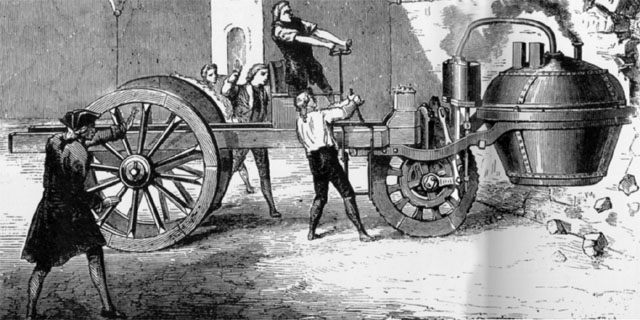
Fr. Ferdinand Verbiest, S.J. Inventor Of Steam Powered Trolley

The Jesuit missionary Ferdinand Verbiest who, around 1670, developed a small steam-powered trolley. Nicholas Joseph Cugnot certainly deserves a mention. In 1770 he built his farrier à vapeur (steam dray), a self-propelled artillery carriage for the French army. This hefty three-wheeler was certainly a car in the loosest sense; more significantly, it was involved in the world's first recorded car crash, when it ran out of control at its heady top speed of 2mph and demolished a wall. The farrier survives to this day.
Original article (here). New Advent article on Fr. Verbiest, S.J. (here)

The Cathedral Of St. Paul, Macau, Built By The Jesuits

The Ruins of St. Paul’s refer to the façade of what was originally the Church of Mater Dei built in 1602-1640 and the ruins of St. Paul’s College, which stood adjacent to the Church, both destroyed by fire in 1835. As a whole, the old Church of Mater Dei, St. Paul’s College and Mount Fortress were all Jesuit constructions and formed what can be perceived as the Macao’s “acropolis”. The façade of the Ruins of St. Paul’s measures 23 metres across and 25.5 metres high and is divided into five levels. Following the classical concept of divine ascension, the orders on the façade on each horizontal level evolve from Ionic, Corinthian and Composite, from the base upward. The upper levels gradually narrow into a triangular pediment at the top, which symbolizes the ultimate state of divine ascension - the Holy Spirit. The façade is mannerist in style carrying some distinctively oriental decorative motifs. The sculptured motifs of the façade include biblical images, mythological representations, Chinese characters, Japanese chrysanthemums, a Portuguese ship, several nautical motifs, Chinese lions, bronze statues with images of the founding Jesuit saints of the Company of Jesus and other elements that integrate influences from Europe, China and other parts of Asia, in an overall composition that reflects a fusion of world, regional and local influences. Nowadays, the façade of the Ruins of St. Paul’s functions symbolically as an altar to the city. The baroque/mannerist design of this granite façade is unique in China (as noted in UNESCO’s Atlas mundial de la arquitectura barroca). The Ruins of St. Paul’s are one of the finest examples of Macao’s outstanding universal value. Close by, the archaeological remains of the old College of St. Paul stand witness to what was the first western-style university in the Far East, with an elaborate academic programme that included Theology, Mathematics, Geography, Chinese, Portuguese, Latin, Astronomy and various other disciplines, preparing a significant number of missionaries to pursue Roman Catholic work in China, Japan and throughout the region. The missionary route followed by the Jesuits from Macao all over the region was crucial in facilitating the dissemination of Catholicism in China, Japan and other countries, also enabling a broader interchange in other scientific, artistic and cultural fields. Original post (here)

Thursday, August 23, 2007

Scholastic Daniel Hendrickson, S.J. "My Swami Said So!"

With a nod of his head to the left and a smile, my swami said, “Yes, well, God is hiding in you. Now come.” He was expounding a truth while ushering me to the door, concluding a last conversation of a short series of meetings through last spring’s academic semester.Originally from India’s Bengali region, Swami Aparananda is the proud pundit of The Vedanta Society of Berkeley, located not far from the University of California’s Sather Gate. Landscaped with lush colors, his compound seems like a quaint, well-kept mission preserved and presented by the state of California. The auditorium-like temple looks rather Western. Inside, moreover, padded chairs sit like pews in forward formation, facing what could pass easily as a Christian sanctuary. My saffron-wrapped swami will convince you otherwise, yet, pointing – as he did with me – to the centralized picture of another swami, Swami Vivekananda. This one preceded mine by a couple of generations and is responsible for what emerged as a network of Upanishadic, Vedantic places of study and worship in the western part of the world. These gurus and their Vedanta Society vie to share “the immortal teachings of the Upanishads” with curious people like you and I, and to make it easy they speak three truths.The first insists upon recognition of a supernatural force which underlies all reality. God is omnipresent and there is nothing his ubiquity does not pervade, you and I included. As God is present in all things of the world around us, God is also present in us, ideas not unfamiliar to practitioners of Jesuit spirituality. The second truth unfolds from the first. God’s presence within human life is hidden. A worthy goal for any of us, then, is to expose God. My swami told me that good moral behavior achieves this. Spiritual practices of prayer and mediation help, too. We can divulge the divine within and discover it of another alike. My swami said the third, professing that truth is universal. “We are all of one heart and one mind, yes?” Certainly not, I thought. Not in practice for sure, nor even theoretically: people are different. More on the Swami (here)

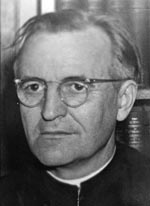
Brother André Marie On Fr. Leonard Feeney, S.J.,

A new blog called Brother André Marie’s Theology Blog, Brother Andre explores the idea's of Fr. Leonard Feeney, S.J. the former editor of America Magazine.

Father Leonard was a great proponent of the dictum, lex orandi est lex credendi (the law of praying is the law of believing); however, he always insisted on doctrine first. Without a solid doctrinal foundation, liturgy soon deteriorates into sheer aesthetics. Back in 1949, when the Archbishop of Boston obscured the single, clear path to salvation, a fracturing of the Church’s prayer life was sure to follow. And it did! Everything still looked perfect. 20,000 members of the Holy Name Society marched through Boston’s main thoroughfare; the Mass of Trent was the only Mass being offered; the parish churches were full and new ones being built all the time, but the Faith which held all this together was already slipping away. If the Faith were restored, we would have the right liturgy. Read more (here)

Brother Andre Marie's bio (here)

A native of New Orleans, Louisiana, Brother Andre Marie graduated from that city’s Holy Cross School in 1988. He went on to study at Louisiana State University’s (LSU) main campus in Baton Rouge, on full scholarship as a music major. After three years at LSU, he transferred to Holy Apostles College and Seminary, in Cromwell, Connecticut, where he took a Bachelor of Arts degree in Spring of 1993 (major in Humanities with a minor in Philosophy). He entered as a postulant for the Slaves of the Immaculate Heart of Mary in May of 1993, and went on to the novitiate on Christmas of that year. He made profession of vows on Epiphany of 1996. Since 1993, he was mentored in philosophy and theology by Brother Francis Maluf, M.I.C.M., Ph.D., a published philosopher of note. His apostolic work has included various facets of the publishing apostolate of the congregation. For ten years, he was also part of the community’s small “mission band” of brothers who traveled to different cities distributing literature to interested persons in an effort to spread the Catholic Faith and bring wayward Catholics back to a sacramental life. He oversaw that apostolate for four years. He has edited three of the Order’s books, published dozens of articles and presented numerous lectures in apologetics, the history of doctrine, the Church’s ecumenical councils, ecclesiology, and devotional topics.

Fr. Bill Brennan, S.J. "Does Peace, Mean Justice?'

Wisconsin Jesuit priest joins humanitarian caravan to Cuba
By Cheri Mantz
Catholic News Service
MILWAUKEE (CNS) -- In his 87 years, many memories have formed in Jesuit Father Bill Brennan's mind.An experience that he said changed his life took place in 1954 in Guatemala. While he was serving as a missionary in Honduras, his parents journeyed from Milwaukee to Honduras and he convinced them to travel to Guatemala to go sightseeing. However, the travelers didn't know that the U.S. CIA was beginning a coup against the elected government of Guatemala.While in the airport saying goodbye to his parents, Father Brennan said he heard a message from Guatemala's president over the public-address system that the Americans were invading."I didn't fully comprehend what was happening," said Father Brennan from his home at San Camillo in Wauwatosa. "It was a shock; there was the president of Guatemala condemning my country." Later, Father Brennan found out the reason for the invasion. Guatemala's president was attempting to buy back from local farmers land used to grow bananas. According to the priest, this was viewed as a communist act by the CIA.In July, Father Brennan traveled to Cuba as part of the Pastors for Peace caravan. The trip was made as an act of civil disobedience against the U.S. economic blockade of Cuba, and to deliver humanitarian and medical supplies to the Cuban people.Father Brennan feels strongly that Americans and Catholics should step in to help the people of Cuba. "A blockade is an act of war," he said. "(The United States) refusing to sell medication to a poor country is hardly an act of a good neighbor." The caravan of three buses and 140 people met in Texas. The buses carried passengers from the U.S., Canada, Germany and England into Mexico. They collected medication, wheelchairs, walkers, notebooks and bicycles along the way. The group flew from Mexico to Cuba and their supplies were shipped by boat.While the trip was not glamorous and included many hours on an uncomfortable bus,
Father Brennan said he plans to make it again next summer. "I'm going to go with the next caravan," he said."My goal is to have an ecumenical service at the tomb of Che Guevara. We really need much more Catholic participation in this." Pastors for Peace is made up mostly of Protestant ministers. Father Brennan is the only Catholic priest from the Milwaukee area who is involved.
He is a member of the Wisconsin Coalition to Normalize Relations With Cuba, which meets at Central United Methodist Church in Milwaukee. Father Brennan said the teachings of the Second Vatican Council inspired him to make the trip." In Vatican II, it said seeking justice in this world is an integral part of the Gospel," he explained. "How do you challenge the government? Say the rosary together? As a Catholic, what do you do? Jesus came to the poor; he did not have lunch with the governor." During the 10-day trip that Father Brennan described as a "nonviolent protest," participants visited medical clinics, an adult day-care center and homes for the elderly. They also attended the graduation of the first class of American doctors trained at the Latin American School of Medicine in Havana." The people were thrilled we were there," Father Brennan said of the Cuban people. "They're suffering. They're grateful; they know we're violating federal laws."  Father Brennan said he feels called to be more active in justice issues. "That experience in 1954 changed my life," he said. After working as a missionary in Belize and Honduras for 16 years, Father Brennan returned to the U.S. as a teacher at Marquette University High School and as pastor at St. Patrick Church in Milwaukee. He said Catholics should educate themselves about this situation. "It's a war process," he said. "Catholics should ask themselves why we are at war. Can we say this is a just war, that we're fighting atheistic communism? Castro was educated by the Jesuits."How do you explain not selling our medical treasures?" he continued. "Why are we punishing these people? As a Catholic I have to be concerned."

Wednesday, August 22, 2007

English Jesuits Extend Helping Hand To Ukrainiane Rite Catholics

The Jesuits of Farm Street in central London have come to the rescue of their Byzantine neighbours, after the ceiling of the latter's church in Duke Street collapsed. From 26 August, the 1,000-strong congregation of the Ukrainian Catholic Cathedral of the Holy Family in Exile - just off Oxford Street - will be temporarily worshipping at the Jesuit Church of the Immaculate Conception in Farm Street. Although the two churches belong to the same cluster of parishes, their styles of worship are quite different. The main Eucharistic service of the Byzantine rite is the Divine Liturgy of St John Chrysostom, which dates back to the fourth century and includes much ritual alongside hymns, prayers and readings. While repairs to the Ukrainian Cathedral ceiling are taking place, this service will be held at 1.45pm at Farm Street Church each Sunday.
Link to article (here)

Fr. Donald McGuire, S.J. A Disgrace

Priest faces suit in abuse claims
Man on probation for previous case
By Manya A. Brachear Tribune religion reporter
August 22, 2007

A prominent Jesuit priest convicted of molesting two Loyola Academy students during the 1960s was accused this week of abusing another boy as recently as 2003.In a lawsuit filed Tuesday, a 21-year-old college student says Rev. Donald McGuire molested him between 1999 and 2003 while the teen shared a bedroom with the priest in Canisius House, a Jesuit residence in Evanston. The suit accuses McGuire of abusing the boy in 12 states and six countries as he traveled the globe providing spiritual retreats. Read the full article (here)

Fr. James Schall, S.J. On The Latin Mass


Fr. Z does an excellent job in providing a magnification and illumination of Fr. James Schall's awsome article regarding his life long experience with the Latin Mass. Read it in total (here)


On September 14, the Feast of the Exaltation of the Holy Cross, Benedict’s
Motu Proprio takes effect. Any priest can then, if he wishes or is requested,
celebrate Mass in Latin according to the latest Tridentine Latin form. This
permission is not to be seen as somehow taking away something from those who
still prefer the vernacular, as no doubt many will prefer. While there are not a
few who look upon this decree as "conservative," or "back-going," I fail to see
why giving me the permission to say Mass in another language is somehow a
"narrowing" of my freedom. If I say you can say Mass in any language but French,
that does not expand but it narrows my liberty. The pope is not saying that
anyone "must" say or attend a Tridentine Mass, bur rather that if someone wants
to say or attend Mass in that form, well and good. If I can go to Mass any
Sunday in Spanish, as I can, why cannot I go in Latin, which is the remote
source of Spanish? [Bingo.]

Tuesday, August 21, 2007

St. Isaac Joques, S.J. 17th Century Missionary To The New World


Departure of the Jesuit
Jesuit priest, Isaac Jogues, is aided in his secret departure from the colony of Rensselaerswyck by sympathetic supporters in October of 1643, on the banks of the Hudson River.

Read more about Isaac Joques (here) and (here) .

Monday, August 20, 2007

Irish Jesuit, Fr. John Sullivan, S.J.

From the blog know as the Rationabile Obsequium Fr. B post on the great Irish Jesuit Fr. John Sullivan, S.J. Read it (here)

After becoming a Catholic there was a dramatic change in his lifestyle. He removed all material comforts from his room in Fitzwilliam Place. His ward-robe was changed drastically. From his reputation as one of 'the best-dressed men around Dublin', his clothes were of the simplest and plainest style.

He became a regular visitor to the Hospice for the Dying in Harold's Cross, Dublin. From this time onwards he was to become known for his devotion to the sick, to the poor and to anyone in need. This was to be part of the driving force for the rest of his life. And, as they say, the rest is history.
[...]

From the time of his arrival in Clongowes, he was always known as a friend to the poor and to anyone in need. His ministry radiated from the People's Church and he was usually to be found there, praying, unless he was away on some errand of mercy. His confessional became a haven of peace for many. Those who were ill sent for Father John. People had great faith in his prayers. He could bring comfort and peace where others failed. Why?

Beautiful Pictures Of Bom Gesu In India

In this post I will take you to Basilica of Bom Gesu (Jesus) located in South Goa. Located in old Goa this church was built in 1605. The church houses the sacred relics of St.Francis Xavier. The body of St. Francis Xavier is still fresh(incorruptable) in this church. This miraculous fact draws many visitors to this church every year. This church has now been declared as world heritage site.
See many great pictures
(here)

Jesuit College To End Discrimination, By Discriminating

Colleges offer financial aid to gain diversity in student body

By Kaitlynn Riely
Catholic News Service

WASHINGTON (CNS) -- For parents of college-age children, the start of a new school year may mean an empty wallet along with an empty nest.

According to The Chronicle of Higher Education, the median tuition at a four-year school was $7,490 for the 2006-07 school year. The figure includes private and state-run schools, some of which charge in-state students very low tuition.

The median tuition at private schools was $15,900, with the more expensive colleges costing more than $30,000 a year.

The numbers do not include room and board and other fees that can carry high price tags, such as textbook purchases and travel expenses.

The high cost of college has made it difficult for lower-income students to afford it. Most schools have some form of financial aid, and the government provides grants to needy students and will pay the interest on a student loan and defer payments for those who qualify financially.

But some Catholic schools are taking extra measures to help students better afford college tuition.

Dominican-run Providence College in Rhode Island, in an effort to attract minority and first-generation college students and to put less emphasis on test scores, has made submission of scores from SAT and ACT -- traditional college entrance exams -- optional.

Providence's incoming freshman class is the first that did not have to submit scores. Christopher Lydon, the school's associate vice president for admission and enrollment planning, said the reason behind it was to put into action the school's philosophy that grades and extracurricular activities matter more than test scores.

He said Providence also wanted to return to its original mission of making college a viable option for a new generation of immigrants. Lower-income students often cannot afford the hours of SAT-prep classes that their peers can take to get higher scores.

In the first year that Providence dropped the SAT requirement, applications swelled by about 1,000, Lydon told Catholic News Service in a telephone interview.

Within the pool of about 9,000 applicants for a class of 960 students, Lydon said there was greater cultural, ethnic and socioeconomic diversity than in years past. In the class of 2011, there was about a 36 percent increase in the number of students of African-American, Asian, Hispanic and American Indian heritage compared to the class of 2010.

Lydon said there was also an increase in the number of students enrolled whose parents had not gone to college, and a 70 percent increase in the number of students who were eligible for federal Pell grants given to low-income students.

This program is still in the test stages to see whether Providence can reliably select high school seniors -- without using SAT scores -- who will perform well the next four years, but Lydon said he was happy with the results of the first year. He emphasized that Providence was not watering down standards with this approach to admissions. Rather, he said, they had a higher percentage of students in the top 10 percent of their high school class this year than in previous years.

However, Lydon said, if a school's goal is to make college more accessible, it can't stop at admissions. To retain students, Lydon said, Providence has shifted money away from merit scholarships to need-based scholarships. About 65 percent of students at the school receive some sort of aid.

Similarly, the University of San Francisco is leading a group of Jesuit-run colleges with the same goal -- to increase the numbers of underrepresented students in their student bodies. The university is one of 16 Jesuit colleges across the country working together to discover the best ways to recruit and retain low-income, first-generation and ethnic minority students.

The Jesuit Network for Equitable Excellence in Higher Education, started in the fall of 2006 and financed by a grant from the Lumina Foundation for Education, has spent its first year discussing ways each school attracts and retains students in these groups.

Preston Walton, the project coordinator for the network, said making education available for students who normally would not consider it or could not afford it is part of the Jesuit mission. Providing more financial aid is one way the schools are working to make college an option for every student.

St. Mary's College of California, a school run by the Christian Brothers in Moraga, also puts a strong emphasis on financial aid. Michael Beseda, the vice provost for enrollment, said the school strives to have 25 percent of entering students eligible for Pell grants.

It's important that the school has students from all income levels and all backgrounds, Beseda told CNS.

"There's all kinds of research that shows that there are huge educational benefits to having a diverse student population," he said. "Students learn from one another."

And the promise of more available financial aid means the number of applicants to the college is up, he said, which gives admissions officers a bigger pool to choose from.

Approximately 70 percent of St. Mary's undergraduates receive some form of financial aid, he said.

Financial aid is not going just to students from low-income families, but also to middle-income families who find it difficult to pay the high costs of a college education.

"We try to make an education available to all those students," Beseda said.


Original article (here)

European Jesuit Archbishop Sigitas Tamkevicius SJ, Supports The Latin Mass

Traditional Latin Mass Returns to Lithuania
8/19/2007 - 08:39 PST

CHICAGO, IL - AUGUST 19, 2007 - Fr. Scott Haynes, S.J.C. offered the Tridentine Latin High Mass at the Shrine of Our Lady of Siluva on 8-11-07. This was the first time the Traditional Latin Mass was offered at there since the Communist Occupation of Lithuania. Participants of Ad Fontes, a study-week of Gregorian Chant for young people, sang Gregorian Chant and rededicated themselves to their Catholic faith.

After attending the High Mass, all received the blessing of Archbishop Sigitas Tamkevicius SJ, the Archbishop of Kaunas, Lithuania. As His Excellency confirmed our commitment to the implementation of Summorum Pontificum, he encouraged us to have devotion to Our Lady of Siluva, and fidelity to Our Holy Father. He asked us to continue our study of the Sacred Liturgy.

This shrine has an interesting history. The Protestant Reformation swept over Europe in 1532, the local governor became a zealous Calvinist as did many nobility. The Catholics of Siluva were weak and did not resist the repression of their Catholic Faith by the powerful gentry. Church property was confiscated and the land turned over to the Calvinists.

With these terrible developments, a parish priest of Siluva found a large rock on his parish property and buried there a chest containing a painting of the Blessed Virgin Mary and Child, the vestments for Mass, and church documents. He had hope that these again might be used when the persecution ended.

Eighty years later, in 1608, with no active Catholic faith left, Our Lady appeared to a number of children standing on that same rock. She was holding the baby Jesus in her arms. She wept bitterly. Later the Blessed Mother appeared in front of the Calvinist pastor and a large group of people weeping in the same way. The Calvinist pastor asked, “Why are you weeping?” She replied, “There was a time when my beloved Son was worshipped by my people on this very spot. But now they have given this sacred soil over to the plowman and the tiller and to the animals for grazing.”

The eldest man in the community was now about 100 years old and he remembered that it was on that spot under the rock that the Catholic priest had buried the Icon, the vestments and the documents. When the old man, who was blind, opened the chest to see the beautiful image of Mary, he at once regained his sight. This would prove to be the first of many miracles.

The people understood. The Mother of God had appeared in person to chide them for their neglect of the Catholic Faith. The people heeded Mary’s message and began to return to the One, Holy, Catholic, and Apostolic Church founded by her Divine Son, Jesus Christ.

Like that wise elder who opened the treasure chest, Our Holy Father Pope Benedict, in his wisdom and charity, has re-opened the ancient treasure chest of the Traditional Roman Rite.

Original article (here)

Sunday, August 19, 2007

Fr. Jose O'Callaghan, S.J. "The Gospel of Mark, Was Written By Saint Mark!"

Fr. Jose O'Callaghan was born in Tortosa (south of Catalunya, Spain), on the 7th of October 1922. He entered the Society of Jesus in 1940 and was ordained to the priesthood in 1952. He obtained a licentiate in Theology in 1953 and a doctorate in Philosophy and Letters at the University of Madrid in 1959. His interest in Christian culture and classical world led him to continue his studies in Milan, where he worked under the supervision of Prof. Montevecchi. In 1960 Fr. O'Callaghan obtained a doctorate in Classics at the University of Milan with his thesis Cartas cristianas griegas del siglo V. From 1961 to 1971 Fr. O'Callaghan taught at the Faculty of Theology of San Cugat of Valles (Barcelona). During those years he founded the "Seminari de Papirologia", which he continued to direct throughout his life. Thanks to the generosity of his brother-in-law, Josep Palau Ribes, Fr. O'Callaghan was able to purchase a large number of papyri and to found the journal Studia Papyrologica (1962-1983) and two series of publications, Papyrologica Castroctaviana (1967-1988) and Estudis de Papirologia i Filologia Biblica (1991-1995). In 1971 he was called to teach papyrology at the Pontifical Biblical Institute, where he remained until his retirement in 1992. He was dean of the Biblical Faculty from 1983 to 1986. During these years he was also visiting professor at the University of Urbino.
In 1972, Fr. O'Callaghan provoked a heated discussion among New Testament scholars when he proposed that one of the Greek texts from Cave 7 of Qumran should be identified as a fragment of the Gospel of Mark. Based on this identification, he also suggested that other fragments from Cave 7 may correspond to New Testaments books. In the ensuing, occasionally bitter debate, he always knew how to maintain a reasonable and balanced distance.
From his encounter as student with another Jesuit, Fr. José María Bover, who was engaged in the preparation of a critical edition of the New Testament, Fr. O'Callaghan was also introduced to textual criticism, to which he dedicated many efforts. He published, among other works, Nuevo Testamento Trilingüe (1977) and Introducción a la crítica textual del Nuevo Testamento (1999). Fr. José O'Callaghan died on the 15th of December, 2001 in the Jesuit infirmary at San Cugat del Valles (Barcelona), following a long illness. The memory that he leaves behind is one of a dedicated priest and scholar, a welcoming and cheerful man, who, in addition to his academic work, always knew how to find time for pastoral activities and be close to his colleagues and friends.
Original article (here)


Why Fr. Jose O' Callaghan is so important!


The Catholic traditionalists hold that an earlier Gospel date is important because it directly refutes "liberal Protestants and modernist Catholics" who hold that the historical Jesus hardly resembles the "later" Jesus of faith. The Lefebvrists are in agreement with this view; in the April 15, 1995 edition of their bulletin , which focused on O'Callaghan's dating of the 7Q5 fragment, they censure modern biblical scholars as "enemies of Gospel historicity." For traditionalists, O'Callaghan's theses are determinative in overturning the "rationalist" biblical criticism () of scholars such as Rudolf Bultmann (Bultmann, while accepting the historical figure of Jesus, relegated to mythology most of what he termed the New Testament "framework," including the Virgin Birth, the Resurrection, the Ascension, the Assumption, and all miracles). Bultmann maintained that a process of "de-mythification" was necessary in Christianity, a purification of the Christian message to return it to its original form, the form he believed it had when first preached by Jesus and his immediate disciples (see box on Bultmann.)

Read the rest of this great article (here)

CatholicCulture.org On Georgetown Center For Liturgy

Georgetown Center for Liturgy»
DESCRIPTION
The Georgetown Center for Liturgy, "founded in 1981 by Georgetown University and Holy Trinity Catholic Church, is an education, research, and consultation center dedicated to transforming American Catholic parishes through the liturgical renewal initiated by the Second Vatican Council." Sadly, GCL and its staff claim allegiance to Vatican II while simultaneously disregarding and distorting many of its teachings. Likewise, GCL does not faithfully adhere to the liturgical norms and guidelines for the liturgy established by the Vatican. It is organizations like GCL that have misguided the faithful and led to the many liturgical abuses we see today.
STRENGTHS
None Reported.
WEAKNESSES
Example(s)
GCL's founder and Associate Director are known for their dissidence (Fidelity)
Example(s)
Questionable links (Fidelity)

MORE INFORMATION
Georgetown University & Holy Trinity Church
Bruce Baumgartner
3513 N Street, NW
Washington, DC 20007
USA
202-687-4420
202-687-3728 (fax)
bruceb@technopro.org

Vow Day, Scholastic Sean Salai, S.J. New Orleans Province

Here are some photographs from my vow Mass on Wednesday, August 15, feast of the Assumption of the Blessed Virgin Mary. Sean Salai's blog is called Living Bread. Living Bread is not an active blog but links will be updated periodically

See pictures (here)

The Kind Of Jesuit Everyone Wants To Know! Fr. Bill O'Leary, S.J.

Creighton prep punster to be missed - no joke
BY MAHALIA ASANAENYI

You can accuse the Rev. Bill O'Leary of being a jokester, but don't call him a saint.

The Rev. Bill O'Leary is retiring as an Omaha Creighton Prep instructor but plans to remain on campus as the "good cop-bad cop" supervisor of detention hall. His legion of fans say he's more often "Mr. Softy" than "Mr. Tough Guy."The 78-year-old Omaha Creighton Prep instructor says he doesn't qualify.

"I'm mediocre and a little bit crazy," O'Leary said.

The distinction of being a saint should go to married couples that last more than a year together, he said.

O'Leary is good for gags — especially bad ones.

"Guess what I heard? I'm a sheepherder, I herd sheep," he said. "Guess what I saw? I'm a carpenter, I saw wood."

And he curses. In a moment of frustration, he'll say, "Look at that! Sunken ditch!"

To Creighton Prep alumni, he is an icon.

Over more than 43 years, the Jesuit priest has taught a dozen subjects at Creighton Prep, including English, world history, religion and Latin.

This fall, he is retiring from his teaching duties, although he will still be a presence at Prep.

"He is about as saintly a man as he could possibly be and still be walking on the face of Earth," said Pat Lacy, a 1970 Prep graduate.

Born in Milwaukee, O'Leary found his calling while attending Regis University in Denver.

After joining the Society of Jesus, he attended St. Louis University, where he received a bachelor's degree in philosophy and letters and a master's degree in modern European history. He also pursued a master's in theology at St. Mary College in Kansas.
Before joining the Prep staff in 1964, he taught at Rockhurst High School in Kansas City, Mo., and St. Francis (S.D.) Indian Mission.

At Prep, he was known for his bald head, blue coat and bad jokes, and was revered for his teaching style.

"He always made class fun," said Connor Lacy, now a sophomore at the University of Notre Dame. He's one of three of Pat Lacy's sons who have attended Prep.

But what made O'Leary a spiritual model was his knack for bringing people to Christ with a lot of humor and a consistent display of kindness to others, said the Rev. Thomas Merkel, Prep president.

O'Leary has traveled across the nation — mainly by Greyhound bus — and ministered to the sick and poor.

"My motto is 'Have Bible, will travel,'" said O'Leary, adding that he enjoyed that change of pace from his Prep duties. "You meet (everyone) on the bus. Everyone has a story to tell."

"He's pretty amazing," Pat Lacy said. "He just had a way of making you feel really special."

His behavior doesn't come without controversy. He preaches love for terrorists, murderers and agents of genocide.

"Are you serious?" is most people's reaction, Merkel said. "The reality of Bill O'Leary is that he really believes that people like Osama (bin Laden) are worthy of God's love."

Though O'Leary is retiring, he plans to stay busy in the community and at Prep, where he will monitor the halls and check students for rogue shirttails.

He also plans to supervise at "Justice Under God," aka detention hall.

"I make them obey and tell them to shape up," O'Leary said. "I try to get a nice balance between being 'Mr. Tough Guy' and 'Mr. Softy.'"
He also is still filling his appointment book with weddings, Masses and funerals.

Ministering to people about God's love and grace has brought him his greatest joy, O'Leary said: "It fulfills me as a priest."

Original article (here)

When Your Mentors Are Giants

Fr. Joseph Fessio, S.J. has brief biography put together by Fr. Jay Toborowsky of Young Fogey's blog. It is pretty incredible to read his first person influences.

On Tuesday (November 2006) I taped an interview with Fr. Joe Fessio for my radio show. He's the founder of Ignatius Press, as well as Provost of Ave Maria University down in Florida. Ignatius has three new books out, two of them by Pope Benedict, and one of them about him. This is the second time he's been a guest on the show, and it's always a great half-hour of radio when he gets going.

Of course, the coolest thing about Fr. Fessio is that, in his years of formation in the Jesuits, he studied under two of the great theologians of the 20th century. Studying in France in the early 1970's, Fessio's advisor, Jesuit Fr. Henri deLubac, suggested he write his doctoral dissertation on the writings of theologian Fr. Hans Urs von Balthasar. To do this, deLubac sent him to the University of Regensburg in Germany to complete his work under the tutelage of a German professor named Fr. Josef Ratzinger. Talk about brushes with greatness! deLubac was named a Cardinal by Pope John Paul II in 1983, von Balthasar was named a Cardinal in 1988 (but sadly died the eve before the ceremony), and Ratzinger was, well, you know the story. Fessio and the other doctoral students of Professor Ratzinger formed a Schulerkreis, a "student circle" that continued to meet with their former teacher every year in a seminar setting. With the election of Ratzinger to the papacy, they assumed the meetings would stop. But as Fessio explains it, the Holy Father wanted to keep the meetings going. Last year's seminar at Castelgandolfo discussed Islam, while the seminar this past September discussed creation and evolution.


Full blog post (here)

Saturday, August 18, 2007

Paris and Jesuit Architecture

Check out this great picture of St. Paul Catholic Church in Paris, France. (here) and more (here)

Father Pierre-Jean De Smet And The Oregon Trail

Father Pierre-Jean De Smet was a Belgium-born Jesuit Priest who would play a great role not only with the Oregon Trail but also American history.

The Oregon Trail started in earnest in 1843. Wagons and people would arrive at Independence landing. Supplies would be bought from the local stores. Men would gather in the court house square to discuss the formation of wagon trains. Because of its history as the start of the Oregon and other trails Independence is known as the "Queen City of the Trails."

Original blog post at CatholicGauze (here)

Guru, St. Ignatius of Loyola

Hindu students accept saint as guru, hail Jesuit mission

By Prakash Chand Dubey
8/16/2007
UCANews

BETTIAH, India (UCAN) – Celebrations of St. Ignatius Loyola's 450th death anniversary in 2006 had an unexpected impact on Hindu students in an eastern Indian school. They now consider the saint their revered guru.

Khrist Raja (Christ the King) School in Bihar state's Bettiah Diocese held various programs observing the death centenary of the Society of Jesus' co-founder. The 80-year-old Jesuit school is in Bettiah, a town 980 kilometers (about 610 miles) east of New Delhi.

The school conducted debates, seminars, dances and dramas during the yearlong celebration. The programs explained how Saint Ignatius and the Jesuits pioneered education in the world for social betterment. Students hailed him for providing spiritual and temporal leadership in the Indian tradition, through his followers.

This year, some 2,000 students, a majority of them Hindus, took the initiative to celebrate the 16th-century saint's feast day.

Akash Tiwary, an eighth-grader who joined in organizing the celebration, told UCA News the celebration was the first such event at their school. Students came to know more about the saint and the Jesuits through the programs of last year, he added.

When students rejoined classes after summer vacation this July, Akash said, some seniors suggested celebrating the July 31 feast. Later, class leaders discussed the matter.

Priyanka Verma and a few other senior students mooted and mulled the idea.

"Everyone lapped it up," Priyanka, a 10th-grader, told UCA News Aug. 2. "We thought we should celebrate the feast as a tribute to the Jesuits' sacrifices and contributions," the Hindu girl added.

Hindu tradition and scriptures, she explained, "allow us to choose our guru from any creed or community." She said all agreed they have a right to revere St. Ignatius as their guru and celebrate his feast.

But the schools' Jesuit officials were reluctant, saying Hindu students celebrating the feast could have negative impact, Priyanka recounted.

Permission was granted when students assured they would not celebrate the feast as a religious ceremony, but as a cultural event, with programs stressing the saint as their "guru and world teacher."

Each student contributed 5 rupees ($0.12 USD) for programs on July 30, a date chosen to avoid colliding with the Jesuits' programs the following day, Priyanka explained.

The students' programs were a "synthesis" of cultures and religions, commented Ajay D'Cruze, a Catholic who teaches in the school. He said Hindu students staged dramas based on biblical themes and Jesuit history. They also honored the 11 Jesuits at the school with flowers and gift packets.

The students' celebration was on a "miraculously auspicious" day, commented Brij Mohan Sharma, a Brahmin who teaches Sanskrit in the school. July 30 this year was Guru Purnima, a full-moon feast when Hindus recognize their gurus.

Hitendra Narayan Mitra, 83, a Hindu physician who studied at the school during the 1940s, said high-caste Hindus at that time avoided close interaction with the Jesuits. Mostly Caucasian Americans, the eeligous were "considered untouchable" in the caste-ridden society, he recalled.

"So we neither tried to know who they were, nor did they try to tell us," Mitra said, thanking the present students for "their marvelous act." He said Jesuits, having worked in the school since 1927, "are our real gurus."

D'Cruze said that in the past, only Catholic students attended the feast-day programs. Others enjoyed a holiday.

"The feast used to be a non-event. But this year virtually everyone in the town came to know about it, thanks to our Hindu students," he remarked.

For centuries the feast has been the Church's "exclusive affair," commented Jesuit Father Francis Palliparambil, the school headmaster. But this year "our students set a new historic trend,"
he told UCA News. He hopes students in Jesuit institutions in more than 100 countries will emulate his students.

School rector Father Joseph Thadavanal said he and the other Jesuits were "really inspired by our students to do more and more to actualize our mission."

Big Indian Catholic website (here)

Original article (here)

Good Franciscan, Bad Franciscan

The coloration between liturgy (here)

Rev. Gerard Connolly, who serves as parish priest at St. John, 811 Chestnut Ave., and Our Lady of Mount Carmel, defended the destruction of the altar that, one expert says, would cost $15,000 to $50,000 to replace.

Connolly said the altar stone, a sacred object was removed and put in storage before the altar, a mixture of horsehair reinforced with steel, was discarded.

The altar was to be taken to a landfill and buried. The Two devotional altars also were dismantled and discarded, Connolly said.

"What is the reason for renovating St. John?" Wadium asked. "There is no church law, or even directive, that states our altar had to be destroyed. It was an integral part of our church architecture and the pride and joy of our community."


And sexual church politics (here)

Rev. Gerard Connolly, who formerly served at a Windber church and now is an Altoona pastor, also is accused of furnishing alcohol to the prisoner at State Correctional Institution-Cresson while he was a chaplain there.

Connolly, 66, has been arraigned before Cresson District Judge Charity Nileski on 12 felony counts of institutional sexual assault and five counts of taking contraband into the prison. The inmate – 36-year-old William Victor – has been charged with extorting $7,607 from Connolly. Victor has been moved to SCI-Huntingdon.

State police Cpl. Jeffrey Dombrosky alleged that the sexual contact took place five times between Sept. 15, 2006 and Jan. 16.

The inmate told police the incidents occurred during counseling sessions with the priest in the prison chapel.

Victor said Connolly brought alcohol into the prison for him and that he had been drunk when the sexual contact took place. The inmate said the priest touched him with his hand in a sexual manner, according to a police affidavit.

Connolly allegedly kept the alcohol hidden in his prison office. Three bottles of alcohol were recovered by prison officials and turned over to state police.

Former Jesuit, Mariano Yulo Of The Phillipines Passes Away

Ex-solon passes away
BY NANETTE GUADALQUIVER
Former Rep. Mariano Yulo of the 5th District of Negros Occidental succumbed to a massive heart attack at 1:11 p.m. yesterday at the Bacolod Adventist Medical Center, his family announced yesterday.

He was 74. Yulo, who was single, is survived by his two adopted sons. He is the eldest of 10 siblings, one of them former Board Member Gregorio Yulo, born to Alfredo and Remedios Yulo.

His brother, Oscar, told the DAILY STAR the late congressman was in a hotel in Bacolod and was preparing to leave for Manila, when he suffered a heart attack.

He also said the former solon had a heart problem before and had already undergone a bypass operation 25 years ago in Texas.

Yulo, whom former Hinigaran Mayor Caroll Guanco described as a well-loved politician, had a political career that spanned almost 40 years. Yulo was based in Hinigaran and was engaged in farming and real estate at the time of his death. A former Jesuit seminarian, Yulo started his political career in 1959 as councilor of Hinigaran. When he ended his term in 1963, he was elected as mayor and served for three terms until 1980. He was a provincial board member from 1980 to 1986.

In 1987, he became congressman of the 5th District and served for three terms until 1998. He ran for governor in 1998, but lost to then Gov. Rafael Coscolluela.

Yulo's remains lie in state at the Rolling Hills Memorial Chapels in Mandalagan, Bacolod City. On August 20, Yulo's remains will be brought to the Hinigaran Municipall Hall and on August 21, at his residence in Hacienda San Roque. His interment is scheduled in the morning of August 23 at the Rolling Hills Memorial Park.*NLG

Original article (here)