What Loyola promised, he performed.
Numbers of his emissaries were dispersed over Europe, Asia, and Africa,
and their success in propagating the gospel was considered miraculous.
Link (here)


He found himself enlightened and fortified by a vision which took place not on earth, but in Heaven, in which he saw Jesus Christ holding His Cross aloft, and saying, "I will be favourable to you at Rome."God therefore signified to him the place to which he was to go, and assured him at the same time that he would succeed in founding the Society of Jesus, and that Christ Himself would be the true Head and Founder of it,

 |
| St. Ignatius of Loyola in arms |

He confessed with the most edifying contrition, and he asked for rules for the guidance of his future conduct. The holy monk confirmed him in his designs, and did all that he required. In the evening, carrying his pilgrim's dress, he went out to find a poor man, to whom he could give his clothes, the rich and costly garments which he had determined never to wear any more.


The Padre bade him get up several times over, but he would not. Then I saw that he took it ill, that that person did not rise. Being put out, he turned and left the room, going into his camera.

requires us to apply more especially remedies to those portions of this same body which are suffering from dangerous sickness, we have thought it right that our Society should devote itself with particular attention, according to the feeble measure of our powers, to the succour of Germany and the northern nations whom the malady of heresy exposes to the greatest dangers.
that the Lord may be pleased at last to have mercy upon that nation and the other lands which heresy has infected by its contagion, and to bring them back by His grace to the purity of the Catholic faith and true religion.


It is said that Ignatius hesitated to allow him to come at that terribly dangerous season of the year, but the other fathers listened only to their own eagerness to see Favre once more, or, in the case of many of them, for the first time, and the prudence of the General was overruled. Favre had hardly been in Rome a week, enjoying the renewal of his long disused intercourse with the "father of his soul,"
Favre's latest biographer tells us how a feeling of peace and joy came over the fathers at Rome almost at the moment of their great loss; how St. Ignatius, in announcing his death to the Society, left out the usual order that Masses should be celebrated for the repose of his soul, and spoke of him as an intercessor gained to the Society in heaven; how St. Francis Xavier in the Indies, on his first voyage after receiving the news of his death, invoked his assistance in a terrible tempest; and how St. Francis Borgia at Gandia, saw him at the moment of his death, in great glory, "saying great things concerning Christ's obedience and his own, expressing the greatest happiness at having died for obedience, and promising never to cease to pour forth supplications to God for the Church."

Still, some virtues are more fundamental than others and I do not think that any one will quarrel with me if, in this case, I take Christlikeness as the great virtue to be outlined. The imitation of Christ is a topic familiar to all, and everyone in his measure knows something, or even much, about the ideals which the word recalls. Moreover, in the case of Saint Ignatius of Loyola this standard is especially appropriate.

Everything was very poor and unpretentious. He worked a great deal in Ignatius's own room. "I loved to see him and to hear him speak. Many came in to ask his blessing, going or coming from distant countries. He always remained so perfectly peaceful; never a vain word. Amongst other admonitions, he would say to me—'You, Benedetto, nothing is wanting to you excepting the blessing of heaven.'Once a neighbour wanted to run up a wall which would have cut off the light from the refectory. Ignatius would not allow of any intercessors nor any controversy; still finally the man gave up his project. I never saw him angry except once. He was standing with his stick, for one leg was weak, when some one of the house came into the room and fell at his feet, begging pardon and mercy for some fault or other. The Padre bade him get up several times over, but he would not. Then I saw that he took it ill, that that person did not rise. Being put out, he turned and left the room, going into his camera. I was also there when two reverend religious brought in two skulls from the relics of Saint Ursula and 12,000 Virgins at Cologne. At another time came a present of confetti and wax. The wax was sent to the Sacristy, but the confetti, being well ornamented, he presented to the Cardinals."

He desired three of his cardinals to examine the Constitutions; these were men of eminent learning and worth; but one of them was Bartolomeo Giudiccioni, of Lucca, whose opinion was entirely hostile to religious orders;and he would not even take patience to read the papers sent him; 'For,' said he, 'all orders become relaxed, and then do more harm to the Church than they did good in the beginning.' Giudiccioni was a redoubtable opponent, for he was an excellent theologian, a distinguished poet, possessing great abilities, and so highly venerated for his holy life, that when he died Paul III. exclaimed, 'My successor is dead.' His horror at the disorders into which many of the monks and nuns had fallen, made him desire, not reform, but suppression; he wished all orders abolished but four, which he would remodel and place under strict governance.
To allow a new order was, to his mind, an idea not deserving even to be discussed. He would not waste a thought on the scheme of Ignatius; and the weight of his judgment carried with it that of the two cardinals conjoined with him. Ignatius, not discouraged, had recourse to prayer —reminded the Saviour of His promise;then, in the name of himself and all his company, he vowed to the Lord that the sacrifice of the mass should be offered three thousand times in thanksgiving when the confirmation they prayed for was granted.

His residence in this College is connected with an incident which is at once illustrative of his own spirit, and of the manners of the time. Loyola had come to Paris for the purpose of study; but he could not resist the temptation to make converts to his great mission.
The regent thrice warned him of what would be the result, and at length made his complaint to the principal. Gouvea was furious, and gave orders that next day Loyola should be subjected to the most disgraceful punishment the College could inflict. This running of the gauntlet, known as la salle,was administered in the following manner.

Again, a great part of that for which, under this head, the souls which stand before the judgment-seat of our Lord will have to feel such intense shame, will be the indulgence of shame itself as a motive of action, which may so often have induced them to be afraid of men, to yield to human respect, to fear not only those who can kill the body but those who could laugh at them, or make them unpopular, or put them to slight inconveniences, or the company in which they found themselves, rather than bear witness to the law or the truth of God in word or in action.
Much more dangerous are those which prevent us from being perfectly open in confession, in cases where there may not be an absolute necessity for it, but when it would be much more ingenuous, and gain us much more light and grace from God, to speak, as in the confession of deliberate small sins to which we have an attachment,


A Father asked him how to obtain perfect humility. 'This is the way,' said Ignatius; 'do exactly the opposite of what is done by men of the world—hate what they seek, and seek what they avoid.' Ignatius gave large instructions on this subject to novices; he impressed on them that 'humility is truth.'
He said, 'If God sends you great sufferings, it is a sign He will make you a great saint; and if you wish Him to make you a great saint, pray that He may send you great sufferings.' 'All the honey which can be extracted from worldly pleasures is not so sweet as the gall and vinegar of Christ.'
Well then, who is saved? "Who?" the reformers will say, "That's easy. Those are saved whom God predestines. They get the grace; they cannot help being good. Sadly, you must add, and the evil of those who will be lost cannot help being bad." But no freedom. The cardinal heresy of the Western world is the denial of human freedom.
Because God gave us a free will to either serve Him or reject Him. And if we want to, as every page of the Exercises brings out, we can be either just sufficiently cooperative with God's grace to keep out of hell – a big risk needless to say; you're taking a chance.

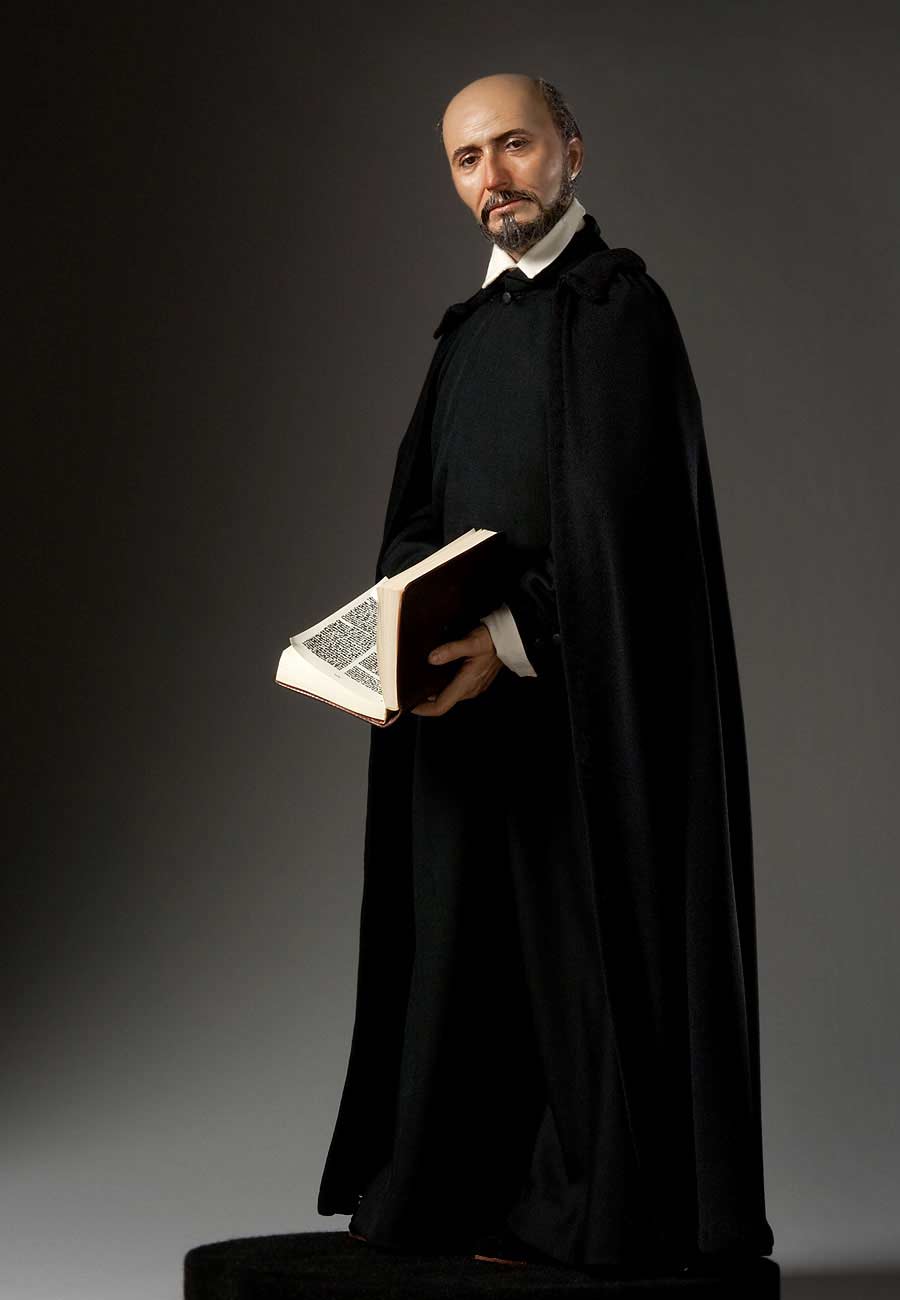
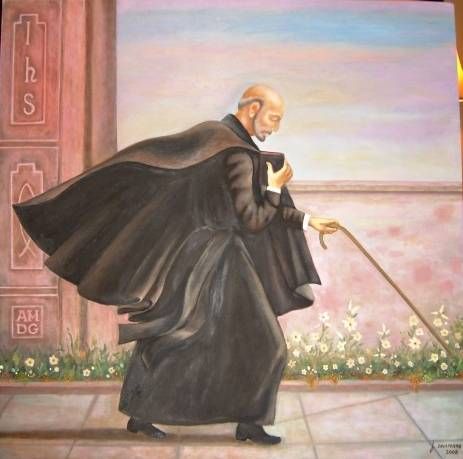
These three things were, that the Society of Jesus should be confirmed by the Pope, that the book of the Spiritual Exercises should be approved by the Holy See, and that the Constitutions should be completed and observed in the whole Society.These three things are the work of St. Ignatius' life. He wrote the Exercises, he founded the Society, and he gave it its Constitutions. The motto under which his life was spent was Ad Majorem Dei Gloriam.
Several of the Fathers served them, as they were accustomed to wait on the patients in the hospitals; washed their feet, performed the most menial offices in their service, and lavished every care and attention upon them; happy to think that in their persons they served Jesus Christ himself.
The report of these good works spread abroad, and the principal nobles in Rome, thinking it too humiliating for them, that men who possessed nothing were providing for the wants of the indigent, whilst they with all their wealth had contributed nothing to their support, began to send in assistance of every kind, which helped to maintain during the winter, and to support till the following harvest, nearly three thousand persons.
As soon as they arrived there, they were exhorted to confession, and instructed in the Christian doctrine, whilst religious discourses were frequently addressed to them. At certain fixed hours they all repeated prayers, which not only helped to pass the time when they were assembled together, in a profitable manner, but which gave rise in many a heart, to a fervent desire of leading a more Christian life for the future.